Evaluation Of Inside Heat Transfer
Coefficient of Roll Bond Evaporator for Room
Air Conditioner
P.S.Ravi
1, Dr Arkanti Krishnaiah
2, Dr Suresh Akella
3, Dr Md. Azizuddin
4Research Scholar, Osmania University, Hyderabad, Lecturer in Mechanical Engineering, SS Government Polytechnic,
Zaheerabad, Telangana, India1
Professor & Head of Mechanical Engineering, College of Engineering, Osmania University, Hyderabad India2
Professor and Principal, Sreyas Institute of Engg & Technology, Hyderabad, India 3
Professor, Deccan College of Engineering and Technology, Hyderabad, India 4
ABSTRACT: In all refrigeration and air conditioning equipment the evaporator is either a plate and fin evaporator, tube and fin or a plate and tubular evaporator. There were little changes in manufacturing methods and geometry. This paper presents a new design of evaporator, in which roll bond evaporator is used in room air conditioner. Presently the use of roll bond evaporator is limited to domestic refrigerators only. The study throws light on evaluating the inside heat transfer coefficient ( refrigerant side) of the roll bonded evaporator using R-22 as Refrigerant
KEYWORDS:Roll bond evaporator, R- 22, Weld Stop, ASHRAE
I. INTRODUCTION
In the pursuit of reducing global warming, the world is looking for the methods of reducing energy consumption. In India, appliances working on refrigeration system are one or the major contributing factor to energy consumption. With changing life style and increased standard of living the energy consumption is steadily increasing. Studies have been conducted to reduce the energy consumption by developing higher efficiency products. In a Refrigeration and Air conditioning system, major part of the energy is wasted by the system components compressor, condenser, evaporator and capillary tube due to irreversible processes. The thermodynamic study of these parts has emphasised the need to develop higher efficiency products. A house hold refrigerator or even a room air conditioner has to be designed so as to reduce the losses. In his studies, Jakobsen [1] has concluded that the losses in a Refrigeration and Air conditioning system are mainly in compressor and in the evaporator. In India, the most widely used evaporator in refrigerators is either a plate and tube evaporator or a roll bond evaporator. In air conditioners, tube and fin evaporator is widely used. In this study, roll bond evaporator is used in room air conditioner instead of tube and fin evaporator. . The heat transfer characteristics of the refrigerant is studied and inside heat transfer coefficient refrigerant side) is evaluated.
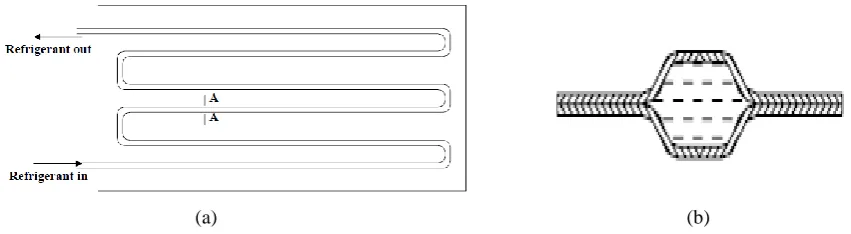
(a) (b)
Fig 1 Roll bond evaporator to be used in room air conditioner, showing the path of refrigerant (a) Roll bond panel as evaporator (b) Flow of refrigerant through the roll bond evaporator at section A-A
Thus by applying the coating in a serpentine pattern, it is possible to create a serpentine shaped un-welded region within this welded part. By subsequently applying hydraulic pressure to this un-welded region, it is possible to inflate the un-welded serpentine region to form a serpentine passage through the plate. Thus a plate with an integral serpentine passage can be created in a very cost effective manner. Except for the passage the evaporator plate is primarily flat. One end of the evaporator plate is connected to the exit of expansion valve and the other end to the compressor inlet. The refrigerant passes through the channel and produces the desired refrigeration effect.
II. BACKGROUND
A lot of work has been done earlier on suitability of roll bond evaporator as a heat exchanger device. Numerical models were developed and simulation is carried out. Different manufacturing methods of roll bond evaporator were explored.
Siviero, Roberto [2], in their invention, used a roll bond evaporator for use in refrigerator appliance, in a domestic refrigerator. They have stated that the roll bond technique makes the manufacture of refrigerant circuit simple. Even though there might be some short comings in this method, a skilled art makes the roll bond evaporator to be more suitable for the appliance.
A.G. Janos[3] , in his patent presented that the evaporator structure which is of roll bonded type is suitable for general refrigeration application. He has provided a method of manufacturing a roll bond evaporator having a heater wire, which forms an integral part of it. This helps in defrosting.
Fieramonte, Luigi [4], in their patent experimentally found out that the performance of a refrigerator container increases drastically with the use of roll bond evaporator. They conducted experiments on using different materials of different thickness for manufacture of roll bond evaporator and found an optimum solution to increase the performance of refrigerator container.
Anthony J. Cesaroni, Clarance W.Fulton [5], in their patent used a roll bonded metal sheets for making a non planar article. They have demonstrated that this article can be used for automotive heat shield which protects the occupants of any automobile from excessive heat developed by components of exhaust system.
Chandrakant patel [6], in his invention developed a cooling apparatus for a computer sub system. The panel gave maximum cooling when it was configured by a roll bond panel.
Stephen R. Callender [8] had a very interesting observation. He noticed that his family dog always preferred to lie on cool surfaces, like ceramic tiles. In his effort to give comfort to his dog he manufactured a cool surface for the dog to lie on. He observed that the cooling is uniform when the plate is manufactured by roll bonding technique.
JB Thomas [9] has given a detailed account on the method of making evaporators for refrigerators and similar devices. He has further stressed on annealing process so as to give high strength to the panel.
Yilmaz, Turan [10], in their patent gave a different method of production of plate tube type of evaporator. They claimed that the evaporator produced by this process has high heat conductivity
DE IZPARILNIKI [11], in their specification catalogue gave different varieties of roll bond evaporators which fit for different refrigerating systems. The specifications are with respect to the materials used, type of cross section, thickness etc.
Wei Yang and Jyhwen Wang [12] , in their study have found that diffusion process which is a primary mechanism for roll bonding of metals sheets will be more compact if it is done by warm rolling process.
Christian J.L Hermes, Claudio Melo, Cezar O.R. Negrao [13], have studied the importance of using a roll bond evaporator in refrigerating system. In their journal paper, they have developed a numerical simulation model for plate type roll bond evaporators. They have validated their results with experimental data.
A. Wintry, MH Al-Hager, Ali A. Bondok[14] in their Journal paper have done CFD analysis of fluid flow and heat transfer in a Roll bonded Plate type radiator made from Aluminum . They have concluded that this method gives higher heat transfer, Low size of radiator and cheaper manufacturing.
Cezar O.R. Regarao, Raul H, Ertal[15], while conducting experiments on domestic refrigerator have developed a Semi Empirical model for steady state simulation of domestic refrigerator. They claimed that this method is simple to evaluate performance of the whole system.
III. REFRIGERANT SIDE (INSIDE) HEAT TRANSFER COEFFICIENT
The heat transfer in any application can be reduced into a simple equation
q = U A ∆ tm
Where q is the rate of the rate of heat transfer, U is overall heat transfer coefficient, A is Area of heat transfer and ∆ t m
is temperature difference (either mean temperature difference, or logarithmic mean temperature difference). The overall heat transfer coefficient can be based on either inside or outside diameter of the roll bond evaporator. In general the overall heat transfer coefficient is given by the relation
1 Ui Ai
=
1 Uo Ao
=
1 { h.Af .ηf}o
+
∆ x kwAw
+
1 { h.Af .ηf}i
Where A is Area of the roll bond evaporator, h is convective heat transfer coefficient, ∆x is wall thickness, K w is
thermal conductivity of wall, and η represents efficiency of fin. The subscripts i and o represents inside and outside of the roll bond evaporator.
h D
k
=
C 1{{
G Dµ
}
2
J ∆x hfg
L g
}
n
... {
Equation 1}h is inside heat transfer coefficient, D is inside diameter of the roll bond evaporator, k is thermal conductivity of the
refrigerant in liquid phase, C 1 is a constant = 9 x 10 - 4 if quality of refrigerant leaving the roll bond evaporator is less
than 0.9 and 8.2 x 10 - 3 if quality of refrigerant is greater than or equal to 1. G is mass velocity of refrigerant through
evaporator in kg sec -1 m 2 . µ is dynamic viscosity of the refrigerant, J is Joule equivalent, ∆ x is change in quality of
the refrigerant, h f g is latent heat of vaporisation and L is length of the tube and n is a constant = 0.5 when quality of
refrigerant is less than 0.9 and is equal to 0.4 when the quality is greater than or equal to 1. The above equation is solved in SI system of units.
The design is carried out for 1 ½ TR ( Ton of Refrigeration) capacity room air conditioner. The refrigerant used in the
room air conditioner is R -22 ( Mono-Chloro Di-Fluro methane – CHClF2) .The following assumptions are made to
carry out the design
.
i. The refrigerant is dry and saturated when it leaves the roll bond evaporator
ii. There is no under cooling ( sub cooling) of refrigerant in condenser.
Design conditions:
Capacity of room air conditioner – 1 ½ TR
Pressure in Condenser _ 19.423 bar (282 PSI)
Condensing Temperature _ 50 º C
Pressure in Evaporator _ 5.8378 bar ( 87.3 PSI)
Temperature in Evaporator _ 5 º C
The properties of the refrigerant R-22 are taken from ASHRAE. With the above data, the enthalpy of the refrigerant at
the entry of compressor (h 1) is 407.45 KJ/Kg and at the entry of evaporator ( h 4 ) is 262.27 KJ/Kg.
Mass flow rate :
The mass flow rate of the refrigerant is evaluated as m x (h 1 - h 4 ) = 1.5 ( 210/60)
Mass flow rate of refrigerant will be, m = 0.03616 Kg/sec
Quality of refrigerant at the inlet of evaporator:
The expansion process in capillary tube (expansion valve) is isenthalpic process. Equating the enthalpy at inlet
and exit of capillary tube
hf , at inlet = [ h f+ x h f g ] at exit
From refrigerant properties h f , at inlet = 263.264 K J/Kg and at exit, h f = 205.899 KJ/kg , h f g = 201.244 KJ/Kg
Substituting these values, the quality of refrigerant at the exit of capillary tube, i.e at the inlet of evaporator is 0.285 i.e 28.5 %
Commercially available roll bond evaporators are have outside diameter of 1 4, 3 8, 1 2, 5 8,1, 141, 112 inches with
lengths 6, 8, 10, 12 , 16 feet , with thickness 14 BWG ( Brimingham wire gauge). For the present design the roll bond
diameter of the roll bond evaporator d i will be 5.325 mm. The other refrigerant properties like thermal conductivity,
dynamic viscosity are taken from ASHRAE refrigerant tables. Now the inside heat transfer coefficient ( refrigerant side heat transfer coefficient ) of the roll bond evaporator is evaluated from equation 1. The value of heat transfer
coefficient, h i , so obtained was found to be 816. 62
W m2 K
The above calculations were repeated fixing diameter of the roll bond evaporator and varying the lengths of the roll bond evaporator. Inside heat transfer coefficient was calculated. The results so obtained are represented graphically in Fig 2.
Fig 2. Variation of Inside heat transfer coefficient with length of the roll bond evaporator keeping inside diameter of the tube fixed
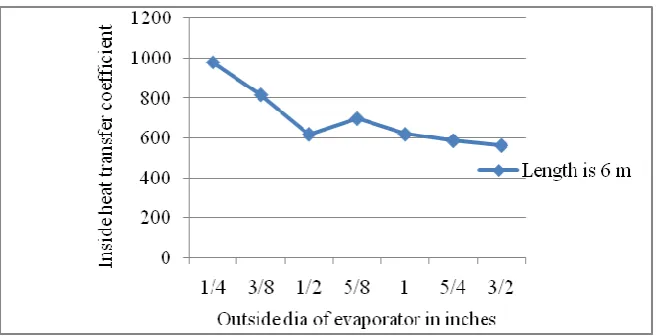
The calculations were repeated fixing the length of roll bond evaporator as 6 m, varying the inside diameter of the roll bond evaporator. Inside heat transfer coefficient was calculated. The results so obtained are represented graphically in Fig 3.
IV. CONCLUSIONS
For the above design conditions, i.e 1 ½ TR room air conditioner, a roll bond evaporator has been designed. The inside
heat transfer coefficient (refrigerant side) is found to be 816. 62 W
m2 K. Further, the design has been extended by varying
the length of the roll bond evaporator, fixing its diameter and also by varying diameter and fixing the length. It can be concluded from the two graphs that with the increase in length of the evaporator, the inside heat transfer coefficient decreases. Further with increase in outside diameter and hence inside diameter, the inside heat transfer coefficient
decreases. The graphs suggests that the roll bond evaporators of outside diameter3 8, 1 2, 5 8 inches provide
optimum performance. As this roll bond evaporator is to be used in room air conditioner, a length of 4m or 6m is preferred.
ACKNOWLEDGEMEMT
The authors wish to thank and acknowledge the support rendered by Osmania University and Sreyas Institute of Engg & Technology, Hyderabad in preparation of this manuscript
REFERENCES
[1] Jakobsen A, “Energy optimization of Refrigeration systems: The Domestic Refrigerator – A case study, Ph.D Thesis”, Technical University of Denmark, Lyngby, Denmark, 1995
[2] Siviero Roberto,“Method of making an improved evaporator”, European Patent Specification: EP 0580138B1”, 1996. [3] A.G. Janos,“Evaporator structure and method of manufacture”, United States Patent No 2,920,377, 1960.
[4] Fieramonte, Luigi, “An improved refrigerating container and a process for manufacturing the same”, European Patent Specification : EP No 1016838A1, 1998,
[5] Anthony J. Cesaroni , Clarance W.Fulton , “Method of making Non-planar article from roll bonded metal sheets”, United States Patent No: 5,392,625, 1995.
[6 Chandrakant patel, “Cooling apparatus for computer sub system”, United States Patent No 6,115,251, 2000.
[7] Diego Castanon Seoane, “Atmospheric water generator”, United States Patent Application Publication No: US 2012/0073320 A1, 2012. [8] Stephen R. Callender, “Cooled surface for Animals”, United States Patent Application Publication No: US 2012/0167607A1, 2013. [9] JB Thomas, “Method of making refrigerator evaporators or the like”, US Patent No: 3,226,808, 1966,
[10] Yilmaz , Turan, “ Production method of evaporator”, European Patent Specification : EP 1906113B1, 2007 [11] DE IZPARILNIKI, Sales specification of Roll bond evaporator panel, 2009
[12] Wei Yang and Jyhwen Wang, Deformation of coated materials, Diffusion Bonding by Warm Rolling, Department of Mechanical Engineering, Texas A & M University
[13] Christian J.L Hermes, Claudio Melo, Cezar O.R. Negrao , “A numerical simulation model for plate-type, roll-bond evaporators”, Science Direct, Elsevier, International Journal of Refrigeration Vol 31, pp 335-347, 2008.
[14] A. Witry, MH Al-Hajeri, Ali A. Bondok, 2003, CFD analysis of fluid flow and heat transfer in patterned roll bonded aluminum plate radiators, Third International Conference on CFD in the Minerals and Process Industries, CSIRO, Melbourne, Australia.
[15] Cezar O.R. REgarao, Raul H, Ertal, 2008, “Semi-empirical model for steady state simulation of domestic refrigeration systems”, 12th Brazilian Congress of Thermal Engineering and Sciences, Belo Horizonte, MG, pp 335-347, Nov 10-14, 2008.
BIOGRAPHY
Dr. Arkanti Krishnaiah is working as Professor & Head, Mechanical Engineering Dept, College of Engineering, Osmania University, Hyderabad . He is a Post doctorate and his specialization /areas of interest include Materials Forming, Severe Plastic Deformation and Nano materials. He has more than 30 publications to his credit, and is presently guiding five (05) research works (PhD) and has completed two research projects sponsored by AICTE
Dr. Suresh Akella is working as Professor & Principal, Sreyas Institute of Engg & Technology, Hyderabad, India. His areas of interest are Refrigeration and air conditioning, Design & analysis of products, Modeling & simulation, Process control using Taguchi methods and 6 Sigma methods. He has 80 publications and three patents to his credit. He has a experience of 8 years in teaching, 25 years in MNCs (Tecumseh & Denison Hydraulics), in R&D & Quality systems. He is presently working on a project by BRFST for welding simulation.
Dr. Md Azizuddin is working as Professor in Mechanical Engineering Department, Deccan college of Engineering and Technology, Hyderabad, India. His Specialization / Interest Area include Refrigeration and Air conditioning, Thermal Engineering. He has more than sixteen years of teaching experience and published fifteen papers in various national and international journals and conferences. He is presently guiding one research scholar for PhD.