116
Improving Term Extraction Using Particle
Swarm Optimization Techniques
Mohammad Syafrullah and Naomie Salim
Abstract—Term extraction is one of the layers in the ontology development process which has the task to extract all the terms contained in the input document automatically. The purpose of this process is to generate list of terms that are relevant to the domain of the input document. In the literature there are many approaches, techniques and algorithms used for term extraction. In this paper we propose a new approach using particle swarm optimization techniques in order to improve the accuracy of term extraction results. We choose five features to represent the term score. The approach has been applied to the domain of religious document. We compare our term extraction method precision with TFIDF, Weirdness, GlossaryExtraction and TermExtractor. The experimental results show that our propose approach achieve better precision than those four algorithm.
Index Terms—Term Extraction, Particle Swarm Optimization, Feature Selection, Text Mining.
—————————— ——————————
1 I
NTRODUCTIONecently many experiments have been conducted for term extraction task. Literatures provide many ex-amples of term extraction methods. Most of these are based on linguistic method, terminology and NLP me-thod, and the others based on statistical/information re-trieval method [1].
In linguistic method, most of existing approaches use shallow text processing techniques such as tokenizer, part-of-speech (POS) tagger and syntactic analyzer (pars-er). Text-to-Onto is one of the systems that use linguistic method that they called SMES (Saarbrucken Message Ex-traction System) in their system architecture to produce list of terms from the data input [2]. Another system called SVETLAN, use syntactic analyzer Sylex to find list of terms from the input text [3].
In terminology and NLP method many researchers have invented their new techniques [4], [5], [6]. In the work of [4], they use statistical measurement of frequency occurrence (C-value/ NC-value method), for the auto-matic extraction of multi-word terms, from English medi-cal corpus. Park et. al [7], [8] introduced term cohesion which is used to calculate the cohesion of the multi-word terms. The measure is proportional to the co-occurrence frequency and the length of the term. Panel and Lin [5] present a language independent statistical corpus-based term extraction algorithm. In their algorithm, first, they collect bigram frequencies from a corpus and extract word candidates. After collecting features for each two-word candidate, they use mutual information (mi) and log likelihood ratio (LLR) to extend them to multi-word terms. All those experiment done both with English and Chinese corpora.
In statistical method, statistical analysis will be per-formed on data gathered from the input, and this analysis will identifies the term from the data input based on the statistical rank. Most of the statistical methods for term extraction are based on information retrieval method for term indexing [9], [10]. Another works in this method can be found in the literature, such as the notion of “weird-ness” in [11], domain pertinence in [12], [13] and domain specificity in [7], [8].
Terminology and NLP approach is more emphasize on the internal analysis for the term extraction within the corpus, while in the statistical method is more underline on the comparison of frequencies between domain specif-ic and general corpora (external analysis).
2 R
ELATEDW
ORKSKea is one of the extraction systems which are using sta-tistical method. It uses TFIDF and first occurrence in the document as its features to determine the weight of each keyphrase. Kea’s extraction algorithm has two stages, first is training stage (using Bayesian learning) which has the task to create a model for identifying keyphrases, using training documents. The second one is extraction stage which will choose keyphrases from a test document, us-ing the model that has been made in the previous stage [14].
Turney [15] treats the problem of keyphrase extraction as supervised learning task. He presented two approach-es to the task of learning to extract keyphrasapproach-es from text. The first approach was to apply the C4.5 and the second one was using genetic algorithm. Turney’s program is called Extractor. One form of this extractor is called Ge-nEx, which is use Genitor genetic algorithm to maximize the performance (fitness) on the training process. Genitor is used to tune Extractor, but is no longer needed once the training process is complete.
Glossary Extraction [7],[8] is a glossary extraction tool
————————————————
Mohammad Syafrullah is with the Faculty of Computer Science and Infor-mation Systems, Universiti Teknologi Malaysia, 81310, Skudai, Johor, Ma-laysia.
Naomie Salim is with the Faculty of Computer Science and Information Systems, Universiti Teknologi Malaysia, 81310, Skudai, Johor, Malaysia.
that use two features which are domain specificity and term cohesion for calculating the term weight. Glossary Extraction algorithm, has the two important parts which are identification of candidate glossary items and glossary item ranking and selection. After obtaining candidate glossary items, the algorithm will rank them before select-ing the final set. In the paper [7], [8], they claim that their method can improve the document-relevancy ranking compared with log likelihood ratio and mutual informa-tion.
The term extraction algorithm called Kea++ is the im-provement of the original keyphrase extraction algorithm Kea. Medelyan and Witten [16] called their new approach as index term extraction, because they combine the ad-vantages of both keyphrase extraction and term assign-ment into a single scheme. Their preliminary evaluations shows that the Kea++ significantly outperforms com-pared with Kea extraction algorithm.
Another term extraction systems called Term Extractor [12], [13], use three features to compute their term weight. Domain pertinence is used to perform a contrastive anal-ysis between domain of interest documents and other domains documents. Domain consensus is used to meas-ure the distribution of terms in a domain of interest, while the definition of lexical cohesion similar to that already introduced in [7], [8].
3 P
ARTICLES
WARMO
PTIMIZATIONParticle swarm optimization first introduced by Kennedy and Eberhart [17], [18], [19], as an optimization technique based on the movement and intelligence of the swarm. It inspired by social behavior and dynamics of movement of birds and fish. PSO uses a number of particles that consti-tute a swarm moving around in the search space to find the best solution. Each particle is treated as a point in the search space which adjusts its flying according to its own flying experience and other particles flying experience.
Initially, the PSO algorithm randomly selects candi-date solutions (particles) within the search space. During each iteration of the algorithm, each particle is evaluated by the objective function being optimized, determining the fitness of the solution. A new velocity value for each particle is calculated using the following equation:
(1)
The index of the particle is represented by i. So, (t) is the velocity of particle i at time t and (t) is the position
of particle i at time t. Parameters w, c1, and c2 are user-supplied coefficients. The values r1 and r2 are random values regenerated for each velocity update. Value (t) is
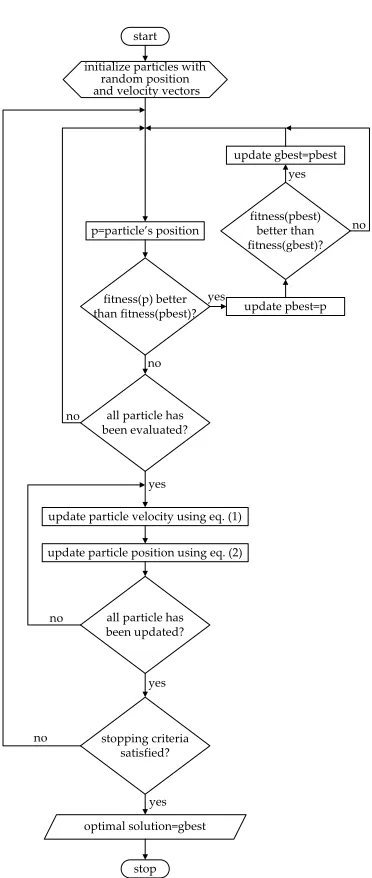
the individual best candidate solution for particle i at time t, and g (t) is the swarm’s global best candidate solution at time t. Once the velocity for each particle is calculated, each particle’s position is updated by applying the new velocity to the particle’s previous position using equation (2). This process is then repeated until some stopping condition is met. Figure 1 describes the flowchart of PSO
algorithm
(2)
Fig. 1. Flowchart of particle swarm optimization algorithm.
4 T
ERME
XTRACTIONU
SINGP
ARTICLES
WARMO
PTIMIZATIONIn this section, we propose a new approach of term ex-traction, which takes into account several kinds of fea-tures, including domain relevance, domain consensus, term cohesion, first occurrence and length of noun phrase, to produce a list of terms.
Two steps are employed in our propose approach. First, terms are ranked to emphasize the most relevant from domain of input document; second, the score func-tion is trained by the particle swarm optimizafunc-tion to ob-tain a suitable combination of feature weights.
4.1 Methodology
The goal of term extraction is to generate list of terms that start
initialize particles with random position
and velocity vectors
p=particle’s position
fitness(p) better than fitness(pbest)?
optimal solution=gbest
update gbest=pbest
update pbest=p fitness(pbest)
better than fitness(gbest)?
all particle has been evaluated?
update particle velocity using eq. (1)
update particle position using eq. (2)
stopping criteria satisfied? all particle has been updated?
stop
yes
no
no
yes
yes no
yes no
yes
are relevant to the domain of the input domain. Our pro-posed approach consists of the following steps:
1. Read the input document.
2. Preprocessing step consist of three sub tasks:
Syntactic parser does a syntactic analysis on every input sentence from input document, and produces a list of syntactic information (Noun Phrase-NP). Stop words should be filtered from each of the list of NP. Finally, the list of NP should be stemmed to produce list of clean NP, as the term candidate.
3. Each term candidate is associated with vector that contains five features.
4. The five features are used to calculate the term score and then rank the terms based on their score.
Our propose term extraction approach has two stages: 1. Training stages: This stage has the task to create a model
for identifying terms using training documents. Features are extracted from training documents and used to train the swarm optimization model.
2. Extraction stages: This stage will choose terms from a test document (this document is different than that were used for training), using the model that has been made in the training stage.
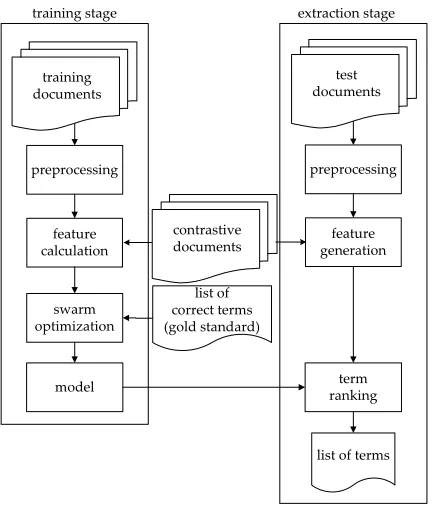
Figure 2 shows our proposed term extraction model. Both stages choose a set of term candidate from their input docu-ments, and then calculate the values of certain features for each candidate.
Fig. 2. The training and extraction stage processes
4.2 Feature Definition
In order to characterize the noun phrases in the
docu-ments we have adopted five features. These five features are calculated for each candidate term and used both in training and extraction stage. The features used are: do-main relevance, dodo-main consensus, term cohesion, first occurrence and length of noun phrase.
f1: Domain relevance-domain relevance can be given
ac-cording to the amount of information captured in the tar-get document with respect to contrastive documents. Let Di is the domain of interest (a set of relevant documents)
and {D1... Dn} is sets of documents in another domain,
domain relevance of a term t in class Di is computed as
[12], [13]:
(3)
where (P (t|Dk)) estimated as:
(4)
f2: Domain consensus-domain consensus measures the
distributed use of a term in a domain Dk. Domain
consen-sus is expressed as follows [12], [13]:
(5)
where:
(6)
f3: Term cohesion-term cohesion is used to calculate the
cohesion of the multi-word terms. The measure is propor-tional to the cooccurrence frequency and the length of the term [7], [8]:
(7)
f4: First occurrence-the main idea behind this feature is
that important terms tend to occur at the beginning of documents. First occurrence is calculated as the number of words that precede its first appearance, divided by the number of words in the document. The resulting feature is a number between 0 and 1 representing the proportion of the documents before the term's first appearance [14].
f5: Length of noun phrase-candidate length is also a
use-ful feature in extraction as well as in candidate selection, because the majority of terms are one or two words in length. Length of noun phrase score is calculated as its frequency times its length (in words) [20].
4.3 Term Generation
For a term t, a weighted score function, as shown in the following equation, is used to integrate all the feature preprocessing
feature calculation
swarm optimization
model
list of
correct terms
(gold standard)
preprocessing
feature generation
term ranking
list of terms
training documents
contrastive documents
test documents
scores mentioned in the previous section, where wi
indi-cates the weight of fi.
(8)
Moreover, the particle swarm optimization is used to obtain an appropriate set of feature weights. We have set the particle swarm optimization variables as follows: number of particles=40, maximum number of itera-tions=500, c1=2, c2=2 and w= (0.5 + (random/2)). During each iteration of the algorithm, each particle is evaluated using the fitness function as in (9). By applying particle swarm optimization, a suitable combination of feature weights could be found.
(9)
where |extracted| is a number of terms extracted by the system and |ti goldstandard| is the number of
terms that is a member of the gold standard (reference of correct terms).
4.4 Datasets
1. Quran (focus on verses about prayer): we use English translation to the meaning of the Quran (focus on verses about prayer) as the input document in the experiment. We separate the documents into a train-ing documents and test documents.
2. Reuters-21578: the documents in the Reuters-21578 collection appeared on the Reuters newswire in 1987. In 1990, the documents were made available by Reu-ters for research purposes. We converted all the doc-uments into 22 plain text file (reut2-000.txt until reut2-021.txt) and use it as contrastive documents. 3. Gold Standard: list of the Quran terms (focus on
verses about prayer).
5 E
XPERIMENTALR
ESULTSIn the extraction stage, we evaluate the precision of our propose methods at 4 points: top 25, top 50, top 150 and top 250 terms using the following equation:
(10)
We compare the terms extracted by the system with the gold standard that we have prepare before. Table 1 shows the term extraction precision for each feature for different number of terms evaluated.
precision(feature) 25 50 150 250 f1 0.800 0.820 0.607 0.552
f2 0.880 0.760 0.673 0.596
f3 0.880 0.780 0.673 0.596
f4 0.800 0.740 0.650 0.610
f5 0.880 0.740 0.600 0.584
number of terms
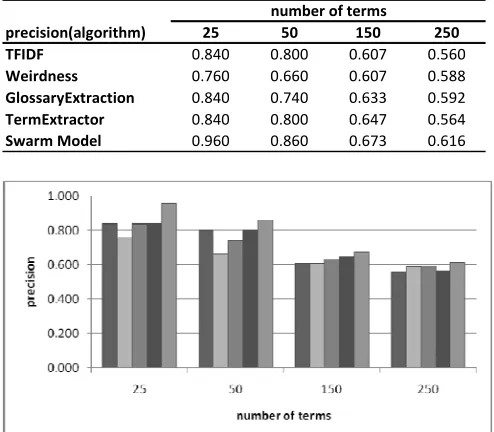
We compare the precision of our propose method with four other known algorithms. The result show that our propose method based on particle swarm optimization can improve the precision of the extracted terms. Table 2 and Figure 3 show the comparison of the precision be-tween swarm model and the four other algorithms (TFIDF, Weirdness, GlossaryExtraction and TermExtrac-tor).
precision(algorithm) 25 50 150 250 TFIDF 0.840 0.800 0.607 0.560
Weirdness 0.760 0.660 0.607 0.588
GlossaryExtraction 0.840 0.740 0.633 0.592
TermExtractor 0.840 0.800 0.647 0.564
Swarm Model 0.960 0.860 0.673 0.616
number of terms
Fig. 3. Comparison of the term extraction precision (Swarm Model, TFIDF, Weirdness, GlossaryExtraction and TermExtractor)
6 C
ONCLUSIONWe have presented a particle swarm optimization tech-nique to improve term extraction precision. We choose five features to represent the term score: domain relev-ance, domain consensus, term cohesion, first occurrence and length of noun phrase. In the experiments, we use a translation of the meaning of the Quran (focus on verses of prayer) as an input document, both for training and testing phases. We separate the documents between train-ing documents and test documents. Particles swarm op-timization is trained using the training documents to de-termine the appropriate weight of each feature to produce the best score for each term. We conduct tests with the
TABLE1
TERM EXTRACTION PRECISION FOR EACH FEATURE
TABLE2
test document using the weight of each feature which is generated from the training stage to calculate the final score for each term to be extracted. Our experimental re-sults show the use of particle swarm optimization tech-nique can improve the precision of the extracted terms compared with four other known algorithms (TFIDF, Weirdness, GlossaryExtraction and TermExtractor).
A
CKNOWLEDGMENTThis project is sponsored by the Ministry of Science, Technology and Innovation under grant vote number: 79303.
R
EFERENCES[1] P. Cimiano, Ontology Learning and Population from Text: Algorithms, Evaluation and Applications. Springer, 2006.
[2] A. Maedche and S. Staab, “Mining Ontologies from Text”, Knowledge Engineering and Knowledge Management Methods, Models, and Tools. Springer Berlin / Heidelberg, 2003.
[3] G. Chalendar and B. Grau, “SVETLAN’ Or How to Classify Words Using Their Context”, Knowledge Engineering and Knowledge Management Methods, Models, and Tools. Springer Berlin / Heidelberg, 2003.
[4] K. Frantzi, S. Ananiadou and H. Mima, “Automatic recognition of multi-word terms: The C-value/NC-value method”, International Journal on Digital Libraries, vol. 3, no. 2, pp. 115-130, 2000.
[5] P. Panel and D. Lin, “A Statistical Corpus-Based Term Extractor”, Lecture Notes in Artificial Intelligence. Springer, pp. 36-46, 2001. [6] P. Ryu and K. Choi, “An Information-Theoretic Approach to
Taxonomy Extraction for Ontology Learning”, Ontology Learning from Text: Methods, Evaluation and Applications. IOS Press, 2005.
[7] Y. Park, R. J. Byrd, and B. K. Boguraev, “Automatic Glossary Extraction: Beyond Terminology Identification”, Proceedings of the Nineteenth International Conference on Computational Linguistics, pp. 772–778, 2002.
[8] L. Kozakov, Y. Park, T. Fin, Y. Drissi, Y. Doganata and T. Cofino. "Glossary extraction and utilization in the information search and delivery system for IBM Technical Support", IBM System Journal, pp. 546-563, vol. 43, no. 3, 2004.
[9] G. Salton and C. Buckley, “Term-Weighting Approaches in Automatic Text Retrieval”, Information Processing & Management, pp. 515-523, 1988.
[10] B. Yates and R. Neto, Modern Information Retrieval. Addison-Wesley, 1999.
[11] K. Ahmad, L. Gillam and L. Tostevin, “University of Surrey participation in TREC 8: Weirdness Indexing for Logical Document Extrapolation and Retrieval (WILDER)”, In the Eighth Text Retrieval Conference (TREC-8), pp. 717-724, 1999.
[12] R. Navigli and P. Velardi, “Learning Domain Ontologies from Document Warehouses and Dedicated Web Sites”, Computational Linguistics, vol. 30, no. 2, pp. 151-170, 2004.
[13] F. Sclano and P. Velardi, “Termextractor: a web application to learn the shared terminology of emergent web communities”, Proceedings of the 3rd International Conference on Interoperability for Enterprise Software and Applications (I-ESA), 2007.
[14] I. H. Witten, G. W. Paynter, E. Frank, C. Gutwin, and C. G. Nevill-Manning, "KEA: Practical Automatic Keyphrase Extraction", Proceedings of the. Fourth ACM Conference on Digital Libraries, pp.
254-256, 1999.
[15] P.D. Turney, “Learning algorithm for keyphrase extraction”, Journal of Information Retrieval, vol. 2, no. 4, pp. 303–336, 2000.
[16] O. Medelyan and I. H. Witten, "Thesaurus-based index term extraction for agricultural documents", Proceeding of the 6th Agricultural Ontology Service (AOS) workshop at EFITA/WCCA, 2005.
[17] J. Kennedy and R.C. Eberhart, “Particle swarm optimization”, Proceedings of the IEEE international conference on neural networks IV, pp. 1942–1948, 1995.
[18] R.C. Eberhart and J. Kennedy, “A new optimizer using particle swarm theory”, Proceeding 6th International Symposium on Micro Machine and Human Science, pp. 39-43, 1995.
[19] R.C. Eberhart and Y.H. Shi, “Comparison between genetic algorithms and particle swarm optimization”, Proceedings of Annual Conference on Evolutionary Programming, pp. 611-616, 1998.
[20] K. Barker and N. Corrnacchia, “Using noun phrase heads to extract document keyphrases”, Proceedings of the 13th Biennial Conference of the Canadian Society on Computational Studies of Intelligence: Advances in Artificial Intelligence, pp. 40-52, 2000.
Mohammad Syafrullah is a Ph.D candidate, Faculty of Computer Science and Information System in Universiti Teknologi Malaysia. He received his bachelor degree in Computer Science from Budi Luhur University, Indonesia in 1997. He received his master degree in Computer Science from Swiss German University, Indonesia in 2005. His current research interest includes Ontology Learning, Data Mining and Soft Computing.