Card. (Under the direction of Dr. Scott Stage.)
The purpose of this study was to serve as a pilot study to assess the convergent validity and discriminant validity of a standardized Behavior Report Card (BRC).
by
Sarah Ann Carruthers
A thesis submitted to the Graduate Faculty of North Carolina State University
in partial fulfillment of the requirements for the Degree of
Master of Science
School Psychology
Raleigh, North Carolina 2016
APPROVED BY:
_______________________________ _______________________________
Kate Norwalk Mary Haskett
_______________________________ Scott Stage
BIOGRAPHY
TABLE OF CONTENTS
LIST OF TABLES……… v
The Construct Validity of a Standardized Behavior Report Card……… 1
Behavior Report Cards………..……… 3
Traditional Psychometric Properties of BRCs………..……….. 4
Purpose of this Study ………….……….……...………8
Methods…………...………...14
Participants and Setting………14
Materials……… 15
Procedure………... 17
Data Analyses………..….. 17
Results……… 18
Convergent Validity……….… 18
Discriminant Validity ………..……… 19
Discussion ………...……….. 21
Limitations, Future Directions, and General Conclusions………... 26
Implications for Practice………..… 27
Tables………..…... 31
LIST OF TABLES
Table 1 Operational Definitions of levels or ratings for each target behavior on the Behavior Report Card………. 31 Table 2 Item Similarity Matrix of the Behavior Assessment System for Children-2
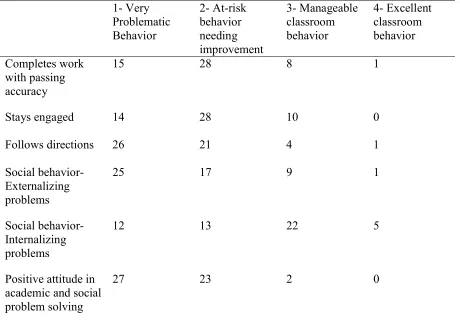
(BASC-2) scales and Behavior Report Card Behaviors………. 33 Table 3 Frequency of Behavior Report Card ratings. ……….... 36 Table 4 Correlation Matrix between Behavior Report Card items and BASC-2
Clinical, Adaptive, and Composite Scales ……… 37 Table 5 Results from ANOVAs between Behavior Report Card Items and BASC-2
In a time of data-based decision making and high stakes testing in schools, where assessments determine interventions received as well as special education placement, it is especially pertinent that the measures used are both reliable and valid. Reliability is the measure of how consistent the ratings on a scale are across items, raters, and time (DeVellis, 1991).Validity is a measure of whether or not the latent variable is the underlying cause of co-variation of the measurement items (Messick, 1995). Measurements of validity include content validity, criterion-related validity, and construct validity. Content validity is the extent to which a specific set of items reflects the content domain, typically measured through expert review of items. Criterion-related validity reflects an empirical association between the measure and a criterion and can be demonstrated through predictive validity, concurrent validity, and post-dictive validity (Cronbach & Meehl, 1995). Construct validity is the extent to which a measure behaves the way the construct is expected to behave with regard to measures of related and non-related constructs. This includes both convergent and discriminant validity. Convergent validity is the similarity between measures of theoretically related constructs, often measured through correlations between measurement tools
(Campbell & Fiske, 1959). Discriminant validity, also referred to as divergent validity, is the extent to which the measure can differentiate between unrelated constructs or the severity of the rating of a construct.
is a need within schools for a reliable and valid measurement tool that teachers can use to quickly and efficiently rate a student’s behavior across time. Behavior Report Cards (BRCs) and similar rating scales may provide one option to meet this need. In the literature, BRCs have been referred to by various names, such as Daily Behavior Report Cards, Daily Report Cards, school notes, school-home notes, and Direct Behavior Rating. For the purposes of this study, measures that share the characteristics of BRCs, such as observing and rating a student on operationalized target behaviors based on a standardized rating scale, are conceptualized as BRCs
Behavior Report Cards
Traditional Psychometric Properties of BRCs
Chafouleas and colleagues have been the primary investigators regarding the psychometrics of BRCs, using a BRC where the rater estimates the percentage of time the target behaviors occur over a set period of time. These studies have focused primarily on the target behaviors academic engagement, disruptive behavior, respectful behavior, and
noncompliance.
Reliability of Behavior Report Cards.
Chafouleas and colleagues have investigated the reliability of BRCs and aspects of the BRC which may influence the reliability of ratings (Chafouleas, Jaffrey, et al., 2013; Christ, et al., 2011; Riley-Tillman, Chafouleas, et al., 2009). In these studies, undergraduate students rated video-taped student behaviors using BRCs that included behaviors such as academic engagement, disruptive behavior, noncompliance, and respectful behavior. The results of these studies indicate three major findings. First, raters are capable of reliably rating target behaviors such as, academic engagement and disruptive behavior on a BRC scale. Second, raters tended to poorly estimate the occurrences of noncompliance and
(2013) found that rater accuracy increased for both academic engagement and disruptive behavior when the BRCs were positively worded. As such, we cannot assume the reliability in the measurement of all target behaviors, which emphasizes the importance of developing a standardized BRC
Validity of Behavior Report Cards.
BRCs with the target behaviors disruptive behavior, off-task, and, academic
engagement have demonstrated evidence for validity (Chafouleas et al., 2005; Chafouleas & Kilgus, 2009; Kilgus et al., 2012; Chafouleas & Kilgus, 2013). Chafouleas et al., (2005) found significant, correlations between teacher ratings of off-task behavior and an external observer’s systematic direct observation (SDO; r=.67). Chafouleas and Kilgus (2009) found significant moderate to large correlations between teacher-ratings of disruptive behaviors on the BRC and scores on the Social Skills Rating System (SSRS) when rated in the fall and spring (Gresham & Elliot, 1990). In particular, teacher ratings of disruptive behaviors on the BRC were strongly correlated with the SSRS problem-behaviors scales in both fall and spring (r = .82); however, teacher ratings of disruptive behaviors on the BRC were
moderately correlated with SSRS social scales scale in the fall (r = -.77), but not as strongly correlated in the spring (r = -.42). Kilgus et al., (2012) and Chafouleas and Kilgus (2013) also found significant moderate correlations between elementary school teacher ratings of
correlations ranging from .54 to .69. However, when replicated with middle school students, though statistically significant, correlations were weaker, ranging from .37 to .39. The target behavior academic engagement has demonstrated moderate levels of validity in measuring problem behaviors (Chafouleas & Kilgus, 2009; Kilgus et al., 2012; Chafouleas & Kilgus, 2013). Elementary school teacher ratings of academic engagement on the BRC was correlated with scales from the SSRS, BESS, SSiS, and SRSS, with correlations ranging from .64 to .88 (Chafouleas & Kilgus, 2009; Kilgus et al., 2012; Chafouleas & Kilgus, 2013). Similar to ratings of disruptive behavior, replications with middle school students had
somewhat weaker correlations, ranging from .49 to .55 (Chafouleas & Kilgus, 2009). While academic engagement demonstrates moderate levels of validity regarding measurement of problem behaviors, it does not reflect a valid measurement of academic performance. At one time point, teacher ratings of academic engagement on the BRC was significantly correlated with academic competence of the SSRS (r = .53), but at a later time point they were not significantly correlated (r = .36; Chafouleas & Kilgus, 2009). Chafouleas and colleagues have also measured the validity of BRC target behaviors compliance and respectful behavior, but found that the correlations between these target behaviors and previously-validated measurements were much weaker than those for academic engagement and disruptive
behavior, with correlations ranging from .37 to .66 (Kilgus et al., 2012; Chafouleas & Kilgus 2013).
to these studies (Chafouleas et al., 2005; Chafouleas, Tillman et al., 2007; Riley-Tillman, Methe & Weegar, 2009; Chafloueas & Kilgus, 2009; Kilgus et al., 2012;
Chafouleas, Kilgus, et al., 2013). The evidence for concurrent validity has been demonstrated by only one study (Chafouleas et al., 2005). While this study found a significant correlation between BRC ratings and SDO ratings, there was lower consistency between teacher BRC ratings and the SDO ratings in comparison to the external-observer’s BRC ratings with the SDO ratings. Predictive validity was demonstrated for behaviors on the BRCs with problem behaviors, but many of the correlations were much weaker in the spring compared to the fall(Chafouleas & Kilgus, 2009). In addition, target behaviors such as compliance and respectful behavior, were found to have particularly low reliability and validity
(Riley-Tillman, Chafouleas, et al., 2009; Christ, et al., 2011; Chafouleas, Jaffrey, et al., 2013; Kilgus et al., 2012; Chafouleas, Kilgus, et al., 2013).
There are also many gaps in the research previously conducted on BRCs. Much of Chafouleas and colleagues’ research focuses primarily on the target behaviors of academic engagement and disruptive behavior (Chafouleas, et al., 2005; Chafouleas, Jaffrey, et al., 2013; Chafouleas, Kilgus, et al., 2012; Chafouleas, Kilgus, and Hernandez, 2009;
Plans (IEPs), as well as a student’s academic performance, which includes behaviors beyond academic engagement and disruptive behaviors. Previous research has shown that ratings of academic engagement are not reflective of a student’s academic performance (Chafouleas, Kilgus, Hernandez, 2009). In addition, most studies on BRCs primarily include externalizing behaviors, such as off task and disruptive behaviors. Consistent research is lacking on BRCs pertaining to internalizing behaviors. Since it has already been determined that there is variability in accuracy and validity of the ratings for different target behaviors it is important to develop a standardized BRC reflective of target behaviors that capture a range of
behaviors of concern in schools.
Purpose of this Study
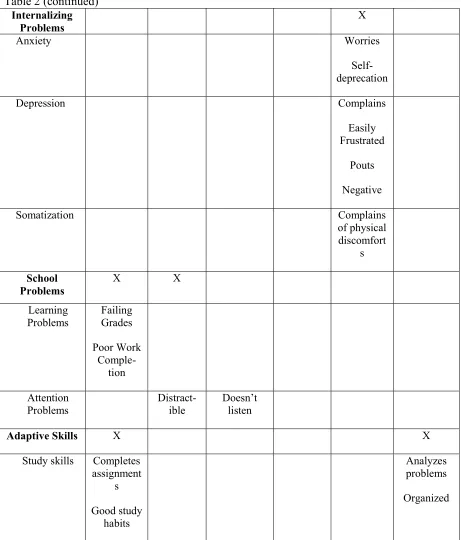
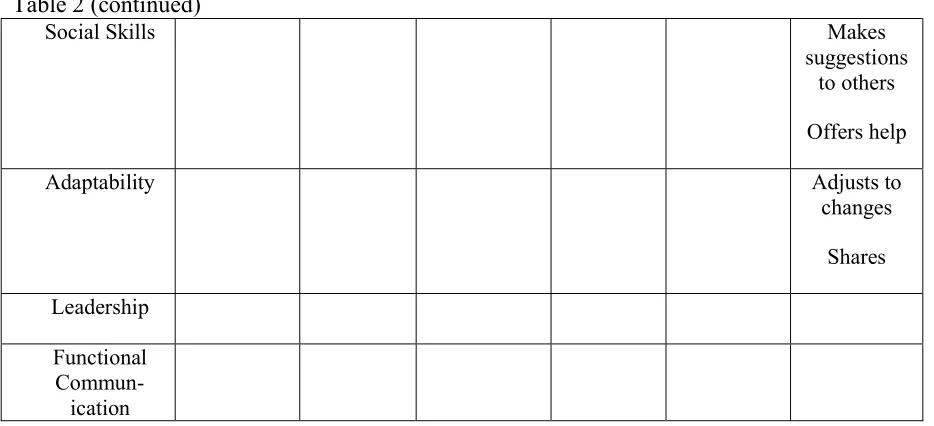
aggression, and conduct problems. Table 2 shows a matrix of behaviors measured by the BASC-2 scales that the BRC target behaviors are expected to correlate with.
These target behaviors were chosen because they reflect a range of behaviors that schools are either legally mandated to provide accommodations for through special education services or are behaviors that are relevant to classroom interventions. Relevant behaviors for the eligibility for special education services would include criterion behaviors related to Emotional Disturbance (ED), Other Health Impairment (OHI), as well as academic performance. Qualification under Emotional Disturbance involves an inability to build or maintain satisfactory interpersonal relationships with peers and teachers, inappropriate types of behaviors or feelings under normal circumstances, a general pervasive mood of
unhappiness or depression, and/or a tendency to develop physical symptoms or fears associated with personal or school problems (IDEA, 2004). The behaviors captured by this definition of ED, can be dichotomized into internalizing behaviors and externalizing behaviors (Merrell & Walker, 2004). Externalizing behaviors are behaviors that are under-controlled and directed at others, such as aggression, disruptive behaviors, noncompliance, and hyperactivity. Internalizing behaviors on the other are over-controlled and directed at the self, such as depressive behaviors, anxious behaviors, social withdrawal, and somatic
problems aim to measure problem behaviors common in students eligible for Emotional Disturbance.
Behaviors related to OHI include limited strength, vitality, or alertness, including a heightened alertness to environmental stimuli resulting in limited alertness with respect to the educational environment. Typically students with diagnoses of Attention Deficit
Hyperactivity Disorder (ADHD) are found eligible for special education services under OHI (IDEA, 2004). Based on this, it is necessary to measure behaviors pertaining to maintaining attention in class and following directions. The target behaviors of stays engaged and follows directions aim to measure the symptoms pertaining to Attention Deficit Hyperactivity
Disorder (ADHD).
The target behavior completes work with passing accuracy aims to measure a student’s academic performance during the observation period. Within a school setting students receive special education services only when the problem behavior negatively impacts their academic performance, reflecting the necessity of measuring not only the problem behavior of interest, but also their current academic performance (IDEA, 2004). In addition, interventions implemented that target varying problem behaviors should also result in improvements in their academic performance, reflecting the need to systematically
Kilgus, & Hernandez, 2009; Chafouleas, Kilgus, et al., 2013; Christ, et al., 2011; Kilgus et al., 2012; Riley-Tillman, Chafouleas, et al., 2009).
Finally, the behavior positive attitude in academic and social problem-solving was chosen because research has found that social problem solving plays a therapeutic role in reducing at-risk students’ classroom problem behaviors (Duanic, Smith, Brank, & Penfield, 2006; Elias & Allen, 1991). When BRCs are implemented as an intervention to change problem behaviors, a key component to the intervention involves problem solving with the student. The teacher discusses with the student about academic or social situations that resulted in the teacher’s lowered evaluation of the student’s behavior on the BRC and then works with the student to devise possible alternatives to the problems encountered that day. Through this process, the student is expected to develop their own problem-solving strategies to implement independently. As a therapeutic agent, social problem solving has been shown to reduce at-risk students’ classroom problem behavior (Duanic, Smith, Brank, & Penfield, 2006; Elias & Allen, 1991). In addition, social problem solving is an integral part of well-established interventions for the treatment of depression (David-Ferdon & Kaslow, 2008; Stark, Reynolds, & Kaslow, 1987) and for the treatment of phobia and anxiety (Silverman, Pina, & Viswesvaran, 2008). In addition, teaching problem-solving strategies has been found to be effective in improving various aspects of academics including reading comprehension (Gahari & Basanjideh, 2015) and math (Alter, Brown, & Pyle, 2011).
found to be a more accurate analysis when using ordinal data compared to Pearson’s correlation (Choi, Peters, & Mueller, 2009; Gadermann, Guhn, Zumbo, 2012). Pearson’s correlation requires the use of continuous data with equal distances between consecutive categories. Often times, behavior rating scales, which use Likert and ordinal scales, are analyzed as if the data were continuous. The use of Pearson’s correlation with these types of data can result in invalid outcomes, underestimates of true associations, and uninterpretable data (Choi, Peters, & Mueller, 2009). Polychoric correlations, on the other hand, are
considered to be more appropriate for ordinal data (Choi, Peters, & Mueller, 2009). These are based on the assumption that the data set has an underlying continuous, latent variable which is observed throughout the ordered data. The underlying variable is considered to be
normally distributed and the analysis estimates the correlation between these underlying partitioned variables. Polychoric correlations have been found to estimate significantly higher associations for ordinal data than Pearson’s correlations, which can result in different interpretations of analyzed results (Choi, Peters, & Mueller, 2009; Gadermann, Guhn, Zumbo, 2012).
composite scale school problems as well as the corresponding clinical scale learning problems. In addition, it is expected to be positively correlated with the adaptive skills composite scale and the study skills adaptive scale. The BRC item stays engaged is
hypothesized to be negatively correlated with the school problems composite scale as well as the clinical scales attention problems and hyperactivity. The BRC item follows directions is hypothesized to be negatively correlated with the externalizing problems composite scale and the hyperactivity, aggression, attention problems, and conduct problems clinical scales. The BRC item social behavior: externalizing problems is hypothesized to negatively correlate with the BASC-2 externalizing problems composite scale and the attention problems, hyperactivity, aggression, and conduct problems clinical scales. The BRC item social behavior: internalizing problems is hypothesized to negatively correlate with the BASC-2 internalizing problems composite scale and the anxiety, depression, and somatic clinical scales. The BRC item academic and social problem-solving item is hypothesized to be positively correlated with the BASC-2 adaptive skills composite scale and the social skills, study skills, and adaptability adaptive scales. It is also anticipated that the BRC will
Methods Participants and Setting
Participants were recruited from Wake County Public Schools through an e-mailed request to partake in an online Qualtrics Survey. The Qualtrics Survey asked participants to evaluate a student they have worked with in the past who is at-risk for or who is eligible for special education services due to challenging behaviors as a student with Emotional
Disturbance (ED).
There were 54 respondents. Of these respondents, 67% were School Psychologists (36), 22% were teachers (12), 2% were administrators (1), 2% were counselors or social workers (1), 2% were teacher assistants (1), and 5.6% were classified as “other” (3). On average, respondents had three years of experience. Thirteen percent of respondents had between 0-3 years of experience, 39% had 3-10 years of experience, 9% had 11-15 years of experience, 13% had 16-20 years of experience, and 26% had greater than 20 years of experience. Eighty-three percent of the respondents were female.
Of the students that the respondents evaluated, 82% were male. Thirteen-percent of the students were classified as an English language learner. Fifty-four percent of the students were African American, 33% were Caucasian, and 11% were multi-racial. Eleven percent of the students were in kindergarten, 19% were in first or second grade, 24% were in third or fourth grade, 11% were in fifth grade, 18% were in middle school, and 16% were in high school.
Behavior Report Card.
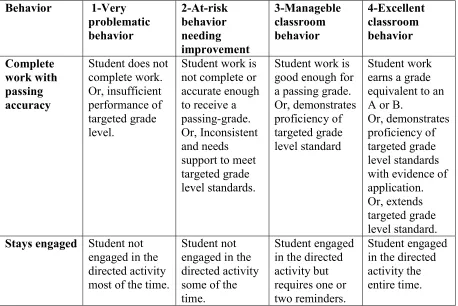
The BRC included six target behaviors. Teachers rated each student on a four-point ordinal scale. The rating categories ranged from 1 to 4. A rating of 1 was conceptualized as “very problematic behavior,” 2 was “at risk behavior needing improvement,” 3 was
“manageable classroom behavior,” and 4 was “excellent classroom behavior.” The six target behaviors included a) complete work with passing accuracy, b) stay engaged, c) follow directions, d) social behavior: externalizing problem, e) social behavior: internalizing problem problems, and f) positive attitude in academic and social problem-solving.
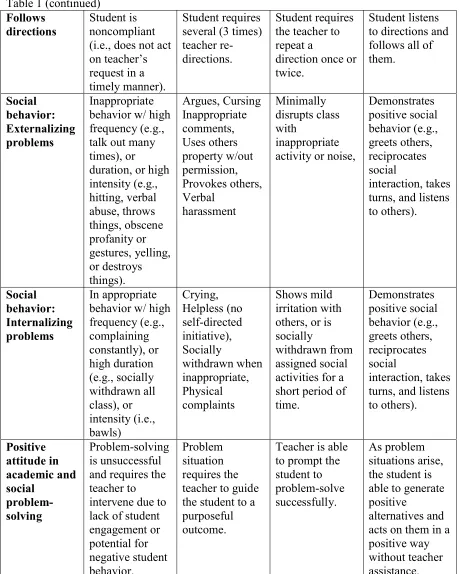
Operational definitions are provided to describe each level of rating for each target behavior (see Table 1). For example, a rating of 1 on completes work with passing accuracy is
described as “Student does not complete work, or insufficient performance of targeted grade level,” and a rating of 4 is described as “Student work earns a grade equivalent to an A or B, or demonstrates proficiency of targeted grade level standards with evidence of application, or extends targeted grade level standard.”
Behavioral Assessment System for Children, 2nd Edition, Teacher Rating Scale (BASC-2, TRS).
problems composites are clinical scales which measure maladaptive behaviors. High t-scores on these scales represent negative or undesirable behaviors. The externalizing problems composite scale consists of hyperactivity, aggression, and conduct problems scales. The internalizing problems composite consists of anxiety, depression, and somatization scales. The school problems composite consists of attention problems and learning problems scales. The adaptive skills composite includes the adaptive scales which measure positive behaviors. High t-scores on the adaptive scales represent positive or desirable behaviors, whereas low scores represent possible problem areas. The adaptive scales include adaptability, social skills, leadership, study skills, and functional communication.
The composite scores have moderate to high test-retest reliability for (r =.78-.94). Within the scales, test-retest reliability ranges from .66 to .92, with the lowest reliability for the adolescent scale of anxiety (.66). Inter-rater reliability for the composite scores fall into the moderate range (r = .45-.70). Correlations between the BASC-2 TRS scales and the Achenbach System of Empirically Based Assessment Caregiver-Teacher Report Form (ASEBA) and the Conners’s Teacher Rating Scale-Revised (CTRS-R) fall in to the moderate to high range. Between the BASC-2, TRS-Children and ASEBA, there were moderate to high correlations between scales measuring externalizing problem behaviors (r =.75), internalizing problem behaviors (r =.80), hyperactivity (r =.80), inattention (r =.71)
problems (r = .68 - .94) on the BASC-2, TRS and CTRS-R, but low correlations for scales measuring anxiety (children, r = .35; adolescent, r = .26) and withdrawal (children, r = .42; adolescent, r =.44).
Procedure
An online 15-minute survey was e-mailed to special education teachers and school psychologists in Wake County. The survey included teacher demographic information, student demographic information, BRC target behavior items, and items from the BASC-2. Each participant was asked to fill out the survey for a student that is either currently in their class or one who they have worked with recently, who is at-risk for or is eligible for special education services due to behavior problems.
Data Analyses
Results Convergent Validity
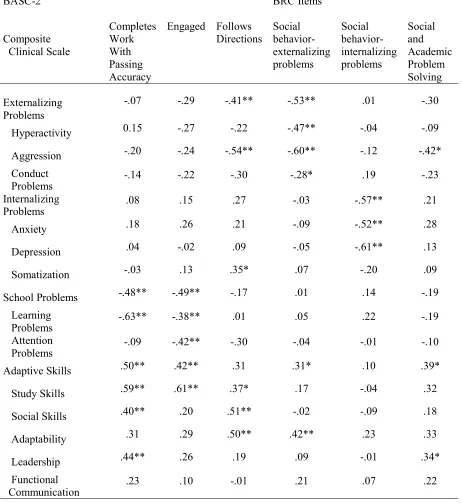
Table 4 shows the correlation matrix between the six BRC items and the BASC-2 clinical and composite scales. A moderate negative correlation was found between the BRC item completes work with passing accuracy and the school problems composite. A strong negative correlation was found between completes work with passing accuracy and the BASC-2 clinical scale learning problems. Completes work with passing accuracy was significantly and positively correlated with the BASC-2 composite scale adaptive skills, as well as with the adaptive scales study skills, social skills, and leadership. A weak but
significant correlation was also found between completes work with passing accuracy and the withdrawal clinical scale. Moderate negative correlations were found between the BRC item engaged and the school problems composite, as well as the clinical scales of learning
problems and attention problems. A moderate positive correlation was found between engaged and the adaptive skills composite scale. A strong positive correlation was found between engaged and study skills. The BRC item follows directions was negatively
correlated with the externalizing problems composite scale. The BRC item follows directions was negatively correlated with the BASC-2 clinical scale aggression and positively
between the social behavior-externalizing problems BRC item and the hyperactivity and conduct problems BASC-2 clinical scales. A weak but significant positive correlation was found between social behavior-externalizing problems and the adaptive skills composite. In addition, a moderate positive correlation was found between social behavior- externalizing problems and the adaptability scale. The BRC item social behavior-internalizing problems had a moderate negative correlation with the internalizing problems composite on the BASC-2. A strong negative correlation was found between social behavior- internalizing problems BRC item and the depression BASC-2 clinical scale. Moderate to weak negative correlations were found between social behavior-internalizing problems and the anxiety and withdrawal clinical scales. The BRC item positive attitude in academic and social problem solving was positively correlated with the adaptive skills composite and the leadership scale. A moderate, negative correlation was found between positive attitude in academic and social problem solving and the aggression scale.
Discriminant Validity
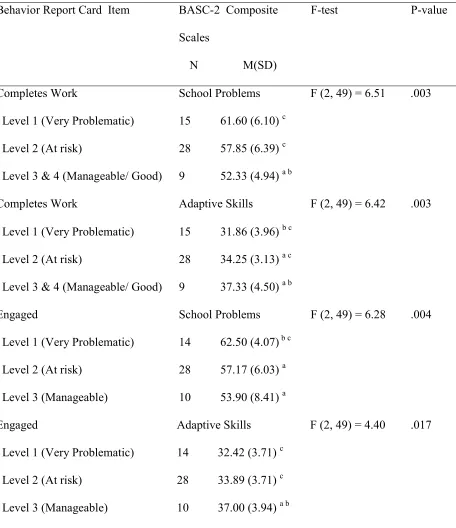
for this level using Analyses of Variance (ANOVA). This combined level will be referred to as level 3. The results from the ANOVAs are presented in Table 5, which revealed
significant findings for all the analyses conducted, indicating that there are significant differences in BASC-2 ratings for students who were rated at different levels for the BRC items.
Discussion
This study served as a pilot study regarding the validity of a standardized BRC. The results of this study provide preliminary evidence for the convergent and discriminant validity of this BRC. Overall results from polychoric correlations between BRC items and BASC-2 composite scales provide evidence for concurrent validity of the items on the BRC with and were consistent with hypotheses. In regards to the correlations between the BRC items and the BASC-2 clinical scales, correlations ranged from weak to strong. Most findings were consistent with hypotheses, but there were some findings that were inconsistent with hypotheses. Of note, more BRC items were correlated with the adaptive scales than were hypothesized.
of the item though, the validity should also be assessed through comparison with performance on an actual completed assignment.
The BRC item stays engaged is a measure of the frequency of time that a student is engaged in the expected activity. This item was hypothesized to be correlated with the school problems composite. It was also hypothesized to be correlated with the attention problems scale, which includes related behaviors such as distractibility, and the hyperactivity scale, which includes behaviors such as staying seated and impulsivity. Stays engaged was found to be correlated with school problems and attention problems, but was not correlated with hyperactivity; however it was found to be correlated with learning problems scale, the adaptive skills composite, and the study skills scale.
Follows directions is a measure student compliance in engaging in teacher requests, specifically regarding the amount of teacher support that is necessary to do so. It was hypothesized that follows directions would correlated with the externalizing problems composite. It was also hypothesized to correlate with the hyperactivity scale, which includes related behaviors such as needs supervision, the aggression scale, which includes related behaviors such as arguing and defying the teacher, the conduct problems scale, which
includes disobeying, and the attention problems scale, which includes related behaviors such as doesn’t listen. Follows directions was correlated with the externalizing problems
typically associated with externalizing behaviors and adaptive skills, rather than behaviors linked to ADHD such as hyperactivity and inattentiveness as was initially expected.
Results for both social externalizing problems and social behavior-internalizing problems were both consistent with hypotheses overall, with correlations with hypothesized clinical scales falling into the weak to strong range. Social
behavior-externalizing problems measures the frequency and duration of inappropriate and disruptive classroom behaviors, including arguing, cursing, inappropriate comments, provoking others, verbal harassment. It was hypothesized to correlate with the externalizing problems
composite and the corresponding clinical scales. Social behavior-externalizing problems was found to correlate with hyperactivity, which includes related behaviors such as disrupting others and being overly active. It was also correlated with aggression, which includes behaviors such as is cruel, bullies others, and disrupts the play of others. It correlated with conduct problems, though this correlation was weak. Social behavior- externalizing behavior was also found to correlate with the adaptive skills composite and the adaptability scale. The social behavior-internalizing problems item measures behaviors common among children with depression and/or anxiety, and includes behaviors such as irritability, crying,
The social and academic problem solving item on the BRC measured the student’s use of problem solving strategies with and without teacher support. It was hypothesized to correlate with the adaptive skills composite and the study skills, social skills, and adaptability scales, which include behaviors such as analyzes problems and adjust to changes. A weak correlation was found between social and academic problem solving and the adaptive skills composite, but it was not found to correlate with the other hypothesize scales. It was found to be correlated with the leadership scale and with the aggression scale.
Results from the ANOVAs reveal evidence for the discriminant validity of the BRC where significant findings indicate that overall BRC items were capable of differentiating between severity of behaviors as rated on BASC-2 composite scales. Results from the post-hoc analyses revealed that there were significant differences between the BASC-2 composite scores between BRC ratings of level 1 compared to the level 3, indicating that the BRC is capable of differentiating between behaviors on either end of the continuum. However, aside from completes work and the BASC-2 adaptive skills composite, there were not a significant difference between level 1 and level 2 or between level 2 and level 3. It is believed that this is possibly due to the fact that students evaluated in this study were all students demonstrating problem behaviors and as such there was not much variability in the severity problem behaviors, especially on the high end of the ordinal scale. Future research will need to
To assess the validity of the BRC, we need to measure not just the statistical
significance of differences between BASC-2 scores across the BRC rating levels, but also the clinical significance of the differences in BASC-2 scores across levels. The BASC-2
considers T-scores falling between 60 and 69 as “at risk” and scores greater than 70 as “clinically significant” (Reynolds & Kamphaus, 2004). Scores lower than 59 are considered average. For the adaptive scales, scores falling between 31 and 40 are considered “at risk, and scores lower than 30 are considered “clinically significant.” As such it would be expected that BRC ratings of level 1 would equate to BASC-2 T-scores that fall into the clinically significant range, indicating significant behavior problems. BRC ratings of level 2 should equate to BASC-2 scores that fall into the at risk range, indicate that there are
behavior problems that are of concern. BRC ratings of level 3 and 4 should equate to BASC-2 scores that fall into the average range, indicating an absence of behavior problems.
directions fell into the at-risk range and the mean score for students with a rating of 3 fell into the average range. The mean externalizing problems score for students with a rating of 1 and 2 on social behavior-externalizing problems fell into the at-risk range and the mean score for students with a rating of 3 fell into the average range. Social behavior-internalizing problems was the only BRC item where BASC-2 composite scores fell into the expected ranges. The mean internalizing problems score for students with a rating of 1 on social behavior-internalizing problems was 71.25 and fell into the clinically significant range. The mean score for students with a rating of 2 fell into the at-risk range and the mean score for students with a rating of 3 fell into the average range. For both completes work with passing accuracy and engaged, mean BASC-2 adaptive skills scores across all three rating levels, fell into the at-risk range. This again reflects a limitation in the discriminant validity of the BRC items, though may also be a reflection of the sample included in this study.
Limitations, Future Directions and General Conclusions
moment. Since the BRC will ultimately be used as a tool to rate student behavior when it occurs, future studies need to be conducted to determine the validity of the BRC when the student is observed by the teacher in real time. The BRC item completes work with passing accuracy was found to be correlated with measures of behaviors related to work completion, such as study skills and learning problems. However, to determine if this item truly captures work completion and academic performance in a period of time, it will also need to be validated using actual student work. In addition to future research clarifying the validity of the BRC, research that measures the reliability of the BRC and research that measures the effectiveness of the BRC in modifying classroom behavior is also needed. In sum, although findings from this study provide evidence of the validity of this BRC, future research is clearly needed.
Implications for Practice
research-based interventions to address behavioral/emotional skill deficiency and documentation of the results of the interventions, including progress monitoring
documentation” (North Carolina Department of Public Instruction, 2014). BRCs have long served as an intervention tool to modify various classroom behaviors and increase
communication between school and home (Fabiano et al. 2010; Fabiano et al., 2009; Vujnovic, Fabiano, Pariseau, & Naylor, 2013; Vannest, Davis, Davis, Mason & Burke, 2010), but more recent research has demonstrated potential for BRCs to be used as a progress monitoring tool and a screener (Riley-Tillman, Chafouleas, & Briesch, 2007; Fabiano et al., 2009; Chafouleas, Kilgus et al., 2009; Chafouleas et al., 2013).
usability of the tool through increasing the teacher acceptability and decreasing the burden of additional progress monitoring.
Tables
Table 1
Operational Definitions of levels of rating for each target behavior on the Behavior Report Card.
Behavior 1-Very problematic behavior 2-At-risk behavior needing improvement 3-Manageble classroom behavior 4-Excellent classroom behavior Complete work with passing accuracy
Student does not complete work. Or, insufficient performance of targeted grade level.
Student work is not complete or accurate enough to receive a passing-grade. Or, Inconsistent and needs support to meet targeted grade level standards.
Student work is good enough for a passing grade. Or, demonstrates proficiency of targeted grade level standard Student work earns a grade equivalent to an A or B.
Or, demonstrates proficiency of targeted grade level standards with evidence of application. Or, extends targeted grade level standard. Stays engaged Student not
engaged in the directed activity most of the time.
Student not engaged in the directed activity some of the time.
Student engaged in the directed activity but requires one or two reminders.
Table 1 (continued) Follows
directions Student is noncompliant (i.e., does not act on teacher’s request in a timely manner).
Student requires several (3 times) teacher re-directions.
Student requires the teacher to repeat a
direction once or twice.
Student listens to directions and follows all of them. Social behavior: Externalizing problems Inappropriate behavior w/ high frequency (e.g., talk out many times), or
duration, or high intensity (e.g., hitting, verbal abuse, throws things, obscene profanity or gestures, yelling, or destroys things). Argues, Cursing Inappropriate comments, Uses others property w/out permission, Provokes others, Verbal harassment Minimally disrupts class with inappropriate activity or noise,
Demonstrates positive social behavior (e.g., greets others, reciprocates social interaction, takes turns, and listens to others). Social behavior: Internalizing problems In appropriate behavior w/ high frequency (e.g., complaining constantly), or high duration (e.g., socially withdrawn all class), or intensity (i.e., bawls) Crying, Helpless (no self-directed initiative), Socially withdrawn when inappropriate, Physical complaints Shows mild irritation with others, or is socially
withdrawn from assigned social activities for a short period of time. Demonstrates positive social behavior (e.g., greets others, reciprocates social interaction, takes turns, and listens to others). Positive attitude in academic and social problem-solving Problem-solving is unsuccessful and requires the teacher to intervene due to lack of student engagement or potential for negative student behavior. Problem situation requires the teacher to guide the student to a purposeful outcome.
Teacher is able to prompt the student to problem-solve successfully.
As problem situations arise, the student is able to generate positive
Table 2
Item Similarity Matrix of the Behavior Assessment System for Children-2 (BASC-2) scales and Behavior Report Card Behaviors
BASC-2 Behavior Report Card
Composite Scale Clinical Scale Work Comple-tion Stays
Engaged Directions Follow Behavior Social External-izing Problems Social Behavior Internal-izing Problems Academic and Social Problem- Solving Externalizing
Problems X X
Hyperactive Difficulty staying seated Impulsive Self-Control Needs
Supervision Disrupts others Overly Active
Aggression Argues
when denied Defies teacher Cruel Temper Bullies Disrupts play of others Threatens Conduct
Problems Disobeys Breaks rules
Gets into trouble Deceives
Table 2 (continued)
Internalizing
Problems X
Anxiety Worries
Self-deprecation
Depression Complains
Easily Frustrated
Pouts Negative
Somatization Complains
of physical discomfort
s
School
Problems X X
Learning
Problems Failing Grades Poor Work
Comple-tion Attention
Problems Distract-ible Doesn’t listen
Adaptive Skills X X
Study skills Completes assignment
s Good study
habits
Table 2 (continued)
Social Skills Makes
suggestions to others Offers help
Adaptability Adjusts to
changes Shares Leadership
Functional
Commun-ication
Table 3
Frequency of Behavior Report Card ratings 1- Very
Problematic Behavior
2- At-risk behavior needing improvement
3- Manageable classroom behavior
4- Excellent classroom behavior Completes work
with passing accuracy
15 28 8 1
Stays engaged 14 28 10 0
Follows directions 26 21 4 1
Social behavior- Externalizing problems
25 17 9 1
Social behavior- Internalizing problems
12 13 22 5
Positive attitude in academic and social problem solving
Table 4
Correlation Matrix between Behavior Report Card items and BASC-2 Clinical, Adaptive, and Composite Scales
BASC-2 Composite Clinical Scale Completes Work With Passing Accuracy
Engaged Follows Directions BRC Items Social behavior-externalizing problems Social behavior-internalizing problems Social and Academic Problem Solving Externalizing
Problems -.07 -.29 -.41** -.53** .01 -.30
Hyperactivity 0.15 -.27 -.22 -.47** -.04 -.09
Aggression -.20 -.24 -.54** -.60** -.12 -.42*
Conduct
Problems -.14 -.22 -.30 -.28* .19 -.23
Internalizing
Problems .08 .15 .27 -.03 -.57** .21
Anxiety .18 .26 .21 -.09 -.52** .28
Depression .04 -.02 .09 -.05 -.61** .13
Somatization -.03 .13 .35* .07 -.20 .09
School Problems -.48** -.49** -.17 .01 .14 -.19
Learning
Problems -.63** -.38** .01 .05 .22 -.19
Attention
Problems -.09 -.42** -.30 -.04 -.01 -.10
Adaptive Skills .50** .42** .31 .31* .10 .39*
Study Skills .59** .61** .37* .17 -.04 .32
Social Skills .40** .20 .51** -.02 -.09 .18
Adaptability .31 .29 .50** .42** .23 .33
Leadership .44** .26 .19 .09 -.01 .34*
Functional
Table 4 (continued)
Withdrawal -.29* -.24 .02 .06 -.35* -.14
Atypicality .03 .03 .10 .28 -.30 .20
Table 5
Results from ANOVAs between Behavior Report Card Items and BASC-2 Composite Scales Behavior Report Card Item BASC-2 Composite
Scales
F-test P-value
N M(SD)
Completes Work School Problems F (2, 49) = 6.51 .003
Level 1 (Very Problematic) Level 2 (At risk)
Level 3 & 4 (Manageable/ Good) 15 28 9
61.60 (6.10) c 57.85 (6.39) c 52.33 (4.94) a b
Completes Work Adaptive Skills F (2, 49) = 6.42 .003
Level 1 (Very Problematic) Level 2 (At risk)
Level 3 & 4 (Manageable/ Good) 15 28 9
31.86 (3.96) b c 34.25 (3.13) a c 37.33 (4.50) a b
Engaged School Problems F (2, 49) = 6.28 .004
Level 1 (Very Problematic) Level 2 (At risk)
Level 3 (Manageable)
14 28 10
62.50 (4.07) b c 57.17 (6.03) a 53.90 (8.41) a
Engaged Adaptive Skills F (2, 49) = 4.40 .017
Level 1 (Very Problematic) Level 2 (At risk)
Level 3 (Manageable)
14 28 10
Table 5 (continued)
Follows Directions Externalizing Problems F (2,49) = 3.26 .047 Level 1 (Very Problematic)
Level 2 (At risk)
Level 3 & 4 (Manageable)
26 21 5
67.19 (9.59) b c 61.60 (8.33) a 58.60 (8.41) a
Externalizing Behavior Externalizing Problems F (2, 49) = 9.82 <.001 Level 1 (Very Problematic)
Level 2 (At risk)
Level 3 & 4 (Manageable/ Good) 25 17 10
67.12 (7.91) c 65.64 (7.16) c 54.00 (9.94) a b
Internalizing Behavior Internalizing Problems F (2, 49) = 10.713 <.001 Level 1 (Very Problematic)
Level 2 (At risk)
Level 3 & 4 (Manageable/Good) 12 13 27
71.25(9.10) c 68.07 (10.41) c 59.14 (6.71) a b
Note BASC-2= Behavior Assessment Scale for Children, second edition
a significantly different from level 1. b significantly different from level 2. c significantly
REFERENCES
Alter, P., Brown, E.T., Pyle, J. (2011). A strategy-based intervention to improve word problem-solving skills of students with emotional and behavioral disorders. Education and Treatment of Children, 34 (4), 535-550.
Blechman, E.A., Taylor, C.J., Schrader, S.M. (1981). Family problem solving versus home notes as early intervention with high risk children. Journal of Consulting and Clinical Psychology, 49(6), 919-926.
Burke, M.D., Vannest, K.J., (2008). Behavioral-progress monitoring using the electronic daily behavioral report card system. Preventing School Failure, 52(3).
Campbell, D.T., Fiske, D.W., (1959). Convergent and discriminant validation by the multrait-multimethod matrix. Psychological Bulletin, 56(2), 81-105.
Chafouleas, S.M., Jaffrey, R., Riley-Tillman, T.C., Christ, T.J., Sen, R. (2013). The Impact of target, wording, and duration, on rating accuracy for direct behavior rating. Assessment for Effective Intervention, 39(1), 39-53.
Chafouleas, S.M., Kilgus, S.P., Hernandez, P. (2009) Using direct behavior rating to screen for school social risk: a preliminary comparison of methods in a kindergarten sample. Assessment for Efective Intervention, 34(4), 214-223.
Chafouleas, S.M., Kilgus, S.P., Jaffery, R., Riley-Tillman, T.C., Welsh, M., Christ, T.J. (2013). Direct Behavior Rating as a School-Based Behavior Screener for elementary and middle grades. Journal of School Psychology, 51, 367-385.
Preliminary evaluation of various training components on accuracy of direct behavior ratings. Journal of School Psychology, (50), 317-334.
Chafouleas, S. M., McDougal, J. L., Riley-Tillman, T., Panahon, C. J., & Hilt, A. M. (2005). What do daily behavior report cards (DBRCs) measure? An initial comparison of DBRCs with direct observation for off-task behavior. Psychology In The Schools, 42(6), 669-676.
Chafouleas, S.M., Riley-Tillman, T.C., Sassu, K.A., LaFrance, M.J., Patwa, S.S. (2007). Daily behavior report cards: an investigation of the consistency of on-task data across raters and methods. Journal of Positive Behavior Interventions, 9(1), 30-37.
Christ, T.J., Riley-Tillman, T.C., Chafouleas, S. Jaffrey, R. (2011). Direct Behavior Rating: an evaluation of alternate definitions to assess classroom behaviors. School
Psychology Review, 40(2), 181-199.
Choi, J., Peters, M., Mueller, R.O., (2009). Correlational analysis of ordinal data: from Pearson’s r to Bayesian polychoric correlation. Asia Pacific Educational Review, 11, 459-466.
Cronbach, L.J., Meehl, P.E., (1955). Construct validity in psychological tests. Psychological Bulletin, 52, 281-302.
David-Ferdon, C., Kaslow, N.J., (2008). Evidence-based psychosocial treatments for children and adolescent depression. Journal of Clinical Child and Adolescent Psychology, 37(1), 62-104.
Drummond, T. (1994). The student risk screening scale. Grants Pass, OR: Josephine County Mental Health Program.
Duanic, A.P., Smith, S.W., Brank, E.M., Penfield, R.D., (2006). Classroom-based cognitive- behavioral intervention to prevent aggression: efficacy and social validity. Journal of School Psychology, 44, 123-129.
Elias, M. J., Allen, G.J. (1991). A comparison of instructional methods for delivering a preventive social competence/social decision making program to at risk, average, and competent students. School Psychology Quarterly, 6(4), 251.
Elliot, S.N., & Gresham, F.M., (2007). SSiS: Social Skills Improvement System. Minneapolis, MN: Pearson.
Fabiano, G.A., Vujnovic, R., Naylor, J., Pariseau, M., Robins, M., (2009). An investigation of the technical adequacy of a daily behavior report card for monitoring progress of students with attention-deficit/hyperactivity disorder in special education placements. Assessment for Effective Intervention, 34, 231-241.
Fabiano, G.A., Vujnovic, R.K., Pelham, W.E., Waschbusch, D.A., Massetti, G.M., Pariseau, M.E., Naylor, J., Yu, J., Robins, M., Carnefix, T., Greiner, A.R., Volker, M., (2010). Enhancing the effectiveness of special education programming for children with attention deficit hyperactivity disorder using a daily report card. School Psychology Review, 39(2), 219-239.
type and ordinal item response data: a conceptual, empirical, and practical guide. Practical Assessment, Research & Evaluation, 17(3).
Gahari, S., Basanjideh, M., (2015). Dynamics of strategies-based language instructionL a study of reading comprehension and problem solving abilities via structural equation modeling. RELC Journal, 46(3), 237-253.
Gresham, F.M., & Elliot, S. (1990). The Social Skills Rating System (SSRS) Circle Pines, MN: AGS.
Girio, E.L., Owens, J.S. (2009). Teacher acceptability of evidence based and promising treatments for children with attention deficit/hyperactive disorder. School Mental
Health, 1, 16-25.
Hanchon, T.A., Allen, R.A., (2013). Identifying students with emotional disturbance: school psychologists’ practices and perceptions. Psychology in the Schools 50 (2), 193-208. Individuals With Disabilities Education Act, 20 U.S.C. § 1400 (2004).
Kamphaus, R.W., & Reynolds, C.R., (2007). BASC-2 Behavioral and Emotional Screening System. Minneapolis, MN: Pearson.
Kilgus, S.P., Chafouleas, S.M., Riley-Tillman, U.M., Welsh, M.E., (2012). Direct Behavior Rating scales as screener: a preliminary investigation of diagnostic accuracy in elementary schools. School Psychology Quarterly, 27, 41-50.
Merrell, K.W., Walker, H.M., (2004). Deconstructing a definition: social maladjustment versus emotional disturbance and moving the EBD field forward. Psychology in the Schools, 41(8), 899-910.
Messick, S., (1995). Validity of psychological assessment, validation of inferences from persons’ responses and performances as scientific inquiry into score meaning. American Psychologist, 50(9), 741-749.
Policies governing services for children with disabilities. (2014). Raleigh, NC: NC Dept. of Public Instruction, Exceptional Children Division.
Reynolds, C.R., Kamphaus, R.W., (2004). Behavior Assessment System for Children, Second Edition Manual. Bloomington, MN: Pearson.
Riley-Tillman, T.C., Chafouleas, S.M., Christ, T., Briesch, A.M., LeBer, T.J. (2009). The Impact of Item Wording and Behavioral Specificity on the Accuracy of Direct Behavior Ratings (DBRs). School Psychology Quarterly, 24(1), 1-12.
Riley-Tillamn, T.C., Chafouleas, S.M., Briesch, A.M, Eckert, T.L. (2008). Daily Behavior Report Cards and Systematic Direct Observation: an investigation of the
acceptability, reported training and use, and decision reliability among school psychologists. Journal of Behavioral Education, 17, 313-327.
Riley-Tillman, T.C., Chafouleas, S.M., Briesch, A.M. (2007). A School Practitioner's Guide to Using DBRC to Monitor Student Behavior. Psychology in Schools, 44(1).
and Parent-Managed Privileges in the Improvement of Adolescents' Classroom Performance. Journal of Applied Behavior Analysis, 10(3), 449-464.
Silverman, W.K., Pina, A.A., Viswesvaran, C. (2008). Evidence-based psychosocial treatments for phobic and anxiety disorders in children and adolescents. Journal of Clinical Child & Adolescent Psychology 37 (1), 105-130.
Stark, K.D., Reynolds, W.M., Kaslow, N.J (1987). A comparison of the relative efficacy of self-control therapy and a behavioral problem-solving therapy for depression in children. Journal of abnormal child psychology, 15 (1), 91.
Vannest, K.J., Burke, M.D., Payne, T.E., (2011). Electronic Monitoring of IEP Goals and Objectives. Teaching Exceptional Children, 45 (5), 40-51.
Vannest, K. J., Davis, J. L., Davis, C. R., Mason, B. A., & Burke, M. D. (2010). Effective intervention for behavior with a daily behavior report card: A meta-analysis. School Psychology Review, 39(4), 654-672.
Vujnovic, R., Fabiano, G.A., Pariseau, M.E., Naylor, J. (2013). Parameters of Adherence to a Yearlong Daily Report Card Intervention of students with Attention