VALID AND ACCEPTABLE FORM AND FORMAT OF ARCHITECT’S INSTRUCTIONS
NOOR AZLIFAH AMIR SUTAN
VALID AND ACCEPTABLE FORM AND FORMAT OF ARCHITECT’S INSTRUCTIONS
NOOR AZLIFAH AMIR SUTAN
A project report submitted in partial fulfilment of the requirements for the award of the degree of Master of Science in Construction Contract Management
Faculty of Built Environment Universiti Teknologi Malaysia
Specially dedicated to my lovely family:
Tuan Muhammad Azhan, husband
Tuan Amir Az-Zikri, son
Tuan Ameer Az-Zafran, son
Amir Sutan Habib Mohamad, father
Arpah Rahim, mother
All siblings and in laws
Thank you for all the infinite prays, supports, encouragement and assistance…
ACKNOWLEDGEMENT
Not to discouraging anybody, but it was not an easy task to complete this research. However, I managed to complete it due the coolness and encouragement from my dedicated supervisor, En. Norazam Othman. I wish to thank him for the support and trust he has in me. His ways of seeing thing differently make me ‘opens up’ my eyes to understand and explore more on this topic. His suggestion for me to read the book Legal Research and Writing by Anwarul Yaqin has helped me a lot in developing my research.
Not to forget, my sincere thanks to En Jamaludin Yaakob for teaching and guiding me to understand what law and contract are. I’m proud enough to say that I’m a better person now in administering and managing my contractual work as an architect. Thank you also to Dr. Nur Emma Mustafa for suggesting me to research on Architect’s Instructions. My heartfelt thanks shall also be awarded to the other lecturers of Master of Science (Construction Contract Management), Assoc. Prof. Dr. Maizon Hashim, Assoc. Prof. Dr. Rosli Abdul Rashid, Assoc. Prof. Dr. Fadhlin Abdullah, Assoc. Prof. Dr. Roslan Amiruddin, Assoc. Prof. Dr. Razali Adul Hamid, Dr. Kherun Nita Ali and Dr. Ismail Mohamad. Thank you all for the commitment and guidance throughout the course.
ABSTRACT
ABSTRAK
TABLES OF CONTENTS
CHAPTER TITLE PAGE
DECLARATION ii
DEDICATION iii
ACKNOWLEDGEMENT iv
ABSTRACT V
ABSTRAK vi
TABLES OF CONTENT vii
LIST OF TABLES xii
LIST OF FIGURES xiii
LIST OF ABBRIEVATIONS xiv
LIST OF CASES xv
LIST OF APPENDICES xx
1 INTRODUCTION
1.1 Background of Research 1
1.2 Problem Statement/ Research Issue 7
1.3 Previous Research 17
1.4 Objective of Research 18
1.5 Scope of Research 18
1.6 Significance of Research 19
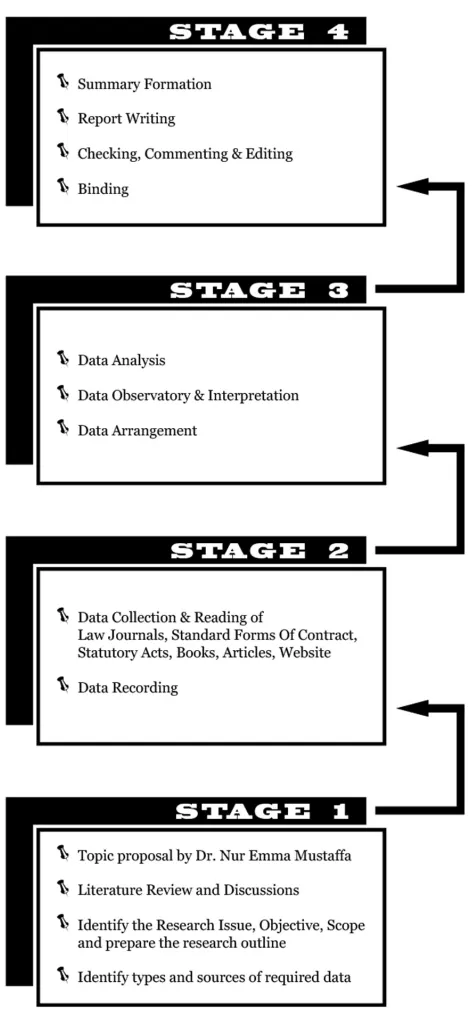
1.7 Research Process and Method of Approach 20
1.8 Tentative Chapter Headings 23
CHAPTER TITLE PAGE
1.8.2 Chapter 2: Architect’s Instructions In Construction Industry
23
1.8.3 Chapter 3: Analysis Of Cases Law 24 1.8.4 Chapter 4: Conclusion And
Recommendation
24
2 ARCHITECT’S INSTRUCTIONS
IN CONSTRUCTION INDUSTRY
2.1 Introduction 25
2.2 Who is the Architect? 27
2.3 Duties of the Architect 28
2.3.1 Design 30
2.3.2 Contract Administration 33
2.3.3 Supervision 34
2.3.4 Certification 35
2.3.5 Instruction 37
2.4 What is an Architect’s Instruction? 39
2.4.1 Definition 39
2.4.2 Instruction = Direction 42
2.4.3 Valid Architect’s Instruction 42 2.5 Provisions Empowering Architect’s Instrution 44
2.5.1 PAM 2006 44
2.5.2 Other Malaysian Forms 48
2.5.3 International Forms 40
2.5.4 Compliance with Architect’s Instruction 52
2.6 Disputes of Architect’s Instruction 52
CHAPTER TITLE PAGE
3 ANALYSIS OF CASES LAW:
IDENTIFYING VALID AND ACCEPTABLE FORM AND FORMAT OF ARCHITECT’S INSTRUCTIONS
3.1 Introduction 57
3.2 Case 1: Myers v. Sarl. 58
3.2.1 Fact of case 58
3.2.2 Issue (relating to instruction) 58
3.2.3 Finding 58
3.2.4 The Principle 59
3.2.5 Valid and Acceptable Form and Format of Instruction
60
3.3 Case 2: Tharsis Sulphur and Copper Co. v. Melroy & Sons & Ors.
60
3.3.1 Fact of case 60
3.3.2 Issue (relating to instruction) 61
3.3.3 Finding 61
3.3.4 The Principle 64
3.3.5 Invalid and Unacceptable Form and Format of Instruction
64
3.4 Case 3: Molloy v. Liebe. 65
3.4.1 Fact of case 65
3.4.2 Issue (relating to instruction) 65
3.4.3 Finding 66
3.4.4 The Principle 67
3.4.5 Valid and Acceptable Form and Format of Instruction
67
3.5 Case 4: Brodie v. Cardiff Corporation. 68
3.5.1 Fact of case 68
3.5.2 Issue (relating to instruction) 69
3.5.3 Finding 69
CHAPTER TITLE PAGE
3.5.5 Valid and Acceptable Form and Format of Instruction
70
3.6 Case 5: Simplex Concrete Piles Ltd v. St Pancras Borough Council.
71
3.6.1 Fact of case 71
3.6.2 Issue (relating to instruction) 72
3.6.3 Finding 72
3.6.4 The Principle 73
3.6.5 Valid and Acceptable Form and Format of Instruction
73
3.7 Case 6: Holland Hanned & Cubbits (N) Ltd v. Welsh Health Technical Services and Others.
74
3.7.1 Fact of case 74
3.7.2 Issue (relating to instruction) 75
3.7.3 Finding 75
3.7.4 The Principle 76
3.7.5 Valid and Acceptable Form and Format of Instruction
76
3.7.6 Invalid and Unacceptable Form and Format of Instruction
76
3.8 Case 7: The Missouri Department of transportation, ex rel. PR Developers, Inc. v. Safeco
Insurance Co. of America and Robertson
Contractors, Inc.
77
3.8.1 Fact of case 77
3.8.2 Issue (relating to instruction) 77
3.8.3 Finding 78
3.8.4 The Principle 78
3.8.5 Valid and Acceptable Form and Format of Instruction
CHAPTER TITLE PAGE
3.9 Case 8: Flooring System Inc. v. Staat Construction Co. DLJ
79
3.9.1 Fact of case 79
3.9.2 Issue (relating to instruction) 80
3.9.3 Finding 80
3.9.4 The Principle 81
3.9.5 Valid and Acceptable Form and Format of Instruction
82
3.10 Analysis of Cases Law 82
3.10.1 Group 1: Bona Fide Written Architect’s Instruction
82
3.10.2 Group 2: Written Architect’s Instruction with Additional Term
84
3.10.3 Group 3: Other Forms of Written Architect’s Instruction
85
3.10.4 Group 4: Arbitration Award 87
3.10.5 Group 1: Oral Instruction 88
3.11 Summary 88
5 CONCLUSION AND RECOMMENDATION
5.1 Introduction 91
5.2 Summary of Research Findings 92
5.3 Problem Encountered during Research 97
5.4 Limitation of Research 98
5.5 Suggestion for Future Research 98
5.6 Conclusion 99
REFERENCES 100
BIBLIOGRAPHY 103
APPENDIX A~B
LIST OF TABLES
TABLE NO. TITLE PAGE
3.1 Summary of Findings (Cases 1 ~ 3) 89
LIST OF FIGURES
FIGURE NO. TITLE PAGE
1.1 Letter 01 12
1.2 Email 01 13
1.3 Drawing 01 14
1.4 Formal AI 01 16
LIST OF ABBRIEVATIONS
AC Law Report: Appeal Case
AI Architect’s Instruction
BLR Building Law Reports, UK
CIDB Construction Industry Development Board, Malaysia CIDB year CIDB Standards Form of Contract for Building Works. CNC Certificate of Non Completion
EI Engineer’s Instructions
EOT Extension of Time
ICE Institution of Civil Engineers JCT Joint Contracts Tribunal, UK PAM Pertubuhan Akitek Malaysia
PAM year PAM's Agreement and Schedule of Conditions of Building Contract
PSSCOC Public Sector Standard Conditions of Contract for Construction Works
PWD Public Work Department (Jabatan Kerja Raya), Malaysia PWDyear PWD Form 203A – Standard Form of Contract
of Building Contract
RIBA The British Royal Institute of Architect
REDAS D&B Real Estate Developers’ Association of Singapore Design and Build Conditions
LIST OF CASES
CASES PAGE
Alexander Corfield v. David Grant (1992) 59 BLR 102. 35
Balfour Beatty Building Ltd. v. Chestermount Properties Ltd.
(1993) 62 BLR 1.
3
Bolam v. Friern Hospital Management Committee 1957 [1957] 1 WLR 582; 2 All ER 118.
30
Brockman v. Soltysiak 49 S.W.3d 740, 745 (Mo.App. E.D.2001). 80
Brodie v. Cardiff Corporation [1919] AC 337 (HL). 53, 68, 87,
90, 95
Cardy v. Taylor (1994) 38 CLR 79. 31
CJ Peace Ltd. v. Hereford Corporation (1968) 66 LGR 647. 54
Consarc Design v. Hutch Investments (2002) 84 Con LR 36. 35
CASES PAGE
Craig Johnson Construction v. Floyd Town Architects (2006 Opinion No. 43, Docket No. 31448).
32
Crosby (J) & Sons Ltd v. Portland Urban District Council (1967) 5 BLR 121, QBD
54
English Industrial Estate Corporation v. George Whimpey Co.
Ltd. [1973] 7 BLR 122.
4
Faulkner Associates v. Newham LBC [1994] 71 BLR 1. 28
Flooring System Inc. v. Staat Construction Co. DLJ ED 80814 and ED 80867, filed 11 February 2003.
79, 87, 90, 96
Gallagher v. Hirsch (1899) NY 45 App Div 467. 26
Glenlion Construction v. The Guinness Trust (1988) 39 BLR 89. 39
Greaves & Co. (Contractors) Ltd v. Bayham Meikle and Partners
[1975] 3 All ER 99.
31
Hickman & Co. v. Roberts (1913) AC 229. 36
Holland Hanned & Cubbits (N) Ltd v. Welsh Health Technical
Services and Others (1981) 18 BLR 89.
17, 74, 82, 90, 93
J & J Fee Ltd. v. The Express Lift Co. (1993) 34 Con LR 147. 39
CASES PAGE
John Holland Construction v. Majorca Projects [2000] 16 Const. LJ 114.
37
Leicester Guardians v. Trollope [1911] 75 JP 197. 34
London Borough of Hounslow v. Twickenham Garden
Developments Ltd [1971] 1 Ch 233.
29, 30, 34
London Borough of Hilingdon v. Cutler [1967] 2 All ER 361. 52
London Borough of Merton v. Stanley Hughes Leach (1985) 32 BLR 51.
39
Mitsui Construction Co. Ltd v. Attorney-General of Hong Kong
(1986) 33 BLR, 1 (PC).
38, 44
Modern Engineering (Bristol) Ltd. v. Gilbert-Ash Northern [1974] AC 689 717.
2
Molloy v. Liebe [1910] 102 LT 611. 65, 83, 87,
88, 89, 94
Myers v. Sarl (1860) 3 E & E 306. 26, 58, 85,
88, 89, 95
Neodox v. Swinton and Pendlebury Borough Council (1958) 5 BLR 34.
39, 54
CASES PAGE
Page v. Llandaff and Dinas Powis Rural District Council (1901) Hudson’s BC 4th ed. Vol.2 316.
36
Pepper v. Bourland (1792) 36
Robinson v. Powers 777 S.W.2d 675 (Mo.App. S.D.1989). 80
Rusell v. Viscont Sa da Bandeira [1862] 13 CB (NS) 149. 26
Sharpe v. San Paulo Railway (1872-1873) LR 8 Ch App 665. 43, 46, 53
Simplex Concrete Piles Ltd v. St Pancras Borough Council (1958) 14 BLR 80.
54, 71, 83, 85, 90, 94, 97
Steven Phoa Cheng Loon & Ors v. Highland Properties Sdn Bhd
& Ors. [2000] 4 MLJ 200.
31
Stockport Metropolitan Borough Council v. O'Reilly [1978] 1 Lloyd’s Rep 595.
38, 44
Sutcliffe v Thackrah [1974] AC 727. 29
Tharsis Sulphur and Copper Co. v. Melroy & Sons & Ors (1878) 3 App Cas 1040.
17, 43, 60, 85, 89, 95
The Missouri Department of transportation, ex rel. PR
Developers, Inc. v. Safeco Insurance Co. of America and
Robertson Contractors, Inc ED 79860, filed 5 November 2002.
77, 87, 90, 96
CASES PAGE
Yorkshire Water Authority v. Sir Alfred McAlpine & Son
(Northern) Ltd. (1985) 32 BLR 114.
LIST OF APPENDICES
APPENDIX TITLE PAGE
A Suggested format for Architect’s Instruction. 105
B Suggested format for Confirmation of Architect’s Instruction.
CHAPTER 1
INTRODUCTION
1.1 Background of Research
Whenever a change is required in a constructional work, no matter by whom, the contractors always ask the architects to issue Architect’s Instruction (AI), even though for purely engineering matters. In practical, the engineers will issue instructions for changes that purely concern engineering matters; but if these changes amounting to additional payments to the contractors, and if the architects are named as the contract administrator of the construction contract, then the AIs are always required to formalize the Engineer’s Instructions (EI). Hence, it shows that AIs are important construction contracts.
‘Contract’ can be defined as a legal terminology of an agreement that legally binding two or more parties1 into doing or not to do certain tasks which are mentioned in the contract. It is an agreement enforceable by law.2 Whereas
1
Vohrah, B. & Wu, M. A. (2005), The Commercial Law of Malaysia, 2nd ed., Malaysia: Longman, p. 6.
2
‘construction’ includes all immovable structures3 like buildings, dam, airports, bridges, tunnels and others. Construction projects “are relatively complex and generally are completed through the combined efforts of different crafts.”4 They also involve engagements “over different points in time of several organisations such as consultants, contractors, subcontractors and suppliers, with a client system that is
organisationally complex.”5 In other words, construction works are complex in terms of their processes and manpower organizations that require high degree of expert skills and professionals.
Hence, the construction contract can be defined as “an agreement entered into between the employer or building owner, and the contractor employed to
execute specified construction works in consideration of payments to be made at
various stages in the works; yet it is different from other types of contract. Its
implementation requires the services and skills of a wide range of professional
advisers, contractors, specialist contractors, suppliers and others.”6 Not only the construction works are complex, the construction contracts are also complicated and tedious. The nature of construction contract was described by Lord Diplock in Modern Engineering (Bristol) Ltd. v. Gilbert-Ash Northern7 as:
“an entire contract for the sale of goods and work and labour for a
lump sum price payable by instalments as the goods are delivered
and the work done. Decisions have to be made from time to time
about such essential matters as the making of variation orders, the
expenditure of provisional and prime cost sums and extension of time
for the carrying out of the work under the contract.”
3
Hinze J. (2001),Construction Contract, 2nd ed., New York: McGraw-Hill Higher Education, p. 1. 4
ibid., p. 3. 5
Mclnnis, A. (2001), The New Engineering Contract: A Legal Commentary. London: Thomas Telford Publishing, p. 51.
6
Tan, P.L., Low, K. S., Sum, P. M. J., and Chee. S. T. (2010), Handbook For PAM 2006 Contract,
Malaysia: Pertubuhan Akitek Malaysia, p. xxi. 7
Even though they are complex, once they are entered into, the contracting parties “are bound to each other for a certain period of time by unique and exclusive relationship which they have created for their mutual benefit. The unique
relationship, called ‘privity of contract,’ gives them both obligations which they
agree to accept so that they both ay benefit. This contractual relationship persists
until the contract is discharged or terminated; that is, until it is performed, or
terminated because of impossibility, agreement (by the parties), by bankruptcy (in
some cases), or breach of contract.”8
As it is highlighted earlier that the construction works are complex in terms of their processes and manpower organizations, which require high degree of expert skills and professionals; so do the construction contracts.9 Therefore the Malaysian standard form of contract, that was the PAM/ISM 1969, was enacted. It based on RIBA 196910 and the judgements of cases law in United Kingdom, Singapore and Hong Kong that using RIBA 1963. At that time, these cases were relevant being applied to Malaysian cases. By 1980, the applicability of some cases law from United Kingdom and Singapore had ceased their effectiveness in guiding the Malaysian cases. Thus their judgements could not be blindly applied onto Malaysian cases “without knowing the primary circumstances that gave rise to their decisions.”11
For example of the irrelevant case, was in the judgements of extension of time (EOT) in Balfour Beatty Building Ltd. v. Chestermount Properties Ltd.12 The case was judged based on JCT 80 and was unrelated to PAM/ISM 1969 or PAM 1998.13 Consequently, clause 23.9 is added into PAM 2006, providing a clearer provision that architects are expressly allowed to issue extension of time (EOT) after
8
Collier, K. (1987), Construction Contract, 2nd ed., United States of America: Prentice Hall, Inc., p.1. 9
Tan, P.L., Low, K. S., Sum, P. M. J., and Chee. S. T., op.cit., p.xxi. 10
ibid.
11
Tan, P.L., Low, K. S., Sum, P. M. J., and Chee. S. T., op.cit., p.xxiii. 12
(1993) 62 BLR 1. 13
the issuance of Certificate of Non Completion (CNC) for the delay caused by the employers only. Clause 23.9 will then be a clearer and precise guidance to judge further ‘Malaysian Balfour Beatty’ situations.14
Providing clearer express provisions are not the only aim of the new PAM 2006, instead, it also omits some controversial clauses of PAM 1998.15 For example was the omission of clause 12.2 in PAM 1998 that states:
“Nothing contained in the Contract Bills shall override, modify or
affect in any way the application or interpretation of that which is
contained in these Conditions.”
This clause was similar to clause 12(1) of RIBA and clause 2.2.1 of JCT 196316, which were considered as too offensive by Lord Denning in the case of English Industrial Estate Corporation v. George Whimpey Co. Ltd.,17in which he held that:
“[The special insertions] were carefully drafted and inserted in type
in the bills of quantities. They were put in specially to enable the
contractor to make their tender and the employer accepted it. They
were incorporated in the formal contract just as much as the
[contract conditions]. In contrast, the [contract conditions] were not
specially inserted at all. They were … in quite general terms. On
settled principles they should have taken second place to the special
insertions … If and in so far as [the contract conditions] contain
anything inconsistent with [the special insertions] … they should be
rejected, just as the printed form was in Love and Steward Ltd v
Rowtor Steamship Co Ltd (1916) …”
14
ibid., p.185. 15
ibid., p.xxiii. 16
ibid., pp.83-85. 17
By providing precise and practical express provisions and omitting controversial clauses, PAM 2006 is seen as a step towards “a positive provision that helps put in as express form a long informal practice or another welcome change
that puts in an express form a common implied practice thus far.”18
Another clause that is significantly affected by the revision and emergence of PAM 2006 which is chosen as the topic of this research is clause 2 on AI. It brings major changes to clause 2 of PAM 1998, especially in clause 2.5 that states:
“All instructions issued by the Architect shall be in writing. If the
Architect issues an instruction otherwise than in writing, it shall have
no immediate effect, but shall be confirmed in writing by the
Contractor to the Architect within seven (7) days. If within seven (7)
days upon receipt of the Contractor’s confirmation, the Architect
does not dissent to it in writing, then the Contractor’s confirmation
shall be deemed to be an Architect’s Instruction. The said instruction
shall have taken effect on the date when the Contractor’s
confirmation was issued.
2.5(i) Provided always that if the ArchitectIf within seven (7)
days of giving instruction otherwise than in writing himself
confirm the same in writing, then the Contractor shall not
obliged to confirm in writing and the instruction shall take
effect as from the date of the Architect’s confirmation; or
2.5(ii) If neither the Architect nor the Contractor confirm such
instruction in the manner and at the time aforesaid but the
Contractor nevertheless does comply with the same, then
the Architect may confirm the same in writing at any time
prior to the issue of the Final Certificate, and the said
18
instruction shall be deemed to have taken effect on the date
when it was issued otherwise than in writing by the
Architect.”
This clause 2.5 was daringly reworded by clause 2.2 of PAM 2006 that states:
“All instructions issued by the Architect shall be in writing expressly
entitled “Architect’s Instruction” (‘AI’). All other forms of written
instruction including drawings issued by the Architect shall be an AI:
2.2(a) upon written confirmation from the Contractor entitled
“Confirmation of Architect’s Instruction” (‘CAI’); or
2.2(b) upon subsequent confirmation of written instruction by the
Architect with an AI.”
Therefore, under the provision of clause 2.2 of PAM 2006, the AIs have now to be in specific format. Whereas previously, there was no requirement for them to be in any specific format under PAM 98 and PAM/IEM 1969, except that they have to be in writing. This sudden change brings in hick up among construction industry people. But why this change was made mandatory in PAM 2006?
According to the drafters of PAM 2006, the change was due to the difficulty faced by construction industry people, including the employers, consultants and contractors to precisely know and recognise what AIs are,19 especially when the instructions are transpired via oral instructions, site memos, minute of meetings, emails, letters, sketches and revised drawings. In such difficulty and in the event the contractors failed to comply with these AIs, they are in breach of the contract. Hence, the employers have right to determine the contractors’ employment.20 In
19
ibid., p. 35. 20
short, the change in clause 2.2 is beneficial in reducing doubts of AIs among the construction people.
1.2 Problem Statement/ Research Issue
Under the provision of clause 2.2 of PAM 2006, each AI must now be in a specific format, which is to be expressly entitled with “Architect’s Instruction.” All other written formats of instructions such as drawings shall only be considered as instructions if they comply with this new format of AI or via the contractor’s written confirmation, headed with “Confirmation of Architect’s Instruction.” This is an excessive change because previously there was no requirement for AIs to be in any specific format under PAM 98 and PAM/IEM 1969, except that they have to be in writing. Examples of written instructions by the Architects “will, therefore, inter alia, include emails, letters, issue of drawings transmittal forms, instructions written
in site record books and site meetings recorded by the Architects.”21 In fact, these formats are still valid as written instructions in PWD 2007 via its clause 5.1 that states:
“The S.O. may from time to time issue further drawings, details
and/or written instructions (all of which are hereafter collectively
referred to as "S.O’s instructions") …”
Moreover, this new express titled format of instruction is not a requirement in other Malaysian standard forms of contract. They only required the instructions to be in writing. For example are clause 2.5 of PAM 1998, clause 5(a)(i) of IEM 1989; clause 5.2 of PWD 2007 and clause 3 in CIDB 2000. Internationally also, no
21
requirement for instruction to be headed with specific words is made mandatory. 22 Most of them require the instruction to only be in written format. For example are in JCT Minor Works Building Contract 2005,23 ICE condition of contract,24 FIDIC forms of contract,25 SIA Forms and PSSCOC.26 However, Singaporean REDAS D&B form is silent for issuing instruction in writing. It is only advisable for evidential purpose.27
It is earlier brought to light that formatting AI as per the clause 2.2 of PAM 2006 is beneficial in reducing doubts of AIs among the construction people; what will happen if there are still instructions issued via the previously acknowledged formats of AIs such letters, drawings and emails? Will they be automatically invalid for not headed with the words “Architect’s Instruction.”? Sundra Rajoo, WSW Davidson and Harban Singh are in the opinion that clause 2.2 has imposed that written AIs are now “mandatorily restricted to only two types of formal instructions namely “Architect’s Instruction” (‘AI’) and “Confirmation of Architect’s
Instruction” (‘CAI’)” and subjected to be signed by the architects and contractors respectively.28 Therefore, the status of written instructions without such expression is a crucial issue to be looked for, especially when approximately 90 per cent of private sector works are using the PAM Form.29
22
Chappell, D. (2006), The JCT Minor Works Building Contracts 2005, 4th ed., Great Britain: Blackwell Publishing, p. 58.
23
ibid.
24
Eggleston, B. (2001), The ICE Conditions of Contract, 7th ed., Great Britain: Blackwell Science Ltd, p. 38.
25
Bunni, N. G. (2005), The FIDIC Forms of Contract: The Fourth Edition of the Red Book, 1992, The 1996 Supplement, The 1999 Red Book, The 1999 Yellow Book, The 1999 Silver Book, 3rd ed., Great Britain: Blackwell Publishing, p. 136.
26
Lip, E. (2009), It’s All About Instruction!, Retreived on February 9, 2011, from http://www.kpkqs.
com/download/KPK%20Research%20Digest%20-%20About%20Instructions%20-%20Aug%202009.pdf, p. 1. 27
ibid.
28
Rajoo, S., Davidson, W. S. W., & Harban Singh, K. S. (2010), The PAM 2006 Standard Form of Building Contract, Malaysia: Lexis Nexis, p.106.
29
Rajoo, S. (2010), The PAM 2006 Standard Form of Building Contract - A Change in Risk
Another issue is on the status of oral instructions. Clause 2.5 of PAM 1998 allows them to happen but needed to be confirmed in writing:
“… If the Architect issues an instruction otherwise than writing, it
shall have no immediate effect, but shall be confirmed in writing …”
In fact, most standard forms required them to be confirmed in writing. For example is in clause 5.2 of PWD 2007 that states:
“If such instruction is given orally, the S.O. shall then issue a written
instruction within seven (7) days from the date of such oral
instruction is given.”
Clause 1.1 of SIA 6th Edition also has the same approach, which states:
“… Any direction or instruction given verbally shall be deemed to
have been given in writing, retrospectively effect from the date of the
verbal direction or instruction, provided that the Contractor confirms
the direction or instruction in writing within 14 days of its being
given, …”
But, the provision for verbal instruction is omitted in PAM 2006 throughout its clauses 2.1 until 2.4. Does this omission mean oral instructions are totally not allowed in PAM 2006? This omission protrudes another practical issue because in the norms of the practice, the architects and other consultants give verbal instructions when site visits.30 They also verbally instruct the contractors on very urgent matters via telephone. Since confirming the oral instruction is not enacted at all in PAM 2006, then it is fair to say that the contractors are therefore “entitled to validly ignore”31 the given verbal instructions. What will happen if the contractors proceed with the verbally instructed works? Let’s say the instructions are on additional
30
Rajoo, S., Davidson, W. S. W., & Harban Singh, K. S., op.cit., p. 106. 31
works. Will they be entitled to claim for the additional payments on the additional works?
The rigid restriction of clause 2.2 of PAM 2006 projects further difficulties to the architects, consultants, contractors and employers especially on very urgent matters that require the contractor to immediately act upon the verbal instruction, and “cannot wait the processes of the Clause 2.2.”32 Without confirming such instructions, the contractors can just disregard them, hence detrimenting the employers. Yet, if the contractors proceed with such instructions, they may face claiming additional compensations. To avoid such difficulties, the contractors will pester the architects to issue the formal AIs for such verbal instruction, because there is no provision in PAM 2006 that allows them to confirm the verbal instructions in writing. On contrary, clause 2.5 of PAM 1998 allows the contractors to do so:
“… an instruction otherwise than writing, it shall have no immediate
effect, but shall be confirmed in writing by the Contractor to the
Architect …”
In comparison, it is fair to justify that PAM 1998 is more practical and friendlier in embarking upon this difficulty via its clause 2.5(ii), by recognising the additional verbal instructed works done by the contractors, provided that they are later formalized by written instruction from the architects before the issuance of Final Certificate. PAM 1998 also upholds the architects’ discretionary powers to formalize the verbal instructions retrospectively.33 But, it is impossible for the architects to do so with the inflexible restraint of clause 2.2 of PAM 2006.
In short, clause 2.2 of PAM 2006 may become considerable distraction among the architects, consultants and employers because the contractors will keep
32
ibid.
33
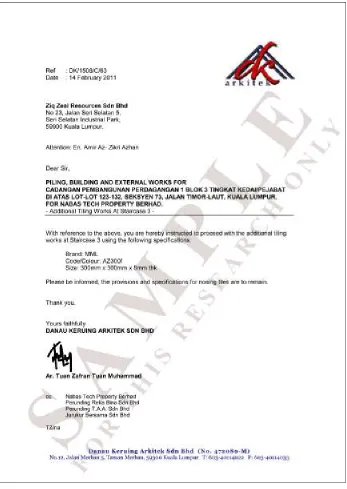
Figure 1.1: Letter 01.
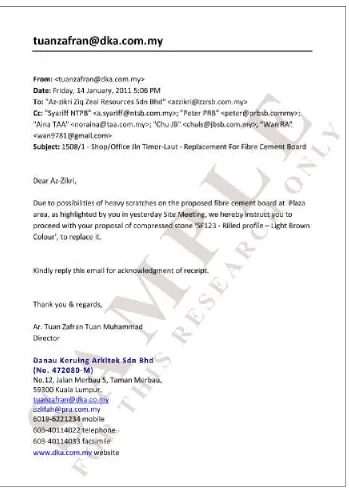
Figure 1.2: Email 01
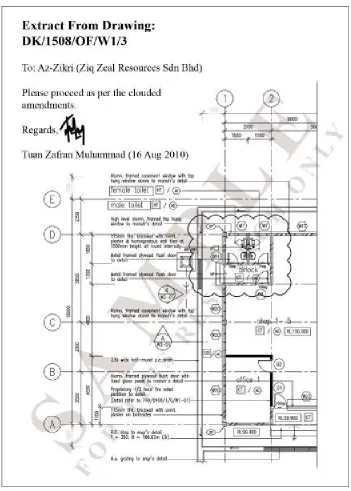
Figure 1.3: Drawing 01
The above samples of letter, email and revised drawing clearly indicate some changes are necessary to be carried out by Ziq Zeal Resources Sdn Bhd, i.e. the contractor in the above mentioned project in the samples. Both Letter 01 (Figure 1.1) and Email 01 (Figure 1.2) have the word ‘instruct’ on them. The words “you are hereby instructed” and “instruct you” convey precise and clear orders for the contractor to proceed with the subject matters of the letter and email. Therefore, it is not wrong at all to remark both of them are valid and acceptable form and format of instructions by the architect. However, in the Drawing 01 (Figure 1.3), no word of ‘instruct’ has been used. Instead, the architect uses the word ‘proceed’. Even though without the exact word of ‘instruct’, the whole sentence by the architect “Please proceed as per the clouded amendments” plus the graphical information on what changes to be done are clearly indicated on the drawing. Thus, it is also fair to perceive that the drawing is also a good, valid and acceptable form and format of instruction. Furthermore, the drawings is signed and dated by the architect.
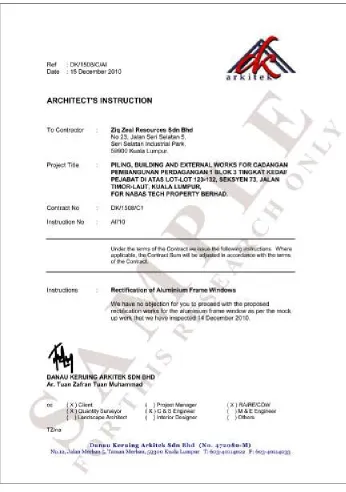
Figure 1.4: Formal AI 01
In short, from the above discussion of this problem statement of the clause 2.2 of PAM 2006, it is not wrong to say that requesting and waiting for issuance of AIs labelled with “Architect’s Instruction” may delay the progress of works. In worse case scenarios, there are some architects and engineers who are reluctant to issue written instructions due to some reasons. For examples were in the cases of Tharsis Sulphur and Copper Co. v. Melroy & Sons & Ors.34and Holland Hanned & Cubbits (N) Ltd v. Welsh Health Technical Services and Others.35 In this scenario, the contractors may not proceed with instructed works if without these formal AIs. The letters, emails, revised drawings, site memos, minute of meetings and other forms that do not label with the words “Architect’s Instruction” are no more the valid instructions. However, it must be noted that “the construction industry is notorious for complex disputes”36 thus more and more pitfalls and unexpected arguments may occur. Thus, in the end, the practicality of this clause is practical to the users and building industries is questionable. It needs to be further studied in detail in order to elucidate possible problems. Maybe, different interpretations may be added to avoid such inherent problems. Therefore, to ease possible difficulties and bring situations back on track, this research will look for cases law and judgments on what it takes to be valid and acceptable form and format of AIs.
1.3 Previous Research
There was no previous study that specifically discussed on AIs, but there were some on instructions. One of those was the study done by Nik Nurhazirah Nik Omar (2008) on Invalid Contract Administrator’s Instructions. She discussed on the limitations of power of contract administrators in issuing instructions and what are
34
(1878) 3 App Cas 1040. 35
(1981) 18 BLR 89. 36
the grounds that make some instruction invalid. For her, the research was valuable for contractors so that they don’t have to comply with the invalid instructions.
Another study which was also related to instruction was done by Lim Cheng Sim (2007), entitled What Constitute A Variation In Construction From Legal Perspective. To be enforceable, variations must be supported by instructions. However, this study aimed and researched for factors and judicial interpretations in determining variations.
1.4 Objective of Research
The approaches and objectives of the above mentioned earlier studies were different from this research. For this research, its objective is to determine the valid and acceptable form and format of AIs. Whether they have to mandatorily comply with clause 2.2 of PAM 2006 or otherwise?
1.5 Scope of Research
1.6 Significance of Research
By referring to the normal practice in Malaysian construction industry and mostly due to time constraint, individual attitude and some standard of procedures by the employers, lots of instructions by the architects are transpired to the contractors in many forms and formats like orally, site memos, minutes of meetings, emails, letters, sketches and revised drawings. Let’s term them as ‘the alternative forms’. In previous PAM 1998, PWD 2007 and some other standard form, the instructions via ‘the alternative forms’ are valid and acceptable. The verbal instructions are also valid provided they are confirmed in writing by the architects or the contractors.37 However, clause 2.2 of PAM 2006 does not recognize them as valid AIs because they are expressly entitled with the words “Architect’s Instruction.”
When ‘the alternative forms’ are not recognized as valid AIs, then the architects are normally required to issue the formal AIs especially towards the Final Account stage,38 in order to formalize all directions and instructions, which were earlier given to the contractor without attaching the so-called “Architect’s Instruction.” However, the provision to issue instructions retrospectively is no more available in PAM 2006.39 Subsequently, what will be the consequences when humans tend to forget on instructed matters in the past, or maybe when there are changes in personnel of construction organization? The previous instructions may be neglected and disputed. Hence, more and more ‘history diggings’ are extremely required.
However, there are few cases law had been judged that instructions via ‘the alternative forms’ can also be valid instructions by the architects. Therefore, this
37
For examples are in clause 2.5 of PAM 1998, clause 5.2 of PWD 2007 and clause 1.1 of SIA 6th Edition.
38
Clause 2.5(ii) of PAM 1998. 39
research is important in finding out and analyzing what are the essential characteristics for form and format of instructions by the architects so that they are valid and acceptable in the construction industry. The findings of this research may provide an insight understandings and recognitions of valid and accepted form and format of AIs to all parties in the construction industry, so that they know on how to proper issue and comply with the AIs. The findings may also help the contractors for better understanding on how to oblige and comply with ‘the alternative forms’ of instructions to minimize the risks of proceeding works without valid and accepted instructions. Moreover, the findings also help in terms of reducing the probability of the contractors being determined by the employer for breach in non compliance of the AIs.
1.7 Research Process and Methods of Approach
This research is an explanatory study on clause 2.2 of PAM 2006, since no study has been conducted on it. Therefore the purpose of this research is to find out whether the words “Architect’s Instruction” is mandatory to be entitled on each instruction issued by the architects, or whether ‘the alternative forms’ of instructions are still valid under PAM 2006? Thus, plausible explanations, mainly from the judgement of cases law, are carefully looked for, gathered and analysed to determine the valid and accepted form and format.
Malaysia is being analysed, due to the scarcity of the case, the foreign cases law are good to be referred in finding the answer of this research.
1.8 Tentative Chapter Headings
The research will be discussed and presented into four chapters. The brief descriptions of each chapter are as follows:
1.8.1 Chapter 1: Introduction
Chapter 1 is presented as the overview of the whole research. It contains the reason on how this topic comes on board, plus its importance and significances. They are discussed in the sub chapters of ‘Background of Research’, the ‘Problem Statements and ‘Significance of Research’. This ‘Objective of Research’ is also discussed and compared against the similar topics which were done by previous researchers.
1.8.2 Chapter 2: Architect’s Instructions In Construction Industry
1.8.3 Chapter 3: Analysis Of Cases Law
This chapter gathers and discusses eight cases law. The judgment of each case law is important in analyzing and outlining the characteristic for form and format of valid and acceptable AIs. The discussed cases are based on the requirement for instructions for variation works, since this aspect is the most delicate aspects if the AIs found to be invalid.
1.8.4 Chapter 4: Conclusion and Recommendation
BIBLIOGRAPHY
Abdul Aziz Hussin. (2006). Ahli Professional Projek Pembinaan Perspektif Undang-Undang. Malaysia: Penerbit Universiti Sains Malaysia.
Bartholomew, S. H. Abdul Aziz Hussin. (2001). Construction Contracting Business and Legal Principles. (2nd ed.) United States of America: Prentice Hall.
Bramble, B. B., and Callahan, M. T. Construction Delay Claims. (3rd ed.) New York: Aspen Publishers.
Chow Kok Fong (1980). The Law Relating to Building Contracts: Cases & Materials. Singapore: Quins Pte. Ltd.
Chow Kok Fong. (2004). Law and Practice of Construction Contracts. (3rd ed.) Sweet & Maxwell Asia, Singapore.
Culberston, A. N. (1983). Contract Administration Manual for the Design Professionals. United States of America: McGraw-Hill Book Company.
Fisk, E. R. (2003). Construction Project Administration. (7th ed.) Ohio: Prentice Hall.
Lim Cheng Sim. (2007). What Constitute A Variation In Construction From Legal Perspective. Master of Science, UTM, Skudai, Malaysia.
Lim Chong Fong. (2004). The Malaysian PWD Form of Construction Contract. Malaysia: Sweet & Maxwell Asia.
Lim Eng Chong. (2007). The Institution of Engineers, Malaysia, Conditions of Contract for Work Mainly of Civil Engineering Construction – 2nd Module:
Comparison of item of IEM from with PAM Essentially The PAM Form.
Retreived on February 9, 2011, from http://www.gnpgroup.com.my/ download/IEM_vs_PAM_Form-COC.pdf
Murdoch, J. (2008). Construction Contracts: Law and Management. London: Spon Press.
Onn Chee Kheng. (2002). Standard Construction Contracts in Malaysia, Issues nd Chalenges. Retreived on February 9, 2011, from http://www.gnpgroup. com.my/download/IEM_vs_PAM_Form-COC.pdf
Speaight, A. (2010). Architect’s Legal Handbook: The Law for Architects. Architectural Press, Oxford.
Sweet, J. and Schneier, M. M. (2009). Legal Aspects of Architecture, Engineering and the Construction Process. (8th ed.) United States of America: Cengage Learning.
Uff, J. (2005). Construction Law; (9th ed.) London: Edition; Sweet & Maxwell.