WEB-BASED UNIT AND INSTRUCTOR EVALUATION SYSTEM
(UIES)
CHOON KWAI MUI
A thesis submitted in fulfillment of the
requirement for the award of the degree of
Master of Science (Information Technology - Management)
FACULTY OF COMPUTER SCIENCE & INFORMATION SYSTEMS
UNIVERSITI TEKNOLOGI MALAYSIA
ACKNOWLEDGMENT
I would like to express my sincere gratitude especially to my project supervisors Prof. Zamri bin Mohamed and Y M Raja Baharuddin bin Anom for their invaluable supervision, advice, guidance and encouragement throughout the course of the project. I also would like to thank all the staff in Universiti Teknologi Malaysia (UTM).
I would like to thank Tunku Abdul Rahman College (TARC) academic staffs and administrative staffs who participated in my project, as well as the many students who gave their suggestions and cooperation.
ABSTRACT
ABSTRAK
TABLE OF CONTENT
CHAPTER TITLE PAGE
1 Project Overview1.1. Introduction 1
1.2. Background of problem 2
1.3. Statement of the problem 4
1.4. Project objective 5
1.5. Project Scope 6
1.6. Importance of project 13
1.7. Chapter Summary 14
2 Literature Review
2.1. Introduction 15
2.2. Literature review framework 15 2.3. Definition of web based performance
evaluation system
18
2.4. Performance evaluation background 18 2.5. Performance evaluation approach 22 2.6. Characteristic of web based performance
evaluation system
24
2.7 Case studies of web-based performance evaluation system
25
2.8 Chapter Summary 26
3 Methodology
3.2. Research operational framework 28
3.3. Project methodology 30
3.3.1.Management and planning 31
3.3.2.Analysis 32
3.2.3.Design 33
3.2.4.Implementation & operations 33 3.4. System development methodology -
unified software development process
34
3.5 Project schedule 38
3.6 Chapter Summary 39
4 System Analysis and Design
4.1. Introduction 40
4.2. Organization analysis 41
4.2.1.Organization background and core business
41
4.2.2.Organization structure 42
4.2.3.Existing IS/IT systems 43 4.2.4.Problem statement in the
organization context
43
4.2.5. As-Is process and data model 45
4.2.5.1.As-Is process 45
4.2.5.2.As Is data model 46
4.3. User requirement 53
4.3.1. SWOT analysis of UIES implementation
54
4.3.2. Functional Requirements 55
4.3.3. Non-Functional Requirements 56
4.3.4. Performance measurement 57
4.3.5. Formula to calculate the evaluation result
4.4. Conceptual Design 59 4.4.1. To-be process and data model 59
4.4.1.1. Use-case diagram for UIES 59 4.4.1.2. Class diagram for UIES 59 4.4.2. System Architecture (Conceptual
Design)
67
4.5. Physical Design 67
4.5.1. Database Design 68
4.5.2. Program Chart 70
4.5.2.1.Overall 70
4.5.3. Interface Chart 76
4.5.3.1.User interface chart 76 4.5.3.2.Main Function Offer By The
UIES User Interface
78
4.5.3.3.User Interface Design 78 4.5.4. Detail Module/ Features 82 4.5.5. System Architecture (Physical
Design)
83
4.6. Hardware Requirements 85
4.7. Test Plan 85
4.8. Chapter Summary 86
5 Design Implementation And Testing
5.1. Introduction 87
5.2. Coding approach 88
5.3. Test Result /System Evaluation 96
5.3.1. Major constraints 96
5.3.2. Test Procedures 97
5.4. User Manual for Administrator 103 5.4.1. Hardware and Software
Installation
103
6 Organization Strategy
6.1. Introduction 108
6.2. Roll-Out Strategy 108
6.3. Change management 109
6.4. Business Continuity Plan (BCP) 110 6.5. Expected Organizational Benefits 111
6.6. Chapter Summary 111
7 Discussion & Conclusion
7.1. Achievement 112
7.2. Constraints and Challenges 113
7.3. Aspirations 115
7.4. Chapter Summary 116
LIST OF FIGURES
FIGURE NO
TITLE
PAGE
1 Project Overview
1.1. Message flow in the three tier client/server architecture
9
2 Literature Review
2.1. Conceptual framework for analyzing web-based performance evaluation system for unit and instructor
16
2.2. Overview of performance evaluation 19 2.3. Performance management process
Vis-à-vis business strategies
20
2.4. Kathleen Guinn performance management model
21
2.5. Student rating of instruction (SRI) model
23
3 Methodology
3.1. Research operational framework 28 3.2 The phases involved in the unified
software development process.
36
3.3. The relationship between unified software development process and object oriented system analysis and design
37
3.5. Gantt Chart for Project 2 39
4 Initial finding
4.1. Organization chart for Johor branch campus
42
4.2. Current evaluation process use case diagram
46
4.3. Class diagram for current evaluation system
52
4.4. To-Be system use case diagram 59
4.5. Class diagram for UIES 66
4.6 The conceptual design of system architecture for UIES.
67 4.7. The overall program chart for UIES 70 4.8 The student user interface chart 76 4.9 The system administrator user interface
chart
77
4.10 The TARC staff user interface chart (academic staff and admin staff)
77
4.11 The system architecture (physical design) for UIES
LIST OF TABLES
TABLE NO
TITLE PAGE
3.1. Comparison of software development methodologies 35
4.1. SWOT Analysis Table 54
4.2. Criteria for evaluation of teaching performance 57 4.3 Summarizes the functions offered by UIES user interface 78 4.4. The summary of UIES features with user requirement. 82 4.5. CRUD (Create, Read, Update, Delete) matrix extract
showing functions and objects
83 4.6. Hardware requirements for the system 85
LIST OF APPENDIXS
APPENDIEX TITLE
PAGE
A Project Management
Team structure and organization 118 Work break down of activities in sequence 119
Project Charter 121
Projected Cost & Benefit 123
B Sequence Diagram, Activity Diagram and State Diagram
Sequence Diagram 124
Activity Diagram 127
State Diagram 130
C Related Forms / Survey
Questionnaire 131
Evaluation Form and summary report for current system
134
CHAPTER 1
PROJECT OVERVIEW
1.1 Introduction
One of the Tunku Abdul Rahman College (TARC) goals is to provide quality education and training, and maintain high academic standards in all education programs offered in the college. In order to achieve this purpose, the linkage of performance evaluation reporting with college strategic planning and objectives is necessary to ensure that the college and evaluation system performance improves in the chosen target areas to move the organization strategically in the desired direction.
An education industry provides quality education is central to its ability to gain competitive advantage. High quality education will attract more students’ study in TARC. Critical mass of students is needed for a college to survive. Unit and instructor evaluation should be a small but significant part of the larger strategy for college improvement.
instructor, also a source of data for faculty performance evaluation. In order to provide comprehensive and trustworthy evidence for employee development and organizational improvement, appropriate data collection method need to be taken to ensure that useful data are gathered and thoughtful student feedback is facilitated.
With the current Information Technology (IT) trends, college can implement course evaluation via an online format for courses in order to lower costs, increase timeliness of feedback, and assist with ease of record-keeping and analysis. This Web-Based Unit and Instructor Evaluation System (UIES) is an automated system to replace the traditional paper evaluation system. This web-based system collects teaching evaluation data for summative and formative purposes.
1.2 Background Of Problem
Tunku Abdul Rahman College (TARC) was established on 1969 under the leadership of Malaysian Chinese Association. The college is one of the country’s major institutions of higher learning and has established an international reputation for the high quality and wide range of courses offered.
In order to develop a powerful work team and improve the quality of education, unit and instructor performance evaluation are implemented in TARC every semester. Current evaluation system creates a lot of administrative workload and the results are kept within individual campus. The administrators are using the same evaluation forms for all faculties.
administering an evaluation, administrator needs to print large quantity of evaluation forms and schedule time for evaluation. Before the start of evaluation of a particular subject, the administrator will inform the instructor for that particular unit that fifteen minutes of class time will be used for the evaluation. Students will fill out the evaluation form for the unit and instructor performance evaluation within that short period of time. The administrator collects all the returned forms and later enters all data into the current system for further processing. A simple summary information can be shown in Microsoft Excel format.
The administrator will print out the unit review for unit leader to help in planning for the next year’s delivery of the unit and produce instructor’s performance report for the Human Resource Department. The purpose is to assist academic administrators in counseling instructors about their teaching and they are carefully weighed as a factor in judging the teaching component for promotion and salary determinations.
Through observation, I found that current evaluation system has a lot of limitations and does not achieve the goals for which it was supposed to. I am going to develop Web Based Unit and Instructor Evaluation System (UIES) because it provides the best solution to the problematic situation in which the power of the web comes through hyperlinking information posting, authoring and interactively. The UIES is a flexible, anonymous, secure, efficient and adaptable means for students to provide their feedback on their units and instructors.
1.3 Statement of the Problem
Current system requires more human effort and time to produce simple evaluation report. The users are divided into four groups which are students, system administrator, academic and administrative staff. The time taken by the users to perform their tasks is time consuming because of the following reasons:
- An administrator is required to go to every class during lecture or tutorial hours to carry out the evaluation process. The tedious process of distributing and collecting the evaluation forms consumes valuable class hours. In addition, it requires three weeks to complete the evaluation for all the units and instructors.
- Summarizing the evaluation data takes another three weeks because it is being performed manually and the administrator also needs to summarize the comments given by students. The summarized results therefore are subjected to human errors.
- It takes one and a half month to complete the evaluation process, which is inefficient and time consuming. Evaluation reports produced lack the ability to compare the performance of an instructor over the past and present semesters.
- The results of the current evaluation system are kept within individual campuses. Therefore, the performance of two instructors from different campuses teaching the same unit cannot be compared.
- The existing evaluation system involves printing a large quantity of evaluation form which may not be cost effective.
1.4 Project Objective
The objectives for implementing a web-based evaluation system are:
- To study how to implement the evaluation system in an on-line environment that would make the evaluation process easier and more efficient.
- To identify the problem and weaknesses of current evaluation system.
- To provide semester-end report for management to evaluate the performance of instructors and schools.
- To standardize and integrate the evaluation system among all the college branches. Presently this project will be localized and upon completion and testing, integration with other branches will be considered.
1.5 Project Scope
Project scope is define as the boundary of the project in term of the functionality of system, input data, software and hardware platform, features of the system, users and type of testing implement in system development. This project will focus on performance management -- performance evaluation. This project will be tested and implemented in TARC Johor branches campus.
1.5.1. The Functionality Of System
The system to be developed will be a web-based system. The system will allow administrator to add, remove and edit questions that will appear on all evaluation forms used at the school level. Question editing is provided through a straightforward web interface that allows two question types: Likert -style question and open-end questions. Administrator needs to set the survey parameters such as instructor name, course and access dates to complete the survey for each unit.
During evaluation, student completes the electronic form by clicking on guided answers for Likert-style question and type in responses to open-ended questions. Once completed, student submits the anonymous evaluation form. The responses are added to the appropriate table in the database. The system summarizes all the evaluation scores automatically and a statistical report will be generated automatically which the user can view on the web or print out.
1.5.2. Data
UIES is developed for collecting teaching evaluation data from students. Students need to fill out electronic survey form. TARC used Student Rating of Instruction (SRI). The SRI form formats include Likert-style questions (strongly agree, agree, neutral, disagree and strongly disagree) and optional open-end questions to capture student’s opinion or suggestion for improving particular unit or instructor’s performance.
Similar with the current paper survey form, the electronic survey form is divided into two parts. The first part is unit review section, which evaluates the unit/subject. Second part is evaluation of lecturer section used for evaluation of the instructor. The sample form and summary report for current evaluation system are attached, Appendix A of this document.
1.5.3. Software/ Hardware/ Platform
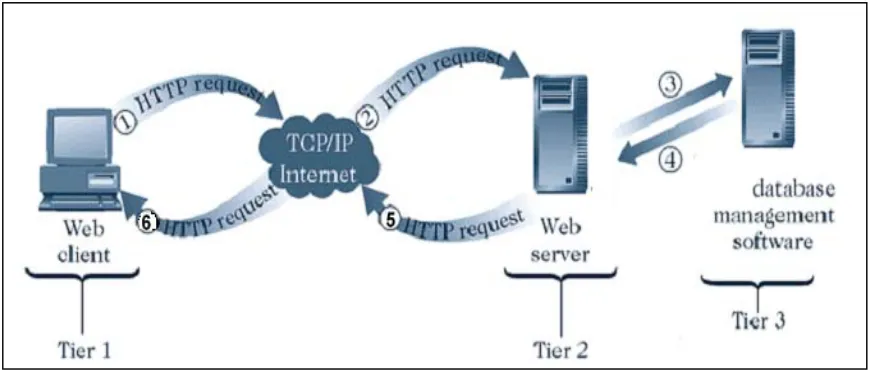
1.5.3.1.Three Tier Client Server Architecture
UIES is support three (3) tier architecture (Browser + Apache web server / PHP + MySQL). This architecture is appropriate for more complicated web interaction which requiring services of database program. The basic structure of a three-tier application: -
a) Client tier
Users interact with application through user interface. Client need interacts with middle tier to make requests and to retrieve data from information tier. The client then displays data retrieved from middle tier to the user. Examples are Internet Explorer & Netscape browser.
b) Middle tier
This Tier is a business logic and data processing layer. It acts as intermediary between data in information tier and application client. A web server is a middle-tier application. UIES used Apache as the Web server. PHP is scripting language supported by Apache. PHP is needed to generate web pages dynamically.
c) Information tier
Figure 1.1. Message flow in the three-tier client/ server architecture
1.5.3.2.Software Requirement
PHP (hypertext preprocessor)
PHP is a server-side scripting language designed specifically for the web. The goal of the language is to allow web developers to write dynamically generated pages quickly. Strengths for PHP when compare with main competitors such as PERL, ASP, JSP is that it can interface to many different database system that provides an open database connectivity standard (ODBC) such as MySQL, Oracle, Microsoft products and others. Other advantages are low cost and availability of source code. PHP is portable across multiple platforms. PHP was created as an open-source technology based on C, Perl, and Java that can run on multiple operating systems and multiple web servers. PHP performs very well and is nearly as fast as ASP, but it’s still held back by its lack of good development tools.
MySQL
database server. As with PHP, web developer can obtain and modify the source code for MySQL.
Apache web server
The apache web server is the software that responds to client requests by providing resources, such as XHTML documents. Based on the following diagram, Apache is a popular web server and holds under 60% of the web server market.
Microsoft Visio professional 2003 is a software for creating the UML diagram, organization chart and project schedule.
Microsoft office 2000 is a software package for preparing the documentation software to assist us in project planning, estimating, scheduling, monitoring and reporting.
1.5.3.3.Hardware Requirement
- Servers
Pentium-based server or equivalent Network interface card
Hub/ switch
- Client
1.5.4. Features
The UIES supports access control. Users need to use their username and password to login. In order to protect student confidentiality, his/ her identity is separated from the evaluation he/ she submits. The content of the evaluation is saved into a separate table that does not include the student’s identity. The student identity will be saved in another table. This table can be used to tell the system whether the student has completed the evaluation for a particular unit. Both tables cannot be linked.
UIES also provide email services. Email will be sent to students when a unit opens for evaluation. Students also will receive reminder email every week follow this initial email until the unit (s) have either been evaluated or the evaluation period has ended.
The system provide online help guide to users who need to obtain detail information about the system and guideline to using the system.
System administrator needs to set the survey parameters such as instructor name, course and access dates in order to complete the evaluation form for each unit. Administrator can modify evaluation questions when requested by top management. Web-based evaluation form can be designed to include a wide variety of response options (e.g. check boxes, Likert scales, pull-down menus).
1.5.5. User
The school offices, human resource department and the management level staffs will use this system. Users are divided into several groups. Each group can access specific functions of the system depending on their needs and responsibilities:
- Student can logging into system by entering their user name and password. Student needs to complete all the unit he/she has enrolled.
- Instructor can view their own teaching evaluation statistic report.
- The human resource department and management level staffs such as the head of department, head of branch or head of school have access to the web-based evaluation system, where they can view the summary of evaluation results and do some analysis of the instructors performance based on some reports that compare the evaluation score over several semester and different campuses.
- System administrator will take full control over the system, manages system resources such as user accounts, assigns permissions, create evaluation forms and access reports for specific unit or instructor and define setting for the system.
1.5.6. Type Of Testing
The UIES uses Unified Software Development Process as the system development methodology. This unified process proposes an iterative approach, which means that test is conducted throughout the project. This allows defect be detected as early as possible.
the test lifecycle of planning, analysis, design, implementation and operation. During analysis, an overall test plan is developed. Unit test plan, an integration test plan and a system test plan are developed during design phase. During implementation, these various plans are put into effect and the actual testing is performed.
1.6 Importance of Project
The primary goal of a performance evaluation system is to provide an equitable measurement of an employee’s contribution to the workforce, produce accurate evaluation documentation to protect both the employee and employer, and obtain a high level of quality and quantity in the work produced.
Education evaluation is a vital part of the process in maintaining and improving the instructor performance and faculty teaching quality. With the unit evaluation report, unit leader can plan better unit content for next time delivery of the unit.
With the instructor performance evaluation report, academic administrators will be able to counsel instructors about their teaching when they fail to meet the performance expectation. The evaluation report is important in judging the teaching component in promotion and salary determinations.
1.7 Chapter Summary
Reference:
1. Alex K B Yong (1996). Job analysis and performance appraisal. Malaysia human resource management, Kuala Lumpur. Malaysia institute of management. 2. Ha, T.S. And Marsh, J. (1998). A Web-based System for Teaching Evaluation.
Lingnam College 30th Anniversary Conference on “ New Challenges & Innovations in Teaching & Training into 21st Century”, May, 1998. Hong Kong. 3. Zuraidah Omar (2001). Managing performance in Malaysia organizations.
Malaysia. Mcgraw hill. Page 51- 66
4. Adelina Aleksieva, Larissa Vladinova, Trayan Iliev. (2002). ARCADE--Software Architecture For Web-Based Education. International workshop NGNT.
5. Craig Larman. (2002). An Introduction To Object-Oriented Analysis And Design And The Unified Process. Pearson hill.
6. Stephen R.Schach (2002), Object-Oriented & Classical Software Engineering. Mc Graw Hill.
7. Yao, Yuankun, Weissinger, Ellen, Marilyn Grady (2003). Faculty use of student evaluation feedback. Practical Assessment, Research & Evaluation, Volume 8(21).
8. George. Batra. Valacich. Hoffer. (2004). Object-Oriented Systems Analysis And Design. Pearson Hill.
9. Philip Weaver (2004). Success in your project. Prentice Hall
10. Kevin Yan (2003).Build Your Own Database Driven Website Using PHP & MySQL. Sitepoint
11. University of Massachusetts. Business Continuity Planning Guidelines. http://www.umassp.edu/policy/data/busines.html
12. Tobias Ratschiler and TILL gerken (2000), Web Application Development with PHP 4.0. New Rider Publishing