A N A LY TICA L SO LU TIO N AND N U M E R IC A L SIM U LA TIO N OF A D V EC TIO N -D IFFU SIO N EQ U A TIO N R EL A T ED TO
FU M IG A TIO N PR O B L E M
M O H D AZUAN BIN M OH A M A D N O R
ANALYTICAL SOLUTION AND NUMERICAL SIMULATION OF ADVECTION-DIFFUSION EQUATION RELATED TO
FUMIGATION PROBLEM
MOHD AZUAN BIN MOHAMAD NOR
A dissertation submitted in partial fulfilment o f the requirements for the award o f the degree o f
Master o f Science
Faculty o f Science Universiti Teknologi Malaysia
iii
To my beloved Ma and Abah, f o r your love and care,
to my siblings, Gee, Wani, Kak Elly and Abang Li f o r your support and concern, and,
iv
A C K N O W LE D G E M E N T
All praise belongs to Allah S.W.T., the Lord o f the world. Thankful for the strength He has given to me to complete my m aster’s degree. This dissertation has been completed with support from many people whom I wish to acknowledge their contribution. I wish to express my sincere appreciation to my supervisor, Dr. Zaiton Mat Isa for her continuous guidance and support. Special thanks to Assoc. Prof. Sharidan Shafie for his invaluable sharing sessions. I am thankful to all my family members especially my parents for their patience, support and understanding, and my siblings for their concern, support and motivation. I am grateful to my wonderful friends, especially Bella, Farid and Dayad for their time, continuous support and motivation.
v
A BSTRA CT
vi
A B STR A K
vii
C H A P T E R T IT L E PA G E
D EC LA R A TIO N ii
D ED IC A TIO N iii
A C K N O W LE D G E M E N T iv
A B STR A C T v
A B STR A K vi
TA BLE O F C O N TEN TS vii
L IS T O F TABLES x
L IS T O F FIG U R ES xi
L IS T O F SYM BOLS / A B BR EV IA TIO N S xiv
L IS T O F A PPEN D IC ES xvi
1 IN T R O D U C TIO N
1.1 Background o f the Study 1
1.2 Statement o f the Problem 3
1.3 Objectives o f the Study 3
1.4 Scopes o f the Study 4
1.5 Significance o f the Study 1.6 Dissertation Outline
4 5 viii
2 L IT E R A T U R E R EV IE W
2.1 Introduction 7
2.2 Transport Phenomena 7
2.2.1 Transport Phenomena in Grain Fumigation 9
2.3 Conservation o f Mass 10
2.4 Fick’s Law 13
2.5 The Advection-Diffusion Equation 14
2.6 Numerical Simulation in Computational Fluid 15 Dynamics (CFD)
3 A N A LY TICA L A PPR O A C H
3.1 Introduction 17
3.2 Derivation o f Advection-Diffusion Equation 18
3.3 Transport Model 24
3.3.1 Initial and Boundary Conditions 25
3.4 Analytical Approach by Using Laplace 27
Transformation Method
4 ANSYS FL U EN T SIM U LA T IO N
4.1 Introduction 41
4.4 Designing of Flow Domain Geometry Using 43 Design M odeler (DM)
4.5 Meshing o f the Flow Domain Using Meshing Mode 49 in ANSYS Fluent
4.6 Solution Setup Using ANSYS Fluent Solver 54 Component
4.7 Solution in ANSYS Fluent Solver Component 64
4.8 Result Analysis in CFD-Post Component 69
5 RESU LTS AND D ISCUSSION
5.1 Introduction 71
5.2 Verification o f the Analytical Solution 72 5.3 Verification o f Numerical Simulation Against 76
Analytical Solution
5.4 Concentration Distribution in Grain Fumigation 80
6 SUM M ARY AND CO N C LU SIO N
6.1 Introduction 81
6.2 Summary o f the Study 81
6.3 Conclusion o f the Study 82
6.4 Recommendations 83
R E FE R E N C E S 84
ix
x
L IS T O F TABLES
TABLE T IT L E PA G E
4.1 Properties o f phosphine gas (Mat Isa, 2014) 58
4.2 Values used for inlet boundary condition 61
4.3 Values used for outlet boundary condition 63
5.1 Value of parameters used for verification of the analytical solution
74
5.2 Data value obtained from works by van Genuchten and A lv e s(1982)
75
5.3 Value of parameters used in analytical solution and numerical simulation
FIG U R E 1.1 2.1 2.2 2.3 2.4 3.1 3.2 3.3 4.1 4.2 4.3 xi
L IS T O F FIG U R ES
T IT L E PA G E
Example of transport phenomena involving diffusion 2 process
Graphical symbols of the mass conservation equation for a 11 control volume
Schematic of a control volume for the equation of mass 12 conservation
Schematic of solute mass diffuses from the location with 13 higher concentration to the location with lower
concentration
Stage o f the discretization process (Moukalled et al., 2016) 16 Schematic o f a control volume for one-dimensional 18 problem
An example of cylindrical silo in grain cultivation industry 24 Rectangular as flow domain geometry of the transport 26 model and its boundary conditions
Flow domain geometry of the transport model, adapted 42 from vertical cross-sectional area of cylindrical silo
4.4 Selecting the analysis type o f 2D and initiating new
xii
44
4.5
geometry to open Design M odeler (DM) component browser
XY plane selection and sketching o f a rectangular to 45
4.6
represent the flow domain for one-dimensional simulation
General dimensions sketching tool used to define the value 45
4.7
o f vertical length V1 and horizontal length H2
Selection of sketch for surface generating 46
4.8 Generating of surface based on the selected sketch 47 4.9 Defining the bottom line o f geometry as “Inlet” boundary 47
4.10 Generating the “Inlet” boundary 48
4.11 Inlet and outlet boundaries and wall of the flow domain are 48
4.12
defined
Geometry meshing using Meshing Mode component 49 4.13 Initiating the Meshing Mode component in ANSYS Fluent 50
4.14
Solver
Generating of mesh in Meshing Mode component 50 4.15 Default meshing and its number of cell elements 51 4.16 Inserting the face sizing and local refinement options 51
4.17 Setting o f the face sizing option 52
4.18 Updating mesh after face sizing set up 52
4.19 Local refinement and its geometry selection 53
4.20 Updating mesh after local refinement set up 53
4.21 Solution setup in ANSYS Fluent Solver component 54
4.22 General dialog box in Solution setup 55
4.23 Mesh checking and report quality function 56
4.25 Local list o f phosphine gas creation in Materials setup 57
4.26 Mixture-template o f phosphine gas and air 59
4.27 Cell zone conditions set up 60
4.28 The mixture-template is selected in Fluid dialog box 61 4.29 Setting o f values used for inlet boundary condition 62 4.30 Setting o f values used for outlet boundary condition 63
4.31 Reference Values dialog box 64
4.32 Solution Methods and Solution Controls dialog boxes 65
4.33 Residual Monitors dialog box 66
4.34 Solution Initialization dialog box 67
4.35 Run Calculation dialog box 68
4.36 Example o f calculation being run 68
4.37 Vertical line in the flow domain geometry to represent the 70 movement o f the solute gas in y-direction
4.38 Example o f the concentration distribution profile o f solute 70 mass within the flow domain over the distance in
y-direction at given time
5.1 Comparison between works by van Genuchten and Alves 76 (1982) and analytical solution for this study
5.2 Distribution profiles o f Phosphine Mass Fraction at time 78 t=900 s
5.3 Distribution profiles o f Phosphine Mass Fraction at time 78 t=1800 s.
5.4 Distribution profiles o f Phosphine Mass Fraction at time 79 t=2700 s.
5.5 Distribution profiles o f Phosphine Mass Fraction at time 79 t=3600 s.
xiv
p Density
c Solute mass concentration
t Time
S t Time interval
x, y, z Cartesian coordinates Sx, Sy, Sz Space volume
qx Diffusive mass flux in x-direction Jx Total mass flux in x-direction
d m cv Net change o f mass within the Control Volume (CV) during time ^ interval
%m in Total mass entering the CV during time interval 'Z'Mout Total mass leaving the CV during time interval
D Solute dispersion coefficient u = ( u , v , w ) Velocity components
m Mass flow rate
V Del operator A Input concentration ro Infinity
xv
K Diffusion dependent variable L Laplace Transformation
L -1 Inverse Laplace Transformation
/C Laplace transformed diffusion dependent variable s Laplace transformed time
m 1, m 2 Roots o f the characteristic equation c1, c2 Arbitrary constants
exp Exponential erfc Error function
xvi
A PPEN D IX A
B1
B2 C
L IS T O F A PPEN D IC ES
T IT L E
Table o f Laplace Transformation (van Genuchten and Alves, 1982)
MATLAB Programming Codes for Plotting for Analytical Solution and works by van Genuchten and A lv e s(1982)
Data from works by van Genuchten and Alves (1982) MATLAB Programming Codes for Plotting for Analytical Solution and Numerical Simulation
PA G E 88
94
C H A P T E R 1
IN T R O D U C TIO N
1.1 B ackground of th e Study
In our daily life, there are so many phenomena occurring in and within the surrounding environment. These phenomena are taking place right in front o f our eyes and in fact, within human body. From movement o f surrounding fluids to blood flow inside the blood veins, these are among many examples o f transport phenomena.
2
natural tendency o f oxygen molecules move around within air in human body system can be described by diffusion process (Beard and Bassingthwaighte, 2001).
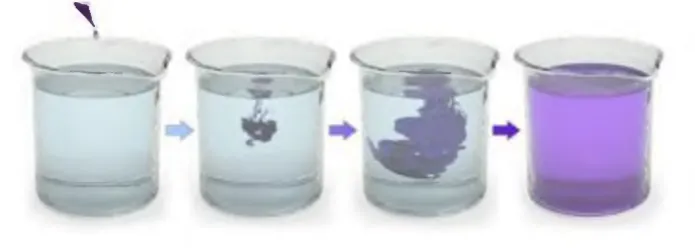
Another example o f transport phenomena also can be found in fabric manufacturing industry. In order to get the desired colour to dye the fabric, the concentrated colour dye is poured into a solvent. The mixing reaction between the liquid dye and the solvent involves diffusion process. At some point, the dye will stop spreading when its concentration is the same within the solvent or in other words, there is no more concentration gradient. These processes are illustrated in Figure 1.1.
\
F igure 1.1 Example o f transport phenomena involving diffusion process.
3
1.2 Statem ent of th e Problem
In the subject o f transport phenomena, the transport process is full of uncertainty when it comes to real life examples in many industrial applications such as reactor design, multiphase flows in furnaces and heat exchangers, design o f better inkjet printers, and grain fumigation in the silo. However, the conventional engineering methods through field experiments to investigate these uncertainties involve a very high cost. Thus, an alternative way is being considered in wide range o f research area. Mathematical modelling is one o f such alternative to experimental method.
Among many applications, the transport phenomena o f solute mass distribution is an example o f advection-diffusion transport process which can be studied by mathematical modelling, either by analytical or numerical approach. Hence, this work o f solute mass transport process analysis is initiated to contribute to the subject o f the transport phenomena. The one-dimensional advection-diffusion equation o f solute mass transport is considered to be solved by both analytical approach and numerical simulation.
1.3 O bjectives of the Study
The following are list o f objectives defined for this study:
4
ii. To perform numerical simulation for the one-dimensional advection-diffusion equation by using ANSYS Fluent software.
iii. To verify results o f the numerical simulation against the analytical solution for one-dimensional problem o f the advection-diffusion equation.
1.4 Scopes of the Study
The transport phenomena o f phosphine gas particularly in grain fumigation application is considered to be studied. This transport process consists o f both advection and diffusion reactions. Only movement o f phosphine gas or its concentration (in terms of mass fraction) distribution in one-dimensional problem is considered. The transport model is partly adapted from grain fumigation application in the silo which it is assumed free from the grain and fully filled with air. This model is solved by both analytical and numerical works. The computational programming tool in MATLAB software is used to demonstrate the result o f analytical work. On the other hand, ANSYS Fluent software is used to perform the numerical simulation. Then, the results from both works are compared for verification.
1.5 Significance of the Study
5
as an alternative approach to conventional engineering method which is normally very costly. This study is expected to contribute to the answer o f those uncertainties so that the outcomes can be useful in the wide range o f related applications in various industries. In addition, this study is expected to encourage the academic community to explore further on the mathematical approach which can be applied in various phenomena o f transport and fluid dynamics.
1.6 D issertation O utline
This dissertation is structured in six chapters. Chapter 1 which consists o f six sections, introduces the study frameworks. First section describes a brief background o f this study. The second section explains the statement o f problem, followed by a list o f the objectives for this study. Scopes o f the study are presented in the following section and significance o f the study is described in the second last section. Lastly, in this section, the contents o f this dissertation is briefly explained.
In Chapter 2, the literature review from previous and current researches are discussed. The advection-diffusion equation is introduced as a governing equation in transport phenomena and its principle o f mass conservation and Fick’s Law will be discussed in details. Subsequently, a brief background o f the numerical simulation is discussed.
6
meshing, setup and solution procedures o f ANSYS Fluent software are shown in Chapter 4.
R E FE R E N C E S
Anderson, Jr., J.D. (1995). Computational Fluid Dynamics, The Basics with Applications. (International Editions). Singapore: McGraw-Hill, Inc.
ANSYS (2013). A N SYS Fluent Theory Guide. SAS IP, Inc.
Beard, D.A., and Bassingthwaighte, J.B. (2001). Modeling Advection and Diffusion o f Oxygen in Complex Vascular Networks. Annals o f Biomedical Engineering. 29(4), 298 - 310. Kluwer Academic Publishers - Plenum Publishers.
Bird, R.B., Stewart, W.E., and Lightfoot, E.N. (2007). Transport Phenomena. (2nd Edition). New York: John Wiley & Sons, Inc.
Ferziger, J.H., and Peric, M. (2002). Computational Methods fo r Fluid Dynamics. (3rd Edition). New York: Springer-Verlag Berlin Heidelberg.
Feynman R.P., Leighton R.B., and Sands M. (2005). The Feynman Lectures on Physics, Volume II: Mainly Electromagnetism and Matter. (The New Millennium Edition). New York: Basic Books.
85
Holzbecher, E. (2007). Environmental M odelling using Matlab. New York: Springer- Verlag Berlin Heidelberg.
Lebowitz, J.L., and Spohn, H.J. (1982). Microscopic Basis for Fick's Law for Self Diffusion. Journal o f Statistical Physics. 28(3), 539 - 556. Kluwer Academic Publishers - Plenum Publishers.
Mat Isa, Z. (2014). M athematical Modelling o f Fumigant Transport in Stored Grain. Mathematical Sciences School, Queensland University o f Technology.
Moukalled, F., Mangani, L., and Darwish, M. (2016). The Finite Volume M ethod in Computational Fluid Dynamics. New York: Springer International Publishing Switzerland.
Ogata, A., and Banks, R.B. (1961). A Solution o f the Differential Eequation of Logitudinal Dispersion in Porous Media. U.S. Geological Survey Professional Papers. 411-A, A1-A7. United States Government Printing Office.
Peairs, F. B. (2010, August). Insect Damage to Farm-Stored Grain. Colorado State University Extension. Retrieved from http://www.ext.colostate.edu
Quarteroni, A., Veneziani, A., and Zunino, P. (2001). Mathematical and Numerical Modeling o f Solute Dynamics in Blood Flow and Arterial Walls. SIAM Journal on Numerical Analysis. 39(5), 1488 - 1511. Society for Industrial and Applied Mathematics.
Sholberg, P., Shepard, T., and Moyls, L. (2003). Monitoring Acetic Acid Vapour Concentrations During Fumigation o f Fruit for Control o f Post Harvest Decay. Canadian Biosystems Engineering. 45, 3.13-3.17. Pacific Agri-Food Research Centre.
Smith, E.A., and Jayas, D.S. (2004). Air Traverse Time in Grain Bins. Applied Mathematical Modelling. 28(12), 1047-1062. Elsevier.
86
van Genuchten, M.Th., and Alves, W.J. (1982). Analytical Solutions o f the One Dimensional Convective-Dispersive Solute Transport Equation. Technical Bulletin No. 1661, 151 p. Agriculture Research Service, United States Department of Agriculture.
Versteeg, H., and Malalasekera, W. (2007). An Introduction to Computational Fluid Dynamics, The Finite Volume Method. (2nd Edition). England: Pearson Education Limited.
Voller, V.R., and Brent, A.D. (1989). The M odelling o f Heat, Mass and Solute Transport in Solidification Systems. International Journal o f Heat and Mass Transfer. 32(9), 1719 - 1731. Elsevier.