Over the past two decades, several new K-12 mathematics curricula have been developed. The question asked by many researchers, administrators, and policy-makers is: “Do these materials work?” This question has led to research on curricular effectiveness and, more specifically, on teachers’ implementations of the curricula. Teachers often transform curricula into a form completely different from the authors’ original intentions. One possible explanation for this transformation is teachers’ conceptions.
To address these issues, the purpose of this study is to examine teachers’ implementation of a mathematical decision-making [MDM] curriculum and how their conceptions influence this implementation. To evaluate the implementation of this
curriculum, a mixed methods study was employed. First, observations and teacher logs were used to examine teachers’ implementation of the curriculum. Second, interviews and surveys were utilized to study teachers’ conceptions, and these results were connected to the
observation and teacher logs results, respectively, to determine how teachers’ conceptions related to their implementation of the MDM curriculum. Six teachers participated in the qualitative portion of the study (observations and interviews), 13 teachers completed at least one teacher log, and 18 teachers completed the survey.
teachers tended to be faithful to the authors’ mathematical and pedagogical intentions. According to the results from the teacher logs, most teachers implemented the MDM curriculum as the authors intended, but there was variety within and among teachers. From this mixed methods study, four types of implementers were identified: (a) thorough piloting teachers, (b) adopting but adapting content teachers, (c) adopting but adapting pedagogy teachers, and (d) partial piloting teachers.
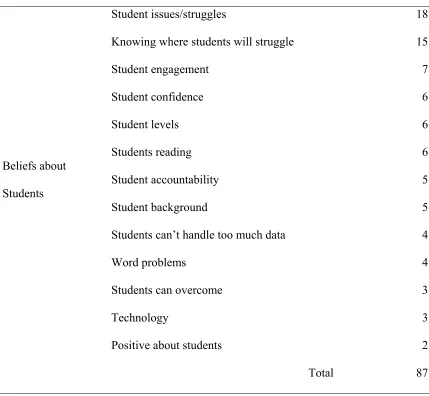
The qualitative and quantitative results showed how teachers’ conceptions may influence their implementation of the MDM curriculum. From the six cases, teachers’ beliefs about teaching and beliefs about students were the conceptions that most consistently
influenced their implementations of the curriculum, but teachers’ beliefs about the MDM curriculum and their subject matter knowledge also influenced their implementations. According to the quantitative results, teachers’ beliefs about math and beliefs about students were significantly correlated with their levels of implementation fidelity of the MDM curriculum.
by
Krista Anne Holstein
A dissertation submitted to the Graduate Faculty of North Carolina State University
in partial fulfillment of the requirements for the degree of
Doctor of Philosophy
Mathematics Education
Raleigh, North Carolina 2012
APPROVED BY:
_______________________________ _______________________________
Hollylynne Lee Allison McCulloch
_______________________________ _______________________________
Michael Singer Robert Young
________________________________ Karen Allen Keene
DEDICATION
BIOGRAPHY
Krista Anne Holstein was born on October 3, 1981 in New Jersey. She grew up and went to Kindergarten through 12th grade in Jackson, NJ. She received her bachelor’s degree in
Mathematics Education at Towson University in Towson, Maryland in May, 2004. Then, she taught high school mathematics in Point Pleasant, New Jersey for two years. She enrolled in the Mathematics graduate program at North Carolina State University in Raleigh, North Carolina in August, 2006 and received her master’s degree in May, 2008. Then, she enrolled in the Mathematics Education doctoral program at North Carolina State University. During this time, she worked as a research graduate assistant, completed a number courses and internships, published papers, and attended several research conferences. Her research focused on enacted curriculum, but she also studied inquiry-oriented differentiation
ACKNOWLEDGMENTS
I would like to thank my advisor and mentor, Dr. Karen Allen Keene, for her guidance and advice. Her support and knowledge guided me through my doctoral program and research, helping me to overcome difficulties and challenges.
I would like to thank my committee members: Hollylynne Lee, Allison McCulloch, Michael Singer, and Robert Young. Their continued support and advice helped me throughout the period of my doctoral studies.
I would also like to thank my fellow graduate students in Mathematics Education and my fellow authors and researchers on the MINDSET project. In particular, Richelle Dietz supported and pushed me as a teacher and researcher over the past four years. I greatly appreciate her friendship.
TABLE OF CONTENTS
LIST OF TABLES ... xii
LIST OF FIGURES ... xiv
CHAPTER ONE: INTRODUCTION ...1
Implementation Fidelity and Teachers’ Conceptions ...2
The MDM Curriculum ...3
Purpose of the Study and Research Questions ...4
Definition of Terms ...6
Overview of Methodological Approach ...6
Significance of the Study ...11
Chapter Summary and Organization of the Study ...13
CHAPTER TWO: LITERATURE REVIEW ...15
Definition of Curriculum ...15
Curricular Effectiveness ...16
Implementation of curricula ...19
Implementation fidelity ...20
Criteria for measuring implementation fidelity ...21
Methodologies used to study implementation fidelity ...24
Results of implementation fidelity studies ...26
Results from individual studies ...26
Categories of implementers ...28
Teachers’ Conceptions ...30
Beliefs ...31
Beliefs about mathematics ...31
Beliefs about teaching ...33
Beliefs about students ...35
Beliefs about curricular materials ...36
Teacher knowledge ...38
Subject-matter knowledge ...40
The influence of subject matter knowledge on curricular decisions ...41
Methodologies used to study conceptions ...43
Chapter Summary ...45
CHAPTER THREE: METHODOLOGY ...48
Research Design ...49
Case studies ...53
Site selection and sampling criteria ...54
Data Collection ...60
Teacher logs ...61
Observations ...67
Survey ...72
Beliefs about math ...74
Beliefs about teaching ...75
Beliefs about students ...76
Beliefs about curriculum ...76
Interviews ...78
Semi-structured interviews ...78
Stimulated recall interviews ...80
Data Analysis ...83
Teacher logs ...83
Observations ...86
Survey ...87
Interviews ...89
Beliefs about curriculum ...90
Beliefs about math ...91
Beliefs about students ...93
Beliefs about teaching ...94
Subject matter knowledge ...95
Connection to instructional decisions ...96
Research Validity and Reliability ...97
Authors’ Intentions ...103
Fraud detection ...104
Subjectivity Statement ...105
Ethical Issues ...106
Chapter Summary ...108
CHAPTER FOUR: CASE STUDIES ...111
Terri ...114
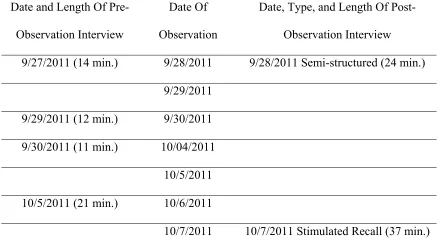
Data collection ...115
Terri’s classroom ...115
Implementation fidelity ...118
Content fidelity ...120
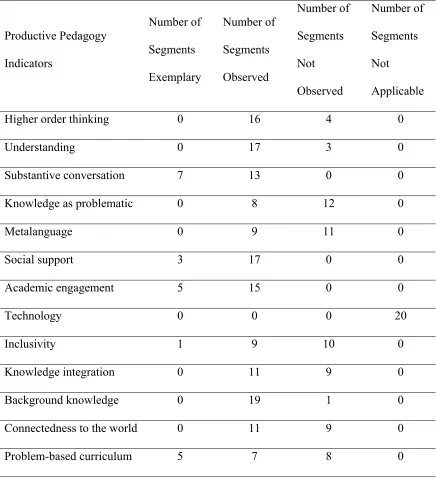
Presentation fidelity ...124
Higher order thinking ...125
Understanding ...126
Substantive conversation ...126
Knowledge as problematic ...127
Metalanguage ...128
Social support ...128
Academic engagement ...129
Technology ...130
Inclusivity ...131
Knowledge integration ...131
Connectedness to the world ...133
Problem-based curriculum ...134
Conceptions related to implementation fidelity ...135
Beliefs about curriculum ...135
Connection to instructional decisions ...140
Beliefs about math ...141
Connection to instructional decisions ...142
Beliefs about students ...143
Connection to instructional decisions ...145
Beliefs about teaching ...145
Connection to instructional decisions ...147
Subject matter knowledge ...148
Conclusions ...151
Kimberly ...152
Data collection ...152
Kimberly’s classroom ...153
Implementation fidelity ...154
Content fidelity ...159
Presentation fidelity ...164
Higher order thinking ...164
Understanding ...165
Substantive conversation ...165
Knowledge as problematic ...166
Metalanguage ...167
Social support ...168
Academic engagement ...168
Technology ...169
Inclusivity ...169
Knowledge integration ...170
Background knowledge ...171
Connectedness to the world ...172
Problem-based curriculum ...173
Conceptions related to implementation fidelity ...174
Beliefs about students ...174
Connection to instructional decisions ...179
Beliefs about teaching ...180
Connection to instructional decisions ...183
Other conceptions ...184
Beliefs about curriculum ...185
Beliefs about math ...185
Subject matter knowledge ...186
Gina ...188
Data collection ...189
Gina’s classroom ...189
Implementation fidelity ...191
Content fidelity ...192
Presentation fidelity ...196
Higher order thinking ...196
Understanding ...197
Substantive conversation ...198
Knowledge as problematic ...199
Metalanguage ...199
Social support ...200
Academic engagement ...200
Technology ...201
Inclusivity ...201
Knowledge integration ...202
Background knowledge ...203
Connectedness to the world ...203
Problem-based curriculum ...204
Conceptions related to implementation fidelity ...205
Beliefs about curriculum ...205
Connection to instructional decisions ...208
Beliefs about students ...209
Connection to instructional decisions ...211
Beliefs about teaching ...212
Connection to instructional decisions ...213
Subject matter knowledge ...215
Connection to instructional decisions ...216
Conclusions ...217
Sharon ...218
Data collection ...219
Sharon’s classroom ...219
Implementation fidelity ...221
Content fidelity ...222
Presentation fidelity ...227
Higher order thinking ...227
Understanding ...228
Substantive conversation ...229
Knowledge as problematic ...229
Metalanguage ...230
Social support ...231
Technology ...232
Inclusivity ...233
Knowledge integration ...233
Background knowledge ...234
Connectedness to the world ...234
Problem-based curriculum ...235
Conceptions related to implementation fidelity ...236
Beliefs about curriculum ...236
Connection to instructional decisions ...243
Beliefs about math ...245
Connection to instructional decisions ...247
Beliefs about students ...247
Connection to instructional decisions ...248
Beliefs about teaching ...252
Connection to instructional decisions ...254
Subject matter knowledge ...256
Connection to instructional decisions ...258
Conclusions ...258
All Four Cases ...259
Implementation fidelity ...260
Content fidelity ...260
Presentation fidelity ...261
Conceptions related to implementation fidelity ...263
Beliefs about curriculum ...263
Beliefs about math ...265
Beliefs about students ...266
Beliefs about teaching ...268
Subject matter knowledge ...271
Cross-case analysis: Terri and Kimberly ...273
Implementation fidelity ...273
Conceptions related to implementation fidelity ...276
Cross-case analysis: Gina and Sharon ...277
Implementation fidelity ...277
Conceptions related to implementation fidelity ...279
Chapter Summary ...280
CHAPTER FIVE: TEACHER LOG AND SURVEY RESULTS ...283
Implementation Fidelity ...283
Results from one teacher ...285
The Lego problem ...286
Mathematical adherence and focus scores ...286
Pedagogical adherence and focus scores ...288
Mathematical adherence and focus scores ...289
Pedagogical adherence and focus scores ...291
Overall results ...293
Correlations with the lesson log scores ...296
Overall results by log ...301
Teacher log results for case-study teachers ...303
Terri ...304
Kimberly ...306
Gina ...306
Sharon ...306
Conclusions from the teacher log analysis ...307
Conceptions Related to Implementation Fidelity ...308
Significant results ...312
Other notable results ...312
Conclusion ...314
CHAPTER SIX: DISCUSSION AND CONCLUSIONS ...315
Discussion of Key Findings ...316
Implementation fidelity ...317
Categories of implementers ...317
Comparison of the types of implementation fidelity ...324
Conceptions related to implementation fidelity ...327
Beliefs about curriculum ...327
Beliefs about math ...328
Beliefs about students ...329
Beliefs about teaching ...330
Subject matter knowledge ...331
Comparison of the two methodologies ...332
Limitations ...335
Implications ...337
Curriculum developers ...337
Teacher professional developers ...338
Educational researchers ...339
Teacher logs ...339
Stimulated recall interviews ...343
Recommendations for Future Research ...345
Closing Remarks ...349
REFERENCES ...352
APPENDICES ...365
Appendix A: Portions of the MDM Curriculum ...366
Appendix B. Teacher Logs ...426
Appendix C. Observation Protocol ...514
Appendix E. Survey Organized by Construct ...529
Appendix F. Pre-Observation Interview Protocol ...535
Appendix G. Post-Observation Semi-Structured Interview Protocol ...536
Appendix H. Post-Observation Stimulated Recall Interview Protocol ...538
Appendix I. Interview Codes and Descriptions ...539
LIST OF TABLES
Table 1.1: Overview of the Dissertation Study ...10
Table 3.1: Overview of the Dissertation Study ...51
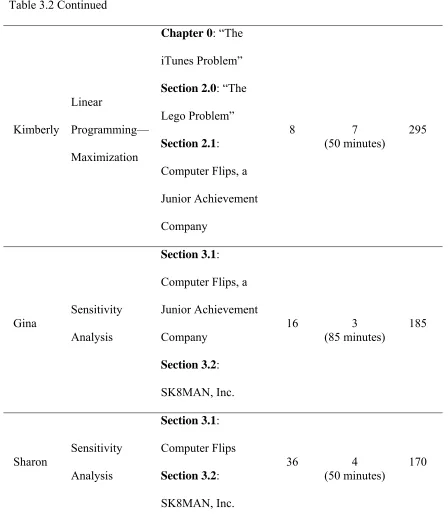
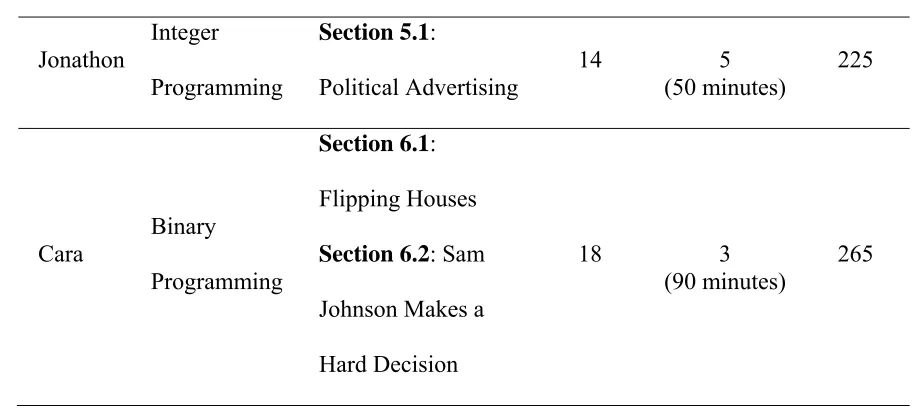
Table 3.2: Case-Study Teachers ...58
Table 3.3: List of Teacher Logs ...62
Table 3.4: Items and Codes from a Teacher Log ...66
Table 3.5: Productive Pedagogies Rating ...70
Table 3.6: Correlation Coefficients ...90
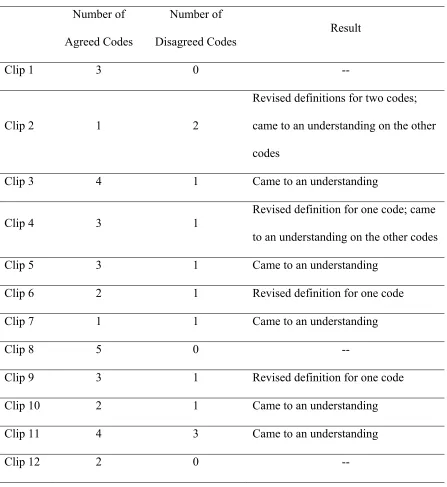
Table 3.7: Inter-Rater Reliability Results ...100
Table 3.8: Consistency Scores from Teacher Logs ...103
Table 4.1: Data Collection Details for Terri ...116
Table 4.2: Terri’s Content Fidelity Results by Number of Segments ...119
Table 4.3: Terri’s Content Fidelity Results by Time (in Minutes) ...119
Table 4.4: Terri’s Presentation Fidelity Results by Number of Segments ...121
Table 4.5: Terri’s Presentation Fidelity Results by Time (in Minutes) ...122
Table 4.6: Terri’s Interview Codes ...136
Table 4.7: Data Collection Details for Kimberly ...153
Table 4.8: Kimberly’s Content Fidelity Results by Number of Segments ...155
Table 4.9: Kimberly’s Content Fidelity Results by Time (in Minutes) ...155
Table 4.10: Kimberly’s Presentation Fidelity Results by Number of Segments ...157
Table 4.11: Kimberly’s Presentation Fidelity Results by Time (in Minutes) ...158
Table 4.12: Kimberly’s Content Fidelity Results without the SAT Warm-Up Segments ....159
Table 4.13: Kimberly’s Content Fidelity Results by Time (in Minutes) without the SAT Warm-Up Segments ...159
Table 4.14: Kimberly’s Presentation Fidelity Results without the SAT Warm-Up Segments ...160
Table 4.15: Kimberly’s Presentation Fidelity Results by Time (in Minutes) without the SAT Warm-Up Segments ...161
Table 4.16: Kimberly’s Interview Codes ...175
Table 4.17: Data Collection Details for Gina ...190
Table 4.18: Gina’s Content Fidelity Results by Number of Segments ...192
Table 4.19: Gina’s Content Fidelity Results by Time (in Minutes) ...192
Table 4.20: Gina’s Presentation Fidelity Results by Number of Segments ...193
Table 4.21: Gina’s Presentation Fidelity Results by Time (in Minutes) ...194
Table 4.22: Gina’s Interview Codes ...206
Table 4.23: Data Collection Details for Sharon ...220
Table 4.24: Sharon’s Content Fidelity Results by Number of Segments ...222
Table 4.25: Sharon’s Content Fidelity Results by Time (in Minutes) ...222
Table 4.26: Sharon’s Presentation Fidelity Results by Number of Segments ...223
Table 4.27: Sharon’s Presentation Fidelity Results by Time (in Minutes) ...224
Table 4.29: Presentation Fidelity Results ...262
Table 4.30: Beliefs about Curriculum ...264
Table 4.31: Beliefs about Students ...267
Table 4.32: Beliefs about Teaching ...270
Table 4.33: Subject Matter Knowledge ...272
Table 5.1: Daniel’s Teacher Log Results ...286
Table 5.2: Overall Teacher Log Results ...294
Table 5.3: Spearman Rank Order Correlation Matrix for Teacher Log Data ...297
Table 5.4: Teacher Log Results by Section ...302
Table 5.5: Teacher Log Results for Case-Study Teachers ...304
Table 5.6: Overall Results from Survey ...310
LIST OF FIGURES
Figure 1.1: Definition of terms ...7
Figure 1.2: Overview of the dissertation study ...9
Figure 2.1: Primary and secondary components of mathematics curriculum evaluation (NRC, 2004, p. 40) ...18
Figure 2.2: Temporal phases of curriculum use (Stein et al., 2007, p. 322) ...20
Figure 3.1: Overview of the dissertation study ...50
Figure 3.2: Vocabulary of research design ...52
Figure 4.1: Example of a linear programming problem from an outside resource ...123
Figure 5.1: Graph of the relationship between the adherence scores ...299
Figure 5.2: Graph of the relationship between the focus scores ...300
Chapter One: Introduction
Curricula play an important role in current educational practices. They influence assessments and administrative mandates in addition to teachers’ instructional decisions. Many new curricula were developed over the past two decades, and undoubtedly, it is
important for decision makers to know how effective these new curricular are, for whom they are effective, and under what conditions they are effective (National Research Council
[NRC], 2004). As a consequence, a committee was charged by the NRC to determine the quality of curriculum evaluations. In their report, On Evaluating Curricular Effectiveness (NRC, 2004), the committee described the framework they developed for curriculum evaluators. They explained,
The framework has three major components that should be examined in each curriculum evaluation: (1) the program materials and design principles; (2) the quality, extent, and means of curricular implementation; and (3) the quality, breadth, type, and distribution of outcomes of student learning over time. (p. 4)
In this study, I focused on the second component: “the quality, extent, and means of curricular implementation” (p. 4). In particular, I examined teachers’ implementations of a new, innovative curriculum (described below) and how teachers’ conceptions influence this implementation.
under what conditions it is effective” (p. 1). When determining curricular effectiveness, one important part to consider is teachers’ faithfulness to the curriculum authors’ intents. If teachers do not implement the materials as the authors intended, they could undermine the effectiveness of the new research-based curriculum. Kilpatrick (2003) noted,
Two classrooms in which the same curriculum is supposedly being ‘implemented’ may look very different; the activities of teacher and students in each room may be quite dissimilar, with different learning opportunities available, different
mathematical ideas under consideration and different outcomes achieved. (p. 473) Due to the varying conditions across schools and teachers, there is a need for curriculum evaluators to measure teachers’ fidelity of curriculum implementation. Researchers must consider whether the curriculum could “survive or thrive” across sites (NRC, 2004, p. 114). That is, they must consider teachers’ implementation fidelity.
Implementation Fidelity and Teachers Conceptions
determine curricular effectiveness.
The recent research on implementation fidelity emerged partly because teachers often transform the written curriculum into a form completely different from the authors’ original intentions. One may ask, “Why does this transformation occur?” Many researchers found that teachers’ conceptions (e.g., about math, teaching, students, or curricula) influence their instructional decisions (e.g., Arbaugh, Lannin, Jones, & Park-Rogers, 2006; Manouchehri & Goodman, 1998; Smith Senger, 1998; Stipek, Givvin, Salmon, & MacGyvers, 2001;
Thompson, 1984). Therefore, when examining implementation fidelity, it is important to consider teachers’ conceptions. I use the word “conception” in the way Lloyd and Wilson (1998) used it: “to refer to a person’s general mental structures that encompass knowledge, beliefs, understandings, preferences, and views” (p. 249).
The MDM Curriculum
The curriculum in the present study is a result of a five-year NSF-funded project called MINDSET (Mathematics INstruction using Decision Science and Engineering Tools). The emphasis of this curriculum is on decision-making using mathematical models based on engineering concepts (Young, Keene, Norwood, Chelst, Edwards, & Pugalee, 2012). Thus, the curriculum has been titled the “Mathematical Decision-Making” [MDM] curriculum. The MDM curriculum is intended for high school seniors who have completed two years of algebra and one year of geometry. The content consists of contextual problems that employ multi-step problem-solving tools and result in multiple solutions that require interpretation.
planning, probability distributions, quality control, and queuing theory. Each topic is
presented using real-life problems from business, government, or students’ lives. Portions of the curriculum that are specifically discussed in this paper are given in Appendix A. In particular, this appendix includes Section 2.0.1 (“The Lego Problem”), Section 2.1
(Computer Flips, a Junior Achievement Company), Section 2.2 (SK8MAN, Inc.), Section 3.1 (Computer Flips, a Junior Achievement Company), and Section 3.2 (SK8MAN, Inc.). These sections came from Chapter 2 (Linear Programming—Maximization), which focuses on exploring and solving linear programming problems using graphing and Microsoft Excel, and Chapter 3 (Sensitivity Analysis), which focuses on interpreting and analyzing linear
programming problem formulations and solutions.
At the time of this study, these materials were still in draft form. However, teachers throughout North Carolina, Michigan, and other states were piloting portions of the MDM curriculum. The teachers in the present study came from this group of piloting teachers.
Also at the time of this study, this new innovative curriculum was in the process of being adopted in several states. However, like other new curricula, people (such as
researchers, policy makers, teachers, parents, and administrators) began to wonder, “Do these materials work?” Therefore, this curriculum needed to be evaluated. One component of effective curriculum evaluation studies is the implementation component (NRC, 2004). This study examines the implementation component of the MDM curriculum.
Purpose of the Study and Research Questions
curriculum and how their conceptions influence this implementation. In particular, I studied how closely teachers’ enacted curriculum aligned with the authors’ intended curriculum. I also investigated what conceptions teachers held that brought their enacted curriculum closer or farther from the authors’ intended curriculum. The particular conceptions I considered were teachers’ (a) subject matter knowledge, (b) beliefs about mathematics, (c) beliefs about students, (d) beliefs about teaching, and (e) beliefs about curricular materials. I acknowledge that these are not the only conceptions that influence teachers’ curricular decisions; however, these were the only ones I considered in this study. Furthermore, I acknowledge that these conceptions could be studied in many subject areas as well as in more general educational research, but they were examined only in the context of the mathematics classroom.
I drew upon research that investigated implementation fidelity as well as research that looked at how teachers’ conceptions affected their implementation fidelity. Then, I extended this research to consider teachers’ implementation and conceptions within the context of a mathematical decision-making curriculum. In particular, I answered the following questions: 1. How do teachers’ implementations of a mathematical decision-making curriculum align
with the authors’ intentions?
2. How do teachers’ conceptions influence their implementations of a mathematical decision-making curriculum?
b. How do teachers’ beliefs about mathematics, students, teaching, and curricular materials influence their implementations of a mathematical decision-making curriculum?
Definition of Terms
In order to answer these questions, some definitions are needed. Figure 1.1 presents the definitions for important terms in this study.
Overview of Methodological Approach
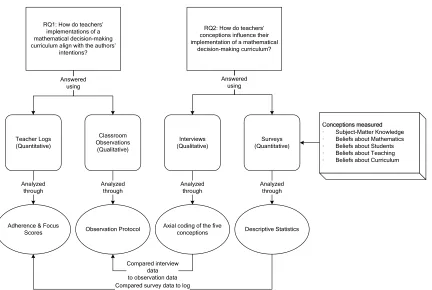
I used a mixed methods design to answer the two research questions (see Figure 1.2 and Table 1.1). To answer the first research question (How do teachers’ implementations of a mathematical decision-making curriculum align with the authors’ intentions?), teacher logs and classroom observations were used.
The teacher logs were adapted from the work done by Heck, Chval, Weiss, and Ziebarth (2012). In these logs, I provided teachers with a list of possible curricular choices they may make. These choices may or may not align with the curriculum authors’
Implementation Fidelity: “The extent to which a teacher implements a curriculum as the author intended, allowing for adaptation, supplementation, and improvisation by the teacher” (Holstein, et al., 2010, p. 2)
Curriculum: “A curriculum consists of a set of materials for use at each grade level, a set of teacher guides, and accompanying classroom assessments. It may include a listing of prescribed or preferred classroom manipulatives or technologies, materials for
parents, homework, booklets, and so forth. [Curricula] usually include a listing or mapping of the curricular objectives addressed in the materials in relation to national, state, or local standards or curricular frameworks” (NRC, 2004, pp. 38-39)
Written Curriculum: The curricular materials themselves; this can be thought of as the authors’ intended curriculum
Intended Curriculum: The teachers’ instructional plan Enacted Curriculum: The actual lesson that was carried out
Beliefs: “Psychologically held understandings, premises, or propositions about the world that are thought to be true… Beliefs might be thought of as lenses that affect one’s view of some aspect of the world or as dispositions toward action. Beliefs… may be held with varying degrees of conviction and are consensual” (Philipp, 2007, p. 259) Subject Matter Knowledge: This includes knowledge of mathematics and knowledge about mathematics. “Propositional and procedural knowledge of mathematics—that is, understandings of particular topics (e.g., fractions and trigonometry), procedures, (e.g., long division and factoring quadratic equations), and concepts (e.g., quadrilaterals and infinity), and the relationships among these topics, procedures, and concepts… Another critical dimension… is knowledge about mathematics. This includes understandings about the nature of knowledge in the discipline—where it comes from, how it changes, and how truth is established. Knowledge about mathematics also includes what it means to ‘know’ and ‘do’ mathematics, the relative centrality of different ideas, as well as what is arbitrary or conventional versus what is necessary or logical, and a sense of the philosophical debates within the discipline” (Ball, 1988, p. 6)
Figure 1.1. Definition of terms.
these segments. Examples of items on the protocol included: (a) encouraging deep
understanding and academic engagement in the students, (b) asking students to reflect and interpret results, and (c) incorporating real-world contexts into the lesson.
To answer the second research question (How do teachers’ conceptions influence their implementations of a mathematical decision-making curriculum?), I utilized surveys and interviews. The survey included items assessing teachers’ subject matter knowledge as well as items examining their beliefs about mathematics, students, teaching, and curricula. Teachers received scores for each construct on the survey, and these scores were correlated with teachers’ responses on the teacher logs to determine any connections between teachers’ implementation fidelity and their conceptions. Like the teacher logs, I distributed the surveys to all MDM teachers (N ≈ 200); 18 teachers completed the survey, but only 12 of these teachers also completed at least one teacher log.
RQ2: How do teachers’ conceptions influence their implementation of a mathematical
decision-making curriculum? Surveys (Quantitative) Descriptive Statistics Analyzed through Answered using RQ1: How do teachers’
implementations of a mathematical decision-making curriculum align with the authors’
intentions? Teacher Logs (Quantitative) Classroom Observations (Qualitative)
Adherence & Focus
Scores Observation Protocol Analyzed through Analyzed through Answered using Interviews (Qualitative)
Axial coding of the five conceptions
Analyzed through
Compared interview data to observation data Compared survey data to log
data
· Subject-Matter Knowledge · Beliefs about Mathematics · Beliefs about Students · Beliefs about Teaching · Beliefs about Curriculum
Figure 1.2. Overview of the dissertation study.
Table 1.1
Overview of the Dissertation Study
Methodology Sample Instruments Data Analysis
Research Question 1: How do teachers’ implementations of a mathematical decision-making curriculum align with the authors’ intentions?
Observations Qualitative Six MDM teachers One observation protocol Completed observation protocol for all lesson
segments
Teacher
Logs Quantitative
13 MDM teachers
16 logs
(Approximately three logs per chapter)
Adherence & Focus scores
Research Question 2: How do teachers’ conceptions influence their implementations of a mathematical decision-making curriculum?
Interviews Qualitative Six MDM teachers
Three interview protocols
Note that when discussing teachers’ beliefs in the qualitative and quantitative results, I refer to “positive” and “negative” beliefs. These terms were not a judgment of the teacher or his/her beliefs but were, instead, a way to provide directionality to the beliefs. Beliefs that were labeled “positive” included beliefs that (a) were child-centered (Perry, Howard, & Tracey, 1999), (b) were nontraditional, and/or (c) aligned with the MDM authors’ intentions. For example, a “positive” belief about math could be viewing math as the dynamic searching for order and pattern in the learner's environment (Perry et al., 1999). A “positive” belief about students could be “Most of my students like doing math” (Fennema & Sherman, 1976; Suinn, 1988). Beliefs that were labeled “negative” included beliefs that (a) were
transmission-oriented (Perry et al., 1999), (b) were traditional, and/or (c) did not align with the MDM authors’ intentions. For example, a “negative” belief about math could be thinking that right answers were more important in mathematics than the ways in which you get them (Perry et al., 1999). A “negative” belief about students could be “Most of my students don’t feel they want to be good math students” (Fennema & Sherman, 1976; Suinn, 1988).
Significance of the Study
Furthermore, most researchers who have studied enacted curricula tended to focus on materials based on the National Council for Teachers of Mathematics [NCTM] Standards (NCTM, 1989, 2000), often called standards-based curricula. However, the MDM curriculum was not written based on the NCTM Standards, although many of its tenets align. Therefore, this study extends the literature on enacted curricula to include curricula not based on the NCTM Standards.
Moreover, the methodology used in this study is significant. The teacher logs that I used to measure teachers’ implementation fidelity are innovative. The idea for these logs was developed through a partnership between the Center for the Study of Mathematics
Curriculum [CSMC] and Horizon Research, Inc. [HRI]. Researchers from these two centers came together to develop an instrument that could accurately give a picture of a teacher’s enacted curricula without an observer having to step foot in the classroom (Heck et al., 2012). At this point, few, if any, studies have used these logs.
In summary, this study adds to the current literature on enacted curricula in three ways: (a) studying the curricular effectiveness of a new, innovative, non-standards-based curriculum, (b) using the innovative teacher logs to examine implementation fidelity, and (c) utilizing stimulated response interviews to study teachers’ conceptions related to their implementation fidelity.
Chapter Summary and Organization of the Study
The NRC committee (2004) made a call to curriculum evaluators to study
implementations of curricula. In the present study, I investigated teachers’ implementations of a mathematical decision-making curriculum and how their conceptions influenced this implementation. I studied implementations through observations and teacher logs; I studied conceptions through interviews and surveys.
In the following chapter, I present the literature that influenced this study. In particular, I discuss research on enacted curricula and implementation fidelity as well as literature on teachers’ conceptions and how these conceptions may influence teachers’ instructional decisions. Throughout the chapter, past research is connected to the current study.
In the fourth chapter, I present the results from the qualitative portion of the study, which included the observations and interviews. Although six teachers participated in this portion of the study, the results from only four teachers are presented. These four teachers provided a representation of the six teachers and allowed for a comparison of how the curriculum could be implemented and how conceptions influence this implementation.
The fifth chapter gives the results from the quantitative portion of the study, which included the teacher logs and the survey. First, I present the results from one teacher’s logs to show how they were scored. Second, I present the results from all the teacher logs. Third, I present the results from researcher-completed logs for the four case-study teachers. Fourth, I present the correlations between the survey results, which showed teachers’ conceptions, and the teacher logs results, which showed teachers’ implementation fidelity levels.
Chapter Two: Literature Review
Over the past several years, researchers have evaluated how closely teachers’ enacted curriculum aligns with the authors’ intended curriculum (e.g., Lloyd, 1999; Lloyd & Wilson, 1998; Remillard, 1999; Remillard & Bryans, 2004; Schoen et al., 2003; Tarr, et al., 2008). Often, teachers transform the written curriculum into a form completely different from the authors’ original intentions. Why does this transformation occur? What conceptions do teachers hold that influence their implementations of a curriculum?
In this literature review, I synthesize the research on curriculum implementation and how teachers’ conceptions influence this implementation, where the word “conception” refers to “a person’s general mental structures that encompass knowledge, beliefs, understandings, preferences, and views” (Lloyd & Wilson, 1998, p. 249). I draw upon research that examines (a) fidelity of implementation, (b) teachers’ conceptions, and (c) the connection between teachers’ conceptions and their fidelity of implementation. Throughout the chapter, I connect the literature to the mathematical decision-making [MDM] curriculum and the present study.
Definition of Curriculum
To begin, a definition for curriculum needs to be given. I use the term “curriculum” in the way given in the National Research Council [NRC] report, On Evaluating Curricular Effectiveness (NRC, 2004):
prescribed or preferred classroom manipulatives or technologies, materials for parents, homework, booklets, and so forth. [Curricula] usually include a listing or mapping of the curricular objectives addressed in the materials in relation to national, state, or local standards or curricular frameworks. (pp. 38-39)
Some researchers mention frameworks (Cohen, 1990; Heaton, 1992), syllabi (Cavanagh, 2006), or standards (King et al., 2011) as outlines or objectives that teachers are expected to follow. In this paper, the term “curriculum” includes such frameworks, syllabi, and standards as well as textbook materials.
The specific curriculum in this study was the MDM curriculum, which includes the types of materials described in the NRC’s (2004) definition. There was a soft-bound textbook that was meant for students’ use. On the website for the MDM curriculum, teachers were provided with (a) a teachers’ version of this textbook, which included answers to in-text questions and occasional teacher notes to help in their implementation of the materials, (b) answers to homework problems, and (c) materials from the summer workshops, such as PowerPoint presentations and hand-outs. The textbook and all the materials on the website made up the MDM curriculum.
Curricular Effectiveness
Standards, the National Science Foundation [NSF] provided extensive funding for
curriculum development projects. In this paper, I refer to these materials as “standards-based curricula,” but they are often known as “reform curricula” or “NSF-funded curricula.” With the development of these conceptually-oriented materials, researchers, policy makers, administrators, and teachers began asking the question, “Do these new materials work?” (Stein, Remillard, & Smith, 2007). Confrey and Maloney (2011) argued that the more appropriate questions are, “What works, for whom, and under what conditions?” (p. 2). That is, researchers must look beyond student performance and consider other factors, such as the content in the materials themselves and the extent to which teachers implement the
curriculum as intended by the authors (NRC, 2004).
Therefore, curricular effectiveness is defined as “how effective a particular
behin which signif comp Comp inclu MDM invol Figur
nd the enactm h referred to ficant forces Scientific ponents of th ponents” pie de the other M curriculum
lved with cur
re 2.1. Prima
ment of a cur o factors that
s on impleme ally valid ev his framewor ece of the fra components m. Thus, the
rricular impl
ary and seco
rricular inno t may emerg entation” (p. valuation stu rk. In the pre amework, wi s of this fram
research pre lementation.
ondary comp 2
ovation” (p. 5 e during the . 53). udies on curr
esent study, ith the under mework to de esented in thi
.
ponents of m 2004, p. 40)
52), and (c) course of im
ricular effect I examined t rstanding tha etermine the
is chapter fo
mathematics c . unanticipate mplementati tiveness shou the “Implem at future stud e overall effe ocuses on the
curriculum e
ed influences on “that exe
Implementation of curricula
Many researchers devoted studies to examining the second component of the NRC’s (2004) framework: teachers’ implementations of the curriculum (e.g., Brown, Pitvorec, Ditto, & Kelso, 2009; Huntley, 2009; Tarr et al., 2008). These studies generally examined
standards-based curricula and/or publisher-developed curricula, often comparing the two. There is a lack of research evaluating NSF-funded curricula that were written not based on the NCTM Standards (1989, 2000), such as the MDM curriculum.
One way to study the implementation components of a curriculum is to examine how the curriculum transforms from the written materials to what students actually experience in the classroom. Stein, Remillard, and Smith (2007) provided a framework for studying the transitions of the curriculum from its written form to its enacted form, as shown in Figure 2.2. The curriculum begins as a written curriculum, which refers to the authors’ original printed materials. Then, the curriculum changes into what the teacher intends to teach. This initial transformation occurs due to teachers’ conceptions, knowledge, goals, and contexts, as shown in the oval in Figure 2.2. Next, the curriculum transforms again into the enacted curriculum. Enacted curriculum is defined as “the classroom implementation of curriculum materials” (Enacted Curriculum Conference, 2010). The enacted curriculum is also
curric inten curric as “th for ad 2). In resea resea
culum is effe ded by the c
Figure
Impleme culum use is he extent to w daptation, su n this section archers studie arch.
ective, one m curriculum au
2.2. Tempor
ntation fide s implementa which a teac upplementati n, I discuss w
ed implemen
must study w uthors. Note
ral phases of
elity. One im ation fidelity cher impleme
ion, and imp what research
ntation fideli
whether the t e that this fra
f curriculum
mportant con y. For this pa
ents a curric provisation b h studied reg ity, and then
eacher is usi amework gui
m use (Stein e
cept when st aper, implem culum as the by the teache garding impl n I present so
ing the curri ides the pres
et al., 2007, p
tudying the p mentation fid
author inten er” (Holstein lementation ome of the re
iculum as sent study.
p. 322).
phases of delity is defin
nded, allowin n et al., 2010
fidelity and esults from t
ned ng 0, p.
Criteria for measuring implementation fidelity. Many researchers provided criteria
for measuring implementation fidelity. O’Donnell (2008) reviewed health literature and found five such criteria:
(a) adherence—whether the components of the intervention are being delivered as designed; (b) duration—the number, length, or frequency of sessions implemented; (c) quality of delivery—the manner in which the implementer delivers the program using the techniques, processes, or methods prescribed; (d) participant
responsiveness—the extent to which participants are engaged by and involved in the activities and content of the program; and (e) program differentiation—whether critical features that distinguish the program from the comparison condition are present or absent during implementation. (p. 34)
Mowbray, Holter, Teague, and Bybee (2003) described two criteria for measuring
implementation fidelity in health and education literature: structure and process. O’Donnell (2008) stated the five criteria she listed could be placed within Mowbray et al.’s criteria. Specifically, fidelity to structure includes adherence and duration; fidelity to process includes quality of delivery and program differentiation; and participant responsiveness takes on characteristics of both structure and process.
In the education literature, McNaught, Tarr, and Sears (2010), Huntley (2009), and Heck et al. (2012) discussed criteria for measuring implementation fidelity. First, McNaught et al. (2010) identified two forms of implementation fidelity: content fidelity and presentation fidelity. Content fidelity refers to how much of the curriculum content is covered. McNaught et al. (2010) explained that having high content fidelity consists of “the content being enacted as written in the textbook and the textbook used as the primary source of content for the lesson” (p. 4). Next, presentation fidelity refers to how the curriculum is implemented, where high presentation fidelity consists of “the enacted curriculum being consistent with the
expectations of the authors as expressed in the author interviews and the author philosophy as reflected in the notes and suggestions to teachers in the Teacher’s Edition of the textbook” (p. 4). Second, Huntley (2009) used similar ideas when discussing the types of implementation fidelity. She used the term quantity the way McNaught et al. used content fidelity, and she used quality to refer to presentation fidelity. Third, Heck et al. (2012) discussed the mathematical and pedagogical storylines. The mathematical storyline referred to “which topics are addressed, at what depth different topics are addressed, and/or what learning goals and student expectations are pursued” (p. 3). The pedagogical storyline included “which activities are conducted and how they are conducted in terms of openness or guidance, how students are grouped for instructional activities, and whether the patterns of interaction that are designed are actually pursued” (pp. 4-5).
the curriculum. In this criterion are: structure (Mowbray et al., 2003), adherence and duration (O’Donnell, 2008), content fidelity (McNaught et al., 2010), quantity (Huntley, 2009), and the mathematical storyline (Heck et al., 2012). I refer to this as the content criterion. The second criterion included the pedagogical philosophies of the curriculum authors. In this criterion are: process (Mowbray et al., 2003), quality of delivery and program differentiation (O’Donnell, 2008), presentation fidelity (McNaught et al., 2010), quality (Huntley, 2009), and the pedagogical storyline (Heck et al., 2012). I refer to this as the pedagogical criterion.
In this study, I refer to the criteria used by McNaught et al. (2010) (i.e., content fidelity and presentation fidelity) and by Heck et al. (2012) (i.e., mathematical storyline and pedagogical storyline). Thus, I meet both overarching criteria for measuring implementation fidelity, and I adapt these criteria for the purposes of this study. Huntley (2009) stated, “If we truly want to understand the relationships among textbooks, teaching, and student learning, it is critically important to develop curriculum-sensitive measures of implementation” (p. 357). Therefore, I define both the content and pedagogical criteria for the MDM curriculum.
When studying the pedagogical criterion, many researchers studied implementation fidelity of standards-based curricula; thus, presentation fidelity typically referred to whether a teacher implemented a standards-based learning environment in their classroom (e.g., Tarr et al., 2008). Because the MDM curriculum authors did not expect teachers to create a
standards-based learning environment, the authors chose to derive their expectations from a source other than the NCTM Standards (1989, 2000). Specifically, the authors chose to utilize the Productive Pedagogy framework from the Queensland Department of Education and Training (K. Makar, personal communication, October 7, 2009; The State of
Queensland, 2002) to study the presentation fidelity of the MDM curriculum. This is discussed further in Chapter Three.
Therefore, both criteria for studying implementation fidelity are met in this study, and they are defined appropriately for the purposes of the MDM curriculum.
Methodologies used to study implementation fidelity. As mentioned above, the goal
of similar previous research was to investigate the implementation fidelity of standards-based curricula (e.g. Lloyd, 1999; Remillard & Bryans, 2004; Schoen et al., 2003; Tarr et al., 2008). Thus, these researchers took into account the types of discourse, teaching methods, assessment techniques, and curricular materials expected in a standards-based learning environment.
interviews (e.g., Remillard & Bryans, 2004). Some additional methodologies included homework assignments (e.g., Cai & Moyer, 2006), textbook-use diaries (e.g., Tarr et al., 2008), and table-of-contents records (e.g., Tarr et al., 2008). Researchers used these instruments to measure several categories of implementation fidelity, including use of curriculum, teacher instructional practices, teacher background information, and teacher beliefs. That is, these instruments were used to measure both content fidelity and presentation fidelity.
Although various methodologies were used to study implementation fidelity,
observations were the most common. However, observations are costly, time-consuming, and sometimes unrealistic. Thus, new methodologies need to be created to gather the same type of data in a less expensive and more realistic manner. In this study, I utilized teacher logs, which provided the same type of data as observations would but can be done on a much larger scale. These logs are discussed in further detail in Chapter Three.
Results of implementation fidelity studies. Using these criteria and methodologies,
researchers found that teachers showed a wide range of implementation fidelity when using curricula. Many of these studies examined the connections among the curriculum, teachers’ implementation of the curriculum, and student achievement. However, since I am not studying student achievement in this study, I only report on the results regarding teachers’ implementation fidelity. That is, I discuss literature that studied student achievement, but I report on the implementation fidelity components, not the student achievement results, of these studies. I begin by discuss the results of some individual studies. Then, I present some categories of implementation fidelity.
Crawford, Carpenter, Wilson, Schmeister, and McDonald (2012) and King et al. (2011) performed similar studies of implementation fidelity. Both studies included a content criterion and a pedagogical criterion to study implementation fidelity. Then, they examined the relationships between these types of fidelity and student achievement. They found similar implementation fidelity results as Tarr et al. (2008), although the results they found regarding the relationship between implementation fidelity and student achievement varied amongst the three articles.
Stein and Kaufman (2010) included both the content criterion and the pedagogical criterion in their study of 48 teachers implementing one of two standards-based mathematics curricula (Everyday Mathematics and Investigations). Unlike the previously mentioned studies, Stein and Kaufman did not study student achievement; instead, they focused on the link between the curriculum and instruction. They studied teachers’ implementations of the curricula in terms of maintaining high levels of cognitive demand, attending to student thinking, and vesting intellectual authority in mathematical reasoning. They found that teachers had higher implementation fidelity of the Investigations curriculum than the Everyday Mathematics curriculum. The main reason for this difference was the greater amount of support, in terms of both the written materials and professional development, provided to the teachers of Investigations than to the teachers of Everyday Mathematics.
Categories of implementers. Freeman and colleagues (1983) studied seven elementary teachers implementing a mathematics textbook published in the 1970s. They found four styles of textbook use among these teachers: (a) textbook bound teachers progressed through the textbook, page by page, over the school year, (b) selective omission teachers also
progressed through the textbook, but skipped certain chapters or lessons, (c) the basics teachers implemented lessons from the textbook that focused on certain topics (e.g., addition, subtraction, introductory work with fractions), and (d) management-by-objectives teachers chose lessons that aligned with the district-enforced list of “minimal competencies in mathematics” (p. 260). These results provided a picture of how teachers implemented their textbooks. However, Freeman et al. (1983) only studied the content criterion, not the pedagogical criterion, in their study of teachers’ implementation fidelity.
Lambdin and Preston (1995) collected data from 34 middle school teachers implementing the Connected Mathematics curriculum. They found three “caricatures” of teachers: (a) the frustrated methodologist referred to teachers with strong math backgrounds who were resistant to the pedagogical techniques found in the new curriculum, (b) the teacher on the grow represented teachers with weak math backgrounds who readily and faithfully adopted the content and pedagogy found in the new curriculum, and (c) the
embraced the philosophies of the curriculum authors. In the present study, the MDM teachers volunteered to implement the materials; thus, they already embraced the authors’
philosophies by agreeing to teach the curriculum.
Remillard and Bryans (2004) studied eight elementary teachers implementing the Investigations curriculum. They found three categories of curriculum use: (a) intermittent and narrow use referred to teachers who minimally used the materials, instead utilizing other resources and instructional techniques than those envisioned by the curriculum authors, (b) teachers in the adopting and adapting category used the curriculum to guide the general structure and content of the class, but they drew upon their own strategies and approaches during instruction, and (c) thorough piloting teachers read and used all parts of the
curriculum in their teaching. Like Lambdin and Preston (1995), Remillard and Bryans (2004) included both the content and pedagogical criteria in their study. However, neither Lambdin and Preston’s nor Remillard and Bryan’s categories necessarily allowed for both criteria to be represented. For example, if a teacher followed the content of the curriculum very closely but strayed from the pedagogical intentions, which category would this teacher fall into? Therefore, clearer categories need to be established.
teachers’ conceptions (Stein et al., 2007). These conceptions are discussed further in the following section.
Teachers’ Conceptions
As shown in the oval in Figure 2.2, teachers’ conceptions influence the
transformation from the intended curriculum to the enacted curriculum. Again, I use the word “conception” in the way Lloyd and Wilson (1998) used it: to describe a person’s “general mental structures that encompass knowledge, beliefs, understandings, preferences, and views” (p. 249). In this study, I was particularly interested in the following teacher
conceptions: (a) subject matter knowledge (note that I will imbed the discussion of subject matter knowledge in the larger construct of teacher knowledge), (b) beliefs about
mathematics, (c) beliefs about teaching, (d) beliefs about students, and (e) beliefs about curricular materials. I acknowledge that these are not the only conceptions that may influence teachers’ curricular implementations. However, I chose these because they emerged as
dominant conceptions in implementation fidelity literature (e.g., Collopy, 2003; Manouchehri & Goodman, 1998; Remillard, 1999). Furthermore, these conceptions could easily be
measured through previously validated survey items, which I employed in this study.
Beliefs. First, teachers’ beliefs influence their curricular choices. In this study, I focused on teachers’ beliefs about math, teaching, students, and curricular materials, all in the context of the mathematics classroom. In order to describe where teachers’ beliefs could lie, I relied on the work of Raymond (1997), who studied teachers’ beliefs about (a) the nature of mathematics, (b) mathematics teaching, and (c) mathematics learning. She placed teachers’ beliefs regarding these three constructs on a five-level scale between traditional and nontraditional beliefs, relying heavily on the work of Ernst (as cited in Raymond, 1997). The types of beliefs discussed here can also be viewed along this scale. In each of the following sections, I briefly describe the belief and how it may fall on the tradition-nontraditional continuum. Then, I discuss how each belief may influence curricular choices.
It should be noted that some researchers claim that beliefs influence instruction while others claim that beliefs are the result of practice (Guskey, 1986). Still others think there is a correlation between beliefs and instruction but it is not cause-and-effect in either direction. For example, Thompson (1992) stated, “The relationship between beliefs and practice is a dialectic, not a simple cause-and-effect relationship” (p. 140). Thus, there is not agreement in the field that teachers’ beliefs cause their instructional decisions. However, there is a
relationship between teachers’ beliefs and their curricular choices, as seen in some of the studies mentioned in this section.
Beliefs about mathematics. According to Raymond (1997), a teacher with a
teacher with a nontraditional view of mathematics thinks it is “dynamic, problem driven, and continually expanding [and] can be surprising, relative, doubtful, and aesthetic” (p. 557). Often, teachers’ views about mathematics affect the way they choose to implement curricula. In other words, how teachers view the nature of mathematics, its origins, and its usefulness influence their curricular decisions (Putnam, Heaton, Prawat, & Remillard, 1992; Remillard, 1999).
For instance, teachers may believe mathematics is a set of procedures to solve
problems rather than as a conceptual tool to think deeply (Stipek et al., 2001). Collopy (2003) examined how a teacher who viewed mathematics as a set of procedures made curricular choices. This teacher viewed mathematics “as a hierarchical cannon of rules, facts, and algorithms” (p. 308). Because of this view, the teacher was unable to accept the standards-based curriculum authors’ ideas and eventually went back to using her traditional textbook.
The mathematics in the MDM curriculum is nontraditional. That is, it is not a set of rules and facts; instead, the mathematical content is problem driven, constructed, and problematic. Therefore, nontraditional beliefs about math align with the curriculum authors’ philosophies.
Beliefs about teaching. Next, teachers’ beliefs about teaching may influence their
curricular decisions. Note that I am imbedding beliefs about learning within the beliefs about teaching construct; also note that I discuss this belief specifically in the context of a
mathematics classroom. Raymond (1997) studied both of these types of beliefs and described them according to the tradition-nontraditional scale.
Raymond (1997) explained that a teacher with a traditional view of mathematics teaching tends to lecture, assign individual work, seek correct answers rather than explanations, and focus on memorization of skills and facts. A nontraditional view of mathematics teaching entails guided learning, valuing explanation over answers, problem-solving activities, and cooperative learning. Furthermore, a teacher with a traditional view of mathematics learning believes students passively receive knowledge from the teacher, repeated practice is necessary, and memorization and mastery of algorithms signify learning. A nontraditional view of mathematics learning includes students learning through problem-solving activities, cooperative group interactions, and students actively learning in their own way.
1999). Standards-based materials typically emphasize student exploration, discussion, and conceptual understanding. Therefore, when teachers focus on students getting correct answers rather than understanding mathematical concepts, for example, they may be in conflict with standards-based ideas (Stipek et al., 2001).
Often, teachers use traditional teaching methods when implementing a standards-based curriculum. For example, Cohen (1990) discussed a teacher who believed she had “revolutionized” her classroom by incorporating standards-based practices into it. However, upon further examination, Cohen concluded that the teacher filtered her instruction through a traditional view of teaching. In fact, she used a mélange of nontraditional and traditional materials and practices.
More specifically, some researchers explored the idea of teaching by “telling” (e.g., Putnam et al., 1992). “Telling” is a teaching method that refers to stating facts and
demonstrating procedures (Smith, 1996). This instructional practice conflicts with standards-based ideas of students discovering properties and relationships through open or guided explorations. That is, if students are being told mathematical truths and shown procedures, they are not given the opportunity to explore, conjecture, and justify mathematical ideas. Thus, when teachers’ beliefs about the teaching and learning of mathematics clash with the ideas contained the curriculum, the teachers may be less faithful in their implementation.
activities, group work, and class discussions that focus on predicting, exploring, interpreting, and analyzing.
Beliefs about students. Teachers’ beliefs about students may also influence their
curricular decisions. Again, I discuss this belief within the context of a mathematics classroom. Although Raymond (1997) did not study teachers’ beliefs about students, this construct could also be viewed along the tradition-nontraditional continuum. A traditional view of students could include (a) students cannot learn through group work, (b) it is not important for students to like mathematics, (c) students do not have appropriate background knowledge, or (d) some students are not “ready” for abstract mathematical thinking (Putnam et al., 1992). A nontraditional view of students includes the belief that (a) students can learn conceptual and abstract ideas before learning procedures and (b) it is important for students to have a positive attitude towards mathematics.
Teachers’ beliefs regarding students’ needs and abilities may influence their implementation of a curriculum, as seen in the oval in Figure 2.2. Ball and Cohen (1996) stated,
In Remillard’s work, she found that when implementing a curriculum, teachers read not only the textbook, but they also read the students (Remillard, 1999; Remillard, 2000; Remillard & Bryans, 2004). In other words, teachers make curricular decisions based on observations and interactions with students while they are engaged in mathematical tasks. Therefore, as teachers implement a curriculum, they study the students and make decisions based on those observations. These decisions may or may not conflict with instructional practices contained in the curriculum.
Thompson (1984) considered teachers’ “views about what constituted evidence of mathematical understanding in students” (p. 120). Thompson also looked at how perceptive teachers were regarding students’ needs and difficulties, as well as how concerned teachers were about students’ interest in and attitudes about math. Since a relationship exists between teachers’ perceptions regarding students’ abilities to do mathematics and the teachers’ level of implementation (Arbaugh et al., 2006), the conceptions found by Thompson (1984) are indicators of teachers’ levels of implementation.
The MDM curriculum authors expect students to engage in the materials, work collaboratively, and complete tasks of high cognitive demand. Even if students were not successful in previous courses, the authors believe that students can complete the real-world problem contained in the MDM textbook. Therefore, the MDM curriculum authors’
philosophy aligns with nontraditional beliefs about students.
Beliefs about curricular materials. Lastly, although Raymond (1997) did not discuss
traditional-nontraditional continuum, in a way similar to beliefs about teaching or beliefs about math. For instance, a traditional view of curriculum could include an emphasis on memorization and repetition. A nontraditional view could include a focus on explanation and problem-solving.
Lloyd (2002) explained teachers’ beliefs about curriculum materials as follows: Beliefs about curriculum encompass understandings of the role of curricular materials in the teaching and learning process, the philosophies of teaching and learning that underlie diverse curriculum materials, knowledge of the appropriateness of particular materials for certain classes and individuals, and the practical and intellectual
understandings necessary for making adjustments to curricular approaches. (pp. 156-157)
Teachers may choose to stray from the written curriculum if they believe that the materials are inappropriate for their students (Arbaugh et al., 2006) or if they are uncomfortable with the standards-based materials (Frykholm, 2004). In fact, sometimes teachers believe that “good teachers” avoid following the textbook materials and instead create their own lessons and materials (Ball & Feiman-Nemser, 1988).
chose to make very few adaptations to the curriculum. The other teacher’s beliefs conflicted with the goals of the curriculum, and she ended up discontinuing her use of this curriculum and going back to a more traditional textbook. Lloyd (1999) found similar results when looking at two teachers’ implementation of Core-Plus, a standards-based curriculum. One of the teachers felt that the curriculum was too structured and provided too much direction for the students. The other teacher felt that the curriculum was not structured enough and was too challenging to allow for cooperative work. However, unlike the teacher in Collopy’s (2003) study, neither teacher in Lloyd’s (1999) study chose to make significant changes to the written curriculum, but they did not always use standards-based instructional practices. Thus, teachers’ beliefs about curricular materials may have an impact on their implementation in whatever form it takes.
In terms of the MDM curriculum, the teachers volunteered to implement the
curriculum. Therefore, it would be expected that they would have positive beliefs about the MDM curriculum. However, if teachers believe that some parts are not appropriate for their students or that the goals of the curriculum do not completely align with their belief structure, then MDM teachers may choose to stray from the written curriculum.
both mathematical knowledge and pedagogical knowledge (Shulman, 1986). Shulman argued that three categories of knowledge should be emphasized: subject matter knowledge,
pedagogical content knowledge, and curricular knowledge. Since Shulman hypothesized the importance of these types of knowledge, many researchers examined, unpacked, and revised them (e.g., Ball, Thames, & Phelps, 2008; Fennema & Franke, 1992).
Although all three types of teacher knowledge are important, I only consider subject matter knowledge in this study because past literature has made a strong connection between subject matter knowledge and curricular implementation (e.g., Cohen, 1990; Heaton, 1992; Manouchehri & Goodman, 1998). Little research has been done to show how pedagogical content knowledge or curricular knowledge influences curricular choices, particularly at the high school level. Due to this lack of research, I was unable to obtain previously validated survey items that measured teachers’ pedagogical content knowledge and curricular knowledge. Therefore, I chose not to include these types of knowledge in this study.
In this section, I look at some of the ways researchers portrayed subject matter knowledge and how teachers’ subject matter knowledge influences curricular
environment, with students, and through professional experiences, to name a few” (p. 161). In this paper, I use Fennema and Franke’s view of knowledge as dynamic; therefore, the word proficiency will only be used when referring to the work of Wilson and Heid (2010).
Subject matter knowledge. Most people agree that effective teachers need to know a
great deal about the subject matter they teach (Ball, et al., 2008; Usiskin, 2001). However, inconsistencies exist among researchers regarding the types of subject matter knowledge that are important for teachers to have. For example, Shulman (1986) combined all subject matter knowledge under the heading of Content Knowledge, while Wilson and Heid (2010)
presented three types of subject matter knowledge: Mathematical Proficiency, Mathematical Activity, and Mathematical Work of Teaching. Some of these inconsistencies occurred because the subject matter knowledge required at the elementary school level is different from the knowledge required at the secondary school level. In fact, most researchers