NEURAL NETWORK AND GENETIC ALGORITHM TECHNIQUES FOR ENERGY EFFICIENT RELAY NODE PLACEMENT IN SMART GRID
MAHMOOD SAFAEI
NEURAL NETWORK AND GENETIC ALGORITHM TECHNIQUES FOR ENERGY EFFICIENT RELAY NODE PLACEMENT IN SMART GRID
MAHMOOD SAFAEI
A thesis submitted in fulfilment of the requirements for the award of the degree of
Master in Computer Science
Faculty of Computing Universiti Teknologi Malaysia
iii
I dedicate my dissertation work to my family. A special feeling of gratitude to my loving parents. My siblings Mina, Maryam, Mitra and Mohammad Hossein have
iv
ACKNOWLEDGEMENT
This Research would not have been possible without the support of many people. I wish to express my gratitude to my supervisor, Professor. Dr. Abdul Samad Haji Ismail, who was abundantly helpful and offered invaluable assistance, support and guidance.
Special thanks to my co-supervisor Dr. Hassan Chizari for very useful comments not only on this dissertation but also during my academic life.
I appreciate my whole family for all supporting. Many thanks also to all my friends who helped me, especially my best friend Outi Rintamaeki for her assistance in writing this thesis.
v
ABSTRACT
vi
ABSTRAK
vii
TABLE OF CONTENTS
CHAPTER TITLE PAGE
DECLARATION ii
DEDICATION iii
ACKNOWLEDGEMENT iv
ABSTRACT v
ABSTRAK vi
TABLE OF CONTENTS vii
LIST OF TABLES xi
LIST OF FIGURES xii
LIST OF ABBREVIATIONS xiv
LIST OF APPENDICES xvi
1 INTRODUCTION 1
1.1 Overview 1
1.2 Background and Motivation 2
1.3 Problem Statement 4
1.4 Research Aim 4
1.5 Research Objectives 5
1.6 Research Scopes 5
1.7 Research Assumption 6
1.8 Research Contributions 8
1.9 Thesis Organization 8
2 LITERATURE REVIEW 9
2.1 Introduction 9
2.2 Smart Grid 10
2.3 Sensor Network Concept 12
2.3.1 Definition of Smart Grid 12
viii
2.3.1.2 Field Area Network (FAN) 14 2.3.1.3 Wide Area Network (WAN) 14 2.4 Wireless Sensor Network in Smart Grid 15
2.4.1 Wireless Sensor Network Parts in Smart
Grid 15
2.4.1.1 Wireless Automatic Meter
Reading 15
2.4.1.2 Wireless Sensor Home Area 16 2.4.1.3 Remote Monitoring System
And Equipment Check-up 16
2.4.2 Wireless Sensor Network Applications in
Smart Grid 16
2.4.3 Wireless Sensor Network Challenges in
Smart Grid 18
2.5 Previous WSN Works in Smart Grid 18
2.6 Link Quality, Path Loss and Packet Reception Rate 23
2.6.1 Path Loss 23
2.6.2 Signal to Noise Ratio 26
2.6.3 Packet Reception Rate 27
2.7 Wireless Sensor Network Life-time 27
2.8 Life-time Estimation 28
2.9 Wireless Sensor Network Design 31
2.10 Wireless Sensor Network Design Based on Lifetime
and Packet Delivery 34
2.11 Neural Network 39
2.12 Simulated Annealing 40
2.13 Genetic Algorithm 42
2.14 Summary 43
3 RESEARCH METHODOLOGY 44
3.1 Operational Framework 44
3.1.1 Investigation Phase 47
3.1.2 Design and Development Phase 47
3.1.3 Evaluation Phase 48
3.2 Summary 50
4 MATHEMATICAL MODEL FOR ESTIMATING
ix
4.1 General Design 53
4.2 Estimation Scenarios 53
4.2.1 Simulation Configuration and Tuning 54
4.2.2 Normal space 55
4.2.3 Urban area 55
4.2.4 Urban area with reflection signal 56
4.2.5 Outdoor 500 kVA transformer 56
4.2.6 Outdoor 500 kVA transformer with
reflec-tion signal 56
4.2.7 Scenario Results 58
4.3 Life-time Estimation Methods 58
4.4 Experimental Calculation 58
4.4.1 Implementing Smart Grid 60
4.4.2 Graph Theory and Spanning Tree for
Checking Connectivity 60
4.4.3 Shortest Path Based on The Link Cost and
Data Flow 62
4.4.4 Calculation of Energy Consumption and
Life-time 62
4.4.5 Experimental Calculation Result 64
4.5 Mathematical Formulation 64
4.6 Evaluation of Mathematical Formula 66
4.6.1 Neural Network Configuration
Parame-ters, Inputs and Output 66
4.6.2 Input data 68
4.6.3 Output Data 69
4.6.3.1 Number of Samples 69
4.6.3.2 Number of Hidden Layers 70
4.6.3.3 Number of Epoch 70
4.6.3.4 Transfer Functions 70
4.7 Analysis and Result 72
4.8 Feature Reduction 72
4.9 Summary 77
5 ALGORITHM FOR EFFECTIVE PLACEMENT OF
RELAY NODES IN WIRELESS SMART GRID 78
5.1 Simulated Annealing Algorithm 78
5.1.1 Fitness Function 80
x
5.1.3 Acceptance Function 81
5.1.4 Temperature function 81
5.1.5 Simulated Annealing Algorithm Setup 82 5.1.6 Simulated Annealing result and Analysis 82
5.2 Genetic Algorithm 84
5.3 Genetic Algorithm Component’s Configuration 85
5.3.1 Create Main Topology 86
5.3.2 Selection Section 87
5.3.3 Recombination Section 87
5.3.4 Genetic Mutation 88
5.3.5 New Selection and Repetition Phase 88
5.4 Genetic Algorithm Result 89
5.5 Testing Result 90
5.6 Summary 94
6 CONCLUSION 96
6.1 General Summarization 96
6.1.1 Methodology 97
6.1.2 Result 99
6.2 Final Achievements 99
6.3 Limitation of Algorithm 100
6.4 Future Work 100
REFERENCES 101
xi
LIST OF TABLES
TABLE NO. TITLE PAGE
2.1 Comparison Between Different Link Quality Estimation
Algorithm 20
2.2 Summary of Related Works 24
2.3 Path Loss Exponent in Different Areas 25
2.4 Wireless Sensor Network Design Based on Different
Applications 35
2.5 Comparison Works Based on Relay Node Design 38
3.1 Research Questions 46
3.2 Path Loss Exponent 49
xii
LIST OF FIGURES
FIGURE NO. TITLE PAGE
1.1 Research Contributions 6
1.2 Thesis Organization 7
2.1 Smart Grid Definition 11
2.2 Overall View of Smart Grid 13
2.3 Smart Grid Application 17
2.4 WSN Challenges in Smart Grid 19
2.5 Home Area Network 22
2.6 Definition and Effective Parts of Life-time 29 2.7 Two Tier Wireless Sensor Network Design with Relay
Node 36
2.8 Three Tier Wireless Sensor Network Design with Relay
Node 36
2.9 Hill Climber is Example of Simulated Annealing Weak
Point 41
3.1 Research Framework 45
4.1 Mathematical Formula and Life-time Calculation 52 4.2 Comparison of Packet Reception Rate and Signal to
Noise Ratio to Distance with differentηand Power Noise 57
4.3 View of Topology Build by Simulation 59
4.4 Data Flow for Topology with 174 Events and 59776
Repetitions 63
4.5 Sensor Nodes in Critical Areas 66
4.6 Neural Network Architecture 67
4.7 Neural Network Configuration for Estimating Life-time 71 4.8 Neural Network Accuracy Based on Number of Sensors 73 4.9 Neural Network Result Compare with Simulation Result 74 4.10 Regression of Training, Validation, Test Steps and Total
xiii
4.11 Validation check, Mu and Gradient values for Neural
Network Result 76
4.12 Mean Square Error for Showing the Performance 76 5.1 Over View of Genetic algorithm and Simulated
Annealing 79
5.2 Simulate Annealing Setup 83
5.3 Simulate Annealing Result 84
5.4 Genetic Algorithm Components 85
5.5 Genetic Algorithm Components 86
5.6 Genetic Algorithm Result 89
5.7 Genetic Algorithm Design for Relay Placement 90 5.8 Genetic Algorithm Design for Relay Placement and
Sensors Dense Area 91
xiv
LIST OF ABBREVIATIONS
BIP – Binary Integer Programming
BS – Base Station
DR – Demand Response
EN – End Node
ETX – Expected Transmission Count
FAN – Field Area Network
GA – Genetic Algorithm
GPS – Global Positioning System
HAN – Home Area Network
ICT – Information and Communication Technology iHEM – in Home Energy Monitoring
LEA – Life-time Estimation Algorithm LEF – Link Quality Estimation Formula LQI – Link Quality Indicator
MSE – Mean square Error
NN – Neural Network
OREM – Optimization-based Residential Energy Management ORPA – Optimize Relay Node Placement
PRR – Packet Reception Rate
QOS – Quality Of Service
RN – Relay Node
RNA – Relay Node Assignment
RNP – Relay Node Placement
RSSI – Received Signal Strength Indicator
RV – Random Variable
xv
SG – Smart Grid
SNR – Signal to Noise Ratio
TOU – Time of Use
WAMR – Wireless Automatic Meter Reading
WAN – Wide Area Network
WCBIP – Weighted Clustering Binary Integer Programming
WMEWMA – Windows Mean with Exponentially Weighted Moving Average WSHAN – Wireless Sensor Home Area Network
xvi
LIST OF APPENDICES
APPENDIX TITLE PAGE
CHAPTER 1
INTRODUCTION
1.1 Overview
Wireless sensor networks (WSNs) are a specific types of ad-hoc network, in which the nodes are independent, small devices equipped with communication element, data computation and sensing capability (Akyildiz et al., 2002a,b; Bharathidasan and Ponduru, 2002; Santi and Simon, 2004; Santi, 2005; Vieiraet al., 2003; Tubaishat and Madria, 2003). In this type of network, each node gathers information from same target area, and sends this information to a base station, through a multi-hop or single-hop communication network.
A WSN consists of hundred or thousands of nodes, which are deployed inside the target area. If some events occur in the environment, sensor node will collect the events from the target area and report this information to the base station. These WSNs can be utilized to many applications such as health-care, intrusion detection and natural disaster, weather monitoring, security surveillance, disaster monitoring, and ambient conditions recognition (Akyildizet al., 2002a; Calvanoet al., 2005; Mladineo and Knezic, 2000; Lorinczet al., 2009). As an example, in forest fire early detection system, wireless temperature and smoke sensors are installed in the forest to detect fire or smoke in its early stage (Mladineo and Knezic, 2000). Battlefield can be another example of WSNs application that a soldier can be detected of the position of friendly soldiers or the availability of equipment’s (Bhattacharyya et al., 2010; Wang et al., 2010; Ritchieet al., 2009).
2
Due to limited energy availability, the energy source of wireless nodes must be managed in a best way to increase the lifetime of sensor nodes. Energy conservation is the main goal in designing of WSNs, since nodes are limited by remaining battery power. Results of many researches show that topology considerably decrease the amount of energy usage in nodes (Ramanathan and Rosales-Hain, 2000). Precisely, several algorithms have been introduced to propose an efficient topology that can reduce the energy depletion while prolonging network connectivity.
The efficient topology increases the network performance attributes such as routing efficiency, network capacity, and network connectivity (Ababnehet al., 2009). Without effective topology, a randomly connected wireless nodes might affect the network lifetime, minimize the network capacity, minimize successful packet delivery, and increase node failures. For example, if the designed topology is too sparse, the network may be partitioned and if the designed topology is too dense, the network capacity will not be optimized.
Above discussion clearly shows that a good research is required to address topology design problem. During a topology design, it is desired to obtain the relay nodes in topology that has direct effect on lifetime and also network connectivity. Hence the focus of this research has been limited to deploying relay nodes in smart grid area to improve the wireless sensor network lifetime.
1.2 Background and Motivation
Smart grid in the electrical generation industry is a new technology to save energy. It is an intelligent power distribution and generation system which can increase energy efficiency. Over the time, it has developed from smart metering, transmission and distribution automation to an overall intelligent process. For monitoring power generation and consumption, and for controlling the equipment, a large amount of real-time data needs to be collected and analyzed (Leeet al., 2011).
3
sensor network. Wireless sensor nodes are installed on the critical equipment to monitor the parameters of their condition. The collected information enables the smart grid system to adjust on changing conditions in fast and timely manner. WSN plays an important role in creating a high level reliability in smart grid that rapidly responds to any event with convenient actions such as alarming, reporting or making decisions. The existing applications of WSN on smart grid cover a wide range of tasks, including wireless automatic meter reading (WAMR), remote system monitoring, equipment fault diagnostics, etc. However, the realization of these currently designed and envisioned applications directly depends on efficient and reliable communication capabilities of the deployed WSNs (Gungor and Lambert, 2006). However, harsh and complex electric power system environments pose great challenges in the reliability of WSN communications in smart-grid applications (Gungoret al., 2010).
Smart grid can divided to three main parts. Home area network, filed area network and wide area network are those main parts that each has own challenges. For example in field area network with a 500 kVa transformer can generate a strong magnetic circle that can known as noise for radio frequency. This noise has direct effect on link quality and it can cause that packet reception rate and signal to noise ratio are not in good condition. Reducing PRR and SNR has direct effect on network life-time.
There are many approaches to maximize life-time in the WSN. The network design (Kulkarni et al., 2012), routing protocols (Quan et al., 2011), coverage area (Zamalloa and Krishnamachari, 2007) and many more can have effect on life-time hence extensive research has been done on these areas. One of the most important parts that has effect on life-time is WSN design. However, design is a very important but main concept of WSN deploy sensor nodes randomly in target area. For approach to network design other ways have been presented such as clustering, relay node station and multi-base station. Relay node station and network design research background are presented in this section.
4
binary program) and non linear programming (Aslam and Robertson, 2007). Choose the algorithm is depended of complexity of topology and resources. However, the most important part is that relay node placements techniques that were used in the wireless sensor network cannot use directly for relay node placement in the smart grid because smart grid environment has it own challenges and difficulties.
1.3 Problem Statement
Due to the importance of up time in the sensor network that has been deployed in the field and also almost change battery in sensor node is impossible hence network life-time play a very important role in sensor network design. As mentioned many algorithms are available based on the network deign and protocol design. However, some relay node algorithm can improve network life-time in sensor network but lack of a network design for smart grid is completely made sense. On the other hand no simulation is available for smart grid. Hence the problem statements of this research are as follows:
(i) How link quality can be precisely assessed in smart grid environment? (ii) How network life-time can be accurately estimated it base on location of relay
nodes?
(iii) How to determine the base location of relay nodes within smart grid to attain fully connectivity and increase the network life-time on the different conditions?
1.4 Research Aim
5
soft computing techniques and achieve full connectivity of network with single-hop or multi-hop data transmission.
1.5 Research Objectives
Based on the research questions, the research objectives of this research are as follows:
(i) To propose a mathematical formula to measure link quality of the network in smart grid environment.
(ii) To develop an algorithm based on neural network that can estimate network life-time.
(iii) To develop an algorithm based on genetic algorithm for efficient positioning of relay nodes under different conditions that can increase the life-time of neural network.
1.6 Research Scopes
The scopes of this research are defined as follows:
(i) Sensor nodes are deployed in smart grid field with several conditions,
(ii) Smart grid field is high-voltage (above 500 kVA) environment with high level of noise (-90 dB) and powerful magnetic field,
6
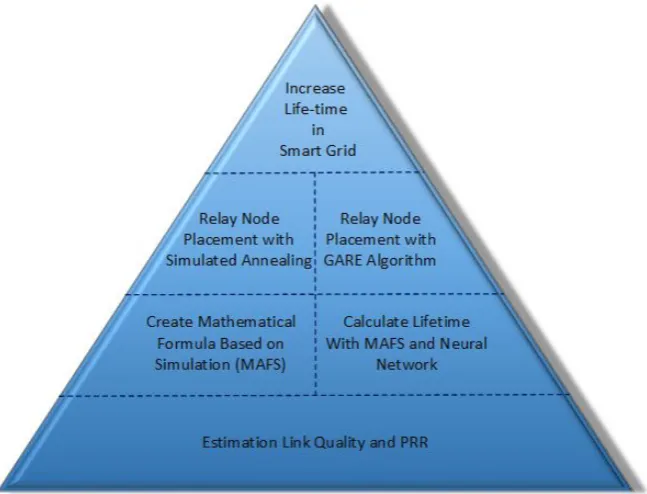
Figure 1.1: Research Contributions
1.7 Research Assumption
Some of the assumption for simulation, energy usage and other elements are defined as follow
(i) Relay can communicate with base station directly, (ii) energy for sending one packet is50×0.39×e−4J,
(iii) receiving energy for one bite is0.15×e−6J,
1.8 Research Contributions
7
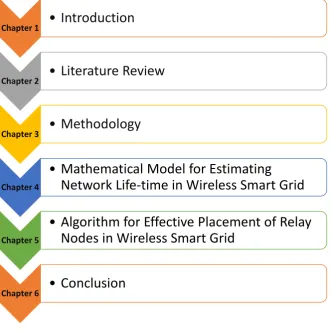
Chapter 1
• Introduction
Chapter 2
• Literature Review
Chapter 3
• Methodology
Chapter 4
• Mathematical Model for Estimating
Network Life-time in Wireless Smart Grid
Chapter 5
• Algorithm for Effective Placement of Relay
Nodes in Wireless Smart Grid
Chapter 6
• Conclusion
8
network. New relay node placement algorithm is final step to reach the main goal of this research.
1.9 Thesis Organization
95
REFERENCES
Ababneh, N., Viglas, A., Labiod, H. and Boukhatem, N. (2009). ECTC: Energy effiCient Topology Control algorithm for wireless sensor networks. In IEEE International Symposium on a World of Wireless, Mobile and Multimedia Networks & Workshops, 2009.1–9.
Ahmed, A. (2009). Experiment measurements for packet reception rate in wireless underground sensor networks.International Journal of Recent Trends. 2(2), 71–75. Akyildiz, I., Su, W., Sankarasubramaniam, Y. and Cayirci, E. (2002a). Wireless sensor
networks: a survey.Computer Networks. 38(4), 393–422. ISSN 13891286.
Akyildiz, I. F., Su, W., Sankarasubramaniam, Y. and Cayirci, E. (2002b). Wireless sensor networks: a survey.Computer networks. 38(4), 393–422.
Asad, O., Erol-Kantarci, M. and Mouftah, H. (2011). Sensor network web services for Demand-Side Energy Management applications in the smart grid. InConsumer Communications and Networking Conference (CCNC), 2011 IEEE. January. IEEE. ISBN 978-1-4244-8789-9, 1176–1180.
Aslam, N. and Robertson, W. (2007). Relay node selection in randomly deployed homogeneous clustered wireless sensor networks. Sensor Technologies . . ., 418– 423.
Baptista, D. and Morgado-Dias, F. (2013). A survey of artificial neural network training tools.Neural Computing and Applications. 23(3-4), 609–615. ISSN 0941-0643.
Bharathidasan, A. and Ponduru, V. A. S. (2002). Sensor networks: An overview.paper, University of California, Davis, CA (August 2002).
Bhattacharyya, D., Kim, T.-h. and Pal, S. (2010). A comparative study of wireless sensor networks and their routing protocols.Sensors. 10(12), 10506–10523.
96
Wireless Sensor Networks in Smart Grid Environments. In2011 Proceedings of 20th International Conference on Computer Communications and Networks (ICCCN). July. Maui, Hawaii: IEEE. ISBN 978-1-4577-0637-0, 1–6.
Bokareva, T., Hu, W., Kanhere, S., Ristic, B., Gordon, N., Bessell, T., Rutten, M. and Jha, S. (2006). Wireless sensor networks for battlefield surveillance. InProceedings of the land warfare conference.
Calvano, S. E., Xiao, W., Richards, D. R., Felciano, R. M., Baker, H. V., Cho, R. J., Chen, R. O., Brownstein, B. H., Cobb, J. P., Tschoeke, S. K. et al. (2005). A network-based analysis of systemic inflammation in humans. Nature. 437(7061), 1032–1037.
Cerpa, A., Wong, J., Potkonjak, M. and Estrin, D. (2005). Temporal properties of low power wireless links: modeling and implications on multi-hop routing.Proceedings of the 6th ACM . . .. (January), 414—-425.
Chang, J.-H. and Tassiulas, L. (2004). Maximum Lifetime Routing in Wireless Sensor Networks.IEEE/ACM Transactions on Networking. 12(4), 609–619. ISSN 1063-6692.
Dietrich, I. and Dressler, F. (2009). On the lifetime of wireless sensor networks.ACM Transactions on Sensor Networks. 5(1), 1–39. ISSN 15504859.
Elleithy, A. and Liu, G. (2012). The Effect Of Communications on the Lifetime of Wireless Sensor Networks.Journal of Emerging Trends in Computing and . . .. 3(4), 645–653.
Erol-Kantarci, M. and Mouftah, H. T. (2011a). Wireless multimedia sensor and actor networks for the next generation power grid. Ad Hoc Networks. 9(4), 542–551. ISSN 15708705.
Erol-Kantarci, M. and Mouftah, H. T. (2011b). Wireless Sensor Networks for Cost-Efficient Residential Energy Management in the Smart Grid.IEEE Transactions on Smart Grid. 2(2), 314–325. ISSN 1949-3053.
Fonseca, R. and Gnawali, O. (2007). Four-bit wireless link estimation. In ACM Workshop HotNets. 0–5.
Ghosh, K. and Das, P. K. (2013). Proceedings of the Third International Conference on Trends in Information, Telecommunication and Computing. 150.
Gungor, V. and Lambert, F. (2006). A survey on communication networks for electric system automation.Computer Networks. 50(7), 877–897. ISSN 13891286.
97
1–10. ISSN 1550-1329.
Gungor, V. C., Lu, B. and Hancke, G. P. (2010). Opportunities and Challenges of Wireless Sensor Networks in Smart Grid. IEEE Transactions on Industrial Electronics. 57(10), 3557–3564. ISSN 0278-0046.
Guo, W., Huang, X., Lou, W. and Liang, C. (2008). On Relay Node Placement and Assignment for Two-tiered Wireless Networks.Mobile Networks and Applications. 13(1-2), 186–197. ISSN 1383-469X.
Huang, X. (2007). Relaying Packets in a Two-tiered Wireless Network Using Binary Integer Programming. International Conference on Wireless Algorithms, Systems and Applications (WASA 2007), 254–259.
Jain, S. (2012). Energy Efficient Maximum Lifetime Routing For Wireless Sensor Network.International Journal of Advanced Smart Sensor Network Systems. 2(1), 107–11. ISSN 22315225.
Jantarasorn, C. and Prommak, C. (2012). Minimizing Energy Consumption in Wireless Sensor Networks using Binary Integer Linear Programming. Inwaset.ac.nz. ISBN 6644224393, 124–128.
Kim, M. S., Kim, S. R., Kim, J. and Yoo, Y. (2011). Design and Implementation of MAC Protocol for SmartGrid HAN Environment. In2011 IEEE 11th International Conference on Computer and Information Technology. August. IEEE. ISBN 978-1-4577-0383-6, 212–217.
Kulkarni, V. V., Lim, J. G. and Jha, S. K. (2012). Feasibility of SINR guarantees for downlink transmissions in relay-enabled OFDMA networks.Automatica. 48(8), 1818–1824. ISSN 00051098.
Lee, K.-j., Kim, K.-m. and Moon, C. (2011). A New Type of Remote Power Monitoring System Based on a Wireless Sensor Network Used in an Anti-islanding Method Applied to a Smart-Grid, 358–367.
Lorincz, K., Chen, B.-r., Challen, G. W., Chowdhury, A. R., Patel, S., Bonato, P., Welsh, M. et al. (2009). Mercury: a wearable sensor network platform for high-fidelity motion analysis. InProceedings of the 7th ACM Conference on Embedded Networked Sensor Systems. 183–196.
Lorincz, K., Kuris, B., Ayer, S. M., Patel, S., Bonato, P. and Welsh, M. (2007). Wearable wireless sensor network to assess clinical status in patients with neurological disorders. In Proceedings of the 6th international conference on Information processing in sensor networks. 563–564.
98
using GIS technology. In Proceedings of the 22nd International Conference on Information Technology Interfaces (ITI). 391–396.
Prommak, C. and Modhirun, S. (2011a). Minimizing Energy Consumption in Wireless Sensor Networks Using Multi-hop. Penang, Malaysia. ISBN 9781618040398, 92– 97.
Prommak, C. and Modhirun, S. (2011b). Optimal Wireless Sensor Network Design for Efficient Energy Utilization.2011 IEEE Workshops of International Conference on Advanced Information Networking and Applications, 814–819.
Quan, W., Zhao, F.-t., Guan, J.-f., Xu, C.-q., Zhang, H.-k., Wei, Q., Fu-tao, Z., Jian-feng, G., Chang-qiao, X. U. and Hong-ke, Z. (2011). An integrated link quality estimation-based routing for wireless sensor networks.The Journal of China Universities of Posts and Telecommunications. 18(December), 28–33. ISSN 10058885.
Rajagopal, S., Trayer, M. and Bhat, K. P. (2011). Architecture model choices for a Smart Grid home network. In 2011 IEEE Online Conference on Green Communications. September. New York, NY, USA: IEEE. ISBN 978-1-4244-9519-1, 52–57.
Ramanathan, R. and Rosales-Hain, R. (2000). Topology control of multihop wireless networks using transmit power adjustment. In Proceedings of a IEEE Nineteenth Annual Joint Conference of the Computer and Communications Societies (INFOCOM), vol. 2. 404–413.
Ritchie, L., Deval, S., Reisslein, M. and Richa, A. W. (2009). Evaluation of physical carrier sense based spanner construction and maintenance as well as broadcast and convergecast in ad hoc networks.Ad Hoc Networks. 7(7), 1347–1369.
Romer, K. and Mattern, F. (2004). The design space of wireless sensor networks.IEEE Wireless Communications. 11(6), 54–61. ISSN 1536-1284.
Santi, P. (2005). Topology control in wireless ad hoc and sensor networks. ACM Computing Surveys (CSUR). 37(2), 164–194.
Santi, P. and Simon, J. (2004). Silence is golden with high probability: Maintaining a connected backbone in wireless sensor networks. InWireless Sensor Networks. (pp. 106–121).
Shi, Y., Hou, Y. T. and Efrat, A. (2007). Algorithm design for a class of base station location problems in sensor networks.Wireless Networks. 15(1), 21–38. ISSN 1022-0038.
99
propagation models in Nigerian rural and sub-urban areas. American Journal of Scientific and Industrial Research. 1(2), 227–232. ISSN 2153649X.
Sobuz, M. (2011). Relay Node Selection Technique in Homogeneous Cluster Based Wireless Sensor Network. . . . Journal of Research and Reviews in . . .. 2(3), 900– 905.
Song, C., Liu, M., Cao, J., Zheng, Y., Gong, H. and Chen, G. (2009). Maximizing network lifetime based on transmission range adjustment in wireless sensor networks.Computer Communications. 32(11), 1316–1325.
Tang, L., Wang, K.-c., Huang, Y. and Gu, F. (2007). Channel Characterization and Link Quality Assessment of IEEE 802.15.4-Compliant Radio for Factory Environments. IEEE Transactions on Industrial Informatics. 3(2), 99–110. ISSN 1551-3203. Taqqali, W. M. and Abdulaziz, N. (2010). Smart Grid and demand response
technology. In 2010 IEEE International Energy Conference. December. IEEE. ISBN 978-1-4244-9378-4, 710–715.
Tubaishat, M. and Madria, S. (2003). Sensor networks: an overview. IEEE on Potentials. 22(2), 20–23.
Vieira, M. A. M., Coelho Jr, C. N., da Silva Jr, D. C. and da Mata, J. M. (2003). Survey on wireless sensor network devices. InProceedings of the IEEE Conference Emerging Technologies and Factory Automation (ETFA), vol. 1. 537–544.
Wang, Y., Lin, W. and Zhang, T. (2010). Study on security of Wireless Sensor Networks in smart grid. In 2010 International Conference on Power System Technology. October. IEEE. ISBN 978-1-4244-5938-4, 1–7.
Woo, A., Tong, T. and Culler, D. (2003). Taming the underlying challenges of reliable multihop routing in sensor networks. In Proceedings of the first international conference on Embedded networked sensor systems - SenSys ’03. New York, New York, USA: ACM Press. ISBN 1581137079, 14.
Zamalloa, M. Z. n. and Krishnamachari, B. (2007). An analysis of unreliability and asymmetry in low-power wireless links. ACM Transactions on Sensor Networks. 3(2), 7–es. ISSN 15504859.
Zhaohua, L. and Mingjun, G. (2009). Survey on network lifetime research for wireless sensor networks. In 2009 2nd IEEE International Conference on Broadband Network & Multimedia Technology. October. Beijing, China: IEEE. ISBN 978-1-4244-4590-5, 899–902.
100