ENHANCING GLOBAL COMPETITIVENESS OF PENANG
ELECTRONICS AND ELECTRICAL SMALL AND MEDIUM
INDUSTRIES THROUGH IMPROVING LINKAGE PROGRAMMES
LEE HUAY KUAN
A thesis submitted in partial fulfilment of the
requirements for the award of the degree of
Doctor of Engineering (Engineering Business Management)
Business & Advanced Technology Centre
Universiti Teknologi Malaysia
IV ABSTRACT
V ABSTRAK
VI
TABLE OF CONTENTS
CHAPTER TITLE PAGE
DECLARATION II
ACKNOWLEDGEMENTS III
ABSTRACT IV
ABSTRAK V
TABLE OF CONTENTS VI
LISTS OF TABLES XIV
LIST OF FIGURES XVI
LIST OF ABBREVIATION XX
LIST OF APPENDICES XXIV
I INTRODUCTION
1.1 Introduction 1
1.2 Problem Statement 3 1.3 Research Objective 3 1.4 Research Hypothesis 4
1.5 Scope 6
1.6 Importance of this Research 6 1.7 Research Methodology 8 1.8 Thesis Outline 9
VII
II LITERATURE REVIEW
2.1 Introduction 11
2.2 Linkages for SMIs in Manufacturing Industry 11 2.2.1 Benefits of Linkages 12 2.2.2 MNCs Self-Interest in Forging Links with SMIs 13 2.2.3 Business Networking 15 2.2.4 Technology Networks and Linkages 16 2.2.5 Internet Linkages on Business Transaction 17 and Technology Acquisition 2.1.6 Technology Transfer Through Linkages 18 2.3 Role to Play on Linkages Programmes 19
2.3.1 Government Role 19
2.3.2 MNCs Role 21
2.3.3 SMIs Role 24
2.4 Success Story on Business Linkages Between MNCs and SMIs 25
2.4.1 Ardennes from France 25
2.4.2 Engtek from Penang 26
2.5 Measures Taken to Strengthen the Linkages for SMIs 27
2.5.1 Main Ingredients of Successful Linkages Programme 29
2.5.2 Criteria on Selection of Potential Suppliers for 31
Linkages Programme 2.5.3 Measures by MNCs to Create and Deepen Linkages 32
2.6 Specific Linkages Promotion Programmes for Benchmarking 34
2.6.1 Ireland’s National Linkages Programme 35
2.6.2 Thailand’s BUILD Programme 37
2.7 SMI Development Experiences for Benchmarking 39
2.7.1 Taiwan Experience 40
2.7.2 Singapore Experience 44
2.8 Review on How Others Conducting Similar Type of Research 51
2.9 Summary 51
VIII
III OVERVIEW OF SMIs IN PENANG MANUFACTURING INDUSTRY
3.1 Introduction 52 3.2 Penang Manufacturing Industry Transformation 53 3.3 Outline of Manufacturing Sector in Penang 56 3.4 Challenges Face by Penang’s Manufacturing Industry 58 3.5 Threats to Penang’s Manufacturing Industry 60 3.5.1 Understand the Reasons Investors Relocating from 60 Penang
3.5.2 Risks of Investors Relocating Faceed by Penang 62 Industry
3.6 Role of SMIs in Penang Manufacturing Industry 62 3.6.1 Higher Employment Generation 64 3.6.2 Reuse of Scrapped Machinery & Equipment 64 3.6.3 Training Ground for Industrial Skills and 64 Entrepreneurship
3.6.4 Supplier for Specialized Market Segment 65 3.6.5 Ancillary and Supporting Industry Role to MNCs 65 3.6.6 Potential Export Contribution for Specific Markets 66 3.7 Constraints Encountered by SMIs in Penang Manufacturing 66 Industry
3.7.1 Inadequate Skilful Manpower 67 3.7.2 Lack of Management Skills 68 3.7.3 Inadequate Finance 69 3.7.4 Lack of Marketing Penetration 69 3.7.5 Low Technological Level and Outdated System 70 3.7.6 Lack of Research and Development and Technical 71
Assistance
3.7.7 Inadequate Raw Material 72 3.7.8 Inadequate Industrial Land, Building and 73 Infrastructure
IX
3.7.10 Lack of Knowledge on Information and 76 Communication Technology
3.7.11 Small Scale and Volume Production 76 3.7.12 No Vision and Strategy for the Future 77 3.7.13 Low Reliability 77 3.8 Threat of AFTA to Penang’s SMIs on Manufacturing Industry 77 3.8.1 “FUTURE” Approach to Counter AFTA Reaction 78 3.8.2 SMIs Role in Coping with Challenges due to AFTA 79 3.8.3 Public Sector in Confronting AFTA Challenges 80
3.9 Summary 82
IV RESEARCH METHOLODOGY
4.1 Introduction 83
4.2 Flow Chart of Research methodology 83
4.3 Design & Development of Questionnaire Survey and 85
Structured Interview 4.3.1 Questionnaire Design 85
4.3.2 Questionnaire Contents 86
4.3.3 Research Population 87
4.3.4 Research Sample Selection 87
4.3.5 Research Sample Size 88
4.3.6 Research Rating System 89
4.4 Data Collection Strategy 90
4.4.1 Survey Procedure 91
4.4.2 Survey Limitation 91
4.4.3 Survey Administration 92
4.4.4 Opening and Confidentiality Statement 92
4.4.5 Improvement Gain from Pilot Study 93
4.4.6 Data Recording 94
4.5 Statistical Analysis Techniques Used 94
X V DATA ANALYSIS
XI
VI PROGRAMMES AND STRATEGIES IMPLEMENTATION
6.1 Introduction 167
6.2 Implementation of Programmes and Strategies 167
6.2.1 Setting Up a One Stop Service Counter for SMIs 168
6.2.2 Penang to Attract More FDI 169
6.2.3 Effective SMI Development Mechanism 171
6.2.3.1 Formulation of Industrialization Strategy 172
6.2.3.2 Specific Assistance Programme 173
6.2.3.3 Intel SMI Development Approach 176
6.2.3.4 Technological Capability Development 177
6.2.4 Penang’s Own Brandname for Long Term Benefits 178
6.2.5 Specific Strategies to Cope with Economic Downturn 179
6.2.5.1 Strategies at Industry Level 179 6.2.5.2 Strategies at Corporate Level 179 6.2.5.3 Strategies at Business Level 180 6.2.6 Measures to Help SMIs Become More Export 180
Oriented 6.2.6.1 Strategy Thrust for SMIs to Be Globalized 182
6.2.6.2 Action Plan to Be Exported Oriented 183
6.2.6.3 Improvement Factors on Products Export 184
6.3.6.4 Immediate Challenges on Exporting 185
Marketing 6.2.7 Critical Elements of IT for Penang’s Industrial 186
Structure 6.2.7.1 Driving Forces Behind E-Business 186
6.2.7.2 Government Action Plan to Promote 188
E-Business Utilization 6.2.7.3 Funding for ICT Implementation 190
6.2.8 Key Adjustments on HR Development Towards 191
XII
6.2.8.3 Better Marketing and Sales Ability 194 6.2.8.4 Good Attitude, Values and Work habits 195 6.2.8.5 Business Leadership and Management Skill 195 6.2.9 Achieve International Quality Standard 196
6.2.9.1 Towards Total Quality Management 197 6.2.9.2 Competing Market Place Via Quality 197 Consciousness
6.2.10 Upgrading Industrial Technology Through R&D 199 6.2.10.1 Create New Business Opportunities 200
6.2.10.2 Improvement on Product Quality and 200 Production Processes
6.2.10.3 Market Orientation for Industrial R&D 201 in Universities
6.2.10.4 Changing the Attitude of SMIs Towards 202 R&D
6.2.11 Boost and Enhance Science and Technology (S&T) 202 6.2.11.1 Government Role to Play to Boost Science 203
and Technology
6.3 Summary 205
VII CONCLUSION
7.1 Introduction 206
7.2 Research Conclusions 207 7.2.1 Identification of Root Causes on Investors Relocating 207 from Penang
7.2.2 Understand Key Concerns of SMIs in Penang 207 Manufacturing Industry
7.2.3 Empirical Data and Conclusion from Survey Interview 208 7.2.4 Programmes and Strategies Implementation on SMIs 209 Development
XIII
7.3 Publication from this Research 212 7.4 Novelty of this Research 212 7.5 Further Research Recommendation 213
REFERENCES 215
Appendices A – K 230 - 250
XIV
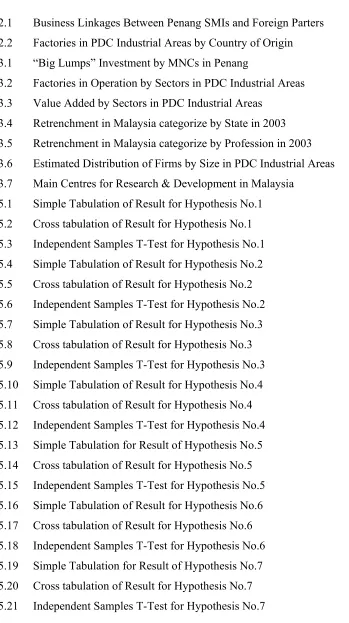
LIST OF TABLES
TABLE NO. TITLE PAGE
XV
XVI
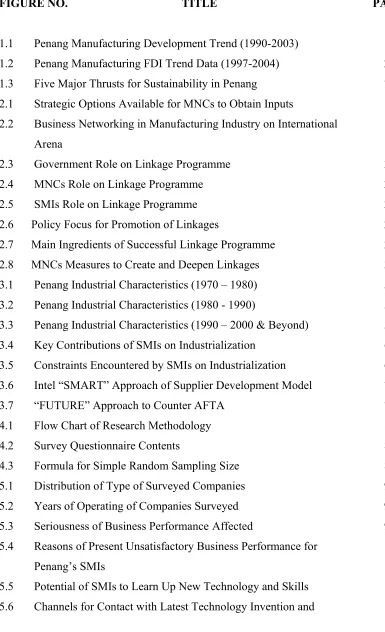
LIST OF FIGURES
FIGURE NO. TITLE PAGE
1.1 Penang Manufacturing Development Trend (1990-2003) 1 1.2 Penang Manufacturing FDI Trend Data (1997-2004) 2 1.3 Five Major Thrusts for Sustainability in Penang 7 2.1 Strategic Options Available for MNCs to Obtain Inputs 14 2.2 Business Networking in Manufacturing Industry on International 16 Arena
2.3 Government Role on Linkage Programme 20 2.4 MNCs Role on Linkage Programme 22 2.5 SMIs Role on Linkage Programme 25 2.6 Policy Focus for Promotion of Linkages 28 2.7 Main Ingredients of Successful Linkage Programme 29 2.8 MNCs Measures to Create and Deepen Linkages 32 3.1 Penang Industrial Characteristics (1970 – 1980) 54 3.2 Penang Industrial Characteristics (1980 - 1990) 54 3.3 Penang Industrial Characteristics (1990 – 2000 & Beyond) 55 3.4 Key Contributions of SMIs on Industrialization 63 3.5 Constraints Encountered by SMIs on Industrialization 67 3.6 Intel “SMART” Approach of Supplier Development Model 74 3.7 “FUTURE” Approach to Counter AFTA 79 4.1 Flow Chart of Research Methodology 84 4.2 Survey Questionnaire Contents 86 4.3 Formula for Simple Random Sampling Size 88 5.1 Distribution of Type of Surveyed Companies 97 5.2 Years of Operating of Companies Surveyed 98 5.3 Seriousness of Business Performance Affected 99 5.4 Reasons of Present Unsatisfactory Business Performance for 101 Penang’s SMIs
XVII
Development from Overseas
5.7 Problems Encountered in Training Employees for SMIs 103 5.8 Methods on Technology and Managerial Skills Improvement 105 5.9 Assistance on Products Exporting 106 5.10 Countries on Products Exporting 107 5.11 Percentage of Business Activity on Exporting 109 5.12 Forecast on Penang’s Economic Situation 110 5.13 Methods on Technology and Quality Improvement and Upgrading 111 5.14 Critical Strength of SMIs to be Competitive 113 5.15 Inhibiting Factors that Hinder SMIs from Attaining International 114 Quality System Certification
5.16 General Performance of Penang’s SMIs 115 5.17 Factors that Restrict Penang’s SMIs from Adopting ICT 117 5.18 Efforts Needed from Government to Promote ICT Utilization 118 Among SMIs
5.19 Company Involvement in Homepage 119 5.20 Achievement on Return of Investment from Website 120 5.21 Participation of Government Incentives and Assistance Schemes 121 5.22 Difficulty Encountered on Development Assistance Application 122 Assistance Application
5.23 Reasons of Poor Participation by SMIs on Government Assistance 123 Programme
5.24 SMIs Expectation from Industrial Development Assistance 124 Programme
5.25 Declaration on Receiving of Circular/ Newsletter from Government 125 Authority
5.26 Awareness of Government Development Assistance Programmes 126 5.27 Problems of Existing SMIs Development Assistance Programmes 128 5.28 Companies Having Active Business Linkages or Sub-contracting 129 Activities
XVIII
Penang
5.33 Company’s Plan to Relocate Their Manufacturing Industry from 135 Penang
5.34 Preferred Location for Set Up of New Manufacturing Facility 136 5.35 Reasons for Certain MNC’s Moving Out from Penang 137 5.36 Factors that Able to Lead Penang’s Manufacturing Industry for a 139 Faster Recovery
5.37 Preference to Work on Familiar Job Rather Than New Job 140 5.38 Referring Organization for Guidance on Technical, Business and 141 Marketing Information
5.39 Corrective Measures to Keep Company Sustaining During 142 Recession Period
XIX
LIST OF ABBREVIATIONS
ACCCIM - Associated Chinese Chamber of Commerce and Industry of Malaysia
AFTA - ASEAN Free Trade Area
ASEAN - Association of South East Asian Nations ASLI - Asian Strategy and Leadership Institute BOI - Board of Investment (Thailand)
CAD - Computer Aided Design
CAM - Computer Aided Manufacturing CEO - Chief Executive Officer CGC - Credit Guarantee Corporation
CIM - Computer Integrated Manufacturing CNC - Computerized Numerical Controller
COSEC - Core Sills for Effectiveness and Changes (Singapore) CRM - Customer Relationship Management
DBS - Development Bank of Singapore DFM - Design for Manufacturing DOE - Design for Experiment E&E - Electronics and Electrical
EDB - Economic Development Board (Singapore)
EDAS - Economic Development Assistance Scheme (Singapore) EIB - European Investment Bank (Spain)
EIF - European Investment Fund (Spain) ERP - Enterprise Resources Planning EU - European Union
FDI - Foreign Direct Investment
FIREBS - Fire Insurance, Real Estate & Business Services FIZ - Free Industrial Zone
FMM - Federation of Malaysian Manufacturers FRIM - Forest Research Institute of Malaysia
XX
FTZ - Free Trade Zone
GDP - Gross Domestic Product GSP - Global Supplier Programme HDD - Hard Disk Drive
HRD - Human Resources Development HRDF - Human Resources Development Fund
ICT - Information and Communication technology IC - Integrated Circuit
IDC - International Data Center
IDIC - Industrial Development and Investment Center ILP - Industrial Linkage Programme
IMP - Industrialization Master Plan IMP2 - Second Industrialization Master Plan IMR - Institute of Medical Research
INTECH - Initiatives in New Technology Scheme (Singapore) ISO - International Organization for Standard
ITAF - Industrial Technical Assistance Fund IT - Information Technology
JICA - Japan International Cooperation Agency JIT - Just In Time
JV - Joint Venture KL - Kuala Lumpur
LDC - Less Developed Country LIS - Light Industries Services
LIUP - Local Industries Upgrading Programme (Singapore) LMW - Licensed Manufacturing Warehouse
LOI - Letter of Intent LSI - Large Scale Industry
MARDI - Malaysia Agricultural Research & Development Institute MATRADE - Malaysia External Trade Development Corporation
MDAS - Market Development Assistance Scheme (Singapore) MIDA - Malaysian Industrial Development Authority
XXI
MITI - Ministry of International Trade and Industry MIER - Malaysian Institute of Economic Research MIMOS - Malaysia Institute of Microelectronics System MTDC - Malaysian Technology Development Corporation MNC - Multinational Corporation
MOEA - Ministry of Economic Affairs (Taiwan) MOF - Ministry of Finance
MSC - Multi Super Corridor
NCB - National Computer Board (Singapore) NIC - Newly Developed Country
NIOSH - National Institute of Occupational Safety & Health NLP - National Linkage Programme
NPB - National Productivity Board (Singapore) NPC - National Productivity Corporation NUS - National University of Singapore
OECD - Organization for Economic Cooperation and Development PC - Personal Computer
PDC - Penang Development Corporation PFI - Participating Financial Institute PLC - Programmable Language Controller PORIM - Palm Oil Research Institute of Malaysia
PPAS - Product Development Assistance Scheme (Singapore) PSDC - Penang Skills Development Centre
PSDP2 - Second Penang Strategic Development Plan QA - Quality Assurance
R&D - Research and Development RLS - Robot Leasing Scheme (Singapore) RM - Ringgit Malaysia (1US$ = 3.8RM) RRIM - Rubber Research Institute of Malaysia SARS - Severe Acute Respiratory Syndrome SDF - Skills Development Fund (Singapore) SDN BHD - Sendirian Berhad (Private Limited) SEB - Small Enterprise Bureau (Singapore)
XXII
SERI - Socio-Economics and Environment Research Institute SIFS - Small Industries Finance Scheme (Singapore)
SISIR - Singapore Institute of Standards and Industrial Research SINGLAS - Singapore Laboratory Accreditation Scheme (Singapore) SMI - Small and Medium Scale Industry
SIRIM - Standards and Industrial Research Institute of Malaysia SMIDEC - Small and Medium Industries Development Corporation SMBB - Small and Medium Business Bank (Taiwan0
SPSS - Statistical Package for Social Science TAF - Technology Acquisition Fund
TDB - Trade Development Board (Singapore) TNC - Transnational Corporation
TQM - Total Quality Management
UNCTAD - United National Conference on Trade and Development USM - Universiti Sains Malaysia
XXIII
LIST OF APPENDICES
APPENDIX TITLE PAGE
A Letter from Penang State Government Endorsing this 230
Research
B Research Recommendation Letter from Penang MIDA 231 C Research Recommendation Letter from Penang 232
Development Corporation (PDC)
D Research Recommendation Letter from Penang Seagate 233 Industries Malaysia Sdn Bhd (MNC)
E Research Recommendation Letter from LKT Engineering 234 Sdn Bhd (LSI)
F Research Recommendation Latter from Eetek Electrical 235 Switchgear Sdn Bhd (SMI)
G Confirmation Letter on Acceptance of Technical Paper 236 from this Research for RAMM 2003 International Conference
H Abstract of Technical Paper Published from this Research 237 Study
I Complimentary Letter from PDC 238 J Supporting Letter from KK Choong Engineering Sdn Bhd 239
K Survey Questionnaire 240
CHAPTER 1
INTRODUCTION
1.1 Introduction
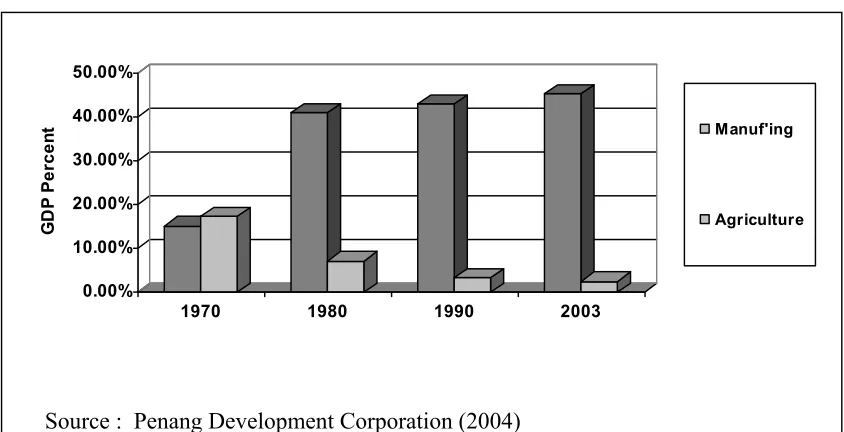
Penang’s economy has dramatically transformed from an agriculture and trade-based economy in the late sixties to a leading industrial state with a diversified and broad-based economic structure today. The contribution of the manufacturing sector to the Penang state’s GDP has increased about threefold from 15.1 percent in 1970 to 45.3 percent by 2003 as shown in Figure 1.1.
0.00% 10.00% 20.00% 30.00% 40.00% 50.00%
G
D
P
P
e
rcen
t
1970 1980 1990 2003
Manuf'ing
Agriculture
Source : Penang Development Corporation (2004)
2
Penang may have developed its competitive edge in the seventies to nineties, the state now has to contend with increasing competition from the region, as well as from other new emerging economies.
In the face of stiff competition from the emergence and continued growth of China, coupled with the very aggressive development of Thailand, Vietnam and India had provided further pressure to Penang as a viable investment destination.
All markets after AFTA implementation by 2010 will be open and accessibility will be based on merit of quality, pricing, market niches and cultural preferences. In this very open system, it becomes vital to develop the right programmes and strategies for the Penang SMIs in electronics and electrical manufacturing industry.
The competitive and very challenging global environment for investments has results in slowdown in inflows of FDI to Penang as shown in Figure 1.2.
0 1 2 3 4 5
1997 1998 1999 2000 2001 2002 2003 2004
FDI (RM B)
Source : Malaysian Industrial Development Authority (2005)
Figure 1.2 : Penang Manufacturing FDI Trend Data (1997-2004)
3
PSG (2001-a) pointed out that in light of those changes, with the right strategies on strengthening the competitiveness of the small and medium industries in Penang electronics and electrical manufacturing industry, Penang needs to improve the existing linkages programmes and incentive schemes to broaden and deepen its
economic base.
Major issues that hinder the realization of the full development potential of each sector of the linkage programmes and strategies have to be identified and
analyzed. Development strategies and linkage programmes need to be high-lighted and strategies formulated. All these should take into consideration the broader context of future national, regional and international trends. These strategies and programmes should see Penang as a major recipient of international investment, as it shifts to higher value-added manufacturing activities.
1.2 Problem Statement
Due to the present economics slowdown, coupled with the increasing competition from those new economics, Penang small and medium industries in electronics and electrical manufacturing industry need to enhance global
competitiveness through improving linkage programmes.
1.3 Research Objective
The main objective of this research study is to highlight the important issues
as recommendations to the Penang state authority in formulating action plans and strategies through effective linkage programmes.
From the main objective above, the following are the sub-objectives of the research :
4
b) To determine the important factors that contribute to the competitiveness of SMIs in Penang electronics and electrical manufacturing industry;
c) To identify the perception of industries (MNCs and SMIs) on variables affecting SMIs in Penang electronics and electrical manufacturing industry performance;
d) To identify the challenges and expectation from SMIs in Penang electronics and electrical manufacturing industry.
1.4 Research Hypothesis
Brain storming and discussion sessions were carried out with few industrialists and government agencies on the core issues faced by the Penang’s manufacturing industry, lead to the development of the Hypothesis as listed below. Through the survey interviews with various industry professional from SMIs and MNCs, the following hypothesis which are related to linkage programmes and improvement strategies will be verified :-
a) Hypothesis #1
Penang’s manufacturing industry still have the potential to revive once the global economy situation improves.
b) Hypothesis #2
Technological and managerial skills of most Penang manufacturing industry’s SMIs have met the requirements of the MNCs expectations.
c) Hypothesis #3
5
d) Hypothesis #4
The key expectation from SMIs through the linkage programme is for technological improvement, rather than the company’s profitability.
e) Hypothesis #5
SMIs need to expand their utilization of Information and Communication Technology (ICT) in order to be competitive in technology and marketing.
f) Hypothesis #6
Present industrial development incentives and schemes are effective and impressive enough as compared to other countries to attract new investors and retain existing investors.
g) Hypothesis #7
Existing linkage programmes for SMIs need to be further reviewed and improved to meet present technological and market competitiveness requirements.
h) Hypothesis #8
The present increasing overhead and labour costs are the main factors for Penang’s manufacturing industry to lose out in the global market.
i) Hypothesis #9
Electronics and electronics industries will still remains as the main steam of the manufacturing sectors in Penang for the next five years.
j) Hypothesis #10
6
1.5 Scope
This research is confines to the small and medium industries in Penang electronics and electrical manufacturing industry.
1.6 Importance of this Research
This research study will contribute to a better understanding of problems involved in development of SMIs in electronics and electrical manufacturing industry in Penang which can be summarized as follows :-
a. To help SMIs expand their business and manufacturing activities which can bring in more government revenue;
b. To assist SMIs in expanding and diversifying the industrial base of the state towards enhancing international competitiveness, increase the value-add in products and exports, domestic investments, employment
opportunities and hence the standard of living and quality of life of the people;
c. To develop improvement strategies on how SMIs and MNCs can work together to increase the productivity and economic viability of the state towards the common goal of a more prosperous and progressive Penang;
d. To re-orientate the government to be more service-oriented in its approach so as to provide a more conducive environment for SMIs to operate profitably, as well as to expand as rapidly as possible to generate more profits.
In essence, the rationale of the innovative linkage programme and
7
her vision of becoming an industrialized state by the year 2020, as emphasized by the ex- Prime Minister Tun Dr. Mahathir Bin Mohamad (Mahathir, 1997).
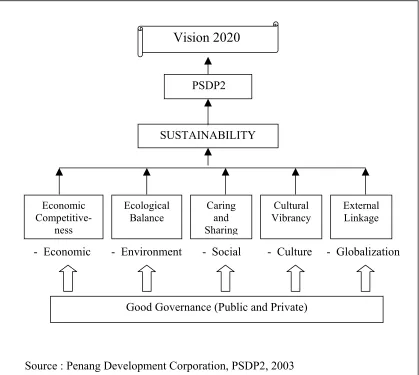
This research study is in line with the 2nd Penang Strategic Development Plan (PSDP2) – 2001 to 2010 (PSG, 2001-a) which is strongly based on the concept of SUSTAINABILITY in heading towards Vision 2020 of Malaysia is as shown in Figure 1.3 (PDC, 2003-a). This study met PSDP2 expectation by looking into the improvement and remedial measures on two of the five major thrusts, i.e., economic competitiveness and external linkages.
- Economic - Environment - Social - Culture - Globalization
Source : Penang Development Corporation, PSDP2, 2003
Figure 1.3 : Five Major Thrusts for Sustainability in Penang PSDP2
SUSTAINABILITY
Economic Competitive-
ness
Ecological Balance
Caring and Sharing
Cultural Vibrancy
External Linkage
Vision 2020
8
1.7 Research Methodology
This research was conducted in three parts :
In the first part of this study, a review was conducted on the existing literature on the industry, both in Penang and internationally, with a particular focus on the problems and activities of SMIs on electronics and electrical manufacturing industry. This included academic, official and public sources. The academic sources consisted of books, journal articles and graduate/ undergraduate report on various aspects of the SMIs in Penang and others countries. The official sources included studies and previous surveys of the SMIs in Penang, conducted by government and semi- government bodies. The public sources consisted of articles from local and foreign newspapers, magazines and websites. A summary of the relevant material is presented in the reference section.
The second part of the research collected aggregate data on the SMIs for electronics and electrical manufacturing industry drawn mainly from the annual census of industrial production conducted by the Malaysia Department of Statistics (DOS, 2003), MIDA, PDC, SERI and DCT Consultancy Services. These data provide a better understanding of the performance of the electronics and electrical industry in Penang.
The third part of the research involve a face-to-face interview or personal delivery of survey questionnaire to 115 firms and organizations whose activities are related to electronics and electrical manufacturing industry in Penang. Each in depth survey interview lasting from one to two hour were conducted with the CEO, managing director, proprietors, top and middle management personnel of the SMIs and MNCs. The interviews were conducted through the month of December 2002 to June 2003. A questionnaire was designed consisting of 50 questions (Appendix K). Information gathered was qualitative as well as quantitative in nature. Valuable insights into the problems and suggestions on improvement were obtained as a result of the interviews. The material and data from the interviews are analyzed and
9
1.8 Thesis Outline
This thesis consists of seven chapters, as described in the table of contents.
Chapter I - Introduction
This chapter sums up the needs, objectives, benefits, hypothesis statements and research methodology of this study.
Chapter II - Literature Review
This chapter reviews the merits and benefits of linkage programmes and strategies for SMIs in the manufacturing industry.
Chapter III - Overview of SMIs in Penang Manufacturing Industry This chapter outlines the overview of the manufacturing industry’s SMIs in Penang, followed up with the experiences from other industrial developed countries on their SMIs development programmes and strategies.
Chapter IV - Research Mathodology
This chapter looks through the research methodology which examines the research design on development of questionnaires and structured interviews.
Chapter V - Data Analysis
This chapter analyses on the data collected from the survey interviews, the Hypothesis are tested and the results presented.
Chapter VI - Strategies and Programmes Implementation
This chapter describes the development and implementation plan of the innovative linkage programmes and improvement strategies.
Chapter VII - Conclusion
10
1.9 Summary
REFERENCES
Abdullah Ahmad Badawi (1999). “International Conference on Penang Towards the New Millenium.” Penang : Penang Development Corporation. 2 - 6
Abdul Aziz Mahmud (1996). “Malay Entrepreneurship Problem in Development – A Comparative Empirical Analysis.” Kuala Lumpur : Jabatan Perdana Menteri. 12 – 18
Abdul Rasid Mahmud (1999). “Managing Economic Crisis – The Malaysian Experience.” Kuala Lumpur : Percetakan Nasional Malaysia Berhad. 119 - 121
ACCCIM (1994). “The Position of Small Scale Industries in Malaysia.” Kuala Lumpur : Associated Chinese Chambers of Commerce and Industry of Malaysia.
Ahmad Sarji (1997). “Malaysia’s Vision 2020 – Understanding the Concept, Implication and Challenges.” Kuala Lumpur : Pelanduk Publications.
Amsden, A. (2000). “Asia Next Giant – South Korea and Late Industrialization.” New York : Oxford University Press. 23 - 24
APEC (2001). “Science, Technology and Innovation in the New Economy –
Enhabcing Capacity Across APEC.” Penang : Asia Pacific Economy Community S&T Policy Forum.
ASLI & PDC (1998). “International Conference on Penang into the 21st Century.”
Penang : Asian Strategy & Leadership Institute and Penang Development Corporation. 25 - 45
216 ASLI (1998-b). “Asian Economic and Financial Crisis.” Kuala Lumpur : Asian
Strategy & Leadership Institute.
ASLI (1999). “Malaysia Today – Towards Vision 2020.” Kuala Lumpur : Asian Strategy & Leadership Institute.
ASLI (2000 - a). “Malaysia Business and Economic Summit – Malaysia 2000 and Beyond.” Kuala Lumpur : Asian Strategy & Leadership Institute.
ASLI (2000 – b). “Penang 2000 – Penang Towards the New Millennium.” Penang : Asian Strategy & Leadership Institute.
ASLI (2001). “Penang Into the 21st Century – Outlook and Strategies of Malaysia’s Growth Centre Toward Vision 2020”. Kuala Lumpur : Asian Strategy &
Leadership Institute. 119 - 129
Bang, H., Lundberg, M and Pedersen, M.H. (1999). ”Industrial Linkages and Development”. Germany : Institute of Geography, University of Copenhagen. 15 – 20, 28 – 30.
Berenson, M.L. and Levine, M.D. (1999). “Basic Business Statistics – Concepts and Applications”. USA : Prentice Hall.
Bertelson, R. (1987). “Why the American Electronic Industry Has Invested in Malaysia.” Kuala Lumpur “ Paper presented at Investment Seminar in conjunction with Internepcon / Semiconductor International Show.
Berman, P.D. (1998). “Small Business and Entrepreneurship.” Canada : Prentice Hall Inc. 8 – 12.
Birley, G.C. and Miller, D.M. (1999). “A Practical Guide to Academic Research.” UK : Kogan Page Limited.
217 Canavos, G.C. and Miller, D.m. (1999). “An Introduction to Modern Business
Statistics”. USA : Duxbury Press.
Choong, K.C., Fong, C.O., Lim, K.C. and Mahani Bt. Zainal Abidin (1981). “Comparative Advantage of manufacturing Industries in Malaysia.” Kuala Lumpur : University of Malaysia.
Cheong, K.C. and Lim, K.C. (1996). “Implications of the Transfer of Technology and Primary Ancillary Linkages – A Case Study of the Electronics and Electrical Industries in Malaysia.” Kuala Lumpur : University of Malaya.
Cheong, W.C. (2003). “Changing the Name of the Game – Competing Via Quality.” The Star Daily Newspaper, 25th October 2003 issue. 11 – 12.
Chew, S.B. (2000). “Small Firms in Singapore.” Singapore : Oxford University Press. 194 – 197, 201 – 213.
Chee, P.L. (1999). “Small Industry in Malaysia.” Kuala Lumpur : Berita Publishing Sdn. Bhd. 15.
Chin, K.F. (1999). “E-Business – Creating Competitive Advantage in the New Economy”. Penang : The Pricewaterhouse Coopers Seminar. 3 – 12.
Clapham, R. (2000). “Small and Medium Entrepreneurs in Southeast Asia.” Singapore : Institute of Southeast Asian Studies. 24 – 25.
Clark, C. and Ray, K.C. (1996). “Comparing Development Patterns in Asia.” UK : Lynne Rienner Publishers Inc.
Cooper, D.R. and Schindler, P.S. (1998). “Business Research Methods.” Singapore : Mc. Graw Hill International.
218 DCT (2002). “Annual Survey of the Manufacturing Industries in Penang
Development Corporation Industrial Areas”. Penang : DCT Consultancy Services Sdn Bhd. Table 6 – 17.
DOS (2003). “State/ District Data Bank – Malaysia”. Kuala Lumpur : Department of Statistics. 125.
Eberhard, L., (1999). “Management Strategies of American, Japanese and Europeans Multinationals in Developing Countries - The Electronics Industry in Malaysia FTZs.” Germany : School of Economic and Politics. 45 - 49
Economic Planning Unit (2001). “Eight Malaysia Plan –2001 to 2005”. Kuala Lumpur : Prime Minister’s Department Malaysia.
Engtek (2000). “SMI Globalization – 25 Years of Engtek Growth.” Penang : Eng Technology Holding Bhd.
Fitzgerald, R. (2000). “The Competitive Advantages of Far Eastern Business.” Singapore : Toppan Company Pte. Ltd. 37 – 39, 107 – 111.
Fleming, M.c. and Nellis, J. G. (1996). “The Essence of Statistics for Business”. UK : Prentice hall.
FMM (1993). “FMM briefings.” Kuala Lumpur : Compilation of articles on Economic and Business Development in The Star newspaper.
FMM (2001 – a). “FMM Business Guide – Small and Medium Size Industries.” Kuala Lumpur : Federation of Malaysian Manufacturers. 11, 154 – 160.
FMM (2001 – b). “HRD Towards Industrialization – The Malaysian Perspective.” Kuala Lumpur : Federation of Malaysian Manufacturers.
219 FMM (2001 – d). “The Malaysian Component Parts Manufacturers – Issues and
Challenges.” Kuala Lunpur : Federation of Malaysia Manufacturers.
FMM (2002). “Berita FMM – Quarterly Newsletter of the FMM.” Kuala Lumpur : Federation of Malaysia Manufacturers – August 2003 issues. 12 – 14.
Fonnesbech, B. and Kofoed, M. (1998). “Sustainable Industrial Development in Penang.” Germany : Institute of Environment, Technology and Social Studies, Roskilde University. 12 – 13, 61 – 67, 69 – 74.
Foo, E.J. (2003). “Funding Options for Business.” New Straits Times – 28th July 2003 issue.
Fozian Ismail (2004). “Roles and Functions of SMIDEC in SME Development”. Kuala Lumpur : Small and Medium Industries Development Corporation. 8 – 9.
Garrigues and Anderson (2000). “A Guide to Business in Spain.” Madrid : The Spanish Institute for Foreign Trade and The Directorate General of Trade Policy and Foreign Investments.
Gay, L.R. and Diehl, P. L (1999). “Research Methods for Business and Management”. Singapore : Prentice Hall.
Ghosh, B.N. and Muhammand Syukri Salleh (1999). “Political Economy of
Development in Malaysia.” Kuala Lumpur : Utusan Publications & Distributions Sdn Bhd.
Ghauri, P., Gronhaug, K. and Kristianslung, I. (1995). “Research Method in Business Studies – A Practical Guide.” UK : Prentice Hall.
220 Graziano, A.M. (2000). “Research Methods – A Process of Inquiry.” USA : Allyn
and Bacon.
Guerrieri, P., Lammarino, S. And pietrobelli, C. (2001). “The Global Challenge to Industrial Districts – Small and Medium Sized Enterprises in Italy and Taiwan.” USA : Edward Elgar Publishing Inc. 63 – 90, 169 – 185.
Heah, M. (2001). “Branding for Long-Term benefits”. Satu – Information Bulletin for Penang Gerakan.
Hng, H.Y. (1998). “CEO Malaysia – Strategy in National Building.” Kuala Lumpur : Asian Strategy & Leadership Institute.
Hou, C.M. and Gee, S.C. (1993). “ National System Supporting Technical Advance in Industry – The Case of Taiwan.” New York : Oxford University Press.
Intel (2000). “UNCTAD International Workshop on Technological and Managerial Upgrading of SMEs Through Linkages With TNCs” Penang : Intel Penang. 12 – 16.
Ishak Yussof and Abd. Ghafar Ismail (1998). “Malaysian Industrialization – Governance and the Technical Changes.” Kuala Lumpur : Penerbit Universiti Kebangsaan Malaysia.
ITC / MATRADE (2000). “Secrets of Electronic Commerce – A Guide for Small and Medium Sized Exporters.” Kuala Lumpur : International Trade Centre / Malaysia External Trade Development Corporation.
JBIC (2001). “ Issues of Sustainable Development in Asian Countries – Focused on SMIs in Thailand.” Japan : Research Institute for Development and Finance, Japan Bank for International Cooperation.
221 Jomo, K.S. (1998). Industrialization Malaysia – Policy, Performance and Prospects.”
London : Routledge.
Kan, S.H. (1998). “Metrics and Model in Software Quality Engineering.” USA : Addison Wesley Longman Inc. 277 – 279.
Koh, T.K. (2001). “International Workshop on Technological and Managerial Upgrading of SMIs Through Linkages with MNCs.” Penang : United nations Conference on Trade and Development (UNCTAD). 3 – 6
LaPalombara, J. and Blank, S. (1997). Multinational Corporation in Comparative Perspective.” New York : The Conference Board.
Lim, C.T. (2000). “Intel Experience in Building Linkages for SMIs Development”. Penang : UNCTAD International Workshop on Technology and Managerial Upgrade of SMIs Through Linkages with TNCs”. 5 – 14.
Lin, O.C.C. (1994). “Development and Transfer of Industrial Technology in Taiwan, R.O.C.” Taipei : Elsevier.
Lonier, T. (1999). “ Smart Strategies for Growing Your Business.” USA : John Wiley & Sons Inc.
Mathews, J. A. (2002). “High Technology Industrialization in East Asia – The Case of the Semiconductor Industry in Taiwan and Korea.” Taipei : Chung- Hua Institution for Economic Research. 20 – 22.
Mahathir Mohamad (1997). “Malaysia Today Toward New Millennium.” London : Asian Academic Press. 8 – 9.
Mahathir Mohamad (1998 - a). “The Challenges of Turnmoil.” Kuala Lumpur : Pelanduk Publications.
222 Mahathir Mohamad ((1999). “A New Deal for Asia.” Kuala Lumpur : Pelanduk
Publication.
MATRADE (2000). “Secrets of Electronic Commerce – A Guide fro Small and Medium – Sized Exporters.” Kuala Lumpur : Malaysia External Trade Development Corporation. 9, 17, 27, 53, 108, 246 – 250.
MASTIC (2002). “2001 National Survey of Research and Development.” Kuala Lumpur : Malaysian Science and Technology Information Centre, Ministry of Science, Technology and the Environment Malaysia.
MIDA (2003). “Annual Report – 2002.” Kuala Lumpur : Malaysian Industrial Development Authority. 10
MIDA (2004). “Investment Opportunities in the Machinery and Equipment Industry”. Kuala Lumpur : Machinery and Engineering Supporting Industries Division, Malaysian Industrial Development Authority. 7 - 8
MITI (2000 -a). “Malaysia International Trade and Industry Report.” Kuala Lumpur : Ministry of International Trade and Industry.
MITI (2000 -b. “Technology Innovation in Malaysia.” Kuala Lumpur : Ministry of International Trade and Industry.
MIER (2002 -a). “Business Condition Survey Report – First Quarter 2002.” Kuala Lumpur : Malaysian Institute of Economic Research (MIER).
MIER (2002 -b). “Consumer Sentiments – Quarter Report.” Kuala Lumpur : Malaysian Institute of Economic Research (MIER) – various issues.
MIER (2002 -c). “Malaysia Economic Outlook – 1st Quarter 2002 Update.” Kuala
223 MIM (2003). “Malaysia Management Review – Incorporating Entrepreneurs’ Traits
into the Technology Acceptance Model.” Journal of the Malaysia Institute of Management, June 2003 issue.
Minister of Special Functions Office (2001). “ Strengthening Economic
Fundamentals – Plan for Action.” Kuala Lumpur : Minister of Special Functions Office, Federal Government Administrative Centre.
Mirzan Mahathir, Yeoh, M., Wong, J., Tayalan Nathan and Ng, J. (1977). “Malaysia Today.” Kuala Lumpur : Asian Strategy and Leadership Institute.
Montgomery,D.C. & Runger, G.C. (1999). “Applied Statistics and Probability for Engineers”. USA : John Wiley & Sons, Inc.
MOF (2001). “Economic Report 2001 / 2002” Kuala Lumpur : Ministry of Finance., Economic and International Division.
Moha Asri Abdullah (1999). “Small and Medium Enterprises in Malaysia – Policy Issues and Challenges”. England : Ashgate Publishing Company.
10 – 11, 25 – 28.
MSC (2002). “Malaysia The Rising Star – Business and Investment Opportunities and Challenge Towards 2020.” Kuala Lumpur : Malaysian Strategic Consultancy
National Economic Action Council. (1998). “National Economic Recovery Plan – Agenda for Action.” Kuala Lumpur : Percetakan Nasional Malaysia Berhad.
Nation, J.R. (1997). “ Research Method”. USA : Prentice – Hall, Inc.
NPC (2001 –a). “Productivity Report 2000.” Kuala Lumpur : National Productivity Corporation.
224 Ng, C.Y., Hirono, R. and Robert, Y.S. (1998). “Technology and Skill in ASEAN –
An Overview.” Singapore : Institute of Southeast Asian Studies.
Noordin Sopiee, Chew, L.S. and Lim, S.J. (1998). “ASEAN At the Crossroad.” Kuala Lumpur : Institute of Strategic and International Studies (ISIS).
OECD (2001). “Best Practice Policies for Small and Medium-Sized Enterprise.” France : Organization for Economic Co-operation and Development Publication Service. 59 – 60, 93 – 96, 135 – 136.
Okposiu, S.B., Abdul Halim Abdul Hamid and Ong, H.B. (1999). “The Changing Phases of Malaysian Economy.” Kuala Lumpur : Asean Academic Press.
Ong, C.I. (2000). “Technological and Managerial Upgrading of SMIs Through Linkages with MNCs”. Penang : Socio-Economic and Environmenatl Research Institute. 1 – 7.
Ong, C.I. (2001). “Human Resource – Issues and Challenges, Prospects for Growth.” Penang : Socio-Economic and Environment Research Institute (SERI).
OSTEMS (1997). “Manufacturing in South East Asia – Cambridge University
Manufacturing Engineering Group Study Tour 1996.” UK : Overseas Science and Technology Export Missions.
Pang, E.F. and Lim, L. (1997). “The Electronics Industries in Singapore – Structure, Technology and Linkages.” Singapore : Chopman Enterprise. 13 – 18, 64 – 82.
PDC (1994). “Progress Through Delication and Competence – 1969 to 1994.” Penang : Penang Development Corporation.
PDC (1992). “Penang Into the 21st Century – A Strategic Plan to Build A
Fully-Developed, Post Industrial Society.” Penang : Penang Development Corporation.
225 PDC (1999 – b). “CEO’s Conference on Emerging Issues in Corporate Leadership in
the New Millennium.” Penang : Penang Development Corporation. 6 – 9.
PDC (2001). “PDC Corporate Plan 2001 - 2005.” Penang : Penang Development Corporation. 8 – 21.
PDC (2002). “Directory of Factories – Penang”. Penang : Penang Development Corporation. 5 – 38.
PDC (2003-a). “Penang – Your Dynamic partner”. Penang : Penang Development Corporation. 3 – 4, 10 – 13, 16.
PDC (2003-b). “Penang Synergy and Success – 30 Years of Industrial Growth (1992 – 2002). Penang : Penang Development Corporation.
Preece, R. (1998). “Starting Research – An Introduction to Academic Research and Desseration Writing”. New York : Cassel Imprint.
Prime Minister’s Office (2001). “Statement by PM on Economic Measures – Pre-Emptive Measures to Counter the Impact of US Economic Slow Down.” Kuala Lumpur : Prime Minister Office Pressroom.
PSDC (1999). “PSDC – 10 Years World Class Training and Education”. Penang : Penang Skills Development Centre.
PSDC (2002). “Annual Report – 2001/ 2002”. Penang : Penang Skills Development Centre. 16 – 21.
PSG (1996). “Penang Economic Seminar – Building a Fully Developed Penang.” Penang : Education, Economic Planning and Information Committee, Penang State Government.
PSG (2001- a). “The Second Penang Strategic Development Plan 2001 – 2010.” Penang : State Economic Planning Unit, Penang State Government.
226 PSG (2001 – b). “K-Measures Toward Responsive, Efficient and Effective Public
Services.” Education, Economic Planning and Information Committee, Penang State Government. 21 – 26.
PSG (2002). “Penang K-ICT Blueprint.” Penang : Penang State Government. 15 – 22, 49 – 50.
Rafidah Aziz (2003). “The Performance of SMIs in the Manufacturing Sectors.” Kuala Lumpur : Ministry of International Trade and Industry. 8 – 10.
Ramon V. Navaratnam (1998). “Strengthening the Malaysian Economy – Policy Changes and Reforms.” Kuala Lumpur “ Pelanduk Publications.
Ramon V. Navaratnam (1999). “Healing the Wounded Tiger – How the Turmoil in Reshaping Malaysia.” Kuala Lumpur : Percetakan Nasional Malaysia Berhad.
Saiful Mahadir Nordin (2000). “Technology Innovation in Malaysia.” Kuala Lumpur : Ministry of International Trade and Industry.
Saunders, M., Lewis, P. and Thornhills, A. (1998). “Research Method for Business Students.” UK : John Wiley & Sons Inc.
Scarborough, N.M. and Zimmerer, T.W. (1996). “Effective Small Business Management”. USA : Prentice Hall.
Seagate (1999). “Six Sigma Green Belt manual.” Penang : Seagate technologies In-House Training Class Material.
Seagate (2002). “Survey Design and Analysis”. Penang : Seagate Technologies In-House Training Class Material.
227 SERI (2001). “Penang Targets Vision 2020 by 2010.” Penang : Socio – Economic
and Environmental Research Institute.
SERI (2003). “Penang Statistics – 2003”. Penang : Socio-Economic & Environmental Research Institute.
Silverman, J., Hughes, E. and Wienbroer, D.R. (2000). “Rules of Thumb for Research”. USA : McGraw Hill. 74 – 76.
Soon, L. Y., Shyamala Nagaraj (1998). “Productivity for Sustainable Development – The Seventh Malaysia Plan.” Kuala Lumpur : University of Malaya Press.
Star (2003). “Economic Matter – Malaysia Woos FDI”. The Star Daily Newspaper, 1st Feb 2003 issue. 12.
Supachai Panichipakdi & Clifford, M.L. (2002). “China and the WTO – Changing China Changing World Trade’. Singapore : John Wiley & Sons (Asia) Pte. Ltd.
Suresh Narayanan, Rajah Rasiah, Young, M.L. and Yeang, B.J. (1998). “Changing Dimensions of the Electronics Industry in Malaysia. “ Kuala Lumpur : Malaysia Institute of Economic Research (MIER).
Tan, P.L. (1996). “Building a Fully Developed Penang.” Penang : Penang State Executive Committee for Education, Economic Planning and Information.
Tan, T.M., Low, A.M., Chew, S.B., Williams, J.J. and Tan, K.G. (2000). “Business Opportunities in Penang, Malaysia.” Singapore : Prentice Hall. 5 – 6.
Teh, A. (2000). “The Eng Technology Perspective – Technology and Managerial Upgrading of SMIs Through Linkages With TNCs”. Penang : UNCTAD International Workshop.
228 UNCTAD (2000). “Technological and Managerial Upgrading of SMIs Through
Linkages with TNCs.” Penang : United Nations Conference on Trade and Development.
UNCTAD (2001). “World Investment Report 2001 – Promoting Linkages.” New York : United Nations Conference on Trade and Development. 129 – 152, 163 – 204.
UNIDO. (1991). “Malaysia – Sustaining the Industrial Investment Momentum – Industrial Development Review Series”. USA : United National Industrial Development Organization.
USM (1998). “Directory of Experts – Partners in Education, Industrial Innovation and Consultancy Centre.” Penang : University Sains Malaysia.
USM (1999). “Directory of Core-Competencies – Partners in Education and Industry”. Penang “ University Sains Malaysia.
UTM (2001). “Panduan Menulis Tesis”. Kuala Lumpur : Universiti Teknologi Malaysia.
UTM (2003). “E-Thesis manual.” Kuala Lumpur : Universiti Teknologi Malaysia.
UUM (1996). “International Conference on Small and Medium Scale Enterprises.” Kedah : School of Management, Universiti Utara Malaysia.
Wong, P.K. (1995-a). “Competing in the Global Electronics Industry – A Comparative Study of the Innovation Networks of Singapore and Taiwan.” Singapore : Journal of Industry Study.
229 Wong, P.K. and Chan, Y.T. (2001). “Technology Masterplan for Industrial
Development – Electronics Technology Sector.” Penang : SERES Sdn Bhd. 5-1 to 5-10.
Wong, K.C. (2000). “Malaysia Progress.” Kuala Lumpur : Malaysian Industrial Development Authority (MIDA). 12 – 15.
Wong, K.C. (2001). “Malaysia – Winners in the New Economy.” Kuala Lumpur : Infineon Technologies Sdn Bhd. 8 - 10
Yeang, B.J. (2000). “Role of PDC in Vendor Development”. Penang : UNCTAD International Workshop on Technology and Managerial Upgrading of SMIs Through Linkages with TNCs. 10 – 17.
Yoshimura,J. (2003). “Top Investment Market – China.” Kuala Lumpur : Smart Investor (Feb issue), Panpas Media (M) Sdn. Bhd.