Analysis and Computer Aided
Microwave Measurement
Jeffrey
S.
Kasten
Center for Communications and Signal Processing
Department of Electrical and Computer Engineering
North Carolina State University
. . . .
Original Contributions
1.2
Thesis Overview1.3
. . . .
35
2 Review of Calibration Theory
Literature Review
2.1
2.1.1
. . . .
Introduction to Calibration of Network Analysis
7
7
12
2.1.2 The One Port Error Model 13
2.1.3 One Port Calibration Standards 17
2.1.4
AN A Two Port Error Models 192.1.5
Fixture Two Port Error Models . 262.2 Conclusion
3.3
Evolution from an Asymmetric to Symmetric Fixture3 Calibration Using a Symmetric Fixture
3.1 Introduction .
Motivation for Using Symmetrical Arguments
3.2
2.1.6
3.3.1
3.3.2
Fixture Two Port De-embedding Standards
First Order Symmetric Fixture ·
Second Order Symmetric Fixture
3.4 Review of Symmetrical Methods . . . 43
3.5 Development of Through-Symmetry-Line - TSL Using First Order
Symmetry .
3.6 Enhanced Through-Symmetry-Line - ETSL (ETRL)
3.6.1 Motivation: Failure of TRL Assumptions . . . .
3.6.2 Calculation of Complex Characteristic Impedance 3.5.1
3.5.2
3.6.3
3.6.4
TRL to TSL
Synthesize Reflection Standards.
Calculation of Propagation Constant
Modifying TSL Algorithm .
46
46
49 53 53 5457
583.7 Development of Through-Symmetric Fixture - TSF Using Second
Order Symmetry
3.8 Conclusion
4 SPAN A: Computer Program for Computer Aided Microwave
Mea-59 62 4.4 Conclusion surement 4.1 ,1.2
4.3
Introduction to SPANA
Str uctu re .
Tools available in SPANA
63
63
f)·1
64
67
5 Results and Discussion
5.1 Introduction. . .
. . . .
68
5.2.4
5.2.5
TSL De-embedding Results
Conclusion .
81
84
5.3 Verification of the Enhanced Through-Symmetry-Line De-embedding
Method .
5.3.3 Embedded Microstrip Transmission Line Parameters 5.3.1
5.3.2
5.3.4
5.3.5
Introduction
Coaxial Transmission Line Parameters
ETSL De-embedding Results
Conclusion . 87 87 87 94
104
104
5.4 Results of the Through-Symmetric Fixture De-embedding Method
107
Measurement and Fixt ure Design
TSF
De-embedding Reslllts 5.4.1 5.4.2 5.4.3 5.4.4 Introduction Conclusion. . . .
. . . .
107
107
109121
5.5 conclusion · · · 121
6 Conclusion 122
6.2
6.3
Discussion . . . .
Suggestion for Further Study
123
124
A De-cascading: Removal of fixture error
B SPANA Semantic Command Description
B.O.I get. B.0.2 put. B.O.3 disp B.O.4 del. 131 cxxxiii CXXXVI CXXXIX cxliii cxlv B.O.S B.O.6 B.O.7 B.O.8 ptor rtop stoy sym cxlvi cxlvii cxlviii cl B.0.9 pul. B.O.IO win B.O.II strp B.O.12 dmb2 B.0.13 bId.
B.O.14
stop B.0.15 drnb3B.0.16 gain .
B.0.17 sigma
. . . .
Introduction
1.1
Motivation
Computer technology increases each year and we can associate this to the
in-creased computational power. These increases are spawned by increased clock
speeds and data rates that require knowledge of transmission line effects to
suc-cessfully design and fabricate systems. It has come to the attention of an ever
increasing number of people that we must include effects such as transmission line
discontinuities or at the very least delay associated with the lines. There exist
two methods of predicting these effects. One, the discontinuity can be studied
analytically by calculating its parameters based on electromagnetic field theory;
analytic modeling. Two, the discontinuity parameters are measured; empirical
model. Analytic models provide a compact representation of the discontinuity yet
they still require experimental verjfir-ation. So regflrrlless of the modeling rnethorl
chosen, measurement of transmission line effects is required.
The discontinuity parameters can be described with scattering parameters (s
parameters) and measurement of scattering parameters is a well define process. S
sinu-transmission line effects with high degree of accuracy.
Inherent to AN A's is the ability to remove systematic error by measuring
sev-eral known networks (standards). This process is referred to by sevsev-eral names;
calibration, error correction or de-embedding. The calibration of automatic
net-work analysis is a general concept that has direct application to the AN A 's and
in this study we consider its application to the measurement of Printed Circuit
Board (PCB) discontinuities.
The AN A calibration is done with coaxial standards but PCB transmission line
structures are microstrip or stripline. This requires adaption from coaxial to PCB
structures and this introduces systematic error. The premise of PCB error
cor-rection is to determine the error associated with this adaption and remove it. An
application of ANA calibration could produce this result, however, manufacturing
of printed circuit boards imparts limitation.
First it is necessary to measure many different st r ur tures on several
rCB's
such that manufacturing variations can be included, this requires a large
num-ber of measurements. Additionally, P(~B manufacturing does not allow insertion
of calibration standards without physically altering the board, i.e. destructive
Again, emphasizing the number of measurements needed is large therefore we
need a non-destructive calibration method. Fortunately PCB manufacturing
of-fers an important property. They are manufactured with repeatable uniformity
on an individual board. With this in mind we are motivated to investigate PCB
calibration.
Calibration of automatic network analysis has been a popular research area
over the last two decades. Fig. 1.1.1 is an indication of past research effort and
potential research. The graph indicates three regions of popularity. First, the late
1960's when the automatic network analyzer was introduced, second early to mid
1970's study of ANA calibration methods and third, early 1980's to future, study
of fixture calibration methods. Our intention is to contribute to the rapid growth
of fixture calibration methods by developing methods that address printed circuit
board fixture calibration. In the following section we provide an overview of this
report.
1.2
Thesis Overview
The pur-poseof this report i~ t"I'O fnld. Fired. t"I'O nrrrldps nf rpsp~rrhhas introrlu ce
a considerable amount of information concerning calibration of network analysis.
The purpose of Chapter 2 is to review calibration methods by organizing this
information into two catagories; one and t\\I'O port calibration. As an introduction
Introduction of Automatic Network Analyzer
1960's
!
Study of Automatic Network Analyzer
Calibration Methods
1970's
!
Study of
Fixture Calibration Methods
1980's
calibration is discussed and concludes with a discussion of previous authors choice
of standards and their motivation. Two port calibration begins with a thorough
review of ANA error models and concludes with fixture two port models and a
discussion about fixture calibration standards. The second focus of this report is
application of symmetrical arguments to printed circuit board fixture calibration.
Printed circuit board is a non-insertable measurement medium and is easily
cal-ibrated using symmetrical arguments. Chapter 3 defines symmetrical arguments
and develops new calibration methods that exploit symmetry. Chapter 5 contains
the results from experimental verification the algorithms developed in Chapter 3.
Chapter 4 introduces SPAN A: Signal Processing of Automatic Network Analy-sis; the computer program where algorithms are implemented and other various
data manipulations are carried out. Finally, we conclude with summary of work
accomplished and suggestions for future work in Chapter 6.
This report also contains three appendices. One contains a discussion of
de-cascading error networks and lists the necessary transformations. Another is a
user's manual for SPANA giving semantic information about commands that are
available. The last appendix discusses the SPANA "shell" comrnanrl where t.he
reader is lead through an example shell subroutine to show how it can be rnndifif'd.
1.3
Original Contributions
ii) the development of Enhanced Through-Symmetry-Line de-embedding
al-gorithm that calculates the cornplex characteristic impedance of the line
standard using the experimentally determined propagation constant and the
free-space capacitance of the line standard,
iii) the direct application of this enhancement to the Through-RefIect- Line
de-embedding algorithm and Line-Reflect-Line algorithm,
iv) the development of Through-Symmetric Fixture de-embedding algorithm for
use on second order symmetric fixtures, and
v) the development of the computer program SPAN A for algorithm
Chapter
2
Review of Calibration Theory
2.1
Literature Review
The determination of network parameters or network analysis is fundamental to
the understanding and design of all microwave systems. It provides a tool for
veri-fication of theoretical research and gives design engineers data needed to complete
their tasks.
Before the introduction of the network analyzer in the late 1960's, one-port
impedance measurements dominated the measurement arena. Slotted lines and
graphical interpretation maintained engineers until the development of the network
analyzer. It was well understood that impedances could be measured through an
unknown junction. If the unknown junction is lossless and represented by an
effec-tive impedance, then reflection coefficient measurements with a matched load and
short circuit at the output of the junction give sufficient information to determine
the unknown impedance. In 1953, Deschamps developed a graphical method to
determine impedance if the junction is Iossless. Through his result it was
possi-ble to determine the unknown impedance by synthesizing the matched load with
introduced a simplified graphical calibration technique [3].
Graphica.l methods provide invaluable insight into processes that effect
rru-crowave measurement yet they are tedious and based on the users interpretation.
To advance the state of the art in microwave measurement it was necessary to
consider other methods for microwave measurement. In the mid 1960's,
scatter-ing parameters (s parameters) began findscatter-ing use in the circuit design community
replacing reflection and transmission coefficients. The need to measure two-port
network parameters became increasingly necessary while existing one-port
graphi-cal methods provided no extension to two-port measurement. There is little doubt
why an automatic means of microwave measurement is essential and history shows
that two-port network analysis is inherently calibratable.
In the late 1960's Hackborn introduced the automatic network analyzer [5]
(ANA) capable of measuring scattering parameters of two port networks. The
way to assure accuracy. Calibration was analytic and performed by cornputer
ron-trol as compared to previous graphical methods and the automatic measurement
Imperfections in the network analyzer were modeled as deviations from an
ideal analyzer and referred to as error representation networks, see Fig. 2.1.1.
Error for each AN A port was modeled with a corresponding scattering matrix
with four complex parameters and easily represented with a signal flow diagram,
see Fig. 2.1.2. Since graphical calibration used known standards e.g. matched
load short circuits or offset short circuits, it would seem appropriate to measure
similar standards with the new ANAin order to determine the error networks i.e.
calibrate. This is exactly what Hackborn did.
First for one port calibration, he measured reflection coefficients with the error
network terminated with an ideal short circuit, offset short and sliding matched
load. These three measurements were sufficient to determine the error network
and repeating this procedure for the second port gave six calibration terms (error
s parameters or products. This result was sufficient for one port measurements
on either AN A port but {or full two port measurements two additional calibration
terms needed to be calculated. A measurement of forward and reverse
transmis-sion coefficients with the error networks connected together (through connection)
completed the two port calihration procedure. Finally, the removal of the error
involved an iterative solution of nonlinear equations based on the signal Ilovv
diu-gram of the device placed between the port error networks. Soon after this work
was published, Kruppa and Sodomsky revealed that Hackborn's iterative solution
SWEU OStIwTtIt
1=
CDKTJI>LI
IfS161Al.WlITS
1-12.Q&HI
nQ
0.1-- 6H.I
SIWL JIIJlTlPlDD
L
REClMGULAR DISPlAY
~
D
MAL.YZD
"E"T'Ol
0
Nll.!..mR
IITUtFACL POW
DlSfUY
c
•
Q~~~OL . - - - -...- -...---- IWoC.'IITUDr , PMsr . - 0 .
- - - -
~==~~~=-l====-===-====-:DIGITAL CIJlf\llU
T[L[lYP[
r----I---PORTS~~----r---l
I
I (1) CONNECTED (2) .I
I
I
a, '21 512 ~I
I
TZ1s b4 I (I) (I) 1 (21 (2) b,
I
I
a' I 5"m .
~
~
(2) 51! T'2·a;
I
I
I
b. 512 521 04I
I
ACTUAL II
ACTUAL :~E~REMENi~RRO~EPRESEN~IO~TWORK
_ _~EASUREM~~
r---~~--~--~T---i
I I ~
I
II
I
SII Sz2 I II
_
I b2 , _ 5'2 _b3 I II
FULLYCHARACTER~ZED
I
DEVICE UNDER TESTI
FULLY CHARACTERIZED IL
~RT_l_ _L
~-_~OR~~_ _ ~contributions include one and two port error models represented by signal flow
diagrams and calibration algorithm for removing these errors.
The history of network analysis calibration shows a significant change as
meth-ods of network analyzer calibration became widely accepted. At this point, authors
began considering fixture calibration rather than
AN
A calibration since manyde-vices to be measured were in transmission media that was of dissimilar geometry
than the analyzer i.e. planar devices and coaxial analyzers. One and two port
error models were still valid only the physical interpretation of the error terms
changed. This resulted in direct application of network analyzer calibration
meth-ods to fixture measurements. However this was only moderately successful and
new procedures were developed.
2.1.1
Introduction to Calibration of Network Analysis
gate subtopics that form the calibration process. First we must look at one port
measurements and discuss general methods of accomplishing one port calibration
followed
by
a review of previous investigators. Second we expand one port resultsHackborn error model.
2.1.2
The One Port Error Model
The measurement of reflection coefficients or impedance at microwave frequencies
requires the determination of systematic error and then removing it i.e. calibrating.
Here we state one port calibration in a general fashion and then review calibration
methods developed by previous authors. The Hackborn one port error model
shown in Fig. 2.1.3, has been examined by many authors. The measured reflection
coefficient Pl'tf is related to the desired reflection coefficient PL by the familiar
bilinear transform.
Rearranging,
PAl
==
(2.1.1)(2.1.2)
(2.1.3)
we can see that the desired reflection coefficient is altered by the error network
which is comprised of scattering parameters eoo,Ell' and the product EOlelO' Two
methods exit for calculating the error network: classical three tertuinati-m «llId
redundant terminations, or the impedance associated with PL can be determine
without calculating the error network byusing properties of the bilinear transform.
e
10a 1~---...- -~
eoo) ella I
fL
~'---~---_-.:..''- -~·-r
(-lola
Figure 2.1.3: Signal flow graph for one port error network. Desired load r~nprfinn
Classical Result of One Port Calibration
Classical one port calibration is the calculation of these terms based on
measure-ments made with three known terminations (standards) connected to the
refer-ence plane. The standards have associated reflection coefficients
r
1,r
2 and I'3 andcorresponding measured reflection coefficients 1\[1,A[2 and 1\13 . These reflection
coefficients along with equation 2.1.2 form three simultaneous equations for the
error terms with the solution:
~4 - 1
ell =
~4r3 -
r
2( ..~[2 - 1\II )(1 - elI
r
1 )(1 - elIr
2 )f 2 - I',
(2.1.4)
(2.1.5)
and
with
(2.1.6)
(2.1.7)
A final measurement and evaluation of 2.1.2 with the desired load in place yields
the error corrected reflection coefficient. When a sweep frequency measurement is
required, these error terms are calrnlaf.ed for each Irequencv therehv providing an
error corrected reflection coefficient ve rsus frequency.
Use of Redundant Standards
Three standards are necessary and sufficient but sensitive to experimental error.
an error function is formed
(2.1.8)
with i = 1,2,3, ... , N the number of standards and ~e as in 2.1.3. A least squares minimization of 2.1.8 yields the error terms which are then used to calculate the
error corrected reflection coefficien t gi yen by 2.1.2.
Use of Bilinear Transformation Properties
Perhaps the most deviation from classical result is the use of bilinear
transforma-tion properties to determine one port impedance. Although this is not a calibratransforma-tion
it does produce a result which corrects for measurement errors. Because bilinear
transform does not use a scattering parameter signal flow diagram of the error
net-work, it saves a remarkable amount of algebraic manipulation with regards to the
classical simultaneous equations. If Zl'
Z2
andZ3
are the impedancescorrespond-associated measured reflection coefficients then by using the crossrntio property
of the bilinear transform [10],
we can directly find the luad im pedance Z Irorn the measure of its reflection
coefficient AI.
]'.[ -]'.[1 ]'.[2 - 1'.[3 1'.[ - 11131'.[2 - 1'.[1
Z2-Z3 Z2- Z1
(2.1.10)
(2.1.11)
The classical corrected reflection coefficient can be used to determine this impedance
however the converse is not true because the reflection coefficient is a function of
the output impedance of the error network which we do not know.
Classical one port, redundancy, and bilinear transform methods encompass the
published results of this area of microwave measurement. The classical one port
is frequently discussed by previous authors and it is directly extendable to two
port calibration. This extention will be discussed in subsequent sections, but first,
discussion of one port calibration standards will conclude the one port methods.
2.1.3
One Port Calibration Standards
Previous authors introduced three known terminations for use with the classical
one port calibration. The investigators were motivated to use their standards
choice for standards was influenced by need. A direct short circuit, offset short,
and a sliding load were used [5]. He chose the sliding matched load because it
compensates for an imperfect load. Since then authors have studied the sliding
load with a direct short circuit and two offset shorts
[11].
A short circuit was convenient and required less space. Similarly, Shurmer was motivated to avoid thesliding load. His standards included an open circuit, direct short, and offset short
[12].
Gould et al. used matcheclload, short circuit, and mismatch load standardsand they were placed directly at the reference plane. Gould chose these standards
because their characteristics vary slightly with frequency therefore reducing the
need for accurate frequency measurements [13]. In 1974, Kzisa analyzed the sliding
termination and found that it was possible to use a known load with two different
sliding terminations [6].
In each case, the authors have indicated that the standard terminations where
known either by an ideal assumption or appropriate model. For example, short
circuits or offset shorts are assumed ideal with reflection coefficients of
r
= -1or expjfJ. An open circuit standard is assumed ideal or the parasitic capacitance
associated with fringing electric field is determined. Of course this capacitance is
geometric and frequency dependent and can be difficult to determine. Tu improve calibration accuracy we need to increase the certainty of the standards used.
In 1978, Da Silva and McPhun examined redunda.nt measurements as a method
short circuit terminations, or open and offset open circuit terminations
[11].
Their motivation was straight forward: offset standards require knowledge of theprop-agation constant of the offset line. A fourth standard (one redundant standard)
gave sufficient information to determine the line propagation constant and if a
fifth standard was used, it was possible to determine the reflection coefficient of
an unknown termination such as an imperfect open circuit.
From this summary, it should be noted that ,"re can use any combination of at
least three standards and the choice is influenced by the accuracy of the standards.
Many of these authors provided an extension of their one port result to a two port
calibration procedure with Hackborn leading the way. Moreover , with a similar
format as one port calibration methods, we will discuss t\VO port calibration.
Two port calibration, containing additional error terrn s , has undergone changes
since the Hackborn model. First, let's examine the Hackborn two port model then
discuss the motivation of authors that followed him, a.nd finally, look at the most
recent model.
2.1.4
ANA Two Port Error Models
Common to all two port calibration methods is the attempt to rnodvl syste-m
imperfections with error networks. These networks, being system dependent, have
taken on different descriptions to suit the system designer. Hackborn extended
error terms and two transmission terms. This eight term result is derived assuming
that no leakage path exits between ports, an assumption which seems intuitively
impossible.
In 1973 Shurmer introduced the concept of leakage and developed a six term
two port error model [12], or simply a "one path" model. Shurmer's motivation
was straight forward, his network analyzer was not automatic. That is, he used
two hardware configurations, one for reflection and another for transmission
mea-surements. This required a reversal of input-output connections of a device under
test (dut) to measure its s parameters. Fig. 2.1.5 shows the "one path" model
introduced by Shurmer. If leakage was important for this model why not
Hack-born's eight term model? Rehnmark, in 1974, introduced the ten term model by
including forward and reverse leakage in the Hackborn model
[15],
see Fig. 2.1.6. Automatic network analyzers used today model system error with a twelve termmonel which is a Shurrner one path for earh direction. This idea "TClS int rod nred
in 1978 by Fitzpatrick and is shown in Fig. 2.1.7 [16]. However, it is not t.he most
comprehensive model that exists. Digressing for a moment, we need to briefly
discuss components that are used in constructing an automatic network analyzer
EXF
,-'7--- ---.--",---...,-,
S I - - 2J",: ETF
I
I
: 51 J• ERR
RFIN Fu-T--t~-r~~-,--'-...,.-o--4-
...--..
nI a
EO F ESF : 522•
I
SII. ESR
I I • DEVICE UNDER TEST I I I I I
,
I I-~--"""'-- 4---- - - --- __ -J
Ex..
Figure 2.1.4: Through connection of the eight term error model. Each port IS
described with four 5 parameters, Si~2, after Hackborn, 1968.
Reference 1 5
21
Reflection
e
oo
e,l
Js~
E:
MR
e
0 1t
512t
Unknown Return
Transmissioft
M,
Figure 2.1.5: One path error model. Six error terms, eij embed the device s
erence)
r
-30nee ~10
Js~21 ~
r
32 M...
--
-
--
-
-
-
--(Ma f
OO
r
11r
22 Ir
33
-
--
--)~ . ~
-
--f0 1 512 f
23 (Ref
I
-R.fere
Figure 2.1.6: Ten term error model. Extension of Hackborn model bv including
ETF, ETR-Trans. Tracking EXF, EXR-Isolation RF IN
1
PORT 2I
I
I
I
E
LRI
I
I
ESF, ESR-Source Match ERF, ERR-Refl. TrackingPORT
1I
I
REVERSE
I
S12AI
I
PORT 2
DUTE
RFI
I
PORT 1
E
XRI
I
I
FORWARD:
I
I
1I
RF INFigure 2.1.7: Twelve term error model. Introduce by Fit.zpatrick, this model is a dual "one path". Full characterization of the device is done without interchanging
determine amplitude and phase information for both ports. Under this condition
two switches are needed as shown in Fig. 2.1.8. In 1979, Saleh examined this
test set indicating that the measurement port impedances looking into
PI
andP2 can be functions of the switch positions [17]. In other words, a general error
model would require terms that model each s parameter measured, Fig. 2.1.9, and
a solution of systems of nonlinear equations would be necessary for calibration.
Fortunately, test sets can be designed that do not require this general model.
For example, by using two detectors it is accurate to use the twelve term model
mentioned above.
Up to this point, we have discussed two port error models needed for calibrating
network analysis. Each author has developed a calibration method based upon
their model yet they have chosen from the "available" one port standards. We
find that new standards were introduced after these models had become widely
accepted and calibra tion of network a n alvsis hegan focusing on fixt ure raliliration.
The next level of discussion applies these models to fixture calibration with the
assumption that the network analyzer has been calibrated using one of the above
models. This is important to note since it will be shown that fixture error models
REFERENCE SOURCE SWITCH SZ2' SZ1 DEVICE UNDER TEST DETECTOR SWITCH DETECTOR
Figure 2.1.8: Automatic Network Analyzer using source and detector switches. In general, impedance looking into PI and P2 is not constant therefore requiring error models for each s parameter.
1 52 1 521
1
-.--rJ
--+-(1 ) I I (2) (1) I I (2)
1
11 m11 "511522+
m11 m12~S11
S22t "'12I I : I
M1 1 L_+_..& M
12
-
..
-~ 1911 512 ~2 512 1
l12 J21
1 521 021 521 Q22
1
r-"-
M21o-~-'
M 22I I
(1) I I (2)
(1) ~
t
m(Z)m22 "5-.1522 t m22 J22
m21 1511 522 1 21 I I
L_ . . _
-+--
1512 512 1
The s parameter measurement of an arbitrary t\VO port network can be divided into
two tiers. First we have the calibration of the network analyzer, i.e. measurement
and calculation of AN ..~ error terms, and second we need to interface our arbitrary
network to the network analyzer. This interface or adaptor is commonly referred
to as the fixture. For example, if we were interested in measuring the s parameters
of a microstrip transmission line we need a fixture to adapt from a coaxial AN A to
microstrip and then back again, Fig. 2.1.10. Fixturing introduces error into our
measurement and modeling and additional calibration measurements we can
re-move this error. This fixture calibration is sometimes referred to as de-embedding
because the device to be measured is embedded within the fixture. From this point
on the terms calibration and de-embedding will be interchangeable.
Fig. 2.1.11 shows the fixture error model. It is composed of two error networks
classical one port calibration, there are six independent error terms for this model
and we can use one port calibration standards to calculate them. This result is
accurate if forward and reverse transmission through the fixture are equal. Fig.
.:
Microstrip Line
Coaxial Reference Planes
, ,
, ,
:~
L
.:
,
.
" ' /
Microstrip Reference PlanesA
1
Line
2
8
Figure 2.1.11: Block diagram of a two port fixture, A and B contain the fixture error networks and the measurement planes are fixture ports 1and 2.
~----I----"---'-"""""""----+---,
e'Ob
rule verifies this fact. In general, a fixture is passive and non magnetic therefore
must have equivalent forward and reverse transmission coefficients. This is the
only difference between Hackborn's AN A two port error model and the six term
fixture model. The ANA, however , can only be minimally modeled by the eight
term two port model. Additionally, fixtures can be constructed such that port to
port coupling is much smaller than that internal to the AN A and we do not need
to modify the fixture error model. The disadvantage with fixture de-embedding
is that its geometry can be very different from one port calibration standards
discussed above.
Unfortunately many fixtures encountered in microwave measurement can not
use the classical one port calibration standards and there exits a need for unique
two port fixture standards or de-embedding standards. To strengthen this point,
consider a microstrip fixture. We have seen that it is advantageous to use a
matched load standard since it allows direct measurement of one error term. This
of course assumes we know its reflection coefficient. In microstrip we can not
fab-ricate an effective matched load and a sliding termination is physically impractical
so we must 1)se other stanrIa r d s. Sirnl1c:l rlv a n open r irr-n it. ~1a n
n
a rrl is rli ffir ulf t.oline of different geometries.
By
measuring our fixture with a known two port(transmission line) inserted between the fixture error networks we introduce a
distributed de-embedding standard.
In 1975 Franzen and Speciale introduced distributed standards for calibrating
their AN A. Although their result is not a two-tier approach it is significant
be-cause they were the first to introduce distributed standards. Their technique was
conveniently called Through-Short-Delay or TSD
[18].
At this point we would like to briefly outline the next discussion of various
fixture calibration procedures. First \\Te will look at the standards used and
con-sider the authors motivation and second we will examine the disadvantages we can
encounter when using them.
TSD - Through-Short-Delay
TSD is based on both reflection and transmission measurements and it ()rrer~ f\YO
advantages. First, a matched load standard in not required and second it uses
mechanically simple standards. In addition, Franzen and Speciale found that an
TSD is not without disadvantage. The delay standard was assumed lossless and
nonreflecting i.e. the propagation constant was pure delay and the impedance was
that of the measurement system or 50 ohms. Also, TSD although not mentioned
by these two, requires information from two delays; the through connection and
the actual delay. If the phase difference between these two is near zero or 180
degrees the algorithm will fail to return a valid result. This is a limitation of any
de-embedding technique that uses a delay type standard. Franzen and Speciale did
not apply their results to a planar fixture but their work is significant. In 1976,
Bianco et al. considered the planar problem first hand by applying distributed
standards to a microstrip fixture
[19].
Line-Offset Open-Line
Bianco used a total of three distributed standards; two delay lines and one offset
open circuit for de-embedding standards. Just as with TSD, the delay lines were
nonreflecting but they were not assumed lossless, in fact, the propagation constant
and open circuit reflection coefficient could be determined for the microstrip line.
The mechanics of their de-embedding required a separate measurement for each
inserted delay line and a one port measurement with the error networksterminated
with the offset open circuit. Of course their algorithm was subjected to the 180
degree bandwidth limitation wit h an added problem. When two delays are used
it is assumed uniform and they have equivalent characteristic impedances. It is
connection and an arbitrary reflection to calibrate their network analyzer. The
delay standard could be arbitrary, that is, its propagation constant need not be
known, however, the line was assumed nonreflecting. The reflection standard
could be any repeatable reflecting load and they suggested either an open or short
circuit. Again, this result was stated by Bianco but Engen was the first to consider
algorithm singularities associated with distributed standards.
Neither the Bianco or Engen work had been applied directly to a fixture.
Benet, in 1982, introduced the universal 1\f11IC test fixture that required
sev-eral distributed standards for calibration yet they chose yet another calibration
algorithm.
Open-Short-Five Offset Lines
Benet developed the open-short-five offset line calibration using a one tier
ap-proach [21]. As discussed before, the one tier calihratioll is usually n'IItnl'" Oil
the twelve term AN A error model, that is, six for each direction of measurement.
To determine the six terms Benet measured the fixture's response with open and
short circuits at the fixture reference plane and then a minimum of three offset
additional error term. Two additional offset lines were used to allow a least squares
fit of the circle to these measurements. Returning to the open and short circuit
error equations, he showed that two additional error terms could be determined.
Finally, by approximation he determined the propagation constant of the thru
lines and the remaining error terms. Benet's contribution showed that insertable
distributed standards could be used to calibrate a test fixture. Next we will see
that a two tier de-embedding method obtains a similar result and requires fewer
assumptions.
Open-Short-Modeled Through Line
Under some circumstances the fixture can not be calibrated using insertable
stan-dards such as a transistor test fixture. Here the fixture can not be separated
to insert the de-embedding standards. In 1982 Vaitkus and Scheitlin proposed a
method of de-embedding such a fixture by considering a two tier de-embedding
method. The AN A was first calibrated using OSL and its twelve term error model
and then fixture de-embedding measurements were done. Their standards were
an open and short circuit and a modeled through line [22]. The error model was
simply a one port error network for each fixture port and tV-TO leakage terms to
compensate for a leakage path around the transistor chip. This is a simplification
of Rehnmark'8 ten term AN A error model. Vaitkus and Scheitlin exploited the
A through line standard had been previously used by others but Vaitkus
dif-fered by using a modeled through line and determined its equivalent circuit by
optimization. A bond wire through line connected the fixture ports together and
the equivalent circuit was optimized to fit the measured fixture s parameters.
A similar procedure was performed on the bond wire short circuits. Vaitkus and
Scheitlin produced results using a through line standard but a general examination
of Open-Short- Through line was introduced later by Vaitkus himself [23] in 1986.
Rather than model the through line, he assumed knowledge of line propagation
constant, short circuit inductance, and open circuit capacitance.
Double Through Line
In 1987, Pennock et al. introduced a de-embedding technique for characterizing
transitions between novel transmission media
[24].
Their motivation was a lack of conventional standards and a need to reduce the tot al ueedvd. In 1!ri(i, I~i(tfH"O ctale eluded to the fact that transition parameters could be determined to within a
multiplicative constant if only two through line standards are used [19]. They also
showed that measurement of an additional through line was a linear combination
the multiplicative constant and proceeded to use two line standards for their
de-embedding.
Their fixture error model was the commonly used six term two port error model
and we know that to completely characterize it we need three standards. Pennock
showed that the Bianco constant was a ratio of two error terms. In fact, this
ratio is nearly equal to unity for reasonable transitions and Pennock proceeded to
de-embed the fixture under this assumption.
This result is not without problems. First, as stated before distributed
stan-dards must avoid
>../2
singularities and second, the line must be reflectionless.Additionally, the line attenuation constant is known or assumed equal (lossless
line) .
TTT - Triple Through
In 1988, Meys introduced a fixture de-embedding method that uses an auxiliary
two port and matched load for standards [25]. Beginning with the standard two
port error model, the
A
andB
error networks are connected together andmea-sured. Also, the auxiliary two port C is cascaded to either side of
A
a nrln
t.oform the measured two ports Be and CA. These and the AB t\VO port provide
necessary but not sufficient information to determine the error networks. TIle
reflection coefficient for the auxiliary two port terminated with a matched load is
sufficient to determine the error networks.
Results of Eul and Schiek
In 1988, Eul and Schiek examined the conventional two port measurement system
from a linear algebraic point of view. Their worked showed results noted by
previ-ous authors such as a need for at least three de- embedding two ports for complete
characterization and previous de-embedding techniques. Their main contribution
was the study of redundancy [26]. When three standards are inserted between the
error networks and subsequently measured, the total number of unique measured
quantities is twelve, yet there are only eight error terms linearly independent.
This redundant information can be used to reduce the required knowledge of the
standards used and as a result they proposed several de-embedding methods
Thru-Match-Reflect is one example.
TMR - Thru-Match-Reftect
Thru-f'vlatch-Reflect uses a through connection, a matched luad (Of any other
known reflection coefficient) and an arbitrary reflection. It offers the broad-band
advantage of these standards however we need a prior knowledge of at least one
standard i.e. the matched load. The reader is referred to [26] for discussion of the
2.2
Conclusion
The review of calibration theory encompassed one port measurements, automatic
network analyzer error models and calibration methods and finally fixture
de-embedding. It is clear that calibration of network analysis has been an ever
chang-ing study coverchang-ing much of our recent history. It contains a variety of methods
because the results of one may not be applicable to another or someone has a
unique de-embedding requirement. It is important to note that when
approach-ing a calibration dilemma one should look at the problem from a know / unknown
point of view. In other words, consider the total number of unknowns in the
mea-surement system and then decide on the variety of standards that are available.
We feel that this review has provided the insight into calibration methods and
hopefully given the reader a "what if we use ... " attitude towards their calibration
of network analysis. The next chapter approaches new calibration methods and
3.1
Introduction
As we have seen from Chapter2, it is clear that a calibration can take many forms.
Naturally, we feel that another calibration topic remains untouched; exploitation
of the symmetrical nature of measurement fixtures. As with past calibration
meth-ods, there was a need for something "new" and we are similarly motivated with
this study.
Chapter 3 concentrates on discussing advantages of symmetry arguments,
re-viewing symmetrical de-embedding methods, and the development of two new
symmetrical de-embedding algorithms. In addition, we will re- examine TRL
cal-ibration and develop a practical enhancement.
3.2
Motivation for Using
Syrn
met r ical Argurnent s
When considering the history of calibration of network analysis, two directions
have been pursued by the measurement community. On one hand, there was a
need to compensate for imperfections in calibration standards, and on the other
at all possible choose the minimum necessary. A symmetrical argument allows a
reduction in required standards thereby improving the certainty. In fact, later in
this chapter we show that it is possibly to reduce the total number of standards
to one. With this in mind, when can we use a symmetric argument or when is a
fixture symmetric?
3.3
Evolution
frorn
an
Asyrn
met r-ic
to Symmetric Fixture
A symmetric fixture is a special case of the general asymmetric fixture. In Fig.
3.3.1, we see the conventional two port error network and its corresponding signal
flow graph. It is composed of two error networks A and B and in general, the
individual signal paths
5
i j a and5
i j b are unique forcing fixture s parameters5
i j /to be unequal to each other. This represents an asymmetric fixture.
A fixture is symmetric if the port 1 and 2 reflection coefficients are equal and
the fixture is reciprocal, i.e. if 51 1 /
==
52 2 / and 52 1 /==
51 2 / . Reciprocity is truewhen the fixture is passive and non-magnetic and these symmetrical equalities are
possible with two orders of symmetry; first and second order.
are related to the individual error terms,
S
-
C'S21a Sl2a S
l l b11J - ,,"711a
+
1 S S- 220 lIb (3.3.1)
•
e-
B
-.
.,
~Il
t
/
---.--~
Sl2
(b)
e
l Oa 1e
Ol b~.--~. '<, •
-eoo)
(ell.
Iell)
t
O
O
h
~~ ~- < ~ ~
e
Ol ae
l Ob(c)
Figure 3.3.1: Two port error model for an asymmetric fixture (a). Fixture error can be described with eight error term SijQ and Sijb. Port 1and 2 are the calibrated
and
S12/ = S12aS12b
1 - S22aSl l b
(3.3.3)
(3.3.4)
Equating 3.3.1 and 3.3.2 and applying reciprocity we find one equation in six
complex unknowns.
(3.3.5)
This is the symmetry condition equation representing an under determined
sys-tern. This implies that symmetry can be produced with an infinite number of six
error parameters. Fortunately, symmetry corresponds to the physical nature of
the fixture which limits the symmetric solutions to two; first and second order
symmetry.
3.3.1
First Order Syrn met r ic Fixture
A first-order symmetric fixture has identical fixture halves that are asymmetric,
see Fig. 3.3.2. The port two error network, B, is now a port reverse of
A,
orc;'} ~[. ,r ('( )vf'r
I 2II,' 1\ ,
these conditions satisfy the symmetry condition equation 3.3.5. A "coaxial to
rTll-crostrip" - "microstrip to coaxial" fixture is an example of first order fixturing.
Most important, the signal flow graph shows that the symmetry reduces the
•
•
(0)
•
el O 1
e
lo~---.-
•
""
•
7
II
(. 7
uu\~Il
ell\00
.-
--~--+- <' ~ " "-t'10 e,o
(c)
Figure 3.3.2: Two port error model for a first order symmetricfixture (a). Fixture error networks are described
by
three s parameters Sija. 811J and 821J are theallows a reduced number of error terms for a two port fixture, and this reduction
is strictly a function of the manufacturing repeatability with direct application to
printed circuit board measurements.
3.3.2
Second Order Symmetric Fixture
If the fixture halves are identical and symmetric, the fixture is second order
sym-metric. This implies that network B is equal to A or all reflection s parameters,
Su;
or5
ii b , are equal,(=
51 1 ) and all transmission s parameters are equal, Sija or5
i j b ,(=
52 1 ) , see Fig. 3.3.3. A second order fixture satisfies the symmetry condi-tion equacondi-tion 3.3.5 and a lumped element transistor test fixture is an example ofsecond order fixturing.
3.4
Review of Syrnrnet r ical Methods
Previous authors have examined symmetric fixtures. In 1982, Souza et. al. used
a rnicrostrip first order fixture to develop a method to calculate the fixture half.
Their results are based on further assumptions. First, the microst rip line used
fixture half has a low return loss [27J. However, this result can not be applied to
a fixture that introduces significant error. If the fixture microstrip line impedance
is different from 50ohms, both assumptions are invalid.
e-
••
A
A
e-(0)
s,
H _ ~_ _ _ _ _ _ _
, I
SII}
(~2
~._--.-~
S12 (b)
Q' Q
.- -
.----;;--6
(6
IJ{6
1 ,
. / ~ ~ ~ . /
~
a Q'
(c)
Figure 3.3.3: Two port error network for a second order symmetric fixture. Fixture
by modelling their fixture half with a pi equivalent circuit with different shunt
capacitances
[35].
Their calibration standards are an open and short circuit and a through connection. The fixture input impedance equations for the open andshort standards give sufficient information to extract the pi equivalent parameters
if second order frequency terms are neglected. As with the Souza result, they use
assumptions in addition to symmetry. Their result is invalid when the fixture is
considerably long or can not be modeled with a lumped element circuit. In 1986,
Ehlers was the first to apply symmetry without additional fixture assumptions.
Ehlers studied a finline first order symmetric fixture. The standards include
a through connection and either a matched load or a reflectionless transmission
line
[37].
He pointed out that a symmetric fixture requires two standards for cali-bration. This is true only if the matched load or a reflectionless transmission linecan be fabricated.
If
neither are accurately possible (as is the case for microstripfixtures) then an additional standard is needed. For the finline example his result
is adequate.
Most recently, In 1989, Enders developed an iterative de-embedding method
that uses three line standards to determine the pararneters of a first order fixture
[36].
His result affirms the belief that symmetry is useful for calibrating fixtures and in the next section we will apply symmetrical arguments and distributedcal-ibration standards. A second order fixturing was examined
by
Martin and3.5
Development of Through-SYlllmetry-Line - TSL Using
First Order Symmetry
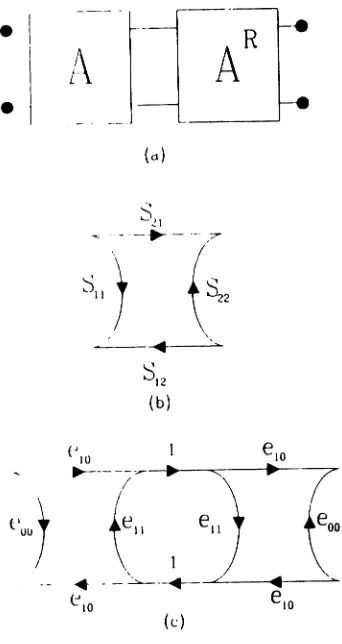
3.5.1
TRL to TSL
As we have seen before, the calibration of a planar measurement fixture, e.g.
microstrip and stripline, requires distributed standards. The preferred method
for planar fixture de-embedding is Thru-Reflect-Line (TRL) or Line-Reflect-Line
(LRL) because the distributed standards are easily modeled and constructed. A
typical microstrip fixture, shown in Fig. 3.5.1, is a first order symmetric fixture.
Identical coax to microstrip transitions and identical microstrip line lengths are the
requirements for symmetry. These can be achieved into low microwavefrequencies
and at higher frequencies through careful design.
Because first orrler svrnrnetrv allows 1he fixtnre to he rpprpsentpd 'Ylfh fhrpp
error terms, three standards are needed. Symmetry permits synthesis of 'I'Rl,
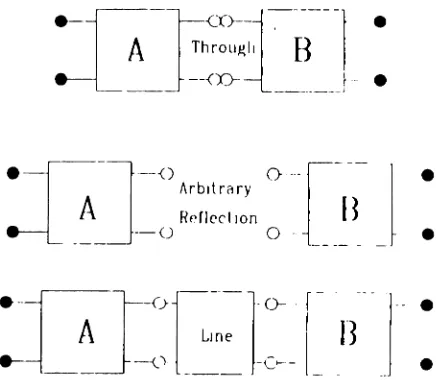
reflection standards thereby eliminating their need. TRL standards are shown
in Fig. 3.5.2; through connection, an reflection and a reference transmission line
Ground Planes
I
'
Embedded - ....~ Microstrip
Une ,
:~
L
=
348 mils
L
=
1348 mils
(a)
Coaxial Reference Planes
8M
..
QJ. ..
~ MicrostriP~"
Q.? ..
A
~
Reference Planes
M1
M2
Vi
(b)
e
hAJ-("">-1~:n~1-~ r~
B
--(")
-c~-- -c~-- - - -
---
.
•
symmetrical through connection, we can calculate the reflection coefficient with
the microstrip ports terminated in ideal open or short circuits. Either synthesized
reflection coefficient can be applied to the TRL algorithm. Conforming to the
naming of de- embedding methods we will refer this substitution as
Through-Symmetry- Line or TSL.
3.5.2
Synthesize Reflection Standards
The TSL standards are a through and line connections, Fig. 3.5.3. These are
similar to Souza et al.
[27]
however their result is based on symmetry and a low fixture return loss assumption. Note, the symmetry reflection coefficients canbe used with the LRL algorithm with similar results. Next we will expound the
derivation of ideal open and short circuit reflection coefficients.
Referring to the signal flow graphs of Fig. 3.5.4, we consider the through
connection 5 parameters given by, 51 1 / (
==
52 2 / ) and 521 / (==
51 2 / ) , and the actualparameters of the A network being
0,
Q and 1 for 51 10.,52 10.==
5
120. and5
220.respectively. In addition, the input reflection coefficient with an ideal short circuit
placed at port. 1h of A is
(3.5.1)
Before we used Mason's rule to relate the fixture parameters to the individual
.--A
.---.
B
Through
(a)
:G
:J~D
Delayt:r
B
t:
(b)
Figure 3.5.3: TSL calibration standards. (a) Through connection and (1») Line
•
r--~\
A
R
10..
~, Jb ~•
J--
-.
(a)
0(.
~--;-I
r
'(IJ
t
\(b)
S.?I
-:.. - - - -.- - - / 7
~ ~
(-..
, II ) :)22
I ~
">
SJ2
(c)Figure 3.5.4: TSL signal Row graphs. (a) Measured fixture s parameters,
(1))
Combining (3.5.1), (3.5.2) and (3.5.3), the short circuit reflection coefficient can
be expressed as a function of fixture s parameters (measured).
(3.5.4)
A similar results holds for an ideal open circuit placed at port 1b.
(3.5.5)
Naturally, TSL can reduce the number of standards needed and requires fewer
connections to the microstrip ports improving the repeatability of this
connec-tion. Moreover, Pae and Poe can be derived for any fixture that exhibits first or
second order symmetry including other planar measurement fixtures. Since these
reflection coefficients are derived mathematically, it is possible to "insert" ideal
open and short circuits within a non-insertable medium such as a dielectric loaded
a symmetrically synthesized short circuit. In the next section will discuss an
3.6
Enhanced Through-Symmetry-Line - ETSL (ETRL)
3.6.1
Motivation: Failure of
TRL Assumpt ions
The development of ETSL, hence ETRL, is necessary because of assumptions
inherent to the TRL algorithm. As introduced in 1979 by Engen and Hoer [20],
the algorithm requires the characteristic impedance of the line standard to be
equal to the measurement system impedance. If not then we its value has to be
determined. Also, the algorithm assumes a pure real characteristic impedance with
no frequency dependence. If the fixture to be calibrated is composed of dispersive
transmission lines, e.g. microstrip, it becomes necessary to determine the complex
characteristic impedance
Z;
as a function of frequency. We present a methodthat enhances the TSL algorithm by determining the characteristic impedance;
Enhanced Through-Symmetry-Line - ETSL. For the sake of discussion we will
consider an embedded rnicrostrip fixture. Application of ETSL to an embedded
microstrip fixture follows in Chapter 5.
An approximate value of
Z;
can be made USIng time domain reflectometry(TDR), however, TDR can not determine frequency variations of the microstrip
characteristic impedance which can vary by as much as 5 percent from DC to 10
GHz
for a typical rnicrostrip line [32]. Also, accurate modeling of Z; is complicatedby several factors; accepted models predict different frequency variations; material
experimentally determined propagation constant, ,
==
a+
jj3.The impedance calculated in this fashion, if used in the conventional TRL algorithm, compensates for the algorithm assumptions. By using a free-space
capacitance explicit knowledge of the dielectric parameters i.e. relative dielectric
constant and loss tangent are not necessary. Also, we can determine characteristic
impedances of geometries that are atypical such as embedded rnicrostrip or any
uniform TEM transmission line. Additionally, by incorporating the propagation constant we embody the effect loss has on the characteristic impedance (complex
Zc).
In short, this method can be used to determine characteristic impedances ofany arbitrary uniform
TErvI
transmission line. In the next section we will developthe characteristic impedance algorithm with microstrip being the transmission
line.
3.6.2
Calculation of
Corn plex
Characteristic Impedance
Microstrip lines are non-homogeneous transmission lines that support. a
f)11~~1-TEM mode [32]. However the TSL algorithm requires the equivalent TElvl mode
characteristic impedance. For uniform TE1'1 transmission lines the characteristic
Dielectric Thickness H
=
5.6 milt
t
Microstrip Width
=
8. mil[§]
Solder Resist LayerD
Substrate Dielectric • Metal (copper)GP Thickness
=
1. milFigure 3.6.1: Embedded microstrip encountered in printed circuit board
1
Zo= =
-Coc
(3.6.2)
where Z; is the dielectric loaded characteristic impedance of the line, Zois its
free-space characteristic impedance,
Co
is the free-space capacitance, c is the velocityof light and fe is the effective dielectric constant.
Co
is a geometrical dependentfactor and is the capacitance of the structure in a dielectric-free medium. It is well
known that the effective dielectric constant is related to the propagation constant
, by [28]
(3.6.3)
where, == a
+
j(3 is available from measurement as a by product of the TRLalgorithm. Recently, Mondal and Chen reported that the TRL algorithm can be
used to determine the propagation constant of the TRL line standard. That is
[29]
where
A
== TIlt· T221+
TIll· T22t - T21t •TI21 - TI2t .T21 ,(3.6.4)
(3.6.5)
Tijl and Tijt are the chain scat tering parameters for the line and through cali
from s to t parameters is given by,
(3.6.6 )
where
(3.6.7)
This result can be derived for any fixture, symmetric or otherwise, and it is a
nat-ural progression to incorporate this information to determine the complex
charac-teristic impedance. Combining (3.6.1)- (3.6.3) and taking the negative root
JW
z,
== ~Cc
0,
(3.6.8)The negative root is chosen because the result must be positive when the line is
lossless and the impedance is positive pure real. This characteristic impedance is
used to overcome impedance assumptions of TRL and is applicable to the TSL
algorithm. The reader is directed to Chapter 5 where this derivation is
experimen-tally verified with a fifty ohm coaxial example. Also, Chapter 5 contains complex
rnicrostrip characteristic impedance calculated with the verified algorithm. Next
we examine singularities that arise when distributed standards are used and
ex-pand on the effect these singularities have on calculating tlie propagation rf)ll~f;'l1f.
3.6.3
Calculation of Propagation Constant
Inherent to the TRL algorithm is the need to separate the error networks with a
mea-degrees it appears transparent. TRL returns invalid results in either case.
In-tuitively the "farthest" we can be from 180 degrees (or zero) would be a phase
difference of 90 degrees and reliable propagation constants can be extracted from
20 to 160 phase differences [30]. By choosing line standards with electrical lengths
within this range the characteristic impedance can be determined with no effect
from the singularities.
3.6.4
Modifying TSL Algor
it hm
Again, the TRL (TSL) algorithm requires a reflectionless line. This is achieved
by transforming each calibration measurement from the measurement reference
impedance to
Zco
Application of TRL then determines the S parameters of theer-ror network referenced to
Zc.
To complete calibration the s parameters of the errornetwork are returned to the measurement reference impedance system, (usually
3.7
Development of Through-Symmetric Fixture - TSF
U sing Second Order Symmetry
What
if
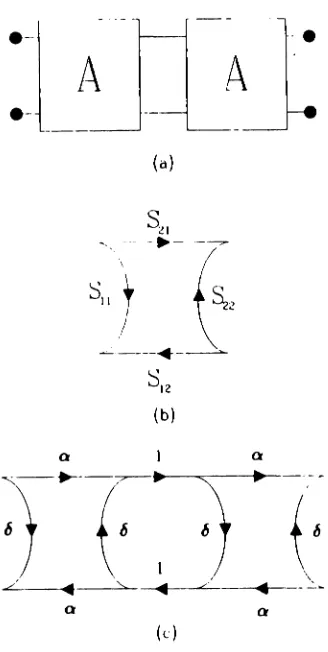
the fixture is second order syrnmetric? Again, we define second ordersymmetry as a first order fixture with symmetric halves. As we have just seen,
symmetry can be used to reduce the number of standards needed. When second
order symmetry is valid the two port error network is represented with two error
terms. Naturally, this allows us to use fewer de-embedding standards, in fact, a
second order fixture requires only one measurement configuration, a through
con-nection, thus in conformance with the practice of naming calibration procedures,
we designate the new technique Through Symmetric Fixture - TSF method.
Fig. 3.7.1 shows the signal flow graph for the fixture s parameters SiiJ and
the corresponding two port error model. Each error is identical and symmetric
therefore the scattering matrix of each is
b Q
[Sija] == (3.7.1)
Q 6
The goal of TSF is to determine the error terms(Q a nd
6)
and based on M ason 'snon-touching loop rule, unlike the matrix renormalizations used by Mar tiu c\11(1
Dukeman [31].
S
parameter measurements of the through connection yield t\VOindependent quantities, 5u / and 521 / , as 5u /
=
522 / and 512 /=
521/ because ofsymmetry and reciprocity. This is sufficient to determine
5
i j a • For clarity, we will•
•
A
(a)
S~I
<, - - - . .
-/
~
I I , 't
i~·
\::i
a- ' - - -_ _~_ _- A .
Sl2
(b)
-
.
-
.
(c)
The signal flow graph provides two algebraic relationships for the known qu a
n-tities as functions of the error terms
,
Rearranging
0:2
S21t -- - -1 _ 6
2
(3.i.2)
(3.i.3)
(3.7.4)
where
Q== (3.7.5)
b== 1
+
S21t (3.7.6)The square root gives t\VO possible solutions and the root choice depends upon the
electrical length
(L
e ) of the through connection. The positive root is valid whenwhere
(2n
+
l)AnA
<
L;<
-2
n == 0,1,2, · ..
(3.7.7)
(3.7.8)
otherwise the negative root is correct. This choice of roots is based on (l
1"'.'
sicalconstraint. The a term is the transmission coefficient of the error network and at
low frequency the phase of Q must be negative therefore the positive root choice
length of the fixture is constructed such that it is not an integer half wavelength
long at any frequency in a desired measurement range. TSF can be used on a
lumped-element transistor test fixture "There this restriction does not exist.
Sim-ilar singularity restrictions exist when other distributed de-embedding techniques
are employed. The reader is directed to Chapter' 5 where
TSF
is experimentallyverified.
3.8
Conclusion
In Chapter 3, we have presented new de-embedding algorithms. By using
sym-metric arguments, it is possible to reduce the required calibration standards. It
was shown that reflection standards can be synthesized from a through
measure-ment. Also, the complex characteristic impedance of uniform TEM transmission
lines can be determined if the transmission line free-space capacitance is known.
T~kln~this irnperlance into ar cou nt . "?P r a n pnhf'nrp thp T~T,or TnT} tllgnrlihms.
Computer implementation of these algorithms is necessary for verification
pur-poses. The next chapter develops SPANA or Signal Processing of Automatic
Network Analysis a command level program useful for algorithm implementation
Chapter
4
SPAN A: Computer Program for Computer
Aided Microwave Measurement
4.1
Introduction to SPANA
Computer processing of microwave measurements is necessary to free the engineer
from the costly measurement time. It is very reasonable to assume that computer
processing is needed since a single t\VO port measurement can produce sixty four
kilobytes (64K) of data.
SPANA
(Signal Processing for Automatic NetworkAnal-ysis) has been developed to meet the needs of automatic microwave measuring
systems.
SPAN A
is a tool to be used for processing measured S parameter data and itsprime use is to implement de-embedding algorithms. SPAN Aalso performs various
tasks such as input/output of data, data format conversions, and others. Written
SPAN A
is by the simplest definitions an operating systemand
the operationsare carried out by using a command language. These commands allow the user
to interact with the data freely. One of the most important assets of