Box length search algorithm for molecular simulation of systems
containing periodic structures
A. J. Schultz, C. K. Hall, and J. Genzer
Department of Chemical Engineering, North Carolina State University, Raleigh, North Carolina 27695
共Received 18 February 2003; accepted 30 October 2003兲
We have developed a box length search algorithm to efficiently find the appropriate box dimensions for constant-volume molecular simulation of periodic structures. The algorithm works by finding the box lengths that equalize the pressure in each direction while maintaining constant total volume. Maintaining the volume at a fixed value ensures that quantitative comparisons can be made between simulation and experimental, theoretical or other simulation results for systems that are incompressible or nearly incompressible. We test the algorithm on a system of phase-separated block copolymers that has a preferred box length in one dimension. We also describe and test a Monte Carlo algorithm that allows the box lengths to change while maintaining constant volume. We find that the box length search algorithm converges at least two orders of magnitude more quickly than the variable box length Monte Carlo method. Although the box length search algorithm is not ergodic, it successfully finds the box length that minimizes the free energy of the system. We verify this by examining the free energy as determined by the Monte Carlo simulation. © 2004
American Institute of Physics. 关DOI: 10.1063/1.1636156兴
I. INTRODUCTION
In molecular-level simulations it is sometimes necessary to allow the shape and volume of a simulation box to change in order to accomodate structures with periodic spacing. The standard way to accomplish this is to run the simulation at constant pressure or tension1– 6 as first described by Par-rinello and Rahman. In this paper, we present a new way to accomodate periodic structures that involves finding the simulation box lengths that equalize the pressure in each direction, while maintaining the total volume at a constant value.
One example of a system that has periodic spacing is a microphase-separated block copolymer system. In order to quantitatively compare block copolymer simulation results with theoretical predictions, simulations need to be con-ducted at constant density. However, if a traditional constant pressure algorithm is used, the density cannot be set. Instead, preliminary simulations would be required to find the appro-priate pressure to match the density, or a single pressure would have to be used, and the resulting variation in density 共and hence the parameter兲 would complicate the analysis of the data.7An alternative that is sometimes used is to run the simulations in a box that is large enough to accommodate multiple orientations of the structure and assume that the system will find the orientation with the correct periodic spacing. To solve this problem, we have developed an algo-rithm which finds the appropriate box lengths 共those corre-sponding to the minimum in free energy兲while maintaining constant density.
The algorithm operates by calculating the pressure in different directions and using that information to change the box lengths to more appropriate values. Additionally, the al-gorithm suppresses box length fluctuations by responding to the average rather than to the instantaneous pressure. The
end result is a system with box lengths that minimize the free energy and desired density. Although this algorithm does not properly sample phase space 共because it responds to the av-erage rather than to the instantaneous pressure兲 it does find the appropriate box length which can then be used in further NVT simulations at fixed box length.
We also describe a new Monte Carlo method to find the appropriate box lengths. This method essentially expands the standard NVT algorithm to include moves which change the box lengths while maintaining constant volume. Although this method samples phase space properly, it does not con-verge to the appropriate box lengths as quickly as the box length search algorithm. We use this Monte Carlo method to verify that the box length from the box length search algo-rithm corresponds to the minimum in the free energy.
II. METHODS
A. Thermodynamic basis for the algorithm
In order for the box length search algorithm to be suc-cessful, it must find the box lengths that minimize the free energy of the system. In this section, we derive an expression for the change in free energy when the box lengths are changed at constant volume, and use this expression to show that the algorithm will converge to the box lengths that mini-mize the free energy.
We start with the expression for the change in free en-ergy at constant number of molecules, n, and temperature, T,
␦A⫽⫺P␦V,
where A is the Helmholtz free energy, V is the volume, and
P is the pressure. This equation only applies to a system in
which the pressure is isotropic. If we reformulate this expres-sion so that it becomes appropriate for a system undergoing a
2049
volume change in only one direction, say the x direction, with the number of molecules and temperature fixed, we find
␦A⫽⫺PxLyLz␦Lx,
where Li and Pi are the box length and pressure in the i direction. This can be extended to the case in which all three box lengths change
␦A⫽⫺PxLyLz␦Lx⫺PyLxLz␦Ly⫺PzLxLy␦Lz. 共1兲 Next, consider the case of having all three box lengths vary, but keeping the total volume fixed as well as the num-ber of molecules and the temperature. The box length changes in this case are then restricted by the equation
LxLy␦Lz⫹LxLz␦Ly⫹LyLz␦Lx⫽0
which can be solved for␦Lz,
␦Lz⫽⫺LxLz␦Ly⫹LyLz␦Lx LxLy
. 共2兲
Substituting Eq.共2兲into Eq.共1兲yields
␦A⫽⫺PxLyLz␦Lx⫺PyLxLz␦Ly⫹Pz共LxLz␦Ly ⫹LyLz␦Lx兲
⫽⫺共Px⫺Pz兲LyLz␦Lx⫺共Py⫺Pz兲LxLz␦Ly.
Reformulating this expression in terms of reduced variables yields
␦A*⫽⫺Z
冋冉
Px⫺PzP
冊
␦Lx
Lx
⫹
冉
Py⫺PzP
冊
␦Ly
Ly
册
, 共3兲
where A*⫽A/nkBT, Z⫽PV/nkBT, and P⫽( Px⫹Py ⫹Pz)/3.
Based on Eq.共3兲, we can see that if the pressure in the x dimension is greater than the pressure in the z dimension, then increasing the box length in the x direction will de-crease the free energy of the system. The same happens if the box length in the y direction is increased when the pressure in the y dimension is greater than the pressure in the z di-mension. This is true regardless of the box length change in the z dimension necessary to maintain constant volume 关 no-tice that ␦Lz does not appear in Eq.共3兲兴so long as the box length changes are small. The ability to predetermine the sign of the free energy change for any given box length change provides the thermodynamic basis for the box length search algorithm.
B. Description of the box length search algorithm
The steps used in the algorithm to determine the box lengths that minimize the free energy of the system are the following. The first step is to run the simulation with fixed box lengths for a set length of time, ⌬t, and calculate the
pressure in each direction ( Px, Py, and Pz). We can use the virial theorem to calculate these pressures
Pk⫽kBT⫹
冓
兺
i兺
j⬎iri jkfi jk
冔
冒
V, 共4兲where is the particle density of the system (Np/V), and
ri jk and fi jk are the k component of the distance and force between particle pair i and j.
The second step is to pick one dimension 共we will choose z for consistency with the previous section兲, and to compare the pressure in that dimension, Pz, with the pres-sure in the other two dimensions. If Pzdiffers from the pres-sure in the x or y dimensions, then the box length in that dimension (x or y ) is changed 共increased or decreased兲 by ⌬Lx or ⌬Ly so that the free energy of the system will de-crease, according to Eq. 共3兲. Simultaneously, the box length in the z direction is changed to maintain constant volume. The coordinates of all the particles, r, are scaled with the box length change ri,x⫽ri,xLx
⬘
/Lx, ri,y⫽ri,yLy⬘
/Ly, and ri,z ⫽ri,zLz⬘
/Lz, where Lk⬘
is the new box length and Lk is the old box length. If the particles have steep or discontinuous potentials, it may be necessary to perform the box length changes in small increments so that the system’s potential energy does not increase too much. These two steps are per-formed repeatedly until each box length converges to a par-ticular value.The behavior of the algorithm can be adjusted by chang-ing the algorithm parameter,⌬t. If⌬t is small, the algorithm
responds quickly to pressure differences. If ⌬t is large, the
algorithm responds more slowly, but the box lengths fluctu-ate less because the average in Eq. 共4兲 contains more samples. The quickest way to find an appropriate value for ⌬t is to guess a trial value and run a short simulation. Once
the box length search algorithm has determined an approxi-mate value for the optimal box lengths, increase⌬t in order
to more precisely determine the optimal box lengths. In order to suppress even more of the fluctuations, the box length search algorithm tracks the pressures from previ-ous iterations and acts only if the pressure in the last iteration and the average pressure in the z direction during the past five iterations are both above or both below the pressure in the x and y directions. Additionally, if the pressure in the z direction from all five iterations is consistently above or be-low the pressure in the x and y directions, then the algorithm acts with twice the normal box length change ⌬L. This
C. Variable box length Monte Carlo algorithm
In this section, we extend the standard canonical Monte Carlo algorithm so that it allows the box lengths to fluctuate while still sampling the NVT ensemble. We use this Monte Carlo algorithm to verify that the box length search algo-rithm described in the previous section finds the minimum in the free energy. In the standard NVT algorithm, reversible particle moves are proposed randomly and accepted with the standard Metropolis criterion,
Pacc⫽min共1,exp兵⫺⌬U其兲. 共5兲
In our modified algorithm, we also include reversible box length ‘‘moves’’ and scale the particle coordinates as in the box length search algorithm. For each box length move, the box lengths in two of the dimensions, for instance x and
y , are changed by⌬Lxand⌬Ly, each of which is randomly chosen between ⫺⌬Lmaxand⌬Lmax. The box length in the third dimension (z) is changed so that the volume remains constant; these moves are accepted with the standard Me-tropolis criterion, Eq. 共5兲, which is applicable because the total volume is conserved.
The algorithm has two parameters, the maximum box length change (⌬Lmax) and the frequency with which box
length changes are attempted. Just as in any Monte Carlo algorithm, these parameters can be adjusted to optimize the algorithm’s exploration of box length phase space.
III. RESULTS
A. Validation of the box length search algorithm In this section, we validate the box length search al-gorithm by calculating the free energy versus the box length using the variable box length Monte Carlo algorithm. As a test to see if the free energy is a minimum at the box length obtained in the box length search algorithm, we consider a system of symmetric block copolymers that we have studied previously.8 This system orders into lamellar sheets, which are one-dimensional periodic structures. Here the only box dimension with a natural periodicity共and hence requiring a particular value for the box length兲is the dimension perpen-dicular to the lamellar interface, Lx. The box lengths in the other directions can take any values that maintain constant volume. Therefore we restrict the box length search algo-rithm and the variable box length Monte Carlo algoalgo-rithm so as to maintain the same box length in the two dimensions parallel to the interface, i.e., Ly⫽Lx and⌬Ly⫽⌬Lx. Equa-tion 共3兲then reduces to
␦A*⫽⫺2Z
冋冉
共Px⫹Py兲/2⫺PzP
冊
⌬Lx
Lx
册
.So now in our box length search algorithm, we only need to look at the average of the x and y pressures and compare that with Pz. For the variable box length Monte Carlo algorithm, we restrict the proposed moves such that⌬Lx⫽⌬Ly. Use of an algorithm that maintains constant volume while the tem-perature, volume fraction of each component, or chain length is varied, is critically important to making quantitative com-parisons with experiment and/or theory. This is because ex-perimental research on block copolymers focuses on melts or
on copolymers in solution at a fixed concentration, both of which are nearly incompressible.9–11Theoretical calculations generally assume incompressibility12–16and most simulation studies are performed on a lattice where the total volume must be fixed.17–20
We use discontinuous molecular dynamics共DMD兲 共Ref. 21兲 to simulate the motion of the individual copolymer chains in both the box length search algorithm and the vari-able box length Monte Carlo algorithm. In the varivari-able box length Monte Carlo algorithm, we run a standard NVT DMD simulation, but attempt box length changes at random time intervals during the DMD simulation. Such a hybrid Monte Carlo/molecular dynamics simulation is valid because both algorithms properly sample NVT phase space.
The systems used for both simulations contain 125 sym-metric ( f⫽0.5) block copolymers modeled as a flexible chain of 10 spheres, with component A spheres on one end and component B spheres on the other. All nonbonded co-polymer beads interact with a hard sphere interaction when separated by a distance . Adjacent beads along the chain have a hard sphere interaction when separated by a distance 0.85 and bounce back when they reach a separation of 1.15.22 Unlike beads interact with an additional square shoulder repulsive interaction of strength ⑀AB when sepa-rated by distance 2. The simulations are conducted at N
⫽49, where⫽⑀AB/kT,is the average number of neigh-bors within the interaction distance, 2, and N is the copoly-mer chain length. The value of N puts the system well
above the order–disorder transition, which occurs at about
N⫽25. Further details on the simulation of this copolymer system can be found in Ref. 8. For the simulations reported here, we always started the system with a lamellar structure oriented perpendicular to the z axis. Although large systems are capable of forming lamellae from disorder in less than 15 CPU hours, the resulting structure is almost always oriented diagonally within the simulation box and often has meta-stable defects. This diagonal orientation confuses the box length search algorithm and variable box length Monte Carlo because spacing in a diagonally oriented structure is less sen-sitive to changes in box length than in a perpendicularly oriented structure.
The box length search algorithm simulation was run for two different size systems, n⫽125 and n⫽1000, until they converged to the optimal box length in the z dimension, Lz ⫽9.602 for the n⫽125 system and Lz⫽19.222 for the
n⫽1000 system.共The n⫽1000 system contained two lamel-lar repeat units in the z direction.兲The uncertainty in each of these measurements is approximately 0.002, which is the amplitude of the box length fluctuations that existed when the algorithm was stopped. The variable box length Monte Carlo algorithm was also run for 300 CPU hours for the n ⫽125 system and 390 CPU hours for the n⫽1000 system to collect a histogram of the probability that the box length in the z dimension takes on any value, Lz,i. The free energy associated with box length Lz,i can then be calculated from the Monte Carlo simulation using23
Ai⫽A0⫺kT ln␣i, 共6兲
that the box length is between Lz,i⫺w/2 and Lz,i⫹w/2,
where w is the histogram bin width. We set A0⫽0. For the
system with n⫽125, we set w/⫽0.001 and for the n ⫽1000 system, we set w/⫽0.0025. The results for A/nkT as a function of d/ are plotted in Fig. 1, where d is the periodic spacing between lamellae. The error bars on se-lected points correspond to the standard deviation in the mean from three sections of the simulation. The uncertainty in the minimum location can be estimated by determining the box lengths共adjacent to the free energy minimum兲where the free energy error bars both lie above those at the minimum. In this case, 9.50⬍d/⬍9.75 for the small system and 9.45⬍d/⬍9.70 for the large system. The minima in the n ⫽125 system and in the n⫽1000 system at approximately
d/⫽9.6 verify共within the error of the variable box length Monte Carlo algorithm兲that the box length search algorithm ‘‘finds’’ the optimal box lengths.
B. Performance
It is of interest to compare the performance of the box length search algorithm and the variable box length Monte Carlo algorithm. To do this, we ran both types of simulations starting from various box lengths to test the rate of conver-gence of both methods to the optimal box length. Since both types of simulations with a small system size (n⫽125) con-verge to the box length relatively quickly. We focused our attention on the more challenging n⫽1000 system, which contains two lamellar repeat units.
The parameters for the box length search algorithm were chosen 共in reduced units兲 to be ⌬t*⬅⌬t
冑
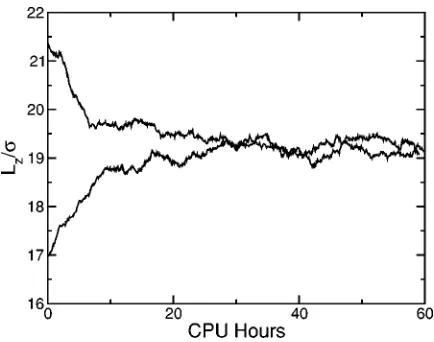
kBT/⫽5 and ⌬L/L⫽0.0001. The Monte Carlo algorithm parameter ⌬Lmax/, the maximum box length change, was chosen to be equal to 0.002; the average number of reduced time units between box length change attempts was chosen to be 0.01. These Monte Carlo parameters maximize the box length fluctuations and hence the algorithm’s rate of exploration of phase space.We plot Lz/2 versus CPU time for the n⫽1000 system from the box length search algorithm in Fig. 2共a兲and from the variable box length Monte Carlo algorithm in Fig. 3.
Both simulations were started with box lengths of 17.0and 21.4. All simulations were performed on 666 MHz Alpha EV67 processors. The most apparent difference between the behavior of the box length search algorithm and the variable box length Monte Carlo algorithm is the absence of fluctua-tions in the box length search algorithm. The fluctuafluctua-tions about the equilibrium value in the Monte Carlo algorithm are substantial (⬃0.3) and slow. In the box length search al-gorithm, the fluctuations are smaller (⬃0.1) and quick. Since the fluctuations in the box length search algorithm do not obey any thermodynamic norm, the only reliable conclu-sion is that the minimum free energy box length lies some-where between the maxmium and minimum box length value. In order to more precisely determine the optimal value for the box length we ran a second set of simulations starting at 19.1and 19.3with⌬t*⫽50. With the increased value for ⌬t*, the algorithm suppresses even more of the fluctua-tions, reducing the uncertainty共the amplitude of the fluctua-tions兲to 0.02.
Although the Monte Carlo algorithm converges to the equilibrium value, the amplitude and slowness of the fluctua-tions hamper the determination of the precise value of the free energy minimum. The Monte Carlo results in Fig. 1
FIG. 1. Free energy as a function of box length from the variable box length Monte Carlo algorithm for system sizes N⫽125 and N⫽1000. Also shown is the free energy minimum as determined by the box length search algo-rithm.
FIG. 2. Box length as a function of CPU hours using the box length search algorithm starting from different initial box lengths with共a兲 ⌬t*⫽5 and共b兲 ⌬t*⫽50.
illustrate this drawback. Although the Monte Carlo algorithm simulation was run for 390 CPU hours for the larger system, the algorithm determined the appropriate box length with less precision (9.49⬍d/⬍9.69) than the box length search algorithm achieved in 3 h (9.55⬍d/⬍9.65). Using a tra-ditional Monte Carlo constant pressure simulation in this case would require additional time to determine the appro-priate pressure and then convergence would be even slower than the variable box length Monte Carlo aglorithm because of the volume fluctuations.
In order to better quantify the performance of the box length search algorithm and the variable box length Monte Carlo algorithm, we calculated the autocorrelation function of the box length in the z dimension while each method was being used. We have plotted these autocorrelation functions versus CPU hours in Fig. 4. The box length in the box length search algorithm appears to ‘‘forget’’ its old value slightly faster than the variable box length Monte Carlo algorithm, 共although this difference is on the order of the uncertainty in the autocorrelation itself兲. This result might at first seem sur-prising since the box length search algorithm was over 100 times faster than the variable box length Monte Carlo algo-rithm. Apparently, the box length search algorithm explores a much narrower range of phase space, so that during the time it takes the algorithm to ‘‘forget’’ its previous value, it is able to get a much better estimate of the optimal box length than the Monte Carlo algorithm.
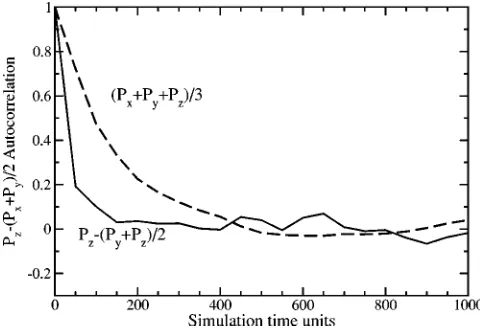
Another autocorrelation function that can help to eluci-date the box length search algorithm’s superior performance compared to the variable box length Monte Carlo algorithm is the autocorrelation function of the difference between the pressure in the z dimension and the average of the pressures in the x and y directions. This is useful because the box length search algorithm’s performance depends directly on how quickly these pressure fluctuations die out. The autocor-relation functions for Pz⫺( Px⫹Py)/2 and the autocorrela-tion funcautocorrela-tion for the total pressure, P⫽( Px⫹Py⫹Pz)/3 were obtained by running the simulation at constant volume and averaging each pressure sample over 50 reduced time units. The results are shown in Fig. 5. From this plot, we can see that the pressure difference is nearly decorrelated within
50 reduced time units, which is much faster than the decor-relation time for the box length seen in Fig. 4. It is also faster than the decorrelation of the total pressure, indicating that the pressure in each dimension fluctuates cooperatively. This cooperative fluctuation means the box length in the box length search algorithm will fluctuate less than in an al-gorithm that depends on the total pressure, such as a constant pressure Monte Carlo algorithm. It is the pressure differ-ence’s fast decorrelation time that leads to the fast perfor-mance of the box length search algorithm.
Although the performance measurements given thus far are based on simulations of chains of length 10, one might wonder if the performance difference between the algorithms would diminish for systems with longer chains. The relax-ation time of these longer chains might be expected to domi-nate any dynamics in the system and cancel advantages that were seen with the box length search algorithm for short chain systems. To test this, we performed additional simula-tions on a system containing 640 chains of length 40. The temperature was adjusted to maintain a constant value ofN
at 49. The simulations were performed with the parameters used in the previous simulations: ⌬t*⫽50 and ⌬L/L
⫽0.0001 for the box length search algorithm and ⌬L
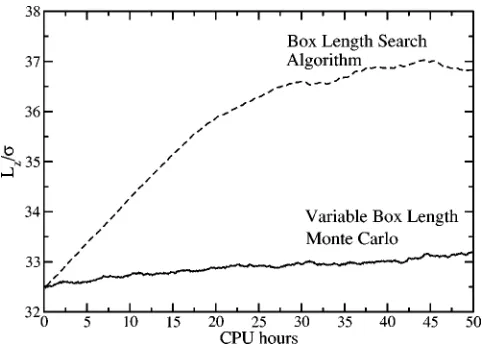
⫽0.002for the variable box length Monte Carlo algorithm. The average time between MC box length change attempts was maintained at 0.01. We plot Lz/2 versus CPU time in Fig. 6 for both algorithms starting with the peridoic spacing at 36.5, which is somewhat lower than the optimal value of 36.9. The box length search algorithm takes about 35 CPU hours to arrive at the optimal value of 36.9 and then fluctu-ates with an amplitude of about 0.2. The box length in the variable box length Monte Carlo simulation fluctuates be-tween 36.2 and 37.4 for the duration of the simulation. Even after 600 h, we were unable to determine the optimal box length based on the Monte Carlo data. We also tested the longer chain system starting with the box length at 32.5, which is much lower than the optimal value. The box length versus CPU hours for this run is plotted in Fig. 7 for both algorithms. The box length search algorithm continues to maintain a substantial advantage over the variable box length
FIG. 4. Autocorrelation function of the box length for the box length search and the variable box length Monte Carlo algorithms.
Monte Carlo algorithm, converging about 10 times more quickly than the Monte Carlo algorithm.
Although we cannot make a quantitative comparison be-tween the performance of the two algorithms, we can say that the box length search algorithm continues to perform much better than the variable box length Monte Carlo algo-rithm, even for longer chains.
IV. SUMMARY AND DISCUSSION
We have developed a box length search algorithm that converges to the box lengths at which the free energy of the system is at a minimum while maintaining constant volume. Such an algorithm is useful for finding appropriate box lengths for periodic structures for further NVT simulations. We have also developed a Monte Carlo algorithm that ex-plores NVT phase space while allowing the box lengths to fluctuate. We have compared the two algorithms using a block copolymer lamellar structure and verified that the box length search algorithm converges to the box length with the
lowest free energy as determined from the Monte Carlo simulation. We also found that the box length search al-gorithm converges more quickly to the optimal box length than the Monte Carlo algorithm because the amplitude of the fluctuations in the box length is reduced.
Although the box length search algorithm performed well in the cases described here, there are some more com-plex cases that the algorithm cannot handle well. For in-stance, if the free energy is insensitive to the box length, then the algorithm assumes that the minimum has been reached and suppresses fluctuations that would move the box length out of the area of insensitivity. If the free energy contains multiple minima, the algorithm can get stuck in a metastable state. In such a case, the variable box length Monte Carlo algorithm could be used to properly simulate the system. A more direct approach that maintains the spirit of the box length search algorithm would be to sample Px, Py, and Pz as a function of the box lengths and then plot the difference in pressure between the dimensions ( Pz⫺Pxand Pz⫺Py) to determine the box lengths at which the pressure differences are zero. This method avoids any convergence problem with the box length search algorithm but would still converge more rapidly than the variable box length Monte Carlo algo-rithm. However, even the Monte Carlo sampling technique would be inadequate for many systems with multiple minima. The lamellar system investigated in this paper does contain multiple minima corresponding to identical periodic spacing but different lamellar orientations or number of re-peat units. Neither algorithm was able to sample these dif-ferent orientations. If sampling multiple minima is truly im-portant, the most robust approach would be to start multiple simulations with different initial box lengths and allow either one of the algorithms to find the free energy minima of the system. Finally, we should point out that the box length search algorithm’s inability to locate the global minimum in some systems with multiple free energy minima does not detract from its applicability to cases without multiple free energy minima.
ACKNOWLEDGMENTS
This work was supported by the GAANN Computational Sciences Fellowship of the U. S. Department of Education and the Office of Energy Research, Basic Sciences, Chemical Science Division of the U. S. Department of Energy under Contract No. DE-FG05-91ER14181. Acknowledgment is made to the Donors of the Petroleum Research Fund admin-istered by the American Chemical Society for partial support of this work.
1M. Parrinello and A. Rahman, Phys. Rev. Lett. 45, 1196共1980兲. 2M. Parrinello and A. Rahman, J. Appl. Phys. 52, 7182共1981兲. 3R. Najafabadi and S. Yip, Acta Metall. 17, 1199共1983兲. 4M. Parrinello and A. Rahman, J. Chem. Phys. 80, 860共1984兲. 5
C. L. Cleveland and U. Landman, J. Chem. Phys. 94, 7376共1991兲. 6C. L. Cleveland, J. Chem. Phys. 89, 4987共1988兲.
7M. Murat, G. S. Grest, and K. Kremer, Macromolecules 32, 595共1999兲. 8A. J. Schultz, C. K. Hall, and J. Genzer, J. Chem. Phys. 117, 10329
共2002兲. 9
T. P. Lodge, M. W. Hamersky, K. J. Hanley, and C.-I. Huang, Macromol-ecules 30, 6139共1997兲.
FIG. 6. Box length as a function of CPU hours using the box length search and variable box length Monte Carlo algorithms for a system of 640 chains of length 40. The box length starts at a 36.5, which is slightly less than the optimal value.
10N. Sakamoto et al., Macromolecules 30, 5321共1997兲.
11C. Lai, W. B. Russel, and R. A. Register, Macromolecules 35, 4044
共2002兲.
12L. Leibler, Macromolecules 13, 1602共1980兲.
13G. H. Fredrickson and E. Helfand, J. Chem. Phys. 87, 697共1987兲. 14M. W. Matsen and F. S. Bates, J. Chem. Phys. 106, 2436共1997兲. 15M. D. Whitmore and J. Noolandi, J. Chem. Phys. 93, 2946共1990兲. 16M. W. Matsen, J. Phys.: Condens. Matter 13, 0共2001兲.
17R. G. Larson, Macromolecules 27, 4198共1994兲.
18A. Hoffmann, J. Sommer, and A. Blumen, J. Chem. Phys. 106, 6709
共1997兲.
19G. Besold, O. Hassager, and O. G. Mouritsen, Comput. Phys. Commun.
122, 542共1999兲.
20H. Fried and K. Binder, J. Chem. Phys. 94, 8349共1991兲.
21S. W. Smith, B. D. Freeman, and C. K. Hall, J. Comput. Phys. 134, 16
共1997兲.
22A. Bellemans, J. Orban, and D. V. Belle, Mol. Phys. 39, 781共1980兲. 23