A DNA SEQUENCE DESIGN FOR DIRECT-PROPORTIONAL
LENGTH-BASED DNA COMPUTING USING
DNASEQUENCEGENERATOR
ZUWAIRIE IBRAHIM, TRI BASUKI KURNIAWAN, and MARZUKI KHALID
Department of Mechatronics and Robotics, Faculty of Electrical Engineering, Centre for Artificial Intelligence and Robotics (CAIRO),
Universiti Teknologi Malaysia, 81310 UTM Skudai, Johor Darul Takzim, Malaysia
[email protected], [email protected] URL: http://blog.fke.utm.my/~zuwairie/
NOR HANIZA SARMIN
Department of Mathematics, Faculty of Science, Universiti Teknologi Malaysia, 81310 UTM Skudai,
Johor Darul Takzim, Malaysia [email protected]
Abstract: - DNA computing has emerged as an interdisciplinary field that draws together molecular biology,
chemistry, computer science, and mathematics. The fundamental of this unconventional computation has been proven to solve weighted graph problems, such as the shortest path problem and the travelling salesman problem. One of the fundamental improvements in DNA computing is direct-proportional length-based DNA computing for the shortest path problem. Generally, in DNA computing, the DNA sequences used for the computation should be critically designed in order to reduce error that could occur during computation. In this paper, a procedure to design the DNA sequences for the direct-proportional length-based DNA computing is presented. The procedure includes DNASequenceGenerator, a graph-based approach for designing a set of good DNA sequences.
Keywords: DNA computing, DNASequenceGenerator, sequence design, the shortest path problem.
1 INTRODUCTION
A new computing paradigm based on DNA computing has appeared in 1994 when Leonard M. Adleman [Adleman, 1994] launched a novel in vitro approach to solve the so-called Hamiltonian path problem (HPP) with seven vertices by DNA molecules. While in conventional silicon-based computer, information is stored as binary numbers in silicon-based memory, he encoded the information of the vertices by generating randomized DNA sequences. The computation is performed by a series of primitive bio-molecular reactions involving hybridization, denaturation, ligation, magnetic bead separation, and polymerase chain reaction (PCR). The output of the computation, also in the form of DNA molecules can be read and “printed” by electrophoretical fluorescene method such as agarose gel electrophoresis or polyacrylamide gel electrophoresis (PAGE).
Various kinds of methods and strategies for DNA sequence design have been proposed to date. As reviewed by Shin et al. [Shin et al, 2005], those strategies are exhaustive search [Hetermink et al, 1998], random search [Penchovsky and Ackermann, 2003], template-map strategy [Frutos et al, 1997; Arita and Kobayshi, 2002], graph method [Feldkamp et al, 2001], stochastic methods [Tanaka et al, 2001], dynamic programming [Marathe et al, 1999], biolo-gical-inspired methods [Deaton et al, 2002; Heitsch et al, 2002], and evolutionary algorithms [Deaton et al, 1998; Zhang and Shin, 1998; Arita et al, 2000; Ruben et al, 2001; Shin et al, 2002].
DNA sequences used for the computation based on DPLB-DNAC should be carefully determined in order to reduce errors that could occur during the computation. In this paper, DNASequenceGenerator [Feldkamp et al, 2001], which is based on the graph method, is employed for designing DNA sequences for DPLB-DNAC. DNASequenceGenerator used a directed graph to design DNA sequences. The nodes in the graph represent base strands and a node has four strands that can appear as successors in a longer sequence as its child nodes. Then, by travelling the graph from root to leaf the DNA sequences can be designed. This approach also is able to find a set of orthogonal DNA sequences within a predefined error rate quickly as shown in Fig.1. The usefulness of the generated DNA sequences is demonstrated by experimentally implementation of the direct-proportional length-based DNA computing for the shortest path problem.
2 THE SHORTEST PATH PROBLEM
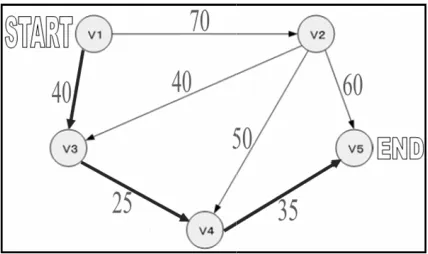
The input to the shortest path problem is a weighted directed graph G = (V, E, ω), a start node u, and an end node v. The output of the shortest path problem is a (u,v) path with the smallest cost. In the case given in Fig.2, if u is V1 and v is V5, the cost for the shortest path will be given as 100 and the optimal path is clearly shown as V1–V3–V4–V5. Even though the shortest path problem is belonging to the class P, it is worthy of being solved by DNA computing because numerical evaluation is involved during the computation.
3 PROCEDURE OF THE DNA SEQUENCE DESIGN
For the DNA sequence design, several constraints adapted from [Innis and Gelfand, 1990] are considered as follows:
− Primers should be 17-28 bases in length − Base composition should be 50-60% (G+C) − Primers should end (3’) in a G or C, or CG or
GC to prevents “breathing” of ends and increases efficiency of priming
− Melting temperature Tm between 55-80ºC are preferred
− Runs of three or more Cs or Gs at the 3’-ends of primers may promote mispriming at G or C-rich sequences (because of stability of annealing) and should be avoided.
These constraints should be critically considered during the DNA sequence design. In this paper, the DNA sequences used for the computation are designed by using the DNASequenceGenerator, a program for constructions of DNA sequences, which can be freely downloaded at http://ls11-www.cs.uni-dortmund.de/molcomp. DNASequence-Generator uses a concept of uniqueness that, within a pool of sequences, allows any subsequence of a certain definable length to occur at most once in that pool. The first step of the DNA sequence design is to generate five unique single-stranded DNA sequences for each node in the graph which satisfy the previous constraints. During the generation of DNA sequences, the constraint for GC percentage (GC%) is chosen within the range of 50-55%. On the other hand, the melting temperature, Tm, which is calculated using the Sugimoto thermodynamic parameters [Sugimoto et al, 1996] is set around 60ºC. Five DNA sequences and the complements for each node which satisfy the constraints are listed in Table 1.
In order to formulate the length constraint in the length-based DNA computing, let |V| be the total number of nodes in the graph.
V
i (i = 1, 2, …, |V|) and Vi(i = 1, 2, …, |V|) be the 20-mer DNA sequences correspond to the ith node in the graph and its complement, respectively. Three rules to synthesize oligos for each edge in the graph are designed as follows:1) For a connection between V1 to Vj, synthesize the oligo for the edge as V1(20) + W1j (ω- 30) + Vj (20)
2) For a connection between Vi to Vj, where i ≠ 1, j ≠ |V|, synthesize the oligo for the edge as Vi (20) + Wij (ω- 20) + Vj (20)
Fig 1. Graph method in DNASequenceGenerator
Table 1. DNA sequences designed for nodes.
Node Sequences
V1 AAAGCTCGTCGTTTAGGAGC
V2 GCACTAGGGATTTGGAGGTT
V3 GCTATGCCGTAGTAGAGCGA
V4 CGATACCGAACTGATAAGCG
V5 CGTGGGTGGCTCTGTAATAG
where V, W, and ‘+’ denote the DNA sequences for nodes, DNA sequences for weight, and ‘joint’ respectively. Furthermore, ‘ω’ denotes the weight value for corresponding DNA sequences for weight Wij where Wij denotes the DNA sequences representing a cost between node
value in parenthesis indicates the number bases or nucleotides for each segment. DNA sequences for weight Wij
during hybridization of initial pool generation, the constraints for these sequences are relaxed for the generation of DNA sequences based on DNASequenceGenerator.
For easier understanding, Fig.3, Fig. visualize how each edge is encoded.
DNA sequences for edges designed based on the rules are listed in Table 2. The synthesized oligos consist of three segments; two node
edge segment.
4 EXPERIMENTAL IMPLEMENTATION
After the DNA sequences are designed, the oligos of the complement of the node sequences and edges sequences are synthesized. Then, all the synthesized oligos are poured into a test tube for initial pool generation via parallel overlap assembly (
To describe graphically how the initial generated by POA [Ibrahim, 2005
DNASequenceGenerator
Fig.2. A weighted undirected graph
Table 1. DNA sequences designed for nodes.
Sequences (5’-3’) Complements (5’-3’)
AAAGCTCGTCGTTTAGGAGC GCTCCTAAACGACGAGCTTT
GCACTAGGGATTTGGAGGTT AACCTCCAAATCCCTAGTGC
GCTATGCCGTAGTAGAGCGA TCGCTCTACTACGGCATAGC
CGATACCGAACTGATAAGCG CGCTTATCAGTTCGGTATCG
CGTGGGTGGCTCTGTAATAG CTATTACAGAGCCACCCACG
, and ‘+’ denote the DNA sequences for sequences for weight, and ‘joint’ ’ denotes the weight value for corresponding DNA sequences for weight denotes the DNA sequences representing a cost between node Vi and Vj. The number of DNA bases or nucleotides for each segment. Since the are not involve during hybridization of initial pool generation, the constraints for these sequences are relaxed for the generation of DNA sequences based on
, Fig.4, and Fig.5 visualize how each edge is encoded. The resultant DNA sequences for edges designed based on the rules are listed in Table 2. The synthesized oligos consist of three segments; two node segments and an
NTATION
After the DNA sequences are designed, the oligos of the complement of the node sequences and edges all the synthesized oligos are poured into a test tube for initial pool
parallel overlap assembly (POA). To describe graphically how the initial pool can be
Ibrahim, 2005], the double
stranded DNA (dsDNA) in Fig.
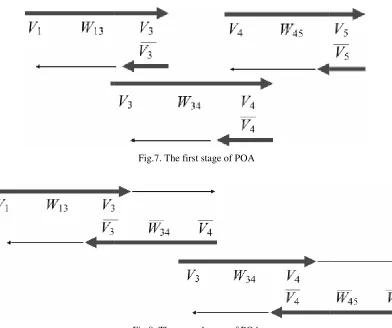
shortest path of the shortest path problem. Several single stranded DNAs (ssDNA), which are shown by thin lines, are required for the generation of that dsDNA. In this example, 3 cycles are required in order to generate the target dsDNA. Th
the first stage, second stage, and third stage of POA for generating the dsDNAs of the shortest path are shown in Fig.7, Fig.8, and Fig.
The initial pool generation by POA was performed in a 100 µl solution containing 12
Primers & Probes, USA), 10
Japan), 10 µl 10x KOD dash buffer (TOYOBO, Japan), 0.5 µl KOD dash (TOYOBO, Japan), and 67.5 µl ddH20 (Maxim Biotech, Inc., Japan). The reaction consisted of 25 cycles and for each cycles, the appropriate temperature were as follow
− 94ºC for 30s − 55ºC for 30s − 74ºC for 10s
Next, the generated initial pool generation is subjected to amplification by PCR in order to amplify exponentially, DNA molecules that contain the start node V1 and end node
accomplished, there should be a big numbers of DNA molecules representing the start node end node V5 travelling through a possible number of nodes. Four types of expected amplified dsDNAs after PCR are given in Fig.10.
. A weighted undirected graph G = (V, E)
GCTCCTAAACGACGAGCTTT AACCTCCAAATCCCTAGTGC TCGCTCTACTACGGCATAGC CGCTTATCAGTTCGGTATCG CTATTACAGAGCCACCCACG
(dsDNA) in Fig.6, represents the shortest path of the shortest path problem. Several (ssDNA), which are shown by thin lines, are required for the generation of that dsDNA. In this example, 3 cycles are required in order to generate the target dsDNA. The output of the first stage, second stage, and third stage of POA for generating the dsDNAs of the shortest path are
, and Fig.9, respectively. The initial pool generation by POA was performed
solution containing 12 µl oligos (Proligo Primers & Probes, USA), 10 µl dNTP (TOYOBO, 10x KOD dash buffer (TOYOBO, KOD dash (TOYOBO, Japan), and ddH20 (Maxim Biotech, Inc., Japan). The reaction consisted of 25 cycles and for each cycles,
riate temperature were as follows:
Next, the generated initial pool generation is subjected to amplification by PCR in order to amplify exponentially, DNA molecules that contain and end node V5. After the PCR is accomplished, there should be a big numbers of DNA molecules representing the start node V1 and through a possible number of nodes. Four types of expected amplified dsDNAs
V1 (20) + W1j (ω-30) + Vj (20)
Fig.3. DNA encoding for edges based on rule (i)
Vi (20) + Wij (ω-20) + Vj (20)
Fig.4. DNA encoding for edges based on rule (ii)
Vi (20) + Win (ω-30) + Vn (20)
Fig.5. DNA encoding for edges based on rule (iii) For amplification, PCR was performed in a 25 µl
solution consists of 0.5 µl for each of forward and reverse primers, 1 µl template, 2.5 µl dNTP (TOYOBO, Japan), 2.5 µl 10x KOD dash buffer (TOYOBO, Japan), 0.125 µl KOD dash (TOYOBO, Japan), and 17.875 µl ddH20 (Maxim Biotech Inc., Japan). The reaction consisted of 25 cycles and for each cycles, the appropriate temperature were as follows:
− 94ºC for 30s − 55ºC for 30s − 74ºC for 10s
The sequences used as forward and reverse primers, as generated by DNASequenceGenerator, were
CCTTAGTAGTCATCCAGACC (V1) and
Table 2. DNA sequences designed for edges.
Edges
V4–W45–V5 CGATACCGAACTGATAAGCGccaagCGTGGGTGGCTCTGTAATAG
V3–W34–V4 GCTATGCCGTAGTAGAGCGAccgtcCGATACCGAACTGATAAGCG
V1–W13–V3 AAAGCTCGTCGTTTAGGAGCacgtcggttcGCTATGCCGTAGTAGAGCGA
V2–W23–V3 GCACTAGGGATTTGGAGGTTccgtcttttacccaagtaatGCTATGCCGTAGTAGAGCGA
V2–W24–V4 GCACTAGGGATTTGGAGGTTacgtgttttaaggaagtacggtaagctgcgCGATACCGAACTGATAAGCG
V2–W25–V5 GCACTAGGGATTTGGAGGTTgcgtcgcgtaaggcagtaccggactctgccCGTGGGTGGCTCTGTAATAG
V1–W12–V2 AAAGCTCGTCGTTTAGGAGCcggtggtttaacgaagtcctgtactatgggttatttgcagGCACTAGGGATTTGGAGGTT
Fig.6. Example of a dsDNA representing the answer
Table 2. DNA sequences designed for edges.
DNA Sequences (5’-3’)
CGATACCGAACTGATAAGCGccaagCGTGGGTGGCTCTGTAATAG GCTATGCCGTAGTAGAGCGAccgtcCGATACCGAACTGATAAGCG AAAGCTCGTCGTTTAGGAGCacgtcggttcGCTATGCCGTAGTAGAGCGA
GCACTAGGGATTTGGAGGTTccgtcttttacccaagtaatGCTATGCCGTAGTAGAGCGA
GCACTAGGGATTTGGAGGTTacgtgttttaaggaagtacggtaagctgcgCGATACCGAACTGATAAGCG GCACTAGGGATTTGGAGGTTgcgtcgcgtaaggcagtaccggactctgccCGTGGGTGGCTCTGTAATAG
AAAGCTCGTCGTTTAGGAGCcggtggtttaacgaagtcctgtactatgggttatttgcagGCACTAGGGATTTGGAGGTT
. Example of a dsDNA representing the answer of the shortest path problem
Fig.7. The first stage of POA
Fig.8. The second stage of POA
GCACTAGGGATTTGGAGGTTccgtcttttacccaagtaatGCTATGCCGTAGTAGAGCGA
GCACTAGGGATTTGGAGGTTacgtgttttaaggaagtacggtaagctgcgCGATACCGAACTGATAAGCG GCACTAGGGATTTGGAGGTTgcgtcgcgtaaggcagtaccggactctgccCGTGGGTGGCTCTGTAATAG
AAAGCTCGTCGTTTAGGAGCcggtggtttaacgaagtcctgtactatgggttatttgcagGCACTAGGGATTTGGAGGTT
Fig.10. Examples of dsDNAs amplified by PCR. The length of dsDNAs in base
5 CONCLUSIONS
By using DNASequenceGenerator, a set of usable DNA sequences is generated for the experimental implementation of the direct-proportional length based DNA computing. The DNA sequences are belong to two groups: sequences for nodes and sequences for edges. The experimental results proved that the sequence design strategy, assisted by DNASequenceGenerator, can be employed
Fig.9. The third stage of POA
(165bp)
(155bp)
(130bp)
(100bp)
Examples of dsDNAs amplified by PCR. The length of dsDNAs in base-pairs (bp) is given in parenthesis and the arrowhead indicates the 3’ end.
By using DNASequenceGenerator, a set of usable DNA sequences is generated for the experimental proportional length-based DNA computing. The DNA sequences are belong to two groups: sequences for nodes and e experimental results proved that the sequence design strategy, assisted by employed for the
implementation of direct-proportional length DNA computing.
ACKNOWLEDGEMENT
This research is supported financially by the Ministry of Science, Technology, and Innovation (MOSTI), Malaysia under ScienceFund research funding (Vot 79034). Tri Basuki Kurniawan is indebted to Universiti Teknologi Malaysia for granting him an opportunity to do this research. This
pairs (bp) is given in parenthesis
proportional length-based
Fig.11. Experimental results of gel electrophoresis on 10% polyacrylamide gel. Lane M denotes 20-bp ladder, lane 1 is the product of PCR, which is the output of the shortest path problem, and lane 2 is the product of parallel overlap assembly for initial pool generation.
acknowledgment also goes to Prof. Osamu Ono, Meiji University, for providing materials and facilities for the experiments.
REFERENCES
Adleman, L. “Molecular computation of solutions to combinatorial problems”, Science, Vol. 266, 1994, pp. 1021-1024
Arita, M. Nishikawa, A. Hagiya, M. Komiya, K. Gouzu, H. and Sakamoto, K. “Improving sequence design for DNA computing”, Proceedings of Genetic and Evolutionary Computation Conference, 2000, pp. 875–882
Arita, M. and Kobayashi, S. “DNA sequence design using templates”, New Generation Computing, Vol. 20, 2002, pp. 263–277
Deaton, R. Garzon, M. Murphy, R.C. Rose, J.A. Franceschetti, D.R. and Stevens, Jr., S.E. “Reliability and efficiency of a DNA-based computation”, Physical Review Letters, Vol. 80, No. 2, 1998, pp. 417-420
Deaton, R. Chen, J. Bi, H. Garzon, M. Rubin, H. and Wood, D.H. “A PCR based protocol for in vitro selection of noncrosshybridizing olgionucleotides”, Proceedings of the 8th International Workshop DNA Based Computers, 2002, pp. 196–204
Feldkamp, U. Saghafi, S. Banzhaf, W. and Rauhe, H. “DNA sequence generator - A program for the construction of DNA sequences”, Proceedings of the 7th International Workshop DNA Based Computers, 2001, pp. 179–188
Frutos, A.G. Thiel, A.J. Condon, A.E. Smith, L.M. and Corn, R.M. “DNA computing at surfaces: Four base mismatch word design”, Proceedings of the 3rd DIMACS Workshop DNA Based Computers, 1997, pp. 238
Hartemink, A.J. Gifford, D.K. and Khodor, J. “Automated constraint based nucleotide sequence selection for DNA computation”, Proceedings of the 4th DIMACS Workshop DNA Based Computers, 1998, pp. 227-235 36.
Heitsch, C.E. Condon, A.E. and Hoos, H.H. “From RNA secondary structure to coding theory: A combinatorial approach”, Proceedings of the 8th International Workshop DNA Based Computers, 2002, pp. 215-228
Ibrahim, Z. Tsuboi, Y. Ono, O and Khalid, M. “In Vitro Implementation of k-shortest Paths Computation with Graduated PCR”, International Journal of Intelligence Research, Vol.1, No.2, 2005, pp.127-137
Ibrahim, Z. Tsuboi. Y and Ono, O. “ Hybridization-ligation versus Parallel Overlap Assembly: An Experimental Comparison of Initial Pool Generation for Direct-Proportional Length-Based DNA Computing”, IEEE Transactions on NanoBioscience, Vol. 5, No. 2, June 2006, pp. 103-109
Innis, M.A. and Gelfand, D.H. “Optimization of PCRs, in PCR protocols”, Academic Press, New York, pp. 3-12, 1990
Marathe, A. Condon, A.E. and Corn, R.M. “On combinatorial DNA word design”, Proceedings of the 5th DIMACS Workshop DNA Based Computers, 1999, pp. 75–89
Penchovsky, R. and Ackermann, J. “DNA library design for molecular computation”, Journal of Computational Biology, Vol. 10, No. 2, 2003, pp. 215–229
Ruben, A.J. Freeland, S.J. and Landweber, L. “PUNCH: An evolutionary algorithm for optimizing bit set selection”, Proceedings of the 7th International Workshop DNA Based Computers, 2001, pp. 260–270
Shin, S.Y. Kim, D.M. Lee, I.H. and Zhang, B.T. “Evolutionary sequence generation for reliable DNA computing”, Proceedings of the IEEE Congress of Evolutionary Computation, 2002, pp. 79–84
Shin, S.Y. Lee, I.H. Kim, D. Zhang, B.T. “Multiobjective evolutionary optimization of DNA sequences for reliable DNA computing”, IEEE Transaction on Evolutionary Computation, Vol. 9, No. 2, 2005, pp. 143-158
Sugimoto, N. Nakano, S. Yoneyama, M. and Honda, K. “Improved thermodynamic parameters and helix initiation factor to predict stability of DNA duplexes”, Nucleic Acid Research, Vol.24, 1996, pp.4501-4505
Tanaka, F. Nakatsugawa, M. Yamamoto, M. Shiba, T. and Ohuchi, A. “Developing support system for sequence design in DNA computing”, Proceedings of the 7th International Workshop DNA Based Computers, 2001, pp. 340–349