404
ESSENTIAL KNOWLEDGE TRANSFER PROCESS MODEL
TO SUPPORT DISASTER MANAGEMENT
1
HASNIZA YAHYA, 2MOHAMMAD NAZIR AHMAD, 2RADZIAH MOHAMAD, 2MOHD
ZUHAILI MOHD RODZI
1Universiti Tenaga Nasional, Jalan IKRAM-UNITEN, 43000 Kajang, Selangor, Malaysia
2Universiti Teknologi Malaysia, 81310 Skudai, Johor, Malaysia
E-mail: [email protected] , [email protected], [email protected], [email protected]
ABSTRACT
There is a lack of knowledge transfer modeling that focuses on the essence of the knowledge transfer process. This paper aims to identify the processes that are common and essential in the implementation of knowledge transfer from multiple senders to one receiver using the star topology as the architecture. This study extracts the actual processes involved during the flow of knowledge from the source to the receiver identified from the literature review and existing theories. The processes are identified as: acquire, convert, implement and store (ACIS). The model is illustrated in a case study of flood management in Malaysia. The utilization of the identified essential processes of knowledge transfer will provide stakeholders with a concrete way of transferring knowledge by standardizing the actual process of knowledge transfer. These processes may be applied in various domains that use the star topology as the communication architecture.
Keywords: Knowledge Transfer, Knowledge Management, Knowledge Sharing, Disaster Management,
Flood Management
1. INTRODUCTION
Knowledge is an asset in any organization, nation or society (1). It brings massive benefits to both the owners and receivers of knowledge. Domains such as business, IT outsourcing, higher education, health management and disaster management (DM) use knowledge extensively to sustain and improve their activities and performance. This research focuses on the transfer of knowledge to enable the relevant parties involve in DM to collaborate and share knowledge effectively.
The International Federation of Red Cross and Red Crescent Societies defines DM as the organization and management of resources and responsibilities for dealing with all humanitarian aspects of emergencies, in order to lessen the impact of disasters ( http://www.ifrc.org/en/what-
we-do/disaster-management/about-disaster-management) . DM involves the management of the
four phases of a disaster event, namely, the mitigation, preparedness, response and recovery phases (2). Some of the activities involved in these phases are risk assessment, preparedness actions, emergency responses, rescue operations, aid distribution and reconstruction tasks. Due to the involvement of multiple agencies in each disaster
event, the decision making activities become complex. Knowledge which originates from different sources needs to be managed and integrated in order to gain accurate information. Agencies also need to collaborate and share the information that they have.
To expedite the sharing of knowledge in the DM domain, a knowledge management (KM) framework for DM has been proposed by Mohd Rodzi et al. (3). Although it is still a conceptual framework, it has a strong foundation of KM to be successful. It consists of four processes: knowledge audit, knowledge transfer, knowledge integration and knowledge dissemination. In terms of transferring knowledge, we assume that the knowledge transfer process starts when the knowledge audit process is complete. When the knowledge transfer process is complete, the knowledge integration process starts. Once the knowledge integration process is complete, the last process starts, namely, the knowledge dissemination process. After all the KM processes are completed, knowledge can be shared with other people.
405 be shared and disseminated, it needs to be transferred from a sender to a receiver. For a receiver to be able to use the knowledge, the transferred knowledge needs to be accurate and useful to the receiver. In addition, when different knowledge is being transferred by different senders to one receiver, the knowledge needs to be integrated and managed in order to be used correctly. Each of these knowledge processes consists of other sub-processes that are essential to be completed before the other process begins. This study initially started from this framework and gradually departed from this framework to focus on the individual processes in the knowledge transfer process.
This study proposes an essential knowledge transfer process model for transferring the relevant knowledge from various agencies to the Malaysian National Security Council (NSC) in the DM domain. This research focuses on the transfer of explicit knowledge due to the current practice that captures knowledge (such as the water levels, the coordinates of the flood areas and the number of victims being evacuated) for the NSC. In the current practice, all agencies are required to share data with the NSC and the NSC will then use the received knowledge to make decisions. Based on this practice, a star topology is the most suitable communication architecture to be used. In a star topology, many components are connected to a central component called a hub. This is similar to the current approach of the agencies being studied. This topology shows the direction of knowledge transfer from the related agencies to the NSC. In other words, it is the transfer of knowledge from many to one.
In section 2, an overview of the background of this research and related works is presented. Section 3 provides the methodology of this research. Section 4 discusses the development of the essential knowledge transfer (EKT) process model and Section 5 illustrates the EKT process model using a case study of flood management in Malaysia. Finally, the conclusion in Section 6 summarizes the proposed model and outlines directions in future work related to this research.
2. BACKGROUND
This section discusses the related works regarding knowledge transfer and DM in Malaysia. An explanation about knowledge, knowledge transfer (KT), KM and existing KT models are explained below.
2.1 Knowledge
Knowledge is difficult to define. However, Nonaka (4) describes knowledge as beliefs, commitments, perspectives, intentions and actions. Knowledge is commonly classified into tacit knowledge and explicit knowledge (4),(5). Tacit knowledge is undocumented and resides in an individual having been gained either through experience or learnt. It is difficult to articulate and transfer (6). Explicit knowledge is knowledge that has been documented in a certain format and is easy to capture. It is also relatively easy to articulate and codify. In this research, the knowledge to be transferred is scoped as explicit knowledge only. This is because the knowledge is already available either on the senders’ websites or documented on several devices or in papers.
Knowledge can be captured, created, transferred, distributed, applied and stored easily using current technology. The process can be completed systematically using a knowledge management system (KMS). A KMS is defined by Alavi and Leidner (5) as a system that can support the process of knowledge creation, storage/retrieval, transfer and application in an organization. Dorasamy et al. (7) describe the KMS as an effective IT tool to enable the KM process. Different types of KMS have been used extensively in many disciplines such as IT outsourcing, business, higher education, health management and DM. In order to increase the amount of knowledge in any KMS, the processes of knowledge acquisition, knowledge transfer, knowledge storage and knowledge application must be completed (8),(9).
KM has many definitions. According to Grover and Davenport (10), KM is the process of capturing, distributing and effectively using knowledge. KM is also defined as a process involving various activities such as creating, storing or retrieving, transferring and applying knowledge (5). Nevertheless, this research only focuses on knowledge transfer which is one of the important components of KM.
2.2 Knowledge Transfer
406 inter-organization transfer and intra-organization transfer. Inter-organization transfer refers to the process of transferring knowledge between two organizations (13),(14), while intra-organization transfer refers to the transfer of knowledge between individuals in the same organization (15).
Knowledge transfer is defined as the process of transmitting information from a sender to a receiver (16),(17). The sender and the receiver can be an individual, a group or an organization (18). Knowledge transfer is considered to be successful when a receiver is able to use and apply the knowledge effectively.
Many knowledge transfer models have been proposed by researchers in several different areas. These models are discussed below.
2.3 Existing Knowledge Transfer Models
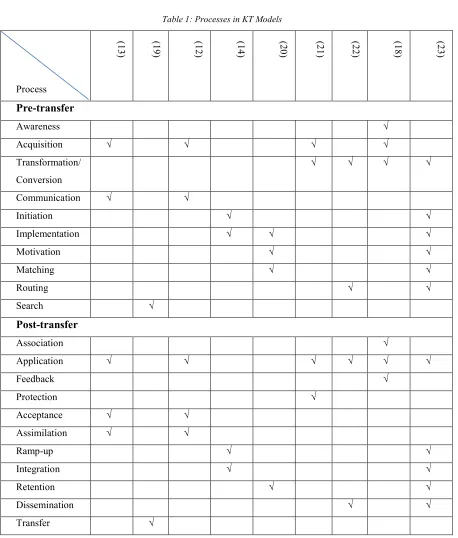
Knowledge transfer models have been developed by several researchers in various fields with the aim to ensure an effective knowledge transfer process. Each of the models is based on several identified processes that occur during the process of knowledge transfer. The processes can be categorized into pre-transfer and post-transfer processes, as summarized in Table 1. As shown in the table, certain common processes exist across several different models.
The knowledge transfer model developed by (13) aims to help the learning process of an organization via the transfer of knowledge. This model involves the five steps of acquisition, communication, application, acceptance and assimilation. For learning to occur, the transfer of knowledge must go through all the steps until the acceptance level is reached; only then can assimilation occur.
Hansen (19) focused on weak-tie theory and developed a model of knowledge transfer based on the search–transfer problem. Albino (12) analyzed the model by (13) and introduced four additional components to the framework, namely, actors, context, content and media. Albino’s model investigates how knowledge can be modified during its transfer in customer–supplier relationships.
Szulanski (24) developed a model for intra-firm knowledge transfer and identified four stages of
transfer process, namely, initiation, implementation, ramp-up and integration. During the initiation stage, the need to transfer and receive knowledge is identified, thus triggering the process of knowledge transfer. In the implementation stage, the actual flow of the resources occurs between the sender and the receiver. During the ramp-up stage, the transferred knowledge begins to be used. In the integration stage, the use of the knowledge has been satisfactory and becomes a routine.
A four-stage process model for knowledge transfer was proposed by Kwan and Cheung (20), who aimed to design a knowledge transfer management system. The four processes are motivation, matching, implementation and retention.
Laframboise et al. (21) proposed a knowledge transfer model that consists of acquisition, conversion, application and protection. The aim of this model is to measure the success of knowledge transfer between an IT department and its clients.
A knowledge transfer model by Narteh (22) is used for inter-firm collaboration. The model distinguishes the source of knowledge to be transferred and the antecedents to the knowledge transfer from the transfer process. The model is constructed from four processes which are conversion, routing, dissemination and application.
The process model proposed by Liyanage et al. (18) uses the theory of communication and the theory of translation to identify the processes involved in knowledge transfer. The processes are awareness, acquisition, transformation, association, application and feedback. Finally, Hashim and Ahmad (23) proposed a knowledge transfer model that combines three different models from (20),(22),(24).
407
Table 1: Processes in KT Models
Process
(1
3) (19) (12) (14) (20) (21) (22) (18) (23)
Pre-transfer
Awareness √
Acquisition √ √ √ √
Transformation/ Conversion
√ √ √ √
Communication √ √
Initiation √ √
Implementation √ √ √
Motivation √ √
Matching √ √
Routing √ √
Search √
Post-transfer
Association √
Application √ √ √ √ √ √
Feedback √
Protection √
Acceptance √ √
Assimilation √ √
Ramp-up √ √
Integration √ √
Retention √ √
Dissemination √ √
Transfer √
Thus, this study differs from the previous research since the focus is only on the actual processes that occur during the transfer from multiple senders to a single recipient. The essence of the knowledge transfer is extracted based on the analysis in Table 1 and other existing theories in the literature. The proposed EKT process model is
408 2.4 Disaster Management in Malaysia
DM in Malaysia is governed by Directive No. 20 which provides a policy guideline on DM and rescue procedures on the land in accordance with the disaster level (25). Directive No. 20 defines a disaster as a sudden event that is very complex in nature and causes fatalities, loss of property or damage to the environment. Such an event requires frequent and intensive handling that involves resources, tools and manpower from many agencies with effective coordination and is likely to involve complex actions for long periods of time. The Disaster Management Committee in Malaysia is led by the NSC within the Prime Minister’s Department. Other agencies involved are the Police Department, Fire and Rescue Department, Civil Defence Department, Welfare Department, Public Works Department, Meteorology Department, Department of Irrigation and Drainage and several others.
Due to the number of agencies involved in DM, effective coordination is necessary. Each agency needs to collaborate and share the information they have with the NSC in order for the NSC to make decisions. The transfer and sharing of information can be done easily via technology. Information can be transferred easily from an agency to the NSC through mechanisms such as web applications, email and chat. This information helps the NSC to make quick decisions. Generally, when disasters occur, urgent attention is required (such as dealing with the demand for medical personnel, food and drinking water, rescue equipment and supplies) which must be met in a short period of time (26). Due to the possible huge impact of disasters including death, homelessness and hunger, any decision made must be accurate and effective. Thus, it is vital for the NSC to receive accurate and up-to-date information from the relevant agencies.
However, the current DM in Malaysia is not optimal. Decisions are not made fast enough to prevent the loss of lives or property. Sometimes, the victims of a disaster have had to wait for several hours to be rescued. This situation occurs due to a lack of effective coordination and sharing of information. Currently, information regarding any disaster is widely separated because each agency has its own website and publishes the information only on its website. The NSC operates a portal that gives information to the public regarding any disaster (http://portalbencana.mkn.gov.my); however, complete information about the events that occur in real time cannot be found. If all the relevant information can be transferred into one
repository owned by the NSC, the sharing of information will be more effective and the NSC decision making process will be improved. Nevertheless, collecting and storing the knowledge in one repository involves a very challenging process. Knowledge has to be transferred properly from the agencies to the NSC in order to have accurate information while at the same time preserving the original form of the data.
Therefore, this research proposes the standardization of the process of transferring knowledge from all the relevant agencies to the NSC by proposing a common model from the KM point of view that represents the essence of the knowledge transfer process. The notion of essence is borrowed from the Design and Engineering Methodology for Organizations (DEMO) which was initially proposed to identify the essential business components in the business process (27). DEMO has also been used by Huysmans et al. (28) to identify the common elements in open source software development process modeling. The methodology of constructing the proposed essential knowledge transfer model is explained in the next section.
3. RESEARCH METHODOLOGY
This section describes the research methodology used to develop the essential knowledge transfer process model in this study. The research methodology was based on the design research methodology proposed by Peffers and Tuunanen (29) which consists of the following six steps:
i. Problem identification and motivation ii. Definition of the objectives for a solution iii. Design and development
iv. Demonstration v. Evaluation vi. Communication.
409 3.1 Problem Identification and Definition of the
Objectives
Problem identification and definition of the objectives constitute the first and second steps of the design research methodology. In the first step, a specific research problem should be identified and the value of a solution should be justified. Then, in the second step, the objectives of a solution should be presented based on the problem definition.
In this study, the problem has been identified as ineffective knowledge sharing due to the transfer of inaccurate knowledge. In order to improve the sharing of knowledge, knowledge that has been transferred needs to be accurate and useful, thus it can be used by all parties. In other words, the knowledge should retain its meaning after the transfer has been done. Therefore, it is crucial to look at the actual processes that occur behind the transfer process. The objective is to separate the essence of the knowledge transfer from the technology by identifying the process at the atomic level. As explained above, this concept is borrowed from the DEMO developed by Dietz (27).
3.2 Design and Development
Design and development is the third step of the presented methodology. In this step, artefacts are designed. These artefacts could be concepts or constructs, models, methods or instantiations. In this study, the artefact is the essential knowledge transfer model developed in the next section. The concepts which are the essential processes of the knowledge transfer were identified based on the analysis of existing knowledge transfer models in the literature. The actual processes from nine knowledge transfer models as discussed above were analyzed and synthesized. Based on the analysis, twenty-one processes were identified (as presented above in Table 1). Some processes were identified as common to several models due to the same processes existing in two or more models.
Based on the common processes, we investigated further using existing theories of knowledge transfer. We identified the essence of the knowledge transfer processes as the acquiring process, converting process, implementing process and storing process. These essential processes were then used to construct a conceptual model of the essential knowledge transfer process.
3.3 Demonstration, Evaluation and
Communication
According to Peffers and Tuunanen (29), the fourth and fifth steps of the research should
demonstrate the use of the model to solve the identified problem, and measure how well the model solves the problem, respectively. These steps also may be viewed as a validation of the research findings. In this study, the EKT process model is demonstrated via an illustrative case study setting in the flood management domain in Malaysia. This domain was chosen due to its suitability in terms of the stakeholders’ involvement during an event. The stakeholders are the related agencies which send the relevant information while the receiver of the information is the NSC. Since each agency has its own terminology for the same concept, the model is expected to successfully transform different terminology into standard terms once the transfer is complete. This will improve the interoperability of the process among the stakeholders.
The last step of this methodology is communication which will be accomplished by publishing this research paper that mainly describes how the essence of the knowledge transfer process was identified. The following section describes the development of the essential processes in the knowledge transfer process model.
4. ESSENTIAL KNOWLEDGE TRANSFER
PROCESS
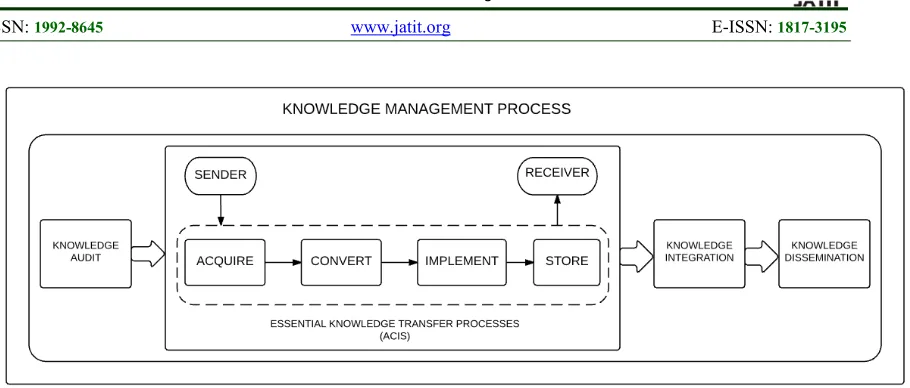
Based on the review of the literature on knowledge transfer processes, a conceptual model of the essential knowledge transfer processes was developed. This model was constructed based on the analysis in Table 1. The identified processes are acquire, convert, implement and store (abbreviated as ACIS). Figure 1 depicts the proposed model of the essential knowledge transfer processes.
410
Figure 1: Essential Knowledge Transfer (EKT) Process Model
Since this research focuses in particular on the processes of knowledge transfer, detail explanations of why these processes were chosen to construct the knowledge transfer model is described in the sub-sections below.
4.1 Acquiring Process
The acquiring process is important before any knowledge can be transferred. It is important for any sender to obtain the correct knowledge to be transferred. It is also crucial to get the latest data in order to send accurate knowledge. According to Laframboise et al. (21), part of the knowledge acquisition process is an ability to obtain knowledge from external parties. Many researchers agree that it is difficult to have successful knowledge transfer if this process is omitted (21),(30). During this process, knowledge from external parties and resources that are critical to its operations need to be identified quickly. Some of the factors affecting this stage are the sender’s speed and intensity in identifying the required knowledge. The ability to acquire the right knowledge will determine the speed of the knowledge transfer process. The knowledge acquisition process has also been identified in several existing knowledge transfer models (12), (13)(21)(18). Thus, acquiring the right knowledge is the first important process identified in this EKT model.
4.2 Converting Process
Once knowledge has been acquired, it needs to be converted into a certain understandable form. The conversion process identified in this section is not the process of converting tacit knowledge into explicit knowledge or vice versa. The
conversion or transformation process identified here is the process of converting different terms that have the same meaning into one common language that can be understood by all parties. Since the purpose of knowledge transfer is to share knowledge, it is very important for both parties (sender and receiver) to understand the same message. Thus, knowledge from a sender needs to be transformed into a standard knowledge used by the receiver in order to collaborate. Appropriate knowledge conversion must be conducted in order to protect important information and retain its original meaning. This process is important because it makes the knowledge accessible to other members for collaboration (Calabrese cited in (21). The knowledge transfer will be useless if knowledge is transferred from the source to the receiver without contextualizing it by reference to the way in which it will be utilized by the recipient (18). Thus, the conversion process is the second important process identified in this EKT model.
4.3 Implementing Process
411 implementation stage is complete when a recipient starts using the knowledge. Szulanski (24) also stated that the implementation stage occurs when the actual flow of resources occurs between a sender and a receiver. As the third important process identified in this model, this process allows the receiver to receive the transferred knowledge. This process is done with the assumption that an appropriate channel is in place and is in good working order, thus, the transferred knowledge can be sent easily.
4.4 Storing Process
The process of storing the knowledge is the last essential process identified in this knowledge transfer model. This process does not exist in any of the knowledge transfer models analyzed above but is very important in this EKT model. The process allows the storing of knowledge before the knowledge is retrieved by other parties. This process also improves the sharing of knowledge among the related parties by increasing the amount of knowledge in any KMS. Although the storing process is not included in any of the knowledge transfer models analyzed above, Jasimuddin and Zhang (31) emphasized the importance of storage in any knowledge transfer activity. They introduced a framework that integrates knowledge storage activities within the knowledge transfer process. They argued that the knowledge transfer process should not be separated from knowledge storage and it is appropriate for an organization to use ICT tools to support the integrated approach of knowledge transfer and knowledge storage (32).
Connelly and Kelloway as well as Argote and Ingram (cited in (31) also agreed that knowledge storage needs to be incorporated within the knowledge exchange process in order to preserve the knowledge.
The storing process identified as the last essential process in this EKT model refers to the storing of knowledge in the conceptual data model. The transferred knowledge is organized in a logical data model according to an appropriate structure and later can be stored physically in a repository. The study of physically storing knowledge in a repository is beyond the scope of this research.
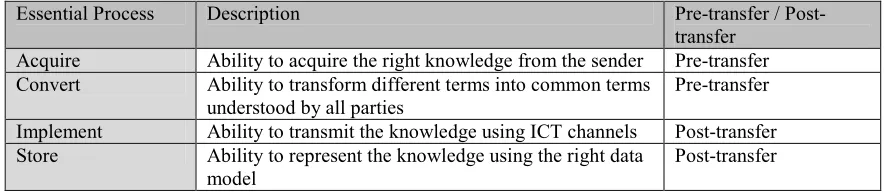
The four essential processes identified above are summarized in Table 2. The processes are divided into pre-transfer and post-transfer activities. These processes are expected to improve and enhance the transfer of knowledge from multiple parties to one central authority in any domain that uses the star topology as the architecture. By executing the four essential processes during the knowledge transfer, accurate knowledge will be received by the recipient since the received knowledge has been standardized, which can lead to a faster decision making process. The transferred knowledge will go through these four essential processes which will be governed by ontology in every process. To understand the proposed EKT process model further, a demonstration of how the model can be used in DM is explained below using a case study in the flood management domain.
Table 2: Essential Knowledge Transfer Processes
Essential Process Description Pre-transfer /
Post-transfer Acquire Ability to acquire the right knowledge from the sender Pre-transfer Convert Ability to transform different terms into common terms
understood by all parties
Pre-transfer
Implement Ability to transmit the knowledge using ICT channels Post-transfer Store Ability to represent the knowledge using the right data
model Post-transfer
5. ILLUSTRATIVE CASE STUDY
Based on the essential knowledge transfer processes identified above, a conceptual model of the essential knowledge transfer processes was developed. The EKT process consists of acquire (A), convert (C), implement (I) and store (S). This model can be demonstrated in case
412 The information includes details on the flood area or location, the water level on the roads, the number of victims to be rescued, the types of victims such as babies, adults or sick people, the number and types of transport needed, the name of the nearest evacuation center, any road blocks or road closures, and the agencies involved. An example of the information that needs to be transferred is illustrated below.
Case Study 1: Recording the Water Level on the Road by Public Works Department
Acquire: Information on the water level on the road may be obtained from the Public Works Department. This information is available on the
department’s website
(http://bencanaalam.jkr.gov.my). This information will be extracted by a system.
Convert: The extracted information will be converted into a standard term understood by all parties. If the water level is recorded in various formats such as inches, or centimetres or metres, it will be converted into one type of format that is common to all parties. The conversion will be done by a specific algorithm in the system.
Implement: Once the format of the data has been standardized, the actual transfer of knowledge will be done. During this process, the mechanism to transfer the knowledge is assumed to be in place and in good working condition. This is when the knowledge from the sender is transmitted to the receiver.
Store: When the knowledge has been successfully transferred, the last process in the EKT process model will be executed. In this process, the transferred knowledge will be stored logically using an appropriate data model. It will be mapped to certain entities or classes in the domain ontology. The ontology will be used as a basis for storing the knowledge physically which will finally allow the sharing and reuse of the knowledge by different parties.
Case Study 2: Providing the Required
Transportation by the Civil Defence
Department to Rescue Flood Victims
Acquire: Information on the number of flood victims to be evacuated will be provided by the Welfare Department via its portal or any specific application. Currently, the information is sent via email or phone calls.
Convert: Based on the information collected, data will be categorized according to the gender,
age and health condition of the flood victims as well as the affected locations using a specific format. This will allow the NSC to provide correct information to the Civil Defence Department in order to decide what kind of transportation should be sent to rescue the victims.
Implement: Once the format of the data has been standardized, the actual transfer of knowledge will be done through the system.
Store: When the information has been successfully transferred from the sender, it will be stored conceptually by mapping the information to the correct entities in the ontology.
In the case studies above, it is assumed that the process of knowledge transfer from the related agencies to the core authority (the NSC) is done via technology in real time. The transferred knowledge is stored logically in the domain ontology before being integrated in the next KM process and disseminated to the intended recipient. The research into knowledge integration by Mohd. Rodzi et al. (33) is related to this research in terms of using the transferred knowledge to integrate and disseminate the information.
6. CONCLUSION
Although extensive research has been conducted in the area of knowledge transfer, the literature on knowledge transfer in the DM domain is still scant. Furthermore, most of the studies in the literature focus only on the knowledge transfer as one activity, with very few studies focusing on the actual transfer process which might consist of several essential processes that need to occur during the process of transferring knowledge.
413 model is expected to improve the accuracy of transferred knowledge which will lead to improved decision making. An empirical study which was not within the scope of this paper will be conducted later in order to prove this claim further.
ACKNOWLEDGEMENT
The authors wish to thank the Ministry of Higher Education, Malaysia, for funding this study under the Long Term Research Grant Scheme (LRGS/b- u/2012/UUM/Teknologi Komunikasi dan Informasi).
REFRENCES:
[1]. Parent R, Roy M, Parent R, Roy M, St-jacques D. A systems-based dynamic knowledge transfer capacity model. J Knowl Manag. 2007;11(6):81–93.
[2]. Othman SH, Beydoun G. Model-driven disaster management. Inf Manag [Internet]. Elsevier B.V.; 2013 Jul [cited 2014 Sep 28];50(5):218–28.
[3]. Mohd Rodzi MZ, Zakaria NH, Ahmad MN, Yahya H. Towards a Knowledge Management Framework for Disaster Management in. New Trends in Software Methodologies, Tools and Techniques: Proceedings of the Thirteenth SoMeT_14. 2014. p. 417–31.
[4]. Nonaka I. A dynamic theory of organizational knowledge creation. Organ Sci [Internet]. 1994 [cited 2013 Oct 20];5(1):14–37.
[5]. Alavi M, Leidner D. Review: Knowledge management and knowledge management systems: Conceptual foundations and research issues. MIS Q [Internet]. 2001 [cited 2014 Sep 29];25(1):107–36.
[6]. Nonaka I, Peltokorpi V. Objectivity and subjectivity in knowledge management: a review of 20 top articles. Knowl Process Manag [Internet]. 2006 Apr [cited 2014 Aug 8];13(2):73–82.
[7]. Dorasamy M, Raman M, Kaliannan M. Knowledge management systems in support of disasters management: A two decade review. Technol Forecast Soc Change [Internet]. Elsevier Inc.; 2013 Nov [cited 2014 Jul 13];80(9):1834–53.
[8]. Hassan N, Hayiyusuh N, Nouri R. The Implementation of Knowledge Management System (KMS) for the Support of Humanitarian Assistance/Disaster Relief
(HA/DR) in Malaysia. Int J Human Soc Sci [Internet]. 2011 [cited 2013 Oct 17];1(4):103–12.
[9]. Katuk N, Ku-Mahamud KR, Norwawi N, Deris S. Web-based support system for flood response operation in Malaysia. Disaster Prev Manag [Internet]. 2009 [cited 2014 Oct 20];18(3):327–37.
[10].Grover V, Davenport TH. General Perspectives on Knowledge Management : Fostering a Research Agenda. J Manag Inf Syst. 2001;18(1):5–21.
[11].Alavi M, Kayworth TR, Leidner DE. An Empirical Examination of the Influence of Organizational Culture on Knowledge Management Practices Background on Knowledge Management. J Manag Inf Syst. 2006;22(3):191–224.
[12].Albino V, Garavelli A, Schiuma G. Knowledge transfer and inter-firm relationships in industrial districts: the role of the leader firm. Technovation [Internet]. 1999 [cited 2013 Oct 16];19:53–63.
[13].Gilbert M, Cordey-Hayes M. Understanding the process of knowledge transfer to achieve successful technological innovation. Technovation [Internet]. 1996 [cited 2013 Oct 14];16(6):301–12.
[14].Szulanski G. The Process of Knowledge Transfer: A Diachronic Analysis of Stickiness. Organ Behav Hum Decis Process [Internet]. 2000 May [cited 2013 Sep 17];82(1):9–27.
[15].Blome C, Schoenherr T, Eckstein D. The impact of knowledge transfer and complexity on supply chain flexibility: A knowledge-based view. Int J Prod Econ [Internet]. Elsevier; 2014 Jan [cited 2014 Mar 31];147:307–16.
[16].Lin L, Geng X, Whinston A. A sender-receiver framework for knowledge transfer. MIS Q [Internet]. 2005 [cited 2013 Nov 25];29(2):197–219.
[17].Wilkesmann M, Wilkesmann U. Knowledge transfer as interaction between experts and novices supported by technology. Vine [Internet]. 2011 [cited 2013 Sep 27];41(2):96–112.
414 [19].Hansen MT. The Search-Transfer Problem:
The Role of Weak Ties in Sharing Knowledge across Organization Subunits. Adm Sci Q [Internet]. 1999 Mar [cited 2014 Jul 29];44(1):82.
[20].Kwan M, Cheung P. The knowledge transfer process: From field studies to technology development. J Database Manag [Internet]. 2006 [cited 2014 Sep 30];17(1):16–8. [21].Laframboise K, Croteau A-M, Beaudry A,
Manovas M. Interdepartmental Knowledge Transfer Success During Information Technology Projects. Int J Knowl Manag [Internet]. 2007;3(2):47–67.
[22].Narteh B. Knowledge transfer in developed-developing country interfirm collaborations: a conceptual framework. J Knowl Manag [Internet]. 2008 [cited 2014 Sep 25];12(1):78–91.
[23].Hashim KF, Ahmad M. A Theoretical Knowledge Transfer Model in Disaster Management in Malaysia. Information Systems International Conference (ISICO). 2013. p. 2–4.
[24].Szulanski G. Exploring Internal Stickiness: Impediments to the Transfer of Best Practice Within the Firm. Strateg Manag J. 1996;17:27–43.
[25].Rahman B a. Issues of Disaster Management Preparedness : A Case Study of Directive 20 of National Security Council Malaysia. Int J Bus Soc Sci. 2012;3(5):85–92.
[26].Chou S-Y, Chen D. Emergent disaster rescue methods and prevention management. Disaster Prev Manag [Internet]. 2013;22(3):265–77.
[27].Dietz J. The deep structure of business processes. Commun ACM [Internet]. 2006 [cited 2013 Oct 12];49(5):59–64.
[28].Huysmans P, Ven K, Verelst J. Using the DEMO methodology for modeling open source software development processes. Inf Softw Technol [Internet]. Elsevier B.V.; 2010 Jun [cited 2014 Aug 3];52(6):656–71. [29].Peffers K, Tuunanen T. A design science
research methodology for information systems research. J Manag Inf Syst [Internet]. 2008 [cited 2014 Oct 22];24(3):45–77.
[30].Byrd T, Cossick K, Zmud R. A synthesis of research on requirements analysis and knowledge acquisition techniques. Mis Q [Internet]. 1992 [cited 2014 Oct 2];16(1):117–38.
[31].Jasimuddin SM, Zhang Z (Justin). Transferring Stored Knowledge and Storing Transferred Knowledge. Inf Syst Manag [Internet]. 2011 Jan 10 [cited 2014 Aug 8];28(1):84–94.
[32].Jasimuddin SM, Connell N, Klein JH. Knowledge transfer frameworks: An extension incorporating knowledge repositories and knowledge administration. Inf Syst J. 2012;22(3):195–209.
[33].Mohd. Rodzi MZ, Ahmad MN, Zakaria NH. Using essential processes in knowledge integration for knowledge enhancement. Vine [Internet]. 2015;45:89–106.