ABSTRACT
POTTMYER, LAURA MARIE. Academic Impact of Learning Styles and Other Factors in a College Botany Course (Under the direction of John C. Park.)
The purpose of this research has been to determine if students with particular learning styles were at an academic advantage over other students in a college botany course. The professor for this course used methodologies within his lectures to reach the needs of all types of learners. The participants were students in the Botany 200 course, an introductory science course taught at North Carolina State University. Each of the 146 participants took the Gregorc Style Delineator at the beginning of the semester to determine their learning style and completed a survey about their views of the class and techniques being used in the class. The student scores on course exams and the associated laboratory course were analyzed with respect to learning style, gender, year in school, academic major, academic college and previous college biology courses. Learning style proved to be a significant predictor of student performance only in terms of the laboratory grades. Academic
performance in the lecture part of the course was not impacted by student learning style. The female students did better than the males on three of the six measures of academic
ACADEMIC IMPACT OF LEARNING STYLES AND OTHER FACTORS IN A COLLEGE BOTANY COURSE
by
LAURA MARIE POTTMYER
A thesis submitted to the Graduate Faculty of North Carolina State University
in partial fulfillment of the requirements for the Degree of
Master of Science
SCIENCE EDUCATION Raleigh
2004
APPROVED BY:
Dr. Glenda S. Carter Dr. C. Gerald Van Dyke
Dr. John C. Park
BIOGRAPHY
In the confinement of the Washington, DC Beltway on the verge of Nixon’s re-election, Laura Marie Pottmyer was born to James Joseph and Alice Allred Pottmyer on October 23, 1972. Raised in a loving home and educated in the excellent Arlington County Public Schools, she was provided with a strong foundation for the rest of her life’s
endeavors. Laura’s love of science was present early as she and her brother, Stephen, would carry out their informal investigations trying to figure out how things worked. As a child she had posters of the International Science and Engineer Fair hung on her walls next to posters of Tom Cruise. She rose from these humble beginnings to win first place in the botany division at the Virginia State Science Fair and Virginia Junior Academy of Science research competition. After some positive experiences in the classroom of Susan Senn at H.B. Woodlawn Secondary Program, Laura thought that teaching science might be for her.
Laura headed down to N.C. State University in Raleigh to begin her studies in science education in the fall of 1991. She graduated summa cum laude with a B.S. in science
education in December of 1995. After spending four months teaching in inner-city London, she came back to the States to take her permanent teaching position. Laura spent six fun filled, developing years working as an eighth grade science teacher at Apex Middle School in Apex, NC.
ACKNOWLEDGEMENTS
My deepest gratitude is expressed to all of those individuals that have worked with me and supported me through this process. Many thanks go out to my father, the graph master, and my mother, the personal cheerleader, for their tremendous support and belief in me. I owe special thanks to Alvin Van Orden for fulfilling his Duty to Laura Award by helping me with all of the statistical calculations (I still believe that SAS just works by magic). Without the willingness of Dr. C. Gerald Van Dyke, I would not have had a class to study or an
TABLE OF CONTENTS
Page
List of Tables ... v
List of Figures ... vi
1 – Introduction... 1
Individual Learners... 2
Learning Style Theory... 2
Large Class Instruction... 4
Purpose ... 6
The Botany Course ... 7
2 – Literature Review... 8
Early Roots ... 8
Defining Learning Style ... 10
Significance of Learning Styles... 11
Teaching Large College Courses... 13
Realistic Applications of Learning Style Research ... 16
3 – Methodology and descriptive analysis... 18
Participants ... 18
The Botany Course ... 20
Learning Style Instrument ... 21
Student Survey... 25
Data Analysis... 27
4 – Academic Impact of Learning Styles and Other Factors in a College Botany Course... 28
Defining Learning Style ... 29
Significance of Learning Styles... 30
Applications of Learning Style Research ... 31
Methodology... 32
Results ... 34
Discussion... 45
Limitations... 49
References(for chapter 4)... 51
(for entire thesis) ... 54
LIST OF TABLES
Page
Chapter Three
Table 3-1. Academic performance statistics for Botany 200... 25
Chapter Four
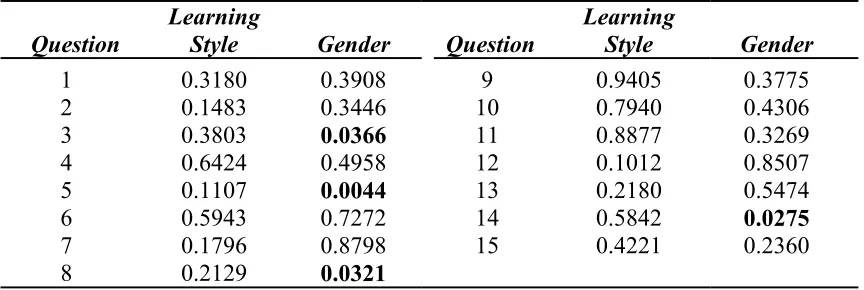
Table 4-1 Significance of demographic variables for academic achievement in
Botany 200 course (p values calculated using ANOVA) ... 36 Table 4-2 Comparison of student test scores and grades by learning style ... 37 Table 4-3 Comparison of Student Test Scores by Gender... 38 Table 4-4 Prior instruction in biology significantly affected performance except
for the lab grade and final exam. ... 39 Table 4-5 Significance of questionnaire responses by learning style and gender
LIST OF FIGURES
Page Chapter 3
Figure 3-1. College enrollment for the 146 students in the analyzed population. ... 19 Figure 3-2. Dominant learning style determined by administering Gregorc Style
Delineator to 211 students, 25 of whom had hybrid, equally
dominant styles of CS-AS (7), CS CR (6), AR-CR (4), AS-CR (3),
CS-AR (2), AS-AR (2), and CS-AR-CR (1). ... 23 Figure 3-3. Dominant learning styles of the analyzed population of 146 students... 24
Chapter 4
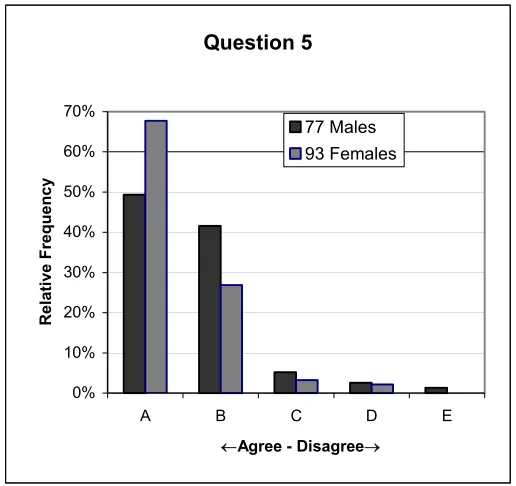
Figure 4-1. Distribution of responses to survey question 5 shows modal value for “strongly agree” with significant difference (p=0.0044) between
males and females... 41 Figure 4-2. Distribution of responses to survey question 7 is centered on a neutral
response without significant difference between males and females. ... 42 Figure 4-3. Distribution of responses to survey question 3 shows a significant
difference between male and female respondents (p=0.0366) with
females agreeing more strongly... 43 Figure 4-4. Distribution of responses to survey question 5 shows the greatest
difference between males and females for any question in the survey, with females agreeing more strongly (p=0.0044)... 43 Figure 4-5. Survey question 8 again shows female respondents agreeing more
readily than males (p=0.0321). ... 44 Figure 4-6. Female survey respondents rated "real-life" examples and analogies
more highly than did their male counterparts (p=0.0275). ... 44 Appendix
1 – INTRODUCTION
The purpose of science education is not simply to deliver scientific information, but for students to comprehend science concepts and develop skills. There are reform efforts specifically aimed to restructure and improve science education including Project 2061 (Rutherford & Ahlgren, 1990) and the National Science Education Standards (National Research Council, 1996). These movements are primarily focused at the state of K-12 education in the United States, but their spirit and suggestions can be applied to institutions of higher education. These reform efforts support the belief that all students can learn and call for all students to be taught more effectively. Research has shown that students can learn, but many students learn differently from the way instruction has been traditionally structured for presentation in the science classroom or lecture hall (Dunn, Beaudry & Klavas, 1989; Manner, 2001; O’Brien, 1991).
Individual Learners
Teachers are quick to acknowledge that each one of their students is a unique individual. However, in a class of 250 students it is easy to lose some of that individuality from the perspective of the teacher and the student. Having one-on-one individually tailored sessions with each of the 250 students in a university class would not be time or cost
effective from the perspective of the university. It is probably not necessary to go to that extreme with individualization, if the instructor is aware and actively seeking to ensure that instruction is accessible to all students regardless of their learning style.
Learning Style Theory
Learning style theory grew out of the work in cognitive psychology involving personality development and traits. Learning style theory is the application of personality types to the specific experiences of a learner. It involves multiple facets of the learning experience and how individual learners have differences in their preference for how learning takes place (Silver, Strong, & Perini, 1997). Learning styles incorporate how learners prefer to take in information from their environment and the internal processes learners favor to organize and make sense of newly encountered information (Gregorc, 1979).
Two major divisions exist within the umbrella of ideas that encompass learning styles. One branch follows closely the original personality categories of analytical psychologist Carl Jung; the other branch expands the learning styles into environmental and physiological factors, in addition to the more traditional psychological and sociological views (Dunn, et al., 1989; Dunn, Denig & Lovelace, 2001; Silver, et al., 1997).
One persuasion within learning style theory holds tightly to Carl Jung’s original categories for classifying personality. Jung’s original observations noted the differences in the way people perceived (sensation versus intuition), the way they made decisions (thinking versus feeling), and how active or reflective they were while interacting (extroversion versus introversion) (Ewen, 1998; Silver, et al., 1997). Isabel Meyers and Katherine Briggs took the work of Jung and created an instrument called the Meyers-Briggs Type Index (MBTI) to categorize individuals into one of sixteen different categories along four scales. The MBTI is used by some to study the elements of personality and their relationship with classroom performance and preferences (Ballone & Czerniak, 2001). The research and work of David Kolb and Anthony Gregorc each branched off more from the work of Meyers and Briggs, but still held tight to the major categories that Jung established for personality. Both Kolb and Gregorc have created their own instruments for classifying learning styles sorting individuals into one of four categories.
sitting on the sofa while studying derive from their model. Many educators are aware of the visual, auditory, kinesthetic and tactile learning styles. This is just one aspect of the broader topic of learning styles, but it is a very concrete idea, and tests exist to analyze this dimension of learning styles.
All of the research on learning styles, no matter the instrument or philosophy, gives evidence that individual learners are unique. Learners do have preferences for how they like to learn and study even if their instructional settings are not always conducive to their
learning style. By the time students have reached the college level, most have found ways to adapt to different teaching styles in order to be successful (O’Brien, 1991). College
instructors are becoming more aware of the reality that their courses are comprised of heterogeneous groupings of students. The focus for the instructors now moves from being aware of learning style differences to using that knowledge to design effective science instruction.
Large Class Instruction
instructor gets to know the students, the students get to know each other, and the instructor interacts with more than just the first few rows of students (McKeachie, 1999).
Another way to improve college instruction in large courses is to focus on
individuation of the class. According to Katz (1985), “individuation begins by recognizing the individual differences in the thinking style, affect, motivation, background, and
aspirations among the students in one’s class” (p.8). In smaller classes one could have individual discussions to ascertain some of this information for each of the students, but in larger classes other means must be implemented. Instructors can actively invite students to come to formal or informal office hours and get to class early and stay late to have
discussions with individual students. Conducting a learning style survey in the class would enable the instructor to better understand the dynamics of the group of students he or she has that semester, since groups change semester to semester (Miller, Wilkes, Cheetham, & Goodwin, 1993). Instructors can also design assignments and assessments with flexibility of products to better match the learning styles of their students regardless of the size of their course (Katz, 1985).
“energy shifts” within the lecture every 20 minutes to help keep students focused, the use of visuals to reach learners that do not pick up concepts as well auditorially, and programming in reflection time for the students to synthesize the information while in class to see if they need to ask questions. Many other professionals recommend breaking down the large classes into smaller groups (Frederick, 1987; Glassman, 1980; McKeachie, 1999: Miller, et al., 1993). These groups can be pairings or triads for discussion of a question posed by the teacher, only meant to be together for a few minutes. Groups can also be longer lasting or larger in scope to incorporate case studies or problem-based learning.
Most science courses also incorporate a laboratory section to give the students hands-on experience with the subject matter to validate what has been presented in lecture. This has been the traditional method of college instruction for over 100 years. At the college introductory level, it is not standard to have much inquiry-based lab instruction incorporated into the course curriculum. These laboratory experiences enable the students to be involved in smaller groups within their larger lecture section. More interactive lessons can be planned within the laboratory sessions depending upon how the course is structured.
Purpose
The Botany Course
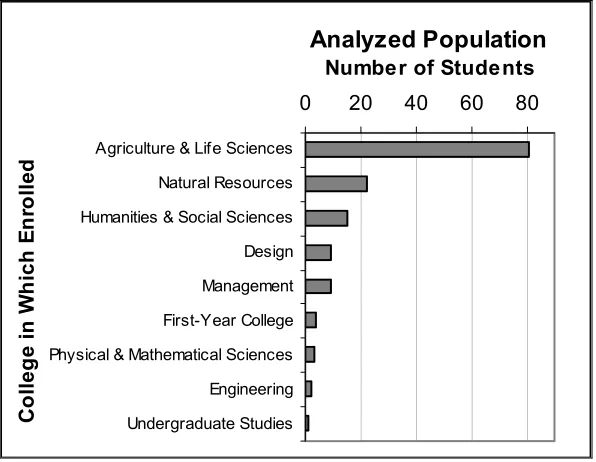
The learning styles study was conducted upon the students in an introductory botany class, Botany 200, held at North Carolina State University. It is a course that does not require prerequisites, so it attracts both individuals that major in the biological sciences and individuals with humanities and business majors who need to fulfill science requirements for graduation. Students from 8 out of 10 of the undergraduate academic colleges within the university and every year of study are represented within this diverse class. The purpose of the course is to provide students with an understanding of plant anatomy, cell function, metabolism, and life cycle. Students should also gain an appreciation for plant diversity and the role of plant ecology within the greater ecosystem.
2 – LITERATURE REVIEW
After 30 years of research, it is now commonly accepted that students have learning preferences and teachers have instructional preferences; the interplay of these two styles makes an impact on student attitude and achievement (Drysdale et al., 2001). Learning style theory grew out of work by Carl Jung in the field of psychology and was more finely
structured by Isabel Myers and Katherine Briggs. Their findings in psychology were applied to practical uses in education in the 1970’s and 1980’s through the work of Gregorc, Dunn & Dunn, and Kolb (Ballone & Czernaiak, 2001; O’Brien & Thompson, 1994). The initial learning style research to find effective instructional strategies for students with similar characteristics was primarily focused on elementary students (Dunn et al., 1989). Learning style research has been expanded and applied to students of all levels, including those in higher education (Drysdale et al., 2001; O’Brien 1991).
Early Roots
Today researchers and practioners study learning styles looking for trends and applications for the classroom. Though this work has become widespread in the last 30 years, its roots go back much farther into history. The analytical psychology perspective of Carl Jung is credited for the birth of the field of learning styles (Ballone & Czernaiak, 2001; Silver, et al., 1997). However, even Jung himself noted that the division of people into distinct categories occurred much earlier.
could be divided into four classes. Those in whom there was a preponderance of blood belonged to the sanguine type; a preponderance of phlegm produced the phlegmatic; yellow bile produced choleric, and black bile the melancholic. As our language shows, these differences of temperament have passed into history, though they have, of course, long since been superseded as a physiological theory. (1971, p. 510).
Jung’s theory of personality involves his division of individuals into polar categories of extroverts and introverts. From there he also discovered other dualities within
personalities such as, thinking versus feeling and sensing versus intuition (Jung, 1971). In defense of his theory, Jung stated that some may “regard such differences as mere
idiosyncrasies of character peculiar to individuals. But anyone with a thorough knowledge of human nature will soon discover that the contrast is by no means a matter isolated individual instances but of atypical attitudes which are far more common than one with limited
psychological experience would assume” (1971, p. 330). These affinities towards one of the opposites are tendencies. Jung believed that individuals have the ability to use all of the modalities, individuals simply have propensity for one to be dominant (Ewen, 1998). This belief has been carried over into the modern interpretations of learning styles (Gregorc, 1982a).
Jung recognized that classification of personality types could be challenging since “in actual reality they are complicated and hard to make out, because every individual is an exception to the rule” (1971, p.516). Due to this, Jung advocated for careful observations to ensure proper classifications. Jung (1971) also argued that classification did not explain the individual psyche, but did enable people to understand human psychology better on a general level. This early work in the psychology of personality types is the foundation for our
Defining Learning Style
The definition of learning style has evolved over time, but all definitions share certain similarities reflecting students’ preferences for how they best learn. Initially Gregorc defined a learning style as “distinctive behaviors which serve as indicators of how a person learns from and adapts to his environment. It also gives clues as to how a person’s mind operates” (1979, p. 234). The commonalties among the definitions include the learning style being a combination of preferences involving the physical environment, biological and sociological needs and emotional and psychological inclinations (Ballone & Czerniak, 2001; Dunn, et al., 1989). These preferences are believed to be both biological and developmental in origin (Ballone & Czerniak, 2001). Learning styles incorporate how individuals take in information and how they internally arrange the information to facilitate learning (Drysdale et al., 2001; O’Brien, 1991).
In order to evaluate learning styles, there are many different instruments available. In research the Myers-Briggs Type Index, the Kolb Inventory of Learning Styles, Dunn and Dunn Learning Styles Model and the Gregorc Style Delineator are the most common instruments used (Ballone & Czerniak, 2001; Lemire, 2000; O’Brien & Thompson, 1994). Though the Myers-Briggs Type Index was designed to classify personality types, this information has been applied to learning styles (Ballone & Czerniak, 2001; Lemire, 2000). All of these instruments ask individuals to self-report their affinity or choice between a set of words to describe themselves. Based upon their responses, individuals are given their
Significance of Learning Styles
Research has shown that one learning style is not necessarily better than another and one is not associated with higher intelligence; they are simply differences in how people prefer to learn (Dunn & Dunn, 1979; Fischer & Fischer, 1979; Riding& Read, 1996).
Gregorc (1982a) established four abilities to describe an individual’s dominant learning style. These four categories involve students scoring themselves along two spectrums. One
preference reflects how students like to receive information, ranging from abstract to concrete, and the other indicates how the students like to order the information once it is received, ranging from sequential to random (Drysdale et al., 2001, Gregorc, 1982a). According to Gregorc (1982a), individuals can then be categorized according to these preferences:
• Concrete Sequential (CS) Learners are pragmatic, methodical and deliberate. They like material presented in a step-by-step manner. They follow directions, enjoy organization and prefer quiet atmospheres in which to study.
• Abstract Sequential (AS) Learners like structure in their learning and enjoy rich full details including meaningful images. These learners are highly verbal and prefer more input rather than less because they have the ability to sort through and sift out what they need to complete the whole picture of what they need to learn. They like mentally stimulating, yet orderly and quiet learning situations.
• Abstract Random (AR) Learners experience the world through their emotions and imaginations. They base most of their learning on their senses and intuition. AR learners prefer information presented in an unstructured manner, enjoy group discussions and like vibrant environments in which to study.
environments that enable them to explore their ideas and express their opinions. They can work well independently or with small groups.
Individual learners each have a dominant learning style, but more effective learners show the ability to expand their learning preferences over the course of their college careers (O’Brien, 1991). However, students with certain learning styles have been shown to have greater achievement in certain subjects at the collegiate level (Drysdale et al., 2001). The Drysdale et al. (2001) study revealed trends in student performance based on learning styles. College students that have a preference for sequential ordering of information show greater achievement in science courses than those who use random internal ordering of the
information. The students in both freshman biology and freshman chemistry that had CS and AS learning styles had higher course grades than those with CR and AR learning styles. Students who receive learning-style intervention have demonstrated higher overall GPAs and greater retention at the collegiate level (Drysdale et al., 2001). Additionally, students that have their learning style matched with instructional strategies demonstrate a better attitude towards learning (Okebukda, 1986).
Research has shown that when student learning styles are matched with instructional strategies, student achievement is maximized (Ballone & Czerniak, 2001; Davidson et al., 1992; Dunn, Denig & Lovelace, 2001; Gregorc, 1979; Okebukola, 1986). It does not matter what the educational environment is, as long as it is matched with how the students best intake and process information (Dunn et al., 2001). It has been found that “academic success and failure in higher education depends not on student characteristics or teaching
effectiveness alone, but on the interactions between the students and the learning
(Drysdale et al., 2001, p. 273). The more compatible the method of information presentation with the student’s preference on how to process it, the better will be his or her academic achievement (Drysdale et al., 2001). The Miller et al. (1993) study found that students in an introductory biology course who “had a cognitive ‛fit’ between task setting and their personal style tended consistently to outperform their less ideally situated peers” (p.34).
It is believed that teachers teach with a bias towards the learning style they prefer as a learner themselves (O’Brien & Thompson, 1994). Based on this assumption, it would seem that students would do better in classrooms where their learning style matched the learning style of the teacher. In O’Brien & Thompson’s (1994) study, this did not end up to be the case. The students did better in courses where their learning style was mismatched with that of the instructor. It should be noted that the O’Brien & Thompson study only looked at the styles of the instructors and students, not the actual instructional strategies being employed in the classroom.
Teaching style is more than the instructor’s own learning style it involves a philosophy that melds together beliefs about the teaching-learning exchange with
methodologies that the instructor employs (Heimlich & Norland, 2002). The hope is that there will be congruence between what the instructor believes to be effective teaching behaviors and what he or she actually does in the classroom. The goal is to have effective instruction that meets the needs of the learners.
Teaching Large College Courses
institutional reality that at large colleges and universities there will be some large
introductory courses. But just because the class size may be large, this does not mean that the instruction must be a boring lecture. Research and experience has shown that lecture can be an effective means of instruction (de Winstanley & Bjork, 2002; McKeachie, 1999). The key to an effective lecture is to move beyond the passive learning typical in the lecture format and create an active learning environment for the students (Frederick, 1987; Knapper, 1987; McKeachie, 1999).
There does not seem to be one panacea for all the reported troubles of lecture style instruction. The reality that most college instructors have a background lacking in pedagogy only compounds the issue (Knapper, 1987). The solutions for creating effective learning environments in large college or university classes share some elements that are common to all quality instructional experiences, but specially need to be adapted to the larger
environment.
Students reported that the larger classes provide them with anonymity, some students enjoy that aspect and others found it to hinder their learning (Wulff, Nyquist & Abbott, 1987). Social research has shown that individuals that feel anonymous feel less personal responsibility in a situation and that can be damaging a student’s motivation for learning in a large classroom (McKeachie, 1999). In order to reduce the anonymity in a class there are a few steps that an instructor can take:
1. Be available to the students after class, during office hours and offers for informal interactions such as getting coffee.
3. Use a seating chart so that the instructor can use a student’s name when he or she participates.
4. Move around the classroom during lecture so that the instructor can make contact with more than just the first three rows of students.
5. Have students fill out autobiographical forms so that the instructor can learn more about the background of the students (McKeachie, 1999).
too large, over seven members, it enables individuals to avoid participating by slipping into the background (Crow, 1980; Frederick, 1987; Glassman, 1980; McKeachie, 1999).
The dynamics of the lecture can also make a significant impact on the effectiveness of the instruction. Engaging student attention is critical to ensuring the students comprehend the material presented (Knapper, 1987; McKeachie, 1999). Shifts in the energy of the class every 20 minutes helps to keep student attention. These shifts can come from a change in the activity of the class, lecture to questioning to sharing to analyzing a diagram to watching a video segment, etc. (Frederick, 1987). Breaks in the class to help students process the information that they have been presented is an effective method of reinforcement
(deWinstanley & Bjork, 2002). Students can be instructed to summarize their notes up until that point in class either individually or with their neighbor. College instructors need to make sure that they demonstrate enthusiasm, competency and concern throughout their instruction (McKeachie, 1999; Wulff, et al., 1987). The attitude of the instructor has a direct impact upon the attitude of the students, so if an instructor wants dedicated and motivated students, he or she is best to project that image him or herself.
Realistic Applications of Learning Style Research
Though it is now widely accepted that matching a student’s learning style with the instructional strategies increases achievement (Ballone & Czerniak, 2001; Davidson et al., 1992; Dunn, Denig & Lovelace, 2001; Gregorc, 1979; Okebukola, 1986), it is a difficult charge to implement in large college science courses. In almost every class, there are
3 – METHODOLOGY AND DESCRIPTIVE ANALYSIS
In order to determine relationships between student learning style and student achievement and attitude in various elements of the course, participants must be characterized and methods of evaluation must be defined.
Participants
This study was conducted on the campus of a large land grant university in the southeastern United States. Subjects were students enrolled in the introductory botany course offered by the university. Only those students who were present on the first day of class, had a defined learning style preference, remained enrolled for the duration of the semester and answered the instructional feedback questionnaire were used in this study. The course had 239 total students; the final sample included a total of 146 students, consisting of 65 males and 81 females. Data from other students were collected, but only data from the students meeting all of the criteria were fully analyzed.
Analyzed Population
0 20 40 60 80
Agriculture & Life Sciences
Natural Resources
Humanities & Social Sciences
Design
Management
First-Year College
Physical & Mathematical Sciences
Engineering Undergraduate Studies C o lle g e in W h ic h E n ro lled
Number of Students
Figure 3-1. College enrollment for the 146 students in the analyzed population.
The course has no prerequisites and therefore the students had a variety of
background courses in biology. Of the students, 38.4% (n=56) indicated that the only
biology they had prior to this botany course was high school biology. This category was not
broken down into what level of biology they had taken in high school, only that they had not
taken any biology courses at the college level. The next largest group of 34.9% (n=51) of
students had taken both semesters of the Biology for Majors course at the university. Two
groups of 15 students each (10.3%) had taken only the first semester of Biology for Majors
or only the Biology for Non-majors course. Nine students (6.2%) classified themselves as
taking another college level biology course prior to the botany course, other than the two
The Botany Course
The Botany 200 course was first offered in 1968 with lectures on tape, laboratory experiences to look at the material covered on tape and small discussion groups. The current professor was involved in the original creation of the class and its evolution to what it is today. Currently, this introductory botany course is held twice a week for 75-minute meetings with a correlated 3-hour laboratory course that meets once weekly. For the past eight years, the professor has been the sole instructor for the lecture section of Botany 200, and various teaching assistants help with the laboratory sections. The class is conducted in a lecture format with the use of overhead transparencies for both notes and diagrams. The students have a “course pack” with structured notes that they fill in during the lecture presentation in addition to a required textbook. The instructor often brings in large-scale models or real life examples for demonstration purposes. Another teaching technique he used a few times in each lecture period was allowing an opportunity for the students to discuss a question he posed to the class with their neighbor(s) before he asked for the answer from the class in general. At the end of each class period, the students were required to fill out a form where they summarized information just learned in class and provided feedback to the professor for questions or concerns about the material covered.
wide range of background and experience in biology. The course objectives include students’ understanding plant anatomy; cell function and metabolism; the processes and cycles involved in plant life; and taxonomic differences of plants as well as evaluating the ecology of plants within the greater ecosystem. A separate introductory botany course exists for students at the university who major in botany, so those students are not within the sample population explored in this study.
The professor was knowledgeable about learning styles and tried to incorporate a variety of teaching methods in his instruction. He had first encountered the concept of learning styles at a symposium about ten years ago. Further exposure to the ideas of
“learning style focused instruction,” at a workshop four years ago, motivated this professor to start implementing expanded teaching methodologies in an attempt to reach out to different learners. He has received multiple teaching awards at the university for his efforts in creating effective instruction.
Learning Style Instrument
The Gregorc Style Delineator (Gregorc, 1985) was administered to all of the students attending the first day of lecture in order to assess their individual cognitive style
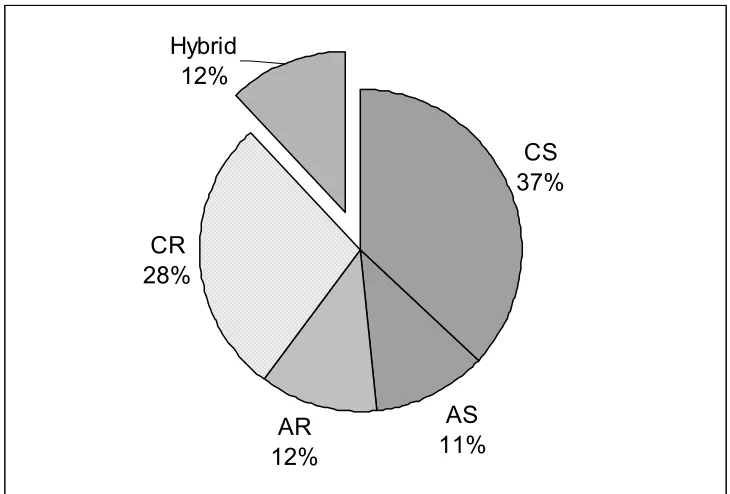
The scores were calculated across the rows, which were associated with a learning style. This generated scores for four scales, defined by ten words each, which can range from 10 – 40. The actual range observed in administering the instrument in Botany 200 was 10 to 38. One student scored a 38 for the CS learning style and another a 38 for CR. One student had a score of only 10, complete aversion, for the AR style and tied between CS and AS for the preferred style. The students then plotted their data on a chart to visualize their scores and indicate where their learning preferences lie. Students scoring 27-40 in a category have high capacity for that learning style (Gregorc, 1982a). The highest score they recorded on the Gregorc Style Delineator classified students according to their dominant learning style. If a student had a tie between two learning styles, then they were not included in the study since they had two dominant modes. Figure 3-2 shows the categorization made for the 211 students who completed the scoring instrument on the first day of class.
CS 37%
AS 11% AR
12% CR
28% Hybrid
12%
Figure 3-2. Dominant learning style determined by administering Gregorc Style Delineator to 211 students, 25 of whom had hybrid, equally dominant styles of CS-AS (7), CS CR (6), AR-CR (4), AS-CR (3), CS-AR (2), AS-AR (2), and CS-AR-CR (1).
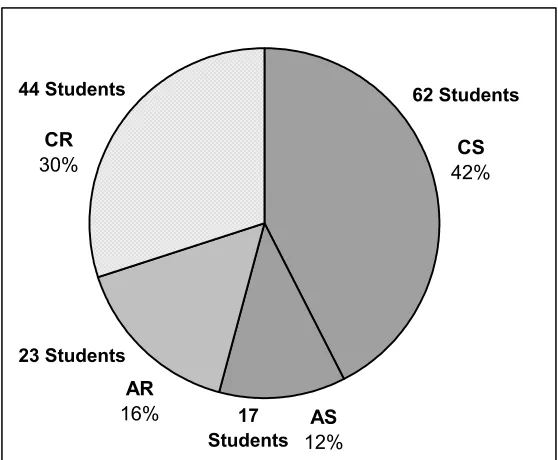
Only a single administration of the style index was given during the semester, since O’Brien’s (1991) study indicated that multiple administrations over the course of a semester yielded highly similar results. Eventually, after eliminating the 25 students who had hybrid learning styles, 38 who did not submit midcourse survey questionnaires, and 2 more who had incomplete academic achievement grades for the semester, there were 146 students
AR 16%
CS 42% CR
30%
AS 12%
44 Students 62 Students
23 Students
17 Students
Figure 3-3. Dominant learning styles of the analyzed population of 146 students.
Student achievement was gauged on performance on the course exams, final
laboratory grade, final exam and cumulative grade for the semester. The students took three instructor-designed course exams during the semester. The exams consisted of material from the lecture sessions and were similar in format. The tests had a mixture of fill in the blank, short answer, matching, multiple-choice and labeling. The final exam contained more objective questions than the other class exams that had been administered during the
semester. The exam questions showed a variety of questioning levels on Bloom’s Taxonomy from knowledge through evaluation.
students are expected to fill in worksheets and make detailed drawings in each lab to show mastery of the material. The weekly quizzes consist of 20% regarding preparation for that day’s activities and 80% reflecting student understanding of what was learned from the previous week’s activities.
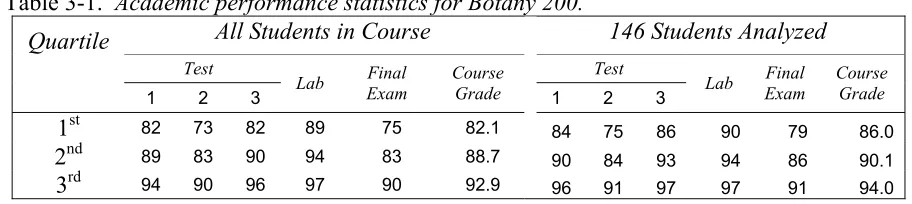
The distributions of grades for the entire class and for the subset of 146 students in the analyzed population are indicated by the quartile values shown in Table 3-1. The bias in the analyzed population towards students with higher academic achievement results from those students who participated were not the students who were truant or tardy to class and they also are the students who were not apathetic towards the strategies the professor was trying to implement in the class.
Table 3-1. Academic performance statistics for Botany 200.
Quartile All Students in Course 146 Students Analyzed
Test Test 1 2 3 Lab
Final
Exam Course Grade 1 2 3 Lab Exam Final Course Grade 1st 82 73 82 89 75 82.1 84 75 86 90 79 86.0 2nd 89 83 90 94 83 88.7 90 84 93 94 86 90.1 3rd 94 90 96 97 90
92.9 96 91 97 97 91 94.0
Student Survey
During the 11th week of the 17-week course, this researcher conducted a student survey. This survey (see Appendix A) consisted of eight questions regarding student
level of previous biology was used as additional demographic data for analysis. The survey was only given once in class and students were not required to answer the survey.
Students who had completed the original learning style inventory but did not
complete this course satisfaction survey were not included in subsequent analysis. Figure 3-4 shows that, for students who had originally completed the Gregorc Style Delineator
instrument and would otherwise have been within the fully analyzed population, those who responded to this 11th week survey questionnaire were higher performing than the students
Academic Performance Comparing Respondents
and Nonrespondents to the Survey
50 60 70 80 90 100
Test 1 Test 2 Test 3 Lab Final
Exam
Course Grade
G
rad
e/
S
co
re
Respondents to Survey Nonrespondents
Figure3-4. Comparison of academic performance showing respondents to have earned
who were absent or unwilling to respond — for midcourse tests 1 and 3 and the laboratory — thereby receiving higher final grades.
Data Analysis
The score data from each exam, final laboratory grade and cumulative score were analyzed to look for a relationship between learning style and academic performance. Using Statistical Analysis Software (SAS), a general linear model (GLM) was created to determine if learning styles or other demographic factors could be used as predictors of student
4 – ACADEMIC IMPACT OF LEARNING STYLES AND OTHER FACTORS IN A COLLEGE BOTANY COURSE
The purpose of science education is not simply to deliver scientific information, but for students to comprehend science content and develop skills. There are reform efforts specifically aimed to restructure and improve science education including Project 2061 (Rutherford & Ahlgren, 1990) and the National Science Education Standards (National Research Council, 1996). These movements are primarily focused on the state of K-12 education in the United States, but their spirit and suggestions can be applied to institutions of higher education. These reform efforts are predicated upon the belief that all students can learn, and they call for all students to be taught more effectively. Research has shown that students can learn, but many students learn differently from the way instruction has
traditionally been structured for presentation in the science classroom or lecture hall (Dunn, Beaudry & Klavas, 1989; Manner, 2001; O’Brien, 1991).
Most research on learning styles focuses on understanding the students and finding instructional methods to enable students to learn more effectively (Dunn & Dunn, 1979). Much of the research on learning styles has been focused on the K-12 student population (Dunn & Dunn, 1979; Dunn et al.,1989; Fischer & Fischer, 1979; Okebukola, 1986; Riding& Read, 1996), but a few studies have shown that application of learning-style-oriented
After 30 years of research, it is now commonly accepted that students have learning preferences and teachers have instructional preferences. The interplay of these two styles makes an impact on student attitude and achievement (Drysdale et al., 2001; O’Brien & Thompson, 1994). Learning style theory grew out of work by Carl Jung in the field of psychology and was subsequently more finely structured by Isabel Myers and Katherine Briggs. Their findings in psychology were applied to practical uses in education in the 1970’s and 1980’s through the work of Gregorc, Dunn & Dunn, and Kolb (Ballone &
Czernaiak, 2001). The initial learning style research attempting to find effective instructional strategies for students with similar characteristics was primarily focused on elementary students (Dunn et al., 1989). Learning style research has been expanded and applied to students of all levels, including those in higher education (Drysdale et al., 2001; O’Brien 1991).
Defining Learning Style
The definition of learning style has evolved over time, but all definitions share certain similarities reflecting students’ preferences for how they best learn. Initially Gregorc defined a learning style as “distinctive behaviors which serve as indicators of how a person learns from and adapts to his environment. It also gives clues as to how a person’s mind operates” (1979, p. 234). A commonality among the definitions is that a learning style is a
combination of preferences involving the physical environment, biological and sociological needs and emotional and psychological inclinations (Ballone & Czerniak, 2001; Dunn, et al., 1989). Learning styles incorporate how individuals take in information and how they
Significance of Learning Styles
Research has shown that one learning style is not necessarily better than another and one is not associated with higher intelligence; they are simply differences in how people prefer to learn (Dunn & Dunn, 1979; Fischer & Fischer, 1979; Riding & Read, 1996).
Gregorc (1982a) established four abilities to describe an individual’s dominant learning style. These four categories involve students scoring themselves along two spectrums. One
preference reflects how students like to receive information, ranging from abstract to concrete, and the other indicates how the students like to order the information once it is received, ranging from sequential to random (Drysdale et al., 2001). According to Gregorc (1982a), individuals can then be categorized according to these preferences:
• Concrete Sequential (CS) Learners are pragmatic, methodical and deliberate. They like material presented in a step-by-step manner. They follow directions, enjoy organization and prefer quiet atmospheres in which to study.
• Abstract Sequential (AS) Learners like structure in their learning and enjoy rich full details including meaningful images. These learners are highly verbal and prefer more input rather than less because they have the ability to sort through and sift out what they need to complete the whole picture of what they need to learn. They like mentally stimulating, yet orderly and quiet learning situations.
• Abstract Random (AR) Learners experience the world through their emotions and imaginations. They base most of their learning on their senses and intuition. AR learners prefer information presented in an unstructured manner, enjoy group discussions and like vibrant environments in which to study.
Research has consistently shown that, when student learning styles match
instructional strategies, student achievement is maximized (Davidson et al., 1992; Dunn, Denig & Lovelace, 2001; Gregorc, 1979; Okebukola, 1986). The educational environment can include a wide variety of elements, but as long as it is matched with how the students best intake and process information, the students will achieve their best (Dunn et al., 2001). The more compatible the method of information presentation is with the student’s preference on how to process it, the better will be his or her academic achievement (Drysdale et al., 2001).
Individual learners each have a dominant learning style, but more effective learners show the ability to expand their learning preferences over the course of their college careers (O’Brien, 1991). However, students with certain learning styles have been shown to have greater achievement in certain subjects at the collegiate level (Drysdale et al., 2001). The Drysdale et al. (2001) study revealed trends in student performance based on learning styles. College students that have a preference for sequential ordering of information show greater achievement in science courses than those who use random internal ordering of the
information. Students who receive learning-style intervention have demonstrated higher grade point averages and greater retention at the collegiate level (Drysdale et al., 2001). Additionally, students that have their learning style matched with instructional strategies demonstrate a better attitude towards learning (Okebukola, 1986).
Applications of Learning Style Research
college science courses. In almost every class, there are students with all of the learning styles represented (Dunn et al., 1989; Dunn & Dunn, 1979). It is not practical for a college or university to create redundant classes differing only in instructional presentation style to create homogeneous classes based on student learning style. Even if this were practical for some “101” courses, some valuable diversity would be lost from the university experience by tracking students into classes where they only interact with their own kind. So, instructors need to make sure that they accommodate the various learning styles within their instruction (Manner, 2001). The purpose of this study was to determine if there is a relationship
between learning-style preferences of the students in a college level science course and their achievement in the course. Providing the instructor with this feedback should enable the professor to better address the learning styles of the individuals in the class and that should increase student achievement and satisfaction.
Methodology
This study was conducted on the campus of a large land grant university in the southeastern United States. Subjects were students enrolled in the introductory botany course offered by the university. Only those students who were present on the first day of class, remained enrolled for the duration in the semester and completed a mid-semester survey were used in this study. Due to the introductory nature of this course, it attracted students from a variety of major fields of study. The sample included a total of 146 students, out of the 238 total that were enrolled in the class, consisting of 65 males and 81 females.
consisted of a total of 40 words organized into ten matrices with four word choices per column. The subject ranked the four words in each column according to how well the words described himself or herself. The scores were calculated across the rows, which were
associated with a learning style. This procedure generated scores for four scales, defined by ten words each, ranging from 10 – 40. The students then plotted their data on a chart to visualize their scores and indicate where their learning preferences lie. The lecture professor then gave a brief explanation of the styles. Only one administration of the style index was given during the semester since O’Brien’s (1991) study indicated that multiple
administrations within a semester yielded highly similar results.
The class was an introductory botany course held twice a week for 75-minute meetings and a correlated 3-hour laboratory session that met once a week. The class was conducted in a lecture format with the use of overhead transparencies for both notes and diagrams. The students had a course pack with structured notes that they could fill in through the lecture presentation. The instructor often brought in large-scale models or real life examples for demonstration purposes. Another teaching technique he used a few times per lecture period was an opportunity for the students to discuss a question he posed to the class with their neighbor(s) before he asked for the answer from the class in general. This professor was knowledgeable about learning styles and tried to incorporate a variety of teaching methods in his instruction.
similar in format. The exam questions showed a variety of questioning levels on Bloom’s Taxonomy from knowledge through evaluation. The scores from these exams and the overall grade received in the laboratory section resulted in the cumulative grade for the course.
The score data from each exam, final laboratory grade and cumulative score was analyzed to look for a relationship between learning style and academic performance. Using Statistical Analysis Software (SAS), a general linear model (GLM) was created to determine if learning styles or other demographic factors could be used as predictors of student
academic success in the botany course. An analysis of variance (ANOVA) was performed to determine these relationships. A significance level of 0.05 was used to determine statistical significance of data. Additional analyses were run to determine if any of the demographic data (gender, class, major, undergraduate college and previous biology courses) had a significant relationship with academic performance. Another GLM was run to analyze the survey data to determine if any of the characteristics of the students could predict their satisfaction regarding different elements of the course.
Results
The original analysis student performance data indicated that student major and undergraduate college were not significant factors in predicting student academic
performance and were left out of future models. The students had 51 different majors and this resulted in too many categories with respect to a population of 146 to do effective analysis of academic performance. The students came from nine different undergraduate colleges, but this category was not significant in any of the measures of academic
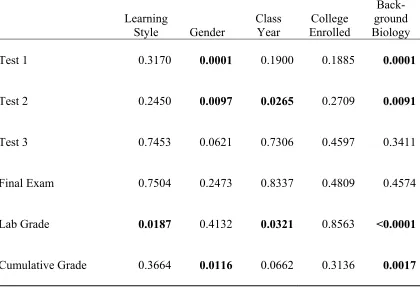
accounted for simply by the “luck of the draw” in a uniform population of the particular size are tabulated below (see Table 4-1).
Table 4-1
Significance of demographic variables for academic achievement in Botany 200 course (p values calculated using ANOVA)
Learning Style Gender Class
Year
College Enrolled
Back-ground Biology
Test 1 0.3170 0.0001 0.1900 0.1885 0.0001
Test 2 0.2450 0.0097 0.0265 0.2709 0.0091
Test 3 0.7453 0.0621 0.7306 0.4597 0.3411
Final Exam 0.7504 0.2473 0.8337 0.4809 0.4574
Lab Grade 0.0187 0.4132 0.0321 0.8563 <0.0001
Cumulative Grade 0.3664 0.0116 0.0662 0.3136 0.0017
Note: Bold face values indicate significance at p<0.05.
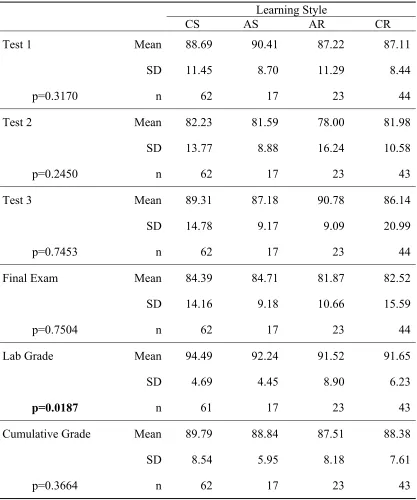
Table 4-2
Comparison of student test scores and grades by learning style Learning Style
CS AS AR CR
Test 1 Mean 88.69 90.41 87.22 87.11
SD 11.45 8.70 11.29 8.44
p=0.3170 n 62 17 23 44
Test 2 Mean 82.23 81.59 78.00 81.98
SD 13.77 8.88 16.24 10.58
p=0.2450 n 62 17 23 43
Test 3 Mean 89.31 87.18 90.78 86.14
SD 14.78 9.17 9.09 20.99
p=0.7453 n 62 17 23 44
Final Exam Mean 84.39 84.71 81.87 82.52
SD 14.16 9.18 10.66 15.59
p=0.7504 n 62 17 23 44
Lab Grade Mean 94.49 92.24 91.52 91.65
SD 4.69 4.45 8.90 6.23
p=0.0187 n 61 17 23 43
Cumulative Grade Mean 89.79 88.84 87.51 88.38
SD 8.54 5.95 8.18 7.61
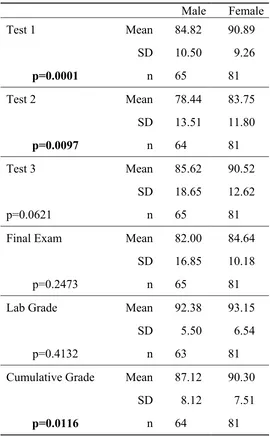
Table 4-3
Comparison of Student Test Scores by Gender
Male Female
Test 1 Mean 84.82 90.89
SD 10.50 9.26
p=0.0001 n 65 81
Test 2 Mean 78.44 83.75
SD 13.51 11.80
p=0.0097 n 64 81
Test 3 Mean 85.62 90.52
SD 18.65 12.62
p=0.0621 n 65 81
Final Exam Mean 82.00 84.64
SD 16.85 10.18
p=0.2473 n 65 81
Lab Grade Mean 92.38 93.15
SD 5.50 6.54
p=0.4132 n 63 81
Cumulative Grade Mean 87.12 90.30
SD 8.12 7.51
p=0.0116 n 64 81
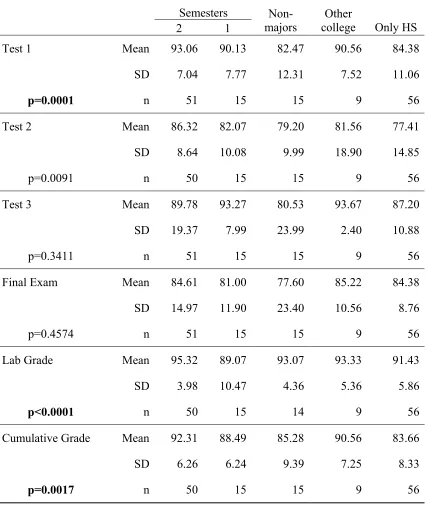
Table 4-4
Prior instruction in biology significantly affected performance except for the lab grade and final exam.
Semesters
2 1
Non-majors college Only Other HS
Test 1 Mean 93.06 90.13 82.47 90.56 84.38
SD 7.04 7.77 12.31 7.52 11.06
p=0.0001 n 51 15 15 9 56
Test 2 Mean 86.32 82.07 79.20 81.56 77.41
SD 8.64 10.08 9.99 18.90 14.85
p=0.0091 n 50 15 15 9 56
Test 3 Mean 89.78 93.27 80.53 93.67 87.20
SD 19.37 7.99 23.99 2.40 10.88
p=0.3411 n 51 15 15 9 56
Final Exam Mean 84.61 81.00 77.60 85.22 84.38
SD 14.97 11.90 23.40 10.56 8.76
p=0.4574 n 51 15 15 9 56
Lab Grade Mean 95.32 89.07 93.07 93.33 91.43
SD 3.98 10.47 4.36 5.36 5.86
p<0.0001 n 50 15 14 9 56
Cumulative Grade Mean 92.31 88.49 85.28 90.56 83.66
SD 6.26 6.24 9.39 7.25 8.33
semesters of majors’ biology outperformed the students who had taken biology for non-majors. The students who had taken only the first semester of biology for biology majors had significantly lower scores in laboratory than the students who had both semesters of the biology for biology majors’ course. Students who had last taken biology in high school ranked last or second to last when the average scores were compared on these academic measurements.
Table 4-5
Significance of questionnaire responses by learning style and gender (p values calculated from ANOVA)
Question Learning Style Gender Question Learning Style Gender
1 0.3180 0.3908 9 0.9405 0.3775
2 0.1483 0.3446 10 0.7940 0.4306
3 0.3803 0.0366 11 0.8877 0.3269
4 0.6424 0.4958 12 0.1012 0.8507
5 0.1107 0.0044 13 0.2180 0.5474
6 0.5943 0.7272 14 0.5842 0.0275
7 0.1796 0.8798 15 0.4221 0.2360
8 0.2129 0.0321
Figure 4-1 shows the relative frequency distributions of male and female answers to survey question 5. This question showed the most difference (p=0.004) between males and females. It asked for an evaluation of the instructor. Figure 4-2 shows through similar histograms the distribution information for question 7, where male and female responses were very nearly the same. That question dealt with the textbook and had a modal value of a neutral response.
Question 5
0% 10% 20% 30% 40% 50% 60% 70%
A B C D E
←Agree - Disagree→
Relative Frequency
77 Males 93 Females
Question 7 0% 10% 20% 30% 40% 50% 60% 70%
A B C D E
←Agree - Disagree→
R e la tiv e Fr e que nc y 78 Males 92 Females
Figure 4-2. Distribution of responses to survey question 7 is centered on a neutral response without significant difference between males and females.
Question 3 - I feel teachers with more personalized classes have a higher-grade distribution than teachers with less personalized classes 0% 20% 40% 60% 80% 100%
←Agree - Disagree→
Cumulative Relativ e Fre que nc y 78 Males 94 Females
Figure 4-3. Distribution of responses to survey question 3 shows a significant difference between male and female respondents (p=0.0366) with females agreeing more strongly.
Question 5 - I learned interesting things about plants because the instructor made the class fun
0% 20% 40% 60% 80% 100%
←Agree - Disagree→
Cumulative Relativ e Fre que nc y 77 Males 93 Females
Question 8 -
The instructor's teaching style meets the needs of my specific learning style 0% 20% 40% 60% 80% 100%←Agree - Disagree→
Cumulative Relativ e Fre que nc y 78 Males 94 Females
Figure 4-5. Survey question 8 again shows female respondents agreeing more readily than males (p=0.0321).
Question 14 - Real-life everyday examples and analogies
0% 20% 40% 60% 80% 100%
←Helpful - Hinders→
Cumulative Relativ e Fre que nc y 78 Males 94 Females
Discussion
From the results it appears that, in this particular botany course, one learning style does not have a significant advantage over another one. Even though research has shown that typically, in science and math courses, students with AS and CS learning styles have higher achievement (Drysdale et al., 2001), that was not evident within this population except with respect to the laboratory grade. The laboratory course was very structured and test-oriented. These attributes align well with the tendencies for individuals with a dominant CS learning style. As Miller et al. (1993) noted in their study, “the students who had a cognitive ‘fit’ between task and setting and their personal style tended consistently to outperform their less ideally situated peers” (p. 34). In the laboratory situation, all of the learning style groups had A averages (see Table 4-2), but the CS students did have a significantly higher laboratory grade average. The decisive differences found in laboratory did not carry over into the student scores in the lecture exams.
The techniques utilized by this professor appear to make the course welcoming to all types of learners, not just the sequential learners that typically do better in a science course. The use of discussion groups within the lecture, visual diagrams to explain concepts and models to increase understanding of abstract concepts is a break in tradition from the typical collegiate large-scale, passive science lecture format (McKeachie, 1999). The class
discussions enable the students to process additional information, and they enable those students who do better in collaborative settings to have an opportunity to work in their preferred mode instead of simply taking notes individually. The use of the reflection and question sheets at the end of a lecture help the students to further process what they have learned and engage them in providing the instructor with a formative assessment, so that instruction can be adjusted to their needs. Those students that do best when they can use written words to organize their understanding are supported in this activity. The results of all learning types succeeding in the course indicate that instructors can make a course accessible to all students, if they are willing to implement a variety of activities that address the learning preferences of the students.
the anatomy and processes carried out by specific parts of the plants; it is possible that these topics are not covered thoroughly in high school biology. These students were in their first semester of their freshman year so that this botany lab was their first laboratory in the college setting. The first-year students could have been at a disadvantage over students that had experienced more college laboratory classes by reason of having to learn procedures and expectations for laboratory at this level. The professor had been concerned about his 18 first-year students and whether or not they had the skills to succeed in class, but this group of students was not shown to be at an overall significant disadvantage in this course when analyzing their overall cumulative grades.
The amount of college biology that the students had taken did prove to be significant in predicting their success in this introductory botany course. The students who had taken both semesters of biology for biology majors offered at the university or had taken another biology course at another college or university usually did better than those with less formal biology background. The second semester of major’s biology offered by the university is when students analyze the form and function of various organisms, which is tightly linked to material covered in the botany course. The findings from this study are consistent with the work from the Norvilitis, Reid, & Norvilitis (2002) study’s finding that, when looking at student performance in college physics, personality variables were not related to proficiency but that the previous course exposure did have a relationship. The students that had greater academic exposure to the material had higher scores on the quizzes (Norvilitis, et al., 2002).
The most surprising results were the higher achievement rates of the females
college did not prove to be significant in most evaluations of performance, it surprised this researcher that gender had a significant difference on achievement in the course.
Observations during lecture did not indicate any preferential treatment or obvious gender bias due to language used or examples presented by the instructor. Greenfield’s (1996) study on student science achievement and attitude showed that, with respect to gender, there were no consistent differences in achievement and only a few when analyzing science perceptions and attitudes. Further, there have been studies to indicate that, when socio-economic status and race are controlled for, male students out-perform female students in science (Von Secker & Lissitz, 1999). Though research shows that females do better in classes that involve
laboratory (Von Secker & Lissitz, 1999), the females in this course did not score significantly better in laboratory than the males. It is possible that the experiences for the females in the laboratory part of the course did help them to perform better in the lecture part of the course.
In the student satisfaction survey, the female students did indicate higher preferences in several categories and this may shed some light upon their success in the course. The females did indicate a greater degree of belief that the instructor had met their individual needs with regards to their learning style. Specifically the females showed a greater
they viewed their teacher as being understanding and supportive. The females in the botany class did view the instructor as fun and meeting their needs and their overall grades in the course were higher than the males, supporting the findings of She & Fisher.
Limitations
Though this study was large (n=146) by educational standards, it did have its
limitations for generalizability. This study was only conducted for one semester and it would be good to gather data for additional semesters to determine if this was typical of the
instructor or limited to this particular cohort of students. The lecture professor was
knowledgeable about learning styles and striving to meet the needs of all of his students; not all college professors have this knowledge or desire. Large classes seldom have multiple sections taught by different professors and, even if they do, university procedures for class registration do not provide for random assignments to sections. Hence, any sort of
comparison to a control group for this type of study is nearly impossible. The results must be considered to be somewhat idiosyncratic to the professor.
Additional qualitative research could be done with groups of students in each learning style to assess what particular elements of the course helped them to be successful. This added data could help to aid in the understanding of the specific methodologies that make an impact for each learning style.
The Gregorc Style Delineator is only available in English. The course did have some students where English was not their native language, though their English is at levels
REFERENCES
(for chapter 4)
Ballone, L.M. (2001). Teacher’s beliefs about accommodating students’ learning styles in science classrooms. Electronic Journal of Science Education, 6 (2), 1-41.
Davidson, G.V., Savenye, W.C., & Orr, K.B. (1992). How do learning styles relate to performance in a computer applications course? Journal of Research on Computing in Education, 24, 348-358.
Drysdale, M.T., Ross, J.L., & Schulz, R.A. (2001). Cognitive learning styles and academic performance in 19 first-year university courses: Successful students versus students at risk. Journal of Education for Students Placed at Risk, 6, 271-289.
Dunn, R.S., Beaudry, J.S., & Klavas, A. (1989). Survey of research on learning styles. Educational Leadership, 46 (6), 50-58.
Dunn, R.S., Denig, S.J., & Lovelace, M.K. (2001). Two sides of the same coin or different strokes for different folks? Teacher Librarian, 28(3), 9-16.
Dunn, R.S., & Dunn, K.J. (1979). Learning styles/teaching styles: Should they, can they, be matched? Educational Leadership, 36, 238–244.
Fischer, B.B., & Fischer, L. (1979). Styles in teaching and learning. Educational Leadership, 36, 245-254.
Greenfield, T.A. (1996). Gender, ethnicity, science achievement, and attitudes. Journal of Research in Science Teaching, 33, 901-933.
Gregorc, A.F. (1982). An adult’s guide to style. Columbia, CT: Gregorc Associates, Inc. Gregorc, A.F. (1985). Gregorc style delineator: A self-assessment instrument for adults.
Columbia, CT: Gregorc Associates, Inc.
Manner, B.M. (2001). Learning styles and multiple intelligences in students: Getting the most out of your students’ learning. Journal of College Science Teaching, 30, 390-393.
McKeachie, W.J. (1999) McKeachie’s teaching tips: Strategies, research and theory for college and university teachers. Boston: Houghton Mifflin.
Miller, J.E., Wilkes, J., Cheetham, R.D. & Goodwin, L. (1993). Tradeoffs in student satisfaction: Is the “perfect” course an illusion? Journal of Excellence in College Teaching, 4, 27-47.
National Research Council (NRC). (1996). National Science Education Standards. Washington, D.C.: National Academy Press.
Norvilitis, J.M., Reid, H.M., & Norvilitis, B.M. (2002). Success in everyday physics: The rose of personality and academic variables. Journal of Research in Science Teaching, 39, 394-409.
O’Brien, T.P. (1991). Relationship among selected characteristics of college students and cognitive style preferences. College Student Journal, 25, 492-500.
O’Brien, T.P. & Thompson, M.J. (1994). Cognitive styles and academic achievement in community college education. Community College Journal of Research and Practice, 18, 547-556.
Riding, R.J. & Read, G. (1996). Cognitive style and pupil learning preferences. Educational Psychology, 16 (1), 81-107.
Rutherford, F.J., & Ahlgren, A. (1990). Science for All Americans. New York: Oxford University Press.
She, H.C. & Fisher, D. (2002). Teacher communication behavior and its association with students’ cognitive and attitudinal outcomes in science in Taiwan. Journal of Research in Science Teaching, 39, 63-78.
REFERENCES (for entire thesis)
Ballone, L.M. (2001). Teacher’s beliefs about accommodating students’ learning styles in science classrooms. Electronic Journal of Science Education, 6 (2), 1-41.
Crow, M.L. (1980). Teaching as an interactive process. New Directions for Teaching and Learning, 1, 41-55.
Davidson, G.V., Savenye, W.C., & Orr, K.B. (1992). How do learning styles relate to performance in a computer applications course? Journal of Research on Computing in Education, 24, 348-358.
deWinstanley, P.A. & Bjork, R.A. (2002). Successful lecturing: Presenting information in ways that engage effective processing. New Directions for Teaching and Learning, 89, 19-31.
Drysdale, M.T., Ross, J.L., & Schulz, R.A. (2001). Cognitive learning styles and academic performance in 19 first-year university courses: Successful students versus students at risk. Journal of Education for Students Placed at Risk, 6, 271-289.
Dunn, R.S., Beaudry, J.S., & Klavas, A. (1989). Survey of research on learning styles. Educational Leadership, 46 (6), 50-58.
Dunn, R.S., Denig, S.J., & Lovelace, M.K. (2001). Two sides of the same coin or different strokes for different folks? Teacher Librarian, 28(3), 9-16.