ABSTRACT
HAWKINS, AMY LYNN. Cluster Analysis of Internal Working Models of Physically Abused Children: Validation of Clusters on Adjustment and Self-concept. (Under the direction of Dr. Mary Haskett.)
One major goal of this study was to advance the research on abused children by examining whether individual differences exist in the internal working models of abused children. A second goal was to determine whether those individual differences were related to any differences in the adjustment of abused children. Specifically, this study was designed to examine whether subgroups exist among physically abused children and whether those subgroups exhibit differences in their socioemotional adjustment and self-concept. Participants included 74 children from a larger longitudinal study designed to examine factors that contributed to physically abused children’s successful transition from preschool to early elementary school. Children ranged in age from 5 to 7 years old and were identified as having a substantiated history of physical abuse. Children’s internal working models were measured using the McArthur Story Stem Battery, which was coded for representations of self, parent, and attachment themes. The Teacher Report Form/Caregiver-Teacher Report form was used to measure socioemotional adjustment (specifically internalizing and externalizing problems) and the Pictorial Scale of Perceived Competence and Social
Cluster Analysis of Internal Working Models of Physically Abused Children: Validation of Clusters on Adjustment and Self-concept
by
Amy Lynn Hawkins
A dissertation submitted to the Graduate Faculty of North Carolina State University
in partial fulfillment of the requirements for the Degree of
Doctor of Philosophy
Psychology
Raleigh, North Carolina 2012
APPROVED BY:
_____________________________ ___________________________
William Erchul Shevaun Neupert
_____________________________ ___________________________
Scott Stage Mary Haskett
BIOGRAPHY
Amy Lynn Hawkins grew up in Bethlehem, Pennsylvania and graduated from Liberty High School. Amy went on to complete her Bachelor of Arts in Psychology and German at the University of Rochester in Rochester, NY. She completed her Bachelors in May of 2002 and then worked for the Mt Hope Family Center in Rochester, NY for 3 years before beginning her graduate education. In August 2005 Amy moved to Raleigh, NC and started her graduate education at North Carolina State University. Amy served as a researcher on a federally-funded grant investigating variables impacting maltreated children’s transition from
ACKNOWLEDGEMENTS
TABLE OF CONTENTS
LIST OF TABLES... vi
LIST OF FIGURES... vii
INTRODUCTION... 1
Purpose of the Study... 2
LITERATURE REVIEW... 3
Person-oriented Approach... 4
Attachment and Internal Working Models... 7
Attachment and Internal Working models of Maltreated Children... 13
Representations and the Person-oriented Approach... 15
Internal Working Models and Socioemotional Adjustment of Abused Children... 16
Internal Working Models and Self-concept of Abused Children... 19
STATEMENT OF THE PROBLEM... 20
Research Questions and Hypotheses... 22
METHOD... 23
Participants... 23
Instrumentation... 24
Measure of Internal Models... 24
Measure of Socioemotional Adjustment... 26
Measure of Self Concept... 28
Procedures... 29
Participant Recruitment and General Data Collection Procedures... 29
Procedures for Coding the MacArthur Story Stem Battery... 31
Representations... 32
Themes... 33
Composite Scores... 34
Table 1... 36
RESULTS... 37
Preliminary Analyses... 37
Clustering Strategy... 37
Cluster Descriptions... 39
Validation of Clusters on Socioemotional Adjustment and Self-concept... 40
Socioemotional Adjustment... 41
Self-concept... 42
Follow-up Analysis... 43
Table 2... 46
Table 3... 47
Table 4... 48
Table 5... 49
Table 6... 50
DISCUSSION... 52
Internal Working Model Clusters... 53
Validation of Clusters on Socioemotional Adjustment... 57
Validation of Clusters on Self-concept... 60
Study Limitations and Future Directions... 62
REFERENCES... 67
APPENDICES... 79
Appendix A. Narrative Story Stems: Administration... 80
Appendix B. Flow Chart for Narrative Story Stems Coding... 86
Appendix C. Dendrogram Using Ward Method... 88
Appendix D. Dendrogram using Average Linkage... 89
LIST OF TABLES
Table 1 Correlations Among Siblings on Study Variables………...…… 36 Table 2 Mean Scores and Standard Deviations of Measures for Full Sample.….…… 46 Table 3 Skew and Kurtosis Values for Measures... 47 Table 4 Means, Standard Deviations, and Test of Significance of Clustering
Variables by Cluster……….……… 48 Table 5 Demographic Characteristics of Clusters ……….………... 49 Table 6 Cluster Differences on Socioemotional Adjustment and Self-concept
Variables………..……. 50 Table 7 Means, Standard Deviations, and Tests of Significance on TRF Subtests by
LIST OF FIGURES
Cluster Analysis of Internal Working Models of Physically Abused Children: Validation of Clusters on Adjustment and Self-concept
Introduction
Despite substantial evidence of negative outcomes associated with the experience of physical abuse in childhood, relatively recent research indicates that there are individual differences in adjustment among children who have experienced abuse (e.g., Cicchetti & Rogosch, 1997). In fact, there are some children who have experienced abuse that show “resilient functioning” in spite of their history of abuse and/or neglect (Bolger & Patterson, 2003; Cicchetti, Rogosch, Lynch, & Holt, 1993). Of particular relevance for the present study, research shows substantial within-group variability among physically abused children in terms of their self-concept and their socioemotional adjustment, that is, the degree to which they exhibit internalizing problems (e.g., withdrawal, anxiety, fearfulness, depression) or externalizing problems (e.g., hyperactivity, aggression, defiance, destructive behavior). A growing area of research seeks to identify factors that are associated with these individual differences in outcomes for maltreated children. The goal of the current study was to add to that literature using a person-oriented approach to examining characteristics of abused children; specifically, this study was designed to explore whether physically abused children, sub-grouped (i.e., “clustered”) on the basis of their internal working models of relationships, differed in their socioemotional adjustment and self concept.
working models of their relationships likely mediate the well-established link between attachment quality and later social and emotional competence. Research has documented that children’s attachment style can be affected by the experience of physical abuse, and that children who have experienced abuse are more likely than non-abused children to develop insecure attachment styles. Because many abused children develop insecure attachments, the internal working models of many of these children tend to reflect harsh and unpredictable relationships (Toth, Cicchetti, Macfie, & Emde, 1997; Toth, Cicchetti, Macfie, Rogosch, & Maughan, 2000). However, each abused child experiences a unique early family
environment, and his or her internal working model is based on that unique experience. Therefore, in addition to differences in internal working models between abused and
nonabused children, there are likely to be within group differences in the working models of abused children. It is possible that the within group differences in internal working models are associated with the variations in socioemotional adjustment (i.e., internalizing and externalizing behavior problems) and self-concept (i.e., maternal acceptance, peer
acceptance, cognitive competence, and physical competence) that have been documented among abused children.
Purpose of the Study
Research on maltreatment has focused largely on maltreated children as a
found support for the presence of important individual differences among maltreated children. The present study advanced the investigation of within-group differences among abused children by using a person-oriented approach to examine individual differences in physically abused children’s internal working models of relationships and determined
whether those individual differences account for variations in indicators of adjustment related to internalizing and externalizing behavior problems as well as aspects of self-concept (i.e., perceived maternal acceptance, peer acceptance, cognitive competence and physical
competence).
Literature Review
The following sections contain a discussion of the person-oriented approach to data analysis and the benefits of using such an approach, followed by an introduction to
Person-Oriented Approach
Two main types of data analytic methods are often used to examine the characteristics of a sample — oriented approaches and person-oriented approaches. In the variable-oriented approach, the focus is on the variable, its intercorrelations, and how it relates to specific criteria (Magnusson, 1998). In this approach, the variable tends to be at the core of constructs and theories and then becomes the main aspect of the research. This approach focuses on the variable by comparing one individual’s score to the scores of others, and it is in this comparison that the score becomes meaningful. Generally this is done by statistically comparing means and by conducting correlations, regression analyses, and analyses of variance. Using these statistical methods in this way assumes that individuals differ
quantitatively rather than qualitatively across a variable or set of variables, and that variables function and relate in the same way across all individuals. Therefore, this approach highlights the scores on a particular variable rather than the person to whom the score belongs, and it assumes that the relations among variables that exist across individuals are also valid within the individual (Magnusson). A typical research question based on a variable-oriented
approach would be “What is the correlation between internal working models and adjustment of abused children”?
variable-oriented approach, an individual’s score for a variable, such as depression, is only meaningful in relation to others’ scores on that same variable. Additionally, examining variables can provide useful information about particular risk factors; however, how those variables influence development may differ among individuals. With respect to the present study, variable-oriented studies have not always found the expected links between children’s internal working models and various indicators of adjustment. For example, despite strong theoretical connections between various aspects of internal working models and children’s social information processing abilities, Lynn (2008) did not find significant correlations between those constructs using the same larger sample of physically abused children as was used in this study. Based on this variable-oriented approach, it appeared that internal working models were not important in terms of their link to children’s social information processing. However, it could be the case that the patterns of components that exist within children’s internal working models are meaningful with respect to social information processing of children.
patterns to a number of factors (i.e., are the patterns in internal working models related to variations in adjustment among physically abused children?). According to Bergman (1998), a pattern refers to a specific individual’s profile on certain variables, and a classification divides the individuals into groups in which the individuals within the group are similar on the variable(s) but the groups themselves are not similar.
models of physically abused children. The following section will provide a basis for the relevance of attachment theory and internal working models in terms of understanding adjustment of maltreated children.
Attachment and Internal Working Models
Attachment theory, which suggests that children form attachment relationships with their caregivers based on their early experiences, started with the work of John Bowlby in the 1950s and 60s. According to Bretherton (1992), the goal of Bowlby’s work was to
understand what contributed to a child to growing up “mentally healthy.” Bowlby concluded that infants and young children needed to experience a warm, intimate, and continuous relationship with their mother in order to increase the chance of having mentally healthy development. Following Bowlby’s contribution to attachment theory, Mary Ainsworth’s work led to a greater understanding of the attachment relationship and designated it as very specific type of relationship consisting of an affectional bond to a specific individual that endures over time and distance (Ainsworth, Blehar, Waters, & Wall, 1978).
Children’s early experiences with their caregivers form the foundation for the development of their attachment style. Secure attachment styles promote a positive
2007). These findings suggest that there is diversity in children’s adjustment that can be explained, at least in part, by their attachment style.
Within an attachment framework, the primary mechanism by which early family relationships are linked to later outcomes is children’s own construction of “internal working models” of relationships. Internal working models of parent-child relationships consist of the knowledge and expectations that a person has about the relationship and the way it functions. Bowlby (1973) added that within an individual’s working model of relationships exist
representations of the self and of the caregiver. It is generally agreed that these models consist of mental structures, rules, and postulates that result from experiences with attachment figures and that these experiences form a collective perceptual record of the affective and behavioral components of child-caregiver interactions (George & Solomon, 1989). Based on their models of self and caregivers, children develop expectations about the self and others; the self is viewed as either worthy or unworthy of care and protection and others are viewed as available or unavailable to provide care and protection (Bowlby). Over time, these internal working models create “knowledge structures” in order for the child to understand current and future relationships (Bowlby, 1982). It also has been suggested that children’s working models contain themes that reflect aspects of their attachment
relationships. In addition to representations of self and parent, Toth, Cicchetti, Macfie, Rogosch, and Maughan (2000) found evidence for the presence of moral-affiliative and conflictual themes within children’s working models.
models and representations of relationships that are formed by children. Indeed, Moss, Bureau, Béliveau, Zdebik, and Lépine (2009) found differences in internal working models between securely and insecurely attached children. Securely attached children had fewer conflictual themes in their narrative stories than did disorganized/controlling children, recounted more discipline themes than avoidant children, and had higher rates of coherence than ambivalent children. Differences between securely attached children and children with insecure attachments are evident in various other aspects of children’s lives such as
socioemotional adjustment and self concept. Specifically, children with secure attachments have been found to experience fewer internalizing symptoms than children with insecure attachment styles; insecurely attached children have been found to experience higher levels of both internalizing and externalizing symptoms (Kidwell, Young, Hinkle, Ratliff, Marcum & Martin, 2010; Vondra, Shaw, Swearingen, Cohen, & Owens, 2001). Additionally, children with secure attachment styles are less susceptible to negative information influencing their self-concept than are children with insecure attachment styles (Broemer & Blümle, 2003).
internal working models have been related to many aspects of their adjustment, including internalizing and externalizing behavior problems and self-concept. Children with higher levels of positive and appropriate discipline representations and lower levels of negative representations exhibited fewer behavior problems (Oppenheim, Emde, & Warren, 1997). Furthermore, using the Narrative Story Stem Battery, Moss and colleagues (2009) found that narratives of 7 to 9 year olds significantly predicted behavior problems as rated by their teachers, such that children with a higher presence of conflictual themes had higher levels of externalizing problems and total behavior problems (Moss et al.). These results suggest that children’s working models are a reflection of their attachment experiences and that these models may have a regulating effect on children’s behavior (Zimmerman, 1999).
Despite the evidence that shows relations between internal working models and socioemotional adjustment, there are studies such as Solomonica-Levi, Yirmiya, Erel, Samet, and Oppenheim (2001) that do not find the same level of relation between these two
With respect to the link between attachment and self-concept, attachment
relationships provide children with a base from which they build their view of themselves and the world with which they interact. Attachment theorists have suggested that attachment security and the internal working models that follow have important implications for
children’s developing self-concept (Bretherton & Munholland, 1999). In fact, Cassidy (1988) found that children’s attachment security was related to their self-concept in that children with more secure attachments had higher levels of perceived cognitive competence and perceived peer acceptance. Goodvin, Meyer, Thompson, and Hayes (2008) found children’s early attachment security to be a unique predictor of their later self-concept. Results showed that children with secure attachments at age 4 exhibited higher rates of positive self-concept at age 5. Additionally, children who were more securely attached demonstrated more
consistency in their self-concept (Goodvin et al.). These findings suggest that attachment is an important variable in the development of a child’s self-concept.
self representations work in conjunction with representations of the parent and various attachment themes to form children’s internal working models of relationships. Therefore, it would follow that additional research should investigate the potential relation of all aspects of children’s working models and their self-concept, specifically with regard to their perceived maternal and peer acceptance as well as their perceived physical and cognitive competence.
Attachment and internal working models of maltreated children. Most studies on attachment of maltreated children have included children who have experienced a variety of types of abuse and neglect; thus, knowledge of attachment and internal working models of physically abused children, specifically, is limited. Research suggests that more maltreated children than non-maltreated children exhibit insecure attachments (Baer & Martinez, 2006; Cicchetti & Barnett, 1991; Egeland & Sroufe, 1981). Particularly, it has been found that many maltreated children display the type of insecure attachment referred to as Disorganized, in that they show a lack of clear attachment behavior and often appear confused, avoidant, or apprehensive during interactions with their caregivers (Carlson, Cicchetti, Barnett, &
Braunwald, 1989). The percentage of maltreated children with insecure attachment styles is much higher than the percentage of non-maltreated children with insecure attachments (Egeland & Sroufe). Lynch and Cicchetti (1991) suggested that these insecure attachments continued beyond early childhood and were still evident when maltreated children were in their school-age years. Thus, differences in the attachment styles of maltreated and non-maltreated children are not temporary.
caregiver and attachment themes) (Toth, Cicchetti, Macfie, & Emde, 1997; Toth, Cicchetti, Macfie, Maughan, & Vanmeenen, 2000; Waldinger, Toth & Gerber, 2001). Narrative measures such as the McArthur Story Stem Battery have frequently been used to assess children’s representations of both self and caregiver as well as themes in children’s working models. The McArthur Story Stem Battery is a story stem completion task in which children use dolls to act out the end of story stems read to them by experimenters. Several
investigators have used the story stem battery to assess representations of maltreated children. The following studies represent some of the most methodologically sound studies designed to examine various aspects of the representations of maltreated children.
Toth and colleagues (1997) used a story stem completion task to examine internal working models; specifically, they examined caregiver and self representations of children who had been maltreated (n = 80) and matched non-maltreated (n = 27) children between 3 and 6 years old. All children were enrolled in the study with their mothers. The mothers of the maltreated participants had perpetrated at least one instance of reported abuse. The authors initially examined how different representations (i.e., positive and negative parent and self representations) correlated with each other. These correlations showed that positive maternal representations were significantly correlated with positive self representations and negative maternal representations were significantly correlated with negative self
maternal and self representations compared to children who had experienced the other subtypes of maltreatment (i.e., neglect or sexual abuse). Toth and colleagues (1997) concluded that relationships that could be potentially positive (with peers and teachers, for example) may be adversely affected by the relationship expectations of maltreated children, and this could be especially true for physically abused children.
Toth, Cicchetti, Macfie, Maughan, and Vanmeenen (2000) furthered the research on internal working models by examining the one-year stability of representations for 56 maltreated children and 37 matched non-maltreated children. Once again, children were enrolled in the study with their mothers, and the mothers of maltreated participants had perpetrated substantiated abuse. The MacArthur Story Stem Battery was used to assess positive and negative representations of caregiver and self. As expected, maltreated children had significantly more negative representations of self and parent compared to the
representations of their non-maltreated peers, which is analogous to the results of Toth and colleagues (1997). Building on previous research, findings from this study also showed that maltreated children had fewer positive parent representations than did non-maltreated children. Representations of parent remained stable over time for both abused and non-abused children. However, grandiose self representations (i.e., the child in the story stem is portrayed to have over-inflated abilities) rose marginally for maltreated children between Time 1 and Time 2.
abused children translate into differences in working models between abused and non-abused children. However, whether patterns of representations exist within the working models of abused children cannot be determined using variable-oriented approaches like those
employed in prior research; to further explore and understand the internal working models of abused children one must examine individual differences using a person-oriented approach.
Abused children’s representations of their attachment relationships are likely to be subject to within-group differences in addition to the between-group differences that have already been examined. Internal working models are highly complex and are composed of a number of facets such as representations of the self and caregiver and numerous relationship themes (Thompson, 2008). Using a person-oriented approach to examine individual
differences would not only allow for consideration of how aspects of children’s internal working models combine, but also whether those different combinations are related to children’s adjustment. The domains of adjustment considered in the current study are abused children’s socioemotional adjustment (internalizing and externalizing behavior problems) and their self-concept (perceived maternal acceptance, peer acceptance, physical competence, and cognitive competence).
Internal Working Models and Socioemotional Adjustmentof Abused Children
fearfulness, and depression, whereas externalizing behavior problems can take the form of hyperactivity, aggression, defiance, and destructive behavior (Achenbach, 1991). Feldman, Salzinger, Rosario, and Alvarado (1995) found that physical abuse was directly related to parent and teacher reports of internalizing and externalizing behavior problems. Children who have been maltreated, specifically those who have been physically abused, often have been found to have higher levels of externalizing behavior problems (Bolger & Patterson, 2001a; Teisl & Cicchetti, 2008). Additionally, studies have found that maltreated children exhibit higher rates of internalizing behavior problems compared to rates for non-maltreated children (Bolger & Patterson, 2001b; Kim & Cicchetti, 2006; Toth & Cicchetti, 1996). Specifically, Keiley, Howe, Dodge, Bates and Pettit (2002) found that early abuse was related to higher rates of internalizing and externalizing behavior problems in kindergarten, as rated by the teacher. Due to the plethora of research supporting higher levels of
internalizing or externalizing behavior problems among abused children, it is clear that maltreatment is related to the development of these problems.
As suggested above, the experience of maltreatment has been related to both
internalizing and externalizing behavior problems; therefore it would follow that there is the potential for a connection between children’s internal working models and behavior
problems among abused children. In fact, several studies conducted by Toth and colleagues show internal working models of maltreated children are related to their adjustment. Toth, Cicchetti, and Kim (2002) found that children’s perceptions of their mothers (a construct similar to representations of parents) mediated the link between maltreatment and
experience of maltreatment influences children’s perceptions of their mothers, which then affects their behavioral adjustment.
Toth, Cicchetti, Macfie, Rogosch, and Maughan (2000) examined whether themes expressed in working models were related to children’s behavior problems and if there were differences between maltreated and non-maltreated children in both internal working models and behavior problems. The authors examined this by using the MacArthur Story Stem Battery to assess moral-affiliative themes and conflictual themes present in narrative stories and the Child Behavior Checklist – Teacher Report Form (CBCL-TRF) to assess behavior problems. Toth and colleagues (2000) found significant positive correlations between conflictual themes and behavior problems and significant negative correlations between moral-affiliative themes and behavior problems. These results suggest that themes present in maltreated children’s representations are significantly related to the socioemotional
adjustment exhibited by maltreated children. The results also suggest that maltreated children who have higher rates of positive themes may be less likely to exhibit the externalizing behaviors common among maltreated children. However, the investigators did not account for the parent and self representations that are present in children’s working models, or how the themes combine with the representations within children’s models. Nor did they examine within-group differences in themes among the maltreated children.
It is possible that differences in the internal working models and the formation of those models may help account for variability in socioemotional adjustment among
adjustment among abused children. In addition to influencing behavior, working models have been shown to influence self-concept among maltreated and non-maltreated children. Self-concept and its relation to attachment and maltreatment are discussed next.
Internal Working Models and Self-concept of Abused Children
Self-concept develops gradually over time and contains various dimensions that create a portrait of the self (Harter, 1988). It has been suggested that children’s perceived levels of competence and acceptance are among the domains that make up self-concept. Harter and Pike (1984) proposed that, for children under the age of 8, self-concept encompasses children’s perceived competence in various domains of functioning (e.g., cognitive and physical competence) and their perceived social acceptance (i.e., maternal and peer acceptance). Additionally, Harter and Pike suggested that children are able to
distinguish between domains of self-concept and are not likely to view themselves as equally adequate in all domains; therefore, for children under 8 years, it is more appropriate to view self-concept as a group of variables rather than one overall variable.
that maltreated children showed significantly more positive self-concept in terms of social acceptance (Barnett, Vondra, & Shonk, 1996) and Kinard (2001) did not find group
differences in perceived academic competence. It is possible, because self-concept develops gradually throughout childhood, that differences in study findings may be age related. Kinard (2001) included a sample of abused children between 6-12 years old, a developmental period during which self-concept is changing (Harter, 1988); therefore, it is possible that his lack of findings is related to the fluidity of self-concept and changes that happen between ages 6 and 12.
To date, research examining the connection between internal working models and self-concept among maltreated children has been quite limited. Toth and Cicchetti (1996) found that maltreated children’s relatedness to mother was significantly correlated with their perceived social acceptance. However, the direct link between children’s working models and their self concept has not been examined for a maltreated sample. The present study was designed to advance this area of research by examining whether there are subgroups of abused children with similar patterns in internal working models who differ from other subgroups (with different internal working models) in terms of aspects of their self-concept.
Statement of the Problem
variable-oriented in nature and has focused on how abused and non-abused children differ in
numerous areas of functioning. Although previous research has been extremely important in providing knowledge of the effects of abuse, little research has provided insight into the wide individual differences that exist within this group of children. Previous research has been useful in the development of interventions to reduce long-term negative outcomes for abused children. However, effectiveness of those interventions varies across abused children (Moss, Dubois-Comtois, Cyr, Tarabulsy, St-Laurent, & Bernier, 2011; Toth, Maughan, Manly, Spagnola, & Cicchetti, 2002), with some abused children less likely to benefit from particular approaches. Understanding factors associated with the diversity in adjustment of abused children could assist in refining intervention approaches for these children.
Using a person-oriented approach to understanding characteristics of abused children should provide important information about heterogeneity among these children. According to Magnusson (1998), by examining a group of children with a common history of abuse, we will be able to provide more in-depth information about the functioning of the individuals. That is, the functioning of abused children may be considered similar when compared to that of non-abused children; however, conducting in-depth examinations of the functioning of physically abused children would provide information on how functioning may differ among children within this group. Therefore, by examining the internal working models of
children with similar patterns of internal working models differ in their socioemotional adjustment and self-concept.
Research Questions and Hypotheses
Individual differences in the internal working models of physically abused children were examined through cluster analysis. Clustering on internal working models included children’s representations of self, representations of parent, moral-affiliative themes, and conflictual narrative themes. Due to the exploratory nature of cluster analysis, specific hypotheses about the number of clusters that would be identified and the nature of those clusters could not be made. However, it was expected that one or more clusters would be characterized by a generally favorable pattern of working models and at least one other would be characterized by a less favorable pattern. Further, it was expected that clusters would differ on measures of socioemotional adjustment and self-concept. Specifically it was hypothesized that:
Method
Participants
Participants were a subset of participants from a larger longitudinal study designed to examine factors that contributed to physically abused children’s successful transition from preschool to early elementary school. Participants in the larger study were 96 child/parent dyads, where the parent enrolled in the study was the abuser. Criteria for inclusion in the larger study included (a) a substantiated report of physical abuse by the parent to the social service registry within the prior 12 months; (b) confirmation that the child/parent dyad was living in the same home; (c) an absence of sexual abuse of the child; (d) the family was predominantly English speaking; and (e) the child was in his or her last year of preschool, kindergarten, or first grade.
In the current study, children were included if they completed the measures of internal working models and self-concept and if their teacher completed the teacher report measure of children’s behavior. Nearly all (79%) of the children enrolled in the larger study were included in the current study. The sample for this study was 74 children who ranged in age from 5 to 7 years old (M = 6.33; SD =.54). A large majority of children in the study were male (n = 49; 66%) and most (70%) children were African American. Finally, the children had a mean IQ score of 90.65 (SD=12.52). Despite the longitudinal nature of the larger study, only one time point for each child was used in the current study. Not all children were
grade time points had equivalent data, the first grade time point was used. The kindergarten time point was used for 22 of the children and the first grade time point was used for 52 of the children.
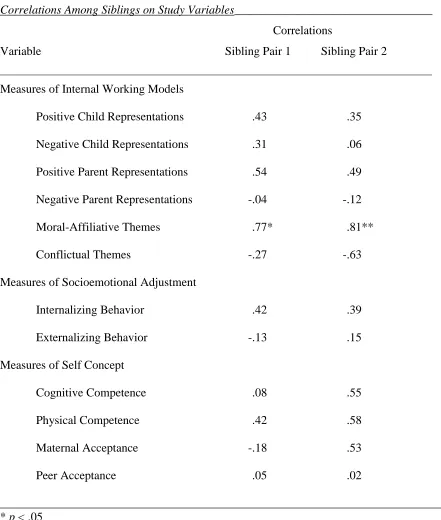
Several children in the larger study had siblings that were also participants in the study. The present study included 10 sets of siblings; seven of the sets consisted of two siblings and the final three sets each consisted of three siblings. The current study included all children from the 10 sets of siblings because each child could have unique representations of their experiences, unique levels of socioemotional adjustment, and a unique self-concept. However, to examine the degree to which including multiple children from one family would impact the independence of observations, correlation analyses were conducted between sibling pairs on all study variables. Two sets of correlations were run due to the fact that three of the sibling sets had three siblings in the study. For these three sets, a different pair was included in each set of correlations. All correlation values for sibling pairs can be found in Table 1. The majority of correlations were not significant, providing statistical justification for including all siblings in the study. However, there were significant correlations in scores for Moral-Affiliative Themes between sibling pairs. Thus, the cluster analysis was run twice—once with all children included and once with only one sibling from each set
included. Because results produced a very similar pattern of findings, a decision was made to retain the full sample.
Instrumentation
Measure of internal working models. Children’s internal working models of
Story Stem Battery (Bretherton, Oppenheim, Buschbaum, & Emde, 1990) and developed by Bretherton and colleagues (Bretherton, Ridgeway, & Cassidy, 1990). The MacArthur Story Stem Battery contains a number of stories and investigators choose which stories to
administer based on their research questions. This study included seven stories that used a combination of dolls (mother, father, grandmother, and two same-sex child dolls) matched to the gender and race of the child participant. Stories portrayed emotionally-laden family interactions designed to be relevant to the lives of young children; content areas included child accident, child injury, parental conflict, child fear, parent-child separation and reunion, and family interaction. Each story and administration directions are provided in Appendix A.
Stories were administered individually to each child by trained research assistants. The child was instructed to “Listen to the beginning of the story, and then finish it any way you would like to.” The research assistant then told the beginning of the story and acted it out, using the dolls. At the conclusion of the story stem, the child was asked to “Show me and tell me what happens now.” An initial story about a birthday party was presented as a practice story to introduce the task and allow children to gain familiarity with the procedures. Administration of all stories was audiotaped and videotaped for later coding.
measure and coding system are useful assessment tools and provide support for the coding of themes present in the stories. Additionally, previous research has continually shown that the differences in outcomes and adjustment can be related to the variables generated by this measure. Specifically, studies have shown that maltreated and non-maltreated children obtained significantly different scores on Child and Parent Representation composites, and that scores on the Conflictual composite mediated the relation between maltreatment status and externalizing disorders (Buchsbaum, Toth, Clyman, Cicchetti, & Emde, 1992; Toth, Cicchetti, Macfie, Rogosch & Maughan, 2000).
On both versions of the measure, teachers rated how true each item was of the child at that time or within the past 6 months using the following scale: 0 = not true; 1 = somewhat or sometimes true; 2 = very true or often true. Raw scores were converted to T scores (M = 50;
SD = 10) based on age group and gender for three composites, including Internalizing Problems, Externalizing Problems, and Total Problems. For purposes of this study, T scores for Internalizing Problems and Externalizing Problems were used as the measures of
socioemotional adjustment. Additionally, the T scores for four subscales from the TRF and C-TRF were used for a follow-up profile analysis of cluster differences on subscales. The Anxious/Depressed, Somatic Complaints, Attention Problems, and Aggressive Behavior subscales were used, as they were the most comparable across the two forms of the TRF (Achenbach & Rescorla, 2000). These four subscales contained the greatest amount of similar items across the two forms, suggesting that they were assessing the same behaviors and that scores across the two forms would be comparable.
The TRF has shown high levels of internal consistency, with alpha = .90 for the Internalizing Problems score and alpha = .95 for the Externalizing Problems score
2000). Validity has been well established through over 40 years of research showing TRF and C-TRF scores distinguish between demographically similar referred and nonreferred children (Achenbach & Rescorla, 2000; Achenbach & Rescorla, 2001).
Measure of self-concept. Children’s self-concept was measured using the Pictorial
Scale of Perceived Competence and Social Acceptance (Pictorial Scale; Harter & Pike, 1984). The Pictorial Scale is an individually-administered measure of perceived competence and social acceptance in young children. The Pictorial Scale included 24 items administered in a picture format. For each item, the child was read a brief statement about pairs of pictures of children engaged in various tasks while the examiner pointed to the corresponding picture (e.g., “this child is good at doing puzzles and this child is not very good”). The examiner then asked the child to point to the child in the picture that was most like him/her and then asked whether the picture was a lot like him/her = 4, somewhat like him/her = 3, a little like him/her
= 2, or not at all like him/her = 1.
The measure yielded scores for four subscales each containing six items: Cognitive Competence, Physical Competence, Maternal Acceptance, and Peer Acceptance. Each item was scored 1 (less competent/less accepted) through 4 (more competent/more accepted). To determine the score for each subscale, scores for all items in that scale were added together and the total was then divided by the number of items in the subscale for a final score. For the present study, self-concept was measured using all four aspects (Cognitive Competence, Physical Competence, Maternal Acceptance, and Peer Acceptance) as individual variables.
(Mantzicopoulos, 2006). Mantzicopoulos, French, and Maller (2004) found support for the multi-dimensional structure of the Pictorial Scale for middle class and low-income
kindergarteners. Internal consistency for the four subscales has ranged from alpha = .75 to alpha = .89 (Harter & Pike, 1984). Additionally, Mantzicopoulos and colleagues (2004) found similar internal consistency scores as those reported by Harter and Pike. The following levels of internal consistency were found for the present study: Physical Competence alpha = .57; Cognitive Competence alpha = .70; Maternal Acceptance alpha = .76, Peer Acceptance alpha = .81. Additionally, according to Harter and Pike, the Pictorial Scale also demonstrated acceptable convergent, discriminant, and predictive validity.
Procedures
To encourage participation, parents received $70 for their participation and transportation to the data collection site and childcare were provided. To promote continued participation in all three time-points of the study, the payments were increased by $10 each year the family participated. Parents also received a book with contact information for local parenting and family support resources and their child was given educational materials and a small toy.
Confidentiality was maintained by assigning identification numbers to all participating families and cataloging data according to these numbers in locked filing cabinets. To take further precautions for confidentiality, a Certificate of Confidentiality was obtained from the federal Department of Health and Human Services, which protects families from research information being used in court proceedings. Procedures for the larger study were approved by the university Institutional Review Board. Informed consent was obtained from parents and assent was obtained from children at the beginning of each session. Teams of undergraduate research assistants, supervised by a graduate student, administered all measures with parents and children. To help ensure unbiased data collections, undergraduate research assistants were not aware of the families’ involvement with Child Protective
Services or participants’ substantiated histories of abuse.
Families were scheduled for a three-hour data collection session at a university-based clinic. Informed consent was obtained from parents at the beginning of each session and assent was obtained from children. Teams of undergraduate research assistants, supervised by a graduate student, administered all measures with parents and children. Children and parents completed measures concurrently in separate, private interview rooms and
process. All measures were completed in a standard administration order, and of the measures used in the present study, children completed the McArthur Story Stem Battery prior to completing the Pictorial Scale of Perceived Competence and Acceptance.
At the data collection session, parents also signed a consent form allowing their child’s teacher to be contacted so that teacher ratings could be obtained. Once consent from the parent was obtained, the teacher was contacted about participation in the study and all teachers were given the option of declining participation. If the teacher agreed to participate, a visit to the school was scheduled and the measures were given to the teacher to complete. Measures would then be collected from teachers once they had been completed and teachers received $15 for participating in the study.
Procedures for coding the MacArthur Story Stem Battery. Creating usable data from the MacArthur Story Stem Battery was an involved process that had two main steps—coding each story along a number of dimensions and generating scores using the codes. A flow chart of score creation is provided in Appendix B. Each story was coded separately using the Rochester Narrative Coding II Manual (2001). This manual is the latest revision of the MacArthur narrative coding manual – Rochester Revision (Robinson, Mantz-Simmons, Macfie, & the MacArthur Narrative Working Group, 1996). Stories were coded by
were assigned a series of tapes to code individually and approximately 30% of the narratives were coded by a second coder in order to assess inter-rater reliability.
Toth, Cicchetti, Macfie, Maughan, and colleagues (2000) reported the inter-rater agreement of the MacArthur narrative coding manual – Rochester Revision ranged from kappa = .71 to 1.0 for all categorical variables. Toth, Cicchetti, Macfie, Rogosch, and
colleagues, (2000) also assessed inter-rater reliability of this coding system and reported it to range from kappa = .73 to .95 and the Moral-affiliative and Conflictual composite scores are negatively correlated (r = -.28, p < .05). Oppenheim, Emde, and Warren (1997) also found adequate inter-rater reliability of the coding system, kappa = .85. However, due to the fact that kappa could not be computed for certain variables in this study, percent agreement was calculated for all variables and ranged from 78% to 100% for all variables of interest. Principal component analyses in previous studies have shown adequate internal consistency ranging from alpha = .70 to .81 for the parent composite scores (Oppenheim et al.). Prior research provides evidence to support the validity of the coding system. For example, Toth and colleagues (1997) suggested that the ability of the codes of MacArthur narrative stories to reveal differences between maltreated and non-maltreated children on their differential care giving histories provides validation for the measure and its coding system.
Representations. Each of the six stories (excluding the practice story) was first coded for representations of self (child representations) and representations of caregivers (parent representations). Generating those codes required several steps. To determine self
about self in any domain (e.g., child doll helps clean up the spilled juice). Negative child representations included aggression, shame, self-blame, and feeling bad about oneself in any domain (e.g., child doll hits the mom doll). False child representations encompassed reports of inappropriate emotions or an overly compliant strategy (e.g., when asked how the child doll feels about the parent dolls arguing, participant says “good” or “fine”).
To determine parent representations, stories were coded for the presence of positive, negative, disciplining, controlling, and incongruent parent representations. Positive parent representations included protection, caretaking, affection, and helpfulness (e.g., mother, father, or grandmother doll puts a band-aid on the hurt finger). Negative parent
representations involved harsh or punitive behaviors, rejection, and ineffectual actions (e.g., mother, father, or grandmother doll rejects a child doll’s bid for closeness, or moves rather than deal with the monster). Disciplining parent representations consisted of descriptions of the mother, father or grandmother dolls disciplining a child doll, which may have included physical punishment if it was not overly harsh (e.g., mother, father, or grandmother doll put the child doll in time out, or parent doll spanked the child doll). Controlling parent
representations were parental doll attempts to control the child doll independent of discipline (e.g., parent doll tells the child doll to go to bed, not as a punishment). Incongruent parent representations were when a child told a story about one or both parent dolls dealing inconsistently with the child doll (e.g., Parent doll comforted the child doll and put a band-aid on the hurt knee, then yelled at the child doll for falling off the rock).
(b) affiliation (a positive situation where two or more dolls were participating in an activity together); (c) compliance (when a child doll yielded to the rules or requests of an adult doll in the story); (d) empathy/helping (character/doll identified with or demonstrated an
understanding of the thoughts or feelings of another); (e) reparation/guilt (character/doll made story stem wrongs/upsets right, made amends, or displayed feelings of guilt); (f) aggression (verbally aggressive comments or physically aggressive acts); (g) verbal conflicts (highly inflected angry verbal remarks such as name calling or yelling); and (h) escalation of conflict (incidence of a coherent escalation in the level of conflict beyond that initially expressed).
Composite scores. Codes for child representations, parent representations, and themes were used to generate scores using the method employed by Toth, Cicchetti, Macfie,
Maughan, and colleagues (2000). Self representations were assessed using the child
Parental representations were assessed using composite scores as outlined by Toth and colleagues (1997). The Positive Parent Representations composite, containing only positive representations, had a range of 0-6, where a 6 corresponded to a positive
representation in each story. The Negative Parent Representations composite consisted of scores on negative, controlling and incongruent representations. Therefore, the Negative Parent Representations composite score was divided by 3, to create an average composite score, because it combined three scales (i.e., negative, controlling, and incongruent). Scores ranged from 0-6, and a score of 6 showed that there were negative, controlling, or
incongruent representations in each story.
Finally, using the method employed by Toth, Cicchetti, Macfie, Rogosch, and Maughan (2000), the coded themes were used to create composite scores for
Table 1
Correlations Among Siblings on Study Variables_________________________________ Correlations
Variable Sibling Pair 1 Sibling Pair 2
Measures of Internal Working Models
Positive Child Representations .43 .35
Negative Child Representations .31 .06
Positive Parent Representations .54 .49
Negative Parent Representations -.04 -.12
Moral-Affiliative Themes .77* .81**
Conflictual Themes -.27 -.63
Measures of Socioemotional Adjustment
Internalizing Behavior .42 .39
Externalizing Behavior -.13 .15
Measures of Self Concept
Cognitive Competence .08 .55
Physical Competence .42 .58
Maternal Acceptance -.18 .53
Peer Acceptance .05 .02
___________________________________________________________________________ * p < .05
Results
Preliminary Analyses
To examine and describe the data, means, standard deviations, and ranges were calculated for all study variables and values can be found in Table 2. Skewness and kurtosis values were computed to examine the distribution of the study variables and all variables had acceptable levels of skew and kurtosis, which can be found in Table 3.
A series of analyses was conducted to identify possible covariates. Previous research has shown gender differences as well as ethnicity differences in the socioemotional
adjustment and self-concepts of children (Chen, 2010; Hatcher, Maschi, Morgen, & Toldson, 2009; French & Mantzicopoulos, 2007; Maschi, Morgen, Bradley, & Hatcher, 2008).
Therefore, two MANOVAs were run to determine if socioemotional adjustment or self-concept differed by gender or ethnicity (African American/ Non-African American). Results indicated that socioemotional adjustment variables did not differ by gender or ethnicity. Additionally, self-concept variables did not differ by gender or ethnicity, with the exception of Physical Competence which differed by gender. Specifically, males had significantly lower Physical Competence score (M = 3.47; SD = .45) than females (M = 3.67; SD = .45),
F(1, 66) = 6.20, p = .02; therefore, gender was included as a covariate in the subsequent MANCOVA analysis for self-concept.
Clustering Strategy
and Conflictual themes were included in the cluster analysis. The first decision was to determine which method of cluster analysis would be used. Due to the exploratory nature of the study, a hierarchical agglomerative, rather than a partitioning method, was most
appropriate (Aldenderfer & Blashfield, 1984). Aldenderfer and Blashfield also suggest that the hierarchical agglomerative method is appropriate for use with smaller samples.
Additional support for conducting a cluster analysis with a sample size of 74 can be found in previous studies that have conducted hierarchical agglomerative cluster analysis with similar sample sizes and found meaningful results (Daignault & Hebert, 2009; Davies & Forman, 2002). The next step in the cluster analysis was to establish the criterion for determining distance between cases. Squared Euclidian Distance was an appropriate measure of distance for the present study because the variables entered into the cluster analysis were continuous and on the same scale (Norusis, 2009). In the third step of cluster analysis, Ward’s minimum variance method was chosen to determine which clusters were merged at successive steps; however, average-linkage was used as a second measure to examine the similarity of the cluster solution and increase confidence that clusters were sound. These two methods are the most often used within social science research (Bergman & Magnuson, 1997) and Ward’s method minimizes the within-group distances for each cluster. The final step in the cluster analysis was to determine the optimal number of clusters to represent the data. Two indices were used for this purpose – the change in the agglomeration coefficients and visual
representation of how subjects were combined into clusters, and helped clarify the appropriate number of clusters.
Using Ward’s method, support was found for a two-cluster solution. The change in agglomeration coefficient generated by Ward’s method provided support for a two-cluster solution with a change between the coefficients of 117.88. The next highest change in the agglomeration coefficient was 42.96 for a three-cluster solution. Visual inspection of the dendrogram offered further support for the two-cluster solution (Appendix C). The dendrogram shows that throughout the successive steps, participants were combined into clusters of varying sizes, with certain clusters being substantially larger or smaller than others. At the step where two clusters are formed, the clusters become more visually
meaningful and relatively equal in size. Finally, re-estimating the clusters using the average-linkage method yielded consistent results with those found using Ward’s method. The largest change in agglomeration coefficient was for a two cluster solution and the visual inspection of the dendrogram produced by the average-linkage method (Appendix D) showed clusters of similar size and make-up as those produced using Ward’s method. In summary, there was substantial support for a two cluster solution.
Cluster Descriptions
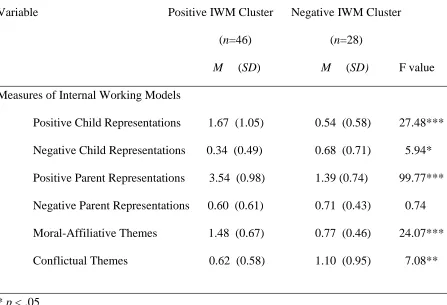
scores on all of the positive aspects of their internal working models (i.e., Positive Child Representations, Positive Parent Representations, and Moral-Affiliative Themes) and lower scores on two of the negative aspects (i.e., Negative Child Representations and Conflictual Themes). Due to lower scores on the positive aspects of internal working models and higher scores on negative aspects, Cluster 2 (n=28) was labeled “Negative IWM”.
The children in the two clusters were relatively similar on demographic variables. Due to the heavy verbal load in narrative story stems, correlations were run to assess the relation between children’s IQ scores and the six representation variables. Only the
Conflictual Themes variable was significantly correlated with IQ (r = .242, p = .05); due to this relation a t-test was conducted to determine if children in the clusters differed on IQ. The
t-test revealed that children in the two clusters were not significantly different in terms of IQ, and therefore, IQ was not considered a covariate in further analyses.Additionally, there were no significant differences between the children in the two clusters on race. However, the clusters did differ significantly on gender, X2 (1, 74) = 7.66, p = .006; the Positive IWM cluster included a significantly greater proportion of females than did the Negative IWM cluster. The Positive IWM cluster included 21 females (46% of the cluster) whereas the Negative IWM cluster included only 4 females (14% of the cluster). See Table 5 for all means and standard deviations of the demographic variables for each cluster and tests for significant differences between clusters.
Validation of Clusters on Socioemotional Adjustment and Self-concept
adjustment variables (Internalizing Problems and Externalizing Problems) came from the TRF/C-TRF and all four self-concept variables (Maternal Acceptance, Peer Acceptance, Cognitive Competence, and Physical Competence) came from the Pictorial scale, Repeated Measures MANOVAs were run to examine (a) differences in the scores across variables from the same measure, and b) differences in the patterns of scores for the two clusters. In order to examine the assumption of homogeneity of variance among variables for the Repeated Measures MANOVAs, Box’s M tests were conducted. The Box-M test for the homogeneity of variance-covariance matrices produced non-significant results for both MANOVAS; socioemotional adjustment, F(3, 93329.263) = 1.997, p > .05; self-concept,
F(10,15209.302) = .981, p > .05. This suggests that there were acceptable levels of homogeneity across variables for both the socioemotional adjustment and self-concept MANOVAs. Then, in order to address specific hypotheses related to whether clusters
differed in their scores on each individual variable, a series of independent samples t-tests or one-way ANOVAs were conducted, depending on whether covariates were included in the analyses.
Socioemotional adjustment. A Repeated Measures MANOVA was run to determine whether the entire sample differed on internalizing and externalizing behavior problems and whether the children in the clusters differed in their pattern of scores. T scores for
not a significant interaction between TRF scores and cluster membership, F(1, 68) = 1.266, p
=.265, partial η2
= .018, indicating that children in the two clusters did not differ in their pattern of scores. That is, Externalizing Problems scores were higher than Internalizing Problems scores for children in both clusters.
In order to specifically examine Hypotheses 1 and 2 and determine whether there were significant differences between children in the two clusters on mean scores for
Internalizing Problems and Externalizing Problems, two separate Independent Samples t-tests were run. All means and standard deviations for the two clusters can be found in Table 6. Results indicated that clusters differed significantly in their mean scores for both
Internalizing Problems, t(68) = -2.099, p =.04, r2 = .061, and Externalizing Problems,
t(68) = -3.321, p =.001, r2 = .140. For both Internalizing Problems and Externalizing Problems children in the Negative IWM cluster had higher mean scores than children in the Positive IWM cluster.
Self-concept. A Repeated Measures MANCOVA was run to determine whether the sample had significantly different scores across self-concept variables and whether children in the two clusters exhibited significantly different patterns of self-concept scores. The scores for Maternal Acceptance, Peer Acceptance, Cognitive Competence, and Physical Competence were entered as the dependent variables and once again Cluster Membership was entered as the dependant variable. Also, because boys and girls differed significantly on Physical Competence, gender was entered as a covariate in this analysis. Results from the Repeated Measures MANCOVA revealed a significant main effect for self-concept, F(1,69)
self-concept and cluster membership, F(1,69) = 1.763, p = .162, partial η2 = .071. Thus, there are differences in Maternal Acceptance, Peer Acceptance Cognitive Competence and Physical Competence scores for the entire sample, but children in the two clusters did not differ in their pattern of scores on the self-concept variables.
To specifically examine Hypotheses 3 through 6, one-way ANOVAs were used to explore the potential for cluster differences on each aspect of self-concept individually. Once again, all means and standard deviations for the two clusters can be found in Table 6. Results revealed that children in the two clusters did not differ significantly on three out of the four aspects: Cognitive Competence, F(1, 71) = .108, p =.743, partial η2 = .002; Physical
Competence, F(1, 71) = .012, p =.914, partial η2 = .000; Peer Acceptance, F(1, 71) = 1.855, p =.177, partial η2 = .025. Maternal Acceptance was the only aspect of Self-concept that was significantly different by cluster, F(1, 71) = 4.223, p =.044, partial η2 = .056, with children in the Negative IWM cluster having higher scores for maternal acceptance than children in the Positive IWM cluster.
Follow-up Analysis
for all subjects who were in the cluster analysis to be included in the profile analysis. Finally, the grouping variable for the profile analysis was Cluster Membership.
To conduct the profile analysis, a repeated measures MANOVA was used to identify subscales on which the two clusters were similar and different and to compare their overall pattern of scores on the subtests of the TRF/C-TRF. Mauchly’s Test of Sphericity revealed a significant effect, suggesting that the assumption of sphericity was violated. In order to avoid an increase in the likelihood of Type I error, the lower-bound epsilon correction was used to correct for the violation of the sphericity assumption. After the correction, results indicated a significant main effect for TRF/C-TRF subscales, F(1, 68) = 9.394, p = .003, partial η2 = .121, suggesting that when children in the clusters were examined together the overall mean scores differed across the various subscales of the TRF/C-TRF. Additionally, there was a significant interaction between TRF/C-TRF subscale scores and cluster membership, F(1, 68) = 5.133, p = .027, partial η2 = .070, revealing that children in the Positive IWM cluster and children in the Negative IWM cluster had significantly different patterns across TRF/C-TRF subtest mean scores. The Negative IWM cluster had elevated mean scores on Attention Problems, and Aggressive Behavior and their scores decreased for Anxious/Depressed and Somatic complaints, whereas the Positive IWM cluster means scores were fairly consistent across all four areas. Please see Figure 1 in Appendix E for a graph of the profile analysis results. Additionally, partial eta squared revealed that 7% of the variance in performance across subtests could be accounted for by cluster membership.
subtests differed significantly by cluster. All means, standard deviations, and tests of significant differences for TRF/C-TRF subtests can be found in Table 7. Results indicated that children in the two clusters differed significantly on Anxious/Depressed, Attention Problems, and Aggressive Behavior. For all three subtests with significant cluster
Table 2
Mean Scores and Standard Deviations of Measures for Full Sample__________________
Variable M SD Range
Measures of Internal Working Models
Positive Child Representations 1.24 1.06 0.0-5.0
Negative Child Representations 0.47 0.60 0.0-2.0
Positive Parent Representations 2.73 1.38 0.0-6.0
Negative Parent Representations 0.64 0.55 0.0-3.0
Moral-Affiliative Themes 1.21 0.69 0.0-3.8
Conflictual Themes 0.80 0.77 0.0-3.3
Measures of Socioemotional Adjustment
Internalizing Behavior 52.23 10.27 37-79
Externalizing Behavior 55.97 10.42 41-83
Measures of Self Concept
Cognitive Competence 3.58 0.51 2.2-4.0
Physical Competence 3.54 0.45 2.3-4.0
Maternal Acceptance 3.04 0.75 1.7-4.0
Peer Acceptance 3.40 0.72 1.5-4.0
Table 3
Skew and Kurtosis Values for Measures ______________________________ Variable Skew S.E. Kurtosis S.E.
Measures of Internal Working Models
Positive Self Representations 1.28 .28 2.16 .55 Negative Self Representations 1.14 .28 0.29 .55 Positive Parent Representations 0.15 .28 -0.14 .55 Negative Parent Representations 1.35 .28 3.53 .55 Moral-Affiliative Themes 0.94 .28 1.66 .55 Conflictual Themes 1.23 .28 1.25 .55 Measure of Socioemotional Adjustment
Internalizing Behavior 0.44 .29 -.39 .57 Externalizing Behavior 0.33 .29 -.30 .57 Measure of Self-Concept
Cognitive Competence -1.34 .28 1.13 .55 Physical Competence -0.77 .28 -0.28 .55 Maternal Acceptance -0.10 .28 -1.26 .55 Peer Acceptance -1.14 .28 0.23 .55
Table 4
Means, Standard Deviations, and Test of Significance of Clustering Variables by Cluster___
Variable Positive IWM Cluster Negative IWM Cluster (n=46) (n=28)
M (SD) M (SD) F value ___________________________________________________________________________ Measures of Internal Working Models
Positive Child Representations 1.67 (1.05) 0.54 (0.58) 27.48*** Negative Child Representations 0.34 (0.49) 0.68 (0.71) 5.94* Positive Parent Representations 3.54 (0.98) 1.39 (0.74) 99.77*** Negative Parent Representations 0.60 (0.61) 0.71 (0.43) 0.74 Moral-Affiliative Themes 1.48 (0.67) 0.77 (0.46) 24.07*** Conflictual Themes 0.62 (0.58) 1.10 (0.95) 7.08** ___________________________________________________________________________ * p < .05
Table 5
Demographic Characteristics of Clusters_________________________________________
Variable Positive IWM Cluster Negative IWM Cluster
Number (%) Number (%) X 2value ___________________________________________________________________________ Child Race
African American 31 (67%) 21 (75%) 0.48 Non African American 15 (33%) 7 (25%)
Child Gender
Male 25 (54%) 24 (86%) 7.66** Female 21 (46%) 4 (14%)
___________________________________________________________________________ Positive IWM Cluster Negative IWM Cluster
Table 6
Cluster Differences on Socioemotional Adjustment and Self-concept Variables___________
Variable Positive IWM Cluster Negative IWM Cluster
M (SD) M (SD) t value
___________________________________________________________________________
TRF/C-TRF
Internalizing Problem 49.3 (8.74) 54.5 (11.91) -2.01* Externalizing Problems 53.0 (8.31) 61.0 (11.80) -3.32*** ___________________________________________________________________________ M (SD) M (SD) F value
___________________________________________________________________________
Self-concept
Maternal Acceptance 2.94 (0.74) 3.21 (0.75) 4.22* Peer Acceptance 3.30 (0.78) 3.56 (0.58) 1.86 Physical Competence 3.56 (0.49) 3.51 (0.40) 0.01 Cognitive Competence 3.57 (0.54) 3.59 (0.44) 0.11
___________________________________________________________________________ * p ≤ .05