An International Round-Robin Test of NDE Reliability for PWSCC
George J. Schuster1), Stephen E. Cumblidge1), Steven R. Doctor1) and Carol E. Moyer2)
1) Pacific Northwest National Laboratorya, Richland, WA 2) U.S. Nuclear Regulatory Commission, Washington, DC
ABSTRACT
Primary water stress corrosion cracking (PWSCC) has occurred world-wide in nuclear power plants and is seen as a serious issue. Crack samples show very tight and very complex cracks in the nickel-base weld metal and forgings that are difficult to detect, size, and characterize. Pacific Northwest National Laboratory (PNNL) is conducting a research program on non-destructive evaluation (NDE) reliability in detecting and characterizing PWSCC. This program is part of an international cooperative research project called the Program for the Inspection of Nickel-Alloy Components (PINC), led by the U.S. Nuclear Regulatory Commission (NRC), which has been set up to leverage efforts in several countries to address this significant and common problem. This work has the general goal of developing an understanding of the morphology of PWSCC and assessing the NDE responses from it.
In this paper we describe the round robin tests that have been designed and are being conducted in the international program. Participants in the PINC have offered more than 30 test blocks for use in round-robin tests of NDE effectiveness. The test blocks have more than 130 flaws in nickel-base weld metal that are intended to simulate PWSCC in a variety of component geometries. NDE techniques representative of current in-service inspections are being applied, along with emerging NDE approaches.
INTRODUCTION
Reliable detection of PWSCC is challenging because this form of cracking exhibits very tight and very complex branching in the nickel-base weld metal and forgings. Leakage has occurred from this service degradation in dissimilar metal welds [1-4], control rod drive mechanism (CRDM) nozzle penetration weldments [5,6], and bottom-mounted instrumentation (BMI) nozzle penetration weldments [7]. These failures demonstrate the need to better understand PWSCC morphology in nickel-base alloys and to improve the in-service inspection.
An international cooperative research program, Program for the Inspection of Nickel-Alloy Components, is underway to document the morphology, to quantify the features of PWSCC, and to assess NDE response effectiveness in Alloy 600 components and Alloy 182/82 welds. The motivations for setting up the international cooperative project included: 1) there are a number of utilities and regulators in various countries that would like to have definitive data of this type available; 2) there is a need to have better NDE techniques to detect the cracking in the J-groove weld reliably and before it causes leaks; and 3) the costs for performing the studies needed are very high, and probably cost prohibitive, for a single organization. In this program, NDE techniques will be evaluated that are or may be applied in the field to detect and characterize cracks with PWSCC morphology. NDE methods will be assessed to determine whether they can reliably detect PWSCC in all of the important locations within the welded assembles of interest in a timely manner that allows for necessary corrective actions to be taken before the structural integrity of the component is challenged.
PWSCC MORPHOLOGY
The NDE response from degradation and the benign conditions that form the baseline against which degradation must be detected depend on the characteristics, form, and shape (morphology) of the degradation. This motivates the measurement of morphology parameters and their variance for known degradation mechanisms and fabrication conditions in light water reactor nickel-alloy components [8].
NDE measurements were made on PWSCC in a CRDM nozzle penetration seal weld. CRDM nozzle weldment number 31 from the former removed-from-service top head of the North Anna 2 reactor pressure vessel showed evidence of leakage, with boric acid deposits on the outside of the weldment and indications detected during in-service inspections. A leakage path, formed by PWSCC, was confirmed and is reported in Cumblidge et al. (2007, unpublished)b.
a
The work was sponsored by the U.S. Nuclear Regulatory Commission under Contract DE-AC05-76RL01830; NRC JCN Y6534; Ms. Carol Moyer, NRC Project Monitor.
b
Cumblidge, S.E., Doctor, S.R., Schuster, G.J., Harris, R.V. and Crawford, S.L., “NDE and DE of Service-Induced PWSCC in NA2 Control Rod Drive Mechanism Housing,” to be presented at PWSCC of Alloy 600 2007 International Conference & Exhibition, Atlanta, Georgia, 2007.
Scanning electron microscope (SEM) images were collected from surface and near-surface PWSCC at its initiation site and examined for a leakage path. The SEM images were analyzed for crack morphology information, including morphology quantification analysis of crack shape and form on the surface and in the through-wall dimension.
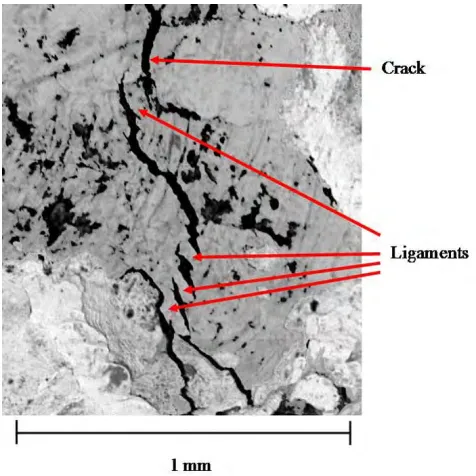
SEM of the wetted surface shows, in Fig. 1, that the crack has a discontinuous profile. Many separate, short (<1 mm) and very tight cracks were found on the weld surface. A 4-mm-long, 25-micron crack opening dimension (COD) discontinuous crack segment begins at the weld/butter boundary and extends at an angle into the buttering. A 2.5-mm-long and very tight (too tight for the SEM to measure in many places) tail extends further into the buttering towards the stainless steel cladding. One important feature of the crack at the surface is the discontinuous nature of the crack. Even along the 4-mm-long main segment there are several ligaments of metal crossing the crack.
Fig. 1 Electron Image of Portion of PWSCC on the Wetted Surface Examined for a Leakage Path in North Anna 2 CRDM Nozzle 31
After the surface examinations were completed, the sample was sectioned into thin slices perpendicular to the crack. These slices were then polished and examined in an SEM. Of interest is a detailed look at the crack COD at various points along the crack. Fig. 2 shows the first 1.5 mm of the through-wall crack. Looking close to the surface, one finds several choke points very close to the surface of the crack. Points 3 and 4 are much tighter than the crack path above and below these points, which would reduce the effectiveness of dye penetrant testing (PT), and they are less than a tenth of a millimeter below the welded surface.
The crack characteristics determined via destructive examination correlate well to the NDE responses. The crack is reasonably tight and on a difficult surface for visual inspection, and was thus missed by direct visual testing (VT) and replica testing. The crack closes down to less than 10-microns wide very close to the surface, making it difficult to find using PT. The crack is oriented at a poor angle for detection with volumetric ultrasonic testing (UT) applied from inside the penetration tube. The discontinuous nature of the crack, both along the surface and through the first 3 mm of depth, reduces the amplitude of the eddy current response.
EDDY CURRENT RESPONSE FROM PWSCC
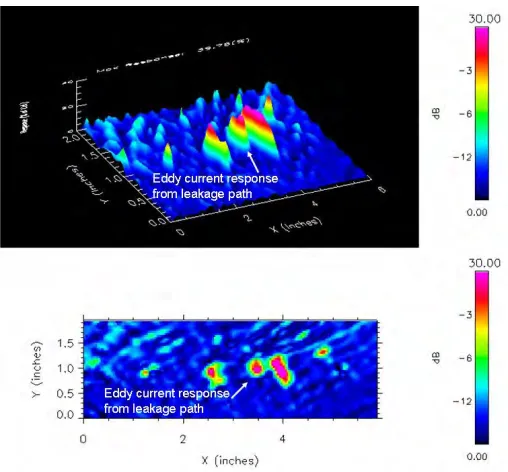
This section describes the eddy current apparatus and shows the eddy current images that were collected from the surface of North Anna 2 CRDM nozzle weldment number 31. Eddy current testing found the surface degradation associated with the PWSCC initiation site for the leakage path, and other confirmed PWSCC initiation sites. Fig. 3 shows the eddy current responses from the wetted surface area on a leakage path caused by PWSCC in nozzle 31.
SMiRT 19, Toronto, August 2007
Transactions, Paper # O-02/2
.
Fig. 2 PWSCC Width (COD) at Several Points Close to the Wetted Surface of North Anna 2 CRDM Nozzle 31
Fig. 3 Eddy Current Responses from Crack Indication on a Leakage Path in North Anna 2 CRDM Nozzle 31
The eddy current probe used was a differential plus-point type of probe, manufactured by Zetec, model PP11A (+Point®) with part number Z0000857-1. This particular style of probe was used by Westinghouse (WesDyne) in the inspection of the V.C. Summer Unit 1 nozzle-to-pipe welds [9] and by PNNL in an earlier study on crack detection in cast stainless steel [10]. It consists of two coils at right angles to each other, making a plus or cross on the probe face. The coil widths are 3-mm
(0.120-in.) and the probe has a 12.5-mm (0.5-in.) spot size with a nylon wear face. The frequency range of this probe is approximately 100-800 kHz. The advantage of a differential coil is that material conditions, including lift-off, that affect both coils simultaneously are minimized. Conversely, conditions not common to both coils produce an imbalance in the electrical system and result in a larger recorded response. Thus, a plus-point probe performs better on rough surfaces than the traditional pancake-type probe that is adversely affected by variations in lift-off or coupling to the inspection surface.
MANUFACTURED CRACKS
One of the objectives of the PINC program is to assess methods for manufacturing test blocks and mockups with flaws that adequately simulate the NDE response from PWSCC. The most important needed product form to add to the open test blocks was Alloy 182/82 seal weld metal and buttering of CRDM and BMI assemblies. Before PNNL could order the Alloy 182 weld metal mockup, a simple parametric study was required to refine specifications and quality requirements for the cracks and coupons, especially the selection of appropriate lengths for the cracks to be used in the blind test.
Fig. 4 shows the three cracked Alloy 182 weld metal coupons received at PNNL. The coupon on the left has a thermal fatigue crack that is 5.3-mm long and 2.3-mm deep. The thermal fatigue crack is introduced into the coupon with controlled thermal fatigue loading [11]. The coupon on the right in the figure has a weld solidification crack that is 10-mm long and 2-mm deep. Such a crack is introduced by performing a weld and adjusting the weld chemistry to produce a centerline crack that is bounded by the fused metal [12]. A laboratory-grown stress corrosion crack is in the coupon at the center of Fig. 4. The main crack is 28-mm long with a mean COD of 50 microns. The method for growing stress corrosion cracks is described in [13]. The method involves the manufacture of a test piece that is suitable for the application of tensile stress.
Fig. 4 Alloy 182/82 Weld Metal Coupons with Manufactured Cracks for Simulation PWSCC
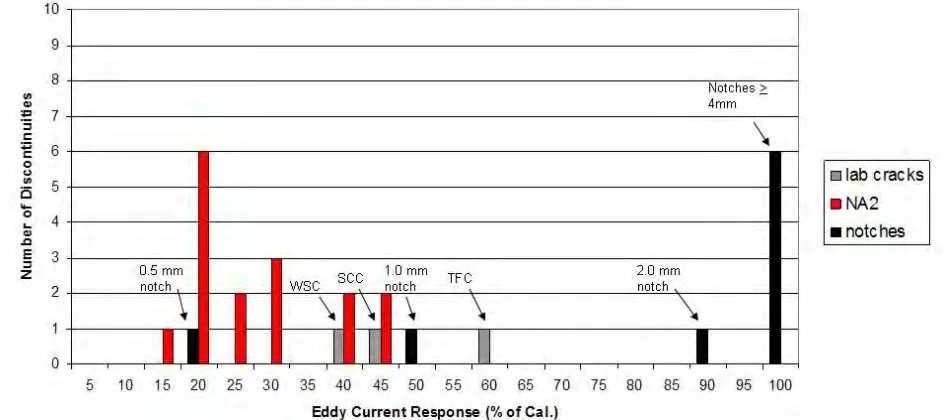
Fig. 5 is the summary chart of eddy current response distributions. The responses from 16 crack indications in NA2 nozzle 31, three manufactured cracks, and nine EDM notches are plotted. The 0.5-mm electrical-discharge machined (EDM) notch and 1.0-mm EDM notch approximately bracket the crack indication distribution. The responses from manufactured cracks are comparable to PWSCC crack indications producing the largest NDE responses.
SMiRT 19, Toronto, August 2007
Transactions, Paper # O-02/2
.
Fig. 5 Eddy Current Response Distribution for Fabrication Flaws, PWSCC Indications, Manufactured Cracks, and Notches
BMI TEST BLOCKS
The most important missing product form in the open test blocks is Alloy 82/182 seal weld metal and buttering of CRDM and BMI assemblies. Fig. 6 shows a BMI nozzle penetration specimen from the cancelled Washington Nuclear Power Unit 1 (WNP-1). Six penetrations have been removed from the specimen. The six BMI nozzle penetrations are shown being prepared for separation using a band saw. Flame cutting was used as a first step to remove excess material in order to fit the specimen on the band saw. Machining of BMI nozzle penetrations from WNP-1 was completed and the penetration was prepared for NDE measurements. Fig. 6 also shows a picture of PINC BMI nozzle penetration seal weld test block 5.7. The test block is 175 mm on a side, 75-mm thick, and weighs 45 kg.
Fig. 6 Portion of Bottom Head from the Reactor Pressure Vessel of the Cancelled Nuclear Plant WNP-1 and a Test Block Removed from It
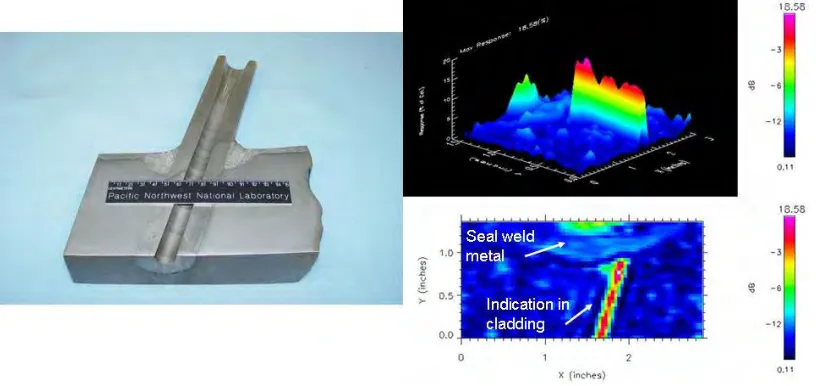
Fig. 7 shows a cross section and macro-etch of another BMI nozzle penetration seal weld specimen from WNP-1. The figure shows the tube geometry, the interference fit with the carbon steel on the bottom head, the seal weld metal, and the cladding of the bottom head inside surface. There is no buttering product form in the figure or in any of the WNP-1 BMI nozzle penetration weldments selected for the PINC mockup. Eddy current testing was performed on the six test blocks. Fig. 7 also shows an indication of a fabrication flaw in the cladding of one of the BMI test blocks. There are more than 10
such cladding flaws in the six test blocks. Their signal strength is high and similar to that from the crack indications in North Anna 2 nozzle 31, but location can be used with weldment design information to characterize these indications as fabrication flaws that should not present a problem for knowledgeable inspectors. Yet, they are interesting as a test of inspector expertise.
Fig. 7 Macro-etch of Seal Weld and Eddy Current Response from a Fabrication Flaw in the Cladding
The macro-etch on the left of Fig. 7 shows the weld profile. The eddy current images on the right were taken from the wetted surface of the seal weld.
PINC ATLAS DATABASE
This section describes the database (Atlas) that is being created in the PINC program for use by cooperative participants in quantifying NDE effectiveness for various PWSCC crack parameters. The purposes of the database are to compile all available data on PWSCC morphology, to quantify NDE effectiveness for the detection and characterization of PWSCC in the nickel-base product forms, and to explain how and when it can be distinguished from fabrication flaws. The database design is based on product forms and welding process zones. This section describes the concept behind the PWSCC/NDE database and shows the main data viewing and entry forms.
In a computational database, the data are organized to support the estimation of a dependant variable, such as the probability of detection for PWSCC. Such calculations use complex relationships with the data in the database. Relational databases typically store only values for independent variables in their tables. The calculation of a dependant variable is typically performed in queries that access data tables using the structured query language. Difficulty arises for a relational database of NDE effectiveness.
The NDE database problem can be stated as: how can large volumes of ultrasonic and eddy current responses be stored and easily retrieved for use in NDE effectiveness estimation? The solution employed in the PINC Atlas database is:
• Store individual records in database tables for important results such as an estimation of NDE effectiveness or the inspection of a crack.
• Allow each record of a result to reference a collection of objects, where the objects can be links, spreadsheets, documents, or images.
• Link to large volumes of data. Extract selected data from large volumes to a spreadsheet. Use spreadsheets for calculations not queries.
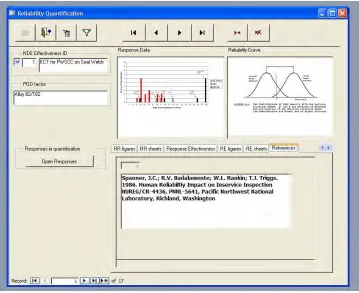
Most important for the database is quantification of NDE reliability. Fig. 8 shows the data viewing form for NDE effectiveness. NDE effectiveness in the in-service inspection of welds in light water reactors is typically measured by performance demonstration in a blind test of cracked and blank weld segments called grading units. Another method for quantifying NDE reliability is the parametric study, where the distributions of noise and signal responses are determined from the data, and the overlap of the two distributions is a measure of unreliability. The reference shown in Fig. 8 is the source for the reliability curve shown at the top right in this figure.
SMiRT 19, Toronto, August 2007
Transactions, Paper # O-02/2
.
Fig. 8 Data Viewing Form for NDE Effectiveness Information in the PINC Atlas Database
SUMMARY AND CONCLUSIONS
This paper described progress on the PINC program’s general goal of developing an understanding of the morphology of PWSCC and characterizing and quantifying the NDE responses from it. The shape and form (morphology) of service-induced PWSCC from a U.S. pressurized water reactor (PWR) is quantified using the methodology contributed by PINC participants. The service-induced cracking is reasonably tight and on a difficult surface for visual inspection, and was thus missed by direct VT and replica testing. The cracking closes down to less than 10-microns wide very close to the surface, making it difficult to find using PT. The crack is oriented at a poor angle for detection with volumetric UT applied from inside the penetration tube. The discontinuous nature of the cracking, both along the surface and through the first 3 mm of depth, reduces the amplitude of the eddy current response.
This paper also described calibrated eddy current responses from PWSCC, manufactured simulations of PWSCC, fabrication flaws, and other manufacturing conditions that contribute to the eddy current noise level of the nickel-alloy components. The signal strengths for the eddy current indications in North Anna 2 nozzle #31 are very high with all signal-to-noise ratios greater than 3.0. But only three of the 16 indications could be confirmed with complementary NDE. This is ascribed to the very tight and discontinuous features of the cracks and to the rough condition of the wetted surface of the seal weld and buttering. To date, only two of the eddy current indications have been validated to be PWSCC by electron microscopy, but additional work is continuing to examine all of the ET indications to determine their causes.
A new bottom-mounted instrumentation nozzle penetration seal weld mockup has been designed using authentic weldments removed from the canceled U.S. PWR reactor pressure vessel WNP-1. This paper described that mockup and the product forms it contains. There is no buttering product form in any of the WNP-1 BMI nozzle penetration weldments selected for the PINC mockup.
PNNL has built a relational database called the PINC Atlas that contains information on PWSCC morphology and NDE responses from field degradation found by the participants and on the PINC mockups of nickel-alloy components, their artificially implanted cracks, and machined reflectors. This paper described the method used to develop and implement the
PINC Atlas database. PNNL is adding data that is offered by the participants – collecting and organizing it in the PINC Atlas database, making it a reference tool for NRC staff and PINC participants. The Atlas database also permits analysis of simulated PWSCC cracks for appropriate NDE response.
REFERENCES
1. Bamford, W.H., et al., Integrity Evaluation for Future Operation: Virgil C. Summer Nuclear Plant Reactor Vessel Nozzle to Pipe Weld Regions, WCAP-15615, Rev. 0, Westinghouse Engineering, 2000.
2. Bamford, W.H., Foster, J., Hsu, K.R., Tunon-Sanjur, L. and McIlree, A., "Alloy 182 Crack Growth and Its Impact on Service-Induced Cracking in PWR Plant Piping," 10th International Conference on Environmental Degradation of Materials in Nuclear Power Systems - Water Reactors, NACE, Houston, Texas, 2002.
3. Jenssen, A., Norrgard, K., Embring, G., Lagerstrom, J. and Tice, D.R., Assessment of Cracking in Dissimilar Metal Welds, 10th International Conference on Environmental Degradation of Materials in Nuclear Power Systems - Water Reactors, NACE, Houston, Texas, 2002a.
4. Jenssen, A., Norrgard, K., Jansson, C., Lagerstrom, J., Embring, G. and Efsing, P., Structural Assessment of Defected Nozzle to Safe-End Welds in Ringhals-3 and -4, Fontevraud V International Symposium, SFEN, 2002b.
5. Frye, C.R., Arey, M.L., Robinson, R.R. and Whitaker, D.E., "Evaluation and Repair of Primary Water Stress Corrosion Cracking In Alloy 600/182 Control Rod Drive Mechanism Nozzles," Proceedings of ICONE10, 10th International Conference on Nuclear Engineering, Arlington, Virginia, 2002.
6. Lang, T.A., Significant Corrosion of the Davis-Besse Nuclear Reactor Pressure Vessel Head, ASME Pressure Vessels and Piping Conference, Cleveland, Ohio, 2003.
7. Halpin, E.D., Bottom Mounted Instrumentation Penetration Indications, STP Unit 1 Licensee Event Report (LER) 03-003, ADAMS, ML031681316, June 11, 203-003, 2003.
8. Wale, J., Crack Characterisation for In-service Inspection Planning - An Update, SKI Report 2006:24, Swedish Nuclear Power Inspectorate, Stockholm, Sweden, 2006.
9. Westinghouse, ET Examination of Reactor Vessel Nozzle to Pipe Welds Inside Surface for V. C. Summer, Westinghouse Nuclear Services Field Service Procedure, Procedure No. CGE-ISI-207-ET, Rev. 2, Westinghouse Nuclear Services, 2003.
10. Diaz, A.A., Mathews, R.A., Hixon, J. and Doctor, S.R., Assessment of Eddy Current Testing for the Detection of Cracks in Cast Stainless Steel Reactor Piping Components, NUREG/CR-6929, PNNL-16253, U.S. Nuclear Regulatory Commission, Washington, DC, 2007.
11. Kemppainen, M., Virkkunen, I., Pitkänen, J., Paussu, R. and Hänninen, H., "Advanced Flaw Production Method for In-service Inspection Qualification Mock-ups," Journal of Nuclear Engineering and Design, Vol. 224, 2003, pp. 105-117. 12. Watson, P.D. and Edwards, R.L., Fabrication of Test Specimens Simulating IGSCC for Demonstration and Inspection
Technology Evaluation, 14th International Conference on NDE in the Nuclear Pressure Vessel Industries, Stockholm, Sweden, 1996.
13. Daniels, W., Roscoe, P., Tice, D.R., Waites, C. and Udell, C. Qualification of Inspection for SCC. Nuclear Engineering International, 2003.
SMiRT 19, Toronto, August 2007
Transactions, Paper # O-02/2
.