Face Recognition for Door Locking/ Unlocking
Devendra Sanghavi1, Karan Pillay2, Omkar Khadilkar3, Shambhavi Bendre4, Vidya Waykule5
B.E Students, Dept. of Computer Engineering, AISSMS College of Engineering, Pune, India1-4 Asst. Professor, Dept. of Computer Engineering, AISSMS College of Engineering, Pune, India5
ABSTRACT: A face recognition system is one of the biometric information processes, its applicability is easier and
working range is larger than others, i.e.; fingerprint, iris scanning, signature, etc. The real-time Camera module face detection has been made possible by using the method of Viola-Jones, Blob Analysis algorithms. The software first takes Camera video/image of all the authorized people and stores the information into database (MySQL). Proposed work deals with automated system to classify the Faces using CNN (Convolutional Neural Network) algorithm. The real-time Camera module body detection has been made possible by using an algorithm of Viola- Jones. Proposed work deals with automated system to detect face and recognized the person. Further classification of face is done using CNN algorithm. The methodology comprised of two phases, first takes video and converts it into frames. Next apply blob analysis and Viola Jones for the purpose of face detection from camera module, second apply CNN for the purpose of classification. Face recognition is further integrated with speech recognition module in which there will be a numeric dynamic generation of code that will imply authenticated access. If there is an unknown person at the door notification will be sent to the owner, who will have an option to raise an intruder alert message to the nearby police station which will include the image, time and location of the unknown person, as we are using GSM Sim900A interfaced with Raspberry Pi Model 3B. Thus we are implementing face recognition using image acquisition and processing combined with speech recognition technology.
KEYWORDS: Face detection, in painting, Viola jones work, Connected component labelling.
I. INTRODUCTION
Face recognition (FR) systems in real-world applications need to deal with a wide range of interferences, such as occlusions and disguises in face images. Compared with other forms of interferences such as non-uniform illumination and pose changes, face with occlusions has not attracted enough attention yet. A novel approach, coined dynamic image-to-class warping (DICW), is proposed in this work to deal with this challenge in FR. The face consists of the forehead, eyes, nose, mouth, and chin in a natural order and this order does not change despite occlusions. Thus, a face image is partitioned into patches, which are then concatenated in the raster scan order to form an ordered sequence.
Face recognition in unconstrained images is at the forefront of the algorithmic perception revolution. The social and cultural implications of face recognition technologies are far reaching, yet the current performance gap in this domain between machines and the human visual system serves as a buffer from having to deal with these implications.
These applications are very interesting due to their potential sociological impact. Since the gallery subjects are allies, rather than opponents, of the recognition system, this creates the possibility of carefully controlling the acquisition of the training data.
II. LITERATURESURVEY
2. “A Robust and Real-Time face detection” the authors have studied and developed a face detection framework that is capable of processing images extremely rapidly while achieving high detection rates. There are three key contributions. The first is the introduction of a new image representation called the “Integral Image” which allows the features used by our detector to be computed very quickly.
3. “Deep Face: Closing the Gap to Human-Level Performance in Face Verification” In modern face recognition, the conventional pipeline consists of four stages: detect ⇒ align ⇒ represent ⇒ classify. We revisit both the alignment step and the representation step by employing explicit 3D face modelling in order to apply a piecewise affine transformation, and derive a face representation from a nine-layer deep neural network. This deep network involves more than 120 million parameters using several locally connected layers without weight sharing, rather than the standard convolutional layers.
4. “Robust face recognition via sparse representation” the authors use sparsity for classification differs significantly from the various parsimony principles discussed above. Instead of using sparsity to identify a relevant model or relevant features that can later be used for classifying all test samples, it uses the sparse representation of each individual test sample directly for classification, adaptively selecting the training samples that give the most compact representation.
5. “Toward a practical face recognition system: Robust alignment and illumination by sparse representation” in the proposed system many classic and contemporary face recognition algorithms work well on public data sets, but degrade sharply when they are used in a real recognition system. This is mostly due to the difficulty of simultaneously handling variations in illumination, image misalignment, and occlusion in the test image. We consider a scenario where the training images are well controlled and test images are only loosely controlled. We propose a conceptually simple face recognition system that achieves a high degree of robustness and stability to illumination variation, image misalignment, and partial occlusion. The system uses tools from sparse representation to align a test face image to a set of frontal training images.
III. RELATEDWORK
In [1], the authors are presenting a proposed work of an automated image Capture system using) using Mat lab. This work is experimented on user face they have to use classification methods, viola jones, CNN convolution neural networks algorithms, etc. But improvements are expected to increase its efficiency of classification. This system automatically detects the user face and detect the by recognizing their face. This system is developed by capturing real time human faces. The detected faces are matched against the reference faces in the dataset and detect the user.
In [2], the different feature points which include terminating points and curved edges are extracted for the recognition of the different face.
In [3]. the inputs for the project is capture the face in Camera module from webcam and classifying on that image using CNN Algorithm then verify the user.
IV. APPLICATIONS
Detect frauds at crowded areas such as
Banking System
Parking Area
Government Sector
Secure Payment Gateways
Healthcare
V. EXISTINGSYSTEM
VI. ALGORITHM
Algorithm for Face Detection and Recognition
Note that Face Recognition and Face Detection are two different cases. Face detection can be regarded as a specific case of object-class detection. The Viola– Jones object detection framework is the principal object location system to give focused item identification rates progressively proposed in 2001 by Paul Viola and Michael Jones. Despite the fact that it very well may be prepared to recognize an assortment of article classes, it was inspired basically by the issue of face identification.
Features and Characteristics of algorithm
The characteristics of Viola– Jones algorithm which make it a decent identification calculation are: Powerful and Robust– high recognition rate (genuine positive rate) and low false-positive rate dependably. Real-time – For functional applications somewhere around 2 outlines for each second should be prepared.
Face detection only (not acknowledgment) - The objective is to recognize faces from non-faces (identification is the initial phase in the acknowledgment procedure).
A simple framework for cascade training is given below: f = the maximum acceptable false positive rate per layer. d = the minimum acceptable detection rate per layer. Ftarget = target overall false positive rate.
P = set of positive examples. N = set of negative examples
while F(i) > Ftarget increase i
n(i) = 0; F(i)= F(i-1) while F(i) > f × F(i-1)
increase n(i)
use P and N to train a classifier with n(I) features using AdaBoost
Evaluate current cascaded classifier on validation set to determine F(i) and D(i) decrease threshold for the ith classifier
until the current cascaded classifier has a detection rate of at least d × D(i-1) (this also affects F(i)) N = ∅
if F(i) > Ftarget then
evaluate the current cascaded detector on the set of non-face images and put any false detections into the set N.
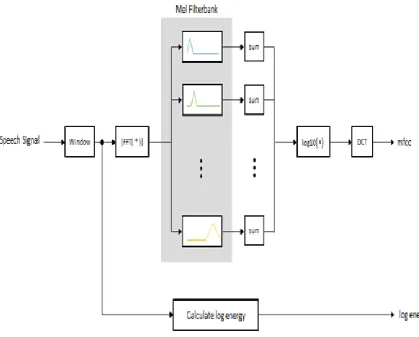
Mel-Frequency Cepstral Coefficients (MFCC)
Mel-Frequency Cepstral Coefficients (MFCC) are popular features extracted from speech signals for use in recognition tasks. In the source-filter model of speech, MFCCs are understood to represent the filter (vocal tract). The frequency response of the vocal tract is relatively smooth, whereas the source of voiced speech can be modelled as an impulse train. The result is that the vocal tract can be estimated by the spectral envelope of a speech segment.
The motivating idea of MFCC is to compress information about the vocal tract (smoothed spectrum) into a small number of coefficients based on an understanding of the cochlea.
Although there is no hard standard for calculating MFCC, the basic steps are outlined by the diagram.
VII.PROPOSEDSYSTEM
This paper is presenting a proposed work of an automated image Capture system using) using Mat lab. This work is experimented on user face we have to use classification methods, viola jones, CNN convolution neural networks algorithms, etc. But improvements are expected to increase its efficiency of classification. This system automatically detects the user face and detect the by recognizing their face. This system is developed by capturing real time human faces. The detected faces are matched against the reference faces in the dataset and detect the user.
Also two extra modules are added to increase the security. First one is the speech recognition in which the person is given a specific key and by speaking the key after face recognition, the user can enter the door. Another contribution is, if someone tries to open the door forcefully, the user will have option to forward the intruder’s captured image, and the current location to the nearby police station. This is possible using GSM Module.
Advantages of Proposed System
We perform a detailed security analysis and performance evaluation of the proposed data Required less time
Increases security Improves the accuracy.
VIII.SOFTWARERESOURCES
There has to be required packages, software’s etc. to interact with system. Operating system : Windows 7 & above/Linux OS Coding language : Java and MATLAB
IX. HARDWARERESOURCES
There should be required devices to interact with software. System : Pentium IV 2.4 GHz. Hard Disk : 80 GB
Ram : 6GB.
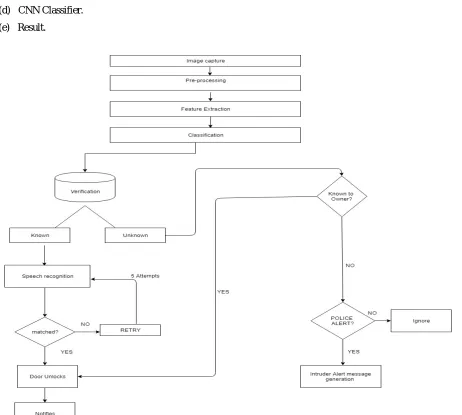
X. SYSTEM ARCHITECTURE
The overall system design consists of following modules: (a) Image Capture. (b) Pre-Processing
(c) Viola-Jones. (d) CNN Classifier. (e) Result.
XI.CONCLUSION
This project focuses on developing an automated system for home. It saves time and effort, especially if it has huge number of person. It can be extended to video surveillance to detect person at crowded areas such as bus stands, theatres, railway stations where in by face recognition techniques, the identity of the culprits can be found. Face recognition is a challenging problem in the field of computer vision, which has received a great deal of
attention over the past years because of its several applications in various domains. Although research efforts have been conducted vigorously in this area, achieving mature face recognition systems for operating under constrained conditions, they are far from achieving the ideal of being able to perform adequately in all various situations that are commonly encountered by applications in the real world.
REFERENCES
[1].Ilhan Aydin and Nashwan Adnan Othman, “A New IoT Combined Face Detection by using Computer Vision for Security Application,” 2017 International Artificial Intelligence and Data Processing Symposium (IDAP), vol. 5, no. 9, pp. 1-6, 2017.
[2].P. Viola and M. J. Jones, “A Robust and Real-Time face detection,” International Journal of Computer Vision, vol. 57, Issue 2, pp. 137-154, 2004.
[3].Y. Taigman, M.Yang, M. Ranzato and L. Wolf, “Deepface: Closing the gap to human-level performance in face verification,” IEEE Conference, vol. 2, no. 7, pp. 1701-1708, 2014.
[4].J. Wright, A. Y. Yang, A. Ganesh, S. S. Sastry, and Y. Ma, “Robust face recognition via sparse representation,” IEEE Transactions on Pattern Analysis and Machine Intelligence, vol. 31, no. 2, pp. 210–227, 2009.
[5].A. Wagner, J. Wright, A. Ganesh, Z. Zhou, H. Mobahi, and Y. Ma, “Toward a practical face recognition system: Robust alignment and illumination by sparse representation,” IEEE Transactions on Pattern Analysis and Machine Intelligence, vol. 34, no. 2, pp. 372–386, 2012.
[6].A.J. Jara, Y. Sun, H. Song, R. Bie, D. Genooud, Y. Bocchi, “Internet of things for cultural heritage of smart cities and smart regions,” in: 2015 IEEE 29th Int. Conf. Adv. Inf. Netw. Appl. Work, IEEE, Gwangiu, pp. 668–675, 2015
[7].H.Gu, D. Wang, “A content-aware fridge based on RFID in smart home for homehealthcare,” in: Adv. Commun. Technol. 2009. ICACT 2009. 11th Int. Conf., Phoenix Park, 2009, pp. 987–990. [4]
[8]. P.N. Belhumeur, J.P. Hespanha, and D. Kriegman, “Eigenfaces vs. fisherfaces: recognition using class spe- cific linear projection,” IEEE Transactions on Pattern Analysis and Machine Intelligence, vol. 19, no. 7, pp. 711–720, 2007.
[9].C G. S. Arias, C. G. García, B. Cristina, P. G. Bustelo, “Midgar: Study of communications security among Smart Objects using a platform of heterogeneous devices for the Internet of Things” Future Generation Computer Systems, Vol. 74, pp. 444-466, September 2017.
[10].Ms. Renuka Chuimurkar, V. Bagdi, “Smart Surveillance Security &Monitoring System Using Raspberry PI and PIR Sensor”, International Journal of Scientific Engineering and Applied Science (IJSEAS), Vol. 2, No. 1, pp. 1-4, January 2016.
[11].Md. Nasimuzzaman Chowdhury, Md. ShibleeNooman, SrijonSarke, “Access Control of Door and Home Security by Raspberry Pi through Internet”, International Journal of Scientific & Engineering Research, Vol. 4, pp. 550-558, November-2013.