JOHNSON, ANN-MARIE CLAYTON. Investigating Personality Profiles in Action Teams: Relationships with Performance. (Under the direction of Dr. Lori Foster).
Action teams are highly interdependent teams of skilled individuals formed to accomplish collective tasks requiring intense yet brief periods of maximum performance.
Examples include, but are not limited to, military combat units, surgical teams, disaster response teams, and law enforcement special weapons and tactics (SWAT) teams. The significance of this type of teamwork creates a pressing need to understand who is best suited to such work. This study investigates whether the personality characteristics of neuroticism, extroversion, openness to experience, agreeableness, conscientiousness, grit, hardiness, and core self-evaluation predict action team performance over and above physical fitness and cognitive ability. This was
examined in two ways, by employing: (a) the more traditional variable-centered approach (i.e., regression analysis) and the (b) the less commonly utilized person-centered approach (i.e., latent profile analysis). Participants consisted of 894 action team candidates working in a physically demanding, high stress team environment to complete complex, interdependent tasks.
by
Ann-Marie Clayton Johnson
A dissertation submitted to the Graduate Faculty of North Carolina State University
in partial fulfillment of the requirements for the Degree of
Doctor of Philosophy
Psychology
Raleigh, North Carolina 2019
APPROVED BY:
_________________________ _________________________
Dr. Lori Foster Dr. Samuel B. Pond III
Chair of Advisory Committee
_________________________ _________________________
Dr. Stephen Craig Dr. Mark Wilson
_________________________ Dr. Arthur Finch
BIOGRAPHY
Ann-Marie Clayton Johnson was born in Fresno, California. She received her Bachelor of Arts degree in Psychology from California State University, Fresno in 2012. She immediately began graduate school at North Carolina State University where she received her Master of Arts degree and Doctor of Philosophy degree in Industrial and Organizational Psychology. During this time, she worked for the Department of Defense applying psychology to teams, selection, assessment and training. She continues this work at Cisco as an Executive Leadership
ACKNOWLEDGMENTS
First, I would like to thank my advisor Lori Foster. She is the epitome of hard work, dedication, and good nutrition while traveling. I have looked up to her for six years as a mentor and friend as we discussed the infinite possibilities available to psychologists willing to work for them. I still cannot believe my good fortune to be accepted to her laboratory in 2012.
Much impact can be attributed to the innovative thinking and commitment to the greater good of Drs. Arthur Finch and Shanna Reyes. This particular research only exists because of their advocacy. Thank you for rich friendship along the way.
Loving thanks to each of my siblings and parents. Thank you thank you thank you. I am grateful beyond measure for your bravery, steadfastness, and collective acceptance of one another. Mom: you are the strongest and most wonderful person I know. I hope I look half as much like you on the inside as I do on the outside. Let’s me and you continue to remind one another of the kind of people we aspire to be—kind, forgiving, and Jesus-loving. Dada: thank you for giving me the start that brought me here and the example I only hope to live up to. Dad and Deana: every call that went late into the Eastern Time Zone kept me connected to my family and pushed me forward one day at a time.
Thank you to English Sall, and the entire Sall family, for being my home away from home, my people. Thank you to Kyle Morgan for talking me through many issues both personal and professional. Thank you to Alexandra Mullins for giving me my very first tour of NC State and being a friend to count on every day after. Thank you to Peter Hegel for being my partner in every group project and opening my eyes to lifestyles unlike my own.
Lee for caring so much about our ethics and my training. Thank you to Robert Kovach for seeing my potential when I had no vision, and always answering my “why” with honesty, integrity, and commitment to the profession.
TABLE OF CONTENTS
LIST OF TABLES ... vi
LIST OF FIGURES ... vii
Investigating Personality Profiles in Action Teams: Relationships with Performance ... 1
Personality ... 2
Core Self-Evaluation ... 8
Profiling Personality: Person-Centered Research ... 10
Ability: Physical Fitness and Cognitive Ability ... 12
Measuring Performance: Peer Evaluations ... 12
Research Questions and Hypotheses ... 13
Method ... 14
Participants ... 14
Design and Procedure ... 15
Measured Variables ... 16
Five Factor Model of Personality (FFM) ... 16
Grit ... 17
Hardiness... 17
Core Self-Evaluation ... 18
Physical Fitness ... 18
Cognitive ability... 19
Performance ... 19
Results ... 20
Manipulation Checks, Missing Data, and Total N ... 20
Personality Profiles and Relationships with Performance ... 21
Conceptual Implications ... 26
Practical Implications ... 29
Limitations and Future Research... 30
APPENDIX ... 56
LIST OF TABLES Table 1. Means, Standard Deviations, Correlations, and
Internal Consistency Estimates ...43 Table 2. Summary of Exploratory Factor Analysis Results
for Peer Ratings of Performance Measure ...44 Table 3. Regression Analysis of Performance Regressed on Personality Variables ...45 Table 4. Analysis of Variance for Performance by Profile ...46 Table 5. Hierarchical Regression Analysis of Personality Variables
Controlling For Physical Fitness and Cognitive Ability ...47 Table 6. Analysis of Co-Variance of Profiles on Performance
Controlling for Physical Fitness and Cognitive Ability ...48 Table 7. Bonferroni Pairwise Comparisons of Performance by Profile
LIST OF FIGURES
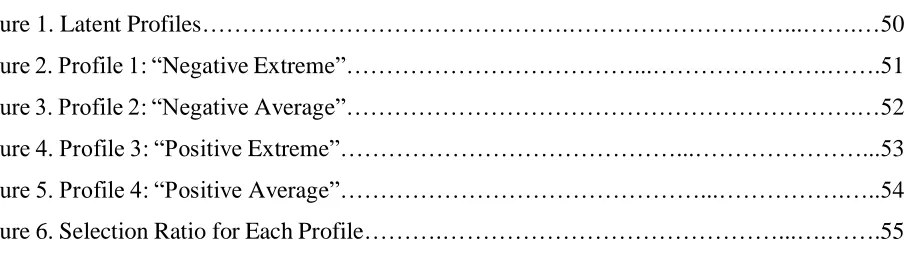
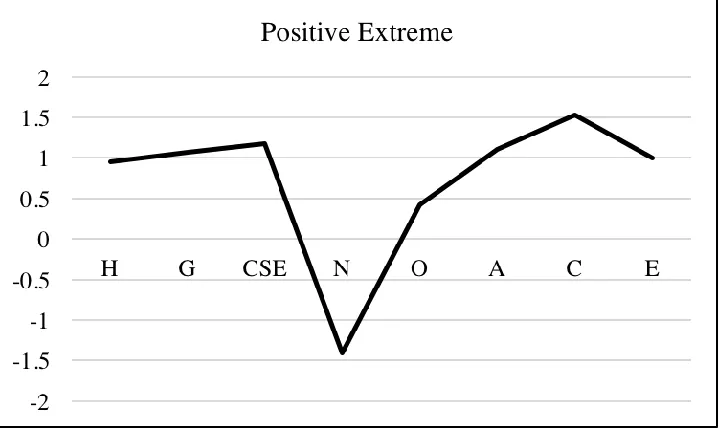
Figure 1. Latent Profiles……….………...…….…50
Figure 2. Profile 1: “Negative Extreme”………...……….…….51
Figure 3. Profile 2: “Negative Average”……….…52
Figure 4. Profile 3: “Positive Extreme”………...………...53
Figure 5. Profile 4: “Positive Average”………...……….…..54
Investigating Personality Profiles in Action Teams: Relationships with Performance Action teams are arguably one of the most elite types of teams in the world. They are made up of men and women considered specialists in their field; among them are surgical teams, disaster response teams, law enforcement special weapons and tactics (SWAT) teams,
firefighting teams, shock trauma medical teams, aircraft flight crews, and military combat units (Sundstrom, deMeuse & Futrell, 1990). The literature defines action teams as highly
interdependent teams of skilled individuals formed to accomplish collective tasks and goals requiring intense yet brief periods of maximum performance (Sundstrom et al., 1990). True action teams occur in physically or psychologically stressful contexts where the outcomes of the team's actions, even in training, can have significant consequences—for example, potential death
(Hannah, Walumba, & Fry, 2011).
On action teams, each team member’s performance is entwined with others’ to the degree that hardly any level of disagreement or miscommunication can be tolerated in the moment of action and still result in success. It is plausible that some types of people do better in such environments than others. Given the high consequences of error, it is critical to look at personality to find out who tends to succeed when put in an action team role. Organizational team research that contributes to our understanding of personality and its relationship to performance has received concerted attention with mixed results; however, scant research has focused on the role individual personality variables play on performance in action
methodology and findings are respectable and interesting. However, questions about external validity remain, as we cannot be certain of the extent to which laboratory research on student samples generalizes to action teams in the field.
The present study aims to close this gap in the literature by analyzing relevant personality variables as they relate to performance of action team members in the field. This study expands the literature by examining the influence of personality on performance in an intact action team context, specifically doing so by exploring whether personality variables cluster to form distinct profiles and then investigating the relationship between personality profiles and action team members’ effectiveness from the perspective of their teammates.
Personality
Physical fitness and cognitive ability are known to be important for action team member performance (Beal, 2010). However, these qualities alone may not be sufficient. It is quite possible that two equally bright, physically fit individuals will not be equivalent action team performers. In all likelihood, there are additional factors at play. Specifically, personality is likely to play a role. Screening for pathology among action team candidates is already common place, for example, with the Minnesota Multiphasic Personality Inventory (Ben-Porath & Tellegen, 2008). While this is important, the current study is designed with a different question in mind. For action teams, (e.g., military combat units) that demand high levels of team
coordination, autonomy from higher authorities, and an expectation of successful interaction with diverse populations, all while under extreme stress, normal personality’s effect on performance becomes a particularly salient contributor to overall mission success
Personality is a spectrum of individual differences that “consistently distinguish people from one another in terms of their basic tendencies to think, feel, and act in certain ways” (Ones, Viswesvaran, & Dilchert, 2005, p. 390). As such, it affects how we think about, influence, and relate to one another, as well as our work. Unlike many more solitary kinds of work such as accounting or some kinds of computer programming, action teamwork is inherently
interdependent and interpersonal in nature. How and whether teammates rely on and react to each other depends on perceptions of those around them. For example, results from a large-scale study of enlisted soldiers known as Project A (McHenry et al., 1990), found that the U.S. Army can improve the prediction of performance of nine military occupational specialties existing within the larger structure of the Army by adding personality predictors to its present battery of selection tests. For example, the correlation between the predictor “leadership ability” and the criterion “extra effort” (R = .33) increased by including facets of conscientiousness and
neuroticism (R = .44; ∆.11). Outside of the action team context, research shows that personality contributes validity in the prediction of both individual and team performance above and beyond other predictors, including general mental ability and biodata (e.g., McHenry, Hough, Toquam, Hanson, & Ashworth, 1990; Mount, Witt, & Barrick, 2000; Neuman, Wagner, & Christensen, 1999; Schmidt & Hunter, 1998).
There are a number of personality variables worth considering in the context of action team performance, beginning with the “Big Five.” A robust set of five factors has emerged from
who score high in neuroticism tend to show poor emotional adjustment in the form of stress, anxiety, and depression. Extraversion represents the tendency to be sociable, dominant, and positive (Watson & Clark, 1997). Scoring high in openness to experience indicates creativity, flexibility, curiosity, and unconventionality (McCrae, 1996). Agreeableness consists of
tendencies to be kind, gentle, trustworthy, and warm. Finally, high scores in conscientiousness indicate achievement-orientation, dependability (Barrick & Mount, 1991), orderliness, and deliberateness (Costa & McCrae, 1992).
The relationship between the Big Five and job performance is unclear to date. Authors have yet to agree on how many Big Five factors are considered valid predictors of performance. For example, in the same journal and issue, two meta-analyses based on similar literature report conflicting results (Barrick & Mount, 1991; Sartori, Constantini, Ceschi, & Scalo, 2016; Tett et al., 1991). Two more recent meta-analyses examining personality and job performance likewise found inconsistent results. Peeters and colleagues (2006) found agreeableness (p = .24) and conscientiousness (p = .20) to be the personality variables predictive of performance, while Hurtz and Donovan (2000) found conscientiousness (p = .20) and emotional stability (p = .13) to be the personality variables predictive of performance.
Another strategy by Ones and colleagues (2005) was to compute multiple correlations for the Big Five as a set with overall job performance (r = .30-.40, p < .05), objectively assessed performance (r = .28, p < .05), citizenship performance (r = .43, p < .05), teamwork (r = .47, p < .05), training performance (r = .44, p < .05), leadership, performance motivation, and job
satisfaction (r = .40-.50, p < .05). All validities and predictor intercorrelations were sourced from meta-analytic investigations. The validities for the Big Five as a set were substantial if not
To overcome what Goldberg (1993) called “befuddling” differences in findings, Sartori and colleagues (2016) recently presented an exploratory study that took into account people’s perceptions, versus correlation coefficients, of the relationship between the Big Five and job performance. This was explored via two different methods with two different results. The first of the two methods involved asking raters to describe the requirements of high levels of job
performance in their own words. Conscientiousness and emotional stability were described most frequently. The second of the two methods involved providing participants explicitly defined Big Five facets to choose from. When defined for them, conscientiousness and extraversion were chosen most frequently. Rothman and Coetzer (2003) claim, “to the lay person it is a self-evident fact that personality factors play an important part in job performance” (p. 69). While this
appears to be true, and offers an important perspective, it does not add definitive clarity to the question of how personality relates to action team performance.
2002; Judge & Ilies, 2002). Despite the aforementioned relationships, authors cite a possible underestimation of the relationship between the Big Five and performance in the literature due to relating each construct to performance individually as opposed to all relevant personality traits when used in combination (Barrick & Mount, 2005). Another reason why researchers Barrick and Mount (2005) deem personality important is because personality has been shown to have cumulative, longitudinal effects, such as enduring relations between conscientiousness and neuroticism measured in childhood to career success measured in adulthood decades later
(Judge, Higgins, Thorensen, & Barrick, 1999). Finally, personality has been linked to many other important outcomes in the workplace—such as, citizenship behaviors, success in teams, job satisfaction, safety, leadership effectiveness, and task performance (Barrick, Mitchell, & Stewart,
2003; Johnson, 2003).
The action team context is unlike that of a regular work team. Job success in this case is
not merely meeting a deadline via collaboration with teammates, for example, but being responsible for the lives of teammates while collaborating on the fly. Past research has given glimpses into the role the Big Five may play on teams in a variety of contexts (e.g., Tobin, Graziano, Vanman, & Tassinary, 2000), but given the added pressures of an action team, and the exaggerated role personality could play in emotionally charged environments, all five factors will be included in the current study for examination. This is in the spirit of exploratory research and to provide basis for more specific inquiry moving forward.
Grit and Hardiness
contexts. These environments often give way to elevated levels of stress and require above average levels of resilience, or a capacity to respond adaptively while remaining
healthy (Bartone, 2006; Lukey, & Tepe, 2008; Maddi, 2002, 2008). Successful action team members are therefore extraordinarily resilient despite high stress levels. Though resilience varies across context, two personality factors have been shown to facilitate resilience under stress: grit and hardiness (Bonanno, 2004; Lukey& Tepe, 2008). According to Maddi, Mathews, Kelly, Villarreal, and White (2012), grit and hardiness offer operationalized forms of the
motivation required to deal with stressful situations.
Ashton, 2001).
Hardiness is a characteristic sense that life is meaningful, we choose our own futures, and change is interesting and valuable (Bartone, 2006; Kobasa, 1979). Since hardiness was originally introduced into the psychological literature in 1979, extensive research has shown hardiness moderates the relationship between stress and health and stress and performance (e.g., Bartone, 1989; Contrada, 1989; Kobasa, Maddi, & Kahn, 1982; Roth, Wiebe, Fillingim, & Shay, 1989; Wiebe, 1991). This effect has been particularly salient in military contexts: U.S. Army casualty assistance workers (Bartone, Ursano, Wright, & Ingraham, 1989), peacekeeping soldiers (Bartone, 1996; Britt, Adler, & Bartone, 2001), Israeli soldiers in combat training
(Florian, Mikulincer, & Taubman, 1995), Israeli officer candidates (Westman, 1990), Norwegian Navy cadets (Bartone, Johnsen, Eid, Brun, & Laberg, 2002), and soldiers with combat exposure in the Gulf War (Bartone, 1993, 1999a, 2000). Hardiness has shown moderate correlations with the Big Five, namely neuroticism, but has demonstrated explained variance over and above the Big Five in studies of leader performance (Bartone et al., 2009). Bartone (2006) contends that under high-stress conditions the resiliency effects of hardiness are most apparent.
In the case of the current study, in order to be placed on an action team, participants must have the stamina required to withstand long, grueling days. For some participants, failure could spell the end of their careers, and for others, a significant negative mark on their employment records. Properly studying grit and hardiness requires a context sufficiently stressful to activate these constructs in the participants that possess them.
Core Self-Evaluation
CSE: locus of control, neuroticism, generalized self-efficacy, and self-esteem. Locus of control can be either internal or external, where internal involves attributing life’s events to one’s own doing and external involves attributing life’s events to external forces beyond one’s control (Judge, Locke, Durham, Kluger, 1998; Spector, 1982). An internal locus of control contributes to more favorable core self-evaluations. As suggested earlier, neuroticism is an enduring tendency to experience unpleasant emotions (e.g., anger or depression; Costa & McCrae, 1988). High levels of neuroticism impede favorable core self-evaluations. Self-efficacy is defined as an individual’s estimate of his or her own ability to perform well and handle situations as they arise
(Judge, Locke, & Durham, 1997). Self-esteem reflects one’s overall appraisal of his or her own worth (Harter, 1993). Both are positively related to favorable core self-evaluations. Interestingly, CSE has been shown to predict in some capacity: manager turnover, team performance when CSE is possessed by the team leader (Resick, Whitman, Weingarden, & Hiller, 2009), job satisfaction (Judge, Erez, Bono, Locke, 2005), job performance (Erez & Judge, 2001; Judge & Hurst, 2008), job and academic burnout (Lian, Sun, Ji, Peng, 2014), and training effectiveness (Stanhope, Pond, & Surface, 2013).
CSE may come to bear in the action team context when considering the short time frame available for decision making. Each member of an action team is highly trained and often relies on his or her ability to perform complex tasks from memory. Low CSE scores, or low
evaluations of oneself and one’s abilities, could slow down the decision-making process to
(Kammeyer-Mueller, Judge, & Scott, 2009; Haynie & Shepherd, 2011). In other words, CSE is seen in behaviors that should affect the performance of action team members both individually and collectively.
Profiling Personality: Person-Centered Research
Several studies have examined the relationship between various personality variables and the performance of general work teams (e.g., Barrick & Mount, 1991; Barrick, Steward, Neubert & Mount, 1998; Halfhill, Nielson, & Sundstrum, 2005; Halfhill, Sundstrum, Lehner, Calderone, & Nielson, 2005; Hofmann & Jones, 2005.) Further, several applied studies have investigated which personality variables are most important for success in particular jobs, roles, and tasks (e.g., Barrick & Mount, 1991; Borman et al., 1980; Lord et al., 1986; Day & Silverman, 1989; Tett et al., 1991). The majority of these studies utilize variable-centered analyses such
as regression to explain how one or more variables predict criteria of interest (e.g., performance), or ANOVAs, to investigate group differences. Variable-centered analyses are both practically useful and theoretically important as a means for considering how characteristics are related to each other. In other words, variable-centered analyses are adequate for telling us how related conscientiousness within a sample is to performance. A researcher can examine multiple predictors at one time as they relate to the criterion of interest, but then must parse the interactions after the fact. Furthermore, in order for a variable-centered analysis to indicate a relationship between a predictor and criterion, the relationship must hold more often than not across all members of the research sample.
Services explored whether various neighborhoods in metropolitan areas produced differing profiles of population body mass indexes (BMI), walkability, recreation, transit scores, and self-reported physical activity. This was confirmed by four distinct profiles where one profile representing 37.6% of the sample, for example, depicted a neighborhood with average BMIs of about 27, low walkability, recreationally dense, and an average of about 60 minutes of physical activity per week (Adams et al., 2011). Each profile included city samples that were similar to each other with a particular combination of characteristics, but different than the cities in the other three profiles that each have their own unique combination of traits. A person-centered approach similarly offers a holistic view of a subject seen as an organized whole, functioning and developing as a totality (Magnusson & Stattin, 1998). In sum, and in the context of the current study, person-centered analyses indicate how variables (e.g., conscientiousness and hardiness) combine within individuals to reveal effective and ineffective personality characteristics in the context of team performance. Said another way, person-centered analyses allow a researcher to examine what performance looks like for team members with different personality profiles or patterns of the personality variables in question.
Ability: Physical Fitness and Cognitive Ability
It is clear that physical fitness and cognitive ability play a critical role in performance for the strenuous, complex tasks associated with action teams. Many of the action teams presented as examples in this paper (e.g., SWAT teams and firefighting teams) have been empirically shown to require levels of physical fitness and cognitive ability beyond that of the average person (Pryor, Colburn, Crill, Hostler, & Suyama, 2012). In fact, even higher levels of cognitive ability and physical fitness delineate tiers of action teams, distinguishing, for example, elite from non-elite combat teams (Beal, 2010; Carlson & Jaenen, 2012). A key question then is not only whether personality predicts action team member performance, but also whether it has
explanatory power over and above physical and mental abilities known to be important (Beal, 2010; Carlson & Jaenen, 2012; Pryor, Colburn, Crill, Hostler, & Suyama, 2012; Teplitzky, 1991). For this reason, both physical fitness and cognitive ability will be included in this study as control variables.
Measuring Performance: Peer Evaluations
Any research focused on understanding the personality characteristics that distinguish top action team performers requires a solid measure of performance. This leads to questions about who is in a good position to evaluate performance in the unique context of action teams. Several options are viable. While supervisory or trainer ratings are common in team research and have their merits, peer ratings deserve serious consideration, given the close and critical
interdependencies among action teammates (Peeters, van Tuikl, Rutte, & Reyman 2006).
teams, where performance of one teammate is heavily dependent on the performance of the other teammates, peer ratings become especially relevant while offering statistically unique variance (Dierdorff & Surface, 2007). Peer judgments of performance, and actions in response to them, are arguably the essence of what moves an action team toward completion of an operation. Peer ratings have been leveraged for selection, training, and promotion purposes for the unique assessment and information peers can provide within action teams of physicians (Ramsey, Wenrich, Carline, Inui, Larson, & Logerfo, 1993), Naval aviators (Wahlberg, Boyles, & Boyd, 1971), Army aviators (McAnulty, 1990), and senior level Army officers (Downey, Medland, & Yates, 1976). Accordingly, the current study will focus specifically on peers’ perception of action teammates’ performance.
Research Questions and Hypotheses
As outlined below, this study’s research questions and hypotheses test the relationships
between personality variables and peer ratings of action team member performance, examine whether personality variables combine to create homogenous profiles, and last, determine whether these profiles have the power to predict action team member performance over and above the influence of physical fitness and cognitive ability.
RQ1: What are the distinct personality profiles within action teams?
H1a: Personality variables (i.e., neuroticism, extroversion, openness, agreeableness,
conscientiousness, grit, hardiness, and core self-evaluation) will significantly predict action team performance.
RQ2a: Do the personality variables of neuroticism, extroversion, openness, agreeableness, conscientiousness, grit, hardiness, and core self-evaluation predict action team performance over and above physical fitness and cognitive ability?
RQ2b: Do the personality profiles (constructed from neuroticism, extroversion, openness, agreeableness, conscientiousness, grit, hardiness, and core self-evaluation) predict action team performance over and above physical fitness and cognitive ability?
Method Participants
This study was conducted on 894 action team candidates working in a physically demanding, high stress environment to complete complex tasks. Participants were male U.S. military soldiers enrolled in a 21-day assessment center designed to identify individuals with the potential to attend and successfully complete subsequent special training. If training is completed by the soldier, he is assigned to a US Army Special Forces team. The possible age of
participants, determined by criteria used to select assessment center attendees, ranges from 18-47 years of age.
Power analyses were completed for bivariate correlations (H1a), ANOVA (H1b and RQ2b), and regression analyses (H1a and RQ2a). This was done using G*Power to determine the minimum sample size needed for 80% power to detect a medium-sized effect of .25 at α = .05, with the medium effect size estimate based on the rule of thumb offered by Cohen (1992). The sample size estimates for all of the relevant analyses produced a range of 92 to 159 total
analyses and fits within this range. The data were pulled from four cycles of the assessment center.
Design and Procedure
This study has eight predictor variables, two control variables, and one criterion variable. The predictor variables are the Five Factor Model of Personality (i.e., neuroticism, extraversion, openness, agreeableness, and conscientiousness), grit, hardiness, and core self-evaluation. The control variables are physical fitness and cognitive ability and the criterion is peer assessments of performance. All data were collected between October 2016 and March 2017 and are considered archival at the time of analysis.
Participants arrived at the assessment center via bus on day one of approximately 21 days total. Each day required anywhere from 18-20 hours of work. Approximately 70% of participants were sent home before the last day of the assessment center. Dismissal typically occurred prior to the opportunity to engage in action teamwork, described below. Common reasons for dismissal included physical injury, voluntary withdrawal, or failing to meet a predetermined standard– for example, failing to complete an event in a prescribed amount of time.
As the days progressed, participants completed challenging individual and team tasks designed to elicit high levels of stress, physical, and mental exhaustion. The tasks were intended to provide participants both the opportunity to draw upon past experiences in order to show their relevant knowledge, skills, and abilities, but also their ability to cooperate, communicate, and manage ambiguity. They were physically demanding, complex assignments that required combined effort and problem-solving for success.
Between approximately day 15 and 17, participants began four days of activities devoted to testing their ability to complete work on a team. Subject matter experts assigned individuals to teams of approximately 15 participants based upon multiple variables (e.g., rank, military
occupational specialty, etc.) to ensure a comparable distribution of leadership and military experience on each team. Each activity was impossible to complete solo, necessitating team members communicate with one another to decide how to proceed. For example, team members were required to move extremely heavy, awkward objects from one point to another. At the completion of each two-day set of team tasks, individuals conducted a computerized eight-item assessment of their teammates’ performance. The survey was completed in a group setting, at the
end of day two in a classroom, via computer. Participants had as much time to complete the survey as they needed. All tasks and team rating sessions were monitored by trained assessors. Another two days of team tasks were then completed with new teams and new, comparable tasks, followed by the same peer assessment. In sum, each person finished the four days of team-based events and were rated twice on an 8-item scale by each teammate.
Measured Variables
sample item used to assess each include: neuroticism (e.g., “I am not a worrier”), extraversion (e.g., “I sometimes fail to assert myself as much as I should”), openness to experience (e.g., “I sometimes lose interest when people talk about abstract matters”), agreeableness (e.g., “I would hate to be thought of as a hypocrite”), and conscientiousness (e.g., “When a project gets too difficult, I decline and start a new one;”; Barrick, Scullen, & Rounds, 2005). The scale includes 30 rationally constructed facets (i.e., six facets per factor and eight items per facet), that each capture one dimension of the FFM. This results in a total of 48 items per factor and 240 items total. Response options are rated on a five-point Likert-type rating scale, ranging from 1 (strongly disagree) to 5 (strongly agree; Costa & McCrae, 1992). Each participant has one averaged score per factor for a total of five scores per participant. Each factor score can range from one to five. Table 1 displays the internal consistency reliabilities for each of the five factors as well as three other personality scales administered.
Grit. Eight items were included to assess participants’ ability to sustain effort over time (e.g., “I have overcome setbacks to conquer important challenge”) and consistency of efforts over time (e.g., “I have difficulty maintaining my focus on projects that take more than a few months to complete”). The eight items cover two dimensions labeled perseverance of effort and
consistency of interests. Response options are on a five-point Likert-type rating scale, ranging from 1 (not like me at all) to 5 (very much like me; Duckworth & Quinn, 2009). Consistent with past research, scores for both dimensions are combined, averaged, and analyzed as a single grit score ranging from one to five (Duckworth & Quinn, 2009; Eskreis-Winkler, Shulman, Beal, & Duckworth, 2014).
things that are meaningful;”) a greater feeling of control (e.g., “By working hard you can nearly
always achieve your goals;”) and an openness to change and challenge (e.g., “Changes in routine are interesting to me;”) Response options are on a four-point Likert-type rating scale, ranging
from 1 (not at all true) to 4 (completely true; Bartone, 2007.) Scores for each of the three
dimensions are added together and analyzed as a single composite hardiness score, ranging from 15 to 60, according to manual instructions for scoring (Bartone, 2014).
Core Self-Evaluation. Twelve items were included to assess the four dimensions associated with core self-evaluation: locus of control (e.g., “I determine what will happen in my life,”) neuroticism (e.g., “Sometimes I feel depressed,”) self-efficacy (e.g., “I am confident I get
the success I deserve in life,”) and self-esteem (e.g., “I am filled with doubts about my competence.”) Response options are on a five-point Likert-type rating scale, ranging from 1
(strongly disagree) to 5 (strongly agree; Judge, Erez, Bono, & Thoresen, 2003.) Core self-evaluation is analyzed as one, unidimensional, averaged score ranging from one to five. (e.g., McNall, Masuda, Rhoades Shanock, & Nicklin, 2011).
Physical Fitness. All participants completed the Army Physical Fitness Test (APFT) to determine their level of physical fitness. The assessment requires participants to demonstrate the maximum number of push-ups and sit-ups they are capable of completing within two minutes for each exercise, as well as a timed two-mile run. The raw data for each of these measures is
Cognitive ability. Cognitive ability was assessed via a proprietary cognitive ability test that is highly correlated with the full-scale WAIS-R (i.e., Wechsler Adult Intelligence Scale-Revised; Wechsler, 1981). The measure includes five verbal subtests (i.e., information, comprehension, arithmetic, similarities, and vocabulary) and five performance subtests (i.e., digit symbol, picture completion, spatial, picture arrangement, object assembly) that are computed into proprietary scale scores and combined to provide a “Full Scale” score. Test-retest reliability for the Full Scale score is r = .97. Each participant was given seven minutes per subscale, or 70 minutes total, to complete the measure with paper and pencil. All scoring was done via computer, by inputting raw scores, resulting in one Full Scale score per participant.
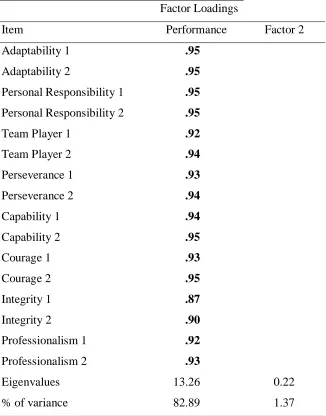
exploratory factor analysis was completed (Table 2). The performance measure, including all 16 items, presented an eigenvalue of 13.26 and explained 82.89% of variance, confirming a robust, one-factor measure (Nunnaly, 1978).
Results
Prior to conducting hypothesis tests, measured variables were assessed for violations of normality assumptions. All measures were within the acceptable range for skewness and
kurtosis. In addition, all between-group comparisons were preceded by a test of the homogeneity of variance assumption. The assumption held in all cases. Descriptive statistics, including means, standard deviations, correlations, and internal consistency estimates can be found in Table 1. All analyses were performed using JMP Version 13 (SAS Institute, Inc., Cary, NC, 1989-2007) and IBM SPSS Version 25.0 (IBM Corp., 2010).
Manipulation Checks, Missing Data, and Total N
The total number of participants was 894. Of that total, 438 successfully made it to the stage of the selection system that resulted in performance reviews, or the criterion, being collected. Responses were then examined for missing values; 49 participants, via listwise deletion, were removed from the dataset for missing data on predictor variables yielding a sample of 389. Listwise deletion removes participants when one or more survey items has not been answered.
“Not at all true,” and/or failed to select the number four, or “Agree” for the second item, were
removed before hypothesis testing. An additional 34 participants were removed.
Latent profiles were investigated (i.e., RQ1) for the entire sample of 894. In response to missing data and attention check items, a total of 355 participants were included in the remaining analyses.
Personality Profiles and Relationships with Performance
To address the RQ1 (i.e., what are the distinct personality profiles within action teams) a latent profile analysis (LPA) was conducted (n =894). When analyzing LPA, several statistical criteria may be used to determine the most appropriate number of latent profiles. The Bayesian Information Criterion (BIC) and the bootstrapped likelihood ratio test (BLRT) are commonly assessed criteria at the introduction of each new profile to the model (Nylund et al., 2007). The BLRT is a likelihood-based technique that provides a p-value indicating whether the increase in model fit between the k-1 and k class models is significant (McLachlan & Peel, 2000). When the p-value with k number of classes is no longer significant, BLRT implies the k-1 class solution is the preferred model.
regardless of n, and BIC has a larger chance than AIC, for any given n, of choosing too small a model. Said another way, AIC is better in situations when a false negative finding would be considered more misleading than a false positive, and BIC is better in situations where a false positive is as misleading, or more misleading than, a false negative. In general, it is considered best practice to use AIC and BIC together in model selection opting for a solution that falls within the number of profiles indicated by each statistical criterion (Vrieze, 2012). In other words, if BIC indicates four profiles and AIC indicates six as the optimal solution, selecting among four, five and six-profile solutions, is the preferred way forward. The ideal solution, then, has the lowest BIC and AIC, a significant BLRT, and no profiles with a negligent number of cases (Meyer, Stanley, & Parfyonova, 2012).
Keeping the above criteria in mind, a four-profile solution emerged as optimal in response to RQ1. The BIC and AIC of the four-profile model was 30891 and 30597.2,
respectively. This was the lowest BIC of the models available. The five-profile model had the smallest AIC at 30533 but indicated an additional, practically redundant profile. Further, BLRT remained significant at p < .05 at the four-profile solution, and lost significance with the
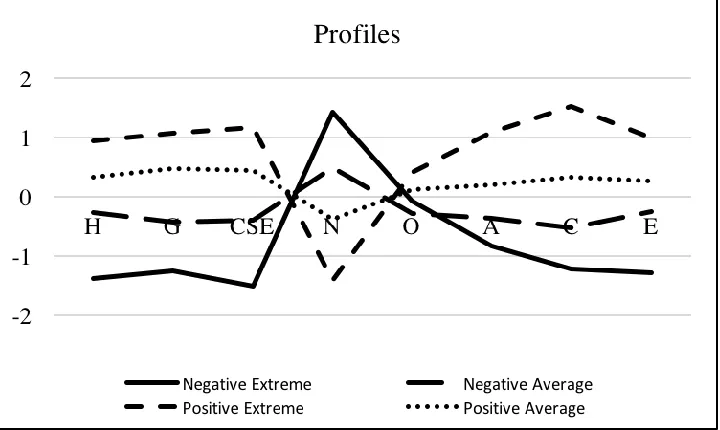
introduction of the fifth profile. Figure 1 depicts each of the four profiles at once, displaying each profile’s standing on the eight predictor variables.
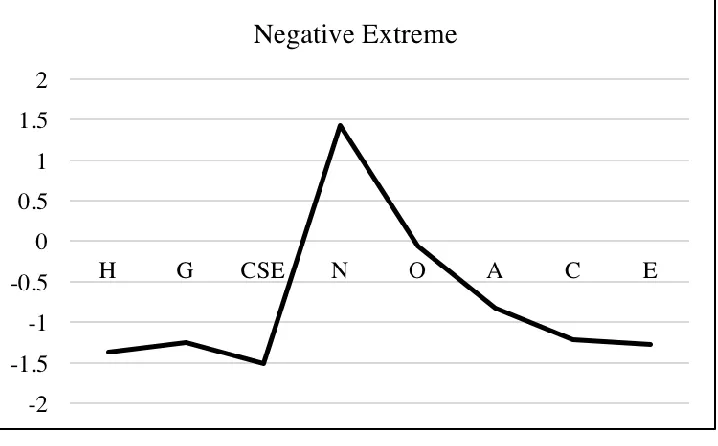
Profile one (n = 78; Figure 2), referred to as the “Negative Extreme,” is lowest on CSE, grit,
hardiness, extraversion, agreeableness, and conscientiousness, highest in neuroticism, and second to lowest on openness. Members of the “Negative Extreme” profile do not appear to: work hard,
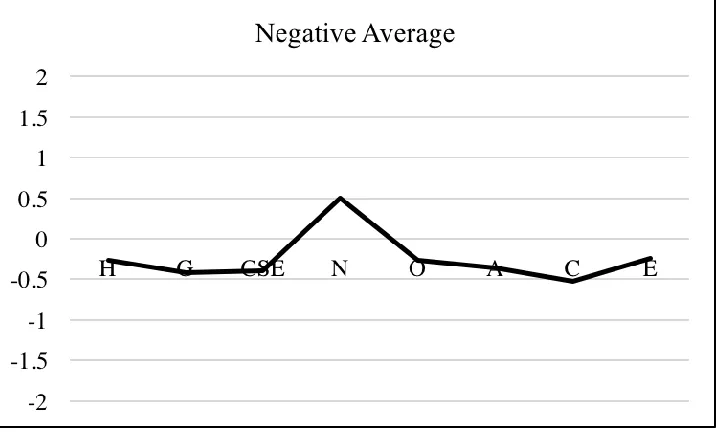
naturally get along with others, or stick it out when the going gets tough. Profile two (n = 296; Figure 3) is referred to as the “Negative Average.” This profile was lowest in openness, second
to highest in neuroticism. Members of the “Negative Average” profile present standardized scores that trend approximately .5 standard deviations below zero, where the only positive deviation from zero is on neuroticism. Profile three (n = 97; Figure 4) was highest in CSE, grit, hardiness, extraversion, openness, agreeableness, and conscientiousness, and lowest in
neuroticism. This profile is referred to as “Positive Extreme.” Members of the “Positive
Extreme” group delineate themselves by an extremely low Neuroticism score (σ = -1.41) and an extremely high Conscientiousness score (σ = 1.53). Profile four (n = 257; Figure 5) is the
“Positive Average” profile, mirroring the approximate opposite of the “Negative Average”
profile. They are second to highest in CSE, grit, hardiness, extraversion, openness,
agreeableness, and conscientiousness, and second to lowest in neuroticism. Where the “Positive Extreme” profile averages 1.04 standard deviations from zero on all variables except
neuroticism, members of the “Positive Average” profile average a positive .32 standard
deviations from the mean.
Next, the variables’ and profiles’ relationships with performance were examined.
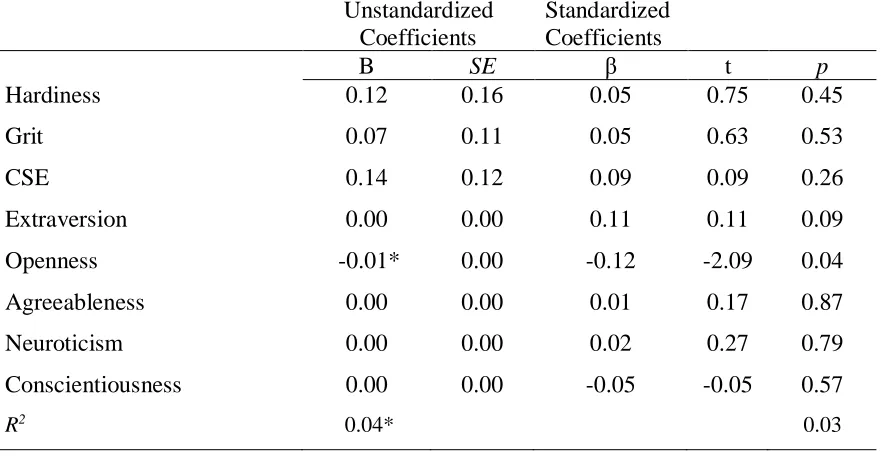
Hypothesis 1a (i.e., that the personality variables of interest would significantly predict action team member performance ratings) was tested by examining the significance of eight bivariate correlations and one regression analysis. All correlations can be found in Table 1. Of note, all variables except for openness and agreeableness were significantly (p < .05) correlated with performance. Specifically, grit, hardiness, CSE, extraversion, and conscientiousness were positively correlated with performance such that when each of the aforementioned variables increased, performance increased as well. Neuroticism was significantly, but negatively
negative relationship with performance (p = .04). Though the remaining seven variables were not significant predictors of performance, the overall regression was significant (R2= .04, p = .03). Together there is support for H1a: the bivariate correlations and regression each indicate a relationship between personality and performance.
Hypothesis 1b (i.e., that the personality profiles would significantly predict action team member performance ratings) was tested by examining the significance of the overall omnibus F provided by a one-way ANOVA. The ANOVA results, shown in Table 4, indicate a significant difference between profiles on performance, providing support for H1b. A Bonferroni post hoc analysis was completed to further investigate the differences among profiles, and results (also shown in Table 4) indicate that participants characterized by Profile 1, the “Negative Extreme,” had significantly lower performance ratings than the “Negative Average,” “Positive Extreme,” and “Positive Average” profiles. The latter three were not significantly different from one
another.
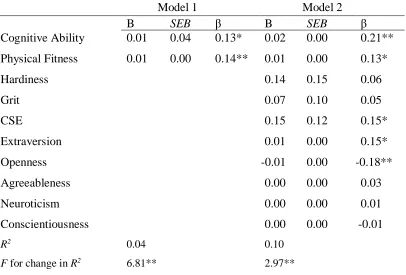
Research question 2a, which inquired whether personality variables predict performance over and above that of cognitive ability and physical fitness, was tested via a hierarchical
regression. Results are shown in Table 5. Model 1, F(2, 352) = 6.81, p < .01, R2 = .04, including cognitive ability (β = .13, p < .05) and physical fitness (β = .14, p < .01), was significant. Model
2, F(10, 344) = 2.97, p < .01, R2 = .10, including cognitive ability, physical fitness, and the eight aforementioned personality variables was also significant. As shown in Table 5, cognitive ability, physical fitness, openness, extraversion, and CSE had significant beta weights in model 2, with openness detracting from and CSE and extraversion contributing to effective
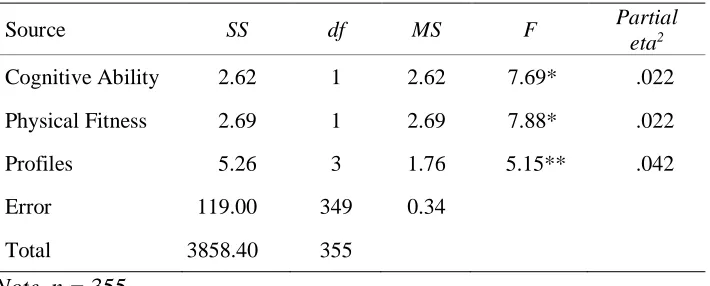
Last, RQ2b, regarding whether the personality profiles predicted performance over and above that of cognitive ability and physical fitness, was tested via ANCOVA. The ANCOVA results, shown in Table 6, indicate the profiles to be significant predictors of performance when the influence of cognitive ability and physical fitness are controlled for as covariates. A
Bonferroni post hoc analysis was completed to further investigate the differences among profiles. The results, shown in Table 7, indicate similarities to that of the analysis computed without holding cognitive ability or physical fitness constant. In other words, people with profile one, the “Negative Extreme” performed significantly worse than the “Negative Average,” “Positive
Extreme,” and “Positive Average” profiles. The latter three were not significantly different from one another.
Candidates who completed the 21-day assessment center moved to subsequent phases of the selection process, which included an interview. Ultimately, a selection decision was made which determined whether each candidate was invited to attend specialized training. In order to further investigate the personality profiles uncovered in this study, the percentage of members in each profile selected to attend the specialized training was examined. As shown in Figure 6 the “Negative Extreme” profile had the lowest proportion selected at approximately 17%. The “Negative Average” was selected at 33%, “Positive Extreme” at 39%, and “Positive Average” at 34%, where the difference amongst the four profiles was significant, 2(3, n = 728) = 11.19, p <
Discussion
The performance of action team members is critical in a way unlike that of a corporate or athletic team. The outcomes, complex, dangerous, or often both, require skill sets and
personalities to culminate in ways we have yet to precisely define. Industrial and organizational psychology offers multiple avenues to increased team performance. This includes, but is
certainly not limited to, the focus of this research: strategies related to performance prediction and subgroup comparisons. This study explored the effects of personality on peer ratings of performance in two ways, by employing: (a) the more traditional variable-centered approach (i.e., regression) and (b) the less commonly utilized person-centered approach (i.e., latent profile analysis; LPA).
Conceptual Implications
Eight predictor personality variables (i.e., grit, hardiness, CSE, extraversion,
conscientiousness, agreeableness, openness and neuroticism) were included in this study. Results of the bivariate correlations indicated that six of the eight were significantly related to
performance, and in combination, they explained a small, but significant, amount of variance. These findings are consistent with studies previously completed that investigated the relationship between personality and performance (e.g., Barrick, Mount, & Judge, 2001; Bonanno,
2004; Haynie & Shepherd, 2011; Hogan & Holland, 2003; Lukey& Tepe, 2008). Further, when physical fitness and cognitive ability were held constant, CSE, extraversion, and openness, are shown to be uniquely explanatory. This means personality is important, over and above
commonly attended to factors such as being smart and strong.
and worth signaled to peers that they, too, should believe in his ability and worth. Further, as previously noted, individuals with high CSE exhibit a persistent effort towards task completion, cope better in the face of challenges, and show more willingness to address problems as they arise (Judge, et al., 1997; Kammeyer-Mueller, Judge, & Scott, 2009; Haynie & Shepherd, 2011).
Those high in CSE and extraversion believe in themselves internally and behave in ways externally that may secure the confidence of their teammates, which may in turn increase their confidence in themselves to be a good teammate. The feedback loop is positive and spirals upward in their favor. Perhaps those whose CSE is coupled with extraversion benefit from an amplified feedback loop by more apparently conveying that CSE to those around them. Interestingly, three profiles with the highest performance (e.g., “Positive Extreme”, “Positive Average”, “Negative Average”) also had the highest levels of CSE.
It is noteworthy that CSE uniquely predicted performance over and above physical fitness and cognitive ability when hardiness, grit, and Big Five characteristics like conscientiousness and agreeableness did not. Further, this is the first study the researchers are aware of that introduces CSE as an important predictor of performance in the action team context. Continued study as to whether this is a population specific phenomenon, or whether CSE should be more regularly included in applied military research is an important way forward. It should be noted that the negative relationship between openness to experience and performance was unexpected. Previous research has found openness to experience to have a positive relationship with
which is characteristic of the military culture under investigation (McRae, 1987). It is possible the facets of openness may have told a more complex story. Personality data, however, were not available at the facet level.
By using both variable-centered and person-centered approaches, this study captures some of the nuance of how personality combines within subgroups to result in performance. The LPA identified like-group membership categories. From there it was possible to test whether the differences among the subgroups were significant. In this case, the “Negative Extreme” profile was the only profile to show significant differences in performance. The remaining three profiles, “Negative Average,” “Positive Average,” and “Positive Extreme,” though displaying
rather different profiles of personality, showed no significant variation in terms of performance and selection even after cognitive ability and physical fitness were controlled for. It is clear that personality matters for performance, but there does not appear to be a single personality profile that will be successful on an action team of this sort.
Aside from performance, this study provides insight into how this set of personality variables commonly attended to in research and practice actually combine in the real world. Figure 1 indicates that the majority (about 62%) of people (i.e., “Negative Average” and
“Positive Average” profiles) fall between -.5 and +.5 standard deviations from the mean on every measured variable. Those in the “Positive Average” profile trended +.5 standard deviations
above the mean on grit, hardiness, CSE, openness, agreeableness, conscientiousness, and
Extreme” and “Positive Extreme”) where each fall between -1.5 and +1.5 standard deviations from the mean on every measured variable. The “Negative Extreme” profile was approximately
-1.5 standard deviations below the mean on grit, hardiness, CSE, openness, agreeableness, conscientiousness, and extraversion and +1.5 standard deviations above the mean on neuroticism. The reverse is true for the “Positive Extreme” profile, trending +1.5 standard
deviations above the mean on grit, hardiness, CSE, openness, agreeableness, conscientiousness, and extraversion and -1.5 standard deviations below the mean on neuroticism. Thus, there are essentially two types of profiles: average and extreme.
Each approach in this scenario offered valuable and unique information in pursuit of understanding personality’s effect on performance. Each approach, separately or in combination,
ought to be investigated when the context calls for it. The addition of the person-centered analysis to our variable-centered approaches inserts flexibility into our models and can provide an increasingly nuanced understanding of how each construct relates to another.
Practical Implications
When thinking about the variables included in this investigation, there is a tendency to look at each individually in terms of “good” or “bad.” Neuroticism, for example, is often thought
of as maladaptive to the lay person, but when considered in conjunction with other variables, it could actually be offset. As this study suggests, openness, which is valued in many societal contexts, can impede performance. Yet its negative effects can be offset by other personality characteristics. In this context, openness shows up highest in the “Positive Extreme” and “Positive Average” profiles, which did not statistically impact either profile’s overall
It is also worth pointing out that top performers in this context came in different
“personality packages.” While personality profile matters in the context of performance, there is
not a single profile that characterizes top performance; rather, there were three distinct profiles that all performed equivalently well. The “Negative Average” profile scored .5 standard deviations above the mean on neuroticism, approximately zero standard deviations from the mean on openness, and despite being .5 standard deviations below the mean in everything else typically considered “good,” any decrement in their average performance was statistically
non-significant. Further, the “Positive Extreme” profile scored between 1 and 1.5 standard deviations from the mean on all things “good,” and -1.5 standard deviations from the mean on neuroticism, but did not perform better or get “Selected” at statistically higher rates than the “Negative Average” or “Positive Average.” These numbers, taken at face value, could cause decision
makers not to select candidates who may actually be very successful. Understanding the ways these commonly measured variables combine in real people could contribute to the proper and effective staffing of the teams that do this special work.
Limitations and Future Research
One limitation of this study is a lack of gender diversity. Action teams are not always all men.
A second limitation of this study pertains to the nature of the performance data available for analysis. The performance data were provided to the researchers as a score aggregated across raters. Prior to this, interrater agreement (e.g., rWG) indices would have typically been
A third limitation of this study stemmed from the real-world context in which it took place, possibly resulting in a restriction of range. Cognitive ability and physical fitness are
established requirements of the military action team. There are cultural minimums for each factor that will not necessarily guarantee the success of a candidate, but will reduce the cost and risk associated with their participation. This results in a restriction of range where a possible maximum score of 300 on the physical fitness test is more likely than a score below a 200 despite still considered “passing.” The variance in cognitive ability and physical fitness is thus limited.
A related, but separate, concern that may come up is that there is a required minimum number of candidates that must pass through the selection system in order to staff all action teams. Ideal standards of performance can give way to these practical staffing concerns. Whereas this issue could mask differences among the profiles that could otherwise emerge in selection ratios, this issue does not explain the statistical similarity in performance ratings across the three top-performing profiles.
A fourth limitation related to the context of this study, is the potential for socially
desirable responding on measures like grit and hardiness. Though the respondents were informed that these responses were not being used for selection, they may not have believed this
assurance. This may have led to a lack of candor, especially on measures where the socially desirable response was obvious.
References
Abuhassàn, A., & Bates, T. C. (2015). Grit. Journal of Individual Differences, 36. 205-214. Adams, M. A., Sallis, J. F., Kerr, J., Conway, T. L., Saelens, B. E., Frank, L. D., Cain, K. L.
(2011). Neighborhood Environment Profiles Related to Physical Activity and Weight
Status: A Latent Profile Analysis. Preventive Medicine, 52(5), 326–331.
Barrick, M. R., & Mount, M. K. (1991). The big five personality dimensions and job performance: a meta‐analysis. Personnel psychology, 44(1), 1-26.
Barrick, M. R., Stewart, G. L., Neubert, M. J., & Mount, M. K. (1998). Relating member ability and personality to work-team processes and team effectiveness. Journal of applied psychology, 83(3), 377.
Bartone, P. T. (1989). Predictors of stress-related illness in city bus drivers. Journal of Occupational and Environmental Medicine, 31(8), 657-663.
Bartone, P. T. (1996, August). Stress and hardiness in US peacekeeping soldiers. In annual convention of the American Psychological Association, Toronto, Ontario, Canada. Bartone, P. T. (1999). Hardiness protects against war-related stress in Army Reserve
forces. Consulting Psychology Journal: Practice and Research, 51(2), 72.
Bartone, P. T. (2000). Hardiness as a resiliency factor for United States forces in the Gulf War. Bartone, P. T. (2006). Resilience under military operational stress: Can leaders influence
hardiness? Military psychology, 18(S), S131.
Bartone, P. T., Eid, J., Helge Johnsen, B., Christian Laberg, J., & Snook, S. A. (2009). Big five personality factors, hardiness, and social judgment as predictors of leader
performance. Leadership & Organization Development Journal, 30(6), 498-521. Bartone, P. T., Johnsen, B. H., Eid, J., Brun, W., & Laberg, J. C. (2002). Factors influencing
small-unit cohesion in Norwegian Navy officer cadets. Military Psychology, 14(1), 1. Bartone, P. T., Ursano, R. J., Wright, K. M., & Ingraham, L. H. (1989). The impact of a military
air disaster on the health of assistance workers: A prospective study. The Journal of nervous and mental disease, 177(6), 317-328.
Ben-Porath, Y. S., & Tellegen, A. (2008). MMPI-2-RF: Manual for administration, scoring and interpretation. University of Minnesota Press.
Bonanno, G. A. (2004). Loss, trauma, and human resilience: have we underestimated the human capacity to thrive after extremely aversive events?. American psychologist, 59(1), 20. Borman, W. C., Rosse, R. L., & Abrahams, N. M. (1980). An empirical construct validity
approach to studying predictor–job performance links. Journal of Applied Psychology, 65(6), 662.
Borman, W. C., White, L. A., & Dorsey, D. W. (1995). Effects of ratee task performance and interpersonal factors on supervisor and peer performance ratings. Journal of Applied Psychology, 80(1), 168.
Britt, T. W., Adler, A. B., & Bartone, P. T. (2001). Deriving benefits from stressful events: The role of engagement in meaningful work and hardiness. Journal of occupational health psychology, 6(1), 53.
Carlson, M. J., & Jaenen, S. P. (2012). The development of a preselection physical fitness training program for Canadian Special Operations Regiment applicants. The Journal of Strength & Conditioning Research, 26, S2-S14.
Cohen, J. (1992). A power primer. Psychological bulletin, 112(1), 155
Contrada, R. J. (1989). Type A behavior, personality hardiness, and cardiovascular responses to stress. Journal of personality and social psychology, 57(5), 895.
Costa Jr, P. T., & McCrae, R. R. (1988). From catalog to classification: Murray's needs and the five-factor model. Journal of personality and social psychology, 55(2), 258.
Costa, P. T., & McCrae, R. R. (1992). Four ways five factors are basic. Personality and individual differences, 13(6), 653-665.
Day, D. V., & Silverman, S. B. (1989). Personality and job performance: Evidence of incremental validity. Personnel psychology, 42(1), 25-36.
Dierdorff, E. C., Surface, E. A. (2007), Assessing training needs: Do work experience and capability matter? Human Performance, 21(1), 28-48.
Downey, R. G., Medland, F. F., & Yates, L. G. (1976). Evaluation of a peer rating system for predicting subsequent promotion of senior military officers. Journal of Applied Psychology, 61(2), 206.
Duckworth, A. L., Peterson, C., Matthews, M. D., & Kelly, D. R. (2007). Grit: perseverance and passion for long-term goals. Journal of personality and social psychology, 92(6), 1087. Duckworth, A. L., & Quinn, P. D. (2009). Development and validation of the Short Grit Scale
Erez, A., & Judge, T. A. (2001). Relationship of core self-evaluations to goal setting, motivation, and performance. Journal of applied psychology, 86(6), 1270.
Eskreis-Winkler, L., Shulman, E. P., Beal, S. A., & Duckworth, A. L. (2014). The grit effect: Predicting retention in the military, the workplace, school and marriage. Frontiers in psychology, 5(36).
Florian, V., Mikulincer, M., & Taubman, O. (1995). Does hardiness contribute to mental health during a stressful real-life situation? The roles of appraisal and coping. Journal of personality and social psychology, 68(4), 687.
Goldberg, L. R. (1993). The structure of phenotypic personality traits. American psychologist, 48(1), 26.
Goldberg, L. R. (1990). An alternative" description of personality": the big-five factor structure. Journal of personality and social psychology, 59(6), 1216.
Halfhill, T., Nielsen, T. M., Sundstrom, E., & Weilbaecher, A. (2005). Group personality composition and performance in military service teams. Military Psychology, 17(1), 41. Hannah, S. T., Walumbwa, F. O., & Fry, L. W. (2011). Leadership in action teams: Team leader
and member’s authenticity, authenticity strength, and team outcomes. Personnel
Psychology, 64(3), 771-802.
Harter, S. (1993). Causes and consequences of low self-esteem in children and adolescents. In Self-esteem (pp. 87-116). Springer US.
Hofmann, D. A., & Jones, L. M. (2005). Leadership, collective personality, and performance. Journal of Applied psychology, 90(3), 509.
Hurtz, G. M., & Donovan, J. J. (2000). Personality and job performance: The Big Five revisited. Journal of applied psychology, 85(6), 869-879.
John, O. P., & Srivastava, S. (1999). The Big Five trait taxonomy: History, measurement, and theoretical perspectives. Handbook of personality: Theory and research, 2(1999), 102-138.
Judge, T. A., Bono, J. E., Erez, A., & Locke, E. A. (2005). Core self-evaluations and job and life satisfaction: the role of self-concordance and goal attainment. Journal of applied
psychology, 90(2), 257.
Judge, T. A., Erez, A., Bono, J. E., & Thoresen, C. J. (2003). The core self‐evaluations scale: Development of a measure. Personnel psychology, 56(2), 303-331.
Judge, T. A., & Hurst, C. (2008). How the rich (and happy) get richer (and happier): relationship of core self-evaluations to trajectories in attaining work success. Journal of Applied Psychology, 93(4), 849.
Judge, T. A., Locke, E. A., & Durham, C. C. (1997). The dispositional causes of job satisfaction: A core evaluations approach. RESEARCH IN ORGANIZATIONAL BEHAVIOR, VOL 19, 1997, 19, 151-188.
Judge, T. A., Locke, E. A., Durham, C. C., & Kluger, A. N. (1998). Dispositional effects on job and life satisfaction: the role of core evaluations. Journal of applied psychology, 83(1), 17.
Kichuk, S. L., & Wiesner, W. H. (1997). The big five personality factors and team performance: implications for selecting successful product design teams. Journal of Engineering and Technology Management, 14(3-4), 195-221.
Kobasa, S. C. (1979). Stressful life events, personality, and health: an inquiry into hardiness. Journal of personality and social psychology, 37(1), 1.
Kobasa, S. C., Maddi, S. R., & Kahn, S. (1982). Hardiness and health: a prospective study. Journal of personality and social psychology, 42(1), 168.
LeBreton, J. M., & Senter, J. L. (2008). Answers to 20 questions about interrater reliability and interrater agreement. Organizational research methods, 11(4), 815-852.
Lian, P., Sun, Y., Ji, Z., Li, H., & Peng, J. (2014). Moving away from exhaustion: How core self-evaluations influence academic burnout. PLoS One, 9(1), e87152.
Lord, R. G., De Vader, C. L., & Alliger, G. M. (1986). A meta-analysis of the relation between personality traits and leadership perceptions: An application of validity generalization procedures.
Lukey, B. J., & Tepe, V. (Eds.). (2008). Biobehavioral resilience to stress. CRC Press. Maddi, S. R. (2002). The story of hardiness: Twenty years of theorizing, research, and
practice. Consulting Psychology Journal: Practice and Research, 54(3), 173.
Maddi, S. R. (2008). The courage and strategies of hardiness as helpful in growing despite major, disruptive stresses.
McAnulty, D. M. (1990). Development of a Peer Comparison Procedure for the US Army Aviation Officer Advanced Course (No. ASI690-320-89). ANACAPA SCIENCES INC FORT RUCKER AL.
McCrae, R. R. (1996). Social consequences of experiential openness. Psychological bulletin, 120(3), 323.
McNall, L. A., Masuda, A. D., Shanock, L. R., & Nicklin, J. M. (2011). Interaction of core self-evaluations and perceived organizational support on work-to-family enrichment. The Journal of psychology, 145(2), 133-149.
Mount, M. K., Barrick, M. R., Scullen, S. M., & Rounds, J. (2005). Higher‐order dimensions of the big five personality traits and the big six vocational interest types. Personnel
Psychology, 58(2), 447-478.
Magnusson, D., & Stattin, H. (1998). Person-context interaction theories. John Wiley & Sons Inc.
Muthén, L. K., & Muthén, B. O. (1998). Statistical analysis with latent variables. Mplus User’s Guide, 2012.
Muthèn, L., & Muthèn, B. (2010, April). MPlus Software (Version 6) [Computer software].
Nielsen, T. M., Sundstrom, E. D., & Halfhill, T. R. (2005). Group dynamics and
effectiveness. SA Wheelan, The handbook of group research and practice. Thousand Oaks: Sage Publications, 285-311.
Paunonen, S. V., & Ashton, M. C. (2001). Big five factors and facets and the prediction of behavior. Journal of personality and social psychology, 81(3), 524.
Peeters, M. A. G., van Tuijl, H. F. J. M., Rutte, C. G. and Reymen, I. M. M. J. (2006),
Ramsey, P. G., Wenrich, M. D., Carline, J. D., Inui, T. S., Larson, E. B., & LoGerfo, J. P. (1993). Use of peer ratings to evaluate physician performance. Jama, 269(13), 1655-1660.
Resick, C. J., Whitman, D. S., Weingarden, S. M., & Hiller, N. J. (2009). The bright-side and the dark-side of CEO personality: examining core self-evaluations, narcissism,
transformational leadership, and strategic influence. Journal of Applied Psychology, 94(6), 1365.
Roth, D. L., Wiebe, D. J., Fillingim, R. B., & Shay, K. A. (1989). Life events, fitness, hardiness, and health: A simultaneous analysis of proposed stress-resistance effects. Journal of Personality and Social Psychology, 57(1), 136.
Rothmann, S., & Coetzer, E. P. (2003). The big five personality dimensions and job performance. SA Journal of Industrial Psychology, 29(1), 68-74.
Sartori, R., Costantini, A., Ceschi, A., & Scalco, A. (2016). Not only correlations: a different approach for investigating the relationship between the Big Five personality traits and job performance based on workers and employees’ perception. Quality & Quantity, 1-13.
Spector, P. E. (1982). Behavior in organizations as a function of employee's locus of control. Psychological bulletin, 91(3), 482.
Stanhope, D. S., Pond III, S. B., & Surface, E. A. (2013). Core self-evaluations and training effectiveness: Prediction through motivational intervening mechanisms. Journal of Applied Psychology, 98(5), 820.
Steed, C. L., Krull, B. R., Morgan, A. L., Tucker, R. M., & Ludy, M. J. (2016). Relationship Between Body Fat and Physical Fitness in Army ROTC Cadets. Military
Sundstrom, E., De Meuse, K. P., & Futrell, D. (1990). Work teams: Applications and effectiveness. American psychologist, 45(2), 120.
Tein, J. Y., Coxe, S., & Cham, H. (2013). Statistical power to detect the correct number of classes in latent profile analysis. Structural equation modeling: a multidisciplinary journal, 20(4), 640-657.
Teplitzky, M. L. (1991). Physical performance predictors of success in Special Forces assessment and selection (No. ARI-RR-1606). ARMY RESEARCH INST FOR THE BEHAVIORAL AND SOCIAL SCIENCES ALEXANDRIA VA.
Tett, R. P., Jackson, D. N., & Rothstein, M. (1991). Personality measures as predictors of job performance: a meta‐analytic review. Personnel psychology, 44(4), 703-742.
Teyhen, D. S., Shaffer, S. W., Butler, R. J., Goffar, S. L., Kiesel, K. B., Rhon, D. I., ... & Plisky, P. J. (2016). Application of Athletic Movement Tests that Predict Injury Risk in a
Military Population: Development of Normative Data. Military medicine, 181(10), 1324-1334.
Tobin, R. M., Graziano, W. G., Vanman, E. J., & Tassinary, L. G. (2000). Personality, emotional experience, and efforts to control emotions. Journal of personality and social
psychology, 79(4), 656.
van Vianen, A.E.M., & Dreu, C.K.W. ( 2001). Personality in teams: Its relationship to social
cohesion, task cohesion, and team performance. European Journal of Work &
Organizational Psychology, 10(2), 97-120.
Wahlberg, J. L., Boyles, W. R., & Boyd, H. A. (1971). Peer Ratings as Predictors of Success in Military Aviation (No. HUMRRO). HUMAN RESOURCES RESEARCH