| INVESTIGATION
High-Throughput Characterization of Cascade type I-E
CRISPR Guide Ef
fi
cacy Reveals Unexpected PAM
Diversity and Target Sequence Preferences
Becky Xu Hua Fu,*,1Michael Wainberg,†Anshul Kundaje,*,†,1and Andrew Z. Fire*,‡,1 *Department of Genetics and‡Department of Pathology, Stanford University School of Medicine, Stanford, California 94305, and †Department of Computer Science, Stanford University, California 94305
ABSTRACT Interactions between Clustered Regularly Interspaced Short Palindromic Repeat (CRISPR) RNAs and CRISPR-associated (Cas) proteins form an RNA-guided adaptive immune system in prokaryotes. The adaptive immune system utilizes segments of the genetic material of invasive foreign elements in the CRISPR locus. The loci are transcribed and processed to produce small CRISPR RNAs (crRNAs), with degradation of invading genetic material directed by a combination of complementarity between RNA and DNA and in some cases recognition of adjacent motifs called PAMs (Protospacer Adjacent Motifs). Here we describe a general, high-throughput procedure to test the efficacy of thousands of targets, applying this to theEscherichia colitype I-E Cascade (CRISPR-associated complex for antiviral defense) system. These studies were followed with reciprocal experiments in which the consequence of CRISPR activity was survival in the presence of a lytic phage. From the combined analysis of the Cascade system, we found that (i) type I-E Cascade PAM recognition is more expansive than previously reported, with at least 22 distinct PAMs, with many of the noncanonical PAMs having CRISPR-interference abilities similar to the canonical PAMs; (ii) PAM positioning appears precise, with no evidence for tolerance to PAM slippage in interference; and (iii) while increased guanine-cytosine (GC) content in the spacer is associated with higher CRISPR-interference efficiency, high GC content (.62.5%) decreases CRISPR-interference efficiency. Ourfindings provide a comprehensive functional profile of Cascade type I-E interference requirements and a method to assay spacer efficacy that can be applied to other CRISPR-Cas systems.
KEYWORDSCRISPR-Cas; CRISPR-interference; Cascade; guide efficacy; phage
C
RISPR-Cas (Clustered Regularly Interspaced Short Palin-dromic Repeats and CRISPR-associated proteins) are adaptive immune systems in prokaryotes (Bhaya et al. 2011; Terns and Terns 2011; Wiedenheft et al. 2012; Shmakov et al. 2015). There are six types of CRISPR-Cas immune systems (hereafter abbreviated to CRISPR-Cas): type I-VI. These systems rely on a mechanism where captured invading genetic material from bacteriophages, plasmids, orconjugative elements is recognized, processed, and copied between repeats in the CRISPR loci as a spacer (Barrangou et al. 2007; Datsenkoet al. 2012; Yosefet al. 2012). The CRISPR spacers are expressed as long transcripts that are processed by Cas proteins either with or without other en-dogenous proteins to produce small guide RNAs (gRNAs) or CRISPR RNAs (crRNAs) (Brouns et al. 2008; Carte et al. 2008; Haurwitzet al.2010; Deltchevaet al.2011; Hatoum-Aslan et al. 2011; Nam et al. 2012). If enough comple-mentarity exists between the target and the crRNA, the Cas proteins cleave the target thus conferring immunity from the invading foreign genetic element (Haleet al.2009; Joreet al. 2011; Wiedenheftet al.2011; Jineket al.2012). In addition to utilizing complementarity between crRNA and the target, CRISPR-Cas systems can use a protospacer adjacent motif (PAM) for target/nontarget discrimination during interfer-ence (Deveauet al.2008; Mojicaet al.2009; Marraffini and Sontheimer 2010; Semenovaet al.2011; Westraet al.2012; Sternberg SHet al.2014).
Copyright © 2017 by the Genetics Society of America doi:https://doi.org/10.1534/genetics.117.202580
Manuscript received March 30, 2017; accepted for publication May 29, 2017; published Early Online June 20, 2017.
Supplemental material is available online atwww.genetics.org/lookup/suppl/doi:10. 1534/genetics.117.202580/-/DC1.
This work is dedicated to the friendship and memory of Dr. Julia Pak. Dr. Pak was senior research scientist in the Fire laboratory at Stanford University until she lost her
fight to cancer in November 2015. Her passion for mentorship and science is irreplaceable. Her strength against adversity and her kindness is an inspiration for those fortunate enough to have known her.
TheEscherichia colitype I-E Cascade system is guided by a 61 nt crRNA and is made up of five different Cas proteins [Cse1 (1); Cse2 (2), Cas7 (6), Cas5 (1), Cas6e (1)] (Jore et al. 2011). The Cascade system recognizes a wide variety of PAM sequences with varying degrees of efficacy. Several PAM sequences found in the initial studies of Cascade are termed “canonical PAMs” (59-AAG, AGG, ATG, GAG-39), while an additional set described in later studies are termed “noncanonical PAMs”(59-CAG, GTG, TAA, TGG, AAA, AAC, AAT, ATA, TAG, TTG-39) (Westraet al.2012, 2013; Mulepati and Bailey 2013; Fineran et al. 2014; Hochstrasser et al. 2014; Caliando and Voigt 2015; Leenayet al.2016). Type I systems are found in various industrially and medically rele-vant microbial strains (e.g.,E. coli,Streptococcus thermophilus, Clostridium autoethanogenum, and Acinetobacter baumannii) (Grissaet al.2007). Various versatile technological tools have been developed utilizing the Cascade type I-E CRISPR-Cas sys-tem. Efficient genome editing and gene repression has been demonstrated in E. coli (Luo et al. 2015; Rath et al. 2015; Changet al.2016). Furthermore, the Cascade system has been shown to be applicable in gene editing and transcription repres-sion when delivered in different species of bacteria (Boxet al. 2015; Rathet al.2015). Beyond its value in bacterial genome engineering, the Cascade type I-E system has been a uniquely applicable tool for bacteriophage genome editing (Kiro et al. 2014; Boxet al.2015).
To further our understanding of the specificity of the Cascade system, we developed a high-throughput in vivo method in which a large population of otherwise unrelated crRNA sequences could be assayed in a single experiment. Previous high-throughput methods of crRNA characteriza-tion include PAM-SCANR (Leenay et al. 2016) and MS2 screening (Abudayyehet al.2016). The PAM-SCANR method utilizes gene repression as a basis assaying varying PAMs (“NNNN”) while holding the target region constant. The PAM-SCANR method offers flexibility in exploring the four bases adjacent to the target region, but is restricted to que-rying a single target. The MS2 phage screening method uses the expression of a CRISPR-Cas system (C2c2) with a library of spacers tiling a MS2 phage genome. The bacterial strain containing the MS2 spacer library is challenged with MS2 phage and after a period of infection, the remaining crRNAs are sequenced (Abudayyeh et al. 2016). The MS2 phage screening method can be used to assay crRNA function by varying the target and the PAM adjacent flanking region. However, this method requires a characterized lytic phage for the host CRISPR-Cas system in question. In devising a high-throughput assay we chose to assay CRISPR-interference with multiple heterogeneous crRNAs with varying sequence features derived from the l bacteriophage genome. For a summary of PAMs found in previous studies for the Cascade type I-E system see Supplemental Material, Table S1 inFile S3. In contrast to previous methods, our assay utilizes self-targeting/bacterial suicide with a Cascade complex that har-bors a functional Cas3 nuclease. The advantage of this method is the ability to test CRISPR-interference with
thousands of crRNAs with diverse sequence features before and after the controlled induction of the CRISPR-Cas system. In addition, the results produced from our analysis can be validated via phage infection assays.
This method allows for a detailed investigation of inter-ference requirements and presents a high-throughput way of assaying spacer efficacy that can be adapted for other CRISPR-Cas systems. Our approach revealed extensive PAM promis-cuity, with about a third of the 64 possible PAMs having the ability to induce interference. We found that PAM identity was the predominant predictive feature of crRNA CRISPR-interference. We found no evidence of PAM slippage contrib-uting to increased crRNA efficacy for CRISPR-interference but didfind evidence for contribution of the base proximal to the PAM (elongated PAM). In addition, moderate GC content increased crRNA CRISPR-interference, while crRNAs with UUU exhibited decreased CRISPR-interference. Finally, low-throughput assays for phage infection in the presence of select crRNAs showed strong concordance with the predicted crRNA CRISPR-interference efficiency from our high-throughput assays, providing additional experimental validation for our approach.
Materials and Methods
To test the crRNA efficacy of the Cascade type I-E system in a high-throughput and nonbiased way, we tested a selection of crRNAs tiling a target region with a 32-bp window and assayed for CRISPR-interference. The overall design of the in vivo assay includes: (1) integrating the target region (lprophage) into the ACT-01strain [an E. coli strain with an inducible Cascade system (Caliando and Voigt 2015)], (2) cloning a crRNA library targeting the region into a crRNA expression vector, (3) transforming the crRNA library into the bacterial strain from step 1, (4) performing a growth assay in induced and noninduced conditions, (5) amplifying and DNA se-quencing the crRNA templates to determine the representation of each crRNA (percent of reads exactly matching to the crRNA) with and without induction of the CRISPR system, and (6) calculating a retention score for each crRNA based on the log ratio of induced to noninduced representations (Figure 1A).
In describing the assay, we note that the target of our library of crRNAs was a phage genome. This assay can work with any target sequence whether it is an integrated or endogenous sequence. However, it is important to note that utilizing self-targeting may provide a slightly different interference profile compared to using phage or plasmid targeting (Manivet al. 2016).
Cascade bacterial library strain construction
studies, we chose a temperature-sensitive mutant in the phage R gene ((Campbell and Del Campillo-Campbell 1963) thel-Rts phage was a generous gift from Allan Campbell). A bacterial lawn was made with 100ml of the overnight culture mixed with 5 ml of 0.7% top agar and spread on an LB plate. About 50ml of
l-Rts phage was spotted on the bacterial lawn. The plate was left to incubate at 27°overnight. The resulting turbid plaques were streaked out on LB plates. The isolated bacterial strains were tested for the presence of the prophage via inability to replaque with the l-Rts phage. The ACT-01 strain from (Caliando and Voigt 2015) with the l-Rts prophage inte-grated is referred to as the ACT-01(Rts) strain.
Construction of crRNA plasmid library
The plasmid used to express the Cascade crRNA was con-structed by redesigning the wild-typeE. coliCascade CRISPR loci. A synthetic DNA fragment of the Cascade CRISPR loci was designed with restriction enzyme sites (BsaI-XhoI-BsaI) replacing the first spacer. The fragment consisted of the CRISPR leader followed by a CRISPR repeat, BsaI-XhoI-BsaI restriction sites, followed by another CRISPR repeat followed by 300 bp of endogenous sequence of the end of the CRISPR locus. This new cloning CRISPR loci fragment was inserted next to an arabinose promoter (pPD207.846). The BsaI sites provide an asymmetric and modular insertion site for incorporating libraries of potential crRNA sequences. A uniqueXhoI site separating the two BsaI sites allows double-digested vector (BsaI+XhoI) to capture inserts with very low religation background. Figure S1 inFile S3depicts a graph-ical schematic of the crRNA expression vector design.
Large sets of synthetic oligos were obtained through mas-sively parallel synthesis (Custom Array, Bothell, WA), tiling thelphage genome at 32-nt increments. These were designed for amplification with a constant primer pair AF-BXHF-42 and AF-BXHF-43 (see Table S2 inFile S3for sequences) and gel purified using the Qiagen gel extraction kit. The resulting dou-ble-stranded DNA was digested with BsaI enzyme and extracted using phenol + phenol/chloroform + ethanol extraction. Thefinal digested double-stranded fragments are appro-priate for ligation into linearized pPD207.846 and ligated with T4 ligase overnight. Figure S2 in File S3 depicts an example oligo sequence through the library construction pro-cess. The ligation products were transformed into TOP10 DH5alibrary competent cells and grown on plates. The trans-formed colonies were allowed to grow at 37°overnight and subsequently incubated for 2 days at 30°. After the 2-day
in-cubation,20,000 colonies were scraped off plates and plasmid DNA was purified using the Qiagen Midi plasmid prep kit.
The crRNA plasmid library was transformed into the ACT-01(Rts) bacterial strain via electroporation (Bio-Rad Gene Pulser Xcell). Transformed bacterial cells were allowed to recover for an hour at 37°and plated. The bacteria were allowed to grow overnight at 37°and were then moved to 30° for a 2-day incubation. Finally, 20,000 ACT-01(Rts) bacterial colonies harboring the crRNA plasmids were scraped off plates and pooled to produce the bacterial spacer library. In this study, two distinct libraries were created and used for experiments: BXHF-BL1 and BXHF-BL2. The bacte-rial crRNA library was washed with fresh 23TY media and resuspended in 30 ml of 50% glycerol solution + 0.5% glu-cose + Kanamycin (50mg/ml) and stored at280°for exper-imental assays.
Cascade spacer in vivo CRISPR-interference assay
About 5–10ml of frozen spacer bacterial library were inocu-lated in 25 ml of 23TY media + Kanamycin + 0.5% glucose and allowed to grow to OD600 of 0.1–0.2 at 37°with agita-tion. After recovery, aliquots of 100 ml of cells were spun down and the supernatant discarded. The cells were used to inoculate new cultures with either arabinose-induced (Cascade+) or noninduced conditions (Cascade2). The non-induced cultures were grown in 23TY + Kanamycin + 0.5% glucose. The induced cultures were grown in 23TY + Kana-mycin + 2 mM arabinose (Caliando and Voigt 2015). The cultures were grown at 37°with agitation for 9–12 divisions. All cultures were passaged before stationary phase (OD600 0.7–0.8). After 9–12 divisions, the induced bacterial cultures showed a lag in growth compared to the noninduced cul-tures (difference of about OD600 0.25–0.3). Once the cul-tures displayed a growth difference between the induced and noninduced conditions, the bacterial cultures were diluted 1/5000–1/10,000 and grown at 20°with agitation overnight (6–10 divisions). Aliquots of 2 ml from each experimental noninduced and induced population were taken at different time points and plasmid DNA prepped (protocol can be found in the“Protocols”section in the Supplemental Materials). Var-ious time points were taken throughout the growth assay, and retention profiles of crRNAs can be found in Figure S3 inFile S3. The number of divisions for each library differs but ranges from 15 to 20 divisions (Figure S3 inFile S3).
Sequencing adapters were added onto the DNA-prepared plasmids via a two-step PCR. Afirst round of amplification
involved short primers AF-BXHF-73 and AF-BXHF-367 (10–12 cycles) (see Table S2 inFile S3). Thefirst round of amplification consists of primers with seven degenerate nucleotides that are necessary to add diversity for high-throughput sequenc-ing. A second round of amplification attached longer primers with index sequences (8–10 cycles). The index sequences used are derived from Illumina Truseq HT Kit [forward pri-mers: AF-KLA- (67–74) and reverse primers: AF-KLA-(124– 135); Table S2 inFile S3]. Primer sequences can be found in Table S2 in File S3 and amplification information can be
found in the“Protocols”section of the Supplemental Mate-rials. All PCR amplifications were performed using Phusion polymerase with GC buffer.
The E. coli MG1655 strain carries a number of cryptic prophage in its chromosome including several fragments matchinglsequence (Blattneret al.1997; Casjens 2003). To prevent crRNAs with complementarity to the E. coli genome from confounding the analysis, all crRNAs were aligned to the E. coligenome with Basic Local Alignment Search Tool (BLAST) using default parameters for short read alignment. All crRNAs with alignmente-values#0.001 were removed from analysis. The control set of crRNAs used for comparison consists of crRNAs aligned to the E. coli and l-Rts genome, and only crRNAs withe-values.0.001 were used for the control set. In addition, the Cascade spacer assay was performed on libraries in bacteria without thel-Rts prophage target in the genome. Minimal off target effects were observed for the control exper-iments (Figure S4 inFile S3).
A table of all Cascadein vivohigh-throughput experiments, experimental conditions, and corresponding data informa-tion can be found in Table S3 inFile S3.
As noted also by Beloglazovaet al.(2015), we observed a small number of highly structured crRNAs with strong Cas-cade PAMs but little or no ability to cause interferencein vivo (Table S4 in File S3). Not all RNAs with strong secondary structure predictions lose their crRNA capabilities and we have not done extensive follow-up to determine either struc-tural determinants for the inhibition or which step of the process has been affected.
Calculation of crRNA retention scores
A log-retention score for each crRNA was calculated by quan-tifying the representation of each sequence before and after the induction of the Cascade CRISPR-Cas system. The number of assessed crRNAs in each library can vary depending on sequencing depth. Sequences withn$50 counts and match-ing thel-Rts prophage in the noninduced control were con-sidered for the analysis. Each library also contains a control population of crRNAs that did not map either to thelorE. coli genome (aligned with BLAST withe-values.0.001). The me-dian retention of the control population was subtracted from each calculated retention score for normalization.
For each sequence:
Representation in control: (number of counts without induc-tion of Cascade system + 1)/(total size of library + 1)
Representation in experiment: (number of counts with in-duction of Cascade system + 1)/(total size of library + 1) Retention score: (log2(Representation in induced experi-ment/Representation in noninduction control))-median (retentions of control crRNAs)
Sequencing ofl-Rts bacteriophage
The integrated l-Rts phage was sequenced using Illumina Nextera reagents. The crRNAs considered in experiments are required to exactly match thel-Rts genome. The sequenced genome can be found in the attached Supplemental Materials.
Plaque assays
To validate the results of the Cascadein vivoassay, 22 crRNAs were selected from the spacer library screens and plaque assays were performed with a lyticlphage (alDcI variant; a generous gift from Gerard Koudelka). The selected crRNAs were cloned into pPD207.846 and transformed into the ACT-01 bacterial strain lacking l-Rts prophage (Caliando and Voigt 2015). A standard phage plaque assay protocol was used to test the 22 candidate crRNAs.
We note that different metrics can be (and have been) used to assess phage resistance (total yield of infectious phage particles following infection, number of plaques on a poten-tially resistant host, relative plaque size and morphology,etc.). Additionally, the efficacy of CRISPR-Cas systems is depen-dent on the nature of the target (e.g., phage vs. plasmid; Manivet al.2016). In assessing infectivity by phage, we in-fected the potentially resistant host and observed both plaque size (smallervs.larger plaques) and plaque number. As the most directly quantitated value, we use plaque numbers to evaluate phage resistance. Corroborating the plaque counts, we observed dramatic differences in plaque size: plaques were universally much smaller on bacteria that carried effective crRNAs. Given the combined observations of smaller and fewer plaques, we note that plaque number provides an evaluative metric for resistance, albeit not necessarily a linear one.
Data availability
All high-throughput retention assay data are deposited at the National Center for Biotechnology Information (NCBI) Ar-chive (Study Accession PRJNA388730 (SRP108442)). Pro-visional “working model”sequence assemblies for plasmid pPD207.846 (File S1) and for the assembledl-Rts genome (File S2) (Campbell and Del Campillo-Campbell 1963) are provided with this manuscript as Supplemental Material.
Results
Design of in vivo Cascade high-throughput spacer efficacy assay
would meet these factors, we designed a crRNA library that targeted thel-Rts phage genome (Campbell and Del Campillo-Campbell 1963). Sequences tiling thelgenome with a window of 32 nts were generated; 12,472 sequences were selected and synthesized via massively parallel solid phase oligo syn-thesis (Figure 1A). The list of ordered spacers included 5446 sequences that spanned the previously characterized canonical PAMs (59-AAG, AGG, ATG, GAG-39) and 7026 ran-domly selected sequences that did not have a canonical PAM. The oligo library was nonredundant.Table S5lists all synthe-sized oligos, with additional detail in Construction of crRNA plasmid library. In this manuscript, position 1 will refer to the first base in the target region closest to the PAM and position 32 will refer to the last position of the target region (Figure 1B). We chose to use the method of bacterial suicide/self-removal to assay spacer efficacy. In order for the spacer library to have the potential of self-removal by self-targeting, the cloned spacer library was transformed into a previously char-acterized bacterial strain that is recombination deficient with one copy of the Cascade CRISPR-Cas system (cas3ABCDE) on an arabinose promoter, also known as the ACT-01 strain (Caliando and Voigt 2015). An integrated lbacteriophage (l-Rts) (Campbell and Del Campillo-Campbell 1963) (Figure 1A) has been added to the genome through lysogeny to allow targeting by l-derived spacer sequences. To obtain precise information on the target, we resequenced the genome of thel-Rts used to produce the target lysogen (File S2). Suc-cessful targeting of the prophage genome by the CRISPR-Cas machinery in this system will cause an irreparable double-strand break, resulting in cell death. The induced and non-induced plasmid libraries were extracted (see Supplemental Materials for“Protocol”) and the crRNAs were amplified with sequencing indices and sequenced using the MiSeq (see Table S2 inFile S3for primers used). A retention score was calculated for each crRNA in the library based on crRNA representations before and after induction of the Cascade system (seeCalculation of crRNA retention scoresfor details on CRISPR-interference scores). Negative retention values indicate efficient CRISPR-interference, while zero or positive values suggest lack of CRISPR-interference.
Two separately cloned and pooled bacterial crRNA libraries were tested and analyzed in this study: BL1 and BXHF-BL2. Following subtraction of segments that fail to meet threshold criteria, failed to clone, or match the MG1655 genome (seeMaterials and Methods) the analyzable crRNA populations for BXHF-BL1 and BXHF-BL2 consist of a total of 6829 crRNAs, with 2374 crRNAs present in both libraries and 4455 unique. Protospacer sequences represented below a minimal count number in the uninduced (effectively CRISPR-) control were omitted from the analysis, as were any crRNAs with detectable matches in the E. coligenome (seeCascade spacer in vivo CRISPR-interference assayfor de-tails on excluded crRNAs). When examined with a prophage target and with and without Cascade activity, the two librar-ies both begin with a unimodal distribution of retention scores and later progress to a bimodal distribution of
reten-tion scores (Figure S3 inFile S3); in the absence of prophage, no evident targeting by the selected crRNAs was observed (Figure S4 inFile S3). Figure 1C shows the density of repre-sentations of crRNAs with canonical or known PAMs before (xaxis) and after (yaxis) induction of the Cascade system in the presence of prophage target. The crRNAs that are effi-ciently removed after the induction of the Cascade system will fall below the diagonal. Figure 1D shows a similar plot to Figure 1C but for crRNAs without any known PAM. As expected, crRNAs with known functional PAMs fall below the diagonal line and the majority of crRNAs with no known PAM fall on the diagonal (Figure 1, C and D). The assay is highly reproducible; sequences shared between the same li-brary assayed at different times (BXHF-BL1 vs.BXHF-BL19) (Pearson correlation: 0.929;P-value,2.2e216) and distinct libraries (BXHF-BL1 vs. BXHF-BL2) (Pearson correlation: 0.926;P-value,2.2e216) have consistent retention scores (Figure 1, E and F). We observed comparable results from the two libraries; the mainfigures in this manuscript will present results for BXHF-BL1, while additional data from library BXHF-BL2 will be provided in the Supplemental Materials (File S3).
PAM recognition and efficacy of crRNA
We hypothesized that features of the crRNA sequence, PAM, and target locus determined differences in retention between crRNAs. We trained gradient boosting regression models from Scikit-learn (Pedregosaet al.2011) (version 0.17.1 with de-fault settings) to predict retention from (a) the PAM, (b) the crRNA/target sequence, (c) the 17 bp upstream of the PAM, and (d) the 20 bp downstream of the crRNA site. The input features provided to the model were (i) base compositions at each position (binary features which are equal to 1 if the input sequence has a particular base at a particular position, and 0 otherwise), (ii) 1–4-mer counts (or 1–3-mer counts in the case of the PAM), and (iii) GC content. Gradient boosting regression is a supervised machine learning method that has been previously used in genomics (Jagadeesh et al.2016). Unlike univariate statistical tests, gradient boosting can learn to predict a label (in this study: retention) from multiple features (in this study: various aspects of the crRNA and tar-get sequence) simultaneously, while accounting for correla-tions between the features (Pedregosa et al. 2011). On a held-out test set comprising 20% of the data, models trained on the PAM explained 69.660.05% of the variance in re-tention between crRNAs, while models trained on the crRNA sequence explained 3 61% of the variance, with the pre-dictive accuracy primarily coming from the seed region (1–6 and 8 bp from the PAM) (Figure 2A). This suggests crRNA effectiveness for a crRNA perfectly matched to its tar-get is primarily driven by PAM identity, with a smaller con-tribution from crRNA and target sequence composition. No consistent contribution to efficacy based on upstream or downstream sequence was observed in these assays.
genome; seeCascade spacer in vivo CRISPR-interference assay for more details on control crRNAs) as a reference in obtain-ing a distribution of retention scores for spacers correspond-ing to each of the 64 possible PAM triplets (Figure 2B). Uscorrespond-ing the Mann–Whitney (MW) test, a total of 22 PAMs were as-sociated with significantly lowered retention scores com-pared to the control crRNAs at 10% false discovery rate (FDR) (one-tailed MW test), including the four canonical PAMs 59-AAG, AGG, ATG, and GAG-39 (Westra et al. 2012),13 of the 14 previously characterized noncanonical PAMs (Westra et al. 2013; Fineran et al. 2014; Caliando and Voigt 2015; Leenayet al.2016), and four novel PAMs: 59-GAC, GAT, ATT, and AGC-39(the last two of which are significant at 10% FDR but not after Bonferroni correction) (Figure S5 inFile S3). Two other novel PAMs, 59-TAC-39and 59-AGA-39, were also significant at 10% FDR but failed to
File S3summarizes the PAM findings of the present and past studies on type I-E Cascade PAMs. Of the 64 possible PAMs, about a third had significant CRISPR-interference ability, in-dicating that Cascade type I-E PAM recognition is more pro-miscuous than previous studies have indicated. As expected (Westra et al. 2010), a perfect match to the repeat locus produces a fully ineffective PAM (CCG), allowing protection of the native CRISPR array from cleavage.
The Cascade type I-E system in wild-typeE. coliis inhibited in native conditions and manipulation has been required to show functional activity (Westraet al.2010). Previous stud-ies have demonstrated that PAM recognition is influenced by the abundance of interference machinery with higher expres-sion levels shown to expand effective interference (Karvelis et al.2015; Xieet al.2015; Hayeset al.2016). In our studies, we utilize a synthetic promoter previously used to character-ize PAM recognition for Cascade with an independent method (Caliando and Voigt 2015). Ourfindings corroborate the PAMs found by Caliando and Voigt (2015), in addition to identifying novel weak PAMs.
PAM adjacent sequence effects on CRISPR-interference
Some CRISPR-Cas systems are known to have PAM sequences that extend beyond the three-base window analyzed above (Leenayet al.2016). While we did not observe strong effects for individual nucleotides outside the three-base protospacer-prox-imal region, at least one such influence was evident from the data. We confirm two of the three elongated PAMs found in a previous study (Leenayet al.2016). We found that AAT and AAA exhibited lower retention when a C is in the24 position, compared to other bases [P-value,1.4 e24 (n= 41vs.158) andP-value,9.08 e25 (n= 33vs. 158), respectively, one-tailed MW test] (Figure 3A). Although CATA exhibited a trend toward lower retention compared to GATA/TATA/AATA, we did not have sufficient power to call significance (one-tailed MW test:P-value,0.34,n= 11vs.22). Examining all possible combinations of PAM and upstream base for differential reten-tion relative to other upstream bases with each PAM, we found seven significant associations after Bonferroni correction (Fig-ure 3B and Table S6 inFile S3). These results are replicated in the second library BXHL-BL2 (Figure S7 inFile S3).
Previous studies have shown evidence of PAM slippage in type I-F (Richteret al.2014; Staalset al.2016) and type I-E (Shmakov et al.2014) CRISPR-Cas, whereby PAM recogni-tion during acquisirecogni-tion can be shifted by 1 bp either upstream or downstream from the ordinary PAM site. We analyzed our data for evidence of this phenomenon for Cascade CRISPR-interference. We found that crRNAs with ineffective PAMs (those not detected as significant in this study) did not have significantly lower retentions when“slipped PAM”occurred. We characterize“slipped PAM”as incidences where position24 to22 created a strong PAM. crRNAs with“slipped PAMs”had a median retention of 0.14 (n= 759) and crRNAs without had a median retention of 0.15 (n= 2033) (P-value,0.6, one-tailed MW test). We observed a small, significant effect for the slipped PAM site at the22 to +1 position relative to the crRNA, 1 bp downstream (median retention 0.13 vs. 0.17, n = 1227 vs. 1565,P-value,0.04), but this did not replicate in BXHF-BL2. We were thus unable to detect evidence of PAM slippage effects on CRISPR-interference in the Cascade type I-E system.
GC content effect on crRNA efficacy
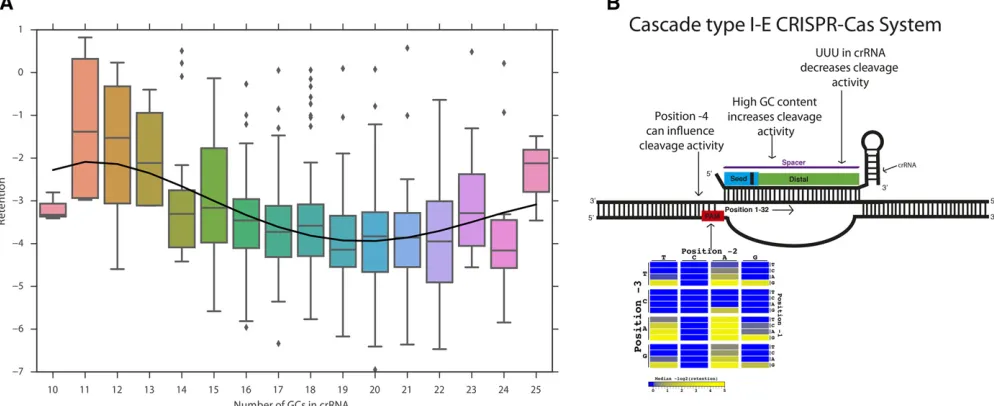
We next considered which other features of the crRNA were associated with lower retention. crRNAs with high GC con-tent tend to be more effective (Spearman correlation20.19, P-value ,5e27), as previously observed for Cas9 from a type II CRISPR-Cas system. However, extreme GC content, whether low or high, has been reported to be harmful to Cas9 efficiency (Renet al.2014; Wanget al.2014). To investigate whether extreme GC content affects the Cascade type I-E system similarly, we examined the relationship between GC content and retention for the spacers in our library (Figure 4A and Figure S8 inFile S3). We found an increase in CRISPR-interference for crRNAs with 13–20 GCs (40.6–62.5% GC content). However, crRNAs with .20 GCs (.62.5%) had
reduced CRISPR-interference, similar to the GC content threshold reported for Cas9 (Wanget al.2014). In addition, the data were fitted on cubic and quadratic models; both models show similar decrease in retention until .62.5%. Overall, the results suggest that a GC content of62.5% is optimal for crRNA activity.
Other sequence effects on crRNA efficacy
Previous studies of Cas9 have indicated that crRNAs contain-ing the homopolymeric runs GGGG or UUUU, as well as UUU near the PAM, tend to be less effective (Wuet al.2014; Wong et al. 2015). Such findings suggest potential premature crRNA transcription stoppage could cause a decrease in Cas9 efficacy. However,E. colitranscription undergoes a dis-tinct mechanism of termination where homopolyermic runs do not cause stoppage [reviewed in Washburn and Gottesman (2015)]. However, we found that a linear regression model trained to predict retention from GC content and UUU counts achieves higher training-set accuracy than a model trained on GC content alone (prediction r2 0.06 vs. 0.04, P-value,0.002, permutation test), suggesting that the pres-ence of UUU is harmful to crRNA effectiveness over and above its effect on GC content. This effect is replicated in BXHF-BL2: GC content aloner2= 0.2 while GC content with UUUr2= 0.22 withP-value,0.01. The UUU effect may also contribute to some of the ineffective crRNAs (retention.22) with strong PAMs: four of the six guides in this category contain UUU (bootstrapP-value ,0.009, bootstrap test for BXHF-BL1). A summary of thefindings in this study can be found in Figure 4B.
Validation of Cascade in vivo crRNA library assay
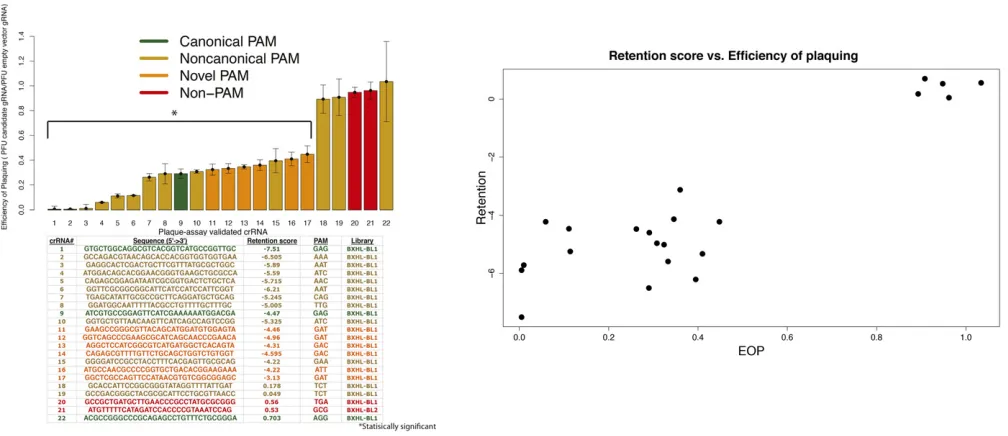
crRNA of interest to confer immunity to phage infection. For these assays, 22 crRNAs were selected from the spacer library screens and cloned into the crRNA expression vector (pPD207.846) and transformed into the ACT-01 bacterial strain lacking l-Rts prophage (Caliando and Voigt 2015). The crRNAs tested in the individual plaque assays repre-sented a range of retention scores in the original high-throughput data and corresponded to a variety of PAMs. Figure 5A shows the sequences of tested crRNAs, the median retention recorded for each in the high-throughput assays, and ability to fight off infection by phage in independent plaque assays. Immunity in the latter assays was calculated by dividing the median plaque-forming units (PFU) of the candidate crRNA expression vector by the PFU of the empty crRNA. Ratios close to 1 indicate plaque-forming efficiency/ sensitivity to phage comparable to having a nonfunctional (empty) crRNA while ratios,1 indicate resistance to plaque formation from phage infection. The 17 crRNAs with nega-tive log-retention scores are resistant to phage infection while thefive crRNAs with little or no CRISPR-interference efficacy in the high-throughput assays show little or no ability to protect the bacteria from infection (comparable to empty vector; Figure 5A). We note previously reported CRISPR immunity with silar but distinct plaque assays have shown larger effects of im-munity. For details on the differences in metrics and target type (plasmid, phage, host chromosome) seePlaque assays. Figure 5B compares retention scores for each crRNA from the high-throughput assay with the plaquing efficiency from the individ-ual infection assays (Pearson’s correlation: 0.902,P-value = 9.34e29). The plaque assays corroboratefindings of the
high-throughput Cascadein vivocrRNA assay and demonstrate that our method of assaying crRNA efficacy via chromosome auto-CRISPR-interference is strongly associated with ability to confer immunity to bacteriophage.
Discussion
We developed a high-throughput method to assay thousands of crRNAs and have applied this to theE. colitype I-E system Cascade. The method explores an extensive spectrum of crRNAs, with application of a gradient-boosting algorithm predicting retention based on the PAM, target, flanking, and seed regions. The availability of previous (lower throughput) analysis for Cascade allowed corroboration of major aspects of the model including the majority of charac-terized PAMs [both canonical and noncanonical PAMs (Westraet al.2013; Fineranet al.2014; Caliando and Voigt 2015; Leenayet al.2016)], with selective single-spacer as-says providing additional corroboration.
CRISPR-interference efficiency (40.6–62.5% GC), although GC content beyond 62.5% seems not to further enhance ef-ficiency. Finally, we were able to validate our findings by testing crRNAs via phage infection and plaque assays. The predicted efficacy of crRNAs in the Cascade spacer assay was highly consistent with the ability of the crRNA to provide immunity to phage infection.
Thein vivomethod presented in this manuscript can pro-vide critical information regarding optimal PAM usage and crRNA targeting in uncharacterized CRISPR-Cas systems, as well as providing a framework for interpreting repertoires of spacers acquired naturally or synthetically. While offering considerable value, extrapolations from spacer acquisition to spacer efficacy are complicated due to additional con-straints related to primed acquisition and preferences of the CRISPR-Cas system to acquire spacers near Chi sites (Mojica et al.2005; Yosefet al.2012; Fineranet al.2014; Levyet al. 2015; Semenovaet al.2016; Shipmanet al.2016). We expect that the capability to investigate selectivity of CRISPR-Cas systems without prior knowledge of effective spacers, and without requiring spacer acquisition, will be particularly use-ful both in understanding the basic biology of such systems and as a driver for technological advances.
Acknowledgments
We thank Allan Campbell, Alice Del Campillo-Campbell, Armin Dale Kaiser, Michael Bassik, Gavin Sherlock, Stuart Kim, Joe Davis, Massa Shoura, Stan Cohen, and colleagues in our laboratories for their help and suggestions. This work was supported by grants R01GM37706 (A.Z.F.) and T32GM00779 (B.X.H.F.), National Science Foundation Graduate Fellowship (B.X.H.F.), Natural Sciences and Engineering Research Council of Canada PGSD3-476082-2015 (M.W.), and an Alfred Sloan Foundation Fellowship (A.K.).
Author contributions: B.X.H.F. conceived and designed the study (with A.Z.F.), developed experimental methods, performed experiments, and contextualized implications for CRISPR function; M.W. carried out machine learning and statistical analyses (with A.K.). All authors contributed to data analysis and interpretation, and to the manuscript.
Literature Cited
Abudayyeh, O. O., J. S. Gootenberg, S. Konermann, J. Joung, I. M. Slaymakeret al., 2016 C2c2 is a single-component programmable RNA-guided RNA-targeting CRISPR effector. Science 353: aaf5573. Barrangou, R., C. Fremaux, H. Deveau, M. Richards, P. Boyaval
et al., 2007 CRISPR provides acquired resistance against vi-ruses in prokaryotes. Science 315: 1709–1712.
Beloglazova, N., K. Kuznedelov, R. Flick, K. A. Datsenko, G. Brown
et al., 2015 CRISPR RNA binding and DNA target recognition by purified Cascade complexes from Escherichia coli. Nucleic Acids Res. 43: 530–543.
Bhaya, D., M. Davison, and R. Barrangou, 2011 CRISPR-Cas sys-tems in bacteria and archaea: versatile small RNAs for adaptive defense and regulation. Annu. Rev. Genet. 45: 273–297.
Blattner, F. R., G. Plunkett, C. A. Bloch, N. T. Perna, V. Burland
et al., 1997 The complete genome sequence of Escherichia coli K-12. Science 277: 1453–1462.
Box, A. M., M. J. McGuffie, B. J. O’Hara, and K. D. Seed, 2015 Functional analysis of bacteriophage immunity through a type I-E CRISPR-Cas system in vibrio cholerae and its application in bacteriophage genome engineering.J. Bacteriol.198: 578–590. Brouns, S. J. J., M. M. Jore, M. Lundgren, E. R. Westra, R. J. H. Slijkhuiset al., 2008 Small CRISPR RNAs guide antiviral de-fense in prokaryotes. Science 321: 960–964.
Caliando, B. J., and C. A. Voigt, 2015 Targeted DNA degradation using a CRISPR device stably carried in the host genome. Nat. Commun. 6: 6989.
Campbell, A., and A. Del Campillo-Campbell, 1963 Mutant ofl bacteriophage producing a thermolabile endolysin. J. Bacteriol. 85: 1202–1207.
Carte, J., R. Wang, H. Li, R. M. Terns, and M. P. Terns, 2008 Cas6 is an endoribonuclease that generates guide RNAs for invader defense in prokaryotes. Genes Dev. 22: 3489–3496.
Casjens, S., 2003 Prophages and bacterial genomics: what have we learned so far? Mol. Microbiol. 49: 277–300.
Chang, Y., T. Su, Q. Qi, and Q. Liang, 2016 Easy regulation of metabolicflux in Escherichia coli using an endogenous type I-E CRISPR-Cas system. Microb. Cell Fact. 15: 195.
Datsenko, K. A., K. Pougach, A. Tikhonov, B. L. Wanner, K. Severinov
et al., 2012 Molecular memory of prior infections activates the CRISPR/Cas adaptive bacterial immunity system. Nat. Commun. 3: 945.
Deltcheva, E., K. Chylinski, C. M. Sharma, K. Gonzales, Y. Chao
et al., 2011 CRISPR RNA maturation by trans-encoded small RNA and host factor RNase III. Nature 471: 602–607.
Deveau, H., R. Barrangou, J. E. Garneau, J. Labonté, C. Fremaux
et al., 2008 Phage response to CRISPR-encoded resistance in Streptococcus thermophilus. J. Bacteriol. 190: 1390–1400. Fineran, P. C., M. J. H. Gerritzen, M. Suárez-Diez, T. Künne, J. Boekhorst
et al., 2014 Degenerate target sites mediate rapid primed CRISPR adaptation. Proc. Natl. Acad. Sci. USA 111: E1629–E1638. Grissa, I., G. Vergnaud, and C. Pourcel, 2007 The CRISPRdb
da-tabase and tools to display CRISPRs and to generate dictionaries of spacers and repeats. BMC Bioinformatics 8: 172.
Hale, C. R., P. Zhao, S. Olson, M. O. Duff, B. R. Graveleyet al., 2009 RNA-guided RNA cleavage by a CRISPR RNA-Cas pro-tein complex. Cell 139: 945–956.
Hatoum-Aslan, A., I. Maniv, and L. A. Marraffini, 2011 Mature clustered, regularly interspaced, short palindromic repeats RNA (crRNA) length is measured by a ruler mechanism an-chored at the precursor processing site. Proc. Natl. Acad. Sci. USA 108: 21218–21222.
Haurwitz, R. E., M. Jinek, B. Wiedenheft, K. Zhou, and J. A. Doudna, 2010 Sequence- and structure-specific RNA process-ing by a CRISPR endonuclease. Science 329: 1355–1358. Hayes, R. P., Y. Xiao, F. Ding, P. B. G. van Erp, K. Rajashankaret al.,
2016 Structural basis for promiscuous PAM recognition in type I-E Cascade from E. coli. Nature 530: 499–503.
Hintze, J. L., and R. D. Nelson, 1998 Violin plots: a box plot-density trace synergism. Am. Stat. 52: 181–184.
Hochstrasser, M. L., D. W. Taylor, P. Bhat, C. K. Guegler, S. H. Sternberg et al., 2014 CasA mediates Cas3-catalyzed target degradation during CRISPR RNA-guided interference. Proc. Natl. Acad. Sci. USA 111: 6618–6623.
Jagadeesh, K. A., A. M. Wenger, M. J. Berger, H. Guturu, P. D. Stenson et al., 2016 M-CAP eliminates a majority of variants of uncertain significance in clinical exomes at high sensitivity. Nat. Genet. 48: 1581–1586.
Jore, M. M., M. Lundgren, E. van Duijn, J. B. Bultema, E. R. Westra
et al., 2011 Structural basis for CRISPR RNA-guided DNA rec-ognition by Cascade. Nat. Struct. Mol. Biol. 18: 529–536. Karvelis, T., G. Gasiunas, J. Young, G. Bigelyte, A. Silanskaset al.,
2015 Rapid characterization of CRISPR-Cas9 protospacer ad-jacent motif sequence elements. Genome Biol. 16: 253. Kiro, R., D. Shitrit, and U. Qimron, 2014 Efficient engineering of a
bacteriophage genome using the type I-E CRISPR-Cas system. RNA Biol. 11: 42–44.
Leenay, R. T., K. R. Maksimchuk, R. A. Slotkowski, R. N. Agrawal, A. A. Gomaaet al., 2016 Identifying and visualizing functional PAM diversity across CRISPR-Cas systems. Mol. Cell 62: 137–147. Levy, A., M. G. Goren, I. Yosef, O. Auster, M. Manor et al., 2015 CRISPR adaptation biases explain preference for acqui-sition of foreign DNA. Nature 520: 505–510.
Luo, M. L., A. S. Mullis, R. T. Leenay, and C. L. Beisel, 2015 Repurposing endogenous type I CRISPR-Cas systems for programmable gene repression. Nucleic Acids Res. 43: 674–681. Maniv, I., W. Jiang, D. Bikard, and L. A. Marraffini, 2016 Impact
of different target sequences on type III CRISPR-Cas immunity.
J. Bacteriol.198: 941–950.
Marraffini, L. A., and E. J. Sontheimer, 2010 Selfvs.non-self dis-crimination during CRISPR RNA-directed immunity. Nature 463: 568–571.
Mojica, F. J. M., C. Diez-Villasenor, J. Garcia-Martinez, and E. Soria, 2005 Intervening sequences of regularly spaced prokaryotic repeats derive from foreign genetic elements. J. Mol. Evol. 60: 174–182.
Mojica, F. J. M., C. Díez-Villaseñor, J. García-Martínez, and C. Almendros, 2009 Short motif sequences determine the targets of the pro-karyotic CRISPR defence system. Microbiology 155: 733–740. Mulepati, S., and S. Bailey, 2013 In vitro reconstitution of an
Escherichia coli RNA-guided immune system reveals unidirec-tional, ATP-dependent degradation of DNA target. J. Biol. Chem. 288: 22184–22192.
Nam, K. H., C. Haitjema, X. Liu, F. Ding, H. Wang et al., 2012 Cas5d protein processes pre-crRNA and assembles into a cascade-like interference complex in subtype I–C/Dvulg CRISPR-Cas system. Structure 20: 1574–1584.
Pedregosa, F., G. Varoquaux, A. Gramfort, V. Michel, B. Thirion
et al., 2011 Scikit-learn: Machine learning in Python. J. Mach. Learn. Res. 12: 2825–2830.
Rath, D., L. Amlinger, M. Hoekzema, P. R. Devulapally, and M. Lundgren, 2015 Efficient programmable gene silencing by Cascade. Nucleic Acids Res. 43: 237–246.
Ren, X., Z. Yang, J. Xu, J. Sun, D. Mao et al., 2014 Enhanced specificity and efficiency of the CRISPR/Cas9 system with opti-mized sgRNA parameters in Drosophila. Cell Rep. 9: 1151–1162. Richter, C., R. L. Dy, R. E. McKenzie, B. N. J. Watson, C. Taylor
et al., 2014 Priming in the type I-F CRISPR-Cas system triggers strand-independent spacer acquisition, bi-directionally from the primed protospacer. Nucleic Acids Res. 42: 8516–8526. Semenova, E., M. M. Jore, K. A. Datsenko, A. Semenova, E. R.
Westra et al., 2011 Interference by clustered regularly inter-spaced short palindromic repeat (CRISPR) RNA is governed by a seed sequence. Proc. Natl. Acad. Sci. USA 108: 10098–10103. Semenova, E., E. Savitskaya, O. Musharova, A. Strotskaya, D.
Voront-sovaet al., 2016 Highly efficient primed spacer acquisition from targets destroyed by theEscherichia colitype I-E CRISPR-Cas in-terfering complex. Proc. Natl. Acad. Sci. USA 113: 7626–7631.
Shipman, S. L., J. Nivala, J. D. Macklis, and G. M. Church, 2016 Molecular recordings by directed CRISPR spacer acqui-sition. Science 353: aaf1175.
Shmakov, S., E. Savitskaya, E. Semenova, M. D. Logacheva, K. A. Datsenkoet al., 2014 Pervasive generation of oppositely ori-ented spacers during CRISPR adaptation. Nucleic Acids Res. 42: 5907–5916.
Shmakov, S., O. O. Abudayyeh, K. S. Makarova, Y. I. Wolf, J. S. Gootenberget al., 2015 Discovery and functional characteriza-tion of diverse class 2 CRISPR-Cas systems. Mol. Cell 60: 385– 397.
Staals, R. H. J., S. A. Jackson, A. Biswas, S. J. J. Brouns, C. M. Brown et al., 2016 Interference-driven spacer acquisition is dominant over naive and primed adaptation in a native CRISPR-Cas system. Nat. Commun. 7: 12853.
Sternberg, S. H., S. Redding, M. Jinek, E. C. Greene, and J. A. Doudna, 2014 DNA interrogation by the CRISPR RNA-guided endonuclease Cas9. Nature 507: 62–67.
Terns, M. P., and R. M. Terns, 2011 CRISPR-based adaptive im-mune systems. Curr. Opin. Microbiol. 14: 321–327.
van der Walt, S., S. C. Colbert, and G. Varoquaux, 2011 The NumPy array: a structure for efficient numerical computation. Comput. Sci. Eng. 13: 22–30.
Wang, T., J. J. Wei, D. M. Sabatini, and E. S. Lander, 2014 Genetic screens in human cells using the CRISPR-Cas9 system. Science 343: 80–84.
Washburn, R. S., and M. E. Gottesman, 2015 Regulation of tran-scription elongation and termination. Biomolecules 5: 1063– 1078.
Westra, E. R., Ü. Pul, N. Heidrich, M. M. Jore, M. Lundgrenet al., 2010 H-NS-mediated repression of CRISPR-based immunity in Escherichia coli K12 can be relieved by the transcription activa-tor LeuO. Mol. Microbiol. 77: 1380–1393.
Westra, E. R., P. B. G. van Erp, T. Künne, S. P. Wong, R. H. J. Staals
et al., 2012 CRISPR immunity relies on the consecutive bind-ing and degradation of negatively supercoiled invader DNA by Cascade and Cas3. Mol. Cell 46: 595–605.
Westra, E. R., E. Semenova, K. A. Datsenko, R. N. Jackson, B. Wiedenheftet al., 2013 Type I-E CRISPR-cas systems discrim-inate target from non-target DNA through base pairing-indepen-dent PAM recognition. PLoS Genet. 9: e1003742.
Wiedenheft, B., E. van Duijn, J. B. Bultema, J. Bultema, S. P. Waghmare
et al., 2011 RNA-guided complex from a bacterial immune system enhances target recognition through seed sequence interactions. Proc. Natl. Acad. Sci. USA 108: 10092–10097.
Wiedenheft, B., S. H. Sternberg, and J. A. Doudna, 2012 RNA-guided genetic silencing systems in bacteria and archaea. Na-ture 482: 331–338.
Wong, N., W. Liu, X. Wang, J. Doudna, E. Charpentier et al., 2015 WU-CRISPR: characteristics of functional guide RNAs for the CRISPR/Cas9 system. Genome Biol. 16: 218.
Wu, X., D. A. Scott, A. J. Kriz, A. C. Chiu, P. D. Hsu et al., 2014 Genome-wide binding of the CRISPR endonuclease Cas9 in mammalian cells. Nat. Biotechnol. 32: 670–676. Xie, K., B. Minkenberg, and Y. Yang, 2015 Boosting CRISPR/Cas9
multiplex editing capability with the endogenous tRNA-process-ing system. Proc. Natl. Acad. Sci. USA 112: 3570–3575. Yosef, I., M. G. Goren, and U. Qimron, 2012 Proteins and DNA
elements essential for the CRISPR adaptation process in Escher-ichia coli. Nucleic Acids Res. 40: 5569–5576.
![Figure 1 Cascade type I-E crRNA eftransformation of the spacer/crRNA library into a bacterial strain with an inducible Cascade CRISPR-Cas system and the target region integrated [ACT-01(Rts) strain], (4) growth assays of the bacterial library with induced](https://thumb-us.123doks.com/thumbv2/123dok_us/1518612.1186080/3.603.51.548.45.640/figure-cascade-eftransformation-bacterial-inducible-cascade-integrated-bacterial.webp)
![Figure 2 Cascade type I-E PAM recognition. (A) Percent of variance in retention ((retention)] for all possible PAMs](https://thumb-us.123doks.com/thumbv2/123dok_us/1518612.1186080/7.603.54.548.46.415/figure-cascade-recognition-percent-variance-retention-retention-possible.webp)