Collaboration of Stakeholder to Apply Value
Engineering In the World of Construction
Ardyanto
1, Chaidir Anwar Makarim
2Master student of Civil Engineering, Tarumanagara University, Jakarta, Indonesia1
Professor of Civil Engineering, Tarumanagara University, Jakarta, Indonesia2
ABSTRACT: The use of conventional approach in construction projects shows a number of drawbacks. Unsuitable
design, bad management among the team often cause conflicts, that may further result in the delay and failure of the construction project. To avoid these potential problems, this research is conducted in order to identify an approach to reduce conflicts between stakeholders, to make project team understand the purpose of the project, and to make them cooperate well throughout the project. This research involved both literature and case study. This analysis used some cases that arise from projects that do and not use collaboration in project. The data was collected from literature study and some real cases in construction projects. The result of this study showed that having collaboration, integrated with value engineering, on the design phase, made it possible for some projects to finish faster than the schedule, better management system among the stakeholders and better relationships between them, as all information is distributed openly among each party involved.
KEYWORDS: Construction, Collaboration, Value engineering, Conflicts
I. INTRODUCTION
The construction industry is an industry that continues to grow along with the economic growth of an area. This condition can be seen by the increasing number of high-rise buildings in big cities. The cause of the construction of high-rise buildings is due to the increasing level of urbanization of the community which is not balanced with the availability of land. Construction of buildings certainly requires experts in their fields. To start a project is certainly the main thing that must exist, namely the land owner. Then there are consultants who design and design buildings and also there are contractors who act as project implementers in the field. After the three parties met to discuss the design and implementation methods in the field, the consultant will design the building in accordance with the owner's wishes. When the owner approves the design submitted by the consultant, the contractor will immediately prepare in the field. When implementing on the ground carried out by contractors, researchers often find an increase in costs for a project due to the lack of good communication between the team in the field and poor management which can lead to increased project duration to the failure of construction and building functions. Therefore, a method is needed that can avoid the failure of construction or building functions. One method that can solve this problem is collaboration. Collaboration involving many parties with various interests who work together to achieve results with the ultimate goal, which is mutually satisfying and beneficial to all parties. To maximize the function of collaboration, value engineering is applied along with the collaboration process.
II. LITERATUREREVIEW
II. 1 Collaboration Concept
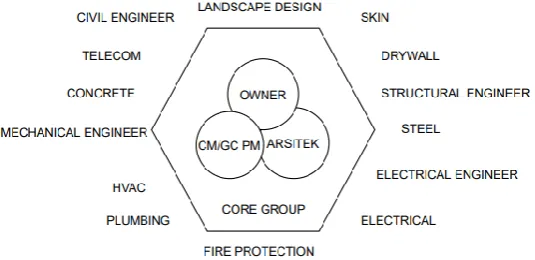
technology, and performance, with less focus on processes, dynamics, and social aspects of contracts (Nicolajsen, 2007; Shenkar and Van, 2002). Collaboration between parties, as shown in Figure II.1, is cross-organization / industry and is shown to increase capacity and generate organizational value through resource exchange, thereby supporting an organization's 'competitive advantage' (Elmarsafi, 2008). Some theorists argue value creation occurs when new situations or create new needs for the exchange of resources, including information. According to the International Partnering institute (2018), "Partnering is a collaborative process that works to develop a" culture "of partnerships between organizations and teams that must work together to achieve successful delivery of construction projects".
Figure II.1 Parties to a construction project (Lichtig, 2005)
Agreement to collaborate: before agreeing to collaborate, parties working together must adhere to the key elements of this process (Giesen, 2007):
1. Collaboration requires similarities between participants, 2. Collaboration is based on shared goals,
3. Collaboration depends on shared responsibility for participation and decision making, 4. Collaboration means shared resources,
5. Collaboration requires shared accountability for results, and 6. Collaboration relies on mutual trust.
II.2 Collaboration Process
The collaboration process begins after all participant agree to collaborate, the first and most important component of the collaborative process is creating the process itself. This involves creating a guide that serves as a framework for how collaborative parties will work together at all stages of the project. This can be done with an independent facilitator or with members from one of the parties collaborating who act as facilitators. A good way, is that in the early stages all parties determine the collaborative process from the start of the process to successful collaboration (Giesen, 2007).
II.3 Value Engineering
process of formalization and the application concept of success for results or products (Berawi et al., 2014). Based on the investigation system accompanied by training, namely a multi-disciplinary team, the values and clients needed can be increased in the following ways:
1. Eliminating or modifying elements that are not essential to function needs. 2. Adding elements that can achieve functions that are not reached.
3. Replacing elements to improve quality or performance so that the level expected by the owner (owner) can be achieved.
III. RESEARCHMETHODOLOGY
This study uses secondary data. Secondary data is data that refers to information collected from existing sources. Secondary data sources are company records and documentation, government publications, industry analysis by the media, websites, the internet and so on (Sekaran, 2011). Secondary data sources in this study come from scientific journals, dissertations, theses, theses, textbooks and project data.
This research was conducted in several stages, namely: Conducting literature studies on the topics to be studied; Collection of library research data; Analysis of library research data and case studies (Qualitative research is a type of research that is rich in data analysis to interpret existing data sources, one of which uses data reduction and then draws conclusions using logic, aesthetics and ethics. Data analyzed is then matched with studies existing project cases); Preparation of reports (In the preparation of qualitative reports must be systematic or coherent in 'telling' (describing) the data, so that continuity occurs from the first chapter to the last chapter).
IV. ANALYSISANDRESULTS
In order for value engineering to obtain the expected results, it is necessary to use collaboration techniques or methods based on the understanding that value engineering deals directly with human attitudes and behavior, as well as problems with decision making and problem solving. This technique is mainly used for engineering design work at the beginning of the project.
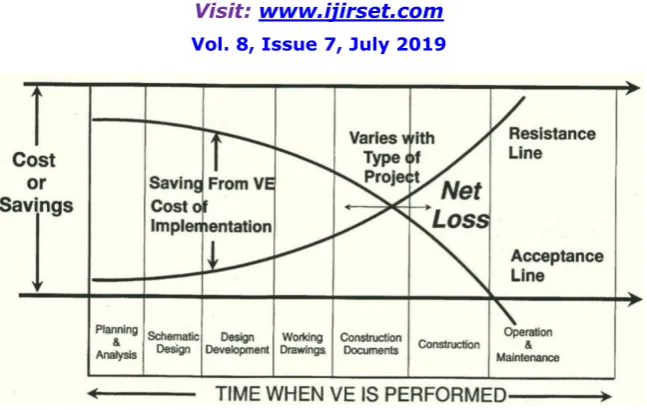
Figure IV.1 Potential savings from the application of value engineering (Training slides module - 1: Value engineering analysis and methodology)
Value engineering can be applied from the beginning of the cost concept to the auction stage. Using value engineering if it gets closer to break-even then the potential to make savings will decrease. From the picture it can be seen that the potential saving lines are getting down. With the development of the project activity process with the existing costs (cost to change) will increase. The potential for savings will continue to fall in accordance with new planning changes in project implementation.
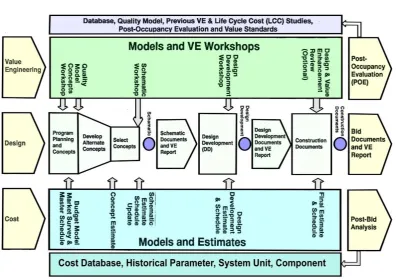
Value engineering is still possible during the construction phase. The contractor can be given the opportunity to propose solutions that offer more value to the owner, and the distribution of financial benefits realized. Obviously the project owner must consider the proposal submitted by the contractor very carefully, both from a life cycle perspective and an obligation perspective (Heralova, 2014). The team must be brought into the decision making process to approve the proposed changes so as not to have a negative impact on the overall design and function of the project. Integrated value engineering processes in the design can be seen in figure IV.2 below. In the figure, it explains the value engineering process that works in the design process and can generate cost estimates for the design that has been carried out by the consultant and value engineering team.
Figure IV.2 Application of value engineering at the design stage (Training slides module - 1: Value engineering analysis and methodology)
IV.1 Case Study
Collaboration has an important role in construction projects. Based on the data that has been collected, the collaboration is able to have a significant impact on the construction project. Below are examples of cases for collaborating projects and not collaborating as a comparison.
IV.1.1 Railroad Construction Project X
The railway line construction project is carried out through a three-party collaboration model between clients, contractors and consultants based on the concept of increasing cooperation. Contract arrangements are in accordance with the design-supply-development approach, clients have separate contracts with consulting firms and contractors. These contracts are a combination of target costs and fixed price contracts with a collection of bonuses for all project parties if they are able to complete the project under the budget. The main reason for choosing a collaborative approach in this railroad project is because of its high complexity. This is a large project with high risk and a lot of uncertainty because heavy rail traffic must be maintained on the track beside construction work. The formation of collaboration is expected to accelerate project completion time and the project team is more responsive to changes.
The team of consultants and the value engineering team collaborated to start detailed design work while waiting for the contractor to join the team. As soon as the contractor joins the team, a meeting is held with all project parties to help strengthen objectives and cooperation, methods for parallel design and construction work.
duration difference in relation to the master time plan with simpler images. Close collaboration with contractors reduces the time to review images by clients, thereby increasing efficiency in the work of the consultant team.
Collaborative work methods help create a harmonious environment because competencies and knowledge between various disciplines, both in project organizations and between technology fields of consulting companies can be shared continuously between the project parties and their individual members. Working in collaboration helps the project organization as a whole, and especially the consultant team, to develop new ways of approaching the general process and continually question how the work is done throughout the project. Furthermore, working in collaboration helps the consultant team to gain important construction knowledge, create a more holistic review of the project and prepare consulting companies for collaborative projects in the future. In this project, the consultant team was involved at an early stage with the intention of working with the contractor. When the contractor is assigned, a parallel process of design and construction work is launched, with a tight time schedule between the production of drawings and construction on the project. In this project, client organizations are smaller than consultants so that clients entrust consultants to organize and be responsible for coordinating design activities together with contractors. This makes the consultant aware of project information and influences the overall budget and contractor's commitment in the design phase so as to produce more images and documents. The project team agreed that at the initial stage when setting common goals everyone must have the same information and understanding of the process, and communication routines must be distributed to all project members. Team consultants and contractors need to review images and documents together to avoid misunderstandings, unnecessary revisions. To achieve the goal of working in collaboration, the three parties confirmed the importance of having people who support the collaborative foundations of openness, trust, and flexibility.
IV.1.2 Public Facilities Building Project Y
This public facility building construction project is in the territory of Indonesia. The contract used is a traditional contract. The project owner asked the planner to design a hospital building including a four-story basement. Communication is carried out in two directions between project owners and planners so that the building design process can be completed more quickly. After the design of the consultant planner is complete and submitted to the project owner for inspection by a team of experts. The design of the building was submitted to a team of building experts for inspection. In the shop drawing, the basement excavation plan is known that the depth of excavation is 17 meters to 20 meters in certain areas. The total basement depth is 20 meters with a total of four basement floors. After the review process by the building expert team is completed and it is stated that the design meets all existing criteria, then the building design document is ready to be worked on. The project owner holds a tender to select the right contractor or executor according to the classification of the project owner.
Contractor X who was selected as the executor of the hospital project started the project implementation in the field, supervised by the owner and at the same time as the Court. The initial process was carried out by the soldier pile as a wall supporting the construction of the land. After the age of the pole is strong enough, the first stage of excavation is done as deep as five meters in stages. Do not forget to also do dewatering so that water does not disturb the excavation process. When the excavation reaches a depth of five meters, the sub-contracting team prepares to install the first phase temporary ground anchor. The excavation process, dewatering and installation of ground anchors continue until the excavation reaches a depth of 20 meters and has three anchor ground layers.
The sub-contractor installed an inclinometer to check the slope of the pole and it turns out that the pole has a slope as far as 500 mm at the mast head. The contractor then reports the matter to the main contractor. Shortly after the sub-contractor reported the incident to the sub-contractor, the ground anchor strand at some point was released. The sub-contractor then asked the sub-contractor to do a re-stressing at the point that was detached from the strand and install a waller beam to support the retaining wall so that it did not collapse. Based on the correspondence between the contractor and the sub-contractor, it was found that when drilling layer one, the ground water flowed heavily and over time, there was an indication that the soil experienced strength degradation in the clay layer due to exposure to water or air.
the anchor, there is an indication that the ground anchor bears a heavier load than the design load so that the soldier pile and ground anchor are not able to withstand this force. Please note that temporary ground anchor is a reinforcement system for retaining walls that generally only lasts for approximately two years. In clay, tensile strength (to hold the soil) on ground anchor while experiencing weakening is called "creep". According to SNI 8640 in 2017 the recommended wall is secant pile if the basement is four floors or more and the diaphragm wall for basement is five floors or more.
Planners are less aware of the existing SNI rules so that they consider the design of the retaining walls that they have made strong enough to withstand the soil load. During the inspection process by a team of building experts, the expert team only reviewed the design in terms of structure and did not involve experts from other disciplines. The owner and the Court only accept and know the design without reviewing the design submitted by the planner. As a result the project suffered a very high loss due to the lack of awareness of the stakeholders involved.
IV.3.3 Discussion of Case Studies
From the case of the success of the collaboration described in the first project, a collaboration manager is able to coordinate, facilitate and control the work of all parties. The consultant team worked together with the value engineering team in conducting design planning. After completing the design planning process, the collaboration manager brings together all parties to discuss the finished design and asks the parties to provide criticism and suggestions to improve the completed design. Collaboration on project X results in a shorter duration of work time than the master plan time. Collaboration also helps create a harmonious environment because competencies and knowledge between various disciplines are shared equally with the project team. Working collaboratively helps the project organization as a whole, especially planning from the consultant and the value engineering team. Every individual's awareness to complete the project properly helps each process to be more smooth. The results of stakeholder collaboration, namely the approach between consultants and the project parties resulted in a new approach to established work methods, better time efficiency, and more production of higher quality images.
In the case of building projects for public facilities X shows that communication occurs only for certain teams. Collaboration did not occur in this project so that the transparency and clarity of information on this project was so lacking that it resulted in a decrease in the productivity of project work in the field. Lack of stakeholder awareness of design and implementation in the field resulted in construction failures which led to more out-of-plan expenses. Planners pay little attention to the latest rules and do not involve experts from other disciplines including value engineering to assist in the planning process. The decrease in water level caused the ground anchor to be attracted so that it carried more burden than the design plan. Should the strand on ground anchor be released, it should immediately take action to prevent the collapse of the retaining wall.
If at the beginning of the project team implementing collaboration on this project, the risk for the collapse of the retaining wall can be minimized. Planners involve the role of the value engineering team to evaluate whether the design choices of the planner are sufficient while discussing with project owners and contractors about the design and risks of the project life cycle.
V. CONCLUSION
Based on the analysis that has been done, there are some conclusions as follows:
1. Collaboration is an organized method from various scientific disciplines that form a good organizational system for the parties involved.
2. The selection of collaboration models is better than traditional organizational models because with the collaboration model, all information is more open and can be well distributed to project members so as to minimize conflicts on construction projects. By applying value engineering at the beginning of the design process to collaboration, reducing the cost of design changes.
attention to aspects of openness and has poor communication with the parties involved in the project, resulting in many problems as told in the case study of Y public facilities
REFERENCES
[1] Berawi, M.A., Susanto, B., Miraj, P., Berawi, A. R. B., Rahman, H. Z., Gunawan, Husin, A. (2014). Enhancing Value for Money of Mega Infrastructure Projects Development Using Value Engineering Method. Elsevier Procedia Technology, 16, 1037-1046.
[2] Chua, David K. H. (2003). Value improvement methods. National university of Singapore.
[3] Elmarsafi, G. M. (2008). Interorganizational Collaboration: Transformation Strategies to Reduce Construction Disputies in The Construction Industry. West Coast of U.S.A.: Capella University.
[4] Giesen, G. (2007). Creating Collaboration: A Process That’s Works. Retrived from Creating Co© Copyright 2007:
http://www.unce.unr.edu/publications/files/nr/other/FS9984.pdf
[5] Gray, Barbara. (1989). Collaborating: Finding Common Ground for Multiparty Problems. San Francisco: Jossey-Bass.
[6] Heralova, R. S. (2014). Life Cycle Cost optimization within decision making on alternative designs of public buildings. Procedia Engineering. vol. 2014, no. 85, 454-463
[7] IPI. (2018). Whats is constructions partnering. International Partnering Institute, https://partneringinstitute.org/about/what-is-construction-partnering/
[8] Irawana, Nita. (2012). Studi integrase manajemen resiko dan value engineering pada laporan hazop proyek pengolahan gas di pulau Gading. Depok: Universitas Indonesia
[9] Kelly, J. dan Male, S. (2004). Value Management in Design and Construction – The Economic Management of Projects. London: E & FN Spon.
[10] Lichtig. (2005). Sutter health: Developing contracting model to support lean project delivery. Lean Construction Journal 2, 26 (3). [11] Makarim, Chaidir Anwar. (2006). “Training slides module – 1: Value engineering analysis and methodology”. Protech value, Jakarta [12] Nicolajsen. (2007). ICT use in inter-organizational collaboration: the field of construction. Proceedings of the 30th Information System
Research Seminar. Scandinavia: IRIS.
[13] Rachwan, R., Abotaleb, I., and Elgazouli, M. (2016). The Influence of Value Engineering and Sustainability Considerations on the Project Value. Elsevier Procedia Engineering, 34, 431-438.
[14] Sekaran, Uma. (2011). Research Methods for Business Edisi 1 dan 2. Jakarta: Salemba Empat.
[15] Shenkar, O., & Van, A. (2002). Failure as a consequence of partner politics: Learning from the life and death of an international cooperative venture. Human Relations 55(5).