CloudNet Security: Cloud Assets by
WAN using Reallocation of Virtual
Machine
Nanda M
1, Prasanna Kumar M
2P.G. Student, Department of Computer Engineering, East West Institute of Technology, Bangalore, India1
Associate Professor, Department of Computer Engineering, East West Institute of Technology, Bangalore, India2
ABSTRACT: Virtualization innovation and the simplicity with wh ich virtual mach ines (VMs) can be moved inside of theLAN have changed the extent of asset administration fro m assigning assets on a solitary server to controlling pools of assets inside of a server farm. We expect WAN movement of virtual machines to in like manner change the extent of provisioning assets from a solitary server farm to various server farms spread the nation over or around the globe. In this paper, we introduce the CloudNet security engineering co mprising of distributed co mputing stages connected with a virtual private system (VPN) - based system foundation to give consistent and secure network in the middle of b ig business and cloud server farm destinations. To understand our vision of effectively pooling topographically appropriated server farm assets, CloudNet gives enhanced backing to live W AN movement of v irtual machines. In particular, we display an arrangement of advancements that min imize the expense of exchanging stockpiling and virtual mach ine memo ry amid movements over low transmission capacity and high -dormancy Internet joins. We assess our framework on an operational cloud stage circulated over the cloud and client framework.
KEYWORDS: Cloud computing, virtualization, Cloud network, wide area network (WAN) migration.
I. INTRO DUCTIO N
Today's endeavors run their server applications in info rmation focuses, which furnish them with co mputational and capacity assets. Distributed computing stages, both open and private, give another street to both little and vast ventures to have their applications by leasing assets on interest and paying taking into account real use. In this way, an ord inary venture's IT ad min istrations will be spread over the co mpany's server farms and additionally progressively apportioned assets in cloud server farms.
connected resource pools that permit flexible placement and live migrat ion of applicat ions and their data across sites.
CloudNet makes the following Contributions:1)The design and implementation of a cloud co mputing platform that seamlessly connects resources at multip le data center and enterprise sites.2)A centralized v irtual private network (VPN) Controller architecture that automates reconfiguration of VPN endpoints; 3)A holistic v iew of WAN VM migrat ion that handles persistent storage, network connections, and memory state with min ima l downtime; 4)Optimizat ions that minimize total migration time, application downtime, and volume of data transferred. 5) A coordination system that synchronizes the migration of multitier applications.
We have implemented a prototype of CloudNet security using the cloud and a VPN imp lementation. We perform an extensive evaluation using cloud and local system. Our results show CloudNet’s optimizations decreasing memo ry migrat ion and pause time, CloudNet saves bandwidth. We also evaluate applicat ion performance during migrations to show that CloudNet optimizations reduce the window of decreased performance compared to existing techniques.
II. RELATED WO RK
CloudNet security provides a networking infrastructure for linking data centers to clouds and an optimized form of live VM migration. These two features are valuable for a variety of situations such as cloud bursting, enterprise IT consolidation, and “follow-the-sun” workloads. We have previously presented our vision for these use cases [1]; in this paper, we focus on the infrastructure required to meet these goals.
Fig. 1. Low-bandwidth links can significantly increase the downtime experienced during migration.
Fig.1 shows the downtime of VMs running several different applications, as the available bandwidth is varied (assumes shared storage and a constant 10-ms round-trip latency). This nearly 200 increase is unacceptable for most applications and illustrates the importance of optimizing VM migrat ion algorithms to better handle low-bandwidth connections. CloudNet security coordinates the hypervisor’s memory mig ration with a disk rep licat ion system so that the entire VM state can be transferred if needed. Current LA N-based live migration techniques must be optimized for WAN environments, and cloud computing network infrastructure must be enhanced to support dynamic relocation of resources between cloud and enterprise sites; these challenges are the primary focus of this paper.
configuration. CloudNet exp licit ly recognizes the need to set up new VPN endpoints quickly and explo its the capability of BGP route servers [6] to achieve this.
Fig. 2. VPN Controller remaps the route targets (A, B, C) advertised by each cloud datacentre to match the proper enterprise VPN (E1 or E2). To migrate VM1 to Cloud Site 2, the VPN controller redefines E1’s VPN to include route target A and C, then performs the disk an d memory migration.
Fig. 2 illustrates an example where is to be migrated fro m enterprise site E1 to Cloud Site 2. The VPN Controller must extend E1’s VPLS to include route targets and, while Enterprise 2’s VPLS only includes route target. Once the change is made by the VPN Controller, it is propagated to the other endpoints via BGP. This ensures that each customer’s resources are isolated within their own private network, providing CloudNet’s virtual cloud pool abstraction.
III. IMPLEMENTATIO N
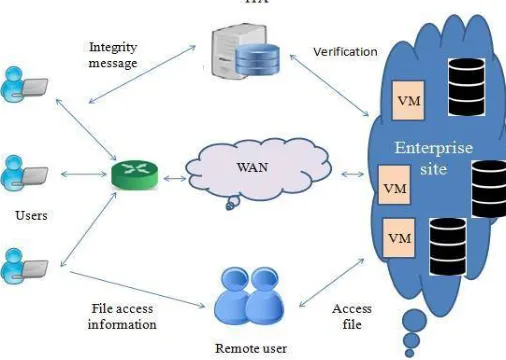
Enterprise site or cloud server is a service provider it stores the user data. Cloud server got data fro m the client site where it ho lds data in cloud. Cloud site o r user upload data to cloud through the WAN where it sent the data to store it in cloud. Our imp lementation only supports removing memory redundancy during migrat ions. TPA will be in itiated to verify over the cloud server wo rk by taking the message or data from the cloud server. By co ns idering mess age fro m clo u d it co mp ared alo ng wit h mess ag e th at th e d at a o wn er co mp ut e it in h is part . After finishing the verification, the TPA will inform the user if the CS was trusted or not. After up load ing file to the cloud by the data owner, Now receiver wants the data fro m the cloud then he needs to log in by entering access in fo rmat ion to cloud. Access informat ion contains file name and security key . If he/she kno ws the correct in format ion then on ly he can access the data from cloud otherwise user will be blocked by the cloud server.
IV. EXPERIMENTAL RESULTS
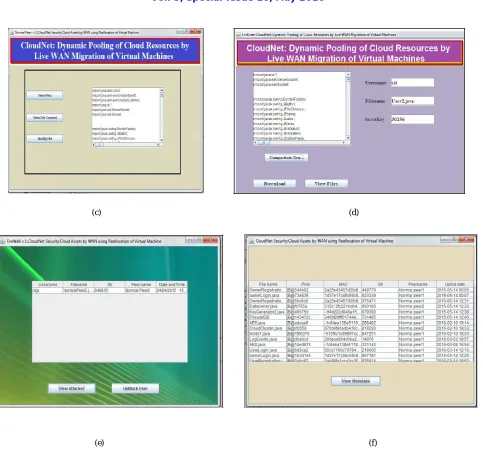
Figures shows (a) The cloud cluster consists of fire walls and peers . The cloud server is responsible for data storage and file authorizat ion for an end user. (b) Data owner uploads their data file into the cloud server and the cloud server will connect to fire wall, the data file is stored in a normal peer and the backup file will be stored in Bootstrap peer. (c) The normal peer software consists of five co mponents: schema mapping, data loader, data indexer, access control, and query executor. The data file will stored in normal peer with their tags such as file name, secret ke y, d igital sign, and owner name. (d)The data consumer is nothing but the end user who will request and gets file contents response from the corresponding cloud servers and fire walls. End user should register before downloading any files fro m the cloud server. After registration he should login. If the file name and secret key is correct then the end user is getting the file response from the cloud or else he will be considered as an attacker and also he will be b locked in corresponding cloud and fire wall. If he wants to access the file after blocking he wants to UN block fro m the cloud. (e) If user is entered a wrong secrete key, then considered as an attacker. Attacker is one who is integrating the cloud file by adding malicious data to the corresponding cloud. (f) The bootstrap peer is the entry point of the whole network.
It has several responsibilities. First, the bootstrap peer serves for various administration purposes; including monitoring and managing normal peers and also scheduling various network management events. Second, the bootstrap peer acts as a central repository for metadata of corporate network applications, including shared global schema, part icipant normal peer list, and role definitions .
(c) (d)
(e) (f)
Fig. 4. Cloud Net Security at file Transfer in Cloud (a) CloudNet Security project architecture (b) Integrity check mechanism by T PA (c) Data Migration in cloud (d) Registered consumer’s activity (e) Attacker detection at firewall (f) Metadata information at Bootstrap peer
V. CO NCLUSIO N
REFERENCES
[1] T. Wood, K. K. Ramakrishnan, P. Shenoy, and J. Van der Merwe, “Enterprise-ready virtual cloud pools: Vision, opportunities, and
challenges,” Oxford Comput. J., vol. 55, no. 8, pp. 995–1004, Jun. 2012.
[2] A. Anand, V. Sekar, and A. Akella, “SmartRE: An architecture for coordinated network-wide redundancy elimination,” Comput .
Commun. Rev., vol. 39, no. 4, pp. 87–98, 2009.
[3] S. Barker, T.Wood, P. Shenoy, and R. Sitaraman, “An empirical study of memory sharing in virtual machines,” in Proc. USENIX Annu. Tech. Conf., Jun. 2012, p . 25.
[4] R. Bradford, E. Kotsovinos, A. Feldmann, and H. Schiöberg, “Live wide-area migration of virtual machines including local persistent.
[5] M. Hajjat et al., “Cloudward bound: Planning for beneficial migration of enterprise applications to the cloud,” in Proc. SIGCOMM,
2010, pp. 243–254.
[6] J. Van der Merwe et al., “Dynamic connectivity management with an intelligent route service control point,” in Proc. SIGCOMM
Workshop Internet Netw. Manage., 2006, pp. 29–34.
[7] C. Clark et al., “Live migration of virtual machines,” in Proc. NSDI, May 2005, pp. 273–286
[8] Cisco, San Jose, CA, USA, “Virtual machine mobility with VMware VMotion and Cisco data center interconnect technologies,” Sep. 2009
[9] T. Wood, A. Gerber, K. Ramakrishnan, J. Van der Merwe, and P. Shenoy, “The case for enterprise ready virtual private clouds,” in
Proc. USENIX Hot Cloud, San Diego, CA, USA, Jun. 2009, Art. no. 4.
[10] T. Wood, K. K. Ramakrishnan, P. Shenoy, and J. Van der Merwe, “CloudNet: Dynamic pooling of cloud resources by live WAN
migration of virtual machines,” in Proc. VEE, Mar. 2011, p. 121132
[11] B. Aggarwal et al., “EndRE: An end-system redundancy elimination service for enterprises,” in Proc. NSDI, 2010, p. 28.
[12] H. Liu, H. Jin, C.-Z. Xu, and X. Liao, “Performance and energy modeling for live migration of virtual machines,” Cluster
Comput., vol.16, no. 2, pp. 249–264, Jun. 2013.
[13] A. I. Sundararaj and P. A. Dinda, “Towards virtual networks for virtual machine grid computing,” in Proc. 3rd VM, 2004, p. 14.
[14] A. Murphy, “Enabling long distance live migration with F5 an VMware vMotion,” Tech. rep., f5 Tech. Brief, 2011.
[15] R. N. Mysore et al., “PortLand: A scalable fault -tolerant layer 2 data center network fabric,” in Proc. ACM SIGCOMM, New
York, NY, USA, 2009, pp. 39–50.
[16] M. Nelson, B.-H. Lim, and G. Hutchins, “Fast transparent migration for virtual machines,” in Proc. USENIX ATEC, 2005, p. 25.
[17] P. Riteau, C. Morin, and T . Priol, “Shrinker: Improving live migration of virtual clusters over WANs with distributed data
deduplication and content-based addressing,” in Proc. 17th Euro-Par, 2011, vol. Part I, pp. 431–442.
[18] P. Ruth, J. Rhee, D. Xu, R. Kennell, and S. Goasguen, “Autonomic live adaptation of virtual computational environments in a