| INVESTIGATION
Editing of Mitochondrial Transcripts
nad3
and
cox2
by
Dek10 Is Essential for Mitochondrial Function and
Maize Plant Development
Weiwei Qi,*,1Zhongrui Tian,*,1Lei Lu,*,1Xiuzu Chen,* Xinze Chen,* Wei Zhang,* and Rentao Song*,†,2
*Shanghai Key Laboratory of Bio-Energy Crops, School of Life Sciences, Shanghai University, 200444, China and†National Maize Improvement Center of China, China Agricultural University, Beijing 100193, China
ABSTRACTRespiration, the core of mitochondrial metabolism, depends on the function offive respiratory complexes. Many respiratory chain-related proteins are encoded by the mitochondrial genome and their RNAs undergo post-transcriptional modifications by nuclear genome-expressed factors, including pentatricopeptide repeat (PPR) proteins. Maizedefective kernel 10
(dek10) is a classic mutant with small kernels and delayed development. Through positional cloning, we found thatDek10encodes an E-subgroup PPR protein localized in mitochondria. Sequencing analysis indicated that Dek10 is responsible for the C-to-U editing at
nad3-61, nad3-62, and cox2-550 sites, which are specific editing sites in monocots. The defects of these editing sites result in significant reduction of Nad3 and the loss of Cox2. Interestingly, the assembly of complex I was not reduced, but its NADH de-hydrogenase activity was greatly decreased. The assembly of complex IV was significantly reduced. Transcriptome and transmission electron microscopy (TEM) analysis revealed that proper editing ofnad3andcox2is critical for mitochondrial functions, biogenesis, and morphology. These results indicate that the E-subgroup PPR protein Dek10 is responsible for multiple editing sites innad3andcox2, which are essential for mitochondrial functions and plant development in maize.
KEYWORDSZea mays;dek10; pentatricopeptide repeat protein; mitochondrion; RNA editing; seed development
M
ITOCHONDRIA are the center of cellular energy ho-meostasis and redox regulation, and integrate numer-ous metabolic pathways (Sweetloveet al.2007). Respiration is the core of mitochondrial metabolism for free energy re-lease and ATP production. During respiration, electrons from NADPH and reduced flavin adenine dinucleotide (FADH2) are transferred to O2 via the electron transport chain (ETC), generating ATP and oxidized NADP1 and FAD1 (Siedow and Day 2000). The ETC is composed offive respi-ratory complexes. Depending on the substrate, electrons are transported from complex I (NADH dehydrogenase) and complex II (succinate dehydrogenase) through ubiquinone and complex III [cytochrome c (Cyt-c) reductase] to Cyt-cand to complex IV [Cyt-c oxidase (Cox)], which produces water, while ATP is generated by complex V (ATP synthase) (Dudkinaet al.2006). In plants, respiratory metabolism can also be fulfilled by alternative glycolytic, phosphorylating, and electron transport pathways. When there is an electron transport defect in the Cyt-c pathway, alternative oxidases (AOXs) are activated to maintain the tricarboxylic acid cycle and electron transport, even in the absence of oxidative phos-phorylation (Vanlerberghe and Ordog 2002).
Though the majority (98%) of mitochondrial proteins are nuclear-encoded, the mitochondrial genome retains some genes encoding proteins involved in the respiratory chain. The primary mitochondrial genome-expressed pre-RNAs could be post-transcriptionally processed (Knoop 2013; Hammani and Giege 2014). These processes are mostly regulated by nuclear genome-expressed factors, including pentatricopeptide repeat (PPR) proteins, which are reported to play a critical role (Barkan and Small 2014). The PPR RNA-binding proteins are defined by the tandem repeats of a degenerate 35-aa motif. PPR proteins are classified into two major subgroups: the P-type PPR members only harbor tandem repeats of the canon-ical 35-aa PPR motif, while and the PLS-type PPR members are Copyright © 2017 by the Genetics Society of America
doi:https://doi.org/10.1534/genetics.116.199331
Manuscript received December 18, 2016; accepted for publication February 2, 2017; published Early Online February 17, 2017.
Supplemental material is available online atwww.genetics.org/lookup/suppl/doi:10. 1534/genetics.116.199331/-/DC1.
1These authors contributed equally to this work.
composed of sequential repeats of P, short (S), and long (L) PPR motifs and often carry an E or E–DYW C-terminal domain extension (Lurin et al. 2004). The PPR family comprises .450 members in plants, and acts specifically in mitochondria or plastids for RNA editing, cleavage, splic-ing, and stability, as well as translational initiation and reg-ulation (Schmitz-Linneweber and Small 2008; Fujii and Small 2011; S. Liu et al.2013; Barkan and Small 2014). To date, the PPR proteins identified to be involved in mito-chondrial or plastid RNA editing mostly belong to the E and DYW subgroups (Lurin et al. 2004). However, the P-subgroup protein PPR596 was also reported to be in-volved in editing efficiency (Doniwaet al.2010; Takenaka 2010). A number of severe growth and developmental de-fects associated with loss-of-function PPR mutants have been previously described (Fujii and Small 2011; Sosso
et al.2012; Y. Liuet al.2013; Colas des Francs-Small and Small 2014; Hammani and Giege 2014; Liet al.2014; Sun
et al.2015; Haïliet al.2016). However, the molecular roles and regulatory functions are still unknown for a great num-ber of PPR proteins.
Maize (Zea mays) is highly suitable for genetics research, partly because of its numerous easily observable pheno-types (Neuffer and Sheridan 1980). Defective kernel (dek) mutants are a major class of maize kernel mutants that are good resource with which to investigate seed development (Neuffer and Sheridan 1980).Dek1encodes a calpain fam-ily protein affecting embryo and endosperm aleurone layer development (Becraft et al. 2002; Lid et al. 2002). Dek* encodes ribosome biogenesis factor Rea1, and dek* as a weak mutant allele partly represses the maturation and ex-port of the 60S ribosomal subunit. Taking advantage of this mutant allele, comprehensive cellular responses to im-paired 60S ribosomal subunit biogenesis were revealed (Qiet al.2016a). dek mutants offer opportunities to inves-tigate many basic biological processes during kernel development.
In this study, we characterizeddek10, a dek mutant with small kernels and delayed development. We report the map-based cloning of Dek10 and demonstrate that it encodes an E-subgroup PPR in maize. We present evidence that Dek10 is specifically involved in the C-to-U editing atnad3 -61,nad3-62, andcox2-550. Defects in this editing reduces the functions of complex I and complex IV in the ETC. Conse-quently, it arrests mitochondrial oxidative phosphorylation, and embryo, endosperm, and seedling development.
Materials and Methods
Plant materials
The maizedek10-N1176Astock was obtained from the Maize Genetics Cooperation stock center. The mutant was crossed into a W22 genetic background to produce the F2 popula-tions. Kernels of the F2 ears exhibited a 3:1 segregation of wild-type kernels (dek10/+ or +/+) and homozygous
mu-tant kernels (dek10/dek10), which were used for analysis. The root, stem, third leaf, tassel, and ear tissues were col-lected from at least three W22 plants at the V12 stage. All the plants were cultivated in afield at the Shanghai University campus, in Shanghai, China.
Measurement of protein and starch
For the protein measurements, the endosperm ofdek10and wild-type mature kernels was separated from the embryo and pericarp by dissection after soaking the kernels in water. The samples were dried to constant weights, pulverized with a mortar and pestle in liquid N2, and then measured according to a previously described protocol (Wanget al.2011). All the measurements were replicated at least three times.
For the starch measurements,five mature kernels of the wild type anddek10were ground in liquid N2. The resulting powders were dried to a constant weight. Finally, the total starch was measured by using an amyloglucosidase/a-amylase starch assay kit (Megazyme). The protocol follows the method by Wanget al.(2014). All the measurements were replicated at least three times.
Scanning electron microscopy and transmission electron microscopy (TEM)
For scanning electron microscopy,dek10and wild-type ker-nels were prepared according to Lending and Larkins (1992): mature maize kernels were rifted with a razor at the periph-eral region and placed in 2.5% glutaraldehyde. Samples were critically dried and spray-coated with gold. Gold-coated sam-ples were then observed with a scanning electron microscope (S3400N; Hitachi).
For TEM, immaturedek10and wild-type kernels were pre-pared according to Lending and Larkins (1992), with some modifications: 18 days after pollination (DAP) kernels of
dek10 and wild type were fixed in paraformaldehyde and postfixed in osmium tetraoxide. After being dehydrated in an ethanol gradient, samples were then transferred to a pro-pylene oxide solution before being gradually embedded in acrylic resin (London Resin Company). Sections (70 nm) of samples were made with a diamond knife microtome (Reichert Ultracut E). Sample sections were stained with ura-nyl acetate and poststained with lead citrate. Sample sections were observed with a Hitachi H7600 transmission electron microscope.
Map-based cloning
A population of 947 homozygous mutant kernels from F2 ears was used for gene mapping. Molecular markers that are distributed throughout maize (Z. mays) chromosome 4 were used for preliminary mapping. Molecular markers for fine mapping (Supplemental Material, Table S2 inFile S1) were developed to localize thedek10locus to a 225-kb region. The corresponding DNA fragments were amplified from dek10
The construction of transgene vectors and the transformation
For functional complementation, a 1416-bp coding sequence ofDek10was cloned into the pHB vector betweenBamHI and
SalI restriction sites. A 2-kb upstream promoter sequence of
Dek10 was cloned into the pHB vector between EcoRI and
BamHI restriction sites replacing the CaMV 35S promoter. For clustered regularly interspaced short palindromic repeats (CRISPR)/Cas9 gene knockout transformation, designed transfer RNA–guide RNA (tRNA–gRNA) units for multiplex CRISPR/Cas9 editing were synthesized by Generey (Generey. com) and cloned into thePsiI andXbaI sites between maize theU6promoter andU6terminator (Qiet al.2016b).
The construct was transferred into Agrobacterium tumefa-ciens (EHA105). Agrobacterium-mediated maize transforma-tion was carried out according to known protocols (Frame
et al. 2002). Seventeen independent transgenic lines were generated for functional complementation. Fourteen inde-pendent transgenic lines were generated for CRISPR/Cas9 gene knockout transformation. Target regions were amplified with specific primers (Table S2 inFile S1) using KOD DNA polymerase (Toyobo). Selected PCR products were cloned into the pGEM-T Easy vector (Promega, Madison, WI) for DNA sequencing.
RNA extraction and RT-PCR analysis
Total RNA was extracted with TRIzol reagent (Tiangen) and DNA was removed by treatment with RNase-free DNase I (Takara). Using ReverTra Ace reverse transcriptase (Toyobo), RNA was reverse transcribed to complementary DNA (cDNA). Quantitative real-time PCR (qRT-PCR) was performed with SYBR Green Real-Time PCR Master Mix (Toyobo) using a Mastercycler ep realplex 2 (Eppendorf) according to the standard protocol. Specific primers were designed (Table S2 in File S1) and the experiments were performed with two independent RNA sample sets, with ubiquitin as the ref-erence gene. Afinal volume of 20ml contained 1-ml reverse transcribed cDNA (1–100 ng), 10 ml 23 SYBR Green PCR buffer, and 1.8 ml 10 mM/L forward and reverse primers for each sample. Relative quantifiable differences in gene expression were analyzed as described previously (Livak and Schmittgen 2001).
Subcellular localization of Dek10
The full-length Dek10 ORF without the stop codon was cloned into pB7YWG. The recombinant plasmid DNA was extracted (1mg total amount) and introduced into onion epidermal cells and tobacco leaf epidermal cells through transient transformation using Bio-Rad PDS-1000/HeTM biolistic particle delivery system (Bio-Rad, Hercules, CA). Thefluorescence signals were detected using LSM710 (Occult International).
Isolation of mitochondria
The isolation of mitochondria was performed as described previously (de Longevialleet al.2008). About 10 g immature
seeds at 18 DAP were harvested and grounded with a mortar and pestle in liquid N2, adding 20 ml extraction buffer (100 mM tricine, 300 mM sucrose, 10 mM KCl, 1 mM MgCl2, 1 mM EDTA-K, 0.1% BSA, and 5 mM DTT, pH 7.4) and 60ml plant protease inhibitor cocktail (Sigma [Sigma Chemical], St. Louis, MO). The samples were twice centrifuged at 2600 3 gfor 15 min, after filtration through a Miracloth membrane (Calbiochem, San Diego, CA; La Jolla, CA), retain-ing the supernatant, and then were centrifuged at 12,0003g
for 25 min to pellet crude mitochondria. The pellet was resus-pended in wash buffer (100 mM tricine, 300 mM sucrose, 10 mM KCl, 1 mM MgCl2, 1 mM EDTA-K, and 0.1% BSA, pH 7.4) and were loaded on sucrose density gradients of 1.5, 2.5, 2.5, 2, and 2 ml containing, respectively, 1.8, 1.45, 1.2, 0.9, and 0.6 M of sucrose diluted in wash buffer. After 90 min of centrifugation at 24,000 rpm at 4°, mitochondria were collected from the 1.2 M/1.45 M interface and diluted four times in wash buffer. The enriched mitochondria were collected after 20 min of centrifugation at 12,000 rpm at 4°. Polyclonal antibodies
For anti-Dek10 antibody production, the full-length cDNA sequence ofDek10was inserted into pGEX-4T-1 (Amersham) at the EcoRI- and BamHI-digested sites. The GST-tagged Dek10 fusion protein was purified and antibodies were pro-duced in rabbits according to the standard protocols of Shanghai ImmunoGen Biological Technology.
For production of polyclonal antibody against NAD7, the first 21 aa were synthesized. Peptide synthesis, protein puri-fication, and production of antibodies in rabbits were accord-ing to standard protocols of Shanghai ImmunoGen Biological Technology.
Immunoblot analysis
Proteins extracted from developing wild-type anddek10
kernels were separated by SDS-PAGE. Separated protein samples were then transferred to a nitrocellulose membrane (0.45 mm; Millipore, Bedford, MA). The membrane with protein sample attached was incubated with primary and secondary antibodies. Using the Super Signal West Pico chemiluminescent substrate kit (Pierce Chemical, Rockford, IL), the signal was visualized according to the manufacturer’s instructions. The antibody against Dek10 was used at 1:1000, the antibody against Nad3 (Agrisera) was used at 1:1000, the antibody against Cox2 (Agrisera) was used at 1:1000, the antibody against NAD7 was used at 1:500, the antibody against Cyt-c (Agrisera) was used at 1:5000, and the anti-body against Tubulin (Sigma) was used at 1:5000.
Blue native (BN)-PAGE and complex I activity assay
buffer before BN-PAGE. The concentration of the separation gel was from 4 to 13%. Electrophoresis wasfirst run at 50 V, adding 25 V every 20 min to afinal 150 V until the loading dye migrated to the edge of the gel. The gel was stained by coomassie brilliant blue (Zhanget al.2015). In-gel complex I activity assay was performed according to a previous report (Meyeret al.2009).
RNA sequencing (RNA-seq) analysis
Total RNA (10 mg) was extracted from the endosperms of
dek10and wild-type kernels harvested at 18 DAP, and three
dek10or wild-type biological samples were pooled together. The poly(A)-selected RNA-seq library was prepared accord-ing to Illumina standard instruction (TruSeq Stranded RNA LT Guide). Library DNA was checked for concentration and size distribution in an Agilent2100 bioanalyzer before se-quencing with an Illummina HiSequation 2500 system accord-ing to the manufacturer’s instructions (HiSequation 2500 User Guide). Paired-end reads were aligned to the maize B73 ge-nome buildZ. maysAGPv2.15 using TopHat 2.0.6 (Langmead
et al.2009). Data were normalized as fragments per kilobase of exon per million fragments mapped (FPKM), since the sen-sitivity of RNA-seq depends on the transcript length. Signifi -cant differentially expressed genes (DEGs) were identified as those with a fold change andP-value of differential expression above the threshold (fold change.2.0,P,0.05).
Data availability
RNA-seq data are available from the National Center for Biotechnology Information Gene Expression Omnibus (www.ncbi.nlm.nih.gov/geo) under the series entry GSE80091. Sequence data from this article can be found in the GenBank/ EMBL data libraries under the following accession numbers:
Dek10, NM_001329449, NP_001316378; nad3, X14709, YP_740388; andcox2, AY973492, YP_740408.
Results
dek10 produces small kernels with delayed development
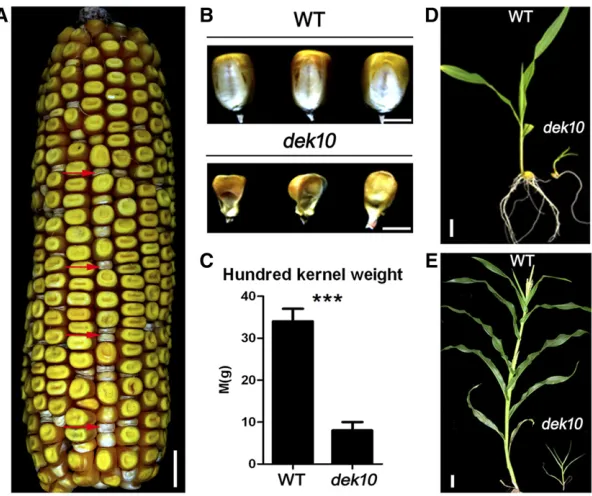
The dek10-ref (dek10-N1176A) mutant was obtained from the Maize Genetics Cooperation stock center. It was crossed to the W22 inbred line to produce a F2 population that dis-played a 1:3 segregation of dek (dek10/dek10) and wild-type (+/+ and dek10/+) phenotypes (81:251,P-value,0.05; Figure 1, A and B). Mature homozygousdek10kernels were small and shrunken. The 100-kernel weight of dek10 was only27% of wild type (Figure 1C), but there was no signif-icant difference in the total protein and zein content per endosperm weight (Figure S1, A and B inFile S1). We also found no obvious difference in total starch content, amylase content per endosperm weight, and starch granule size in
dek10 and wild-type endosperms (Figure S1C and Figure S2 inFile S1). We observed the seedlings ofdek10and wild type at 10 and 30 days after germination (DAG). Fewer seed-lings ofdek10can be generated and thedek10seedlings can
only grow into miniature plants (Figure 1, D and E). These results demonstrated that the growth and development of kernels and seedlings is affected indek10mutants.
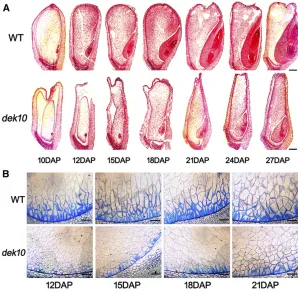
Wild-type anddek10kernels of 10, 12, 15, 18, 21, 24, and 27 DAP were analyzed by light microscopy to compare their development. Longitudinal sections of the whole kernel in-dicated a.10 days’developmental delay indek10compared with wild type (Figure 2A). In particular, the development of the basal endosperm transfer layer (BETL) was dramatically arrested indek10kernels (Figure 2B).
Positional cloning of Dek10
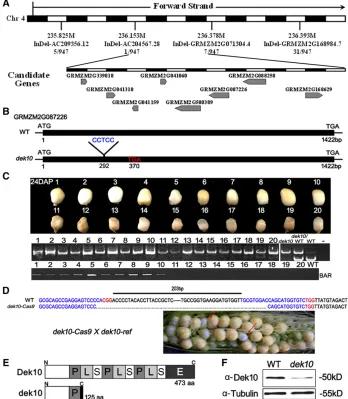
We performed a map-based approach to cloneDek10. After characterizing a population of 947 mutant kernels from the F2 population, the dek10 gene was placed between the molecular markers AC204567.28 and InDel-GRMZM2G071304.4, which encompass a physical region of 225 kb. This region was covered by two BAC clones (AC204567 and AC186864). There are eight candidate genes within the interval (gene 1:GRMZM2G339018; gene 2:GRMZM2G041310; gene 3:GRMZM2G041159; gene 4:
GRMZM2G041060; gene 5: GRMZM2G580389; gene 6:
GRMZM2G087226; gene 7: GRMZM2G088256, and gene
8:GRMZM2G168629) (Figure 3A). Sequence comparison of the eight candidate genes between wild-type and mu-tant alleles revealed a 5-bp (CCTCC) insertion at 292 bp in gene 6 (GRMZM2G087226, Figure 3B). This insertion resulted in a frameshift and a premature stop codon at 370 bp in the mature transcript. There is no sequence differ-ence in other candidate genes. Therefore,GRMZM2G087226
appeared to be the candidate for theDek10.
To confirm that GRMZM2G087226 is the Dek10 gene, functional complementation was performed by using a trans-formed wild-type candidate gene allele. Phenotyping and genotyping analysis indicated that the transgenic kernels carrying the transformedGRMZM2G087226sequence func-tionally complemented the lost function of dek10 and res-cued the mutant phenotype (Figure 3C). Targeted mutation ofGRMZM2G087226was further created by using the multiplex CRISPR/Cas9 system (Qi et al. 2016b).
GRMZM2G087226 was targeted at two sites and the gRNA spacer sequences were at 327 and 553 bp of the ORF. The chromosomal fragment deletion between two gRNA spacers was detected in GRMZM2G087226 Cas9 T0 lines (Figure 3D). The allelism test was done by crossing dek10-ref F1 (dek10-ref/+) anddek10-Cas9F1 (dek10-Cas9/+). The ker-nel phenotypes in the F2 ears displayed a 1:3 segregation of dek (dek10-ref/dek10-Cas9) and wild-type phenotype kernels (76:235,P-value,0.05; Figure 3D), indicating thatdek10-Cas9
cannot complementdek10-ref. Therefore,GRMZM2G087226
is indeed theDek10gene.
Dek10 encodes a E-subgroup PPR protein
searches of GenBank indicated that GRMZM2G087226
encodes an E-subgroup PPR protein with the PLS motifs car-rying an E-terminal domain extension (Lurin et al. 2004; Figure 3E and Figure S3 in File S1). The mutation in the
dek10-refallele results in a premature termination in thefirst P motif (Figure 3E). The mutant protein lost most functional domains.
To examineDek10messenger RNA (mRNA) expression in
dek10, we performed qRT-PCR with the total RNA extracted from 18 DAP to 21 DAP mutant and wild-type kernels. mRNA expression of Dek10 was not downregulated indek10 mu-tants (Figure S4 in File S1). Using an antibody against Dek10, no band was found at the predicted size in 18 DAP
dek10kernels by immunoblot analysis (Figure 3F), and what was detected was likely maternal contamination because of the experimental conditions of extraction.
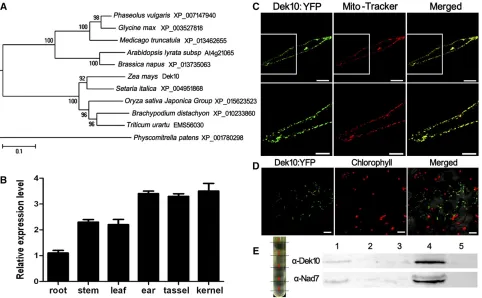
The PPR proteins are prevalently expanded in plants (Fujii and Small 2011). We constructed a phylogenetic tree on the basis of the maize Dek10 full-length protein sequence and homologous protein sequences from other organisms (Figure 4A). The results suggest that Dek10 homologs are clearly diverged into two separated clades belonging to monocots and dicots, respectively, during the evolution. There is no paralog of Dek10 in maize, so a knockout in this single gene would result in a phenotype.
Dek10 is a ubiquitous mitochondrial protein
qRT-PCR analysis revealed thatDek10is expressed in a broad range of maize tissues, including tassel, ear, root, stem, leaf, and kernel (Figure 4B). Expression in the kernel is higher than in the root, stem, and leaf, but is similar to that in the ear and tassel.
PPR proteins are predominantly targeted to plastids or mitochondria (Colcombetet al.2013). To determine its
sub-cellular localization, full-length Dek10 was fused to yellow fluorescent protein (YFP) in a binary vector pB7YWG. The fusion was transiently expressed in onion (Allium cepa) epi-dermal cells by bombarding, and the fluorescent signal was detected by confocal laser microscopy. The YFP signals were detected in small dots that were identified as mitochondria by redfluorescence of Mito-Tracker pBIN20-MT-RK (Nelsonet al.
2007; Figure 4C). The fusion was also transiently expressed in tobacco leaf epidermal cells by bombarding, and chloroplast chlorophyll autofluorescence was also detected. However, the Dek10 was not colocalized with chloroplasts (Figure 4D).
Cellular fractionation assay was then performed to confirm the Dek10 mitochondrial distribution in maize kernels. The total proteins extracted from 18 DAP wild-type kernels were separated intofive sample layers in a sucrose density gradient after differential centrifugation (seeMaterials and Methods). The antibody against Nad7 was used as a mitochondrial indicator and the fourth sample layer was detected as the mitochondrial fraction. The immunoblot with Dek10-specific antibody showed that Dek10 signal was present in the mito-chondrial fraction (Figure 4E). Thus, Dek10 is targeted to the mitochondria.
Dek10 is required for C-to-U RNA editing in nad3-61, nad3-62, and cox2-550 transcript in mitochondria
The E–PPR proteins were found to be involved in RNA editing (Barkan and Small 2014). RT-PCR was performed on RNAs isolated fromdek10and wild-type kernels with the pericarp removed. Bulked sequencing and direct comparison of the mitochondrial transcripts of the dek10 mutant were per-formed using 35 sets of primers (Y. Liu et al. 2013Y. Liu
et al.2013). Sequence analysis revealed three altered editing sites in thedek10mutant: at position 61 and 62 in thenad3
transcript, and at position 550 in thecox2transcript.
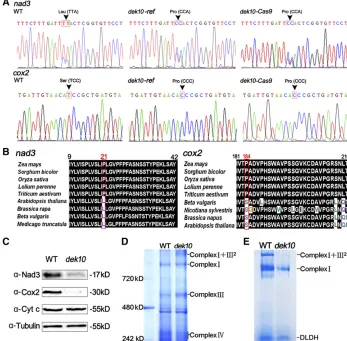
The editing defect results in a Leu-to-Pro mutation in the Nad3 protein and a Ser-to-Pro mutation in the Cox2 protein (Figure 5A). The editing deficiency of these two sites was confirmed in RNAs isolated fromdek10-Cas9kernels (Figure 5A). The C-to-U editing at positioncox2-550 is whole editing in wild-type kernels and was not detectable indek10. How-ever, fornad3-61 andnad3-62, a change of editing efficiency was observed. By sequencing 20 individual clones three times, we found that these two sites are edited to87% on average in wild-type kernels, while they are only edited to 39% on average indek10(P-value = 0.016). An alignment of the Dek10 target siteflanking sequences innad3andcox2
revealed an identity of 43%, a value substantially higher than the 25% expected between unrelated sequences (Figure S5 in
File S1), which was also reported by Sossoet al.(2012).nad3
encodes subunit III of NADH dehydrogenase as part of com-plex I, andcox2encodes subunit II of Cox as part of complex IV, of the ETC. Editing deficiency in these sites affects highly conserved amino acids indek10mutants, as leucine and ser-ine are genomically encoded in Nad3 and Cox2 dicot ortho-logs (Figure 5B). Therefore, the editing of the CCA Pro codon to a UUA Leu codon and the CCC Pro codon to a UCC Ser codon is likely to be required in monocots for the mainte-nance of these strictly conserved amino acids.
dek10 affects Nad3 and Cox2 protein accumulation, NADH dehydrogenase activity, and Complex IV assembly
The defect innad3-61,nad3-62, andcox2-550 editing might affect the level of the Nad3 and Cox2 proteins, which are
essential for electron transport, as well as other components of the respiratory chain. The protein levels of Nad3 (complex I), Cox2 (complex IV), and Cyt-c were examined by immu-noblot analysis ofdek10and wild-type maize kernel proteins with specific antibodies. Nad3-specific antibody detected a protein of17 kDa in wild-type kernels that was significantly decreased in dek10. Cox2-specific antibody detected a pro-tein of 30 kDa in wild-type kernels, while this signal was absent indek10 (Figure 5C). In contrast, the level of Cyt-c was similar in thedek10mutant and wild-type maize kernels, indicating that other components of the ETC are not affected (Figure 5C).
To further investigate the assembly and quantity of re-spiratory complexes, mitochondrial proteins were isolated from dek10 and wild-type endosperm, and were analyzed by blue native BN-PAGE. The bands of different complexes were recognized according to Zsigmond et al.(2008). The two profiles showed a decrease of complex IV, but no signif-icant difference in the complex I band in thedek10mutant, which might be due to the small size of Nad3 and its partial decrease indek10. There was a slight increase in the complex III band, which might occur to compensate for the functional defect of other complexes, as previously reported by Xiuet al.
(2016) (Figure 5D). An in-gel NADH dehydrogenase activity test was carried out to inspect the activity of complex I. Sig-nificant reduction of complex I activity was observed in
dek10. The activities of complex I and super-complex I+III2 were much lower in thedek10mutant (Figure 5E). In sum-mary, editing defects innad3andcox2result in a reduction of Nad3 and the loss of Cox2 protein, which further causes the
functional reduction of complex I and complex IV of the re-spiratory chain.
dek10 affects expression of genes related to mitochondrial functions
We compared the transcript profile of 18 DAPdek10and wild-type endosperm using RNA sequencing (RNA-seq). Among the 48,480 gene transcripts detected by RNA-seq, signifi -cantly DEGs were identified as those with a threshold fold change . 2 and P-value , 0.05. Based on this criterion, 2668 genes showed significant altered expression between
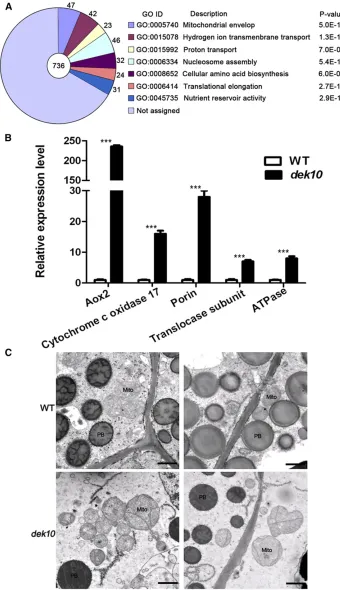
dek10 and the wild type. There were 2248 genes with in-creased transcription, while 420 genes showed dein-creased tran-scription. Within the DEGs, 736 genes could be functionally annotated [annotations were found using BLASTN and BLASTX analyses against the Genbank (http://www.ncbi.nlm.nih.gov/) database]. Gene Ontology (GO; http://bioinfo.cau.edu.cn/ agriGO/) analysis indicated that DEGs were mostly related to seven GO terms (Figure 6A and Table S1 in File S1). Among them, three GO terms were closely related to mito-chondrial function: GO: 0005740 (Mitomito-chondrial envelope,
P-value = 5.0E218); GO: 0015078 (Hydrogen ion trans-membrane transporter activity, P-value = 1.3E213); and GO: 0015992 (Proton transport,P-value = 7.0E206).
Forty-seven DEGs were classified to GO: 0005740 (Mito-chondrial envelope), including Alternative oxidase 2(Aox2, GRMZM2G125669). The expression of Aox2 was 399-fold upregulated indek10 (Table S1 inFile S1), indicating that the alternative respiratory pathway was activated to compen-sate for the inefficient mitochondrial oxidative phosphoryla-tion in dek10. Other DEGs related to mitochondrial function are Mitochondrial ATPases, ETC complex subunits, Cox subunits, and Porins. Transcription of all the genes re-lated to mitochondrial function was increased in dek10 en-dosperm (Table S1 in File S1). To validate the differences observed by RNA-seq, we performed qRT-PCR on the most significant DEGs and the results confirmed similar differences of mRNA accumulation (Figure 6B). To examinenad3 and
cox2mRNA expression indek10, we also performed qRT-PCR with the total RNA extracted from 18 DAP to 21 DAP mutant and wild-type kernels. mRNA expression of nad3 andcox2
was not affected in thedek10mutant (Figure S6 inFile S1).
Figure 3 Map-based cloning and identifi ca-tion of Dek10. (A) The Dek10 locus was mapped to a 225-kb region between molec-ular markers AC204567.28 and InDel-GRMZM2G071304.4 on chr 4, which contained eight candidate genes. See Table S2 inFile S1online for primer information. (B) Structure and mutation site of theDek10 gene. (C) The functional complementation transgenic lines were hybridized to the ho-mozygous mutant (dek10/dek10) and self-pollinated (T2 lines). Using the molecular marker closely linked to the Dek10 locus (primers AC204567.28 in Table S2 in File S1), 10 wild-type and 10 mutant kernels were sorted out from T2 ears both with mu-tant band patterns. The primers of the BAR gene were used to identify the transgenic positive and negative kernels.2, H2O
dek10 affects mitochondria morphology
A mitochondrial function defect in the cytoplasm of 18 DAP
dek10endosperm was also observed by TEM analysis. Nor-mal activation of the ETC is required for the proper formation of the inner envelope cristae in mitochondria (Logan 2006). The mitochondria in the wild-type endosperm formed distinct inner envelope cristae surrounded by a dense matrix, while the internal structure of mitochondria in thedek10mutant lacked cristae and the mitochondrial matrix was extremely light. Fur-thermore, the whole structure of mitochondria in thedek10
mutant were dilated and irregular (Figure 6C).
Discussion
Dek10 is a newly identified E-subgroup PPR protein member responsible for nad3-61, nad3-62, and cox2-550 editing
A number of maize dek mutants have been identified:dek1
causes severe growth and development defects;dek* causes
only mild effects; and the mutants of PPRs, including
ppr2263,smk1,emp5,emp7, anddek10, always have an ob-vious small kernel phenotype, with arrested development of the embryo, endosperm, and seedling (Figure 1 and Figure 2; Lidet al. 2002; Y. Liuet al.2013; Liet al.2014; Sun et al.
2015; Qi et al.2016a). dek10-refand dek10-Cas9 are both severe mutant alleles with abolished function of Dek10, which is a newly identified E-subgroup PPR protein in-volved in mitochondrial RNA editing (Figure 3, Figure 4, and Figure 5).
To date, at least 46 RNA editing factors in plant mito-chondria have been characterized (Hammani and Giege 2014; Liet al.2014; Sunet al.2015). These editing factors mostly belong to the E and DYW subgroups and function either at single or multiple editing sites. For DYW-subgroup PPR proteins, MEF1 is thefirst identified plant mitochondrial editing factor involved in multiple editing sites (Zehrmann
et al.2009). Rice OGR1 is involved in seven specific editing sites on five distinct mitochondrial transcripts (Kim et al.
2009). Moss (Physcomitrella) PPR_77 is involved in the editing
of cox2-370 and cox3-733 transcripts (Ohtani et al. 2010). Maize PPR2263 also encodes a DYW-subgroup PPR protein responsible for multiple editing sites (Sossoet al.2012). For E-subgroup PPR proteins, MEF9, MPR25, SLG1, AHG11, SMK1, and EMP7 are editing factors required for single editing sites in complex I (Takenaka 2010; Murayama et al. 2012; Toda et al. 2012; Yuan and Liu 2012; Li et al. 2014; Sun
et al. 2015).OTP87encodes an E-subgroup PPR protein re-quired for the editing ofnad7-24andatp1-1178(Hammani
et al.2011). SLO2 affects several editing sites inArabidopsis
(Zhuet al.2012). These previously reported editing defects often lead to a compromised or complete loss-of-function of the encoded protein, and affect plant growth and development (Sossoet al.2012; Y. Liuet al.2013; Liet al.2014).
Dek10 is identified to be another E-subgroup PPR protein targeted to the mitochondria in maize. There is no paralog of Dek10 in maize (Figure 4). This newly characterized maize PPR is responsible for C-to-U RNA editing atnad3 -61,nad3-62, andcox2-550 transcripts (Figure 5). Editing at cox2-550 is completely abolished while there is only editing efficiency reduction at nad3-61 and nad3-62, indicating that the editing at these two sites might also involve other proteins. Several PPR proteins have previ-ously been reported to be mitochondrial RNA editing fac-tors involved in multiple editing events (Kim et al.2009;
Zehrmannet al.2009; Ohtaniet al.2010; Hammaniet al.
2011; Sossoet al.2012; Zhuet al.2012). The correspond-ing mutants exhibit both whole editcorrespond-ing abolishment and editing efficiency reduction (Sosso et al.2012; Zhuet al.
2012). Among them, SLO2 is required for two contiguous editing sites, mttB-144 andmttB-145 (Zhu et al.2012). Dek10 is a newly identified PPR protein responsible for the editing of two contiguous editing sites in the same transcript.
Dek10 editing sites are critical for mitochondrial function
Respiration, as the core process of mitochondrial metabolism, depends on the function offive complexes on the substrate (Dudkina et al. 2006). nad3 encodes subunit III of NADH dehydrogenase as part of complex I. cox2 encodes subunit II of Cox as part of complex IV. nad3-61, nad3-62, and
cox2-550 editing are required for the maintenance of strictly conserved amino acids in Nad3 and Cox2 orthologs present in monocots. Comparison of the alignment of the amino acid encoded by unedited nad3 and cox2 revealed that Pro encoded by unedited nad3-61, nad3-62, and cox2-550 is clustered in all monocots investigated, indicating a need for RNA editing at these sites (Figure 5), which was also observed for nad7-836 by Li et al. (2014). Dek10 is also
Figure 5 Dek10 is required for nad3-61, nad3-62, andcox2-550 editing in maize mi-tochondria. (A) Analysis of RNA editing at thenad3-61,nad3-62, andcox2-550 sites in the transcripts from developing kernels of the WT,dek10-ref, anddek0-Cas9mutants at 18 DAP. The arrow marks the editing site. (B) Alignment of the Nad3 sequences around amino acid 21 and alignment of the Cox2 sequences around amino acid 184. The protein sequences are derived from Z. mays,Sorghum bicolor, O. sativa, Lolium perenne,T. aestivum,Beta vulgaris, Nicotiana sylvestris,B. napus,M. truncatula, andArabidopsis thaliana. Numbers indicate amino acid positions in the protein. The red box indicates the position affected by the nad3-61, nad3-62, and cox2-550 editing. (C) Western blot analysis with antibodies against Nad3, Cox2, and Cyt-c. Anti-Tub was used as sample loading control. (D) BN-PAGE of mitochondrial complexes. The positions of super complex I+III2, complex I,
complex III, and complex IV are indicated. (E) In-gel NADH dehydrogenase activity test analysis of complex I activity. The positions of super complex I+III2and complex I are
highly conserved in monocots, implying a coordination of
Dek10 withnad3andcox2 during evolution (Figure 4 and Figure 5). The selective pressure of Dek10 in monocots might be due to the need for RNA editing at nad3-61,
nad3-62, andcox2-550in monocots.
Most of the characterized PPR mutants affect transcripts encoding proteins of complex I (Colas des Francs-Small and Small 2014; Hammani and Giege 2014). Arabidopsis slg1
mutants withnad3transcript editing defects showed severe developmental delay and hypersensitivity to abiotic stresses
(Yuan and Liu 2012). Editing defects of subunits of complex III, complex IV, and Complex V have also been reported and the loss of these complexes is always lethal (Colas des Francs-Small and Francs-Small 2014). MEF32 was predicted to be required for multiple editing sites includingcox2-27 (Takenakaet al.
2013). Abolishedcox2-370andcox3-733transcript editing in a Mossppr_77mutant resulted in severe developmental de-fects (Ohtani et al. 2010). Arabidopsis cod1 mutants were defective incox2-253,cox2-698, andnad4-1129editing lead-ing to seed abortion (Dahanet al.2014). Affectingnad3-61,
nad3-62, and cox2-550 editing results in a significant de-crease or complete loss of the encoded proteins in dek10
(Figure 5). The discrepancy between transcription levels and protein accumulation levels ofnad3 andcox2indek10
(Figure 5 and Figure S6 inFile S1) implies that the functional defect of these proteins affects their assembly into complexes and, thus, further affects protein stability. Respiratory metab-olism was blocked indek10, asAox2and other mitochondrial function-related genes were dramatically upregulated to res-cue the electronflux and functional tricarboxylic acid cycle (Figure 6 and Table S1 inFile S1). AOXs can reduce the re-active oxygen species levels in situations when complexes III and IV are unable to function properly for the maintenance of electronflux. There is also rapid activation of AOXs in pre-viously reported PPR mutants (Vanlerberghe and McIntosh 1994; Sunet al.2015; Xiuet al.2016).
ETC biogenesis was reported to be required for the proper morphology of the cristae in mitochondria (Logan 2006). Reduced complex I in theArabidopsis nmat1mutant and re-duced complex III in the maizeppr2263mutant caused com-promised mitochondrial ultrastructure (Keren et al. 2012; Sossoet al.2012). The cristae formed by the inner membrane are strongly reduced or completely missing in the maize
ppr2263mutant (Sossoet al.2012). Abnormal morphology of mitochondria was also observed in thedek10mutant. The loss of both Nad3 (complex I) and Cox2 (complex IV) func-tion results in defects of ETC biogenesis, which not only af-fects the respiratory metabolism of mitochondria but also their proper morphology. Sosso et al. (2012) hypothesized that the structurally altered mitochondria were likely non-functional or at least less non-functional than mitochondria with a normal ultrastructure.
The mitochondrial function defect in the dek10 mutant affects kernel and seedling development
The development of the BETL was dramatically arrested in
dek10 endosperm (Figure 2). The BETL is the basal endo-sperm layer that develops extensive cell wall ingrowths supporting an enlarged plasma membrane surface, which promotes nutrient (primarily sucrose and amino acids) up-take by the endosperm (Pate and Gunning 1972; Thompson
et al.2001). BETL cells allow rapid solute transport at the interface between maternal vascular tissue and the endo-sperm (Offler et al. 2003), which requires high metabolic rates. Therefore, transfer cells typically have a dense cyto-plasm that is rich in small, spherical mitochondria. The
ab-sence of a properly formed transfer cell layer is correlated with reduced rates of grainfilling and seed abortion (Brink and Cooper 1947; Charlton et al. 1995). Mutation of the maizeEMP4andEMP16genes, which encode PPR proteins, results in a defective transfer cell layer and endosperm (Gutierrezet al.2007; Xiuet al.2016).
Embryo lethality, reduced fertility, and dwarf phenotype are associated with several PPR mutants, highlighting the important functions of PPRs in plant growth and development (Lurinet al.2004; Gutierrezet al.2007). Because theDek10
gene is constitutively expressed in maize (Figure 4), the abol-ished growth ofdek10plants can be attributed to the mito-chondrial function defect in other tissues. The suppressed mitochondrial function in dek10also brings about changes in other important biological processes, including nucleo-some assembly, cellular amino acid biosynthesis, translation elongation, and nutrient reservoir activity (Figure 6 and Ta-ble S1 in File S1). Nucleosome assembly is essential for a variety of biological processes, such as cell cycle progression, development, and senescence (Galet al.2015). Amino acid biosynthesis and translation elongation are both important for cellular protein expression and accumulation. Nutrient reservoir activity in the endosperm, the main storage tissue, largely determines the nutritional value of maize (Holding and Larkins 2006). All these biological processes consume energy produced by the mitochondria. Hence, maizedek10
mutation affects kernel and seedling development due to mi-tochondrial dysfunction and other secondary biological defects.
Acknowledgments
This work was supported by the National Key Research and Development Program of China (2016YFD0101003), the National Natural Sciences Foundation of China (91635303 and 31425019), and the Fundamental Research Funds for the Central Universities (2016QC077). The authors declare no conflicts of interest.
Author contributions: R.S. and W.Q. designed the experi-ment. W.Q., Z.T., L.L., Xiu.C., Xin.C., and W.Z. performed the experiments. W.Q., Z.T., L.L., and R.S. analyzed the data. W.Q. and R.S. wrote the article.
Literature Cited
Barkan, A., and I. Small, 2014 Pentatricopeptide repeat proteins in plants. Annu. Rev. Plant Biol. 65: 415–442.
Becraft, P. W., K. Li, N. Dey, and Y. Asuncion-Crabb, 2002 The maize dek1 gene functions in embryonic pattern formation and cell fate specification. Development 129: 5217–5225.
Brink, R. A., and D. C. Cooper, 1947 Effect of thede17allele on development of the maize caryopsis. Genetics 32: 350–368. Charlton, W. L., C. L. Keen, C. Merriman, P. Lynch, A. J. Greenland
et al., 1995 Endosperm development in Zea mays: implication
Colas des Francs-Small, C., and I. Small, 2014 Surrogate mutants for studying mitochondrially encoded functions. Biochimie 100: 234–242.
Colcombet, J., M. Lopez-Obando, L. Heurtevin, C. Bernard, K. Martinet al., 2013 Systematic study of subcellular localiza-tion of Arabidopsis PPR proteins confirms a massive targeting to organelles. RNA Biol. 10: 1557–1575.
Dahan, J., G. Tcherkez, D. Macherel, A. Benamar, K. Belcramet al., 2014 Disruption of the CYTOCHROME C OXIDASE DEFICIENT1 gene leads to cytochrome c oxidase depletion and reorchestrated respiratory metabolism in Arabidopsis. Plant Physiol. 166: 1788– 1802.
de Longevialle, A. F., L. Hendrickson, N. L. Taylor, E. Delannoy, C. Lurin et al., 2008 The pentatricopeptide repeat gene OTP51 with two LAGLIDADG motifs is required for the cis-splicing of plastid ycf3 intron 2 in Arabidopsis thaliana. Plant J. 56: 157– 168.
Doniwa, Y., M. Ueda, M. Ueta, A. Wada, K. Kadowaki et al., 2010 The involvement of a PPR protein of the P subfamily in partial RNA editing of an Arabidopsis mitochondrial transcript. Gene 454: 39–46.
Dudkina, N. V., J. Heinemeyer, S. Sunderhaus, E. J. Boekema, and H. P. Braun, 2006 Respiratory chain supercomplexes in the plant mitochondrial membrane. Trends Plant Sci. 11: 232–240. Frame, B. R., H. Shou, R. K. Chikwamba, Z. Zhang, C. Xianget al., 2002 Agrobacterium tumefaciens-mediated transformation of maize embryos using a standard binary vector system. Plant Physiol. 129: 13–22.
Fujii, S., and I. Small, 2011 The evolution of RNA editing and pentatricopeptide repeat genes. New Phytol. 191: 37–47. Gal, C., K. M. Moore, K. Paszkiewicz, N. A. Kent, and S. K. Whitehall,
2015 The impact of the HIRA histone chaperone upon global nucleosome architecture. Cell Cycle 14: 123–134.
Gutierrez, L., O. VanWuytswinkel, M. Castelain, and C. Bellini, 2007 Combined networks regulating seed maturation. Trends Plant Sci. 12: 294–300.
Haïli, N., N. Planchard, N. Arnal, M. Quadrado, N. Vrielyncket al., 2016 The MTL1 pentatricopeptide repeat protein is required for both translation and splicing of the mitochondrial NADH DEHYDROGENASE SUBUNIT7 mRNA in Arabidopsis. Plant Physiol. 170: 354–366.
Hammani, K., and P. Giege, 2014 RNA metabolism in plant mito-chondria. Trends Plant Sci. 19: 380–389.
Hammani, K., C. C. des Francs-Small, M. Takenaka, S. K. Tanz, K. Okuda et al., 2011 The pentatricopeptide repeat protein OTP87 is essential for RNA editing of nad7 and atp1 transcripts in Arabidopsis mitochondria. J. Biol. Chem. 286: 21361–21371. Holding, D. R., and B. A. Larkins, 2006 The development and importance of zein protein bodies in maize endosperm. Maydica 51: 243–254.
Keren, I., L. Tal, C. C. des Francs-Small, W. L. Araújo, S. Shevtsov
et al., 2012 nMAT1, a nuclear-encoded maturase involved in
the trans-splicing of nad1 intron1, is essential for mitochondrial complex I assembly and function. Plant J. 71: 413–426. Kim, S. R., J. I. Yang, S. Moon, C. H. Ryu, K. Anet al., 2009 Rice
OGR1 encodes a pentatricopeptide repeat-DYW protein and is essential for RNA editing in mitochondria. Plant J. 59: 738–749. Knoop, V., 2013 Plant mitochondrial genome peculiarities evolv-ing in the earliest vascular plant lineages. J. Syst. Evol. 51: 1–12. Langmead, B., C. Trapnell, M. Pop, and S. L. Salzberg, 2009 Ultrafast and memory-efficient alignment of short DNA sequences to the human genome. Genome Biol. 10: R25.
Lending, C. R., and B. A. Larkins, 1992 Effect of thefloury-2 locus on protein body formation during maize endosperm develop-ment. Protoplasma 171: 123–133.
Li, X. J., Y. F. Zhang, M. M. Hou, F. Sun, Y. Shenet al., 2014 Small kernel 1 encodes a pentatricopeptide repeat protein required for
mitochondrial nad7 transcript editing and seed development in maize (Zea mays) and rice (Oryza sativa). Plant J. 79: 797–809. Lid, S. E., D. Gruis, R. Jung, J. A. Lorentzen, E. Ananiev et al., 2002 The defective kernel 1 (dek1) gene required for aleurone cell development in the endosperm of maize grains encodes a membrane protein of the calpain gene superfamily. Proc. Natl. Acad. Sci. USA 99: 5460–5465.
Liu, S., J. Melonek, L. M. Boykin, I. Small, and K. A. Howell, 2013a PPRSMRs ancient proteins with enigmatic functions. RNA Biol. 10: 1501–1510.
Liu, Y. J., Z. H. Xiu, R. Meeley, and B. C. Tan, 2013b Empty pericarp5 encodes a pentatricopeptide repeat protein that is re-quired for mitochondrial RNA editing and seed development in maize. Plant Cell 25: 868–883.
Livak, K. J., and T. D. Schmittgen, 2001 Analysis of relative gene expression data using real-time quantitative PCR and the 2(-Delta Delta C (T)) method. Methods 25: 402–408.
Logan, D. C., 2006 The mitochondrial compartment. J. Exp. Bot. 57: 1225–1243.
Lurin, C., C. Andres, S. Aubourg, M. Bellaoui, F. Bitton et al., 2004 Genome-wide analysis of Arabidopsis pentatricopeptide repeat proteins reveals their essential role in organdie biogene-sis. Plant Cell 16: 2089–2103.
Meyer, E. H., T. Tomaz, A. J. Carroll, G. Estavillo, E. Delannoyet al., 2009 Remodeled respiration in ndufs4 with low phosphoryla-tion efficiency suppresses Arabidopsis germination and growth and alters control of metabolism at night. Plant Physiol. 151: 603–619.
Murayama, M., S. Hayashi, N. Nishimura, M. Ishide, K. Kobayashi
et al., 2012 Isolation of Arabidopsis ahg11, a weak ABA
hyper-sensitive mutant defective in nad4 RNA editing. J. Exp. Bot. 63: 5301–5310.
Nelson, B. K., X. Cai, and A. Nebenführ, 2007 A multicolored set
ofin vivoorganelle markers for co-localization studies in
Arab-idopsisand other plants. Plant J. 51: 1126–1136.
Neuffer, M. G., and W. F. Sheridan, 1980 Defective kernel mu-tants of maize. I. Genetic and lethality studies. Genetics 95: 929–944.
Offler, C. E., D. W. McCurdy, J. W. Patrick, and M. J. Talbot, 2003 Transfer cells: cells specialized for a special purpose. Annu. Rev. Plant Biol. 54: 431–454.
Ohtani, S., M. Ichinose, E. Tasaki, Y. Aoki, Y. Komura et al., 2010 Targeted gene disruption identifies three PPR-DYW pro-teins involved in RNA editing forfive editing sites of the moss mitochondrial transcripts. Plant Cell Physiol. 51:1942–1949. Pate, J. S., and B. E. S. Gunning, 1972 Transfer cells. Annu. Rev.
Plant Physiol. 23: 173–196.
Qi, W., J. Zhu, Q. Wu, Q. Wang, X. Liet al., 2016a Maizereas1
mutant stimulates ribosome use efficiency and triggers distinct transcriptional and translational responses. Plant Physiol. 170: 971–988.
Qi, W., T. Zhu, Z. Tian, C. Li, W. Zhang et al., 2016b High-efficiency CRISPR/Cas9 multiplex gene editing using the glycine tRNA-processing system-based strategy in maize. BMC Biotech-nol. 16: 58.
Schmitz-Linneweber, C., and I. Small, 2008 Pentatricopeptide re-peat proteins: a socket set for organelle gene expression. Trends Plant Sci. 13: 663–670.
Siedow, J. A., and D. A. Day, 2000 Respiration and photorespira-tion, pp. 676–728 in Biochemistry and Molecular Biology of
Plants, edited by B. B. Buchanan, W. Gruissem, and R. L. Jones.
American Society of Plant Physiologists, Rockville, MD. Sosso, D., S. Mbelo, V. Vernoud, G. Gendrot, A. Dedieu et al.,
Sun, F., X. Wang, G. Bonnard, Y. Shen, Z. Xiuet al., 2015 Empty pericarp7 encodes a mitochondrial E-subgroup pentatrico-peptide repeat protein is required for ccmFN editing, mito-chondrial function and seed development in maize. Plant J. 84: 283–295.
Sweetlove, L. J., A. Fait, A. Nunes-Nesi, T. Williams, and A. R. Fernie, 2007 The mitochondrion: an integration point of cel-lular metabolism and signalling. Crit. Rev. Plant Sci. 26: 17–43. Takenaka, M., 2010 MEF9, an E-subclass pentatricopeptide re-peat protein, is required for an RNA editing event in the nad7 transcript in mitochondria of Arabidopsis. Plant Physiol. 152: 939–947.
Takenaka, M., A. Zehrmann, A. Brennicke, and K. Graichen, 2013 Improved computational target site prediction for pentatricopeptide repeat RNA editing factors. PLoS One 8(6): e65343.
Thompson, R. D., G. Hueros, H. Becker, and M. Maitz, 2001 De-velopment and functions of seed transfer cells. Plant Sci. 160: 775–783.
Toda, T., S. Fujii, K. Noguchi, T. Kazama, and K. Toriyama, 2012 Rice MPR25 encodes a pentatricopeptide repeat protein and is essential for RNA editing of nad5 transcripts in mitochon-dria. Plant J. 72: 450–460.
Vanlerberghe, G. C., and L. McIntosh, 1994 Mitochondrial elec-tron transport regulation of nuclear gene expression. Studies with the alternative oxidase gene of tobacco. Plant Physiol. 105: 867–874.
Vanlerberghe, G. C., and S. H. Ordog, 2002 Alternative oxidase: integrating carbon metabolism and electron transport in plant respiration, pp. 173–191 inAdvances in Photosynthesis and
Res-piration, Photosynthetic Nitrogen Assimilation and Associated
Carbon and Respiratory Metabolism, Vol. 12, edited by G. H.
Foyer, and G. Noctor. Kluwer Academic Publishers, Dordrecht, The Netherlands.
Wang, G., X. Sun, G. Wang, F. Wang, Q. Gaoet al., 2011 Opaque7 encodes an acyl-activating enzyme-like protein that affects stor-age protein synthesis in maize endosperm. Genetics 189: 1281– 1295.
Wang, G., W. Qi, Q. Wu, D. Yao, J. Zhanget al., 2014 Identification and characterization of maize floury4 as a novel semidominant opaque mutant that disrupts protein body assembly. Plant Physiol. 165: 582–594.
Xiu, Z., F. Sun, Y. Shen, X. Zhang, R. Jianget al., 2016 EMPTY PERICARP16 is required for mitochondrial nad2 intron 4 cis‐ splicing, complex I assembly and seed development in maize. Plant J. 85(4): 507–519.
Yuan, H., and D. Liu, 2012 Functional disruption of the pentatri-copeptide protein SLG1 affects mitochondrial RNA editing, plant development, and responses to abiotic stresses in Arabi-dopsis. Plant J. 70: 432–444.
Zehrmann, A., D. Verbitskiy, J. A. van der Merwe, A. Brennicke, and M. Takenaka, 2009 A DYW domain-containing pentatricopep-tide repeat protein is required for RNA editing at multiple sites in mitochondria of Arabidopsis thaliana. Plant Cell 21: 558–567. Zhang, H. D., Y. L. Cui, C. Huang, Q. Q. Yin, X. M. Qin et al., 2015 PPR protein PDM1/SEL1 is involved in RNA editing and splicing of plastid genes in Arabidopsis thaliana. Photo-synth. Res. 126: 311–321.
Zhu, Q., J. Dugardeyn, C. Zhang, M. Takenaka, K. Kühn et al., 2012 SLO2, a mitochondrial pentatricopeptide repeat protein affecting several RNA editing sites, is required for energy me-tabolism. Plant J. 71: 836–849.
Zsigmond, L., G. Rigó, A. Szarka, G. Székely, K. Otvös et al., 2008 Arabidopsis PPR40 connects abiotic stress responses to mitochondrial electron transport. Plant Physiol. 146: 1721– 1737.
GENETICS
Supporting Information www.genetics.org/lookup/suppl/doi:10.1534/genetics.116.199331/-/DC1
Editing of Mitochondrial Transcripts
nad3
and
cox2
by
Dek10 Is Essential for Mitochondrial Function and Maize
Plant Development
Weiwei Qi, Zhongrui Tian, Lei Lu, Xiuzu Chen, Xinze Chen, Wei Zhang and Rentao Song