Comparative Study of performance of
Two-Link Manipulator Using Fuzzy and
Fuzzy+PID Controller
Sibija V S1, Shyju Susan Mathew2
P.G. Student, Department of Electrical and Electronics Engineering, Mar Baselios College of Engineering and Technology, Thiruvananthapuram, Kerala, India1
Assistant Professor, Department of Electrical and Electronics Engineering, Mar Baselios College of Engineering and Technology, Thiruvananthapuram, Kerala, India2
ABSTRACT:Robotics deals with the design, construction, operation and use of robots as well as computer systems for their control, sensory feedback and information processing. Robots are used in supplying the motion required in manufacturing processes such as pick and place, assembly, painting, milling, cutting, welding, drilling etc,
For small parts insertion and assembly, a two revolute joint robot configuration with two degrees of freedom is well suited. Two-link manipulator is a dynamic system that exhibit nonlinear behaviour. Conventional linear methods are not gratifying to control nonlinear systems and therefore the linearization is done by using Taylor series expansion. In the linearization using Taylor series method the higher order terms are neglected. The aim of this paper is to design a controller which helps the manipulator to track the desired trajectory with minimum errors.
KEYWORDS:Two-Link Manipulator, Fuzzy controller, Fuzzy+PID controller. I. INTRODUCTION
Two-link manipulator is a type of mechanical arm, which has similar functions as that of a human arm, which is programmable, the robotic arm may be the sum total of the mechanism or may be a part of a more complex robot. The links are connected by joints which allow rotational or translational motion. The links can be considered to form a kinematic chain. Robot is an electro-mechanical machine that was guided by electronic components. Most companies use robots to accelerate production rate and to produce better quality products. In most engineered systems, the behaviour of the system is required to be accurately modelled to improve the performance of the system. In many applications, design simulation and proposed control algorithms require more than just a simple kinematic or dynamic model. Most of the systems are dynamic in nature. Dynamic in nature is characterized by constant change, activity or process. Not only is an accurate model bust also a real time calculation of the dynamic model needed for control algorithms or simulations. Thus the dynamic modelling of a robot is difficult one. Dynamic model represents the behaviour of an object over time. Most dynamic systems exhibit nonlinear behaviour. Nonlinear system is a system in which the change in output is not proportional to change in input.
II RELATED WORK
First one is the stability [2] and the second one is the robustness of the system. Another control method used is the conventional PID controller. In order to obtain robustness controllers like fuzzy, sliding mode etc can be used.
Paper is organized as follows. Section III describes dynamic modelling and linearization of two-link manipulator. The Lagrangian dynamics is used here. The control method fuzzy and the fuzzy+pid controller is filled using Section IV. Section V presents simulation results that obtained using matlabsoftware. Finally, Section VI presents conclusion.
III DYNAMIC MODELLING AND LINEARIZATION
The dynamic model [6] of a robot studies the relation between the joint actuator torques and the resulting motion. Many control algorithms such as computed torque control, sliding mode control, predictive control, need the accurate model of the dynamics in Lagrangian form. The generalised form of the robot dynamics can be described as,
(
,
)
(
)
)
(
q
q
C
q
q
G
q
M
Where q = vector of joint angles
n = degree of freedom (DoF) of robot arm
n n
R
q
M
(
)
is symmetric, bounded, positive definite inertia matrixn
R
q
q
C
(
,
)
is the Coriolis and Centrifugal forcen
R
q
G
(
)
is gravitational forcen
R
is the vector of actuator torquesIn this,
M
(
q
)
q
C
(
q
,
q
)
represents the kinetic energy of the manipulator and the gravity termG(q)
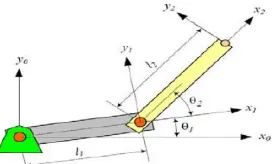
represents the potential energy of the manipulator.Fig 1. Two-link manipulator
Where,
= 1m is the length of link 1 = 1m is the length of link 2 = 1kg is the mass of link 1 = 1kg is the mass of link 2 = =Rotation angle of joint 1 = =Rotation angle of joint 2
Description of linear displacement x and y in terms of joint angles and
1 1 1
l
sin
q
x
1 1 1
l
cos
q
y
)
sin(
sin
1 2 1 21
2
l
q
l
q
q
x
)
cos(
cos
1 2 1 21
2
l
q
l
q
q
y
So, kinetic energy could be formed as,
2 2 2 2 1 1 2 2 2 2 1 1
2
1
2
1
2
1
2
1
I
I
v
m
v
m
KE
Substitute for and
2 2 1 2 2 1 1 2 1 2 1 2 2 1 2 2 1 2 2 2 1 2 2 2 2 1 2 1 2 1)
(
2
1
2
1
cos
2
2
1
2
1
q
q
I
q
I
q
q
q
q
l
l
m
q
q
q
q
l
m
q
l
m
m
KE
Potential energy can be written as,
m
1m
2
gl
1cos
q
1m
2gl
2cos(
q
1q
2)
PE
The Lagrangian dynamics in matrix form can be written as,
2 1 2 1 2 2 1 2 2 10
)
(
u a uu ua au aaG
G
q
q
q
h
q
q
h
q
h
q
q
m
m
m
m
With,
1 2
1 22 2 1 2 2
1
l
1m
l
l
22
l
l
2cos(
q
)
I
I
m
m
aa
c
c
c
1 2
22
2
l
2l
l
2cos(
q
)
I
m
m
m
au
ua
c
c
2 2 1
2
2
l
2l
l
2cos(
q
)
I
m
m
uu
c
c
)
sin(
2 12
l
l
2q
m
h
c
m
1l
1m
2l
1
g
cos(
q
1)
m
2l
2g
cos
q
1q
2
G
a
c
c
1 2
2
l
2cos
q
q
m
G
u
c
The state space linearized model [6] can be written as,
0
0
0
0
D
IVFUZZY CONTROL
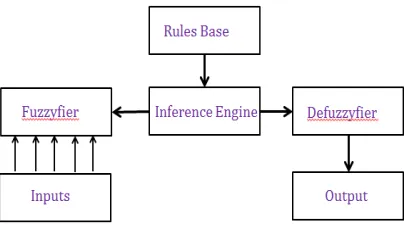
Fuzzy logic [4]is a form of many-valued logic in which the truth values may be any real number between 0 and 1.it is employed to handle the concept of partial truth, in which the truth values may range between completely true and completely false. In case of the Boolean logic, the truth values of variables may only be integer values 0 or 1.Fuzzy logic can be compared to the human being’s feelings. The classical control strategy is a point to point control; the fuzzy logic is either a range to point control or range to range control. The fuzzy logic offers several unique features such as it is inherently robust since it does not require precise, noise free inputs and can be programmed to fail safely if a feedback sensor quits or is destroyed. The output control is a smooth control function despite wide range of input variations, it is not limited to a few feedback inputs and one or two control outputs nor is it necessary to measure or compute rare-of-change parameters in order for it to be implemented etc.The basic block diagram of fuzzy is shwn below
Fig 2 Basic block diagram of fuzzy logic controller
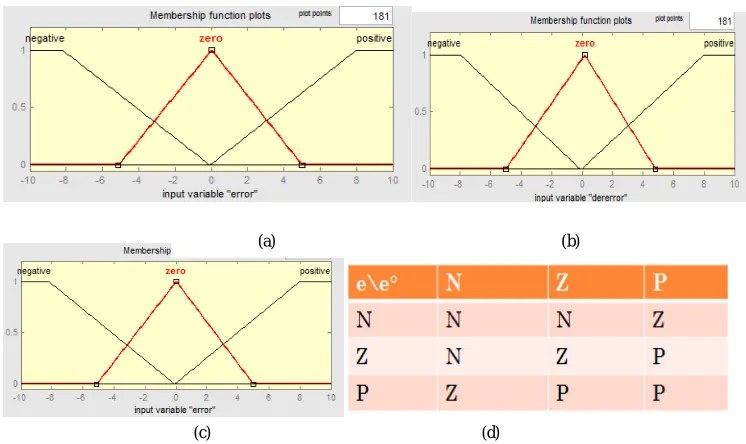
Fuzzification is the process of decomposing a system input or output into one or more fuzzy sets. The crisp input and output is converted to linguistic variables with fuzzy components. Besides these conversions the input and output is converted from crisp to fuzzy data and this process is called fuzzificztion. For each input and output membership functions are assigned. A fuzzy set is fully determined by the membership functions. Various types of membership functions are available such as triangular, trapezoidal and Gaussian. For the two-link manipulator system control triangular membership function is selected, since it is the easier to represent. Once the input and output variables and membership functions are assigned, then the next step is the defining of fuzzy rules. The fuzzy rules are a series of if-then statements. The fuzzy rule depends on the particular application. Process of producing quantifiable result in fuzzy logic, given fuzzy sets and corresponding membership degrees is called defuzzification The membership functions used for fuzzy control is given below.
Fig 3 (a) Membership functions for error (b) Membership function for derivative error (c) Membership function for output. (d) Fuzzy rule table
The fuzzy controller is then combined with PID controller to obtain better results than the fuzzy controller using alone. The values for proportional, derivative and integral are chosen by using manual technique. The simulation results of the controllers are given in the fig.
VSIMULATION RESULTS
Figures show the resultsof simulation of the two-link manipulator with fuzzy control alone and fuzzy control with pid controller in matlab software. The simulation is done with the step input as the reference trajectory.
Fig 4 (a) Closed loop response of the first link using fuzzy controller. (b) Closed loop error response of first link using fuzzy controller
From the fig 4 (a) and (b), it can be seen that the first link is not tracking the reference trajectory. It has a high overshoot, small oscillations and also tracking error.
(a) (b)
(a) (b)
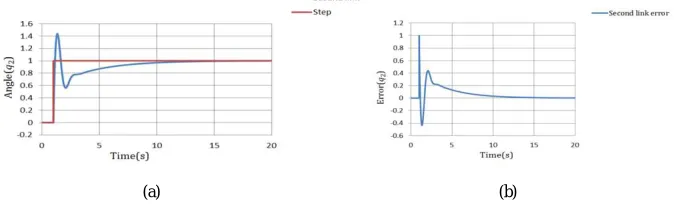
Fig.5.(a) Closed loop response of the second link using fuzzy controller (b) Closed loop error response of the second link using fuzzy controller
From the Figures 5 (a) and (b) it can be seen that the second link is not tracking the reference input step. The second link produces oscillations with constant magnitude. The error response shows that the second link has more error than the first link.
So, in order to improve the response of the first link and to reduce the second link error, the fuzzy logic controller is combined with PID, and the simulation results are shown below,
Fig 6 (a) Closed loop response of first link with fuzzy+pid controller. (b) Closed loop error response of first link with fuzzy+pid controller
The figures 6 (a) and (b) shows the response of the two link manipulator for the first link with PID controller. From the response it can be seen that the first link track the reference trajectory between 5 and 10 seconds. Thus the error tends to zero.
Fig. 7 (a)Closed loop response of the second link with fuzzy+pid controller (b) Closed loop error response of the second link withfuzzy+pid controller
(a) (b)
(a) (b)
The figures 7 (a) and (b) shows the closed loop response for the second link with fuzzy+pid controller. From the response it can be seen that the second link tracks the reference step input between 10 and 15 seconds. Thus the error tends to zero between 10 and 15 seconds.
Comparing with Fuzzy control and with the Fuzzy+pid controller, the fuzzy+pid controller shows better response. With Fuzzy controller alone both the links are not tracking the desired trajectory. With Fuzzy+pid controller, the error is reduced to zero and the settling time is between 5-10 seconds and 10-15 seconds for the first and second link respectively.The PID controller is tuned manually.
VI.CONCLUSION
The modelling of two-link manipulator has been done and the performance is analysed using fuzzy and with fuzzy+pid controller. Using the fuzzy controller alone the links are not tracking the desired trajectory. The simulation results shows that the fuzzy+pid controller has better performance than using fuzzy alone.
REFERENCES
[1] Kyoungchul Kong, “Two-degree of freedom control of a two-link manipulator in the rotating coordinate system” IEEE Transactions on Industrial Electronics, vol.62, no. 9, September 2015.
[2] Z. Wenda, W. Gang, X. Gang, and D. Junxiang . “Design of Adaptive Sliding-Mode Controller for Nonlinear System with Modeling Uncertainties”. International Conference on Mechatronics, Electronic Industrial and Control Engineering (MEIC), pp. 1132-1135,2015 [3] FarzamTajdari, ErfanKhodabakhshi, Mansour Kabganian, AlirezaGolgouneh, “Design, Implementation and control of a two-link fully
actuated robot capable of online identification of unknown dynamical parameters using adaptive sliding mode controller ” Artificial Intelligence and robotics(IRANOPEN) 2014.
[4] TahminaZebin, M.S Alam, “Modelling and control of a two-link flexible manipulator using fuzzy logic and Genetic Optimization Techniques” Journal of computers , vol.7, no.3, March 2012
[5] Aalim M mustafa& A Al-Saif , “Modelling, Simulation and control of 2-R robot ” Global Journal of Researches in Engineering Robotics & Nano-Tech, vol.14 & issue.1, October 2014
[6] Gouasmi , M. Ouali, Fernini.B&Meghatria, “Kinematic Modelling and simulation of a 2-R robot using solid works and verification by MATLAB/Simulink ” International Journal of Advanced Robotic Systems, vol.1, Sep 2012
[7] Yusheng Liu and Xing-Yuan Li, “Robust adaptive control of nonlinear systems represented by input output models” IEEE Transactions on Automatic Control, Vol.48, no.6, June 2003
[8] T. Murukami, K. Kahlen and R De Doncker, “Robust motion control based on projection plane in redundant manipulator ” IEEE Transactions on Industrial Electronics, Vol. 49, no.1, pp.248-255, Feb 2002
[9] Yaochujin “Decentralised adaptive fuzzy control of robot manipulators ” IEEE Transactions on systems , man and cybernetics Part B, Vol.28 & Issue.1, Feb 1998
[10] Byung Kook Yoo, WoonChul Ham, “Adaptive control of robot manipulator using fuzzy compensator” IEEE Transactions on Fuzzy Systems, vol.8 & issue 2, April 2000
[11] Fatima Zahra Baghli, Larbi El Bakkali, YassineLakhal. “Multi-input Multi-output Fuzzy Logic Controller for Complex System: Application on Two-Links Manipulator ”8th International Conference Interdisciplinarity in Engineering, INTER-ENG 2014, 9-10 October 2014,
TirguMures, Romania
[12] Salah Kermiche, Saidi Mohamed Larbi, and Hadj Ahmed Abbassi. “Fuzzy Logic Control of Robot Manipulator in the Presence of Fixed Obstacle”. The International Arab Journal of Information Technology, Vol.4, No. 1, January 2007