Web Image Classification Using Sift and
SVM
Minu R.I
1, N. Sakthi Priya
*2Assistant Professor, Dept. of CSE, Jerusalem College of Engineering, Chennai, Tamil Nadu, India 1 Assistant Professor, Dept. of CSE, Bharath University, Chennai, Tamil Nadu, India2
* Corresponding Author
ABSTRACT: Automatic harvesting of web images is a multimodal approach employing both text, metadata, and
visual features are used to gather many high-quality images from the Web. Candidate images are obtained by a text-based Web search querying on the object identifier (e.g., the word penguin). The Web pages and the images are downloaded and the task is to remove irrelevant images and re-rank the remainder. First, the images are re-ranked based on the text surrounding the image. Second, the top-ranked images are used as (noisy) training data and an SVM visual classifier is learned to improve the ranking further. The principal novelty of the overall method is in combining text/metadata and visual features in order to achieve a completely automatic ranking of the images.
KEYWORDS: SVM,Image Retieval, RE-ranking, automatic ranking
1. INTRODUCTION
Image search is a specialized data search used to find images. To search for images, a user may provide query terms such as keyword and the system will return images "similar" to the query. The similarity used for search criteria could be Meta tags, color distribution in images, region/shape attributes, etc.
Image search engines apparently provide an effortless route, but currently are limited by poor precision of the returned images and restrictions on the total number of images provided. The search can generate thousands of images. But these thousand images are not relevant enough to the search query. This is the major drawback in today’s image search.
Largely and mostly relied search types are Text based image search and Content based image search. Text Based Image Search
Here images are retrieved based on the text related to the image. Most of the search uses the features like file name, website name, image title, image alt name etc to find the images relative to the search query. But this type of search will not be a complete one and the accuracy is not up to the level of consideration. Hence other searching is usually done based on the visual content.
Content Based Image Search
In this type of search the actual content of the images is considered. The content will refer to colors, texture and shape. This content based image search is desirable because most web based image rely purely on metadata and this produce lot of garbage in the results. In this method of search image distance measures are used to image retrieval.
Examining images based on the colors they contain is one of the most widely used techniques because it does not depend on image size or orientation. Color searches will usually involve comparing color histograms, though this is not the only technique in practice.
Texture : Texture measures look for visual patterns in images and how they are spatially defined. Textures are represented by texels which are then placed into a number of sets, depending on how many textures are detected in the image. These sets not only define the texture, but also where in the image the texture is located. Texture is a difficult concept to represent[1]. The identification of specific textures in an image is achieved primarily by modeling texture as a two-dimensional gray level variation. The relative brightness of pairs of pixels is computed such that degree of contrast, regularity, coarseness and directionality may be estimated. However, the problem is in identifying patterns of co-pixel variation and associating them with particular classes of textures such as silky, or rough.
Shape does not refer to the shape of an image but to the shape of a particular region that is being sought out. Shapes will often be determined first applying segmentation or edge detection to an image. Other methods like use shape filters to identify given shapes of an image. In some case accurate shape detection will require human intervention because methods like segmentation are very difficult to completely automate.
Our objective in this work is to harvest a large number of images of a particular class automatically, and to achieve this with high precision. Our motivation is to provide training databases so that a new object model can be learned effortlessly[2]. The low precision does not allow us to learn a class model from such images using vision alone. The best challenge is to combine text and visual information in order to achieve the best image re-ranking. The two main contributions are:
First, the text attributes on the Webpage containing the image provide a useful estimate of the probability that the image is in class, and hence, can be used to successfully rank images in the downloaded pool.
Second, is that probability is sufficient to provide (noisy) training data for a visual classifier, and that classifier delivers a superior re-ranking to that produced by the text.
The two- stage improves the initially downloaded images. The class independent text ranker significantly improves this unranked baseline and is itself improved by quite a margin when the vision-based ranker is employed. We compared our proposed discriminative framework (SVM) to unsupervised methods, concluding that the discriminative approach is better suited for this task, and thus, the focus of this work[3]. Others have used text and images together, however, in a slightly different setting.
II. PREVIOUS RESEARCH
For developing any application the ground work must be done. The ground work includes the study on various available resources for developing the application. This chapter deals with the literature survey done for developing the application. Four papers [1], [2], [3], [4] have been used by us which are discussed below.
[1] Wei-Hao Lin, Rong Jin, Alexander Hauptann “Web Image Retrieval Re-Ranking with Relevance Model” this paper explains web image retrieval, which is a challenging task that requires efforts from image processing, link structure analysis, and web text retrieval. Since content-based image retrieval is still considered very difficult, most current large-scale web image search engines exploit text and link structure to “understand” the content of the web images. However, lo- cal text information, such as caption, filenames and adja- cent text, is not always reliable and informative[4]. Therefore, global information should be taken into account when a web image retrieval system makes relevance judgment. In this paper, we propose a re-ranking method to improve web image retrieval by reordering the images retrieved from an image search engine.
results showed that the re-ranked image retrieval achieved better performance than original web image retrieval, suggesting the effectiveness of the re-ranking method. The relevance model is learned from the Internet without preparing any training data and independent of the underlying algorithm of the image search engines. The re-ranking process should be applicable to any image search engines with little effort.
[2] R. Fergus, L. Fei-Fei, P. Perona, A. Zisserman “Learning Object Categories from Google’s Image Search”. This paper deals about current approaches to object category recognition require datasets of training images to be manually prepared, with varying degrees of supervision. We present an approach that can learn an object category from just its name, by utilizing the raw output of image search engines available on the Internet. We develop a new model, TSI-pLSA, which extends pLSA (as applied to visual words) to include spatial information in a translation and scale invariant manner. Our approach can handle the high intra-class variability and large proportion of unrelated images returned by search engines[6]. We evaluate the models on standard test sets, showing performance competitive with existing methods trained on hand prepared datasets.
[7] Mario Fritz and Bernt Schiele” Decomposition, Discovery and Detection of Visual Categories Using Topic Models”. They presented a novel method for the discovery and detection of visual object categories based on decompositions using topic models. The approach is capable of learning a compact and low dimensional representation for multiple visual categories from multiple viewpoints without labeling of the training instances. The learnt object components range from local structures over line segments to global silhouette-like descriptions. This representation can be used to discover object categories in a totally unsupervised fashion. Furthermore we employ the representation as the basis for building a supervised multi-category detection system making efficient use of training examples and out- performing pure features-based representations[7]. The proposed speed-ups make the system scale to large databases. Experiments on three databases show that the approach improves the state-art in unsupervised learning as well as supervised detection. In particular we improve the state- of-the-art on the challenging PASCAL’06 multi-class detection tasks for several categories.
III. HYPOTHESES
The system prevailing at present depends largely on textual features and on some extent to visual features. Hence this system is not efficient to great extent[8]. It displays lot of unwanted images with the images what we require. It does not make the image search a complete one. With the technology that’s prevailing today the search can be quicker but not a full-fledged one. Using textual features alone or visual alone won’t be an encouraging idea, since both have individual de-merits.
Image search largely depends on mining using textual or visual features
Displays lot of unwanted images.
The result contains objects unrelated to the query what we gave as input
IV. RESEARCH METHOD
Using a single feature for image retrieval cannot be a good solution for the accuracy and efficiency. High-dimensional feature will reduce the query efficiency.Low-High-dimensional feature will reduce query accuracy, so it may be a better way using multi features for image retrieval[9]. Color and texture are the most important visual features. Firstly, we discuss the color and texture features separately. On this basis, a new method using integrated features is provided .Currently most widely used image search engine is GOOGLE. It provides its users with textual annotation. Not many images are annotated with proper description so many relevant images go unmatched. Our proposed system textual and visual feature which overcomes above mentioned disadvantages[10].We also provide an interface where user can give query images as input, automatically extracts the color feature and compared with the images in database, retrieve the matching image
4.1 Proposed Framework
The first phase of theblock diagram deals with the creation of image database. Images are retrieved from the internet for the query considered to implement the project. Then the images are classified based on the textual content of the images[11]. Mostly the file name is considered. Then the textually classified images are re-ranked based on the visual features. In this process we try to remove the unwanted sym8bolic images and drawings[12]. We have already trained these symbols and drawing as negative images. Finally based on the histogram values extracted by the SVM scores are given to these images and re-ranking is done.
Fig1. Proposed Design Project is implemented using following modules:
Creating image database
Textual feature extraction
Filtering symbolic images
Extracting visual features
4.1.1 Creating Image Database
Creating image database is the first step of the project. Any of the image search can be use to download the images to create a database[13]. Many numbers of images is downloaded and stored in the image database based on which the entire re-ranking depends. The image databases must contain all sort of images i.e. symbols, drawings and irrelevant images. So that the training both the positive and negative images will be easier.
4.1.2 Text Feature Extraction
There are seven features from the text and HTML tags on the Webpage:
contextR,
context10,
filedir,
filename,
imagealt,
image title,
Website title.
Using these seven textual features, the goal is to re-rank the retrieved images[14]. Each feature is treated as binary: “True” if it contains the query word (e.g., penguin) and “False” otherwise. The seven features define a binary feature vector for each image a=(a1,…a7), and the ranking is then based on the posterior probability, P(y=in-class/a), of the image being in-class, where y 2 fin-class; non-class g is the class label of an image.
We learn a class independent ranker in order to re-rank the images based on the posterior P(y/a). To re-rank images for one particular class (e.g., penguin), we do not employ the ground-truth data for that class[15]. Instead, we train the Bayes classifier using all available annotations except the class we want to re-rank.
This way, we evaluate performance as a completely automatic class independent image ranker, i.e., for any new and unknown class, the images can be re-ranked without ever using labeled ground-truth knowledge of that class.
We compare different Bayesian posterior models for P(y=in-class/a). Specifically, we looked at the suitability of the following decompositions:
Chow- Liw Tree Decomposition Dependencies
The Chow-Liu model approximates the full joint dependency graph as a tree by retaining the edges between variables with the highest mutual information.
Naive Bayes Model
Given the class label for an image, the text features are assumed to be independent. For our application, this is “obviously” not the case, e.g., filename and image alternative tag is highly correlated.
Pairwise Dependencies
Only pairwise dependencies are modeled. This is similar to the Chow-Liu model, but less sparse. Full Joint Model
The full joint probability distribution is learned. If the amount of available training data is too small, the learned model can be inaccurate.
Mixed Naive Bayes Model
Where P (a1,…a4/y) is the joint probability of the first four textual features (contextR, context10, filedir, and filename).
We evaluate the performance using the discriminative logistic regression model.
4.1.3 Filtering Symbolic Images
Since we are mostly interested in building databases for natural image recognition, we ideally would like to remove all abstract images from the downloaded images[16]. However, separating abstract images from all others automatically is very challenging for classifiers based on visual features. Instead, we tackle the easier visual task of removing drawings and symbolic images. These include: comics, graphs, plots, maps, charts, drawings, and sketches, where the images can be fairly simply characterized by their visual features[17]. Example images are shown in Fig. Their removal significantly reduces the number of nonclass images.
Fig 3: Drawings and Symbolic Images
4.1.4 Visual Feature Extraction
All images are first resized to 300 pixels in width. Regions are detected using difference of Gaussians, Multiscale-Harris, Kadir’s saliency operator, and points sampled from canny edge points. Each image region is represented as a 72-dimensional SIFT descriptor[18]. A separate vocabulary consisting of 100 visual words is learned for each detector using k-means, and these vocabularies are then combined into a single one of 400 words. Finally, the descriptor of each region is assigned to the vocabulary[3,4].
The software for the detectors is obtained from Fuller implementation details are given in and are reproduced in our implementation. The 72-dimensional SIFT is based on the work in and driven by the motivation that a coarser spatial binning can improve generalization, as opposed to a finer binning that is more suitable for particular object matching.
Training Images
At this point, we can select np positive training images from the top of the text-ranked list, or those that have
a posterior probability above some threshold. The case of negative images is more favorable: We select nn images
at random from all downloaded images (ten thousands of images) and the chance of any
image being of a particular class is very low. We did not choose to select the nn images from the low-ranked images
of the text ranker output because the probability of finding in-class images there is higher than finding them in the set of all downloaded images.
Note that we do not use the ground-truth at any stage of training, but we split the noisy training images into 10 training and validation sets. That is, the validation set is a subset of the nn top text-ranked images as well as the
nn background images.
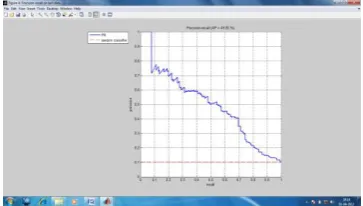
In order to require a performance measure for the cross validation and use precision at 15 percent recall, computed on the validation subset of the np images (treated as positive) and the nn images (treated as negative). This
parameter selection is performed automatically for every new object class.
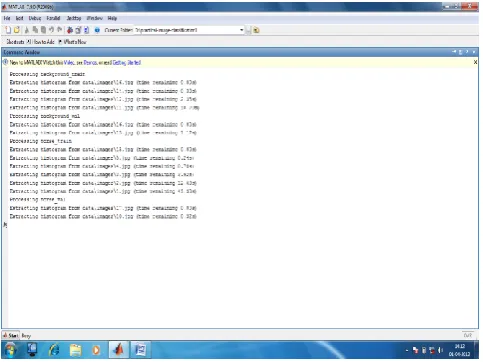
Fig 4: Snapshot of Image Training
Image Ranking
In this section, we evaluate different combinations of training and testing. If not stated otherwise, the text+vision system was used. The clear improvement brought by the visual classifier over the text-based ranking for most classes is obvious. Previously ranked images based on textual features are re-ranked based on visual features. In the process symbolic images and drawings are removed by training them as negative images. Finally all the images are re-ranked based on the histogram values stored after SVM classification. Then all the re-ranked images are displayed to the user with the score for each images.
Support Vector Machine (SVM)
A support vector machine constructs a hyperplane or set of hyperplanes in a high- or infinite-dimensional space, which can be used for classification, regression, or other tasks. Intuitively, a good separation is achieved by the hyper plane that has the largest distance to the nearest training data point of any class (so-called functional margin), since in general the larger the margin the lower the generalization error of the classifier.
Whereas the original problem may be stated in a finite dimensional space, it often happens that the sets to discriminate are not linearly separable in that space[19]. For this reason, it was proposed that the original finite-dimensional space be mapped into a much higher-finite-dimensional space, presumably making the separation easier in that space. To keep the computational load reasonable, the mappings used by SVM schemes are designed to ensure that dot products may be computed easily in terms of the variables in the original space, by defining them in terms of a kernel function K(x,y) selected to suit the problem.
The hyperplanes in the higher-dimensional space are defined as the set of points whose inner product with a vector in that space is constant. The vectors defining the hyperplanes can be chosen to be linear combinations with parameters of images of feature vectors that occur in the data base.
The choices of a hyperplane, the points in the feature space that are mapped into the hyperplane are defined by the relation:
convoluted as a result, allowing much more complex discrimination between sets which are not convex at all in the original space.
Linear SVM
[12] We are given some training data , a set of n points of the form
Where the yi is either 1 or −1, indicating the class to which the point belongs. Each is a p
-dimensional real vector. We want to find the maximum-margin hyperplane that divides the points having from those having . Any hyperplane can be written as the set of points satisfying
Where denotes the dot product and the normal vector to the hyperplane. The parameter determines the offset of the hyperplane from the origin along the normal vector .
We want to choose the and to maximize the margin, or distance between the parallel hyperplanes that are as far apart as possible while still separating the data. These hyperplanes can be described by the equations
And
Scale Invariant Feature Transform (SIFT) Scale-space Extrema Detection
The first stage of computation searches over all scales and image locations. It is implemented efficiently by using a difference-of-Gaussian function to identify potential interest points that are invariant to scale and orientation.[11]
Keypoint Localization
At each candidate location, a detailed model is fit to determine location and scale. Keypoints are selected based on measures of their stability.
Too many keypoints are available:
• points with low contrast (sensitive to noise)
• points that are localized along an edge Low Contrast Points Elimination
• Fit keypoint at to nearby data using quadratic approximation.
• Calculate the local maxima of the fitted function.
• Discard local minima
• “Edge“ keypoints are sensitive to noise, thus should be eliminated.
Orientation Assignment
One or more orientations are assigned to each keypoint location based on local image gradient directions[20]. All future operations are performed on image data that has been transformed relative to the assigned orientation, scale, and location for each feature, thereby providing invariance to these transformations.
, ,
, ,
,
L x y
G x y
I x y
2 2
2 22
1
, ,
2
x y
G x y
e
2 21
( )
2
T T TD
D
D x
D
x
x
x
x
x
1 2 2ˆ
D
D
x
x
x
ˆ
( )
0.03
Keypoint Descriptor
The local image gradients are measured at the selected scale in the region around each keypoint. These are transformed into a representation that allows for significant levels of local shape distortion and change in illumination.
The frequency of each visual word is then recorded in a histogram for each tile of a spatial tiling as shown. The final feature vector for the image is a concatenation of these histograms.
V. RESULT
We first investigate how the classification performance is affected by the choice of np and nn . It can be seen that
increasing nn tends to improve performance. It is, however, difficult to select optimal values for np and nn since
these numbers are very class dependent. Using more images in the background class nn tends to improve the
performance but there is no real difference. All numbers in this section report precision at 15 percent recall.
In order to select the appropriate parameter values, we use cross validation, where the validation set is part of the nþ and nN images as described in Section, together with precision at 15 percent recall as selection criterion. There are two possible cases that can occur:
1) A parameter setting that overfits to the training data. This problem is detected on the validation set due to a low precision at 15 percent recall.
2) All images (training and validation sets) are classified as background. This leads to bad, but detectable, performance as well.
Here, we describe a slight adjustment to this method, which ignores “difficult” images. Parameter settings that classify (almost) all images as fore or background are not useful; neither are those that overfit to the training data. We reject those parameter settings. We then use the “good” parameter settings to train and classify all images. By looking at the distribution of SVM responses (over all parameter settings), we are able to eliminate “intermediate” images, i.e., images that are not classified as positive or negative images in the majority of cases. We assume that those images are difficult to classify and we don’t use those in our model selection step because we cannot rely on their class labels being correct due to the noise.
Note that training is still performed on all images, and the “difficult” images are only discarded during the computation of the precision at 15 percent recall during the cross validation.
This method does not give a significant improvement over all classes, but improves the performance dramatically for some classes, e.g., penguin 90:2% from 9%.The next determine how much the performance is affected by the noise in the training data by training the SVM on ground-truth positive data, i.e., instead of selecting np images
from the text-ranked images, we select np in-class images using the ground-truth labeling.
We find that the text+vision system performs well for the classes where the text ranking performs sufficiently well. If the text ranking fails, the ground-truth performs, as is to be expected, much better than the text ranked based training, e.g., for airplane, camel, and kangaroo. These experiments show that the SVM-based classifier is relatively insensitive to noise in the training data as long as a reasonable noise level is given.
As a baseline comparison, we investigate the performance if no text re-ranking is used, but the np images are
sampled uniformly from the filtered images. If the text re-ranking works well and hence provides good training data, then text+vision improve over the baseline. This is due to the fact that bad text ranking can provide visually consistent training data which does not show the expected class (e.g., for airplanes, it contains many images showing airplane food, inside airplanes/airports, taken out of the window of an airplane).
However, the uniformly sampled images still consist of about 35 percent in-class images and the nn are very
unlikely to contain in-class images.
VI. CONCLUSION
In this project we have analyzed an innovative method of automatic image generation using support vector machine. This implementation presents an approach that is much more superior to the current existing searches. This implementation not only merely retrieves the images from the internet; it refines the images retrieved from the image search. Using only the textual features or using only the visual features would not have brought a drastic improvement in this implementation. But using both the textual and visual features has made a notable difference with the existing system.
Though extracting the histogram and training the images is a tedious process but the result obtained is satisfiable one. Apart from the time consumption this type of search has highly improved performance compared to google or bing image searches. This type of searches will be very useful in artificial intelligence concepts. Face recognition and image comparisons are done easily with this type of search.
The further enhancements of this project lie in the developments of neural network concepts. With this as existing system even more refines classification techniques can be invented. In the field of robotics this sort of image classifying searches are going to play a major role.
REFERENCES
1. K.Barnard, P.Duygulu, N.de Freitas, D.Forsyth, D.Blei, and M.Jordan, “Matching Words and Pictures,” J.Machine Learning Research, vol. 3, pp. 1107-1135, Feb. 2003.
2. T.Berg, A.Berg, J.Edwards, M.Mair, R.White, Y. Teh, E.Learned-Miller and D. Forsyth, “Names and Faces in the News,” Proc. IEEE Conf. Computer Vision and Pattern Recognition, 2004
3. R.I.Minu,Dr.K.K.Thyagharajan “MULTI MODAL ONTOLOGY SEARCH FOR SEMANTIC IMAGE RETRIEVAL” ICTACT Journal
on Image and Video Processing, August 2012, Volume 3, Issue 1, Page(s):473-47
4. R.I.Minu,Dr.K.K.Thyagharajan" A NOVEL APPROACH TO BUILD IMAGE ONTOLOGY USING TEXTON " International symposium on Intelligent Informatics 2012 proceeding published by Springer's INTELLIGENT INFORMATICS, Advances in Intelligent Systems and Computing,2013,Volume 182 Pg:333-339
5. R.I.Minu,Dr.K.K.Thyagharajan"SCRUTINIZING THE VIDEO AND VIDEO RETRIEVAL CONCEPT"International Journal of Soft Computing and Engineering Volume-1, Issue-5, November 2011, ISSN: 2231-2307 (Online) Pg270-275
6. R.I.Minu,Dr.K.K.Thyagharajan”Automatic Image Classification using SVM classifier”•,CIIT International Journal of Data Mining & Knowledge Engineering ISSN 0974 – 9683 & Online: ISSN 0974 – 9578
7. T.L.Berg and D.A.Forsyth, “Animals on the Web,” Proc. IEEE Conf. Computer Vision and Pattern Recognition, 2006. 8. D.Blei, A.Ng, and M.Jordan, “Latent Dirichlet Allocation,” J.Machine Learning Research, vol. 3, pp. 993-1022, Jan. 2003. 9. K.K.Thyaghrrajan,R.I.Minu "Prevalent color extraction and Indexing" International journal of Engineering and Technology,Jan 2014. 10. Udayakumar R., Khanaa V., Saravanan T., "Analysis of polarization mode dispersion in fibers and its mitigation using an optical
compensation technique", Indian Journal of Science and Technology, ISSN : 0974-6846, 6(S6) (2013) pp. 4767-4771.
11. G.Nagarajan,.K.K.Thyagharajan(Jan 2012) “A Novel Image Retrieval Approach for Semantic Web” International Journal of Computer Applications (0975 – 8887) Volume 37– No.8, January 2012
12. G.Nagarajan,.K.K.Thyagaharajan “A Machine Learning Technique for Semantic Search Engine”International conference on modeling optimization and computing 2012” NI University,Nagercoil
13. G.Nagarajan,Dr.K.K.Thyagaharajan(2012)”Linguistic Conversion of Syntactic to Semantic Web Page” “The Second International conference on Advances in Computing and Information Technology 2012
14. Udayakumar R., Khanaa V., Kaliyamurthie K.P., "Performance analysis of resilient ftth architecture with protection mechanism", Indian Journal of Science and Technology, ISSN : 0974-6846, 6(S6) (2013) pp. 4737-4741.
16. T.Hofmann, “Unsupervised Learning by Probabilistic Latent Semantic Analysis,” Machine Learning, vol. 43, pp. 177-196, 2001. 17. T.Hofmann, “Probabilistic Latent Semantic Analysis,” Proc. Conf. Uncertainty in Artificial Intelligence, 1999.
18. Udayakumar R., Khanaa V., Saravanan T., "Chromatic dispersion compensation in optical fiber communication system and its simulation", Indian Journal of Science and Technology, ISSN : 0974-6846, 6(S6) (2013) pp. 4762-4766.
19. W.H.Lin, R. Jin, and A. Hauptmann, “Web Image Retrieval Re- Ranking with Relevance Model,” Proc. IADIS Int’l Conf. WWW/ Internet, 2003.
20. D.Lowe, “Object Recognition from Local Scale-Invariant Features, ” Proc. Seventh IEEE Int’l Conf. Computer Vision, pp. 1150-1157, Sept. 1999.
21. Dr. T.Nalini, Dr.K.Manivannan, Vaishnavi Moorthy, Efficient Remote Data Possession Checking In
Critical Information Infrastructures Ensuring
Data Storage Security In Cloud Computing, International Journal of Innovative Research in Computer and Communication Engineering, ISSN (Online): 2320 – 9801,pp 12-18, Vol. 1, Issue 1, March 2013
22. Dr.K.P.Kaliyamurthie, Cervical Cancer Screening and Classification
Using Acoustic Shadowing, International Journal of Innovative Research in Computer and Communication Engineering, ISSN(Online): 2320-9801,pp 1659-1662, Volume 1, Issue 8, October 2013
23. Dr.K.P.Kaliyamurthie, Automated Information Retrieval System Using Correlation Based Multi- Document Summarization Method, International Journal of Innovative Research in Computer and Communication Engineering, ISSN(Online): 2320-9801,pp 4328-4335, Vol. 1, Issue 7, September 2014
24. Dr.K.P.Kaliyamurthie, D.Parameswari, Modelling Cloud Storage, International Journal of Innovative Research in Computer and Communication Engineering, ISSN: 2249-2651,pp 1-5, Volume1 Issue3 Number2–Dec2011
25. Dr.K.P.Kaliyamurthie, D.Parameswari, Implementation of Customized Greencall
Algorithm for Energy-Efficient Of Wireless