ISSN(Online): 2320-9801 ISSN (Print): 2320-9798
I
nternational
J
ournal of
I
nnovative
R
esearch in
C
omputer
and
C
ommunication
E
ngineering
(An ISO 3297: 2007 Certified Organization)
Vol. 3, Issue 4, April 2015
Clustering Based Routing Protocol
(LEACH Protocol)
Khushboo Manohar1, A. I. Darvadiya2
Department of Electronics and Communication, C. U. Shah University, Wadhwan City, India1
Asst. Prof, Department of Electronics and Communication, C. U. Shah University, Wadhwan City, India2
ABSTRACT: Contemporary expansions in the field of Micro-electro-mechanical system (MEMS) technology,
microelectronics and network communications are making it possible to establish in a wide-ranging Wireless sensor network. Now a days these sensor networks have come into prominence because they hold the potential to revolutionize many segments. The Wireless Sensor Network (WSN) is made up of a collection of small and intelligent sensor nodes, these nodes have energy constrained devices. So, to increase lifetime of sensor network and throughput, we have to save energy. This is done by shaping an efficient cluster-head selection technique based on soft thresholding method and by using efficient dual amplification energy. In this paper, we are drawing a new technique for cluster-head selection. The work is simulated in MATLAB 8.1.0.604, and the result will shows increase in the network lifetime and throughput.
KEYWORDS: WSN, LEACH, lifetime, soft-threshold, lasting energy, throughput.
I. INTRODUCTION
Wireless Sensor Networks (WSN's) are being used in physical phenomenon such as industrial monitoring, surveillance, traffic monitoring, cropping monitoring, habitat monitoring, and crowd counting etc. which calls for monitoring before taking an appropriate action. WSN typically established in a geographical area in which hundreds or thousands of sensor nodes that are deployed to sense events. Many theoretical considerations have received by Wireless sensor networks
(WSN) and this technology is considered with huge influence in the current century [1]. The growing use and recent
ISSN(Online): 2320-9801 ISSN (Print): 2320-9798
I
nternational
J
ournal of
I
nnovative
R
esearch in
C
omputer
and
C
ommunication
E
ngineering
(An ISO 3297: 2007 Certified Organization)
Vol. 3, Issue 4, April 2015
Fig.1: Wireless Sensor Network [4]
A few examples of application are
Military application
Environmental application
Health application
Industrial application
Other application
II. BACKGROUND
Wireless Sensor Networks (WSN) is an active research area in today’s computer science and telecommunication. The development of clustered sensor networks have recently been shown to decrease system delay, save energy while performing data aggregation and increase system throughput. These are strong motivational points behind selecting LEACH as the baseline protocol for the analytical study.Also LEACH has a few but very significant disadvantages like it assumes all the nodes to have same energy, which is not the case always in real-time problems, its cannot be applied for mobile nodes, failure of cluster-heads creates a lot of problems and it doesn’t take into account that the systems might have multiple base stations. A node which generates data and events is called source node where event is information to be routed. In wireless sensor network data and queries are routed this process is called data dissemination. There are various data dissemination methods. Here we will discuss about some of FLOODING, GOSSIPING and SPIN in detail. Flooding: In the flooding protocol each node receives a data or management packet
recurrences the packet by broadcasting it. Only packets that are destined for the node itself or packets[5] whose hop
count has surpassed a preset limit are not forwarded. The main advantage of flooding is that it needs no costly topology maintenance and route discovery. When the sent packet follows all possible routes for their terminus, if any topology changes earlier sent packets would simply follow the new routes. Flooding does though have several problems. One
ISSN(Online): 2320-9801 ISSN (Print): 2320-9798
I
nternational
J
ournal of
I
nnovative
R
esearch in
C
omputer
and
C
ommunication
E
ngineering
(An ISO 3297: 2007 Certified Organization)
Vol. 3, Issue 4, April 2015
Gossiping: The Gossiping protocol is based on the flooding protocol[5]. In its place of broadcasting each packet to all
neighbors the packet is sent to a single adjacent neighbor chosen at random from a neighbor chart. Those node having the received packet, the neighbor picks it another random node to send packet. This packet may contain the node ID which sent the packet. This continues until the packet reaches to its terminus or to the maximum hop count of the packet will be exceed. Gossiping protocol evades the collision problem which are knowledgeable by flooding and only a single copy of a packet is in shipment at a single time. SPIN: The SPIN stands Sensor protocol for information via negotiation, Spin protocol family is a combination for the development of the flooding protocol which was based on
data-centric routing[7]. In order to overcome the problems of collapse and overlap the SPIN family of protocols uses 3
way cooperation before sending data. ADV is used to advertise a message to its neighbor’s node. REQ is used for requesting data. DATA is for data. Data gathering: The main motto of data gathering algorithm is effectual use of energy in order to maximize the lifespan of the network by increasing number of rounds. Various protocols for data gathering are: LEACH, PEGASIS.
LEACH: LEACH (Low Energy Adaptive Clustering method). In this protocol, each clusters and cluster heads are formed. Clusters are assortment of nodes. Cluster head gathers data from the cluster nodes within the cluster and then forward the collected data to the Base Station. PEGASIS: PEGASIS (Power-Efficient Gathering in Sensor Information Systems). PEGASIS method of open chain staring from the node which is farthest from Base Station. It undertake that global information is available. This algorithm uses a greedy algorithm for the chain structure. Before first round of
data transmission for the chain formation is done[8]. For the duration of formation of chain upkeep must be taken so that
nodes which are already in chain should not revisited. When a node die then chain will be reconstructed by bypassing
that node. In Rong Ding [9] paper, they presented a novel cluster-head selection algorithm. Instead of changing the
threshold value directly to 0, the proposed algorithm will adjust the threshold of each node gradually according to the characters they had played in the previous round, so more nodes could have the opportunity to be CHs. The Simulation results will show that the proposed algorithm outperforms LEACH in network lifetime by an average of 30% approximately.
III. LEACH PROTOCOL
LEACH stands for Low-energy adaptive clustering hierarchy. It is first proposed by Wendi B. Heinzelman of MIT[2]. It
is TDMA based MAC protocol which are combined with clustering and routing protocol in the sensor network. It is a clustering-based protocol which is used to minimize energy dissipation in sensor networks.The reason we need these type of protocol for network like LEACH is due to the fact that a node in the sensor network is no longer useful when its battery dies. The main objective of clustering techniques are effective load balancing which is used to achieve data processing and significant intra-cluster management. Fault tolerance used to avoid important sensor data in a harsh environment. Maximal network longevity: As we know that sensor nodes are energy constrained device, so the Cluster head should be loaded carefully, which on failure may lead to the death of Cluster Head foremost to funnel occurrence. The protocol is a clustering-based protocol which minimizes energy dissipation in sensor networks. Reason we need such network protocol like LEACH protocol is due to the fact that a node in the sensor network is no longer used to sense data, when sensor node battery exhaust. LEACH protocol allows to space out the life expectancy of the nodes, which allow sensor node to do only the minimum work when it needs to transmit data otherwise it will go in not sensing mode. The main determination of leach is to randomly choice sensor nodes as cluster-heads, thus the high-energy dissipation in communicating with base station is spread among all sensor nodes in the sensor network.
ISSN(Online): 2320-9801 ISSN (Print): 2320-9798
I
nternational
J
ournal of
I
nnovative
R
esearch in
C
omputer
and
C
ommunication
E
ngineering
(An ISO 3297: 2007 Certified Organization)
Vol. 3, Issue 4, April 2015
Fig.4: LEACH Protocol [10]
( ) =
1− ∗ ∗
T(n) = 0 otherwise
Where p is the probability of the node being selected as a cluster-head node, r is the number of rounds, and G is the
set of nodes that have not been cluster-heads in the last 1/p rounds, mod denotes modulo operator. Nodes that are
cluster-heads in round r shall not be selected in the next 1/p rounds. In Steady phase :-During the steady phase, the
sensor nodes i.e. the non-cluster head nodes starts sensing data and sends it to their cluster-head according to the TDMA schedule. The cluster-head node, after receiving data from all the member nodes, aggregates it and then sends it to the base-station. After a certain time, which is determined a priority, the network again goes back into the setup phase and new cluster-heads are chosen. Each cluster communicates using different CDMA codes in order to reduce interference from nodes belonging to other clusters
IV. PROPOSED WORK
In this paper we propose a new routing technique called advance LEACH based on the efficient selection of cluster-head scheme & considering the type of communication between within the cluster. Every time or in every round cluster-head election procedure is done after that cluster formation is required. This indications an unnecessary routing overhead resulting in excessive use of inadequate amount of energy of the sensor node. If a cluster-head did not utilized much of its energy during last round than there will be a probability that some low energy node may not replace it as a cluster-head in the next cluster-head selection process. In basic LEACH algorithm, cluster-head selection is based on a kind of hard thresholding techniques. Once a node has been elected as a Cluster-head, the threshold value for again election as a Cluster-head is changed to 0 directly & that node lose its chance to become a Cluster-head again, even it has enough energy. So, in our proposed scheme cluster head selection will be done on the basis of hard thresholding technique, with the use of lasting energy.
Pseudo code for the proposed protocol Round 1:
1. In the first round all the sensor node generates a random number between 0 and 1 & if it is less than T(n), then
elected as cluster head for the round.
2. CH broadcast advertisement.
3. Sensing & reporting is based on the mode of transmission.
Round 2:
4. For very next round, it will check
If energy of existing cluster-head < threshold Then initiate cluster-head formation Or,
ISSN(Online): 2320-9801 ISSN (Print): 2320-9798
I
nternational
J
ournal of
I
nnovative
R
esearch in
C
omputer
and
C
ommunication
E
ngineering
(An ISO 3297: 2007 Certified Organization)
Vol. 3, Issue 4, April 2015
Then previously made cluster head is used for next round
5. Election of the next cluster.
6. CH broadcast advertisement
V. SIMULATION RESULTS
A. Simulation platform
This experiment is performed in MATLAB simulator. MATLAB software is used to simulate different routing protocols. MATLAB (matrix laboratory) is a numerical computing environment and it developed by MathWorks and also it is fourth-generation programming language.
B. Simulation Setup
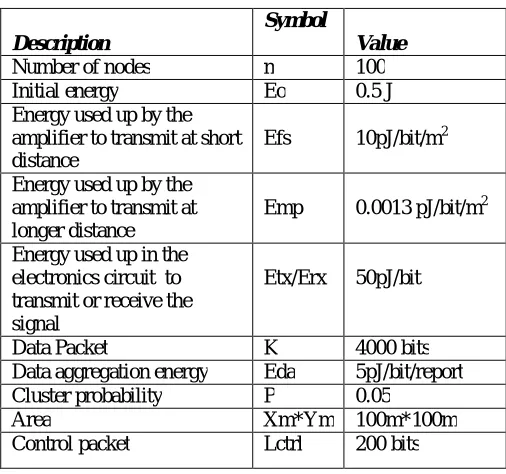
The basic simulation parameter for the model are mentioned in table I. The experiment is carried out by using the
homogenous network having same energy source have initial energy is 0.5J. Every node transmits a data packet of k
bits per round to its cluster-head. The size of a control packet Lctrl is 200 bits and Rmax=3000.
A hundred sensor nodes are organized randomly in the field of 100m×100m sq. meters. The Base Station (BS) is situated at (50,50)m.
Table 1: simulation parameter
Description
Symbol
Value
Number of nodes n 100
Initial energy Eo 0.5 J
Energy used up by the amplifier to transmit at short distance
Efs 10pJ/bit/m2
Energy used up by the amplifier to transmit at longer distance
Emp 0.0013 pJ/bit/m2
Energy used up in the electronics circuit to transmit or receive the signal
Etx/Erx 50pJ/bit
Data Packet K 4000 bits
Data aggregation energy Eda 5pJ/bit/report
Cluster probability P 0.05
Area Xm*Ym 100m*100m
Control packet Lctrl 200 bits
C. Simulations Results
In WSNs, there are a lot of parameters to evaluate a clustering algorithm. In this paper, by increasing the number of alive node and using lasting energy of sensor node, we can increase the network lifetime and result will compare the performance of the improved algorithm of the proposed algorithm with LEACH. If sensor node’s energy gone less than zero, we can termed it as a dead node. When all nodes in the sensor network got dead, we can realize that the sensor network is faile. Figure 5 shows the network establishment of our proposed work in the field of 100m×100m.
The simulation results portrayed in Figure 6 shows increase in the number of alive node as compared from the existing LEACH.
ISSN(Online): 2320-9801 ISSN (Print): 2320-9798
I
nternational
J
ournal of
I
nnovative
R
esearch in
C
omputer
and
C
ommunication
E
ngineering
(An ISO 3297: 2007 Certified Organization)
Vol. 3, Issue 4, April 2015
0 500 1000 1500 2000 2500 3000 0 10 20 30 40 50 60 70 80 90 100 rounds N o .o f A liv e N o d e s Proposed LEACH
Fig.5: Network establishment Fig. 6: No. of alive node
Fig. 7: No. of dead nodes Fig.8: residual energy
The simulation results portrayed in Figure 7 shows network lifetime of the proposed work which is compared from the existing LEACH.
From all the simulation result portrayed in the above figures, we can convey that in the proposed work, nodes started dying later due to efficient use of cluster-head selection technique and also by considering the dual amplification energy during the communication between the nodes. So, by performing this experiment proposed method shows increases network lifetime.
IV. CONCLUSION AND FUTURE WORK
In Wireless Sensor Networks the main purpose of designing energy efficient routing protocol is to efficiently use the energy of the network so that the network lifetime get increased. In this paper one of the most efficient routing algorithms everyone uses is the LEACH routing protocol. In this paper we had design a new way of selecting a cluster-head, with this new descendent of LEACH we can increase the number of alive node, decrease the number of dead nodes, in comparison with LEACH and get the better result than LEACH and improve the network lifetime with 0.5J/node energy over a network area of 100m×100m. In future concept of lasting energy and type of communication and implemented together with the concept of chain formation will give the better result for wireless sensor network.
0 10 20 30 40 50 60 70 80 90 100 0 10 20 30 40 50 60 70 80 90 100
0 500 1000 1500 2000 2500 3000
0 10 20 30 40 50 60 70 80 90 100
rounds
N
o
.o
f
D
e
a
d
n
o
d
e
s
Proposed LEACH0 500 1000 1500 2000 2500 3000
ISSN(Online): 2320-9801 ISSN (Print): 2320-9798
I
nternational
J
ournal of
I
nnovative
R
esearch in
C
omputer
and
C
ommunication
E
ngineering
(An ISO 3297: 2007 Certified Organization)
Vol. 3, Issue 4, April 2015
Fig. 9: Network lifetime Fig. 10: Throughput
REFERENCES
[1] Salim El khediri, Nehaj Nasri, Anne Wei, Abdennaceur Kachouri,”A New Approach for clustering in wireless sensor network”, procedia
computer science 32 (2014) 1180-1185.
[2] Wendi Rabiner Heinzelman, Anantha Chandrakasan, and Hari Balakrishnan,”Energy Efficient Communication Protocol for Wireless
microsensor network”, Proceedings of 33rd Hawaii International Conference on the system science-2000.
[3] Wendi B. Heinzelmaan, Anantha P. Chandrakasan, Hari Balakrishnan,”An Application Specific Prptocol Architecture for Wireless microsensor
Network”, IEEE transactions on wireless communications, vol. 1, no. 4, october 2002.
[4] C. Edward,”Wireless Sensor network”,ppt., April 2014.
[5] Kemal Akkaya , Mohamed Younis ,”A survey on routing protocols for wireless sensor”, networks Ad Hoc Networks 3 (2005),pp 325–349.
[6] Gurbhej Singh, Harneet Arora,” Review on Data Dissemination and Gathering in Wireless Sensor Networks”,International Journal of Emerging
Research in Management &Technology, February 2013.
[7] AnkitJoshi,LakshmiPriya.M. "A Survey of Hierarchical Routing Protocols in Wireless Sensor Network", In Second International Conference on
Information Systems and Technology, pp. 67.
[8] A. Seetharam, A. Acharya , A. Bhattacharyya , M. K. Naskar ,” An Energy Efficient Data Gathering Protocol for Wireless Sensor
Networks”,Journal of Applied Computer Science, no.1 (2) /2008,Suceava.
[9] Xiaobing Wu and Guihai Chen,” Dual-Sink: Using Mobile and Static Sinks for Lifetime Improvement in Wireless Sensor Networks”, IEEE,
1-4244-1251-X/07,2007.
[10] Potdar V, Sharif A, Chang E, “Wireless sensor networks: A survey”, proceeding of International Conference on Advanced Information
Networking and Applications, Piscataway, NJ: Institute of Electrical and Electronics Engineers Inc., pp. 636-641, 2009.
[11] Qian Liao, Hao Zhu, “An Energy Balanced Clustering Algorithm Based on LEACH Protocol” Proceedings of the 2nd International Conference
On Systems Engineering and Modeling (ICSEM-13)
[12] Meena Malik, Dr. Yudhvir Singh, Anshu Arora, “Analysis of LEACH Protocol in Wireless Sensor Networks” International Journal of
Advanced Research in Computer Science and Software Engineering, Volume 3, Issue 2, February 2013.
[13] Ravneet Kaur, Deepika Sharma and Navdeep Kaur, “Comparative Analysis Of Leach And Its Descendant Protocols In Wireless Sensor
Network” International Journal of P2P Network Trends and Technology- Volume3 ,Issue1- 2013.
BIOGRAPHY
Khushboo Manoharis aM.tech in the Electronics and Communication Department, C. U. Shah College of Engineering
& Technology, C. U. Shah University. She received Bachelor of Technology degree in 2012 from MGITER, Surat,Gujarat, India.
A. I. Darvadiya is a Asst. professor in the electronics and Communication Department, C. U. Shah College of
Engineering & Technology, C. U. Shah University.
0 500 1000 1500 2000 2500 3000
0 1 2 3 4 5 6 7 8 9 10x 10
4
rounds
N
e
tw
o
rk
l
if
e
ti
m
e
Proposed LEACH
0 500 1000 1500 2000 2500 3000
0 10 20 30 40 50 60 70 80 90