ISSN(Online): 2320-9801
ISSN (Print): 2320-9798
I
nternational
J
ournal of
I
nnovative
R
esearch in
C
omputer
and
C
ommunication
E
ngineering
(An ISO 3297: 2007 Certified Organization)
Vol. 3, Issue 9, September 2015
Multiple Jammer Localization for Minimizing
Error in Wireless Sensor Networks
Sneha V.Tiwari1, Prof. Munmun Bhagat2
Research Scholar, Dept. Computer Engineering
,
RMD Sinhgad School of Engineering,
Pune, India Professor, Dept. Computer Engineering,
RMD Sinhgad School of Engineering, Pune, IndiaABSTRACT: Jamming attack can severely affect the performance of Wireless sensor networks (WSNs) due to the
broadcast nature of wireless medium and jammers position information allows the defender to actively eliminate the jamming attacks. Thus, in this paper, our aim to localize one or multiple jammers to obtain high accuracy .In most of already existing jammer localization schemes they had utilized indirect measurements ( hearing ranges) to minimize attacks occurred by jammer, but it was failure to localize jammers accurately. Hence to delimit the jammer localization we exploited a direct measurement i.ethe strengthen of jamming signals (JSS) with the improvement of jammer node method. We devised an estimation scheme which is based on ambient noise floor and validating it with real-world experiments. Furtherly, for reducing estimation errors, we defined an evaluation feedback metric for quantifying the estimated errors and formulate jammer localization as a nonlinear optimization problem, whose global optimal solution is close to jammers’ true positions. Our simulation will be able to show that our minimizing error based framework achieves better performance in the comparison of the existing schemes. In this paper we took the average of jammer location obtained by jammed node based method and JSS based on direct measurement technique.
KEYWORDS: Jammer, centroid localization , Jamming Strength Signal ,Radio Intereference .
I. INTRODUCTION
To localize jammers in wireless sensor network is very challenging .As earlier it has been noted that in wireless sensor network the localization of jammers plays an important role as it causes an unintentional radio interference, or enable a wide range of defense strategies for combating malicious jamming attackers .In earlier , prior work there was use of indirect measurement like neighbouring ranges and hearing ranges which results in accuracy but unable to localize jammer on proper position.
Hence for overcoming earlier challenges and to minimize the error in localization framework and to obtain the accuracy, we formulated a non-linear optimization problemwhich is referred as jammer localization problem and on the other hand defined an evaluation metric as its objective function. The evaluation metric reflects the value which are closer to the estimated jammers locations from their true locations, and thus from this we can obtain the best estimations which minimize the evaluation metric. In this paper we have proposed a jammer node based method which utilizes a prior work and by enhancing it we can obtain the accuracy as compare to prior work.
A. Jamming attacks in wireless network
An entity known as Jammer which always try to perform the interference of transmission and
reception of packets in physical arrangement of wireless communication . In jamming attack ,a
network get jammed by the continuous emission of Radio Frequency signal perform in wireless
ISSN(Online): 2320-9801
ISSN (Print): 2320-9798
I
nternational
J
ournal of
I
nnovative
R
esearch in
C
omputer
and
C
ommunication
E
ngineering
(An ISO 3297: 2007 Certified Organization)
Vol. 3, Issue 9, September 2015
There are various types of jamming attacks in wireless network.
i) Constant jammer
ii) Deceptive jammer
iii) Random jammer
iv) Reactive jammer
Constant Jammer: In constant jammer , it continuously emits a radio signal and transmit randomly arranged bits to the channel. As, It does not follows any MAC layer etiquettely and also not waits for the channel to become indolently. Deceptive Jammer: In Deceptive jammer, regular packets gets injected continuously to the channel and packets getdeceived by the usual nodes and normal nodes just checks the preamble and remains noiseless.
Random Jammer: In Random jammer, there is alternate sleeping and jamming after jamming occur for tj units of time between them , it turned off its radio and enters into sleeping mode randomly. After entering to sleep mode for ts units of time, it wakes up and resumes jamming constant or deceptive.
Reactive Jammer: In Reactive jammer, Jammer stayed quiet when the channel indolent and it starts transmitting a radio signal as soon as it senses activity on the channel . It is not preserving energy because the jammers is continuously on in order to intellect the channel however it is harder to detect.
Interference Level in wireless sensor network: It is used to define a distance between jammer and nodes. And also defining the relative transmission power of the jammer and nodes. In wireless network the MAC protocols get engaged by the nodes.
Detecting jammer attacks in wireless sensor network: By using strength of signal, carrier sensing time and PDR the jamming attacks can be perceived.
(A)Jammer is off (B)Jammer is on
Fig 1.Jammer Region
II. RELATED WORK
In the literature survey we are going to discuss recent methods over the jammer localization approaches: Below in literature we are discussing some of them which are used in prior work
Pelechrinis et al.[1] proposed to localize the jamming by measuring packet delivery rate (PDR) and performing gradient decent search. However, they did not present performance evaluation. Liu et al. utilized the network topology changes caused by jamming attacks and estimated the jammer’s position by introducing the concept of virtual forces. The virtual forces are derived from the node states and can guide the estimated location of the jammer towards its true position iteratively. Both jamming localization algorithms are iterative-based, while our algorithm leverages the neighbour changes caused by jamming attacks to localize jammers in one round.
ISSN(Online): 2320-9801
ISSN (Print): 2320-9798
I
nternational
J
ournal of
I
nnovative
R
esearch in
C
omputer
and
C
ommunication
E
ngineering
(An ISO 3297: 2007 Certified Organization)
Vol. 3, Issue 9, September 2015
problem of conducting radio interference attacks on wireless networks, and second we examine the critical issue of diagnosing the presence of jamming attacks.
I. Broustis et al [7] experimented to gather all the information with regards to PDR. Z. Liu et al [3] Wireless Networks (WiNet) performed simulation results have shown that the virtual-force iterative approach is effective in localizing the jammer with high accuracy and outperforms the existing centroid based methods.
P Bahl et al [9] They utilized the network topology changes caused by jamming attacks and estimated the jammer’s position by introducing the concept of virtual forces. The virtual forces are derived from the node states and can guide the estimated location of the jammer towards its true position iteratively. Both jamming localization algorithms are iterative-based, while our algorithm leverages the neighbor changes caused by jamming attacks to localize jammers in one round.
Y. Chen et al [3], proposed a least squares (LSQ) based localization algorithm. Yingying Chen et al [16] ” An Error Minimizing Framework for Localizing Jammers in Wireless Networks [6] defined an evaluation feedback metric that quantifies the estimation errors of jammers’ positions.In this project particularly , we combined the centroids based localization with the existing error minimizing framework to extend. By combining these two methods we can achieve the better result to locate the jammer in wireless network.
III.PROPOSED ALGORITHM
As jammer is mostly having different attacking strategies which are mentioned above section, Hence in this paper we have mainly focused on a common type of jammer is constant jammers. A constant jammers are the jammers which emits radio interference signals continously either the channel remains idle or not to receive or send the packet . Dueto this jammers the network get disturbed continously without any interruption. For example, considering an scenario that a node B is a neighbour of node A and if node A can communicate with node B prior to jamming .The network nodes can be classified into three categories according to the impact of jamming: unaffected node, jammed node, and boundary node:
Unaffected node: An unaffected node are a nodes which are able to communicate with all of its neighbours node.Unaffected node rarely get affected by jamming attack and are not able to calculate accurate JSS measurements.
Jammed node: A jammed node are a nodes which are not able to communicate with any of the unaffected nodes. As it has been noted that this type of node can measure the strengthen of signal (JSS), but cannot always report their measurements.
Boundary node: A boundary node are a nodes which allows one to communicate with its neighbours node partly ,as not from all of its neighbours nodes which get jammed due to jammer. Hence this nodes not only able to measure the JSS , but also report their measurements to a designated node to localize the jammer.
ISSN(Online): 2320-9801
ISSN (Print): 2320-9798
I
nternational
J
ournal of
I
nnovative
R
esearch in
C
omputer
and
C
ommunication
E
ngineering
(An ISO 3297: 2007 Certified Organization)
Vol. 3, Issue 9, September 2015
A. Proposed Algorithm in exist model:
i) Jammed node based method:
Jammed node based Method is derived from the idea of centroid .It uses location information of all neighboring nodes, which are nodes located within the transmission range of the target node. In case of jammer localization, the target node is the jammer, and the neighboring nodes of the jammer are jammed nodes.
Algorithm 1: Jammer Node Based Method
p = MeasureJSS()
z = Initial positions
whileTerminating Condition True
doez =EvaluateMetric(z, p) ifNotSatisfy(ez)
then z = SearchForBetter()
end if end while
Min ez=ez (xj,yj)=GetEstJammer(z);
(xjammer, yjammer) = GetCentroid(); (xest,yest) = Average(xj,yj, xjammer, yjammer);
B. Localization Formulation In Proposed Work:
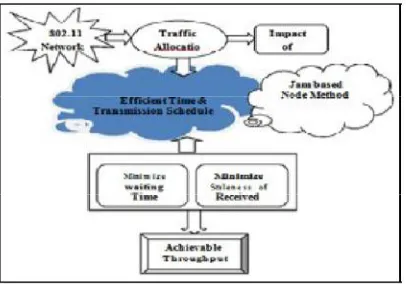
In this proposed model jammer localization formulation approach works as follows. Considering a given set of strength signal JSS for every estimated strengthen jamming signal location, hence it will be able to provide a quantitative evaluation feedback metric which defines a distance between the jammer of estimated locations and its true locations. Efficient Time &Transmission Schedule Jam based Node Method
Considering an example, as a value of evaluation metric gets minimize it shows closest distance between the estimated jammer and the true localised jammer and vice versa. Although it was not able to adjust the estimated jammer directly, hence it becomes possible with high probability jammers distance. Following this idea, our proposed approach comprises two steps:
1. Strength Of Signal (JSS) Collection : It is a collection of a strengthen signal obtained from each node.
2. Best Estimation Searching: The value obtained from the collected JSS, a node having high strength signal will
get jammed through the jammer position. The further details are describing in Algorithm 1. The search based localization of jammer approaches have a few challenging subtasks:
a.EvaluateMetric(): It is used to define an appropriate value of metric for quantifying the locations of estimated jammers from its true positions.
b.MeasureJSS(): It is used to measure a JSS strengthen signal of jammer of each node in regular transmission.
c.SearchForBetter(): It is used to search efficiently for the b est estimation node distance from its true location.
d.GetEstJammer(): It is used to define the value of distance obtained from the true jammer to the estimated jammer.
ISSN(Online): 2320-9801
ISSN (Print): 2320-9798
I
nternational
J
ournal of
I
nnovative
R
esearch in
C
omputer
and
C
ommunication
E
ngineering
(An ISO 3297: 2007 Certified Organization)
Vol. 3, Issue 9, September 2015
C. Localization Using Smart Estimation Of Ambient Noise Algorithm:
Previously in prior work used method were dependent on indirect measurement which results in an inaccuracy to position a jammer. As for overcoming this issue nextly it get focused on the direct measurements with the replacement of indirect measurements by enhancing the jamming signal strength which is very difficult to estimate. Hence due to this we develop an estimation method which rely on ambient noise floor. For increasing the accuracy between jammers and their position, an evaluation feedback metric has been defined to evaluate the estimated error and derive jammer localization as a nonlinear optimization problem.
Ambient Noise Floor is defined a sum of The all unwantedsignals get summed together which are always present to define an Ambient Noise and the ambient noise floor is defined as the measurement of unwanted signals i.e Ambient Noise.
JSS estimation
For originating the signal strength of jamming , our method contains sampling surrounding noise values nevertheless of whether the channel is ideal or busy.
IV.MATHEMATICALMODELOFPROPOSEDWORK:
Pr = Pf + Xσ ……….[1]
Where ,
Pr = The received signal power subject to random attenuation.
Pf = The received signal strength subject to path loss attenuation.
Xσ = Gaussian zero-mean random variable with standard deviation σ.
Pf = Pt + K − 10η log10(d)……….[2]
Where,
Pf = The received signal strength subject to path loss attenuation. Pt = The power of a transmitted signal.
K = A unitless constant which depends on the antenna characteristics and the average channel attenuation.
η = The Path Loss Exponent.
..…..[3] Where,
Xσi = Random attenuation at a boundary node i. Xσ = Standard Deviation of random attenuation. Z = Unknown variable vector of jammer.
ISSN(Online): 2320-9801
ISSN (Print): 2320-9798
I
nternational
J
ournal of
I
nnovative
R
esearch in
C
omputer
and
C
ommunication
E
ngineering
(An ISO 3297: 2007 Certified Organization)
Vol. 3, Issue 9, September 2015
……[4] Where,
dji = Distance between jammer j and boundary node i.
Xjj = Co-ordinate x of jammer j. Yjj = Co-ordinate y of jammer j.
Xi = X Co-ordinate of a boundary node i. Yi = X Co-ordinate of a boundary node i.
s = [s1, s2,. . .,sn] (s = sa∪sc) Where s is a subset of sa and sc as,
sa = {si|si = PJ}
It contains the ambient noise measurements when only jammers are active.
sc = {si|si = PJ + PC}
It contains ambient noise measurements when both jamming signals (PJ ) and signals from one or more senders (PC) are present.
……[5] Where ,
Xjammer = X co-ordinates of jammed region. Yjammer = Y co-ordinates of jammed region.
Xi = X co-ordinates of boundary region i.
Yi = Y co-ordinates of boundary region i.
N = No. of jammed nodes.
……..[6] Where,
Xjammer = value obtained of X co-ordinate from centroid localization algo.
Yjammer = value obtained of Y co-ordinate from centroid localization algo.
xj = value obtained using evaluation feedback metric.
yj = value obtained using evaluation feedback metric of y co-ordinate.
Xj,Yj = New value obtained by taking average.
V. PROPOSED ALGORITHM JAMMED NODE BASED METHOD:
Jammed node based Method is derived from the idea of centroid.It uses location information of all neighboring nodes, which are nodes located within the transmission range of the target node. In case of jammer localization, the target node is the jammer, and the neighboring nodes of the jammer are jammed nodes. This method collects all coordinates of jammed nodes, and find the averages over their coordinates as the estimated position of the jammer. By assuming that there are N jammed nodes (X1; Y1); (X2; Y2); :::; (XN; YN), the position of the jammer can be estimated by:
ISSN(Online): 2320-9801
ISSN (Print): 2320-9798
I
nternational
J
ournal of
I
nnovative
R
esearch in
C
omputer
and
C
ommunication
E
ngineering
(An ISO 3297: 2007 Certified Organization)
Vol. 3, Issue 9, September 2015
Localizing Jammers by Average :
Finaly to localize the jammer with more accuracy we will takethe average of (Xj,Yj) with less ez and (Xjammer,Yjammer)
calculated by Jammer Node Based Method. By taking theaverage of these two values we can localize the jammer with high accuracy.
(Xj,Yj)=((Xjammer+Xj)/2,(Yjammer+Yj)/2)…..[8]
V. RESULTANALYSIS
Working of Project:
Step1: Configure a network with a selection of nodes in WSN. Step2: Select a source node and destination node for sending packet.
Step3: Select a route to send a packet from source to destination.
Step4: Select a centre of radius to localize a jammer in an area.
Step5: Apply an jammer node based framework algorithm to obtain accuracy and minimize the error.
Step6: Obtain a result in the form of graph which shows a difference between the proposed method and existing work.
Firstly configure a WSN area with a selected nodes to communicate with each other and made available path to send a
packet from source to destination.
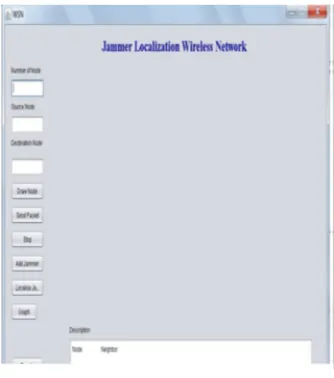
Fig 3: Screenshot of node description GUI.
ISSN(Online): 2320-9801
ISSN (Print): 2320-9798
I
nternational
J
ournal of
I
nnovative
R
esearch in
C
omputer
and
C
ommunication
E
ngineering
(An ISO 3297: 2007 Certified Organization)
Vol. 3, Issue 9, September 2015
Fig 4: Screenshot of node selection and packet delivery GUI
Hence above mentioned the information of sending packets from source to destination. Andin description it is showing the information of all nodes boundary nodes.
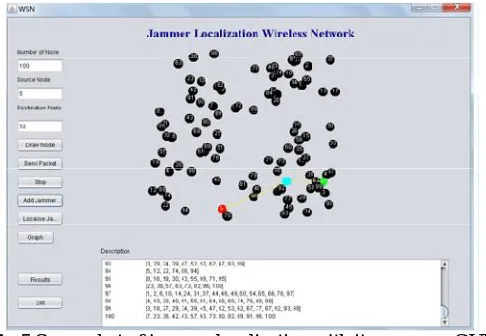
Fig 5.Screenshot of jammer localization with its accuracy GUI.
In above screenshot the jammer get added and localized within the range.
VI.CONCLUSION AND FUTURE WORK
ISSN(Online): 2320-9801
ISSN (Print): 2320-9798
I
nternational
J
ournal of
I
nnovative
R
esearch in
C
omputer
and
C
ommunication
E
ngineering
(An ISO 3297: 2007 Certified Organization)
Vol. 3, Issue 9, September 2015
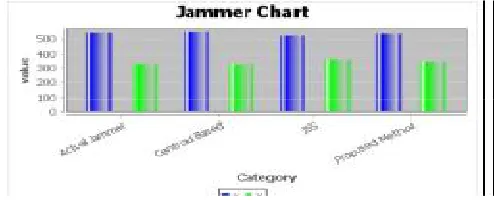
Fig 3 .Graph Region based on comparison of proposed work and existing work
The proposed work implements the jammer localized framework which enhanced the property of evaluation feedback metric with a centroid based algorithm to obtain the accuracyand minimize the error between the jammer.
REFERENCES
[1] K. Pelechrinis, I. Koutsopoulos, I. Broustis, and S.V. Krishnamurthy, “Lightweight Jammer Localization in Wireless Networks:System Design and Implementation,” Proc. IEEE GLOBECOM, 2009.
[2] H. Liu, Z. Liu, Y. Chen, and W. Xu, “Determining the Position of a Jammer Using a Virtual-Force Iterative Approach,” Wireless Networks, vol. 17, pp.
531-547, 2010.
[3] Z. Liu, H. Liu, W. Xu, and Y. Chen, “Exploiting Jamming-Caused Neighbor Changes for Jammer Localization,” IEEE Trans. Parallel and Distributed Systems, vol. 23, no. 3, pp. 547-555, Mar. 2012.
[4] H. Liu, Z. Liu, Y. Chen, and W. Xu, “Localizing Multiple Jamming Attackers in Wireless Networks,” Proc. 31st Int’l Conf. Distributed Computing Systems (ICDCS), 2011.
[5] T. Cheng, P. Li, and S. Zhu, “Multi-Jammer Localization in Wireless Sensor Networks,” Proc. Seventh Int’l Conf. Computational Intelligence and
Security (CIS), 2011.
[6] A. Wood, J. Stankovic, and S. Son, “JAM: A Jammed-Area Mapping Service for Sensor Networks,” Proc. 24th IEEE Int’l Real-Time Systems Symp., 2003.
[7]W. Xu, W. Trappe, Y. Zhang, and T. Wood, “The Feasibility of Launching and Detecting Jamming Attacks in Wireless Networks,” Proc. ACM MobiHoc,
2005.
[8]A. Goldsmith, Wireless Communications. Cambridge Univ. Press, 2005.
[9] T. Rappaport, Wireless Communications—Principles and Practice. Prentice-Hall, 2001.
[10] P. Bahl and V.N. Padmanabhan, “RADAR: An In-Building RFBased User Location and Tracking System,” Proc. IEEE INFOCOM, 2000.
[11]J. Yang, Y. Chen, and J. Cheng, “Improving Localization Accuracy of RSS-Based Lateration Methods in Indoor Environments,” Ad Hoc and Sensor
Wireless Networks, vol. 11, nos. 3/4, pp. 307-329,2011.
[12]D. Goldberg, Genetic Algorithms in Search, Optimization and Machine Learning. Addison-Wesley, 1989.
[13]E. Polak, Computational Methods in Optimization: A Unified Approach. Academic Press, 1971.
[14] P.V. Laarhoven and E. Aarts, Simulated Annealing: Theory and Applications. Springer, 1987.
[15]Z. Liu, H. Liu, W. Xu, and Y. Chen, “Wireless Jamming Localization by Exploiting Nodes’ Hearing Ranges,” Proc. IEEE Int’l Conf. Distributed Computing in Sensor Systems, 2010.
[16] Z. Liu, H. Liu, W. Xu, and Y. Chen, An Error Minimizing Framework for Localizing Jammers in Wireless Networks,2014.
BIOGRAPHY
Sneha V.Tiwari1 is a Research Scholar in the Computer Engineering Department, RMD Sinhagad College of
Engineering,PuneUniversity.Her research interests are Computer Networks,WSN.
Prof, Munmun Bhagat2 working as a Assistant professor in computer Engineering in RMD,Sinhagad College Of