ISSN(Online): 2320-9801
ISSN (Print) : 2320-9798
I
nternational
J
ournal of
I
nnovative
R
esearch in
C
omputer
and
C
ommunication
E
ngineering
(An ISO 3297: 2007 Certified Organization)
Vol. 3, Issue 9, September 2015
Differentiating Identical Twins by Using
Conditional Face Recognition Algorithms
Swati Y. Dhote1, Mrudula S. Nimbarte3, A. D. Gotmare2
Dept. of Computer Engineering, B.D.C.E., Sewagram, Wardha, RTMNU, Nagpur, Maharashtra, India1
Professor, Dept. of Computer Engineering B.D.C.E., Sewagram, Wardha, RTMNU, Nagpur, Maharashtra, India2, 3
ABSTRACT: Reliable and accurate verification of people is extremely important in a number of business transaction as well as access to privileged information. Identical twins have the closest genetics-based relationship and therefore, the maximum similarity between face is expected to be found among identical twins. This paper presents facial features, which has important for the acceptance of expert proof in legal proceedings for determining the identity of an individual from facial images. Our experiments show that modal of face recognition systems can distinguish two different person who are identical twins. We show the effect of using a variety of facial surface representation and suggest a method of identifying identical twins. Performance results are broken out by lighting, expression, gender and age.
KEYWORDS: Facial landmarks, Face and gesture recognition, Identical twins.
I. INTRODUCTION
Authentic and precise verification of people is exceedingly important in a number of business transaction as well as access to favor information [14]. Biometrics, which refers to automatic identification of people based on their physical or behavioral characteristics, is constitutionally more reliable than traditional knowledge-based (password) or token-based (access card) methods of identification [7]. Identical twins can have biometric signatures that are very similar, especially when the signature is derived from a face image. While face recognition software system exhibited inadequate performance, there are other biometric modalities that can offer a performance increase at the cost of increased invasiveness [12].
In this the focus is to evaluate the performance of current face recognition algorithm on a dataset containing face image of identical twins. As the performance of face recognition system in constrained environment continues to improve focus is shifting from methods that improve face recognition performance in general, to methods that handle specific cases of failure. Until recently, a scenario that has been known to confound even human face recognition had not been studied for automated face recognition systems. This setup is the ability to distinguish between identical twins. Because identical twins are genetically equivalent, their facial appearance is also quite similar. Generally, differences in their appearance can only be attributed to exposure to different environmental factors and rare cases of genetic mutations [14].
The work flow of the system is shown below. The proposed system is based on four primary stages. The different phases are Preprocessing, Feature Extraction, Classification, and Verification.
Fig. 1: Process flow of Detection of Identical twins
ISSN(Online): 2320-9801
ISSN (Print) : 2320-9798
I
nternational
J
ournal of
I
nnovative
R
esearch in
C
omputer
and
C
ommunication
E
ngineering
(An ISO 3297: 2007 Certified Organization)
Vol. 3, Issue 9, September 2015
images taken one year apart. The effect of the four covariates can then be applied to images taken on the same day and one year apart to assess the effect of elapsed time on the recognition of twins.
The use of face recognition in forensic applications is becoming more and more common, especially because when other biometric modalities may not be available. The main focus is to assess the performance of current face recognition algorithms on a dataset containing face images of identical twins.
II. RELATED WORK
J. R. Paone, J. M. Grant [1] presented the performance is reported for variations in illumination, expression, gender, and age for both the same day and cross-year image sets. Algorithms are designed to differentiate an image of one person from an image of another person or to confirm if the two images are of the same person.
A. Ariyaeeiniaa, C. Morrison, A. Malegaonkara [2] described a, speaker verification capability for discriminating between identical twins has been investigated. The additional challenge introduced by monozygotic twins the process is due to their identical physiological developments.
M. Bronstein, M. M. Bronstein, and R. Kimmel [3] explored the use of facial surface data, derived from 3D face models (generated using a stereo vision 3D camera), as a substitute for the more familiar two-dimensional images. A number of investigation shave shown that three-dimensional structure can be used to aid recognition
A. Jain, S. Prabhakar, and S. Pankanti, [7] proposed the most widely used measure of fingerprint similarity is based on minute details of the ridges if the relative configuration (e.g., placement and orientation) of ridge anomalies (endings and bifurcations) of two fingers is similar, then their minutiae-based similarity is high. The primary focus of the work is the fingerprint similarity based on the fingerprint minutiae information.
A. Wai-Kin Kong, D. Zhang [8] Examining an automatic palm print system on identical twins and Identifying their genetically related features. Identical twins having the closest genetics-based relationship are expected to have maximum similarity in their biometrics.
P. Jonathon Phillips, Patrick J. Flynn [11] proposed a, ability of face recognition algorithms to distinguish between identical twin siblings. Performance results are reported for both same day and cross year matching. Confidence intervals were generated by a bootstrap method. Recognition performance is reported for three of the top submissions to the Multiple Biometric Evaluation (MBE) 2010 Still Face Track. For the Cognitec FaceVACS system, there is greater overlap between the match distribution and the non-match distribution consisting of identical twin sibling face images than a general impostor distribution.
M. T. Pruitt, J. M. Grant [12] described a, three covariates are examined, namely expression, lighting, and glasses. For the baseline experiments, the expression is neutral, the lighting is controlled, and the subject is not wearing any kind of glasses.
ISSN(Online): 2320-9801
ISSN (Print) : 2320-9798
I
nternational
J
ournal of
I
nnovative
R
esearch in
C
omputer
and
C
ommunication
E
ngineering
(An ISO 3297: 2007 Certified Organization)
Vol. 3, Issue 9, September 2015
III.PROPOSED ALGORITHM
The Fig. 2 describes the system flow. The system is to be composed of a number of sub-systems. These stages are Input Image – image from dataset which is color, Noise Removing –remove the errors in the image, Face Landmark and alignment – measurements of the face for discriminating between two similar looking faces, Based on the eyes face side detection is perform.
The objective of this study is to compute the ability of algorithms to distinguish between identical twins. The primary performance information reflects this objective.
A. Input Images
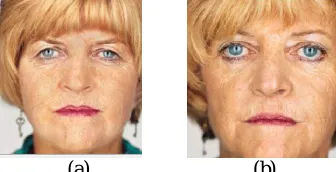
In our implementation designs we take the separate images from database i.e. Pairs of twins. These images are of in different condition images of twins is used. This module loads the pair of twins’ image first which is shown below.
(a) (b)
Fig. 3 (a) and (b) is the pair of input twins’ images.
B. Perform Noise Removing from Images
ISSN(Online): 2320-9801
ISSN (Print) : 2320-9798
I
nternational
J
ournal of
I
nnovative
R
esearch in
C
omputer
and
C
ommunication
E
ngineering
(An ISO 3297: 2007 Certified Organization)
Vol. 3, Issue 9, September 2015
C. Face Landmarking and Alignment
Facial landmarks are a set of salient points, usually located on the corners, tips or mid points of the facial components. Alignment is used to identify regions of similarity that may indicate functional, structural and/or evolutionary relationships between two images. Reliable facial landmarks and their associated detection and tracking algorithms can be widely used for representing the important visual features for face registration and expression recognition. We get the 68 landmark points on the facial region to facilitate the analysis of human facial expressions. On the basis of these 68 landmarks we get the position of feature object from face.
(a) (b)
Fig.5 (a) and (b) is the output of landmark.
D. Face Side Detection on Eyes Based
After the landmark, we have the position of the eyes. Based on the eyes we find out whether the images are frontal or no frontal. If faces have two eyes than it is frontal images and if it have the one eye than it is no frontal. From above figure it shows that it is frontal image.
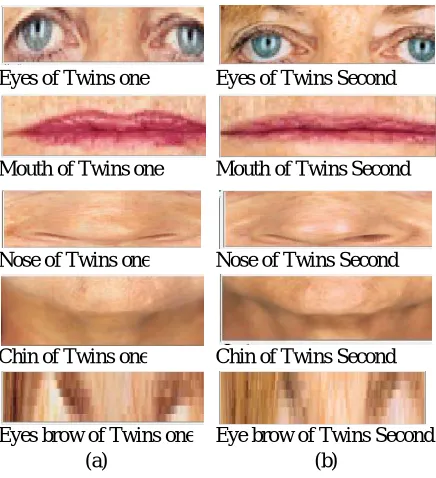
After landmarking we get the position of the feature object from the images. On bass of that we get the feature object, shown in below. Feature i.e. Eyes, Nose, Mouth, Chin, Eye brow.
Eyes of Twins one Eyes of Twins Second
Mouth of Twins one Mouth of Twins Second
Nose of Twins one Nose of Twins Second
Chin of Twins one Chin of Twins Second
Eyes brow of Twins one Eye brow of Twins Second (a) (b)
Fig.6 (a) and (b) is the output of feature object.
E. Get Feature Distance
ISSN(Online): 2320-9801
ISSN (Print) : 2320-9798
I
nternational
J
ournal of
I
nnovative
R
esearch in
C
omputer
and
C
ommunication
E
ngineering
(An ISO 3297: 2007 Certified Organization)
Vol. 3, Issue 9, September 2015
(a)
(b)
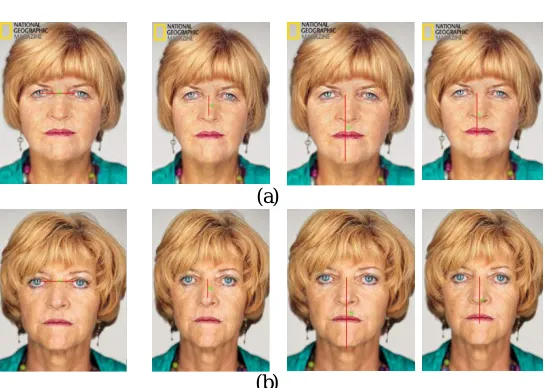
Fig. 7 (a) and (b) is the output of to get feature distance.
In first row show the output of first pair of twins and in second row show the pair of twins. Find out the distance between eyes to mouth, eye to chin, eye to nose, eye to eye. This distance is different than the second twins.
F. SIFT (Scale Invariant Feature Transforms)
A SIFT feature is a selected image region (also called keypoint) with an associated descriptor. Keypoint are extracted by the SIFT detector and their descriptors are computed by the SIFT descriptor.
Following are the major stages of computation used to generate the set of image features:
Scale-space extrema detection
This stage of the filtering attempts to identify those locations and scales those are identifiable from different views of the same object. The scale space is defined by the function.
L(x, y, σ) = G(x, y, σ) * I(x, y)
Where * is the convolution operator, G(x, y, σ) is a variable-scale Gaussian and I(x, y) is the input image.
Fig 8. Difference of Gaussian (DOG)
This process is done for different octaves of the image in Gaussian Pyramid. It is represented in above figure.
Keypoint localization
This stage attempts to eliminate more points from the list of keypoints by finding those that have low contrast or are poorly localized on an edge. If this difference is below the ratio of largest to smallest eigenvector, from the 2x2 Hessian matrixes at the location and scale of the keypoint, the keypoint is rejected.
ISSN(Online): 2320-9801
ISSN (Print) : 2320-9798
I
nternational
J
ournal of
I
nnovative
R
esearch in
C
omputer
and
C
ommunication
E
ngineering
(An ISO 3297: 2007 Certified Organization)
Vol. 3, Issue 9, September 2015
Keypoint descriptor
Keypoint descriptors typically uses a set of 16 histograms, aligned in a 4x4 grid, each with 8 orientation bins, one for each of the main compass directions and one for each of the mid-points of these directions. This result in a feature vector containing 128 elements. This resulting image descriptor is referred to as the SIFT descriptor. Resulting vectors are known as SIFT keys and are used in a nearest-neighbors approach to identify possible objects in an image. Collections of keys that agree on a possible model are identified, when 3 or more keys agree on the model parameters this model is evident in the image with high probability. By applying the SIFT algorithm we get the following result pair of images with key point and one message show that whether the pair of images are twins or not.
(a) (b) (c)
Fig. 9 (a), (b) and (c) is the output of SIFT.
From above figure (a) and (b) show the keypoint on the face. Matching these keypoint show the person are identical twins or not. If the two person keypoint is matches than it show the message person are identical twin. If two person are same than it show the person are identical but not twins.
IV.SIMULATION RESULTS
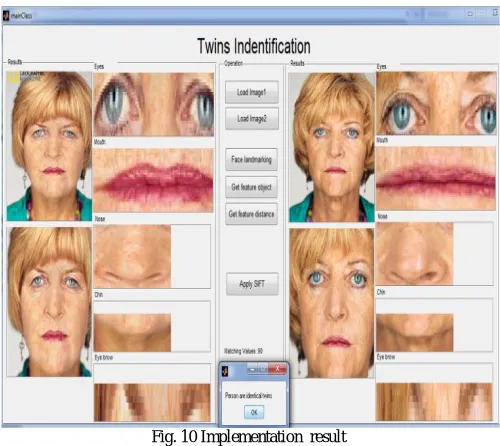
In our implementation designs we take the separate images from database i.e. Pairs of twins. These images are of in different condition images of twins was used. This module loads the pair of twins image first then we gets the output to the result
.
Fig. 10 Implementation result
ISSN(Online): 2320-9801
ISSN (Print) : 2320-9798
I
nternational
J
ournal of
I
nnovative
R
esearch in
C
omputer
and
C
ommunication
E
ngineering
(An ISO 3297: 2007 Certified Organization)
Vol. 3, Issue 9, September 2015
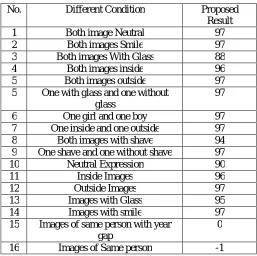
The performance of system, experimental results and analysis on various conditions. Showing the matching rate for every identical twins and check what percentage of same facial features them having match.
No. Different Condition Proposed Result 1 Both image Neutral 97 2 Both images Smile 97 3 Both images With Glass 88 4 Both images inside 96 5 Both images outside 97 5 One with glass and one without
glass
97
6 One girl and one boy 97 7 One inside and one outside 97 8 Both images with shave 94 9 One shave and one without shave 97 10 Neutral Expression 90 11 Inside Images 96 12 Outside Images 97 13 Images with Glass 95 14 Images with smile 97 15 Images of same person with year
gap
0
16 Images of Same person -1
Table 1 List of output of different condition.
From above result we have the following graph
Fig. 11 Proposed Result of different condition.
ISSN(Online): 2320-9801
ISSN (Print) : 2320-9798
I
nternational
J
ournal of
I
nnovative
R
esearch in
C
omputer
and
C
ommunication
E
ngineering
(An ISO 3297: 2007 Certified Organization)
Vol. 3, Issue 9, September 2015
From existing system [11] we have the following EER for different conditions.
Error-Rate Condition Existing System[11] Proposed System
EER Studio-Neutral expression
0.01 to 0.04
0
EER Studio-Neutral-Smile
0.04 to 0.07
0
EER Studio-Ambient Neutral
0.03 to 0.07
0
EER Studio-Ambient Neutral-Smile
0.05 to 0.10
0
EER Ambient Neutral 0.12 to 0.21
0
EER Ambient Neutral-Smile
0.12 to 0.16
0
Table 2 Comparison between existing system and proposed system.
The above comparisons help demonstrate that traditional schemes found EER for different condition and proposed system have not EER if condition changes.
V. CONCLUSION AND FUTURE WORK
The Experimental results measured the performance when faces were collected on the same day and a year apart. The results also measured the effect of changes in expression and lighting. Also, an experiment examined the effect of gender and age on performance. Performance of system by considering different conditions such as illumination, expression, gender, age and images of with or without glass, one which is inside and one outside are measured. Error rate from all the result are less from existing system.
From the experimental result it is found that the average matching value for different types of images are for inside 96.2 %, outside 97 %, smiley expression 97, neutral expression 90 %, with glass 95.2%. The matching value is 0 if we pass two images of same person having year gap. When we pass same images at the same time it show matching value -1 with message person are identical but twins.
To improve the accuracy of facial feature extraction methods, because face contains lots of features and it should be extracted by various methods. It needs to implement better preprocessing method. In Future Work New research ideas are needed to help improve performance on recognition of identical twins in realistic imaging contexts. For future papers, having more cross year data can be used to see the effect of aging on twins recognition which may turn out to be significant due to the fact that as twins age, their features are more influenced by natural processes leading to different features for each twin. Expanding the size of twin datasets to improve the training for twin identification. The results shown in this work should also be considered by commercial vendors in order to improve system performance in the presence of identical twin pairs.
REFERENCES
1. Jeffrey R. Paone, Patrick J. Flynn, “Double Trouble: Differentiating Identical Twins By Face Recognition”, IEEE Transaction on information Forensics And Security, Vol. 9, No. 2, February 2014 .
2. Ariyaeeiniaa, C. Morrison, A. Malegaonkara, and B. Black, “A Test Of Effectiveness of The Speaker Verification for Differentiating Between Identical Twins” ,Sci. Justice, vol. 48, no. 4, pp. 182–186, Dec. 2008.
3. A.M. Bronstein, M. M. Bronstein, and R. Kimmel,”Three Dimensional Face Recognition”, Int. J. Comput. Vis., vol. 64, no. 1, pp. 5-30, Aug 2005.
4. Biswas, K. W. Bowyer, and P. J. Flynn, “A Study Of Face Recognition Of Identical Twins By Humans” in Proc. IEEE WIFS, Dec. 2011, pp. 1–6.
ISSN(Online): 2320-9801
ISSN (Print) : 2320-9798
I
nternational
J
ournal of
I
nnovative
R
esearch in
C
omputer
and
C
ommunication
E
ngineering
(An ISO 3297: 2007 Certified Organization)
Vol. 3, Issue 9, September 2015
6. K. Hollingsworth, K. Bowyer, and P. Flynn,” Similarity of Iries Texture between Identical Twins”, in Proc. IEEE Comput. Soc. Conf. CVPRW, Jun. 2010, pp. 22–29.
7. A.Jain, S. Prabhakar, and S. Pankanti, “On the Similarity of Identical Twins Fingerprints”, Pattern Recognit. vol. 35, no. 11, pp. 2653-2663, pp. Nov 2002.
8. K. Kodate, R. Inaba, E. Watanabe, and T. Watanabe,”Face Recognition By a Compact Parallel Optical Correlator”, Meas. Sci. Technol., vol. 13, no. 11, pp. 1756–1766, Nov. 2002.
9. W. Kong, D. Zhang, and G. Lu, “Study Of Identical Twins Palmprints For Personal Verification ”, Pattern Recognit., vol. 39, no. 11, pp. 2149–2156, Nov. 2006.
10. U. Park and A. Jain, “Face Matching And retrival Using Soft Biometrics”, IEEE Trans. Inf. Forensics Security, vol. 5, no. 3, pp.406-415, Sep-2010.
11. P. J. Phillips, P. J. Flynn, K. W. Bowyer, R. W. V. Bruegge, P. J. Grother, G. W. Quinn, et al., “Distinguishing Identical Twins By Face Recognition”, in Proc. IEEE Conf. Autom. Face Gesture Recognit. Workshops Mar. 2011, pp. 185–192.
12. M. T. Pruitt, J. M. Grant, J. R. Paone, P. J. Flynn, and R. W. V. Bruegge, “ Face Recognition Of Identical twins” , in Proc. 1st Int. Joint Conf. Biometrics, Oct. 2011, pp. 185–192.
13. Z. Sun, A. A. Paulino, J. Feng, Z. Chai, T. Tan, and A. K. Jain, “A Study Of Multibiometric Traits Of Identical twins, ” Proc. SPIE, Biometric Technology for Human Identification VII, vol. 7667, pp. 76670T-1–76670T-12, Apr. 2010.
14. Brendan Klare, Alessandra A. Paulino, and Anil K. Jain ,” Analysis of Facial Features in Identical Twins” in proceedings of the IEEE international joint conference on biometrics(IJCB) ,pages 1-8, oct 2011.
15. Klare and A. K. Jain. “On taxonomy of facial features”. In Proc. of IEEE Conference on Biometrics: Theory, Applications and Systems, 2010. 16. U. Park and A. K. Jain.” Face matching and retrieval uses soft biometrics.” IEEE Trans. Information Forensics and Security, 5(3):406–415,
2010.
17. Lowe. “Distinctive image features from scale-invariant keypoints.” International Journal of Computer Vision, 60(2):91–110, 2004.
18. P. J. Phillips, J. R. Beveridge, B. A. Draper, G. Givens, A. J. O’Toole, D. S. Bolme, J. Dunlop, Y. M. Lui, H. Sahibzada, and S. Weimer. “An introduction to the good, the bad, & the ugly face recognition challenge problem”. In The 9th IEEE Conference on Automatic Face and Gesture Recognition, Santa Barbara, CA, March 2011.
19. T. Friedrich, “Nonlinear Dimensionality Reduction-Locally Linear Embedding versus Isomaps” Machine Learning Group, the University of SheffieldS1 4DP, U.K., 2000.
20. Hoffmann, “Kernel PCA for Novelty Detection,” Pattern Recognition, volume 40, No. 03, pp. 863-874, March, 2006.
21. B. Moghaddam and M. H. Yang,”Learning Gender with Support Faces”, MERL- A Mitsubishi Electric Information Center America, TR-2002-12, January 2002.