Knowledge Sharing
among Ideal Agents
Alessio Lomuscio
A thesis submitted
to the School of Computer Science of The University of Birmingham for the degree of Doctor of Philosophy
School of Computer Science The University of Birmingham Birmingham B15 2TT
U.K.
Abstract
Multi-agent systems operating in complex domains crucially require agents to interact with each other. An important result of this interaction is that some of the private knowledge of the agents is being shared in the group of agents. This thesis investigates the theme of knowledge sharing from a theoretical point of view by means of the formal tools provided by modal logic.
More specifically this thesis addresses the following three points.
First, the case of hypercube systems, a special class of interpreted systems as defined by Halpern and colleagues, is analysed in full detail. It is here proven that the logic S5WD constitutes a sound and complete axiomatisation for hypercube systems. This logic, an ex-tension of the modal system S5 commonly used to represent knowledge of a multi-agent system, regulates how knowledge is being shared among agents modelled by hypercube systems. The logic S5WD is proven to be decidable. Hypercube systems are proven to be synchronous agents with perfect recall that communicate only by broadcasting, in separate work jointly with Ron van der Meyden not fully reported in this thesis.
Second, it is argued that a full spectrum of degrees of knowledge sharing can be present in any multi-agent system, with no sharing and full sharing at the extremes. This theme is investigated axiomatically and a range of logics representing a particular class of knowledge sharing between two agents is presented. All the logics but two in this spectrum are proven complete by standard canonicity proofs. We conjecture that these two remaining logics are not canonical and it is an open problem whether or not they are complete.
Third, following a influential position paper by Halpern and Vardi, the idea of refining and checking of knowledge structures in multi-agent systems is investigated. It is shown that, Kripke models, the standard semantic tools for this analysis are not adequate and an alternative notion, Kripke trees, is put forward. An algorithm for refining and checking Kripke trees is presented and its major properties investigated. The algorithm succeeds in solving the famous muddy-children puzzle, in which agents communicate and reason about each other’s knowledge.
The thesis concludes by discussing the extent to which combining logics, a promising new area in pure logic, can provide a significant boost in research for epistemic and other theories for multi-agent systems.
Contents
1 Introduction 9
1.1 Agent technology . . . 9
1.2 Modal logic . . . 11
1.2.1 Syntax . . . 12
1.2.2 Semantics . . . 12
1.2.3 Proof theory . . . 14
1.2.4 Methodologies . . . 16
1.3 Agent theories . . . 21
1.3.1 Single-agent theories . . . 23
1.3.2 Multi-agent theories . . . 29
1.4 Knowledge sharing among a community of agents . . . 37
1.4.1 Degrees of knowledge sharing . . . 38
1.4.2 The content of this thesis . . . 38
2 Hypercube systems 43 2.1 Introduction . . . 43
2.2 Definition of hypercube systems . . . 44
2.3 Maps between hypercubes and equivalence frames . . . 46
2.4 Composition of maps between hypercubes and Kripke frames . . . 48
3 Axiomatisation of hypercube systems 53 3.1 Introduction . . . 53
3.2 Correspondences . . . 54
3.3 Completeness of equivalence D frames . . . 58
3.4 Completeness of equivalence DI frames . . . 61
3.5 Decidability . . . 66
3.6 The logic S5WD . . . 68
3.7 Knowledge sharing in hypercube systems . . . 77
3.8 Homogeneous broadcasting systems . . . 78
3.8.1 Introduction . . . 78
3.8.2 Environments . . . 79
3.8.3 Homogeneous broadcasting agents . . . 81
4 A spectrum of degrees of knowledge sharing 83 4.1 Introduction . . . 83
4.2 Interaction axioms of the form . . . 84
6 CONTENTS
4.2.1 Correspondence and completeness . . . 85
4.2.2 Discussion . . . 88
4.3 Interaction axioms of the form . . . 90
4.3.1 Correspondence and completeness . . . 90
4.3.2 Discussion . . . 94
4.4 Interaction axioms of the form . . . 96
4.4.1 Correspondence and completeness . . . 96
4.4.2 Discussion . . . 105
4.5 Conclusions . . . 107
5 Refining and checking knowledge structures 109 5.1 Introduction . . . 109
5.1.1 Syntax and semantics . . . 110
5.2 Refining Kripke models . . . 112
5.2.1 The muddy children puzzle . . . 112
5.2.2 An engineering example . . . 113
5.2.3 Halpern and Vardi’s formulation . . . 114
5.2.4 Problems with refinement of Kripke models . . . 116
5.3 Refining Kripke trees . . . 119
5.3.1 Kripke trees: basic definitions . . . 119
5.3.2 Kripke trees: refinement . . . 122
5.4 The muddy children puzzle using Kripke trees . . . 124
5.5 Properties of refinement on Kripke trees . . . 125
5.6 Conclusions . . . 129
6 Discussion: combining logics for MAS theories 133 6.1 Introduction . . . 133
6.2 Combining logics . . . 134
6.2.1 Introduction . . . 134
6.2.2 Positive results . . . 135
6.2.3 Negative results . . . 145
6.3 MAS theories as combined logics . . . 147
6.3.1 Knowledge and other single mental state theories . . . 147
6.3.2 BDI logics . . . 147
6.3.3 Knowledge and belief . . . 148
6.3.4 Knowledge and time . . . 148
6.4 Conclusion . . . 149
A Some proofs for Chapter 4 151 A.1 Interaction axioms of the form . . . 151
A.1.1 Interaction axioms of the form . . . 151
A.1.2 Interaction axioms of the form . . . 153
A.2 Interaction axioms of the form . . . 154
A.2.1 Interaction axioms of the form . . . 154
A.2.2 Interaction axioms of the form . . . 155
Preface and acknowledgements
A posteriori, beginnings and ends are always easy to recognise.
For the case of this thesis, it all started with my interview in Birmingham in September 1996. At the end of it I was asked what occupation I was hoping to have in ten years time. Back then I knew even less English than now and I was simply trying to guess what the natives were saying. In that case my interpretation was “What were you doing when you were ten?”; without hesitation I answered “playing football all the time”.
The end of it started with a trip to London in September 1998 for another interview, this time for a job at Queen Mary and Westfield College. At the time myknowledgeof London was very limited and I thought I would leave about fifty minutes to go from Euston Station to Mile End where QMW is located. No one had told me that travelling times in London can vary enormously depending on many conditions. Needless to say I was late.
Two things come to mind. The first is the puzzlement about the fact that I was actually offered both positions. At time of writing, I am still not sure how that happened.
The second is that the beginning and the end of the time I was involved with this research are truly marked by events in which I did notknowsomething crucial that many other people around me knew. I find it peculiar that the research I carried out between these two events is actually about various degrees of how knowledge can be shared among a community of agents.
Acknowledgements. I would like to thank all the persons with which I have had dis-cussions on some of the issues of this thesis. In particular, I would like to mention: Marco Colombetti, Robert Goldblatt, Guido Governatori, Joe Halpern, Manfred Kerber, Ron van der Meyden, Aaron Sloman and Timothy Surendonk who have all provided me with inter-esting remarks about my work.
A big special thanks goes to my friend Mathias Kegelmann for being such a rigorous test-bed for many of the proofs here contained, for providing valuable ideas and especially for having done all this without saying “After all this is simply this-and-that category and therefore...”. Well, at least not too often!
Most of all I would like to thank my supervisor, Mark Ryan. From the very beginning of my application for a PhD to the very end of the final modifications of these pages he has offered me what I found to be an extremely qualified supervision. I am very grateful to him for this and possibly even more for all the help he has offered me on matters not at all related to this work. This has really played a fundamental role in creating the conditions to carry out this research.
My studies in Birmingham were supported by an internal grant of the School of Com-puter Science of the University of Birmingham; this support is gratefully acknowledged.
Chapter 1
Introduction
1.1
Agent technology
Under the caption name of “Agent” lives one of the potentially ground-breaking paradigms that have hit Computer Science since the advent of Object-Oriented Programming [Mey88, Boo86]. Agents (see [WJ95, Woo97] for short reviews, or [Je98, Bra97] for more extensive expositions), like expert systems and others, are one of the paradigms that originated in Artificial Intelligence (AI) and that were quickly taken up by many computer scientists not necessarily working in AI. Indeed, it is striking to note how many Computer Science sub-disciplines have now well-established research areas that contain the keyword “agent-based” in their titles. The international community has seen research in agents for automatic diagnosis [Sch98], agents for control systems [GL87], agents for Internet-based information retrieval [EW94], agents for telecommunication [HB99b, HB99a], agents for automatic nego-tiation [PSJ98], etc.
The agent-paradigm has even gone beyond the boundaries of AI and Computer Science where it was born and has influenced Psychology [CC95, Cas98], Economics [Wel93], and other disciplines. Only in Computer Science there are currently no less than ten annual or bi-annual international conferences on agents themes, and more than a handful of inter-national journals. So many different theories, languages and architectures for agents have been proposed that agentstandardsare currently under investigation (see [FIP] for example) in order to provide a more systematic technology transfer to the industry.
Indeed, even more striking for an idea forged in academic departments, big business is also fascinated by the concept. In 1998, the pioneer agent company ”Firefly” was sold to Mi-crosoft for approximately US$40M. Similarly, NetBot, the company set up by agent pioneers Oren Etzioni and Dan Weld, was acquired by the search engine company Excite for a sim-ilar sum in early 1998. Still in 1998, even Excite was taken over for about US$7Billion and in January 1999 a major investment of News Corporation, the global media conglomerate controlled by Rupert Murdoch, in Yahoo was unveiled.
Microsoft, Sun, Hewlett Packard, Mitsubishi Electronics, British Telecom, just to name a few, all have internal ongoing research on agent-related topics.
So, what are these agents and what is all this fuss about? Many definitions of agents have been proposed [RN95, Mae95, HR95, WJ95, Ld95]; I will not argue about any of these, nor will I discuss which ones and why are perhaps the more appropriate and I simply refer
10 CHAPTER 1. INTRODUCTION
the interested reader to [FG96b] for some of the most recent discussions. Instead, in line with much of the literature in this area, we will use the working definition of agent given in [WJ95] to denote aself-contained problem solving system capable of autonomous, reactive, pro-active, social behaviour. More precisely, as it will become clear in the next section, we will follow Dennet’s (see [Den87]) “intentional’s stance” approach by assuming that an agent’s behaviour can usefully be described in terms of collections of mental attitudes such asknowledge, beliefs, intentions, desires, obligations, etc. Clearly, depending on the application only a subset of these will be employed.
As to why agents are attracting so much attention, agents are new abstraction tools and as such they are increasingly seen as a most promising approach to developing complex distributed computing systems. Applications built upon the agent paradigm (agent-based systems or simply multi-agent systems (MAS)) already cover a wide number of areas includ-ing electronic commerce [CM96], information management [Mae94], health care [HJF95], process control [JCL95], electronic games [WG96], manufacturing [Par98], etc. (for a com-parative survey of these applications, see [JW95, JW98] and [Par96]). The nowadays general feeling about developing agent-based software can perhaps be summarised by using the own words of one of the many companies selling packages for agent-based programming:
Software developers and system designers use high-level abstractions in building complex software for one reason; to manage complexity. An abstrac-tion focuses on the important and essential properties of a problem and hides the incidental components of that problem. Agents provide a new way of managing complexity because they provide a new way of describing a complex system or process. Using agents, it is easy to define a system in terms of agent-mediated processes.
([AGB], front page).
With so much different intellectual and economic investment in the idea of agent-based computing, it should not be too surprising that the term “agent” is seriously running the risk of becoming a conceptually overloaded term and agent-based technology an ill-defined software architecture (and sometimes quite simply a vehicle for re-branding object-oriented software for distributed computing).
Indeed some researchers (see for example [WJ98]) have already pointed out the real risks for agent-based systems of a backslash similar to the one happened to, for example, expert systems that were once guaranteed to change the face of computing as we knew it.
My opinion on this is that after more than 5 years years since the real boom in interest in MAS (perhaps to be identified by the publication of [Sho93]) we still desperately needto groundour intuitions as to what properties MAS should have and how we should go about building a MAS system.
This thesis offers no contribution to the latter issue (see [KG97, Woo97] for some recent approaches) but tries to enhance our understanding on the former. Arguably the best option to try to understand and explore a complex concept as the one of agent is to use a formal language. Among many that have been proposed (Z for example [Ld95] but see [dFL 97] for a short discussion) here I chose formal logic to carry out my analysis. The reasons for this are threefold. Firstly, logic is now a fully-fledged formal technique that has been pursued with great success for many years for its own sake1and with respect to Computer Science2.
program-1.2. MODAL LOGIC 11
Secondly, logic has been proven to be particularly suitable as formal model of key charac-teristics of agents such as their knowledge, beliefs, intentions, etc. and some results on these topics are already available. Thirdly, and perhaps most importantly, logic-based methods are now clearly valuable tools for the task ofvalidationandverification[MP91, MP95, CES86] of computing systems3. This is indeed crucial if we are to deliver on our promises of using agents to build safe and reliable systems to fly airplanes, to control space missions, to op-erate automatic transactions on the Internet, to diagnose automatically telecommunication networks and so on. In fact in all these areas the techniques now currently used to certify software (e.g. testing [Mye79, Bei84, Bei90]) have been proven in some cases quite unsuc-cessful; the Intel Pentium division bug [Pra95], the explosion of Arianne V [Dow97] being perhaps the most distressing.
In this thesis I will use formal logic as a working technique to reason about key character-istics of MAS. By presenting some technical results achieved by using this tool, my ultimate aim is to show that some very basic questions on MAS theories are still unanswered and that logic is a good tool for such an investigation. More specifically, this work will focus on interactions in the private knowledge of agents in a MAS. Quite surprisingly, little work has been done in this area so far and my intention is to contribute to this by carrying out a case study analysis at different level of abstraction (logical, semantical, and with a more low-level descriptive language).
Given this assumption, the content of this work is bound to be quite technical and this is why in the next section we will give a quick overview at some of the technical tools that we will be using through this thesis. This is needed for two reasons. First, because it will give formal logic the up-front role that it is going to have in the rest of this work. Secondly, and more importantly, because it will introduce the frame of reference for the discussion that it will follow on MAS theories and on the reasons why this thesis is an attempt to contribute to them.
1.2
Modal logic
If one is to use formal logic to reason about MAS the obvious question to ask is which logic to adopt. As we will observe in Section 1.3, one of the key mental states of an agent is its beliefs and it can be observed that first-order logic [End72], the natural candidate, is actually not the best option available. For example, for representing beliefs, one could think about formulae like
-
-
-
This formula raises two types of problems. The first one is syntactic: the formula above is not a legal first-order formula because the predicate
occurs in the scope of the predicate
. This could be overcome (at the expense of a much heavier formalism) by using one of the extensions that have been presented4to allow for this kind of expressions. The second
ming, functional programming, etc.
3This isnothandwaving. Big commercial enterprises like Intel, British Telecom and others are now currently investing much financial resources into the use of formal methods (model checking for example) to valididate and verify hardware and software. The reason they are doing this is that the development of formal tools for validation and verification are currently seen as more economical than testing on a mid-long term perspective.
12 CHAPTER 1. INTRODUCTION
one is semantical and is bound to the fact that states like belief, desire, etc. are referentially opaque. To see what we mean by this consider a reasonable interpretation in which we have the equality of terms
-
-
. By substitution of terms we may now derive
-
-
-
but this is counterintuitive as agent ‘Tweety’ may be in a situation in which he does not believe that Lewis Carroll is actually a pseudonym for Charles Dodgson.
Modal logic offers a neat solution to this and other problems related to representing mental states and it also comes with a semantics which is more intuitive for this task. This is the reason why this thesis builds upon some techniques developed in propositional modal logic, whose knowledge I will have to assume from the reader. The aim of the rest of this section is not to present an introduction to modal logic, but to fix the notation we will be using throughout the thesis and to provide references for some of the known results that we will be using later on. Proofs of the theorems reported in this section can be found in most of the references below.
The first systematic approach to modal logic can be found in [LL59]. More recent and very good introductions to the subject are [Che80, HC84, Boo93, Pop94, HC96] and the more concise [Gol92]. For the similarities of themes and motivations [MH95] is also an excellent reference and it has provided a basis for this work. Among these, [Pop94] and [MH95] are the only one taking a full multi-modal perspective from the beginning. Recent-ly, more advanced works have been presented (see [CZ97], [Sur98]) or are in preparation (see [BdRV99]) showing how active the field is, especially with respect to Computer Sci-ence. Modal propositional logic in itself builds upon propositional calculus whose standard references are [Men64] and the more recent [Gam91, Ham78].
1.2.1 Syntax
As standard, sets
will be denoted by Italic capital letters. If
is a set, denotes
its cardinality, and
the identity relation on it. Ifis an equivalence relation on and
, then
is the set of equivalence classes of , and
is the equivalence class
containing .
We assume a countable set
of propositional atoms, and a finite set
of agents. For most of this work, our formal language is given by the usual
grammar:
where
. We will make it clear when we are operating in a richer language.
The other propositional and modal connectives can be defined in the usual way, in par-ticular:
Everything which has not been defined or discussed here is to be interpreted in line with the standard tradition.
1.2.2 Semantics
1.2. MODAL LOGIC 13
put forward by Halpern and Fagin in [HF89]. Other approaches are possible, for example algebraic semantics (which dates back to [McK41]) was the first semantics for modal logic.
Like in Section 1.2.1 as throughout this work we assume a set of agents. We first recall the basic definitions of Kripke semantics.
Kripke frames were first proposed in [Car46] and later developed in [Bay58, Hin57, Kan57, Mon60, Pri62]. The formalisation presented here and widely used nowadays was first presented in [Kri59, Kri63] and later advocated in [Lem77]5.
Definition 1.1 (Kripke frames and Kripke models). A frame is a tuple , where
is a non-empty set of points or worlds and
, are binary
relations on
. If all the relations are equivalence relations, the frame is anequivalence frameand
we write
for
.
Amodelis a tuple , where
is its underlying frame
and
is an interpretation for the atoms. An equivalence model is a model whose underlying frame is an equivalence frame.
Committing an abuse of notation, given a frame
and an inter-pretation
, we will sometimes denote as
. Also we will denote as and as . If
is clear from the context, we will sometimes simply write and .
Satisfactionon Kripke structures is defined as follows:
Definition 1.2 (Satisfaction). The satisfaction of a formula
in a world
of a model, formally
, is inductively defined as follows:
if , if , if and ,
if for each
we have implies .
Satisfaction for the other logical connectives can be defined in the usual way.
Validityon Kripke structures is defined as follows:
Definition 1.3 (Validity). A formula
is valid on a model
, formally
, if for any point
we have
. A formula
is valid on a frame
if for any interpretation
we have
. A class of models validates a
formula
if for any model
we have
. A formula
is valid on a class of framesif
for any frame
we have
.
We now turn our attention to interpreted systems; we follow the definition in the form given in [FHMV95]. Given a set
, consider
sets of local states, one for every agent of the MAS and a set of states for the environment. We denote by
the non-empty set of local states possible for agent
, and by
the non-empty set of possible states for the
environment. Elements of
will be denoted by Elements of
will be denoted by
14 CHAPTER 1. INTRODUCTION
Definition 1.4 (Global states of interpreted systems). A set of global states for an interpre-ted systemis a subset of the Cartesian product
.
A global state represents the situation of all the agents and of the environment at a par-ticular instant of time. The idea behind considering a subset is that some of the tuples that originate from the Cartesian product might not be possible because of explicit constraints present in the MAS. By considering functions (runs) from the natural numbers to the set of global states, it is possible to represent the temporal evolution of the system. An interpre-ted system is a set of functions on the global states with a valuation for the atoms of the language.
Although in this work we will discuss temporal evolution of MAS, we will not consider runs of interpreted systems explicitly. So, for us the key definition will be the one of global states (Definition 1.4) and an interpreted system will simply be defined on global states. We call thesestatic interpreted systems.
Definition 1.5 (Static interpreted systems). Astatic interpreted systemis a tuple
, where is a set of global states as in Definition 1.4 and
is an interpretation for the atoms.
Any static interpreted system is immediately suitable to interpret a propositional lan-guage on its set of global states. We now see how they can be adapted to interpret a multi-modal language.
Consider a family of first-order predicates
; we can use these to specify when two global states are related for agent
.
Definition 1.6. Given a static interpreted system
, consider the Kripke model
, where the frame
is defined by:
if
. The model
is called the modelgeneratedby.
This construction can be regarded as a way of seeing interpreted systems as a special class of Kripke models.
When is clear from the context we will omit the subscript from . If
is the model generated by , then
, the frame underlying
, is also called the frame generated by the set of global states.
In the applications (logics for knowledge for example), the family of predicates
is
fixed in advance; if that is the case we can then define validity on static interpreted systems by relying on the generated Kripke models.
Definition 1.7. A formula
is valid on a static interpreted system ,
, if
. A formula
is valid on a set of global states ,
, if for any interpretation
we have that
. A formula
is valid on a class of static interpreted systems
if for every
we have
. A formula
is valid on a class of global states
if for every
we have that
.
1.2.3 Proof theory
1.2. MODAL LOGIC 15
[Lew18]). Modal systems were simply described as sets of formulae that could be deduced from axioms and rules of inference. This Hilbert-style way of expressing a logic is sometimes referred to as “syntactic approach” in contrast to the “semantic approach” described in the previous subsection.
Definition 1.8. Anormal modal system , where
is the number of modal boxes of the logic, is the set of formulae that can be deduced from a set of axioms and inference rules. The set of axioms includes the following:
Taut Any propositional tautology
K
The set of inference rules include the following:
Uniform Substitution The result of uniformly replacing any propositional variables
in a theorem by any formula
is itself a theorem6,
Modus Ponens If
and
are theorems so is
,
Necessitation If
is a theorem, so is
, for any
.
Sometimes we will use the short-cuts US for the rule of uniform substitution and similar-ly MP and Nec for modus ponens and necessitation. In the following we will also extensivesimilar-ly use the term “logic” for normal modal system. We write
to mean that the formula
is a theorem of the logic , and, as expected, we write
to mean that it is not the case that
.
Definition 1.9 (Maximal consistency). A formula
is -consistent (or simply consistent if is clear from the context) if
. A finite set of formulae
is -consistent if
. An infinite set of formulae is -consistent if any finite subset of is -consistent.
A set of formulas ismaximalif for every formula
we have that either
or
. A set is -maximal consistentif it is both-consistent and maximal.
Formulae and sets of formulae are inconsistent if it is not the case that they are consistent. The importance of consistent sets is mainly due to the fact that every set admits a maximal consistent extension:
Lemma 1.10 (Lindembaum’s Lemma). Let be a normal modal logic. Given an -consistent set of formulae , there is a maximal -consistent setsuch that
.
The maximal extensionis not necessarily unique.
We now introduce the logic systems that will be used as reference throughout this thesis. The weakest normal modal logic (i.e. the one containing the smallest number of theorems) is the logic K . The logic K is obtained from Definition 1.8 by stipulating that no extra axioms and inference rules are included.
Stronger logics can be defined by enriching the list of axioms and inference rules. Fig-ure 1.1 will serve as a reference for the names of the axioms we will be using in this work.
6
In the following we will use the expression
to denote the formula which results from
by replacing
uniformly by
16 CHAPTER 1. INTRODUCTION
Axiom Axiom name
T
D
4
5
G1
M
B
Triv
Figure 1.1: The traditional reference names for some important axioms.
Logic Name of the logic
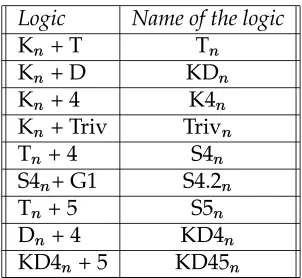
K + T T K + D KD K + 4 K4 K + Triv Triv T + 4 S4 S4 + G1 S4.2 T + 5 S5 D + 4 KD4 KD4 + 5 KD45
Figure 1.2: The traditional reference names for some important logics.
We will use only modal logics that can be expressed by using Definition 1.8 in which no extra inference rules are included. So, we will be able to express any logic of interest as the system K to which we add a set of axioms . In doing this we will sometimes write = K + . Often the set will be a singleton. Historically some logics have been given particular names, that we will also use and that we report in Figure 1.2.
It should be noted that a certain logic can be defined in many ways by adding different axioms to the system K and Figure 1.2 is only a possible definition. For example the logic S5 above defined as S5 = T + 5 can also be defined as S5 = S4 + B. Many more systems are known and this list serves only as a reference.
We will also make use a standard shortcut: If a system L can be axiomatised by taking a logic M and adding an axiom whose name is A, by MA we will denote the logic L = M + A.
1.2.4 Methodologies
Over the last thirty years, many formal techniques have been developed for the study of modal logics grounded on Kripke semantics, such as completeness proofs via canonical models [Mak66, Kap66, Lem77], decidability via filtrations [Lem77], and more recently com-pleteness and decidability transfer via combining logics [KW91, Gab96a]. Indeed part of this heritage of techniques constitutes the pillars upon which most of this thesis is built upon.
1.2. MODAL LOGIC 17
assumed familiar with these and they serve as a reference only. For the proofs the reader is referred to any of the general references for modal logic mentioned before.
Definition 1.11 (Isomorphism of frames). Two frames
,
of a classof frames areisomorphic(
) if and only if:
There exists a bijection
, For all
, and all ,
if and only if .
Isomorphic frames validate the same formulae.
Lemma 1.12. If and
are isomorphic frames then for all
we have
if and only
.
An equivalent notion of isomorphism can be defined on models. A result equivalent to Lemma 1.12 holds for that case.
Isomorphism is a very strong property. A weaker interesting property isp-morphism. We can define these both at the level of frames and at the level of Kripke models.
Definition 1.13 (P-morphism). Aframe p-morphismfrom
to
is a function such that:
1. the function
is surjective,
2. for all and each , if then ,
3. for each
and and , if
then there exists such that and . If and
are Kripke structures, then amodel p-morphismfromto
is a mapping
that is a frame p-morphism from
to that satisfies
if and only if
for all propositions
and
points
.
If there is a p-morphism from to
,
is also said to be a p-morphic image of . The following result (see for example [Gol92] for the mono modal case) shows that
-morphisms preserve satisfaction and validity for the language.
Lemma 1.14. If
is a model p-morphism from to
then for all worlds
ofand formulae
, we have
if and only if . Thus
is valid inif and only if
is valid in
. If
is a frame p-morphism from to
then for all
, if then .
The following are two other basic concepts that we will use.
Definition 1.15 (Reachable points). Given a frame
and two points
, we say that isreachable in stepsfrom if there are
and in such that
. We also say that isreachablefrom if there is
somesuch that is reachable from insteps.
Definition 1.16 (Connected model). A frame is connected if for every
we have that is reachable from . A model is connected if its underlying frame is.
18 CHAPTER 1. INTRODUCTION
Property of the frames Property name Axiom A Name
Serial D Reflexive T and Transitive 4 Symmetric B and Euclidean 5 and and Convergent G1 and Reflexive dead-end Triv
Figure 1.3: Correspondences between property of the frames and validity of axioms (Theo-rem 1.19).
Definition 1.17. Given a model
and a point
, the model
generatedby
fromis defined as follows:
The set
contains
and all the points reachable from
. If and then
, for any .
The interpretation is defined by: .
Clearly, given any equivalence model the model generated by any point of it is connect-ed.
The following result (see, e.g. [HC84] page 80) makes precise the claim that satisfaction of a formula ofat a world depends only on connected worlds.
Lemma 1.18. For all worlds
of a modeland for all formulae we have if and only if .
One of the basic insights into modal logic is provided by what is usually referred to as
correspondence theory. This provides a one-to-one relation between the validity of a certain axiom on a class of frames and properties of the relations of these frames.
Theorem 1.19 (Correspondences). For the properties and axioms A indicated in Figure 1.3 we have that: a frame has the property if and only if .
Some axioms do not correspond to any order property and conversely some first-order properties (irreflexivity for example) cannot be captured by any axiom. Correspon-dence theory studies under which circumstances syntax and semantics are equally powerful. See [Ben84] for details.
As in any logic, two major concepts relate the syntax and semantics in modal logics:
soundnessandcompleteness.
Definition 1.20 (Soundness and completeness). Given a logic and a class of frames, is
soundwith respect toif for any formula
we have that
implies
. A logic is
completewith respect to a class of framesif for any formula
we have that
implies
1.2. MODAL LOGIC 19
Note that completeness is defined with respect to a class of frames, not with respect a class of models. Completeness can be proven in a number of ways, the easiest of which is by using what is often called thecanonical model.
Definition 1.21 (Canonical model). Given a logic , thecanonical model
is a model built as follows.
The set
is made of all the maximal -consistent sets of formulae,
the family of relations
on
is defined by
if for all formulae
we have that
implies
The interpretation
for the atoms is defined as
if
.
When it is clear that we are referring to the canonical model of a logic , we will simply denote it as. The canonical model has the property of validating all and only the theorems
of the logic.
Theorem 1.22. For any formula
,
if and only if
.
The importance of the canonical model is due to the fact that some logics are not only described by the canonical model but also by the frame of the canonical model, called the
canonical frame. When this circumstance holds we call the logiccanonical.
It can be proved that under certain circumstances completeness of a logic L with respect to a class of framescan be proved simply by reasoning about the canonical frame.
Theorem 1.23 (Completeness via the canonical model). Let be a logic and letbe a class
of frames. If the frame
underlying the canonical model
for is in the classthen the
logic is complete with respect to.
By using Theorem 1.23 and considerations on soundness, it is not hard to show the fol-lowing:
Theorem 1.24 (Completeness of basic logics). For the properties and logics shown in Fig-ure 1.4 we have that: the logic is sound and complete with respect to the class of frames that have property .
The last meta-property we need to introduce isdecidability.
Definition 1.25 (Decidability). A logic isdecidableif there is an effective procedure that in a finite number of steps determines whether given a formula
it is the case that
or that
.
Decidability is related to two other properties properties as follows.
Theorem 1.26. If a logic is finitely axiomatisable and has the finite model property then is decidable.
20 CHAPTER 1. INTRODUCTION
Property of the frames Logic L
- K Reflexive T Serial KD Transitive 4 Reflexive and transitive S4 Reflexive, transitive and convergent S4.2 Reflexive, symmetric, transitive S5 Serial and transitive KD4 Serial, transitive and Euclidean KD45 Reflexive dead-end7 Triv
Figure 1.4: Completeness table for some basic modal systems discussed in Theorem 1.24.
Definition 1.27 (Finite model property). A logic is said to have thefinite model property
(orfmpin short) if for any formula
we have that
implies that there is a finite model
for such that
.
A logic can be proved to have the fmp in a number of different ways: algebraically as in [McK41], [Ber49], by the use of a “mini-canonical” model as in [HC96], etc. Here we will use the another standard technique which is better suited for this case:filtrations(first presented in [Lem77]). It is more convenient to describe this technique while we will be using it, i.e. in Chapter 3.
For now all we need to mention is that all the logics that we discussed so far can be proven to have the fmp.
Theorem 1.28 (Decidability of basic logics). All the logics in Figure 1.2 have the fmp and so they are decidable.
1.2.4.1 Two useful lemmas about S5
In this thesis we will extensively use the modal logic S5 . We report here two lemmas that we will extensively use later.
Lemma 1.29. For any
we have
implies
and
.
Proof. If
, by necessitating by
(the logic S5 is normal; see Definition 1.8 and Figure 1.2) we have
. By axiom K we have
. If
, by contraposition and the first part of this lemma we have
. By contraposition again and by using the definition
we have
.
Lemma 1.30. For any
, we have
and
where
.
7
This is defined as follows. Given any worldwe have that
and that for any world
implies
1.3. AGENT THEORIES 21
Proof. We prove the first chain of bi-implications. By axiom 4
. By axiom T and Lemma 1.29 we have
. For the second part of the bi-implication, assume
, then by taking the contrapositive of axiom T:
and substituting
we have
. The implication
is simply an instance of the contrapositive of axiom 5.
1.3
Agent theories
In this section we will give a quick overview at which characteristics of agents can effectively be expressed by means of a modal language - it should be stressed that this section is by no means an exhaustive review of the work in this area as this has already been carried out elsewhere (see [WJ95]). My wish, instead, is to give the flavour of these formalisms in order to prepare the grounds for discussing the topic of this thesis in the last section.
The basic assumption of logicians working on agents, as for any other researcher work-ing on MAS formalisms for that matter, is that it is both reasonable and useful to ascribe
mentalistic attitudes to agents8. The philosophical background to such an attitude was
giv-en by the influgiv-ential [Dgiv-en87], in which Daniel Dgiv-ennet coined the term “intgiv-entional stance” to describe the attitude of describing and predicting the behaviour of complex systems by means of intensional attitudes such as beliefs and desires.
Interestingly, Dennet was not the first to put forward such a proposal and a similar ap-proach was also suggested nearly twenty years before by one of the fathers of AI, John Mc-Carthy. Back in 1979, he wrote:
To ascribebeliefs, free will, intentions, consciousness, abilities, orwantsto a ma-chine is legitimate when such an ascription expresses the same information about the machine that it expresses about a person. It is useful when the ascription helps us understand the structure of the machine, its past or future behaviour, or how to repair or improve it. It is perhaps never logically required even for hu-mans, but expressing reasonably briefly what is actually known about the state of the machine in a particular situation may require mental qualities or qualities isomorphic to them. Theories of belief, knowledge, and wanting can be con-structed for machines in a simpler setting than for humans, and later applied to humans. Ascription of mental qualities is most straightforward for machines of known structure such as thermostats and computer systems, but it is most useful when applied to entities whose structure is incompletely known.
([McC79], page 1. Cited in [Woo92, Sho93]).
The above is exactly the approach taken in this thesis, in line with much of the literature on MAS. We look at agents as systems that can be described by assuming an “intentional stance” and we aim to model key characteristics of them. MAS formal theories are then to be regarded asspecifications.
If specifications are to be useful, they need to beverifiable. Loosely speaking verification means “testing that the specification meets the desired requirements”. In this thesis we take the view that formal logic provides a good tool for specifying and reasoning about MAS; why is it so? The answer comes by considering three key issues: syntax, semantics and
22 CHAPTER 1. INTRODUCTION
proof-theory. The syntax of a specification is just the language that we use to describe it and as such it cannot provide many insights into the system. In most of the cases, this will be the multi-modal language that we described in Section 1.2.1 (we will make clear when we are using extensions of it).
The semantics of a MAS theory will be based on Kripke style possible worlds or inter-preted systems (see Section 1.2.2). Semantics provides a way of describing the application which is “relatively” grounded on it. Suppose we have a class of MAS that can be fully de-scribed by a class of framesand we want to test whether a particular MAS of this class,
described by a finite conjunction of formulas
, satisfies a property that can be written as
. This can be done by checking the entailment
, i.e. whether for any modelbuilt on a frame inand for any world
we have that
.
Proof theory (which we will use in the shape of Section 1.2.3) can also be used to check the properties of a MAS, but it takes a different perspective. The class of MAS under analysis is specified by a set of axiom schemas and inference rules that describe a logic ; a particular MAS in this class is again identified by a conjunction of formulas. In this case, verifying
that the specification of the particular MAS meets a requirement
amounts to proving in the logic that
follows from, i.e. that
, or in other words that
.
Throughout this thesis we will be often be proving soundness and completeness of a logic with respect to a certain semantics. This guarantees that these two methods for reasoning about a MAS are equally powerful, i.e. that
if and only if
.
Although the two methods are logically equivalent we need to be careful here as there are two schools of thought on how one should in principle verify a MAS.
There are those who think that given a MAS one could in principle be able to have a model of the system (for example as a class of frames of modal logic). According to these completeness is about being able to reason about a MAS by using a Hilbert style proof sys-tem that is equivalent to the semantical description. This unlocks the possibility of using automatic theorem proving techniques (Isabelle [Pau94] is one of them) to test the specifica-tion.
A radically different way of seeing the process is to start from the axiomatisation. One could choose the axiom schemas that suit best his or her needs to describe the system and then test whether a formula (representing a property) is a theorem of the logic (representing the system) by testing validity of the formula on the corresponding semantical class, for example by using semantical refutation techniques like tableaux ([Fit83]).
People feel (and argue) quite passionately about these issues and this thesis is not about solving this long-going dispute (but we come back to this point in Section 1.4.2). More neu-trally I would take the view that completeness gives us a collection of new methods for prov-ing properties of the MASwhicheverside we come from. Another advantage is that thanks to completeness we have two expressive tools to prove properties and sometimes simply by switching to the more appropriate one, proof-theoretical or semantical, hard problems be-come easier to solve. For example, it is thanks to completeness that comparing two or more logics and deciding whether they are different or equivalent is now an accessible problem (note that this used to be a very hard problem before works such as [Lem77] became known) and it is very relevant for MAS theories.
We should see the process of generating a good specification for a MAS as anincremental
1.3. AGENT THEORIES 23
true and some other formulae that we assumed would hold actually do not. By completeness the semantics we started from is either not the intended one or, if matching the application, it reveals some unwanted properties about the application. We can then go back to the semantics and change it accordingly. But the opposite path9, is in principle equally possible and it is up to us to decide what to start with.
The argument above is to show that if we want agent theories to be useful for the speci-fication of MAS, we need to providesound and complete axiomatisationsfor them. This is the reason why the theme of completeness will play such a crucial role in this work.
The rest of this section is organised as follows. First I will present logics modelling a single aspect of agency. After this we will move to the multi-agent case where we will discuss some general issues and analyse a few important multi-agent theories.
1.3.1 Single-agent theories
In this subsection we use modal operators to model intentional aspects of agency. The whole sub-section is devoted to the specification of a single agent. Syntax, semantics and proof theory are the ones described in Section 1.2 but limited toonemodal box.
1.3.1.1 Epistemic logics
The design of an agent of knowledge is a central issue in agents theory, as knowledge is a key property of any intelligent system (see for example [RN95], Section 1).
The most widely used system to model knowledge was proposed by Hintikka in his famous book [Hin62] and since then used by many others.
The syntax is the one presented in Section 1.2, in which the modal box is here written
as . In this setting a formula
reads as “the agentknows
”. The operatorthe dual of
, is defined as in corresponding to the modal diamond (page 12). A formula
is read as “the agent considers
to be possible according to his knowledge”.
The interpretation is given on Kripke models (Definition 1.1) following Definition 1.2. In this case the fact that two states
are related by the accessibility relation intuitively means “the states
are epistemically possible according to the agent’s knowledge”. The favoured approach uses an equivalence relation for the accessibility relation. Let us see why.
First the relation should be reflexive. In fact, if not an agent in the state
, the actual state, could regard
as being impossible. So the agent would be able to havefalse knowl-edge. This is contrary to our intuition of knowledge as “true belief”.
Let us now see why the relation should be symmetric. Suppose an agent at a state
considers
as possible but in
she considers
not to be possible. Then she would know in
that
cannot be a possible state, but we have just noticed in the previous paragraph that this would be absurd. So
has to be possible from
whenever
is possible from
.
Finally transitivity. Suppose an agent in
considers
to be epistemically possible and that in
she considers
as epistemically possible. Then if she did not regard
as possible when in
, it would mean that in
, she would know that
cannot be the case. But then, she would also know this at
(because it is considered possible from
) and so
would not be regarded as possible from
.
9
24 CHAPTER 1. INTRODUCTION
There is another way of showing that an equivalence relation is adequate for the case of knowledge. Recall Definition 1.4 of static interpreted systems and how these generate Kripke models (Definition 1.6). Consider two global states10:
and
; where
are local states for the environment and
are states for agent 1. Suppose the
agent is in the state
(which implies that its local state is
), when can we say that
is epistemically possible for the agent in consideration? Well, we can say that the agent will regard
to be possible when its local states in the two global states are the same. In fact if
then up to the agent’s knowledge there is no difference between the two states
and
. So, for the case of knowledge we can fix the predicate
of Definition 1.6 to be exactly the equality of local states, i.e.
if
. So, any generated frame
will be an equivalence frame. This is the approach taken in [FHMV95]; see this reference for more details.
So, whether we favour Kripke models or interpreted systems as semantic foundations for logic for MAS, it is reasonable to consider the accessibility relation on the frames to be an equivalence relation. As we observed in Theorem 1.24, the logic which is complete with respect to equivalence frames is S5 = T + 5. Note that that axiom 4 can be proven in S5. So, it is convenient to think of S5 as defined as follows:
Taut
, where
is any propositional tautology K
T
4
5
US If
, then
MP If
and
, then
Nec If
, then
In the context of knowledge, the axiom K states the closure of the agent’s knowledge under implication. Axiom T asserts the truth of anything that is known by the agent. Axiom 4 expresses positive introspection (in the sense of [Kon86]) in the agent knowledge, meaning that if the agent knows a fact then he or she knows to know it. Axiom 5 represents a negative introspection property, because it states that the agent knows that he or she does not know something whenever he or she does not know it. The inference rule of necessitation asserts that the agent knows any valid formulae, in particular all the propositional tautologies.
The properties described above are very strong. It would not be reasonable for us to think that any real agent can master these abilities while operating in any scenario and we should regard agents modelled by S5 (or S5-agents) as ideal agents. This is so, because they behave likeperfect reasoners. Indeed we should interpret any formula
as “
follows from the information that the agent holds”, thus an agent would have explicit knowledge of
if he or she had infinite computational resources. In this idealisation an S5-agent is logi-cally omniscient and with complete introspection properties. For a review of philosophical arguments for and against S5 as a logic for knowledge see [Len78].
The logic S5 with its extensions is extensively studied because it provides an important theoretical base for the study of knowledge. In order to model more realistic scenarios the system S5 has been modified to incorporate more practical needs.
10Here we are dealing with the case
1.3. AGENT THEORIES 25
If it is positive (respectively negative) introspection bothering us for its philosophical implications (how can an agent be aware ofanythinghe or she knows and does not know?!), then S5 can simply be replaced by the weaker KT4 (respectively KT5). Or we could simply consider KT should we want to drop both. We know from Theorem 1.24 that these logics are still complete with respect to an appropriate class of frames.
If we are uneasy with what is usually called “the logical omniscience problem” (i.e. the agents knowing all valid formulae together with his or her knowledge being closed under implication), we would like to drop axiom K and the inference rule of necessitation altogeth-er. This is not possible in any normal modal system (see Definition 1.8) and we would need to modify the semantics heavily. A number of frameworks have been proposed, the most known of which are perhaps [Thi92] and [FHV95]. Neither of these last two systems reject modal logic on its own: the former uses a partial semantics for interpreting the formulae, the latter has a non-standard negation built in the semantics in order to block some of the critical schemas of inference, that provoke omniscience.
S5 is a successful logic for modelling idealised knowledge also because, apart from being complete, is also decidable (see Theorem 1.28).
Some proposals [Gar84, LM94, LC96, Lom95] have also been put forward on how to extend systems similar to S5 to the first order case in order to provide more expressive specifications. A major expressive capability in first order epistemic logic is the ability of representing statements like “knowing who” (rather than the usual “knowing that” of the propositional case described here), but this has to be paid in terms of the heavy formal ma-chinery needed and in the difficulty of proving completeness results.
Of course modal logic is by no means the only logic technique to model knowledge and alternative proposals have been put forward (for example [Lev84, Kon86, Tur90] or even first order [McC78]). Since in this thesis we only deal with modal logics we will not discuss these here.
1.3.1.2 Doxastic logics
The representation of beliefs of an agent is equally (some would argue more) important as the representation of the agent’s knowledge. The commonly accepted difference between the two concepts is that while the beliefs of an agent may be false, this is not the case for her knowledge. This is why the logic commonly used for this task is the logic KD45 which is basically the logic S5 in which the axiom T:
is replaced by the weaker D:
, that simply guarantees the coherence of the agent’s beliefs.
As we showed in Figure 1.2, the logic KD45 can be axiomatised as below in which modal formulae
in this case are meant to be read as “the agent believes that
”:
Taut
where
is any propositional tautology K
D
4
5
US If
, then
MP If
and
, then
Nec If
, then
26 CHAPTER 1. INTRODUCTION
The semantics is given through Kripke structures and, for reasons similar to the one presented on page 23 for the epistemic case, the binary relation (which intuitively means “being possible according to the agent’s beliefs)” is in this case chosen to be serial, transitive and Euclidean. Indeed the logic KD45 is complete with respect to serial, Euclidean and transitive frames, and decidable (see Theorem 1.24 and Theorem 1.28). The methods and the aims of extending KD45 to first order logic are equivalent to the ones for S5; see the references above.
The logic KD45, just as S5, suffers from the logical omniscience problem and in order to overcome this difficulty some systems have been presented. The most famous is probably the one presented in [Lev84] in which Levesque distinguishes between implicitandexplicit
beliefs. Implicit beliefs, i.e. beliefs that an agent may not be aware of, still enjoy logical omniscience (indeed they are modelled just like KD45) but explicit believes are based on a model similar to the one in situation semantics [BP84]. Interestingly it has been noted in [MH95] that even Levesque’s explicit beliefs suffer from logical omniscience when seen from a relevance logic perspective [Dun86]. Other treatments that depart further more from the traditional approach presented here are [FH88], [Jas91], [Jas93], and [HM89]. Discussing these is beyond the scopes of this introduction.
1.3.1.3 Logics of intention
Philosophers have long been concerned with the mental state of intention. It has been con-sidered for long time that the intention of an agent could be expressed as a combination of desires and believes, but after the influential work of Bratman [Bra87] and [Bra90] intentions are generally considered as an irreducible mental state.
Intentions involve actions, hence change, differently from belief and knowledge that con-cern static states. For this reason some authors ([Cas75] and others) have suggested that in-tentions should be specified with logics for actions, e.g. dynamic logic. Others ([CL90] and [Bra83]) have claimed that this would make it impossible to integrate different mental states in a single framework.
For the scopes of this section here we report a simple modal treatment of intentions that constitutes a fragment of the BDI system presented in [Rao96] to define a comprehensive formalism for MAS. The language is the usual modal propositional logic, where a modal formula
reads “the agent intends that
”; on the semantical side a world is related to another one, if the latter is a possible way of achieving the agent’s intention at the former world.
The system used in that work, the modal logic KD, is axiomatised as follows:
Taut
, where
is any propositional tautology K
D
US If
, then
MP If
and
, then
Nec If
, then
KD models an ideal agent of intention. This is because the modal schema D guarantees the consistency of the agent’s intentions. It is therefore not admissible for an agent to intend
and
1.3. AGENT THEORIES 27
The modal logic KD has also been used in [Col96] to model intentional comunication.
1.3.1.4 Time
Although time is not a mental state, it is an essential component of any model aiming at representing the temporal evolution of agent’s and environment’s change.
The formalisation of temporal evolution has been for a long time topic of research among logicians and the literature of the field is cumbersome (excellent references are [MP92, CE81, GHR93, Ben83, Eme90]). For the purpose of this document we only point out the most common usages of modal logic for representing temporal evolution in agent theories.
First we report the mainstream approach (the one presented in [GHR93] for example). This is given by a syntax defined on a propositional language enriched by two modal opera-tors,
, which are read as “always in the future” and “always in the past” respectively.
The boxes and
generate through the usual relation their duals:
, and
. Formulae
are read as “sometimes in the future”, while
are read as “sometimes in the past”.
The semantics is given through Kripke frames
, in which the worlds represent state of affairs at particular time instants and the two binary relations
are
bound by the property
For any
if and only if
that captures the intuition of the the two (forward and backwards) flows (sequences of states related by one of the relations) of time being one the converse of the other. Further proper-ties can be imposed on these relations. Often it is meaningful to consider
, as partial orderings, but many more issues arise like whether the relations have to be linear or branch-ing, strict, total, etc. Indeed much of the literature of modal logic arose in the effort of having a good formal model of temporal evolution. All these issues are very important but not so relevant in the context of this thesis and so we simply present the weakest axiomatisation for linear time (from [GHR93], page 92):
Taut Any propositional tautology K
K
R
R
4
4
US If
, then
MP If
and
, then
Nec If
, then
and
It can be observed that axiom 4 is present for both modal operators representing the transitivity of temporal evolution.
28 CHAPTER 1. INTRODUCTION
used to model knowledge (see page 24), we now show how they can also be used to model time. To describe it we use the full notion of interpreted sytem without limitating it to the static case as we did in Definition 1.5.
Given a set of global states , consider a set of runs
, where is the set of natural numbers. Thus a run is simply a sequence of globals states
. If
is the global state identified by run
at time , then and , for
. An interpreted system suitable to model time can then be defined as , where
is an interpretation function suitable to interpret a set of propositional variables, and
is a set of runs
as defined above.
The syntax commonly used in this context is slightly different from the one presented above and it is defined from the usual set of propositional variables enriched by two modal operators:
, the first being unary and the second binary. We do not present here op-erators for the past. A formula
should be read as “at the next step
”, while a formula
means “
until
”. The interpretation for these connectives is standard and the opera-tors of (“always true”), and (“sometime true”) can be defined in terms of
, given the equivalence .
Satisfaction for this language is defined as follows:
if if if and if if for some and for all such that
Satisfaction for the other logical connectives can be defined in the usual way.
This formal machinery does not deal with continuous time, nor with the indeterminism of branching time, but it can be extended appropriately to deal with them (see for example [EH85]).
An interpreted system suitable to model temporal evolution can be axiomatised by the following:
Where
is any propositional tautology
If , then If , then If , then
The above axiomatisation is known to be sound and complete for linear flows of time [GPSS80].
1.3. AGENT THEORIES 29
1.3.2 Multi-agent theories
So far we have discussed theories addressing one of the mental states that we can ascribe (in the sense of [McC79] and [Den87]) to a system composed by one agent and the envi-ronment. Distributed Artificial Intelligence, though, needs theories that take into account
severalagents operating in their environment (sometimes in cooperation, sometimes in con-flict, sometimes independently one for another). This is why the theories of mental states for an agent of Section 1.3.1 have been extended to the multi-agent case.
In order to discuss properly the multi-agent case, three issues need to be considered: multiplicity of the agents, group properties and interaction properties.
1.3.2.1 Multiplicity of the agents
In order to deal with the multiplicity of the agents, a MAS theory has to be able to represent not just one mental state (as we saw in Section 1.3.1) but severalmental states of the same type, one for every agent in the set . Technically, this can be achieved by considering the
multi-modal extensions of the modal logics in use for the mental state in consideration. So, in order to represent a group of agents, we need to use the syntax, semantics and proof theory as they were defined in a multi-modal context over a set of agents in
Sec-tion 1.2. As it was reported there, the properties of the logics that are relevant here (mainly completeness and decidability) are not affected by moving to the multi-agent case.
For the case of knowledge, the multi-modal extension of [Hin62] was first proposed by Halpern and Moses in [HM90]; a good analysis of the logic appears in [HM92a]. Similarly, all the logics that we reported in the previous section can be extended to the multi-agent case. For example the logic KD45 has been extensively used for the representation of beliefs.
1.3.2.2 Group properties
Group properties arise naturally when we investigate a group of agents as a whole instead of as a collection of individuals. Let us consider the interesting case of knowledge; we will follow the approach that appears in [FHMV95].
We have seen how to reason about the knowledge of any agent in a set
: we can use a language with
modal boxes
and we now know why the system S5
is a suitable candidate. As stated in Theorem 1.24, the logic S5 is complete with respect to equivalence frames.
We now extend this machinery by considering particular types of knowledge of the group. In doing so we will extend the syntax of Section 1.2.1 with new modal operators and we will give their semantics. Three notions of group knowledge are particularly impor-tant: “everybody knows”, distributed knowledge and common knowledge. All of these can be expressed in modal logic by extending the logic S5 .
“Everybody in a group knows
” is a state of knowledge of a group
of agents
that arises when all the agents have the knowledge about some fact
. Formally, we can extend our syntax by introducing a modal box
, whose interpretation is defined in terms of the
:
if
for any