Machine Learning Techniques for Detecting
Identifying Linguistic Patterns in News Media
A Samuel Pottinger
11
Data Driven Empathy LLC, USA
{
[email protected]
}
June 4, 2019
Abstract
An article’s tone and framing not only influence an audience’s perception of a story but may also reveal attributes of author identity and bias. Building upon prior media, psychological, and machine learning research, this neural network-based system detects those writing characteristics in ten news agencies’ reporting, discovering patterns that, intentional or not, may reveal an agency’s topical perspectives or common contextualization patterns. Specifically, learn-ing llearn-inguistic markers of different organizations through a newly released open database, this probabilistic classifier predicts an article’s publishing agency with 74% hidden test set accuracy given only a short snippet of text. The resulting model demonstrates how unintentional ‘filter bubbles’ can emerge in machine learning systems and, by comparing agencies’ patterns and highlighting outlets’ prototypical articles through a new open source exemplar search engine, this paper offers new insight into news media bias.
1
Introduction
An author’s language patterns influence how readers will perceive them and their message. For example, psychological and linguistic studies demonstrate how subconscious ‘asymmetries’ in word selection can reveal attributes of a speaker’s identity and viewpoints (“The Linguistic Intergroup Bias As an Im-plicit Indicator of Prejudice”; “Inferring Identity From Language”; Harvard Dialect Survey). In addition to these unintentional phenomena, speakers may also consciously introduce bias while making an argument, influencing opinion through deliberately selected modifiers or framing (Framing: How Politicians
Debate). For instance, a defender of a welfare program may call its support-ing taxes ‘a small necessary burden’ while their opponent might attack the same as ‘wasteful and stifling.’ This study’s model examines these characteris-tic linguischaracteris-tic markers to detect patterns separating each agency from the rest, highlighting what those markings say both about news organizations and the machine learning-rich platforms disseminating their work.
1.1
Prior work
Related work in media studies, machine learning, and psychology inform this paper’s modeling. To begin, prior research scores news publishers’ audience ideological leaning and examine how trust in agencies differs demographically and politically (Political Polarization & Media Habits;American views: Trust, media and democracy). Bridging audience to content, earlier research also finds consumption bias towards material that agrees with a reader’s pre-existing opin-ions (“Looking the Other Way”). In addition to investigation of audience behav-ior, previously published text mining techniques uncover coverage bias towards political entities within the context of specific events and infer political orien-tation from social media posts (“Media coverage in times of political crisis: A text mining approach”; “Predicting political affiliation of posts on Facebook”). Meanwhile, prior Bayesian analysis and more recent neural network based ap-proaches can determine authorship of political or scientific writing (The fed-eralist: inference and disputed authorship; “Authorship Attribution with Con-volutional Neural Networks and POS-Eliding”). Finally, as this study earlier references, psychological human studies also show that perception of subtle pat-terns (like linguistic inter-group biases) allow audiences to infer attributes of the speaker’s identity and beliefs (“Inferring Identity From Language”; “The Linguistic Intergroup Bias As an Implicit Indicator of Prejudice”). This study extends this prior work by learning linguistic patterns that identify a news agency across a large body of work despite variations in authorship and subject matter.
1.2
Hypotheses
This study uses the following three hypotheses to investigate news media lin-guistic patterns:
• Given article titles, this paper’s method can predict publishing agency better than chance.
• In comparison to using titles which are often very short, this study’s model can better predict the originating agency using article descriptions.
• Using an example set of topics, this method’s performance increases when filtering for articles discussing a common subject by isolating different treatment of similar issues.
2
Methods and Materials
A probabilistic predictor for publishing agency investigates journalistic patterns by learning from approximately 49,000 articles to generate scores from 0 to 1 for each of the ten agencies examined. In this neural network-based classifier, 0 represents low likelihood that an article came from a particular agency and 1 represents high likelihood (The Softmax Function, Neural Net Outputs as Probabilities, and Ensemble Classifiers). The agency of highest score for an article becomes the model’s overall prediction.
2.1
Data
A program run daily uses BeautifulSoup and Requests to capture public Re-ally Simple Syndication (‘RSS’) feeds from the BBC News (‘BBC’), Breitbart, CNN, Daily Mail, Drudge Report (‘Drudge’), Fox News (‘Fox’), New York Times (‘NYT’), NPR, Vox, and Wall Street Journal (‘WSJ’) (Beautiful Soup; HTTP for Humans). RSS feeds are built for machine parsing and, among many uses, inform search engines of new content availability (Are There Any SEO Ben-efits With Having an RSS Feed?). This ideologically broad sample of news sources are persisted into a SQLite database with Pandas and Numpy provid-ing data manipulation (SQLite; Python Data Analysis Library; NumPy). The code for gathering these data are released under a permissive open source license (datadrivenempathy/who-wrote-this-news-crawler). The resulting 48,997 unique articles from January 29, 2019 to May 27, 2019 are divided into training, vali-dation, and test sets of 80%, 10%, and 10% respectively. This study publishes its dataset under a creative commons license (Machine Learning Techniques for Detecting Identifying Linguistic Patterns in the News Media;Who Wrote This Data). Note that article title and description come from the news agency itself with the later often containing article snippets or matching preview text on the source’s website. Additional information is available at the dataset’s webpage (Who Wrote This Data).
2.1.1 Abuse and standards
These data are collected in compliance with the Robots Exclusion Protocol by observing robots.txt files, industry-standard instructions which convey to systems like this crawler what data is or is not permissible to automatically process (A Method for Web Robots Control). This helps prevent this study from abusing services while building an index for its demonstrational search engine.
2.2
Neural network architecture
encoding if a word is found within a document or not as described in Formula 1. These one dimensional vectors are processed through two fully connected ‘dense’ layers of variable length (using ReLUs) and a final softmax layer for output (Deep Learning using Rectified Linear Units (ReLU); The Softmax Function, Neural Net Outputs as Probabilities, and Ensemble Classifiers). Meanwhile, the LSTM architecture features an integer encoding of the input words as a sequence where each unique word from the corpus has a unique integer index to which it is converted. These one dimensional vectors are fed into an encoding layer converting those word indices into a one-hot form before forwarding them to a variable number of LSTM units whose output are processed through a final softmax layer.
vectordocument[itoken] =
(
1 iftoken∈document
0 otherwise
Formula 1: Occurrence Vector Formulation
Though both offer advantages, LSTMs often better fit text-based tasks as the re-current structure can take advantage of the ‘ordered’ nature of language whereas FF networks treat text as unordered tokens (Sequence Classification with LSTM Recurrent Neural Networks in Python with Keras). However, prior work does see FF outperform LSTM in some circumstances (When Recurrent Models Don’t Need to be Recurrent). To contrast these structures, Figure 1 summarizes both architectures.
Figure 1: Neural network template architectures
2.3
Regularization
To prevent overfitting where performance in training exceeds that in a hidden validation set, regularization techniques in both FF and LSTM improve predic-tive generalization. First, this paper varies L2 activation regularization within interior layers of both network types (dense layers and LSTM units) before also varying dropout rates within the same layers (“Feature Selection, L1 vs. L2 Regularization, and Rotational Invariance”; “Dropout: A Simple Way to Pre-vent Neural Networks from Overfitting”). Additionally, as uncommon words
may uniquely identify articles, the number of words included in the encoding provide a form of regularization. Therefore, the frequency of a word is calcu-lated across the entire dataset and only the ‘top n’ words are included in the encoding (with multiple values of n explored).
2.4
Other preprocessing
Some articles ‘leak’ information about the publisher, preventing actual extrac-tion of linguistic patterns. This includes, for example, hyperlinks to the agency’s website or a publisher referring to itself (an article mentioning it is part of a Vox series reveals its publisher to be Vox). With this in mind, HTML elements are converted to the text visible to the user and the name of the publisher is removed from the title and description text before training. Some agency-specific features that are not part of the ‘body’ of the title or description such as agency-specific advertising text are also hidden from the neural network.
2.5
Voice similarity
Incorrectly classified articles may indicate that two news agencies exhibit similar ways of speaking, helping explain model behavior and the nature of media lin-guistic patterns. For example, a large number of articles from the BBC classified as published by NPR may indicate that the two share similar characteristics. With that motivation in mind, this study offers bidirectional similarity calcula-tions through a Jaccard Index-like measure (“The Distribution Of The Flora In The Alpine Zone.1”). In Formula 2,s1 refers to the set of articles from source 1,
s2 refers to the set of articles from source 2,classif ied(s1, s2) refers to the set of articles incorrectly classified as being from source 2 while actually being from source 1, andsimilarity(s1, s2) refers to the bidirectional similarity betweens1 ands2. A largersimilarity(s1, s2) could indicate a greater overlap in patterns.
similarity(s1, s2) = |classif ied(s1, s2)|+|classif ied(s2, s1)| |s1|+|s2|
Formula 2: Bidirectional Similarity
2.6
Comparison to prior work
2.6.1 Formulation for comparison with Pew
Pew audience ideology scores provide a conservative to liberal scale for news agencies (Political Polarization & Media Habits; “Looking the Other Way”). However, Formula 2’s method presents some issues when comparing Pew’s work to this model. First, Formula 2 does not provide a one dimensional scale, requiring this study to measure distances from a reference agency in this paper’s model to all other outlets to create a single axis of comparison. Breitbart in particular provides a convenient reference as it is the most conservative source this paper examines according to Pew (Political Polarization & Media Habits). Second, values generated using Formula 2 will be close to 0 ifs1! =s2 and close to 1 ifs1 =s2. This causes a ‘crowding’ of values on the extremes of a distance measure when agencies’ distance to themselves are included. That in mind, Formula 3’s alternative distance from source 1 (s1) to source 2 (s2) calculates the percent of incorrectly classified articles froms1 that were predicted ass2. In contrast to Formula 2, this affords comparison to Pew scores but is only suited to ‘directional’ tasks (no guarantee thatdistance(s1, s2) =distance(s2, s1)).
distance(s1, s2) =
(
0 ifs1 =s2
1−|s1|−||classif iedclassif ied(s1(,ss12)|,s1)| otherwise
Formula 3: Directional Distance Function
2.6.2 Formulation for comparison with sentiment polarity
To understand model behavior, this study also contrasts results to a pre-trained sentence polarity model, examining model relationship to not only agencies’ average title polarity score but also the percent of articles from an agency whose titles exhibit ‘substantial overall’ positive or negative polarity (found by filtering for titles with polarity averages<−0.3 or>0.3) (Simplified Text Processing).
2.7
Understanding feature importance
To understand the types of patterns that this model identifies, this study presents findings through Local Interpretable Model-agnostic Explanations (LIME) (“‘Why Should I Trust You?’: Explaining the Predictions of Any Classifier”). This method can quantify the importance of features (words) to model predictions.
2.8
Finding exemplars and examining topics
Qualitatively exploring the nature of news media patterns, the final softmax lay-ers’ 0 to 1 scores indicate likelihood that an article came from a particular news agency such that filtering to the top ‘n’ documents sorted by an agency’s score
in descending order identifies news articles that are most like their publishing source. This reveals, for example, which NPR articles are the most prototyp-ical of NPR coverage within the model. Similarly, one can find cross-agency exemplars and sorting Fox articles by their Breitbart score allows one to find the most ‘Breitbart-like’ articles published by Fox, revealing possible similari-ties in voice. Finally, filtering for exemplars within a topic affords comparison of news sources within a single issue or event, subject matter exemplars this paper explores through an example topic set that the author believes a priori may provoke interesting comparisons: school, climate, democrat, Trump, and immigration. Though this paper uses this set below, an open source application enables investigation of other topics (Who Wrote This App).
2.9
Supplemental resources and reproducibility
Multiple configurations for neural networks are considered through a newly re-leased open source system and, in addition to code and data in Code Ocean for reproducibility, this study supplements this methods section via Protocols.io (datadrivenempathy/who-wrote-this-training;Machine Learning Techniques for Detecting Identifying Linguistic Patterns in the News Media; “Machine Learning Techniques for Detecting Identifying Linguistic Patterns in the News Media”).
3
Results
The study finds evidence to support all three originally posed hypotheses (re-stated and referred to as Hypotheses 1 through 3):
1. Given article titles, this paper’s method can predict publishing agency better than chance.
2. This study’s model can better predict the originating agency using article description compared to using title.
3. This method’s performance will increase when filtering for articles dis-cussing a common topic from within an example subjects set.
3.1
Model performance
Figure 2: Model outperformed ‘naive’ approach across inputs
3.1.1 Feed-forward or LSTM
To decide between FF and LSTM, both are trained on the same corpus using a set of similar parameters (descriptions, 10,000 words, 0.01 L2 regularization, no dropout). LSTM achieves 70% validation set accuracy while FF achieves 73%, justifying a preference for FF. As cataloged, training within other parameter sets similarly sees FF outperform LSTM in this study (README).
3.1.2 Architectural variation
In FF, all dense layer sizes yield comparable validation accuracy as shown in Table 1. Similarly, the number of LSTM units does not drastically impact validation accuracy (16 units yield 68%, 32 yield 70%). Based on this, FF with the (32, 16) layer configuration is used to classify news agency source in subsequent evaluations as it achieves the highest validation set accuracy.
FF 1st Dense Layer FF 2nd Dense Layer Validation Accuracy
8 8 71%
16 8 71%
32 16 73%
64 32 73%
Table 1: Feed forward dense layer sizes and validation set performance
3.1.3 Regularization
Regularization dramatically impacts performance and moderate L2 regulariza-tion yields preferred accuracies as shown in Figure 3.
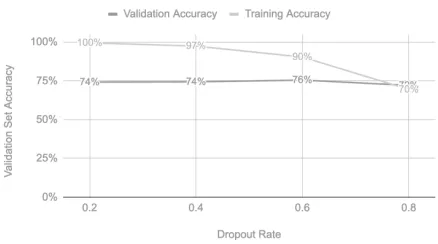
This paper also explores various dropout rates in Figure 4, observing peak validation accuracy around 0.6. That said, this study prefers the more balanced
Figure 3: L2 penalties
performance of L2 regularization and uses L2 of 0.01 in subsequent comparisons.
Figure 4: Dropout rates
3.1.4 Number of words encoded
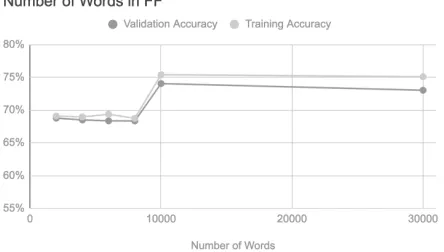
Figure 5: Performance across different number of words encoded
3.2
Selected configuration
Given empirical results, the study recommends the following:
• 32 node first dense layer, 16 node second dense layer FF.
• 0.01 L2 kernel regularization but no dropout.
• Using 10,000 top words.
The model achieves achieves a 74% test set accuracy after selecting this config-uration, a result in line with its 73% validation set accuracy. This paper uses these settings in presenting results below.
3.3
Topical performance
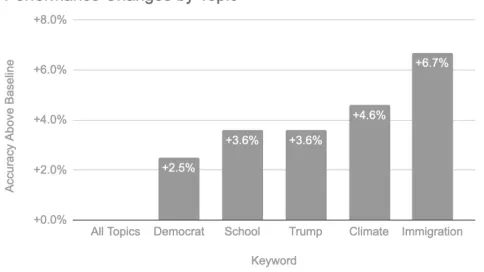
Next, supporting Hypothesis 3, accuracy increases when comparing different organizations coverage of the same subjects (Figure 6). However, uneven per-formance distribution across topics may indicate that some subjects showcase differences in voice better than others. Note that this test uses accuracy across all sets (test, validation, and training) as topic filtering causes a sharp reduction in n size, especially when considering either just validation or test sets. Also, due to filtering on topic yielding low sample sizes, observe that the model is not retrained when evaluating each topic. As explored later, this may suggest that the model compares signals within the context of a topic (different agen-cies’ ‘treatments’ of an issue) but the same model can perform across different subject matter.
Figure 6: Performance after filtering for keywords within the example topics set
3.4
Voice similarity
Helping to understand these linguistic relationships, consider that two news agencies may have similar ways of speaking if articles from one source are of-ten confused as having come from another source. Figure 7 shows the results of applying Formula 2 and is consistent with prior work on political ideology, demonstrating clear links between NPR, CNN, and the New York Times as well as between Breitbart and Fox (Political Polarization & Media Habits). That said, some edges may indicate pattern similarities less emergent from politics. Though prior work would suggest that their political leaning differs, Fox’s strong connection to CNN indicates that the ‘voice’ in which they deliver their different message is still itself similar (Political Polarization & Media Habits). This is explored further below.
3.5
Quantitative understanding of patterns
To understand the types of patterns identified, this study compares this model’s behavior to related work and calculates feature (word) importance.
3.5.1 Ideology and polarity
Using Formula 3, Figure 8 describes a modest correlation between the Pew score and the distance from Breitbart in this model (R2 = 0.3). This relationship suggests that, while this classifier may interpret political signals, model behavior is poorly explained by political lean alone.
Similarly, Figure 9 depicts a modest correlation between model Breitbart dis-tance and percent of titles of substantial negative polarity (R2 = 0.4). That
Figure 7: News agency graph with line width proportional to similarity score
do not correlate as well with Breitbart model distance. Therefore, while polar-ity and politics likely play a role in the patterns identified by this model, these findings suggest that neither can explain the model’s overall behavior.
3.5.2 Word importance
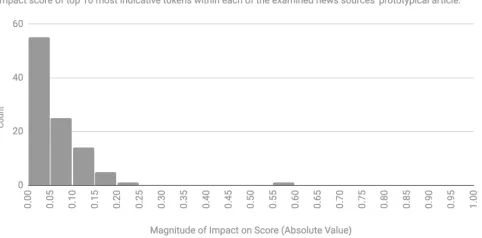
As polarity and ideology fail to fully explain model behavior, this study next evaluates the importance of different words using LIME (“‘Why Should I Trust You?’: Explaining the Predictions of Any Classifier”). However, using the pro-totypical articles’ described in Section 2.8, even the ten most ‘important’ words identified per article only weakly influence predictions (Figure 10).
Indeed, 98% of words examined shift an agency’s score by less than 0.2 (57% under 0.05) despite this prototypical set’s agency scores nearing 1. Furthermore, as published in supplemental material, LIME observes the model using logical candidates for discrimination (Donald, growth, wounded, police, federal, ‘Eng-land’ rugby team, etc.) even if no token achieves overwhelming power (Who Wrote This Template Workbook). This highly dispersed token importance
Figure 8: Pew audience ideology score and Breitbart distance
Figure 9: Percent articles with negative polarity and Breitbart distance
tribution implies that this model behavior is complex beyond simple word or topic probabilities, possibly indicating that the model is interpreting something like contextual sentiment towards topics or framing devices. This study further explores this in the qualitative results below.
3.6
Qualitative understanding of patterns
To give context to quantitative exploration, prototypical articles provide quali-tative understanding of these patterns as they manifest in individual stories.
3.6.1 Agency exemplars
Figure 10: LIME analysis of prototypical articles
also reveal some possible topical bias like in BBC’s reference to England’s rugby team. That said, in addition subject matter discrimination, this collection also highlights characteristic vantage points for some agencies (Fox discussing violent crime and the Wall Street Journal’s economic focus) that emerge again below. Still, consistent with the quantitative results, none of these features (sentiment, topical bias, and framing) seem to alone describe this exemplar set.
Source Exemplar Title
BBC News Jones to bring in expert in bid to fix England’s mental weak-ness under pressure
Breitbart Mark Levin: ’Hate-America Democrats Passed a Resolution Telling You That America Sucks‘
CNN
The move shows a potential growing threat to the President and those in his orbit from probes by the Manhattan US At-torney’s office
Daily Mail Children behind half of London knife crime as machete is sold for just£19
Drudge Report Pelosi Warns Dems: Stay in Center; Trump May Contest Elec-tion Results...
Fox News The Latest: Vegas police: Wounded robbery suspect has died NPR Retired Military Officers Urge Caution In Proposed
Diplo-matic Spending Cuts
New York Times French Raise a Glass to a Health Warning About Too Much Wine
Vox Google employees walked out for the right to sue their bosses. Now they’re taking the fight to Congress.
Wall Street Journal How Bad Is the China Slowdown? U.S. Companies Offer Some Answers
Table 2: Overall exemplar articles per agency
3.6.2 Topical exemplars
Prototypical articles can also isolate differences in coverage in the context of a particular topic, sharpening a view into the model’s learned trends. For ex-ample, Table 3 displays prototypical stories discussing climate. While again no single attribute of ‘voice’ seems to define all of the sources, some observations from that set which may reveal framing devices:
• Breitbart frames climate change within context of political power.
• Fox’s exemplar places the topic within a political frame whereas NPR places it within a scientific one.
• Wall Street Journal situates the issue within an economic context, consis-tent with its economic focus.
• Both BBC News and the Daily Mail discuss climate protesters but one puts an emphasis on violence.
Source Exemplar Title
BBC The Papers: Climate protests and Trump probe
Breitbart Warren: Climate Change, Gun Violence, Student Loan Debt Constitute for National Emergency Declaration
CNN John Avlon speaks the cold truth about climate change Daily Mail Dramatic moment police DRAG two climate change protesters
along the street Drudge Report Climate-first...
NPR The Role Climate Change Plays In Weather Extremes Fox Trump pokes fun at Klobuchar’s climate-change stance as she
announces candidacy in snow
New York Times Nonfiction: Two New Books Dramatically Capture the Cli-mate Change Crisis
Vox Amazon says it’s a leader on fighting climate change. 5,000 employees disagree.
Wall Street Journal Glencore, the King of Coal, Bows to Investor Pressure Over Climate
Table 3: Prototypical articles discussing climate
3.6.3 Cross-agency exemplars
Voice of Source Actual Source Title
CNN Fox AP FACT CHECK: Trump blames media for his McCain rant
Fox CNN Gunman in Quebec mosque shooting sen-tenced to life in prison
Wall Street Journal NPR Fed Changes Course, Holds Off On Raising In-terest Rates
NPR Wall Street Journal U.S. Bets on China’s Special Envoy
Table 4: Selection of cross-agency articles
3.7
Other observations
This study wishes to highlight final observations within results before discussion.
3.7.1 Per-agency performance
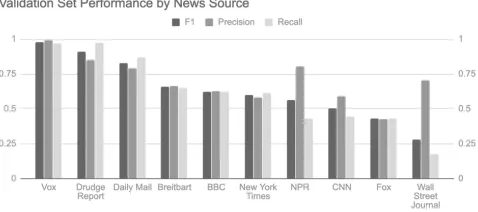
Figure 11 shows some like Vox have ‘high separability’ whereas some like Fox saw more confusion.
Figure 11: Validation set performance per agency
That said, a weak correlation of F1 score to sample size (R2 = 0.2) sug-gests added data aids learning but class imbalance does not bias towards more strongly represented agencies (Figure 12). Therefore, Figure 11 likely sees fea-ture discernibility lead some agencies to be more identifiable than others.
3.7.2 Fox News
In early training, Fox News’ recall in the validation set was below 1% and, to remedy this, Fox is re-sampled (articles duplicated) so that additional instances appear in training (but not in test or validation sets). The amount of resam-pling (from 0% to 100%) of Fox does not impact overall validation accuracy by more than 1% but, using 100% duplication (each Fox article in the training set duplicated exactly once), Fox’s recall reaches 43%. This study does not re-sample other agencies as performance is not as disparate for any other outlet. Depending on use case, derived work may consider this resampling optional.
Figure 12: Validation set F1 score versus number of articles for an agency
3.8
Search engine
To enable researchers to further explore the exemplars generated by this model, a public demo search engine is made available at whowrotethis.com using the Flask framework and an ‘inverted index’ (Flask (A Python Microframework);
Exploring Solr Internals : The Lucene Inverted Index). The application (Figure 13) is available as open source (datadrivenempathy/who-wrote-this-server).
Figure 13: Who Wrote This running in Firefox on Mac OS X
4
Discussion
relation-ship with a publisher. After demonstrating predictive power and information retrieval capability, this study now turns to discussion of findings.
4.1
Implications for modeling
The length of documents, number of training instances, and choices made in regularization / model architecture all impact accuracy. However, this study finds complex relationships between outcome and those inputs and structures.
4.1.1 Sensitivities to amount of input data
As described, amount of input data impacts accuracy but more data may not always yield better outcome. Most notably, description out-performs title likely because the later is longer (Figure 14). That said, increasing dictionary size does improve performance but only up to a certain point of rapidly diminishing returns and, while increased sample sizes may aid learning for some agencies, more training instances do not guarantee increased performance.
Figure 14: Lengths of inputs across all agencies
4.1.2 Decisions for regularization
This model may require regularization because articles have highly identify-ing word co-occurrences which enable them to be identified without extractidentify-ing broader patterns. That said, weight penalties like L2 regularization outperform dropout in this model and results suggest L2 weight penalties may also improve regression in related tasks such as topic modeling or authorship assignment.
4.1.3 Feed-forward vs LSTM
FF prevails in this task possibly because, given recent research in useable con-text, the number of tokens per instance may simply be too short to take full
advantage of LSTM’s properties (Sharp Nearby, Fuzzy Far Away: How Neural Language Models Use Context). Note that there have been other findings of FF outperforming recurrent structures in some circumstances (When Recurrent Models Don’t Need to be Recurrent). Beyond accuracy, FF sees notably lower wall clock training time than LSTM as cataloged (README).
4.2
Emergent signals of ideology
While model behavior seems broader than conservative versus liberal or senti-ment polarity, some learned patterns are likely ideological in nature. For ex-ample, a learned belief around agency co-occurrence of ‘economy’ and ‘climate’ or ‘Trump’ and ‘honorable’ could be a form of ‘commentary’ on a publisher, an emergent ‘form of speech’ without explicitly ideological feature engineering. While this model seeks that linguistic bias, this could have implications for other machine learning systems desiring or requiring neutrality. Even without express instruction to extract ideology, consider that news recommenders could learn ideological-correlated features to suggest articles matching users’ subjectivities, creating or reinforcing ‘filter bubbles’ (Filter bubbles are a serious problem with news, says Bill Gates). Alternatively, in ‘cold start’ or a non-personalized sys-tem where all users are presented the same recommendations, an unintended non-neutrality in the platform could emerge to reflect majority preferences (The Cold Start Problem for Recommender Systems — Yuspify Blog). Similar to prior work discussing racial or sexual disparity in algorithm performance, this unin-tended bias may impact discussion of technology companies’ ethical responsi-bilities when they act as mediators of the news media ecosystem or host public discourse (Is Facebook a publisher? In public it says no, but in court it says yes;Is Artificial Intelligence Racist?). Furthermore, like earlier work in biased word embeddings, recognition of possible content-emergent bias could open av-enues of remediation in both recommenders and other systems processing this kind of text (“Man is to Computer Programmer As Woman is to Homemaker? Debiasing Word Embeddings”).
4.3
Implications for news media
other attributes of ‘voice’ like framing or polarity influence consumption in ways similar to politics, an article’s addressable audience may not only be limited by perceptions of its political bias but by audience affinity for the other linguistic markers with which it is written, further dividing the modern media landscape beyond politics alone (American views: Trust, media and democracy; “Looking the Other Way”). In short, if voice ‘mediates’ the way an article is received, these linguistic patterns not only present a challenge to a journalist attempting to reach an audience but non-political signals may further shrink the number of avenues through which ‘facts’ are established for a population. This is discussed further in future work.
5
Future Work
This study suggests multiple avenues for future work both within machine learn-ing and through other methods of inquiry.
5.1
Class imbalance
Though this study does take some steps to address class imbalance when it impacts performance, future studies could explore instance weighting and re-sampling to confront the fact that some agencies publish more work. That said, this paper suggests that an increased number of instances may or may not im-prove performance and some infrequent classes do see high performance in the current model iteration.
5.2
Full article length
This study does not attempt classification using full article text which could potentially improve performance. Still, given that the number of words in-cluded in an encoding offers only a diminishing return after a certain point, this study suggests that regressing on the full article may not necessarily improve performance substantially.
5.3
Testing voice preferences
As discussed, this paper cannot empirically establish that the identified patterns increase appeal to certain audiences and, in the case of non-political patterns, it is possible but not necessarily true that these markers impact media consump-tion (“Looking the Other Way”). Future work could close this gap by exploring the interaction of favorability and voice in different populations similar to prior
work but outside an explicitly political lens, comparing framing devices (eco-nomic vs political) or polarity for example (“Looking the Other Way”).
5.4
Topic modeling and sentiment analysis
This paper simply filters for keywords within a title when exploring a topic and brief experiments with Latent Dirichlet Allocation and Tf-Idf did not result in sensible topic modeling yet ready for publication (“Latent dirichlet allocation”; “Document clustering: TF-IDF approach”). Furthermore, this study only uses pre-existing sentiment models. Therefore, it is possible other studies could cre-ate more performant sentiment or topic modeling system with tailoring to this dataset, possibly providing alternatives to this paper’s example subject set.
6
Conclusions
Learning from publicly available RSS feeds for ten news organizations, this machine learning method uncovers different agencies’ linguistic characteristics through a neural network-based model capable of identifying the publisher of an article with 74% test set accuracy. This probabilistic classifier allows for quan-titative contrasting of different organizations’ patterns and empirical findings provide recommendations for related tasks both on this study’s newly released open database and in similar news media datasets. Furthermore, an ‘exemplar’ search engine using the learned model enables researchers to qualitatively un-cover new insight into organization’s un-coverage. Finally, ending with commentary rooted in previous linguistic, psychological, and media studies research, discus-sion highlights possible implications of these patterns for the media landscape and, in demonstrating a mechanism for inadvertent ‘filter bubble’ emergence, describe practical ethical implications for other machine learning efforts. That said, in addition to recommending investigation outside an explicitly liberal versus conservative lens, this paper invites future work to further investigate observed phenomena both through machine learning methods like topic model-ing and through psychological / lmodel-inguistic studies.
Reproducibility and data
This study releases code under a permissive open source license and provides runnable containers via Code Ocean (datadrivenempathy/who-wrote-this-training;
Patterns in the News Media). Empirical results for attempted model config-urations are also archived via Weights and Biases and the methods section is supplemented via Protocols.io (README; “Machine Learning Techniques for Detecting Identifying Linguistic Patterns in the News Media”). To respect the spirit of a publisher’s wishes, data are made available under the Attribution-NonCommercial-ShareAlike 4.0 International Creative Commons license (Who Wrote This Data;CNN RSS). It is advised that derived work ensure compliance with governing restrictions around use of article information including possible applicability of ‘fair use’ and, especially if crawling, updated state of publish-ers’ robots.txt files (More Information on Fair Use; A Method for Web Robots Control).
Acknowledgements
This study thanks Carey Phelps (Product Lead at Weights and Biases) for conversation that motivated this research as well as Shreyas Jayanna and David Joy for suggestions regarding presentation, investigation, and implications of these findings.
Competing Interests
Carey Phelps is a friend of AP and this study’s machine learning pipeline op-tionally uses her employer’s product (Weights and Biases) to log training infor-mation. Operation of all released code and use of released data does not require leveraging Weights and Biases.
References
Agarap, Abien Fred. 2018.Deep Learning using Rectified Linear Units (ReLU).
Available athttp://arxiv.org/abs/1803.08375[Last accessed on 3 June
2019].
AllSides. 2019.Balanced news via media bias ratings for an unbiased news
per-spective. Available at https://www.allsides.com/unbiased-
balanced-news[Last accessed on 3 June 2019].
Bafna, Prafulla, Dhanya Pramod and Anagha Vaidya. 2016. “Document
clus-tering: TF-IDF approach”. In:2016 International Conference on Electrical,
Electronics, and Optimization Techniques (ICEEOT).doi:10.1109/iceeot.
2016.7754750.
Benedetti, Alessandro. 2018. Exploring Solr Internals : The Lucene Inverted
Index. Available at https : / / sease . io / 2015 / 07 / exploring solr
-internals-lucene.html[Last accessed on 3 June 2019].
Blei, David M. et al. 2003. “Latent dirichlet allocation”. In:Journal of Machine
Learning Research 3, p. 2003.
Bolukbasi, Tolga et al. 2016. “Man is to Computer Programmer As Woman is to
Homemaker? Debiasing Word Embeddings”. In:Proceedings of the 30th
In-ternational Conference on Neural Information Processing Systems. NIPS’16.
Barcelona, Spain: Curran Associates Inc., pp. 4356–4364.isbn:
978-1-5108-3881-9. Available at http : / / dl . acm . org / citation . cfm ? id = 3157382 .
Brownlee, Jason. 2019. Sequence Classification with LSTM Recurrent Neural
Networks in Python with Keras. Available athttps://machinelearningmastery.
com / sequence classification lstm recurrent neural networks
-python-keras/[Last accessed on 3 June 2019].
Chang, Che-Chia, Shu-I Chiu and Kuo-Wei Hsu. 2017. “Predicting political
affiliation of posts on Facebook”. In: Proceedings of the 11th International
Conference on Ubiquitous Information Management and Communication
-IMCOM ’17.doi: 10.1145/3022227.3022283.
CNN RSS. Available at http://www.cnn.com/services/rss/#terms [Last
accessed on 3 June 2019].
de Bruijn, Hans and Gerdien de Vries. 2018.Framing: How Politicians Debate.
Available at
https://www.edx.org/course/framing-how-politicians-debate-delftx-frame101x-1[Last accessed on 3 June 2019].
Delaney, Kevin J. 2017.Filter bubbles are a serious problem with news, says Bill
Gates. Available at
https://qz.com/913114/bill-gates-says-filter-bubbles- are- a- serious- problem- with- news/[Last accessed on 3 June
2019].
Fortuny, Enric Junqu´e De et al. 2012. “Media coverage in times of political
crisis: A text mining approach”. In:Expert Systems with Applications39.14,
pp. 11616–11622.doi: 10.1016/j.eswa.2012.04.013.
Gaspar, Huba. 2018. The Cold Start Problem for Recommender Systems —
Yuspify Blog. Available at
https://www.yuspify.com/blog/cold-start-problem-recommender-systems/[Last accessed on 3 June 2019].
Hess, Amanda. 2017.How to Escape Your Political Bubble for a Clearer View.
Available at
https://www.nytimes.com/2017/03/03/arts/the-battle-over-your-political-bubble.html [Last accessed on 3 June 2019].
Hippel, William Von, Denise Sekaquaptewa and Patrick Vargas. 1997. “The
Linguistic Intergroup Bias As an Implicit Indicator of Prejudice”. In:Journal
of Experimental Social Psychology 33.5, pp. 490–509.doi: 10.1006/jesp.
1997.1332.
Hitschler, Julian, Esther Van Den Berg and Ines Rehbein. 2017. “Authorship
Attribution with Convolutional Neural Networks and POS-Eliding”. In:
Pro-ceedings of the Workshop on Stylistic Variation. doi:
10.18653/v1/w17-4907.
Hochreiter, Sepp and J¨urgen Schmidhuber. 1997. “Long Short-Term Memory”.
In: Neural Computation 9.8, pp. 1735–1780.doi: 10.1162/neco.1997.9.
8.1735.
Jaccard, Paul. 1912. “The Distribution Of The Flora In The Alpine Zone.1”.
In: New Phytologist 11.2, pp. 37–50. doi: 10 . 1111 / j . 1469 - 8137 . 1912 .
tb05611.x.
Khandelwal, Urvashi et al. 2018.Sharp Nearby, Fuzzy Far Away: How Neural
Language Models Use Context. Available athttps://nlp.stanford.edu/
pubs/khandelwal2018lm.pdf[Last accessed on 3 June 2019].
Knight Foundation. 2018.American views: Trust, media and democracy.
Avail-able at https : / / knightfoundation . org / reports / american views
Knobloch-Westerwick, Silvia and Jingbo Meng. 2009. “Looking the Other Way”.
In:Communication Research36.3, pp. 426–448.doi:10.1177/0093650209333030.
Koster, M. 1996.A Method for Web Robots Control. Available athttp://www.
robotstxt.org/norobots-rfc.txt[Last accessed on 3 June 2019].
Lan, Haihan. 2017.The Softmax Function, Neural Net Outputs as Probabilities,
and Ensemble Classifiers. Available athttps://towardsdatascience.com/
the-softmax-function-neural-net-outputs-as-probabilities-and-ensemble-classifiers-9bd94d75932[Last accessed on 3 June 2019].
Levin, Sam. 2018.Is Facebook a publisher? In public it says no, but in court it
says yes. Available athttps://www.theguardian.com/technology/2018/
jul / 02 / facebook - mark - zuckerberg - platform - publisher - lawsuit
[Last accessed on 3 June 2019].
Loria, Steven. 2019.Simplified Text Processing. Available athttps://textblob.
readthedocs.io/en/dev/[Last accessed on 3 June 2019].
Miller, John. 2018.When Recurrent Models Don’t Need to be Recurrent.
Avail-able athttps://bair.berkeley.edu/blog/2018/08/06/recurrent/[Last
accessed on 3 June 2019].
Mitchell, Amy et al. 2014.Political Polarization & Media Habits. Available at
https://www.journalism.org/2014/10/21/political-
polarization-media-habits/[Last accessed on 3 June 2019].
Mosteller, Frederick and David L. Wallace. 1964.The federalist: inference and
disputed authorship. Addison-Wesley.
Ng, Andrew Y. 2004. “Feature Selection, L1 vs. L2 Regularization, and
Ro-tational Invariance”. In: Proceedings of the Twenty-first International
Con-ference on Machine Learning. ICML ’04. Banff, Alberta, Canada: ACM,
pp. 78–.isbn: 1-58113-838-5.doi:10.1145/1015330.1015435. Available at
http://doi.acm.org/10.1145/1015330.1015435.
Numpy. 2019. NumPy. Available at https://www.numpy.org/ [Last accessed
on 3 June 2019].
Pandas. 2019. Python Data Analysis Library. Available at https://pandas.
pydata.org/[Last accessed on 3 June 2019].
Porter, Shanette C., Michelle Rheinschmidt-Same and Jennifer A. Richeson.
2015. “Inferring Identity From Language”. In: Psychological Science 27.1,
pp. 94–102.doi:10.1177/0956797615612202.
Pottinger, A Samuel. 2019(a).datadrivenempathy/who-wrote-this-news-crawler.
Available at
https://github.com/datadrivenempathy/who-wrote-this-news-crawler[Last accessed on 3 June 2019].
Pottinger, A Samuel. 2019(b).datadrivenempathy/who-wrote-this-server.
Avail-able at https : / / github . com / datadrivenempathy / who wrote this
-server[Last accessed on 3 June 2019].
Pottinger, A Samuel. 2019(c).datadrivenempathy/who-wrote-this-training.
Avail-able at https : / / github . com / datadrivenempathy / who wrote this
Pottinger, A Samuel. 2019(d).Machine Learning Techniques for Detecting
Identi-fying Linguistic Patterns in the News Media. https : / / www . codeocean .
com/. Version v2.doi:https://doi.org/10.24433/CO.5660509.v2.
Pottinger, A Samuel. 2019(e). “Machine Learning Techniques for Detecting
Identifying Linguistic Patterns in the News Media”. In: Protocols.io. doi:
dx . doi . org / 10 . 17504 / protocols . io . 3j6gkre. Available at https :
/ / www . protocols . io / view / machine learning techniques for
-detecting-identify-3j6gkre.
Pottinger, A Samuel. 2019(f). README. Available at https://app.wandb.
ai/sampottinger/who- wrote- this/reports?view=sampottinger%5C%
2FREADME[Last accessed on 3 June 2019].
Pottinger, A Samuel. 2019(g). Who Wrote This App. Available at https : / /
whowrotethis.com[Last accessed on 3 June 2019].
Pottinger, A Samuel. 2019(h). Who Wrote This Data. Available at https://
whowrotethis.com/data[Last accessed on 3 June 2019].
Pottinger, A Samuel. 2019(i).Who Wrote This Template Workbook. Available at
https://docs.google.com/spreadsheets/d/1ofxgeF6W-G7I6M5Cqcah0d9D-nRDEXpcjKWvekCe7aE/edit?usp=sharing.
Reitz, Kenneth. 2018. HTTP for Humans. Available at
https://2.python-requests.org/en/master/[Last accessed on 3 June 2019].
Ribeiro, Marco, Sameer Singh and Carlos Guestrin. 2016. “‘Why Should I Trust
You?’: Explaining the Predictions of Any Classifier”. In: Proceedings of the
2016 Conference of the North American Chapter of the Association for
Com-putational Linguistics: Demonstrations. doi:10.18653/v1/n16-3020.
Richardson, Leonard. 2019.Beautiful Soup. Available athttps://www.crummy.
com/software/BeautifulSoup/[Last accessed on 3 June 2019].
Ronacher, Armin. 2019.Flask (A Python Microframework). Available athttp:
//flask.pocoo.org/[Last accessed on 3 June 2019].
Santamicone, Maurizio. 2019. Is Artificial Intelligence Racist? Available at
https://towardsdatascience.com/https-medium-com-mauriziosantamicone-is- artificial- intelligence- racist- 66ea8f67c7de [Last accessed on
3 June 2019].
Slegg, Jennifer. 2015.Are There Any SEO Benefits With Having an RSS Feed?
Available at
http://www.thesempost.com/are-there-any-seo-benefits-with-having-an-rss-feed/[Last accessed on 3 June 2019].
SQLite. 2019. SQLite. Available at https : / / www . sqlite . org / index . html
[Last accessed on 3 June 2019].
Srivastava, Nitish et al. 2014. “Dropout: A Simple Way to Prevent Neural
Net-works from Overfitting”. In:J. Mach. Learn. Res.15.1, pp. 1929–1958.issn:
1532-4435. Available at http://dl.acm.org/citation.cfm?id=2627435.
2670313.
US Copyright Office. 2019.More Information on Fair Use. Available athttps:
/ / www . copyright . gov / fair - use / more - info . html [Last accessed on
Vaux, Bert et al. 2003.Harvard Dialect Survey. Available athttp://dialect.
redlog.net/[Last accessed on 3 June 2019].