Toward Practical Private Access to Data Centers via Parallel ORAM
∗
Jacob R. Lorch, Bryan Parno, James Mickens
Mariana Raykova
†Joshua Schiffman
Microsoft Research
IBM Research
AMD
Abstract
Recent events have shown online service providers the perils of possessing private information about users. Encrypting data mitigates but does not eliminate this threat: the pattern of data accesses still reveals informa-tion. Thus, we present Shroud, a general storage system that hides data access patterns from the servers running it, protecting user privacy. Shroud functions as a virtual disk with a new privacy guarantee: the user can look up a block without revealing the block’s address. Such a vir-tual disk can be used for many purposes, including map lookup, microblog search, and social networking.
Shroud aggressively targets hiding accesses among hundreds of terabytes of data. We achieve our goals by adapting oblivious RAM algorithms to enable large-scale parallelization. Specifically, we show, via new tech-niques such as oblivious aggregation, how to securely use many inexpensive secure coprocessors acting in par-allel to improve request latency. Our evaluation com-bines large-scale emulation with an implementation on secure coprocessors and suggests that these adaptations bring private data access closer to practicality.
1
Introduction
Using systems like GFS [2] and Haystack [3], com-panies store petabytes of sensitive user data, including emails, photos, and social networking activity. Early cloud stores optimized for the traditional metrics for dis-tributed file systems: performance, availability, and scal-ability. However, information privacy has become in-creasingly important. Mutually distrusting users expect the cloud provider to prevent unauthorized cross-user data access. However, users may also distrust the cloud provider itself. For example, unscrupulous employees of the provider may try to inspect user data for criminal purposes [4]. Even if the provider is honest, its treasure trove of private data is alluring to hackers, who can lever-age stolen data for political or financial gain [5].
Applications like the Persona social network [6] op-erate solely on encrypted user data, preventing the ser-vice provider from directly inspecting sensitive informa-tion. However, even if data is encrypted, user access patternscan leak important information [7–9]. For ex-ample, a malicious observer can use access patterns to correlate two users’ activities, e.g., to discover friend-ships in a social network or to tell whether users are
∗This is the full version of our conference paper [1]. †
geographically close. Even visiting the service via an anonymous proxy [10] does not obviate this threat, since the attacker may have auxiliary information. For exam-ple, if he knows where the victim lives, he can observe when map tiles in that location are fetched, then correlate subsequent accesses to learn the victim’s work address. Even without data access, an observer can see how of-ten each item is accessed, then use statistical inference to deduce the contents of encrypted items. For instance, one study identified over 80% of encrypted email queries based on access pattern alone [7].
We thus introduce Shroud, a cloud-based storage sub-strate that hides user access patterns from the servers that store user data. Shroud implements a distributed block interface [11] that allows clients to read and write to ad-dresses 1 toN, whereNis large, e.g., 235. Shroud’s block interface is oblivious—storage servers cannot learn: the plaintext of user data, the addresses requested, nor rela-tionships between requested addresses. Shroud’s block interface is directly usable by services, like maps, that require simple, one-to-one bindings between names and objects, e.g., from geographic coordinates to map tiles. Services with richer semantics can layer complex data structures atop Shroud, as ext3 and NTFS do atop a phys-ical disk’s block interface.
To hide user access patterns, Shroud leverages obliv-ious RAM (ORAM) algorithms [12–20]. Prior ORAM algorithms cannot satisfy the performance and scalabil-ity demands of cloud applications: these algorithms han-dle thousands instead of trillions of items, and they offer access latencies of minutes or hours. In contrast, we set aggressive goals: on modern hardware, Shroud targets low-latency access times for storage of tens of billions of 10KB blocks. For this, Shroud uses several techniques.
First, Shroud uses many secure coprocessors acting in parallel as client proxies in the data center. Clients estab-lish secure connections with the proxies, which return the small results of expensive message exchanges between the proxies and cloud servers.
Second, using a novel intra-data-center communica-tion protocol,oblivious aggregation, Shroud implements a distributed, parallel ORAM algorithm that remains se-cure even when the adversary controls the network that connects the proxies and servers.
Unlike nearly all other ORAM work, we implement our algorithms on real, secure hardware and run at large scale. Implementation reveals critical bottlenecks not ap-parent in previous big-O analysis or simulations, such as the I/O bottleneck of modern secure hardware (§4.2).
In summary, Shroud is the first practical system for oblivious data access at data-center scales.
2
Background and Related Work
We briefly survey prior work on cloud file systems, ORAM, and private information retrieval (PIR). For de-tails on PIR and ORAM, we defer to surveys [20,21].
2.1 Cloud File Systems
There are a variety of enterprise-scale systems for stor-ing and analyzstor-ing large amounts of data [2,3,22–26]. These systems emphasize massive scalability, high avail-ability, and robustness to multiple server-side failures, and they are generally designed to scale using cheap commodity hardware.
Cloud storage systems export a variety of interfaces to clients. For example, FDS [23] is a simple, fast blob store that requires clients to implement richer semantics like locking schemes. S3 [25] defines a key-value interface. HDFS [24], Cosmos [22], and GPFS [26] export a hier-archical namespace, but only the latter is fully POSIX-compliant. Shroud’s simple block-level API is closer in spirit to low-level interfaces like those of FDS and S3. However, prior work like Petal [11] demonstrates that many useful services can be built atop a distributed block abstraction. Note that none of the systems above pro-vides oblivious data access.
2.2 Private Information Retrieval (PIR)
Traditional PIR.In a private information retrieval (PIR) protocol [27], a user retrieves block i from a database ofNitems held by a server, without the server learning
i. Sion et al. [28] argue that in practical settings, exist-ing PIR schemes will never be more efficient than the trivial PIR scheme of downloading the entire database. However, they evaluate number-theoretic solutions; tech-niques based on other assumptions, e.g., lattice-based linear algebra schemes [29], can outperform the triv-ial PIR scheme [30]. Nonetheless, Olumofin and Gold-berg’s results [30] indicate that even these schemes re-quire over 25 minutes to access one block from a 28GB database over a home network connection, suggesting single-server PIR is not yet ready for the massive (ter-abyte or pet(ter-abyte) data sets and sub-second requirements of the data center (§4.1).
Multi-Server PIR. Using multiple non-colluding servers can improve the efficiency of both information theoretic and computational solutions [21,27, 30, 31]. Nonetheless, these response times are still too slow for data-center workloads, and more importantly, the
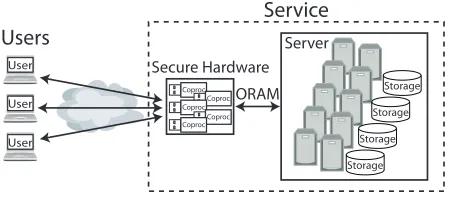
data sets we consider (§4.1) are large enough to make duplication prohibitive and are held by companies with little incentive to allow others to duplicate their data. Trusted Hardware PIR.A more practical approach to PIR is for the user to trust a secure coprocessor installed at the server. The user sends an encrypted request to the coprocessor, which uses an Oblivious RAM (ORAM) protocol to access the requested block and return it to the user via the secure channel (Fig.1). This means that the user employs essentially the same amount of bandwidth as it would for a non-private request. It is also more effi-cient than performing the ORAM operations between the user and the server. Finally, it allows many independent users to use the same service.
Iliev and Smith first proposed this elegant combination of trusted hardware and ORAM for PIR [32], though the notion is implicit in the earlier work of Smith and Saf-ford [33] and Asonov and Freytag [34].
2.3 Oblivious RAM (ORAM)
Classic. Goldreich and Ostrovsky [12–14] introduced ORAM as a mechanism by which a trusted processor could make use of an untrusted RAM. Most existing ORAM solutions use the basic memory structure sug-gested by Ostrovsky’s “Hierarchical Scheme” [13,14]. The ORAM is arranged in a series of progressively larger caches. Each cache consists of a hash table of buckets. When a block is requested, the algorithm checks a bucket at each level of the hierarchy. If the block is found, the search continues, to hide the location where the block was found, but looks for a dummy block instead. Finally, the block is reinserted into the top-level cache. When a cache is close to overflowing, it is obliviously shuffled into the cache below it. This scheme and the modern schemes derived from it require serial operation for se-curity, making it challenging to leverage a large number of distributed secure coprocessors.
Modern. Recent ORAM work has explored optimiza-tions of the classic Hierarchical Scheme [13,14], includ-ing the use of cuckoo hashinclud-ing [17,19,20] and Bloom filters [16]; used incautiously, these optimizations can leak information [20]. This work has steadily improved both the asymptotics, constants, and security of earlier schemes, to the point of achievingO(log2N/log logN) overhead/access, for a data set withNitems [20].
User
User
User
Coproc Coproc Coproc
Coproc Coproc
Storage
Storage
Storage
Storage
ORAM
Service
Users
Secure Hardware Server
Figure 1: Private Data Access Overview. To read and/or write data, a user establishes a secure channel to a secure co-processor in the service’s data center. Along with other copro-cessors, the coprocessor uses an ORAM algorithm to retrieve or update a block without revealing to the service which block was accessed. It returns the result via the secure channel.
Very recent work considers practical aspects of ORAM [18,36–38], but they perform all operations be-tween the client and the data center (rather than using a hardware proxy) and/or run code on the main CPU, rather than on actual secure hardware. Concurrent work also adds parallelism [36], but only across multiple re-quests, rather than within a single request.
For use in a data-center environment, we selected Shi et al.’s Binary Tree scheme [15] (§5.1). It suits our goals because it hasO(log3N)worst-caseaccess time, its bi-nary tree structure lends itself to parallelization, and its algorithm uses simple primitives that lend themselves to implementation on a coprocessor. It also usesO(1) stor-age, making it suited to our limited secure coprocessors.
3
Problem Definition
3.1 Execution Model
At a high level, remote users access data privately by indirecting their requests through secure coprocessors running in the service’s data center (Fig.1). A coproces-sor uses standard attestation techniques [39] to convince those users that it is a real secure coprocessor running the expected code. Collectively, using the data center’s servers as untrusted storage, the secure coprocessors im-plement an ORAM algorithm, allowing them to answer requests without leaking information to the server.
In contrast to having the users execute the ORAM algorithm directly, this model keeps the bandwidth-intensive ORAM protocol within the data center net-work. It also allows the users to share a single ORAM, rather than creating an ORAM per user or forcing the users to share a secret key.
In this work, we assume each coprocessor has lim-ited internal trusted storage that can indefinitely store a few keys and a small amount of state. The coprocessors are distinct from theserver, which is the untrusted com-ponent that handles storage and communication. The server may run on multiple processors and/or machines to achieve parallelism and fault tolerance.
3.2 Threat Model
We assume the attacker physically controls the ser-vice’s data center and can run arbitrary code on the servers. The attacker can also submit known queries to the service and observe the service’s internal operations in response. However, we assume he cannot violate the tamper-responding secure coprocessors. We assume this not because secure coprocessors are absolutely inviolate, but because they present a high barrier. By defending against the large class of attackers who cannot subvert them, we substantially increase security.
We do not consider denial-of-service attacks, since the attacker can always power off the service or sever the network connection. We also do not consider attacks that could be launched by a standard network attacker; e.g., the attacker is able to observe that a particular IP address has submitted three requests today. If desired, users can mitigate this risk via standard techniques [10].
3.3 Strawman Solutions
Used na¨ıvely, parallelism can be problematic.
Replication. One natural approach to using a collec-tion of secure coprocessors is replicated execucollec-tion, i.e., to have each secure coprocessor maintain an independent copy of the ORAM data structure. Such a scheme would trivially improve response throughput, but not latency. Unfortunately, this also increases storage requirements enormously. For a database ofNitems, ORAM schemes typically require the untrusted server to store between
O(N) and O(NlogN) encrypted blocks. The encryp-tion key is unique to the ORAM scheme, meaning that each replica of the ORAM scheme would require its own freshly encrypted copy of the original database. While storage is indeed growing cheaper, existing data sets are already hundreds or thousands of terabytes (§4.1), so replicating them tens of thousands of times is imprac-tical. It is also unclear how this would support writes. Distributed Caches. A more practical approach would have all the secure coprocessors share a key and oper-ate on the same encrypted data set. Unfortunoper-ately, deal-ing with writes as well as reads is complicated, and even handling only reads may leak information about whether two requests are for the same address. Imagine two re-quests arrive for itemv, each routed to a different co-processor. If neither coprocessor has previously fetched
v, then neither one will find it in their cache, and hence both will requestvfrom the server. From this, the server will observe that two different requests were actually for the same block, undermining ORAM’s obfuscation.
Data Set # of Blocks Block Size
Map Tiles 235 10 KB
Twitter Tweets 235 0.14 KB
Facebook Images 236 10 KB
Flickr Photos 232 5 MB
Table 1:Data-Center-Scale Data Sets.Approximate sizes.
4
Operating Constraints
The main practical challenges of using ORAM are the large size of real data sets used by real web services (§4.1), and the limitations of secure hardware (§4.2).
4.1 Big Data
Modern web services expose vast data sets via public interfaces; we describe several examples (Table1). Map Tiles.Many location-based services ultimately plot a user’s location, or her friend’s, on a map. Even if the exchange of location data is strongly protected [40], retrieving map information may leak the location data. Thus, a privacy-preserving map service must also ensure the obliviousness of a user’s tile requests.
To characterize a real-world map service, we sam-pled Bing Maps tiles on “road” view. This service uses 256×256-pixel tiles organized by levels of detail, also known as zoom levels. The number and size of tiles varies by level, but about half (∼235) are at level 19. The maximum tile size at that level is∼10 KB.
Twitter.Although Twitter posts or “tweets” are public, a user may wish to conceal which accounts she follows or which tweets she is interested in. According to public re-ports [41], Twitter currently receives one billion tweets every week. Extrapolating from previously published metrics [42], we estimate that Twitter has received ap-proximately 235tweets throughout its history. Each tweet is 140 bytes or less.
Facebook Images. Social networks raise many privacy concerns, but even if they migrate to more decentralized and privacy-enhancing platforms [6], data retrieval will still threaten privacy unless it hides access patterns.
An illustrative data set is Facebook’s photo sharing site, with more than 65 billion photographs consuming 20 petabytes [43]. Each photograph is stored in four im-age sizes. Extrapolating from published numbers and images sampled from Facebook, we estimate that these sizes consume an average of 3 KB, 10 KB, 18 KB, and 71 KB respectively. A site deploying ORAM for these images would likely use a separate ORAM structure for each size. Since 84.4% of image requests are for small images [43], we choose this image size as representative. Flickr Photos. Flickr is another popular photo sharing site with over six billion photos as of August 2011 [44]. Like Facebook, it stores versions of each photo in multi-ple sizes; unlike Facebook, it also makes the original im-age available. Consumer-grade cameras produce imim-ages
Infineon SLE 88 IBM 4764
CPU 66 MHz 266 MHz
Memory 16 KB 32 MB
I/O 12 KB/s 9.85 MB/s
3DES, 1 KB 73 KB/s 1.08 MB/s SHA-1, 1 KB 155 KB/s 1.42 MB/s
Cost $4 $8,000
Table 2: Secure Coprocessor Performance. Specifications and measured performance of representative coprocessors.
in the 3–14 MB range, so we arbitrarily choose 5 MB to represent data sets with larger blocks.
4.2 Secure Hardware Performance
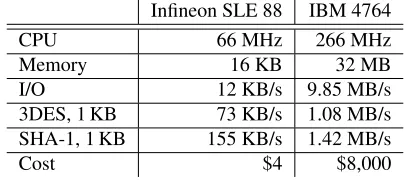
We selected a representative from each end of the co-processor spectrum and performed microbenchmarks to characterize their performance (Table2). Both devices provide cryptographic accelerators, internal key storage, active protection against physical tampering, and the ability to attest to the code they run [39].
At the low end, the Infineon SLE 88 [45] is a small but surprisingly powerful chip often found in smart cards, pay TV boxes, and various military applications. For use in a data center, it can be packaged in a USB dongle. We use the CFX4001P cards, which come with 400 KB of EEPROM, 16 KB of RAM, and a 66 MHz CPU. The chip’s design is EAL5+ certified, and the physical pack-aging is certified at FIPS 140-2 level 3, meaning that it has a high probability of detecting and responding to physical attacks. It includes sensors to detect voltage and temperature irregularities, and it draws power across a capacitor to frustrate power analysis. Its biggest appeal is its price, $4, making it feasible to add one to every computer in a data center.
In contrast, the IBM 4764 [46] is a high-end secure co-processor. Each contains a 266 MHz PowerPC 405 CPU, with 32 MB of RAM and much faster I/O and crypto-graphic processing. The 4764 is certified at FIPS 140-2 level 4, the highest possible, meaning it includes strong protections that detect physical tampering and respond by zeroing its secrets.
5
Scaling Oblivious RAM to Data Centers
In this section, we describe our scheme for achieving a highly parallel ORAM service. We start by describ-ing the Binary Tree algorithm [15], then show how to restructure it to enable parallelism, fault tolerance, and resilience to a malicious server. Proofs of correctness and security appear in AppendicesA–D.
5.1 Background: The Binary Tree Algorithm
Symbol Meaning
N # of block addresses
B Block size in bits
M Maximum # of operations on the ORAM
δ Probability of ORAM failure
R # of stages, typically≈4 for our data sets
c # of designators that can fit into a block Figure 2:Notation Summary.
5.1.1 Functionality
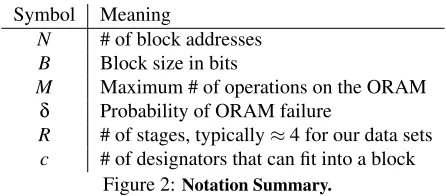
We assume that the data blocks stored in the ORAM have virtual addresses ranging from 1 toN. We further assume that all blocks have sizeBbits. We assume there will be a maximum ofM operations, and that we can tolerate a failure probability ofδduring that sequence of
operations.§5.5presents a method we devised to remove this assumption of a bounded number of operations.
Users can perform reads or writes. A read takes an address and returns the block with that address. A write takes an address and new block, and overwrites the old block at that address. To prevent the server from distin-guishing between reads and writes, we treat them identi-cally; this requires an ignored input block for reads and an ignored output block for writes.
5.1.2 Operation
The Binary Tree algorithm, as illustrated in Figure4, uses a binary tree with N nodes called buckets. Each bucket containsO(logN)entries, each of which contains an address and a block. Each bucket is treated as a “triv-ial ORAM”; it is accessed by examining all entries and reading or updating the one with the desired address.
To track an entry’s location in the tree, the coprocessor maintains a mapping from addresses todesignators. A block will always be in an entry of a bucket on the path from the root to the leaf indicated by the designator.
When a data entry is written to the ORAM, we insert it into the root bucket of the binary tree. To prevent buck-ets from overflowing, on each request, we randomly se-lect two buckets from each level of the tree, for a total of
O(logN)buckets, toevict from (EvictStagein Fig-ure3). To evict from a bucket, we remove a valid entry from it and add that entry to the bucket’s child, along the path toward the evicted designator’s leaf bucket. If no empty space exists in that child, the ORAM algorithm fails, so bucket sizes are chosen so that the probability this ever happens is≤δ.
When a user requests a read or write at an address (ORequest), we look up the address’s designator in a table that maps addresses to designators. We then read all buckets in the tree along the path between the root and this designator (LookUpAndRemove). When we find the entry, we remove it from its current bucket and rewrite it at the top of the tree using a new designator.
ORequest(Address,IsWrite,NewBlock):
For eachStagefrom 1 to R:
IfStage=1: Block←the sole stage-1 block Else:
EvictStage(Stage)
Block←LookUpAndRemove(Address,Stage,
Designator) IfStage=R:
IfIsWrite: Block←NewBlock
Else:
CurDes←designator atAddress’s offset inBlock
Randomly update des. atAddress’s offset inBlock Designator←CurDesif valid, else random InsertBlockinto the root bucket forStage
ReturnBlock
LookUpAndRemove(Address,Stage,Designator):
Result←0
For eachBucketalong tree path towardDesignator: For each entry index inBucket:
Read the entry from storage intoEntry
IfEntry’s address field matchesAddress:
Result←Entry’s contents field
Entry←0
Re-encryptEntryand write it to storage ReturnResult
EvictStage(Stage)
Compute the set of buckets to evictBucketsToEvict
For eachBucketinBucketsToEvict:
SelectedIndex←index of a valid entry inBucket EvictedEntry←entrySelectedIndexofBucket
Invalidate entrySelectedIndexofBucket
Re-encrypt other entries ofBucketto obscure access
Designator←designator inEvictedEntry Child←Bucket’s child on path towardDesignator SelectedIndex←index of an empty entry inChild
EntrySelectedIndexofChild←EvictedEntry
Re-encrypt all entries ofBucket’s children to obscure Figure 3:Basic Pseudocode for ORAM operations. Overlined values must be hidden from the server.
Thus, repeated reads for the same entry will produce dif-ferent lookup paths through the tree.
The table mapping addresses to designators must itself be accessed obliviously. However, it containsO(N) map-pings, making it far too large to store locally. Fortunately, each mapping is tiny, about log2Nbits, so the countcof mappings that fit in a block is large. Thus, we can re-cursively apply the same ORAM scheme to this smaller collection of blocks. Each ORAM, orstage, will be pro-gressively smaller, and theRth stage whereR≈logcN
will be a single block. As a result, each access performs
Address Designator
12345 22222 34345
91282...
LLR RRR RLL
LRL...
1) Lookup designator 2) Follow
designator R
L
L
Stage R 4) Reinsert entry
3) Remove entry
Stage R -1 AddressDesignator
12345 22222 34345 91282...
LLR RRR RLL LRL...
Stage R-2 AddressDesignator
12345 22222 34345 91282...
LLR RRR RLL LRL...
...
Stage 1
Figure 4:Overview of the Binary Tree Algorithm.Each of the N buckets in the binary tree consists of O(logN)entries. To find the entry for a given address, we look up the address’s designator, and follow the path through the tree dictated by that designator. For each bucket on the path, we read all of the entries in that bucket. This continues along the entire path, even if we find the address we’re looking for, to hide the entry’s actual location from the server. After reading or writing the entry, we remove it from wherever it was found, assign it a new designator, and reinsert it into the top-level bucket. Since the address-to-designator table is large, it is itself stored in a recursive version of the ORAM structure. Each stage is smaller than the one it stores designators for.
The following example illustrates this recursion. Sup-pose an ORAM has 1,000 addresses and each block holds 10 designators, so the number of stages isR=4. If the user asks for address 789, we first fetch the sole block of the stage-1 ORAM and extract the designator at offset 7. This is needed to find a block in the stage-2 ORAM. This stage-2 block contains, at offset 8, the designator needed to find a block in the stage-3 ORAM. Finally, this stage-3 block contains, at offset 9, the designator needed to find the user’s requested block in stage 4.
5.1.3 Storage
The server provides storage to support the ORAM ser-vice. Since the server is distrusted, coprocessors encrypt all sensitive data using a symmetric key with an IND-CPA secure encryption scheme before storing it with the server. The IND-CPA property ensures that the server cannot learn anything about the underlying plaintext, not even whether it has been modified by the coprocessor. Each encrypted item has a name, like“7th entry in bucket 12 at depth 6 of stage 3,”so that coprocessors can tell the server which item to store or retrieve.
5.2 Parallelizing ORAM for the Data Center
5.2.1 Initialization
To parallelize the Binary Tree algorithm, we need to be able to form multiple coprocessors into a coordinated, mutually-trusting group. We do this by letting any par-ticipating coprocessorCvet and induct any other copro-cessorCnew that wishes to join the service.
To initiate the service, the server connects to a copro-cessor and asks it to create a new ORAM of sizeNand block sizeB. The coprocessor generates fresh key mate-rial and outputs a public key,PublicKey.
To join the service, Cnew asks the server for PublicKey. Via attestation [39,47,48],CandCnew con-vince each other that they are both running the correct code in a secure environment.Cnew then usesPublicKey to create a secure channel toC, andCtransmits the ser-vice’s secret key material toCnew.
5.2.2 User Requests
A user initiates secure communication with the ORAM service by requesting a standard attestation from one of the secure coprocessors [39,48]. The attestation certifies thatPublicKeyis held only by true secure co-processors running the ORAM code. UsingPublicKey, the user creates a secure channel to a coprocessor. She uses this channel to convey the operation she wishes to perform, without revealing it to the server. The copro-cessor coordinates with the other secure coprocopro-cessors in the data center to perform the Binary Tree algorithm in parallel, as described below. Eventually, the coprocessor returns the result over the secure channel.
5.2.3 Parallelism Goals
Our primary aim is to minimize coprocessor reads and writes of large blocks on the critical path. We also use parallelism to mitigate computationally taxing steps. We only worry about expensive computations, such as hash-ing and encryption. Thus, we treat asO(1)any operation that is technicallyO(logN)but actually fast, like an XOR of two log2(N)-bit numbers. To distinguish expensive coprocessor operations from relatively cheap server op-erations, we useOC(·)to summarize coprocessor
band-width and CPU costs, andOS(·)for server overhead.
The main limit to our ability to parallelize is the it-eration of lookups through theR≈logcNstages. Each iteration produces the designator for the next, so we can-not perform them in parallel. Fortunately, sincecis large,
Ris typically small. For our data sets, and for most data sets we can envision, it is five or less.
The primary bottleneck of the algorithm is the R en-try lookups, each of which readsB-size entries from the server in two nested loops: one over theO(logN) buck-ets in the path, and one over theO(logN)entries in each bucket. Thus, the overhead is OC(RBlog2N). This is
substantial given how slowly coprocessors operate. Below, we show how to employ the parallelism of
sets we consider and expect to see in practice, this allows us to achieve low latency (§7).
5.2.4 Parallelizing Bucket Accesses
We show how to access entries in a bucket inOC(B).
Parallelizing entry updates is straightforward since there is no dependency between entries in a bucket. By assigning one coprocessor to each of theO(logN)entry indices, we can complete all iterations in the time it takes to do one. The dominant cost for this is that of reading, decrypting, encrypting, and writing an entry:OC(B).
It is more difficult to parallelize entry reads. If we assign one coprocessor to each entry index examined, they must all cooperate to collectively produce the out-put. Fortunately, we know that exactly one of the co-processors has something to contribute to this compu-tation, since each is assigned a different index but only the one assigned index i has anything to contribute to the computation. Thus, the output can be computed by XOR’ing the coprocessors’ respective outputs. In§5.2.7, we present an algorithm calledoblivious aggregationfor efficiently (inOC(B)time) and securely computing such
a collective XOR.
Finding a valid or invalid entry index in a bucket uses a lot of coprocessor bandwidth, since it requires reading all of the bucket’s entries. Thus, we separate this small, frequently-accessed validity information from the large
O(B)-size entries containing them. Specifically, we use a
validity vector: a vector of bits, one per entry, indicating if that entry is valid. Naturally, we must also keep this vector current whenever we change a bucket.
5.2.5 Parallelizing Lookups
To look for an entry (LookUpAndRemove), we must look at allO(logN)entries in allO(logN)buckets on the path to the designator. This takesOC(RBlog2(N))time.
But, if we access all entries in parallel onO(log2(N)) coprocessors, we only useOC(B)bandwidthR−1 times.
The challenge is that these coprocessors must cooperate to compute the lookup result.
Fortunately, for each of these computations, at most one of the coprocessors will have something to contribute to it. This is because an invariant of the algorithm is that the same virtual address appears in at most one bucket of the tree [15]. This is ensured by preceding any write to addressvwith a removal of the entry with addressv
from the tree. Thus, the output (Result) can be computed by XOR’ing the coprocessors’ respective contributions, at most one of which is nonzero. This means we can use oblivious aggregation (§5.2.7) to effect this computation. A minor wrinkle is that, as we will see, oblivious ag-gregation requires the server to XOR togetherO(log2N) values. Fortunately, the commutativity of XOR makes it straightforward to parallelize using a modest number
of untrusted server processors. Each ofO(logN)server processors can XOR O(logN) values in parallel, then one processor can XOR those processors’ results; this all takes OS(RBlogN) time. If increased speed is
de-sired, each ofO(log2N) server processors can do it in
OS(RBlog logN)time. Since these XORs take place on
fast server processors at GB/s, orders of magnitude faster than coprocessor writes, the time spent on this is trivial.
5.2.6 Parallelizing Eviction
Finally, we consider entry eviction (EvictStage). Na¨ıvely, this requires iterating serially through the tree. For each bucket selected for eviction, we find a valid en-try, remove it, find an empty space in its child, and up-date both children so the server cannot tell which child receives the entry. Since we evict fromO(logN) buck-ets at each stage and evict to twice that many, this takes
OC(RBlog2N)time.
Fortunately, we can parallelize eviction by assigning a coprocessor to each of the involved entries. We have already seen how to parallelize access to a bucket across one entry per coprocessor. Furthermore, eviction opera-tions for buckets are independent of each other, as long as we first do all eviction from buckets and then do all eviction to buckets. As a consequence, eviction takes
OC(RB)time withO(log2N)coprocessors.
In addition to the parallelism within eviction, we ob-serve that eviction and lookup can themselves be per-formed in parallel, given enough coprocessors. This can be done safely since evict only moves each entry along the path specified by its designator, while lookup ex-amines all buckets on that path. Thus, eviction cannot change whether a lookup will succeed.
5.2.7 Oblivious Aggregation
Sometimes our algorithm requiresqsecure coproces-sors to aggregate their individual values, without reveal-ing these values to the untrusted server. More concretely, each secure coprocessor m knows some private value
vm∈
V
, and they collectively need to output thecom-bined valueS←Lqm=1vmwithout revealing any
partic-ularvm. We could accomplish this by having each secure
coprocessor encrypt and output its value, and then have one secure coprocessor read in, decrypt, and XOR all of the values together, but this would takeOC(q)I/O
opera-tions, which are quite expensive for the secure coproces-sors (§4.2). If we use the protocol below, we only need a single I/O operation from each secure coprocessor. The server still doesOS(q)computation, but the constants are
so small that this is essentially negligible.
crypto-graphically secure pseudorandom functionPRF. Protocol: Given its secret value vm∈
V
, shared keyK, fresh nonce j, and the number of secure coprocessors
q, each secure coprocessormcomputes
xm=PRFK(jkm)⊕PRFK(jk(m+1 modq))
It then outputszm=xm⊕vm. From these, the untrusted
server computes and outputsZ=Lqm=1zm.
AppendixAproves the correctness and security of this protocol.
5.3 Dealing with Malicious Servers
Thus far, we have assumed an honest-but-curious server. But, if we distrust the server enough to use ORAM to hide our data access patterns, it seems sensi-ble to treat the server as fully malicious. Since the server acts as a relay between coprocessors, it has four broad classes of attack available: attacks on data secrecy, in-tegrity, freshness, and availability.
Attacks ondata secrecy, are, at a high level, handled by the ORAM protocol itself, and, at a low level, pre-vented by encrypting all secret values with an IND-CPA secure scheme. Combined with a MAC, this protects data secrecy against a malicious server [49]. Data integrity
can largely be addressed by having the coprocessors MAC their outputs and verify MACs on their inputs. The oblivious aggregation protocol complicates this, how-ever, since the server combines the coprocessors’ output, but cannot produce a MAC on the result (§5.3.1). Data freshness is generally complicated in ORAM schemes, since, for efficiency reasons, each request touches only a portion of the data structure (§5.3.2). Finally, we ignore
data-availabilityor denial-of-service attacks, since they are impossible to prevent; the coprocessors are entirely dependent on the server for communication.
Overall, we defend against malicious servers using only OC(RB+RlogN) time per request, compared to
OC(RB)for honest-but-curious servers. We require no
more coprocessors to perform the necessary validations than are needed to parallelize the basic algorithm.
5.3.1 Ensuring Data Integrity
As mentioned above, most integrity attacks can be pre-vented by having each coprocessor MAC its outputs and check the MAC on its inputs. Coprocessors also check data from the server, e.g., to check that a given bucket is indeed scheduled for eviction based on the current re-quest number.
The use of oblivious aggregation complicates integrity checks, since the server computes the final outputZand clearly cannot produce a corresponding MAC. Thus, we ensure thatZis always self-attesting; i.e., it consists of a statement and a MAC of that statement’s hash.
5.3.2 Ensuring Data Freshness
The attacker can learn inappropriate information if al-lowed to present stale state to a coprocessor. By replay-ing an old state with the same input as before, he may learn something from the differences in the coprocessors’ output. By replaying an old state with a new input, he may learn something from the differences and similari-ties between how the coprocessor handles the two inputs. We prevent attacks in the first class by making co-processors stateless and deterministic. This ensures that given the same state with the same input, a coprocessor will always produce the same output. An exception is that encryption uses randomness, but since our encryp-tion scheme is IND-CPA secure, the server gains no in-formation by making us encrypt the same content repeat-edly with different randomness.
We prevent attacks in the second class by uniquely numbering each request and associating each state with one request, as we will now describe. This way, given the same state with two different requests, coprocessors will only act on the request associated with that state.
UNIQUELY NUMBERING REQUESTS. To ensure each request receives a unique number, we use a master copro-cessor. §5.4shows how to replicate the master for fault tolerance, but for simplicity here we treat it as a single coprocessor. When the user initially submits a request to a coprocessor, the coprocessor encrypts it and provides it to the server, which gives it to the master. The mas-ter keeps an inmas-ternal counmas-ter of how many requests have occurred thus far. When a new request arrives, it assigns it the next request number and increments the counter. The master binds the request to the assigned number by outputting a MAC of the two values.
BINDINGSTATES TOREQUESTS. We use an authenti-cated data structure to bind each state of the ORAM data structure to the request that produced it. Thus, coproces-sors will only act on state for requestr+1 if the state is bound to requestr. Giving a coprocessor staterwith any other request will produce an error.
Binding the entire ORAM structure to a request num-ber is difficult since it is has enormous size,O(BNlogN). To cope with this scale, we use a collection of Merkle trees [50]. A Merkle tree is a tree of hashes such that each leaf is the hash of a component of a data structure, and each parent is the hash of the concatenation of its children. A MAC using the root hash is equivalent to a MAC using a hash of all data structure components.
Evicted from Evicted to Visited during lookup 0
1
2
3
4 Depth
Figure 5:Accessed Buckets.In each half of each level of the bucket tree, at most four buckets are accessed during a request: one evictor, two evictees that are children of evictors, and one that is accessed by the lookup for the specified address. Some-times these overlap, particularly at the low depths depicted in this figure; e.g., in the left half of depth 3 (shaded), one bucket is an evictor and evictee, so only three buckets are accessed.
each operation, since large swaths of the Merkle tree that are unchanged do not have to be touched.
Each Merkle-tree leaf is the hash of a bucket’s entry, with a bucket’s validity vector treated as the zeroth entry. Intermediate hashes above the leaves represent contin-uous ranges of entries within the same bucket, and the topmost of these represent entire buckets. Above that, Merkle hashes represent continuous ranges of bucket in-dices within the same depth. The root hash represents all entries in all buckets, but only in one half of the tree, at a given depth, and in a given stage.
Because of this structure, it is possible for a copro-cessor to quickly evaluate whether a Merkle hash is un-changed by an operation. Each hash corresponds to only a single side and depth, and a certain bucket index range within that depth. A coprocessor can be told, using only
O(1)bandwidth, what bucket index was looked up at that side and depth, and it can compute inO(1)time which buckets were evicted from a given side and depth. Thus, a coprocessor can quickly determine whether anything could have changed in the subtree summarized by the Merkle hash. If not, it can treat an attestation of the hash’s value after requestras an attestation of the hash’s value after requestr+1.
We now analyze the time to read or update the Merkle trees. We have seen that a coprocessor can access a Merkle node in OC(1)time. For any Merkle depth d,
all Merkle nodes can be handled in parallel, even nodes from different Merkle trees and even different stages. This is because, as we discuss further in§5.5, we can do eviction for all stages at once and even overlap eviction with lookup. Since each Merkle tree has Merkle depth
O(logN), the total time to update all the Merkle trees is
OC(logN).
Next, we analyze the number of coprocessors needed to achieve this time. Each Merkle tree corresponds only to buckets from one side and depth, and thus contains at most four buckets that can change. This is because at
each bucket depth and half there is at most one evictor, two evictees, and one bucket used for lookup (Fig.5). Since each bucket containsO(log2N)entries, and there are R stages, there are at most O(Rlog2N) nodes at each Merkle depth that change. Thus, we need at most
O(Rlog2N)coprocessors for maximum parallelism.
5.4 Fault Tolerance
Since it is fairly well understood how to make un-trusted components fault-tolerant through replication, we discuss only how to tolerate coprocessor failures.
Our system is designed so all of the coprocessors, ex-cept the master coprocessor, keep no long-term state be-yondN,B,UHFSeed, and keys (§5.3.2). Thus, if a non-master fails, its functionality can be duplicated by having a freshly initialized coprocessor join the ORAM service. To deal with the failure of the master coprocessor, the master should actually consist of 2f+1 cooperat-ing master instances. Here, f is the number of mas-ter coprocessor faults we want to tolerate. A coproces-sor becomes a master instance by randomly choosing a fresh, globally-unique instance identifier and storing this in nonvolatile storage, alongside a counter set to zero. The counter’s value indicates the highest request number the instance has assigned using this identifier. The global uniqueness ensures that if the coprocessor loses its state and creates a new instance, the new instance will not be confused with the old one. Thus, the counter associated with an instance will never roll back.
A master instance will assign, via attestation, any number higher than its current counter to any request the server asks it to. A request is considered definitively as-signed a number when a quorum of the instances, i.e., at least f+1 of them, have assigned it the same number.
To cope with master instance failures, we replace the master instances periodically, say once a day, via dele-gation. To begin delegation, the server selects a new set of master instances, and asks the existing masters to del-egate their authority to the new group starting with the next request numberr. A master performs this delegation if its counter is less thanr. It delegates its authority by deleting its master instance and outputting an attestation of its delegation that includesrand the new set of master instances. Once the server collects such attestations from a quorum of the old master instances, it presents them as proof that the new master instances are responsible for requestsrand beyond. AppendixBcontains a proof that delegation can never cause two requests to be assigned the same request number.
5.5 Recommended Optimizations
We denote byNs the number of addresses served by
the stage-sORAM, soNR=N. Each stagesis
respon-sible for storing the designators for theNs+1addresses in stage s+1. Each designator takes ≤ dlog2Ne+1 bits, so a block can hold at leastcpointers, wherec= j
B
dlog2Ne+1 k
. Thus, we useNs=dNs+1/ce.
The storage for ORAM stagesconsists logically of a binary tree with depthDs=dlog2(Ns)e. Each node in
this tree is a bucket withEs entries. To keep the
proba-bility of overflow bounded byδ, Shi et al. demonstrate
Es =O(log2(MN/δ))is sufficient [15]. The root and depth-1 buckets need only one entry each since they are evicted on every operation.
Shortening the Critical Path. A critical bottleneck is the need to iterate through all the stages, since each stage must look up a designator before the next stage can pro-ceed. However, we can arrange for stagesto output the designator needed by stage s−1 as soon as possible, thereby overlapping the rest of stageswith subsequent stages. A simple way to do this is to break LookUp-AndRemoveinto a lookup phase and a remove phase, and start the next stage after the lookup phase completes. We can reduce the critical path even further by having the lookup phase first output just the part of the block needed by the next phase. By encrypting blocks with counter mode, a coprocessor can quickly decrypt and output just the part that contains the designator needed by the next phase. It will later have to decrypt the entire block, but this can be overlapped with subsequent stages. Removing Eviction From the Critical Path. A stage can do eviction before its lookup designator is known. All that is needed is the block address, so that the eviction-based update can invalidate any entry it finds with that address; unlike the designators, this address is known at the beginning ofORequest. Thus, any ex-tra coprocessors not needed by the critical path can be assigned to perform steps ofEvictStage for any or all stages, even stages that have not yet begun LookUp-AndRemove.
Verifying Evicted Buckets. Since we cannot trust the server to accurately report which buckets are scheduled for eviction, we need each coprocessor to verify these choices. Furthermore, as discussed in§5.3.2, it is use-ful for a coprocessor updating a Merkle tree to quickly compute the set of buckets evicted from at each side and depth. Therefore, we use the following technique to effi-ciently compute the evicted buckets.
A coprocessor or server can quickly compute the indices of the depth-d buckets to evict during re-questr asUHF(UHFSeedkdkrk0) (mod 2d−1)and UHF(UHFSeedk dkrk1) (mod 2d−1) +2d−1. This method is not securely random in that the server can know, even in advance, what choices will be made.
For-tunately, hiding this information is not important to the scheme’s security properties.
Note that this always selects one bucket from the left half of the tree and one bucket from the half. This does not impact the overflow analysis since it maintains the same probability of eviction for each bucket. We do this so a coprocessor working on a bucket can verify whether it is scheduled for eviction quickly, using one UHF eval-uation; it can also verify if its parent is scheduled for eviction with another UHF evaluation.
Smaller Non-leaf Buckets. By improving on the over-flow analysis of Shi et al. [15], we can use fewer en-tries for non-leaf buckets than are necessary in leaf buck-ets: log2(M(Ds−2)(R−1)/δ)instead of log2(MNs(R−
1)/δ). This reduces the number of entries per non-leaf bucket by almost log2Ns, and half of all buckets are
non-leaves. The reason we can use fewer entries in non-leaves is that overflows of non-leaf buckets can only happen as a consequence of eviction, and only 2M(Ds−2)evictions
ever happen; for a full proof, see AppendixC.
In practical terms, workloads we consider require about 19% fewer entries per non-leaf due to this opti-mization. Although non-leaves only account for half of all buckets, they account for nearly all of the buckets ac-cessed in any ORAM operation. Thus, the effect on la-tency is significant, as we will see in§7.6.
Packing Designators. Designators areDs+1 bits long.
For a stages<R,Ds=dlog2(Ns)e<dlog2(N)e, so des-ignators take fewer thandlog2Ne+1 bits. This means a block can hold much more thancsuch designators; it can holdCs=bDsB+1cof them. Thus, we actually only
needNs=dNs+1/Cseblocks in stages. If we pack
des-ignators into blocks in this more efficient manner, all the
Nsvalues fors<R−1 get smaller, thereby saving time.
In some cases it may even reduceRby one, which would save even more time.
Extending Service Lifetime.IfMmight be an underes-timate of the number of operations the ORAM will have to perform, it is possible to plan for this eventuality, as follows. At the beginning, we use one additional entry per bucket. After each operation numbered(2i−1)M, wherei is a positive integer, we add an additional two entries per bucket. This allows indefinite operation, at the cost of a slight increase in the number of entries per bucket: If we underestimateM by a multiplicative fac-tor ofu, we use log2(u+1)more entries than necessary. The additional entry at the start ensures that the probabil-ity of overflow in the firstMoperations isδ/2 instead of
δ. Every time we add two entries, we divide the
0 100 200 300 400 500 600 700 800 900
0 200 400 600 800 1000 1200 1400 1600 1800 2000 2200
Execution time (ms)
Block size (bytes) Look up entry
Evict from entry Evict to entry First-stage lookup
0 100 200 300 400 500 600 700 800 900
0 200 400 600 800 1000 1200 1400 1600 1800 2000 2200
Predicted time (ms)
Block size (bytes) Look up entry
Evict from entry Evict to entry First-stage lookup
Figure 6:SLE 88 Performance.The effect of block size on the time to perform the most performance-impacting operations in our ORAM algorithm. The left side shows actual measured performance, and the right side shows our simulator’s predictions. Error bars, generally too small to see, indicate 95% confidence intervals about the mean of 50 trials.
6
Implementation
Our implementation of Shroud consists of two compo-nents: the coprocessor and the server.
The coprocessor component runs on Infineon SLE 88 cards. The implementation includes all aspects of our al-gorithm, including protection from malicious servers as described in§5.3. It is 2,898 lines of C, as measured by SLOCCount [51]. Our code uses 3DES for encryption, since the smart card supports it with hardware acceler-ation. It uses SHA-1 as its hash function, HMAC for a MAC, and the NH hash from UMAC [52] as the UHF.
The server component consists of a worker, a sched-uler, and a file server. A worker attaches to a coprocessor and sends it commands. The scheduler parcels out work among several workers to complete a user’s request. The file server provides access to items by name and also facilitates communication between workers. The server component is 5,000 lines of C#; 932 of these lines are the scheduler. We have not yet implemented user interaction or fault tolerance.
To evaluate our system at modest scale, we also built a coprocessor emulator. It simply runs the coproces-sor’s code on the worker’s CPU, then waits an additional amount of time consistent with how much longer a co-processor would have taken.
Finally, to evaluate our system at large scale, beyond the number of machines we have available, we built a simulator. It uses the measurements from our imple-mentation to extrapolate the performance on thousands of machines. The simulator is 893 lines of Python.
7
Evaluation
In all experiments, unless stated otherwise, we use the following parameters: 235addresses; 10-KB blocks; 10,000 coprocessors; desired lifetime failure probability 2−80; and ORAM lifetime 250requests. These are mod-eled after the map tiles data set. Because user interaction and fault tolerance are not yet implemented, we do not evaluate their performance impact.
When evaluating a storage system, it is typically vital to ensure the workload is realistic, e.g., by using traces of a real system. However, to avoid leaking information
0 50 100 150 200 250 300 350 400
Assign request number
Merkle previous
state Middle
stage insert
Last stage insert
Update validity vector
Get index to evict
Merkle next state
Encrypt reply
Execution time (ms)
Figure 7:Time to Perform Miscellaneous Algorithm Steps on the SLE 88. Times shown are for 1 KB block sizes. Er-ror bars, generally too small to see, indicate 95% confidence intervals about the mean of 50 trials.
via timing channels, ORAM always has the same perfor-mance no matter what addresses are accessed and which accesses are reads or writes. Furthermore, since our algo-rithm never overlaps multiple accesses, workload bursti-ness also has no effect on performance. Therefore, work-load is irrelevant and we use a simple synthetic one.
7.1 Microbenchmarks
We evaluate how long different steps of our ORAM algorithm take on a real coprocessor, the Infineon SLE 88. We focus on three operations that consume signif-icant amounts of time and must be repeated more than once, since these are the primary drivers of performance and opportunities for use of parallelism. These arelook up entry,evict from entry, andevict to entry.
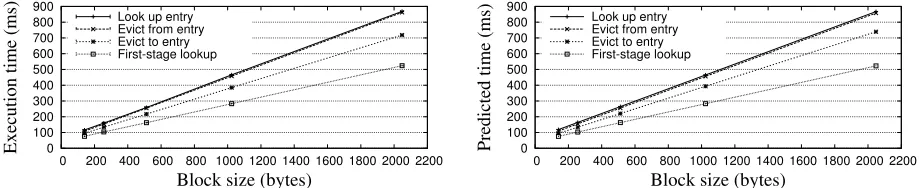
The left graph of Figure6shows the results of 50 trials for each step at each of five block sizes. We observe that, as expected, the dominant cost in all steps is proportional to block size.
The right graph of Figure 6 shows the predictions made by our simulator for these times. We see that they are in close agreement, and never off by more than 3%. Since we have few coprocessors, when we later perform simulations of data-center scale deployments we will use our validated simulator instead of real hardware.
0 500 1000 1500 2000 2500
2 4 6 8
Request latency (sec)
Number of coprocessors
Eviction Lookup Merkle Non-coprocessor
Figure 8:Request Latency of Shroud.Total time per request for a 1 KB block, including defense against a fully malicious adversary. Non-coprocessor overhead is the part of average request time not accounted for by coprocessor run time.
7.2 Benefits of Parallelism
To evaluate the parallelism Shroud can achieve, we employ a cluster of machines; each has 24 GB of RAM, two 10 Gbps NICs, and two quad-core Intel E5410, 2.33 GHz processors. As Figures8and9show, the se-cure coprocessors are the dominant bottleneck.
First, we measure parallelism on our full system. Due to limited budget, we only use eight coprocessors: Co-processors are inexpensive when bought by the thou-sands, but expensive when bought individually. Figure8 shows the results of these experiments; because of the modest scale, we use 1024-byte blocks and setN=220,
M=220, andδ=2−20to make it finish in a reasonable
amount of time. We see that by far the biggest compo-nent of operation time is time spent running on copro-cessors, over 98% in all cases. Operation is highly par-allelizable with this few coprocessors, so we see near-linear scaling with number of coprocessors.
Since the data set easily fits in memory, we do not in-cur disk latency. We expect that, under normal condi-tions, reading all the entries needed for request process-ing will incur only modest disk latency with careful disk scheduling, since it is amenable to bulk prefetching. The disk-scheduling element, however, is future work.
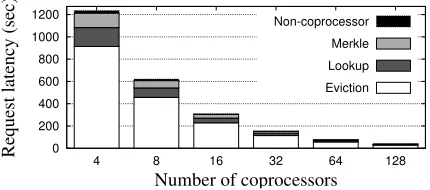
To evaluate on a larger scale, we use our coprocessor emulator in a cluster with 139 machines. We run one scheduler, 10 file servers, and up to 128 workers. Fig-ure 9 shows the results of this experiment; again, we use 1024-byte blocks and set N=220, M=220, and
δ=2−20. For small numbers of coprocessors, the em-ulated results match their real counterparts to within 6%. We see, as before, that most of the time is spent by copro-cessors, and that performance scales essentially linearly. This is not surprising since, thanks to the high parallelism of our design, there is nearly always parallel work avail-able to keep all coprocessors busy.
To evaluate parallelism on a massive scale, we now use our simulator. We vary the number of coprocessors used for ORAM and measure the time to perform a re-quest. Recall that the algorithm treats reads and writes identically, so it does not matter which we do.
0 200 400 600 800 1000 1200
4 8 16 32 64 128
Request latency (sec)
Number of coprocessors
Eviction Lookup Merkle Non-coprocessor
Figure 9: Request Latency of Server with Emulated Co-processors.Total time per request for a 1 KB block, including defense against a fully malicious adversary.
1 10 100 1000 10000 100000 1e+06 1e+07 1e+08
1 10 100 1000 10000 100000
Request latency (sec)
Number of coprocessors
Flickr Photos Map Tiles Twitter Tweets
Figure 10:Varying Number of Infineon SLE 88 Coproces-sors. The effect of number of coprocessors on ORAM request latency for various workloads using simulated SLE 88 copro-cessors. X-axis and Y-axis are log-scale.
Figure 10shows the effect of varying the number of coprocessors for various workloads using SLE cards. We see that parallelism is quite effective, reducing the time by over three orders of magnitude. For the Twit-ter tweets workload, it reduces the time from 13,000 sec to 8.6 sec, and for the map tiles workload, it reduces it from 160,000 sec to 44 sec. For the Flickr photos work-load, it also reduces it substantially, from 16,000 hours to 4.1 hours, but this is still an unreasonably long period of time. This is due to the large block size, 5 MB; re-call that our ideal performance isO(RB)even without defense against malice.
Latency reduction is essentially linear in the number of coprocessors, since thanks to our restructuring, most of the expensive operations are highly parallelizable. A notable exception is the transition from one to two copro-cessors, which reduces cost by much less than a factor of two because of the additional requirements for communi-cation between the coprocessors. Also, effectiveness of parallelism stops after a certain number of coprocessors as we no longer have enough tasks to distribute among them. This occurs when we have about 19,000 coproces-sors, enough to handle all entries in all buckets evicted to during the final stage.
0.1 1 10 100 1000 10000 100000 1e+06
1 10 100 1000 10000 100000
Request latency (sec)
Number of coprocessors
Flickr Photos Map Tiles Twitter Tweets
Figure 11: Varying Number of IBM 4764 Coprocessors.
The effect of number of coprocessors on ORAM request latency for various workloads using simulated IBM 4764 coprocessors. X-axis and Y-axis are log-scale.
0.0001 0.001 0.01 0.1 1 10 100 1000 10000 100000
100 1000 10000 100000 1e+06
Request latency (sec)
Total cost of coprocessors ($)
Infineon SLE 88 IBM 4764 FPGA (estimated)
Figure 12: Latency as a Function of Budget. Request la-tency as a function of money spent on coprocessors, for differ-ent coprocessor types. X-axis and Y-axis are log-scale. FPGA line assumes 1.4 Gb/s for all operations and$100 per FPGA.
0 2000 4000 6000 8000 10000 12000 14000 16000 18000 20000
2 3 4
Max coprocs usable
Stage Evict to entry
Merkle previous or next state Evict from entry
Look up entry
Figure 13: Available Parallelism. How many coprocessors each step of the algorithm can make use of.
least until technology trends make HSMs with this per-formance more affordable.
To fairly compare these two coprocessors, we conduct another experiment where we hold total coprocessor cost budget fixed and see how fast ORAM is with each copro-cessor type. Figure12shows the results. We see that for low budgets, the inexpensive Infineon SLE cards offer better performance per unit cost. Only with more than about $100,000, when the SLE cards exhaust available parallelism, do the IBM 4764 coprocessors become suit-able for use in our parallel ORAM. Finally, we estimate the performance of an FPGA-based implementation (§8). To understand which steps of the algorithm are most amenable to parallelism, Figure13shows, for each par-allelizable step, how many coprocessors it can make use of. We see that later stages can make use of more copro-cessors, as they have larger ORAMs and thus more buck-ets. The step that can make most use of extra
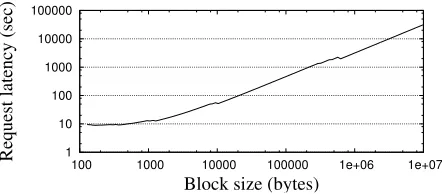
1 10 100 1000 10000 100000
100 1000 10000 100000 1e+06 1e+07
Request latency (sec)
Block size (bytes)
Figure 14: Variable Block Size. Effect on parallel ORAM latency of varying block size. Simulation assumes235 blocks and 10,000 coprocessors. X-axis and Y-axis are log-scale.
0 10 20 30 40 50 60 70 80 90 100
210 215 220 225 230 235 240 245 250
Request latency (sec)
Number of block addresses (log base 2) Figure 15:Variable Block Count. Effect on parallel ORAM latency of varying number of addresses where blocks can be stored. Simulation assumes 10-KB blocks and 10,000 copro-cessors. X-axis is log-scale and starts at210blocks.
sors isevict to entry,which updates all entries in evictee buckets. In contrast,evict from entryonly touches entries of evictor buckets, of which there are half as many. The step that can make the least use of them islook up entry,
which only updates entries of buckets along the designa-tor path, of which there are half again as many.
7.3 Effect of Block Size and Count
In our next experiments, we look at the effect of vary-ing workload characteristics on parallel ORAM perfor-mance. Specifically, we look at the effect of varying the size of blocks stored and the number of such blocks.
Figure 14 shows the effect of varying block size on ORAM performance, with all other parameters set to de-faults. Below about 0.5 KB, request latency is under 10 sec, and below about 11 KB, it is under one minute. Thus, while ORAM may be feasible for workloads like Twitter tweets, Facebook images, and map tiles, it is un-reasonable for the Flickr workload’s 5-MB block size.
0 10 20 30 40 50 60 70
Twitter Tweets Map Tiles Facebook Images
Request latency (sec)
Workload
Assume server is honest-but-curious Ensure data integrity
Ensure data integrity and freshness
Figure 16:Cost of Defense Against Malicious Servers.How ORAM latency increases due to defenses against malice.
Figure15shows the effect of varying number of ad-dresses on ORAM performance. We see that, unlike block size, address count has a less dramatic effect on request latency: in most cases, doubling it has no effect on performance. For some doublings, there is a large jump, due to the number of stages increasing by one; for other doublings, there is a small increase as the number of coprocessors required for a step goes above the next multiple of 10,000. For the range of block counts seen in our data sets, 232 to 236, request latency is between 51 and 60 sec, but even data sets containing substantially more blocks than this would have comparable latency.
7.4 Cost of Defense Against Malice
Next, we evaluate the cost of defending against mali-cious servers by running experiments in which we turn off integrity and freshness checks. Figure16shows the results. The cost of these defenses is noticeable, demon-strating the importance of making their performance rea-sonable via parallelism and Merkle trees. For the Twit-ter tweets workload, the small block size means that the cost of communication dominates, and thus integrity and freshness checks are significant. Time increases by 21% for integrity, due to the need to compute and transmit MACs; adding freshness increases it by a further 278%, primarily due to Merkle tree maintenance. For the other workloads, where block sizes dominate hash sizes, in-tegrity checks increase latency by only 6% and freshness checks by only 13–14%.
7.5 Comparison to the Hierarchical Scheme
To emphasize the importance of worst-case perfor-mance analysis, we simulate the traditional hierarchi-cal algorithm [13,14], which has O(log3N)amortized latency, but Ω(N) worst-case performance. Since the scheme is not parallelizable, for fairness we assume it runs on the fast IBM 4764. With 235 blocks of 10 KB each, the average response time is 127 seconds. But, much more troubling are the slow responses. Every 10,000 requests, a request takes almost 92 minutes to complete, and every 10,000,000 requests, a request takes a week to complete! Since the entire service must wait for these requests to complete before serving the next re-quest, this scheme is unsuited to the data center.
0 10 20 30 40 50 60 70
Twitter Tweets Map Tiles Facebook Images
Request latency (sec)
Workload
With all of these optimizations
Without attesting all next stages at once Without packing designators
Without smaller non-leaf buckets
Figure 17: Effect of Default Optimizations. Increase in ORAM latency when various optimizations we devised are re-moved. Simulation assumes 10,000 coprocessors.
5 10 15 20 25 30 35 40 45 50 55
Twitter Tweets Map Tiles Facebook Images
Request latency (sec)
Workload With none of these optimizations
Reduce critical path
Overlap eviction with lookup
With both of these
Figure 18: Effect of Coprocessor-Intensive Optimizations.
Decrease in ORAM latency when various additional optimiza-tions we devised, which involve partially overlapping several stages, are added. Simulation assumes unlimited coprocessors.
7.6 Effectiveness of Optimizations
We use our simulator to measure how effective certain optimizations are. We start with the standard optimiza-tions we always apply: attesting all next stages at once, packing designators, and using smaller non-leaf buckets. Figure17shows the results. We see that each optimiza-tion always helps, but their effect depends on the work-load. Attesting all next stages at once is highly useful for the Twitter tweets workload, reducing its latency by 25%. This is because this workload has a small block size, so attestation is a sizeable fraction of total run time; for the other workloads, the effect is small. Packing des-ignators is highly useful for the map tiles workload, re-ducing its latency by 19%. The large effect is because it causes the number of stages R to drop from five to four; recall that our algorithm’s performance isO(RB). Smaller non-leaf buckets have a large effect on the map tiles and Facebook images, reducing latency by 13% and 11% respectively; although non-leaf buckets account for only half the buckets, they account for nearly all of the buckets accessed during the algorithm.
out-putting designators early in the lookup process, and the other is to overlap eviction with lookup. To evaluate the effectiveness of these optimizations, we performed sim-ulations with an unlimited number of coprocessors.
The results are in Figure18. We see that the effective-ness of these optimizations is substantial for the work-loads with large block sizes, and also significant for the small-block Twitter tweets. For Twitter tweets, reduc-ing the critical path reduces latency by 5%; overlappreduc-ing eviction with lookup decreases it by 17%; and doing both reduces it by 23%. For the others, reducing the critical path reduces latency by 14–18%; overlapping eviction with lookup decreases it by 51%; and doing both reduces it by 65–68%.
These large effects indicate it pays off substantially to use these optimizations when many coprocessors are available. Recall that Figure13discussed how many co-processors would be necessary to overlap all stages at once, as these optimizations demand. However, even without that many coprocessors, it may be possible with intelligent scheduling to make partial use of the opti-mizations during periods when not all coprocessors are in use. Devising such schedules is future work.
7.7 Summary
Using parallelism substantially reduces the cost of ORAM, e.g., from 13,000 sec to nine seconds in the case of Twitter tweets. However, the resulting latency is still substantially more than that of a non-oblivious access. Such an access would have latency primarily caused by WAN latency and SSL overhead, and so would be only tens to hundreds of milliseconds. Clearly, more work is needed to bring ORAM latencies to full practicality.
8
Future Work
There are many avenues for extending Shroud. Most importantly, since we found secure coprocessor band-width to be the limiting factor, it would be useful to explore higher-bandwidth coprocessors, such as secure FPGAs, which may be able to offer multiple Gb/s of bandwidth. To estimate the potential of this approach, the “FPGA” line in Figure12simulates ORAM perfor-mance using estimates of FPGA capabilities.
If we can overcome the coprocessor bandwidth bot-tleneck, an important next consideration will be server storage latency. One way to reduce it is to use solid-state drives. However, it may be possible to just use disks and schedule requests so as to reduce seek time. After all, most disk accesses are due to eviction, which can be an-ticipated well in advance. By providing these access re-quests to the disk early, we may enable bulk prefetching. Another concern is to improve not only latency but throughput of ORAM operations. One technique, which takes advantage of our approach of using many copro-cessors in parallel, is to batch requests together and look them up in parallel. Note, however, that if requests in a batch use the same address, we must replace all but one with a random address so an adversary does not learn of the match. Also, after a batch is complete, we must re-place the result of each modified request with that of the corresponding unmodified one.
9
Conclusion
Securing user data within the data center requires more than encryption; hiding data access patterns adds addi-tional protection against malicious employees and hack-ers. We showed how to achieve this with Shroud, a dis-tributed storage system that hides all information about block accesses. We show that deploying such oblivious storage in the data center creates new challenges and op-portunities, including issues of scale, parallelism, mali-ciousness, fault tolerance, and worst-case performance. Our evaluation shows the usefulness of our approach, particularly our use of many secure coprocessors in par-allel, in scaling ORAM to data-center-scale workloads.