Automated Analysis and Synthesis of Block-Cipher
Modes of Operation
∗
Alex J. Malozemoff
†Jonathan Katz
†Matthew D. Green
‡Abstract
Block ciphers such as AES are deterministic, keyed functions that operate on small, fixed-size blocks. Block-cipher modes of operation define a mechanism for probabilistic encryption of arbitrary length messages using any underlying block cipher. A mode of operation can be proven secure (say, against chosen-plaintext attacks) based on the assumption that the underlying block cipher is a pseudorandom function. Such proofs are complex and error-prone, however, and must be done from scratch whenever a new mode of operation is developed.
We propose an automated approach for the security analysis of block-cipher modes of operation based on a “local” analysis of the steps carried out by the mode when handling asingle message block. We model these steps as a directed, acyclic graph, with nodes corresponding to instructions and edges corresponding to intermediate values. We then introduce a set oflabelsandconstraintson the edges, and prove a meta-theorem showing that any mode for which there exists a labeling of the edges satisfying these constraints is secure (against chosen-plaintext attacks). This allows us to reduce security of a given mode to a constraint-satisfaction problem, which in turn can be handled using an SMT solver. We couple our security-analysis tool with a routine that automatically generates viable modes; together, these allow us to synthesize hundreds of secure modes.
1
Introduction
Designing and proving security of cryptographic constructions can be difficult, time-consuming, and error-prone. Developing a protocol for some task meeting various requirements involves creativity and hard work; even when only small changes to an existing construction are involved, each change typically requires a cryptographic proof of security to be redone from scratch.
To simplify, streamline, and speed up this process, it would be hugely beneficial to automate (parts of) this design process. Being able to automate the analysis of cryptographic constructions would enable rapid examination of proposed candidates with less chance of error; coupling this with a systematic way of generating candidates that satisfy a given set of functional requirements would enable automated synthesis of secure constructions. Here we can draw inspiration from the field of program synthesis [MW80], which has recently witnessed several successes (see Srivastava’s Ph.D. thesis [Sri10] for a recent survey).
The past few years have seen the first steps toward automated analysis and synthesis of cryptographic constructions; we refer the reader to Section 1.1 for a review of prior work. In this work we focus on automated analysis and synthesis of block-cipher modes of operation. A block cipher is a deterministic, keyed functionF; with a keykfixed, the functionFk:{0,1}n→ {0,1}n operates on small,n-bit blocks. (A
prominent example is the standardized block cipher AES, which has a 128-bit block size.) Secure1encryption
using a block cipher requires choosing somemode of operation to handle both probabilistic encryption (so that the same message, encrypted twice, does not yield the same ciphertext) as well as messages of arbitrary
∗The proceedings version of this work appears in the 27th IEEE Computer Security Foundations Symposium, Vienna Austria, July 19–22, 2014. This is the full version.
†Department of Computer Science, University of Maryland.Email: {
amaloz,jkatz}@cs.umd.edu
‡Department of Computer Science, Johns Hopkins University. Email:
length. Several secure modes of operation were specified as part of the DES standard in the 1970s, and modes such as CTR and CBC are in widespread use today. More recently, various modes of operation with stronger security properties, or based on newer primitives such as tweakable block ciphers, have been proposed; see
http://csrc.nist.gov/groups/ST/toolkit/BCMfor some examples.
The core idea of our approach to the automated analysis of block-cipher modes of operation is to focus on the operations carried out by a given mode when handling asingle message block. We model these steps as a directed, acyclic graph in which nodes correspond to atomic operations (such as XORing two values together, evaluating a pseudorandom function on some value, etc.) and edges correspond to intermediate values. We introduce a set of labels for the edges in such graphs, along with a set of constraints on how edges can be labeled. Our central result is a meta-theorem stating that if a given graph, corresponding to some mode, can be labeled while satisfying the constraints, then that mode is secure. We thus reduce the security of any mode of operation to a constraint-satisfaction problem, which in turn can be addressed by an SMT solver.
Our meta-theorem shows that our constraints aresound, in that any mode classified as secure is, indeed, secure; it is notcomplete, and so may falsely reject a secure mode. Nevertheless, we show that our constraints are permissive enough to capture all commonly used (secure) modes we are aware of, including CBC, CTR, OFB, CFB, and PCBC.
Based on the above meta-theorem, we implemented a model checker designed to evaluate candidate modes of operation. Our model checker takes as input a mode specified as a graph, and determines both whether the mode iscorrect(i.e., whether there exists a corresponding decryption algorithm that recovers the message from the ciphertext) and whether it is secure. We then use our model checker to synthesize secure modes of operation in the natural way. That is, we implement a program synthesizer that automatically generates candidate modes of operation for analysis, and then filters out those modes that are not identified as being secure by our model checker. Doing this in a na¨ıve manner would be prohibitively slow due to the combinatorial explosion in the number of candidate modes. To deal with this, we use several pruning strategies that allow us to eliminate more than 99.99% of potential candidates from consideration before invoking our model checker. Using our approach we are able to synthesize hundreds of secure modes of operation. Our implementation could easily be integrated with a simple tool assigning scores to different modes (e.g., expressing a preference for minimizing calls to the block cipher or for avoiding integer addition) to synthesize secure modes with desired properties.
Although our approach currently only addresses security against chosen-plaintext attacks, we are hopeful that our ideas can be extended to handle stronger security definitions such as authenticated encryption. More generally, we believe our techniques could find application to the automated design and verification of other cryptographic primitives and protocols.
1.1
Prior Work
Several works have recently considered automated generation and/or analysis of cryptographic algorithms. Akinyele et al. [AGHP12,AGH13] developed tools for automatically generating batch-verification algorithms for digital-signature schemes [AGHP12], for converting schemes using symmetric bilinear groups into ones us-ing asymmetric bilinear groups [AGH13], and for compiling signature schemes to schemes achieving stronger security properties [AGH13]. In all these cases, their tools do not directly analyze or verify security of new constructions; instead, they take as input schemes that are assumed to be secure, and then attempt to apply a fixed set of transformations that have been proven to preserve (or amplify) security. Closer to our results are those of Barthe et al. [BCG+13], who propose a technique for the automated analysis of public-key encryption schemes based on trapdoor permutations and a small set of other instructions. They also use their analysis tool to synthesize secure schemes. However, the proof techniques and analysis methods are very different in the public-key setting as compared to the symmetric-key setting we consider here.
Roughly, they show that if, after the execution of a mode, all variables are marked as indistinguishable from uniform, then the mode is secure. The required property can be proven for a given mode by applying their Hoare-logic rules to the entire sequence of operations used by the mode when encrypting some message. A drawback of their approach is that it can only reason about the encryption of messages of some pre-specified, fixed length, and their proofs provide no “inductive” guarantee about what happens when the mode is used to encrypt messages of other (arbitrary) lengths. Thus, to use their approach one would have to provide a separate proof for all possible message lengths one would expect to encounter in practice. Moreover, our “local” approach is fundamentally different from their “global” perspective. In contrast to Gagn´e et al., we analyze the operations carried out by a given mode when processing asingle message block; our meta-theorem guarantees that if that (finite) set of operations has a valid labeling, then it corresponds to a mode of operation that is secure for encrypting messages of arbitrary (polynomial) length. Besides this conceptual difference, our approach also ensures that analysis of a given mode (for messages of unbounded length) can be reduced to the satisfiability of afinite set of constraints. This, in turn, can be easily solved (in practice) using an SMT solver. Our approach is thus particularly suited for the synthesis ofnew modes of operation. In a similar vein, Courant, Ene, and Lakhnech [CEL07] use a type system (rather than a compositional Hoare logic) to analyze various symmetric-key encryption schemes, including modes of operation. However, this approach suffers some of the same drawbacks as the above work, in that state regarding specific values needs to be maintained across blocks, and thus it does not appear that this approach can be generalized to handle encrypting arbitrary length messages. In addition, their type system does not support the ability to increment a value (and thus cannot prove CTR mode secure), and the authors do not use their type system to synthesize modes, as is done in this work.
1.2
Outline
We introduce some background material in Section2, and in Section3we discuss our approach to modeling block-cipher modes of operation. Section4contains our central meta-theorem and proof. Section5describes our implementation of the model checker and a program synthesizer that together can be used to automati-cally generate secure modes of encryption; the results of our experiments using those tools are described in Section6. We conclude in Section7.
2
Preliminaries
We use the standard definitions of private-key encryption schemes and block ciphers (i.e., pseudorandom permutations) [KL08]. We let n denote the block length of a block cipher F; thus, for a fixed key k, the function Fk defines a bijection on n-bit strings. Formally we treat n as a security parameter, and so
“polynomial” (resp., “negligible”) means “polynomial inn” (resp., “negligible inn”). A message/ciphertext block is just ann-bit string.
We utilize a notion of security for private-key encryption calledIND$-CPA[Rog04], which is stronger than indistinguishability against chosen-plaintext attacks in that it requires ciphertexts to be indistinguishable from uniform strings.
Definition 1. Let Π = (Enc,Dec) be an encryption scheme in which the encryption of an `-block message yields an (`+ 1)-block ciphertext, and let $(·) be an oracle that, when queried on input m ∈ {0,1}`·n,
returns a uniform string of length (`+ 1)·n. We say Π is IND$-CPAsecure if the following is negligible for all probabilistic polynomial-time algorithmsA:
Pr
k←{0,1}n
h
AEnck(·)(1n) = 1i−PrhA$(·)(1n) = 1i
.
IV
IV
F
km
1F
kF
km
2m
3c
1c
2c
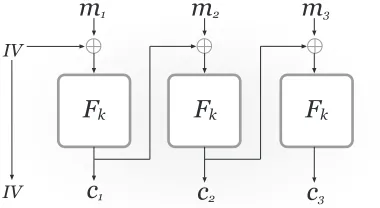
3Figure 1: CBC mode.
3
Modeling Modes of Operation
A mode of operation refers to a mechanism for encrypting arbitrary length messages based on any underlying block cipher. For simplicity, we assume all messages being encrypted have length a multiple of the block length. (This is without loss of generality, as messages can be padded unambiguously to such a length using known techniques.) For our purposes in this and the next section, a mode is defined by a pair of efficient algorithmsInitandBlockthat each expect oracle access to a functionFk:{0,1}n→ {0,1}n. These
algorithms have the following functionality:
• Init: This is a probabilistic algorithm that, on input 1n, outputs an initial ciphertext blockc
0∈ {0,1}n and state informationz0∈ {0,1}n.
• Block: This is a deterministic algorithm that takes as input a message block m ∈ {0,1}n and state
informationz∈ {0,1}n, and outputs a ciphertext blockc∈ {0,1}n and updated state informationz0∈
{0,1}n.
(The above could be generalized so that, e.g.,Block outputs two ciphertext blocks for each message block processed, or both Init and Block output two-block state. While this would require modifications to our constraints, our approach would be able to handle such generalizations.)
With some block cipherF fixed, a mode of operation (Init,Block) induces an encryption algorithmEnc. Specifically, ifm=m1k · · · km` is an`-block message, thenEnck(m) does the following:
1. Compute (c0, z0)←Init(1n), whereInitis given oracle access toFk.
2. Fori= 1, . . . , `, set (ci, zi) :=Block(mi, zi−1), where Blockis given oracle access toFk.
3. Output the ciphertextc0kc1k · · · kc`.
As an example, consider the CBC mode of operation in Figure1. In CBC mode, theInitalgorithm simply generates a uniform initialization vector (IV); the IV is both output as the initial ciphertext block and also passed along as state information. The Block algorithm XORs the incoming state information z with the current message blockm, passes the result through a block cipherFk, and uses the resulting valueFk(m⊕z)
as both the next ciphertext block and the updated state.
In this paper, a mode (Init,Block) issecureif the induced encryption scheme isIND$-CPAsecure whenever
F is a secure block cipher. (Here, we do not concern ourselves with decryption since we are only interested in security. For a given mode to be meaningful, it will also need to possess a corresponding decryption algorithm. When we synthesize modes, we check for existence of a suitable decryption algorithm in addition to verifying security.)
3.1
Viewing Modes as Graphs
GENRAND
DUP
OUT NEXTIV
START
XOR M
PRP
DUP
OUT NEXTIV
Initalgorithm
Blockalgorithm
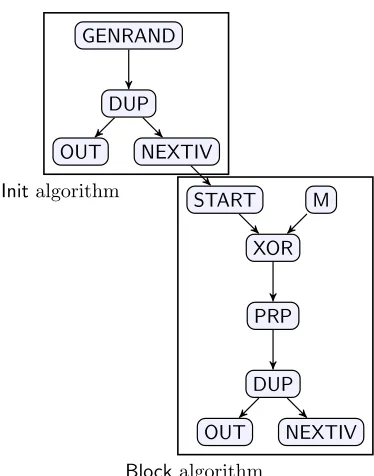
Figure 2: CBC mode expressed as a graph.
(intermediate) values, which are all n-bit strings. A node applies its associated operation on the value(s) contained on its ingoing edge(s), with the result(s) of the operation assigned to its outgoing edge(s). As an example, consider the graph version of CBC mode in Figure2. TheInitportion of the graph corresponds to the generation of a random IV (theGENRANDnode) which is then duplicated (theDUPnode) and output as part of the ciphertext (through theOUTnode) as well as passed on to theBlock algorithm (through the NEXTIVnode). TheBlockportion of the graph contains aSTARTnode, which is how the state information is provided as input (this information comes from theNEXTIVnode of either theInitalgorithm or a previous invocation of Block), as well as anM node, which is how the current message block is provided as input. In the case of CBC mode, those input values are XORed and the result is then passed through Fk. That
resulting value is duplicated, and again one copy is output as the next block of the ciphertext (via OUT) and another copy is passed on as state (viaNEXTIV).
From now on, we view a mode of encryption as being defined by a pair of directed, acyclic graphs, corresponding to theInitandBlockalgorithms, whose nodes are labeled with instructions from the list below and which also satisfy certain constraints described next. The instructions we support include:
• DUP: Has in-degree one and out-degree two. Replicates the ingoing value on both its outgoing edges.
• GENRAND: Has in-degree zero and out-degree one. Generates a uniform value in{0,1}n.
• M: Has in-degree zero and out-degree one. This corresponds to the current message block being provided as input. This instruction appears exactly once in theBlock graph, and does not appear in theInitgraph.
• PRFandPRP: Have in-degree one and out-degree one. These instructions both apply the block cipher to the value on the ingoing edge and assign the result to the outgoing edge;PRPis invertible butPRF need not be.
• XOR: Has in-degree two and out-degree one. XORs the values on its two ingoing edges and assigns the result to its outgoing edge.
• NEXTIV: Has in-degree one and out-degree zero. (The outgoing edge from NEXTIV in Figure 2 is conceptual.) The value on the ingoing edge is treated as the state that is output byInitorBlock. This instruction appears exactly once in each of the InitandBlockgraphs.
• START: Has in-degree zero and out-degree one. (The ingoing edge toSTARTin Figure2is conceptual.) The value on the outgoing edge is the state information provided as input to Block. This instruction appears exactly once in theBlock graph, and does not appear in theInitgraph.
• OUT: Has in-degree one and out-degree zero. The value on its ingoing edge represents the next ciphertext block that is output. This instruction appears exactly once in each of the Init and Block graphs.
The above provide a “basic” instruction set that we consider in the main body of this paper. In the appendix we additionally consider the following instruction:
• INC: Has in-degree one and out-degree one. Increments the value on its ingoing edge (modulo 2n), and
assigns the result to its outgoing edge.
The above instructions (includingINC) are sufficient to model all the standard modes such as ECB, OFB, CFB, CBC, CTR, and PCBC.
3.2
Edge Labels and Constraints
In the previous section we defined what it means for a pair of directed, acyclic graphs to correspond to a
legal mode. But not all legal modes are secure! In this section we introduce a set of edge labels, and also describe a set of constraints that a valid labeling must satisfy. Our meta-theorem states that if a legal mode of operation has a valid edge labeling, then that mode is secure.
We now give the details of the edge labeling for some (legal) mode of operation specified by directed, acyclic graphs (Init,Block). LetGdenote the union ofInitand Block, and letE denote the total number of edges inG. Alabel is a 3-tuple (fam,type,flags) where
• fam ⊆ {1, . . . , E} represents the set of families to which the edge belongs. Two edges e1, e2 with families fam1,fam2, respectively, are related iffam1∩fam26=∅.
• type∈ {R,⊥}represents a “type,” where, intuitively,Rdenotes “random” and⊥denotes “adversarially controlled.” We impose the ordering ⊥<R.
• flags∈ {0,1}2is a bit-vector denoting whether the edge can be used as input toOUTor PRF, respec-tively. We index into this bit-vector by using the notation flags.OU T andflags.P RF. We define the (partial) orderingflags≤flags0 iffflags.OU T ≤flags0.OU T andflags.P RF ≤flags0.P RF.
In trying to labelG, we begin by assigning each edge inGa set of families using the following, deterministic procedure that first handles edges inInitbefore moving on to the edges inBlock:
1. While there is an instruction node whose ingoing edges have all been assigned a set of families, assign its outgoing edge(s) a set of families using the following rules:
• DUP: The outgoing edges are both assigned the same set of families as the ingoing edge.
• PRF: Let int be the least unused value in {1, . . . , E}. The outgoing edge is assigned the set of families {int}.
2. Otherwise, we choose an instruction node with in-degree 0, with preference for theSTARTnode if its outgoing edge has not yet been labeled. The outgoing edge from this node is assigned {int}, whereint is the least unused value in{1, . . . , E}.
Once each edge in Ghas been assigned a set of families, we then try to assign atypeand flags to each edge inGsubject to the following constraints:
• START: Say there is a NEXTIV node in G(whether in Initor in Block) whose ingoing edge has type typeand flagsflags. Then the outgoing edge fromSTARThastype0 ≤typeandflags0 ≤flags.
• GENRAND: The outgoing edge gets typeRandflags= 11.
• M: The outgoing edge gets type⊥andflags= 00.
• DUP: Say the input edge has type type and flags flags. The two output edges get types type1 = type2 = type, and flags flags1 and flags2 such that the following hold: (1) flags1 &flags2 = 00 and (2)flags1|flags2=flags, where & and|refer to bit-wise AND and OR, respectively.
• PRF: We require that the ingoing edge toPRFhas typeRandflags.P RF = 1. The outgoing edge gets typeRandflags= 11.
• XOR: We require that the ingoing edges to anXORnode are unrelated, and that at least one of them has typeR. The outgoing edge gets typeR. Say the input edges have flagsflags1 andflags2, respectively. Then:
1. If both ingoing edges have typeR, the outgoing edge gets flags flags1|flags2.
2. If only one edge (say, the first) has type R, the outgoing edge gets flags flags1.
• OUT: We require the ingoing edge to anOUT node to have typeRandflags.OU T = 1.
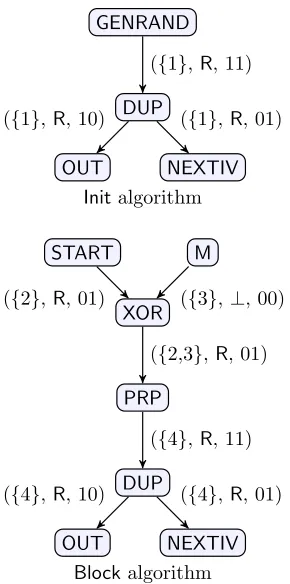
A labeling of G that satisfies all of the above constraints is called avalid labeling. One can verify that the graphs corresponding to each of CBC, CFB, and OFB modes have valid labelings,2 whereas ECB mode (which is known to be insecure) does not. See Figure3for a valid labeling of CBC mode.
We now briefly describe some intuition behind these labels and constraints. We define two types for the edge labels: “random” (a.k.a.,R) and “adversarially controlled” (a.k.a.,⊥). For instructions likePRFand XOR, we want a guarantee that the output from these instructions is random. Thus, we do not, for example, allow adversarially controlled values as input into aPRFnode, as the output is not “random” to an attacker who can query thePRFnode on the same input multiple times.
There are only two instructions that introduce values: GENRAND produces a random value, and M produces an adversarially controlled value (as the adversary supplies the message to be encrypted). For random values, we want to enforce that they are used in ways that do not void their “randomness.” This is where theflags bit-vector comes into play: by accounting for whether a random value can be input into an OUTnode or aPRFnode, we prevent a random value from both being output as ciphertextand input into a PRF node, which can lead to insecure schemes. (This does not mean there do not exist secure schemes which have this property; however, our tool does not allow such schemes.)
In the next section we prove thatany mode that has a valid labeling is secure. Importantly, determining the existence of a valid labeling for a given mode requires reasoning over a finite graphGand a finite set of constraints, and we can therefore use an SMT solver to check whether a valid labeling is possible.
GENRAND
DUP
OUT NEXTIV
START
XOR M
PRP
DUP
OUT NEXTIV
({1},R, 11)
({1},R, 10) ({1},R, 01)
({2},R, 01) ({3},⊥, 00)
({2,3},R, 01)
({4},R, 11)
({4},R, 10) ({4},R, 01) Initalgorithm
Block algorithm
Figure 3: A valid labeling for CBC mode.
4
Meta-Theorem and Proof
Theorem 1. Let (Init,Block) be a legal mode of operation. If it has a valid labeling, then it is secure. In other words, when the mode is instantiated with any secure block cipher, the resulting encryption scheme is
IND$-CPAsecure.
Proof. Consider the encryption scheme that results from instantiatingInit/Blockwith a secure block cipherF. The experiment in which a polynomial-time adversary interacts with this scheme proceeds as follows:
• A uniform key for the block cipher is chosen.
• The attacker may then (adaptively) specify messages to be encrypted. After an `-block message
m=m1k · · · km` is specified, we imagine creating a connected graph Gconsisting of one copy ofInit
and`copies ofBlockby simply adding an edge from aNEXTIVnode ofInit/Blockto theSTARTnode of the subsequent copy ofBlock. To encrypt the message, we begin by assigning theith message blockmi
to be the value on the outgoing edge of theM-instruction in theith copy ofBlock. We then iteratively assign values to the edges in G(based on the instruction at each node) until every edge is assigned a value. (The outgoing edge from a NEXTIV node or aSTART node is assigned the same value as the ingoing edge to that node.) This, in particular, assigns values to the ingoing edges to everyOUTnode, and so defines an (`+ 1)-block ciphertext that is given to the attacker.
value used previously. Otherwise, assign to the outgoing edge a uniform value in{0,1}n. Once we make this
substitution, the entire experiment becomes information-theoretic and we no longer need to be concerned with the running time of the attacker. (However, we continue to assume a polynomial upper bound on the number of messages the attacker can request to be encrypted as well as the block-length of each such message.) As the adversary is computationally unbounded we may, without loss of generality, treat the attacker as deterministic. The probability space of the attacker’s interaction is then taken only over choice of the random function and any internal randomness of the mode (i.e., inGENRANDinstructions). For each edge in all the graphsG(corresponding to all the messages whose encryption is requested by the attacker), the value assigned to that edge is a random variable. Let val(e) be the random variable corresponding to the value assigned to some edgee. If E is a set of edges, thenval(E) denotes the multiset{val(e)|e∈E}. We show that the joint distribution of the random variables corresponding to all the ingoing edges to OUT nodes—and hence the joint distribution of all ciphertext blocks returned to the attacker—is statistically close to uniform. This implies the scheme isIND$-CPAsecure.
Fix some valid labeling ofInitandBlock. As discussed above, each time the attacker requests an encryp-tion of some`-block message we imagine creating a graphG consisting of one copy of Initand ` copies of Block. The valid labeling of Initand Blocknaturally extends to a labeling of this graphG; the edges inInit are labeled in the obvious way, and the corresponding edges in each copy of Block are assigned the same label. (The only special case is an edge from a NEXTIV node in one block to a START node in the next block, which we assign the same label as the ingoing edge to thatNEXTIVnode.)
Consider the step-by-step process by which edges inGare assigned values when a messagemis encrypted. (Although we speak here of “assigning values,” we will continue to treat these as random variables and so “assigning a value” is merely conceptual.) Edges are assigned values in topological order; i.e., the value of an edge is not assigned unless values have been assigned to its parents. We say an edge is active if it has been assigned a value but its children have not. (When we begin encrypting a message, the only active edges are the outgoing edges from all the M-nodes.) The only exceptions are ingoing edges toOUT nodes as well as the ingoing edge to the finalNEXTIV node; these become active when they are assigned a value, and remain active until the relevant instruction is processed. (Processing an OUT instruction just means declaring the ingoing edge to that instruction as no longer being active, but instead being “output” as part of the ciphertext. Processing the finalNEXTIVnode means giving the computed ciphertext to the adversary.) For simplicity, we assume all edges in a given copy ofBlockare assigned a value before assigning a value to the outgoing edge of theNEXTIVnode in that copy ofBlock.
When we are done encrypting a message we give the resulting ciphertext to the attacker, who then chooses the next message to be encrypted. We then create another graph and assign values as above. We stress that previous graphs are maintained: even though none of their edges are active, we may still refer to the values taken by edges in previous graphs.
At any step in the above process, define the following sets of edges:
P RFa = edges of typeRwithflags.P RF = 1 that are active
OU Ta = edges of typeRwithflags.OU T = 1 that are active
OU T = edges output for the message currently being processed
These sets change as instructions are processed. We prove that with all but negligible probability the following invariants hold at the end of each step:
• Invariant 1: For anyS⊆P RFa, the random variables val(S) are jointly uniform, even conditioned
on the values on all active edges unrelated to edges inS and the values of all edges previously used as input to aPRFinstruction.
• Invariant 2: For anyS ⊆OU Ta, the random variables val(S) are jointly uniform, even conditioned
on the values of all previous ciphertext blocks (including those in OU T) and the values on all active edges unrelated to edges inS.
Invariant 3 implies that when encryption of the given message is done, the resulting ciphertext is (sta-tistically close to) uniform, which is what we wanted to show. The other two invariants are used as part of proving that Invariant3 is maintained. (Intuitively, Invariant1 enforces that the inputs into everyPRF instruction are uniform, and thus distinct with high probability; this, in turn, means that all the outputs of thePRFinstructions are uniform and independent. Invariant2enforces that values on ingoing edges toOUT instructions are uniform, and thus when we “output” these values the resulting ciphertext is also uniform.) Clearly the above invariants all hold when beginning to encrypt some message. (At that point in time,
P RFa,OU Ta, andOU T are all empty.) Now, assume the invariants hold before executing some instruction;
we show that, with high probability, they continue to hold after executing the instruction. We let P RFa, OU Ta, andOU T denote the sets in question before the instruction, and letP RF\a,OU T\a, andOU T[ denote
the (possibly modified) sets following the instruction. (Observe thatOU T only changes when processing an OUT instruction. Thus, Invariant3 trivially holds for all other instructions, and we only consider it when we analyze theOUT instruction.)
• NEXTIV: The ingoing and outgoing edges have the same label and the same value; thus, the invariants trivially continue to hold.
• START: We consider Invariant1; the argument is identical for Invariant2.
Let e, labeled (fam,type,flags), be the ingoing edge to this instruction and let e0, labeled
(fam0,type0,flags0), be the outgoing edge. The labeling constraints imply that type0 ≤ type and
flags0 ≤ flags. Note further that the only other active edges at the time this instruction is applied are outgoing edges from M nodes, none of which is related to either eor e0, and none of which is in
P RFa or P RF\a. Ife06∈P RF\a then Invariant1trivially holds after the instruction is applied.
Other-wise, the fact that type0 ≤typeandflags0 ≤flagsmeans thate∈P RFa. Sinceeande0 have the same
value and Invariant1 holds before the instruction is applied, the invariant continues to hold after the instruction is applied.
• DUP: We consider Invariant1; the argument is identical for Invariant2.
Let e0 be the ingoing edge to this instruction, and let e1 and e2 be the two outgoing edges. If
e0 6∈P RFa, then e1, e2 6∈P RF\a; this means that P RFa =P RF\a and—sincee0, e1, and e2 all have the same families—the invariant continues to hold. If e0 ∈P RFa, then exactly one of e1 or e2 is in
\
P RFa. Since the values ofe0,e1, ande2are the same, and all these edges have the same families, the invariant again continues to hold.
• GENRAND: Because of the way outgoing edges of aGENRANDinstruction are labeled, this instruction adds an edge to P RFa and OU Ta. Since the value on this edge is uniform and independent of any
previous values, the invariants continue to hold.
• PRF: Using Invariant 1, the value on the ingoing edge to the PRF instruction is uniform, even con-ditioned on the values of all previous ingoing edges to a PRF instruction. Therefore, with all but negligible probability, the value on this edge is distinct from all values previously used as input to a PRFinstruction. When this is the case, the value on the outgoing edge is uniform and both invariants continue to hold just as for a GENRANDinstruction.
• XOR: We consider Invariant1; the argument is identical for Invariant2.
Let e0 and e00, labeled (fam0,type0,flags0) and (fam
0
0,type00,flags
0
0), respectively, be the two ingoing edges, and let e1, labeled (fam1,type1,flags1), be the outgoing edge. Note that e0 and e00 must be unrelated and at least one ofe0 ande00 must have typeR. Also, fam1 =fam0∪fam
0
0 and so anything related toe0 ore00 is also related toe1.
Otherwise, e1∈P RF\a and at least one ofe0 ore00 (saye0) is inP RFa. By Invariant 1 we have that val(e0) is uniform even conditioned on val(e00). Thus, val(e1) = val(e0)⊕val(e00) is uniform and the invariant continues to hold.
• OUT: Let e be the ingoing edge. This instruction reduces the number of active edges, so clearly Invariant1 and Invariant2continue to hold.
The labeling constraints ensure thate∈OU Ta. Also, note thatOU T[ =OU T∪ {e}. Using Invariant2,
we have thatval(e) is uniform even conditioned onval(OU T), and thus Invariant3continues to hold.
This completes the proof.
It is possible to extract from our proof a bound on the concrete security of the mode of operation as a function of the number (and type) of instructions inInit/Blockas well as the total number of message blocks encrypted.
5
Implementation
We have developed a prototype model checker for verifying whether a given mode has a valid labeling, as well as a synthesizer for generating modes. The code is written in OCaml, and is freely available at
https://github.com/amaloz/modes-generator. The implementation includes use of the INCinstruction, with the modified constraints as described in the appendix.
5.1
Model Checker
The core of our system is a model checker designed to evaluate a candidate encryption mode. Our model checker takes as input a description of the mode of operation (defined in terms of itsInitandBlockroutines) and determines both whether the corresponding encryption algorithm is correct (i.e., whether there exists an efficient decryption algorithm) and whether it issecure(i.e., whether the mode is IND$-CPA-secure).
5.1.1 Correctness
We have developed an algorithm that takes as input a mode of operation, and determines whether decryption of that mode is possible (with knowledge of the key). This is useful for pruning out uninteresting modes. The algorithm works by examining the description ofBlock to see whether each message block can be recovered from the ciphertext. To do this, we proceed as follows:
• If the value on the outgoing edge of the M node in Block (i.e., the current message block) can be recovered from the ingoing edge to the OUT node (i.e., the current ciphertext block), the mode is decryptable. (This is not typical, but is true for, e.g., ECB mode.)
• Otherwise, we checkBlock to see whether the requisite message block can be recovered from both the current ciphertext block and the value on the outgoing edge of theSTARTnode (i.e., the state passed from one invocation ofInit/Blockto the next). If not, we reject the mode as being undecryptable.
If so, then we need to verify that the state can be recovered from the previous ciphertext block(s). So:
– We check the Initalgorithm to see whether the value on the ingoing edge to the NEXTIV node can be recovered from the value on the ingoing edge to theOUTnode. If not, we reject the mode as being undecryptable.
1 ( d e c l a r e−c o n s t d u p l t y p e I n t ) 2 ( d e c l a r e−c o n s t d u p l f l a g o u t B ool ) 3 ( d e c l a r e−c o n s t d u p l f l a g p r f Bool ) 4 ( d e c l a r e−c o n s t d u p r t y p e I n t ) 5 ( d e c l a r e−c o n s t d u p r f l a g o u t Bool ) 6 ( d e c l a r e−c o n s t d u p r f l a g p r f Bool )
7 (a s s e r t (= d u p l t y p e d u p r t y p e g e n r a n d t y p e ) )
8 (a s s e r t (= (and d u p l f l a g o u t d u p r f l a g o u t ) f a l s e ) ) 9 (a s s e r t (= (and d u p l f l a g p r f d u p r f l a g p r f ) f a l s e ) )
10 (a s s e r t (= (or d u p l f l a g o u t d u p r f l a g o u t ) g e n r a n d f l a g o u t ) ) 11 (a s s e r t (= (or d u p l f l a g p r f d u p r f l a g p r f ) g e n r a n d f l a g p r f ) )
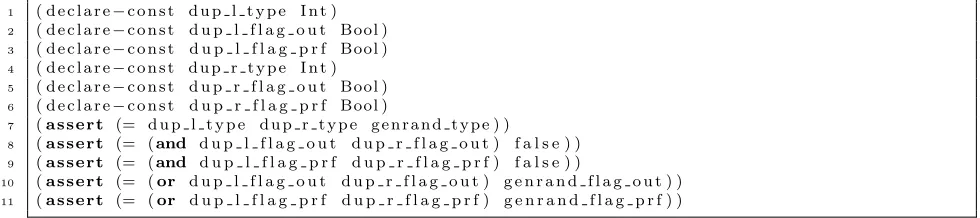
Figure 4: Example Z3 encoding of aDUPinstruction.
Our algorithm is sound, and successfully identifies the standard modes as being decryptable.
To perform each of the above checks, we recursively progress through the graphs defining theInit/Block algorithms in the natural way. We begin, say, with the value on the ingoing edge to the OUTnode known. If we know the value on any edge of aDUPnode, then we can derive the value on all other edges incident on that node. If we know the values on anytwo edges incident on anXORnode, we can derive the value on the remaining edge. In this way we determine whether it is possible to derive the value on, say, the outgoing edge of theMnode.
As an example, consider again the graph representation of CBC mode depicted in Figure 2. From the current ciphertext block (i.e., the value on the ingoing edge of theOUTnode), we can recover the value on the ingoing edge to theDUPnode and then, using the fact that the PRPnode is invertible, derive the value on the outgoing edge of theXORnode. This is not enough, by itself, to recover the message block; however, if we are additionally given the state (i.e., the value on the outgoing edge of theSTARTnode), then we can recover the message block. We then need to verify that, in both Initand Block, the state (i.e., the ingoing edge to theNEXTIVnode) can be derived from the ciphertext block.
5.1.2 Security
Theorem1states that if a mode has a valid labeling, it is a secure mode of operation. Thus, determining if a mode is secure reduces to a constraint-satisfaction problem in which the goal is to assign a valid label to all the edges in theInit/Blockgraphs while satisfying the constraints in Section3.2. Viewing the problem in this way lets us use an SMT solver to derive a correct satisfying assignment if one exists. In our implementation, we use the Z3 Theorem Prover3.
We check for a valid labeling in several phases. Because assigning families to edges is deterministic and straightforward, we do this first. After this we check whether two ingoing edges to any XOR node (if one exists in the graph) are related. If there are, a valid labeling cannot exist and we reject the mode as being (potentially) insecure. Otherwise, we proceed to a second phase in which we encode each constraint from Section 3.2 as an assertion in Z3. That is, we encode each edge of the graph as a variable, and each node as an assertion which forces the proper labels on the input and output variables of that node. We then run this through Z3, which tells us whether the expression is satisfiable or not given the asserted constraints.
Figure4presents an example encoding of aDUPnode. Lines 1–6 define the labels for the outgoing edges. We encode the edge’s typeas an integer, treating⊥as 0 andRas 2. (In the appendix we add a third type which we treat as 1.) Each bit inflags is treated as a Boolean value. In the referenced figure, dup l type, dup l flag out, anddup l flag prfdenotetype,flags.OU T, andflags.P RF, respectively, for the left outgoing edge of theDUPnode, and likewise,dup r type, etc., denote the corresponding values for the right outgoing edge. In this example, the ingoing edge to theDUPnode comes fromGENRAND, whose labeling is denoted bygenrand type, etc.
Lines 7–11 define the constraints. As an example, in Line 7 we “assert” that dup l type,dup r type, and genrand typeare all equal. This equates to the constraint onDUPas defined in Section3.2. Likewise, Lines 8–11 enforce the correct behavior of theflags variable for each edge.
5.2
Program Synthesizer
We also developed a synthesizer for generating secure modes. Given a fixed sizeN (where by “size” here we mean the number of instructions in Block), one could na¨ıvely iterate over all possible (valid) combinations of N instructions, feeding each resulting mode into our model checker to determine whether the mode is secure or not. Such an approach would be exceedingly slow, as the majority of instruction combinations result in trivially insecure (or undecryptable) schemes. Thus, we implement several simple but effective pruning mechanisms to remove incorrect or uninteresting modes from being analyzed. This pruning process eliminates more than 99.99% of the possible modes from being passed through the model checker, greatly improving the running time of our synthesizer.
We now describe some of our pruning techniques. One approach looks at the current instruction being added to the generated mode, and checks the previous program instruction(s) against a set of disallowed neighboring instructions. One such example is an XORinstruction applied to the two outgoing edges of a DUPinstruction, which can never have a valid labeling. Another pruning strategy disallows two back-to-back PRP instructions; while this is not invalid per se, it only produces uninteresting modes (as no security is gained by the secondPRPinstruction).
6
Results
We ran our synthesizer to generate modes having Block algorithms containing up to 10 instructions4. We
do not currently synthesize an Init algorithm, but instead used a fixed Init algorithm which generates a uniform IV and both outputs it and passes it on (as state) to the Block algorithm (cf. Figure 2). Our experiments include the INC instruction, which increments its input modulo 2n, and the more complex
constraints introduced in the appendix to handle this additional instruction.
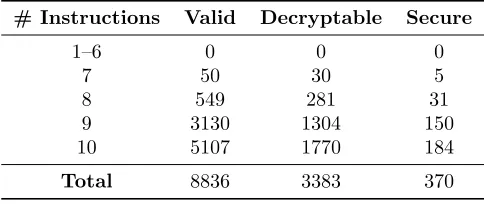
Table1shows our results.5 In the context of this table, a “valid” mode is defined as a mode whose acyclic graph representation is connected, contains at least onePRForPRPnode, contains exactly oneM,START, OUT, andNEXTIV node, and contains noGENRAND nodes. A “decryptable” mode is a valid mode which passes our decryption check. Finally, a “secure” mode is one that also has a valid labeling. We also include a check for removing duplicate modes; that is, modes that have different graph layouts but are equivalent. (E.g., in one the left outgoing edge of aDUPnode is output, and in the other the right outgoing edge of a DUPnode is output.) Thus, the results in Table1 representdistinct nodes.
We discovered 370 secure modes (out of 8836 valid modes). The modes containing seven instructions constitute the well-known CBC, OFB, and CFB modes. The modes containing eight instructions include CTR mode, as well as variants of CBC, OFB, and CFB mode with an additional PRFor PRPinstruction introduced. We also synthesize PCBC mode.
In terms of performance, we found that we can synthesize secure modes of operation with≤10 instructions in around 7 minutes on a standard laptop. However, we believe this can be greatly improved. Due to the fact that the Z3 OCaml bindings were not available at the time of this writing, we had to write our Z3 input to a file and then run a separate process to check the result. This additional process creation constitutes a large portion (nearly half) of the running time of our synthesizer. Porting our approach to use the Z3 OCaml bindings, once available, should greatly improve the overall running time of our tool.
4In our implementation we actually encode modes using a stack-based language which includes some additional instructions for moving items around the stack. When we say “up to 10 instructions,” we include these extra instructions. However, the instruction counts in Table1donot include these extra instructions, and thus denote the actual sizes of the modes.
# Instructions Valid Decryptable Secure
1–6 0 0 0
7 50 30 5
8 549 281 31
9 3130 1304 150
10 5107 1770 184
Total 8836 3383 370
Table 1: Number of valid, decryptable, and secure modes by number of instructions.
7
Conclusion and Future Work
We have introduced a method for reasoning about modes of operation using only “local” analysis of a single block of the given mode. We model modes as graphs and develop a labeling and constraint system on the edges of the graph, and show that if a mode can be correctly labeled then it is secure. Using this meta-theorem, we developed a model checker and synthesizer for both automatically verifying whether a mode is secure and automatically generating new modes. With these tools, we discovered 370 unique secure modes, many of which have never been studied before in the literature.
As future work, we plan to investigate whether it is possible to adapt our approach to the automated analysis and synthesis of authenticated encryption schemes and/or message authentication codes. We hope that the general framework presented in this paper can be applied to these primitives as well as other cryptographic tools.
In terms of extending the present work, it would be useful to couple our approach with automated generation of a proof of security inEasyCrypt [BGHB11]. One could also explore adding operations such as concatenation or field multiplication to our language.
Acknowledgments
The authors thank Michael Hicks and Jeff Foster for comments on an earlier draft of this work, and Martijn Stam for identifying issues with the results in Table1in the proceedings version.
Work of Alex J. Malozemoff was conducted with Government support awarded by DoD, Air Force Office of Scientific Research, National Defense Science and Engineering Graduate (NDSEG) Fellowship, 32 CFR 168a. Work of Jonathan Katz was done for Exelis under contract number N00173-11-C-2045 to NRL. Work of Matthew D. Green was supported by the U.S. Defense Advanced Research Projects Agency (DARPA) and the Air Force Research Laboratory (AFRL) under contract FA8750-11-2-0211.
References
[AGH13] Joseph A. Akinyele, Matthew Green, and Susan Hohenberger. Using SMT solvers to automate design tasks for encryption and signature schemes. In Ahmad-Reza Sadeghi, Virgil D. Gligor, and Moti Yung, editors, ACM CCS 13: 20th Conference on Computer and Communications Security, pages 399–410, Berlin, Germany, November 4–8, 2013. ACM Press.
[BCG+13] Gilles Barthe, Juan Manuel Crespo, Benjamin Gr´egoire, C´esar Kunz, Yassine Lakhnech, Benedikt Schmidt, and Santiago Zanella B´eguelin. Fully automated analysis of padding-based encryption in the computational model. In Ahmad-Reza Sadeghi, Virgil D. Gligor, and Moti Yung, editors, ACM CCS 13: 20th Conference on Computer and Communications Security, pages 1247–1260, Berlin, Germany, November 4–8, 2013. ACM Press.
[BGHB11] Gilles Barthe, Benjamin Gr´egoire, Sylvain Heraud, and Santiago Zanella B´eguelin. Computer-aided security proofs for the working cryptographer. In Phillip Rogaway, editor, Advances in Cryptology – CRYPTO 2011, volume 6841 ofLecture Notes in Computer Science, pages 71–90, Santa Barbara, CA, USA, August 14–18, 2011. Springer, Berlin, Germany.
[CDE+08] Judica¨el Courant, Marion Daubignard, Cristian Ene, Pascal Lafourcade, and Yassine Lakhnech. Towards automated proofs for asymmetric encryption schemes in the random oracle model. In Peng Ning, Paul F. Syverson, and Somesh Jha, editors,ACM CCS 08: 15th Conference on Com-puter and Communications Security, pages 371–380, Alexandria, Virginia, USA, October 27–31, 2008. ACM Press.
[CEL07] Judica¨el Courant, Cristian Ene, and Yassine Lakhnech. Computationally sound typing for non-interference: The case of deterministic encryption. In V. Arvind and Sanjiva Prasad, editors,
FSTTCS 2007: Foundations of Software Technology and Theoretical Computer Science, volume 4855 ofLecture Notes in Computer Science, pages 364–375, New Delhi, India, December 12–14, 2007. Springer, Berlin, Germany.
[GLLSN09] Martin Gagn´e, Pascal Lafourcade, Yassine Lakhnech, and Reihaneh Safavi-Naini. Automated security proof for symmetric encryption modes. In Anupam Datta, editor,13th Asian Computing Science Conference, pages 39–53. Springer, Berlin, Germany, 2009.
[GLLSN12] Martin Gagn´e, Pascal Lafourcade, Yassine Lakhnech, and Reihaneh Safavi-Naini. Automated verification of block cipher modes of operation, an improved method. In Joaqu´ın Garc´ıa-Alfaro, Fr´ed´eric Cuppens, Nora Cuppens-Boulahia, Ali Miri, and Nadia Tawbi, editors,5th International Symposium on Foundations and Practice of Security, volume 7743 ofLecture Notes in Computer Science, pages 23–31. Springer, Berlin, Germany, 2012.
[KL08] Jonathan Katz and Yehuda Lindell. Introduction to Modern Cryptography. CRC Press, 2008.
[MW80] Zohar Manna and Richard Waldinger. A deductive approach to program synthesis. ACM Transactions on Programming Languages and Systems, 2(1):90–121, 1980.
[Rog04] Phillip Rogaway. Nonce-based symmetric encryption. In Bimal K. Roy and Willi Meier, editors,
Fast Software Encryption – FSE 2004, volume 3017 ofLecture Notes in Computer Science, pages 348–359, New Delhi, India, February 5–7, 2004. Springer, Berlin, Germany.
[Sri10] Saurabh Srivastava.Satisfiability-Based Program Reasoning and Program Synthesis. PhD thesis, University of Maryland, 2010.
Appendix
In this appendix, we modify the labels and constraints to support theINC instruction, and prove a version of Theorem1 in this setting.
Edge labels. Recall we have a mode of encryption specified by directed, acyclic graphsInitandBlock. Let
Gdenote their union, and letEdenote the total number of edges inG. Every edge is labeled with a 3-tuple (fam,type,flags) where
• type ∈ {R,U,⊥} represents the “type” of the edge. Intuitively, R denotes “random,” U denotes “unique,” and⊥denotes “adversarially controlled.” We impose the ordering⊥<U<R.
• flags ∈ {0,1}4 is a bit-vector. The first three bits denote whether the edge can be used as input to OUT, PRF, or INC, respectively, and we index into this bit-vector using the notation flags.OU T, flags.P RF, andflags.IN C. In addition, we have a flagflags.IN Cdthat, intuitively, indicates whether the given edge or one of its related edges ever hadflags.IN C= 1 (either currently or in the past).
Constraints. In trying to labelG, we begin by assigning each edge inGa set of families as in Section3.2, with the following rule for INC nodes:
• INC: The outgoing edge is assigned the same set of families as the ingoing edge.
Once each edge in Ghas been assigned a set of families, we then try to assign atypeand flags to each edge inGsubject to the following constraints:
• START: Say there is a NEXTIV node in G (whether in Init or in Block) whose ingoing edge has type type and flags flags. Then the outgoing edge from START has type0 ≤ type, flags0 ≤ flags, andflags0.IN Cd=flags.IN Cd.
• GENRAND: The outgoing edge gets typeRand flags.P RF =flags.OU T = 1. The value offlags.IN C
can be arbitrary, and we setflags.IN Cd=flags.IN C.
• M: The outgoing edge gets type=⊥andflags= 0000.
• DUP: Say the input edge has typetypeand flagsflags. The two output edges get typestype1=type2= type and flags flags1 and flags2 such that: (1)flags1.OU T & flags2.OU T = 0, and (2) flags1.OU T | flags2.OU T =flags.OU T(the rules forflags.P RFandflags.IN Care analogous), and (3)flags1.IN Cd= flags2.IN Cd=flags.IN Cd.
• INC: We require that the ingoing edge toINChastype∈ {U,R}andflags.IN C= 1. The outgoing edge getstype0=U,flags0.OU T = 0, andflags0.IN C=flags0.P RF =flags0.IN Cd= 1.
• PRF: We require that the ingoing edge to PRFhas type∈ {U,R} and flags.P RF = 1. The outgoing edge is treated just like the output of GENRAND.
• XOR: We require that the ingoing edges to anXORnode are unrelated, at least one of them has type R, and both haveflag.IN Cd= 0. The outgoing edge gets typeR. Say the input edges have flagsflags1 andflags2, respectively. Then:
1. If both ingoing edges have type R, the outgoing edge gets flags flags0 such that flags0.OU T = flags1.OU T |flags2.OU T (the rule forflags0.P RF is analogous), andflags0.IN C =flags0.IN Cd= 0.
2. If only one edge (say, the first) has type R, then flags0.OU T = flags1.OU T and flags0.P RF = flags1.P RF but flags0.IN C =flags0.IN Cd= 0.
• OUT: We require the ingoing edge to anOUT node to have typeRandflags.OU T = 1.
One can verify that the following invariants hold for any labeling satisfying the above constraints:
• Invariant 1: If an edge has flags.IN C= 1, then it also hasflags.IN Cd= 1.
• Invariant 2: If edge e has flags.IN Cd = 1 and edge e0 has flags0.IN Cd = 0, then e and e0 are unrelated.
Theorem 2. Let (Init,Block) be a legal mode of operation specified using the instructions above (including
INC). If the mode has a valid labeling, then it is a secure. In other words, when the mode is instantiated with any secure block cipher, the resulting encryption scheme isIND$-CPAsecure.
Proof. We assume the reader has read the proof of the analogous theorem in Section4, and thus we jump straight to the details.
Fix some valid labeling of Init and Block. Each time the attacker requests encryption of some `-block message we imagine creating a graphGconsisting of one copy ofInitand`copies ofBlock. The valid labeling ofInitandBlocknaturally extends to a labeling of this graphG; the edges inInitare labeled in the obvious way, and the corresponding edges in each copy ofBlock are assigned the same label. (The only special case is an edge from aNEXTIVnode in one block to aSTARTnode in the next block, which we assign the same label as the ingoing edge to thatNEXTIVnode.)
Consider the step-by-step process by which edges inGare assigned values when a messagemis encrypted. (Although we speak here of “assigning values,” these are really random variables and so “assigning a value” is conceptual.) Edges are assigned values in topological order; i.e., the value of an edge is not assigned unless values have been assigned to its parents. We say an edge is active if it has been assigned a value but its children have not. (When we begin encrypting a message, the only active edges are the outgoing edges from all the M-nodes.) The only exceptions are ingoing edges toOUT nodes and the ingoing edge to the final NEXTIV node; these become active when they are assigned a value, and remain active until the relevant instruction is processed. (Processing anOUT instruction just means declaring the ingoing edge to that instruction as no longer being active, but instead being “output” as part of the ciphertext. Processing the finalNEXTIVnode means giving the computed ciphertext to the adversary.) For simplicity, we assume all edges in a given copy ofBlock are assigned a value before assigning a value to the outgoing edge of the NEXTIVnode in that copy ofBlock.
When we are done encrypting a message we give the resulting ciphertext to the attacker, who then chooses the next message to be encrypted. We then create another graph and assign values as above. We stress that previous graphs are maintained: even though none of their edges are active, we may still refer to the values taken by edges in previous graphs.
At any step in the above process, define the following sets of edges in the graph:
P RF = edges withtype∈ {U,R}andflags.P RF = 1 that are either active or have entered aPRFnode in the past
P RF∗ = active edges withtype=R,flags.P RF = 1, andflags.IN Cd= 0
IN C = active edges withtype∈ {U,R}andflags.IN C= 1
OU Ta = active edges withtype=Randflags.OU T = 1
OU T = edges output for the message currently being processed
Let T be a bound on the number of instructions in the graph G defined earlier. (Note that T must be polynomial, since the number of message blocks is assumed to be polynomial.) We prove that with all but negligible probability the following invariants hold at the end of each step:
• Invariant 3: For alle, e0 ∈P RF,val(e)6=val(e0). (Formally,val(e) andval(e0) are random variables, and what we mean here is that with all but negligible probability they take on different values.)
• Invariant 4: After executing theith instruction, for alle∈IN C ande0∈P RF:
val(e)6∈ {val(e0)−T +i, . . . ,val(e0)−1}.
Moreover, for all distincte, e0 ∈IN C:
val(e)6∈ {val(e0)−T+i, . . . ,val(e0)}.
• Invariant 5: For alle∈P RF∗ and any set E of active edges unrelated toe, val(e) is uniform even conditioned on val(E) andval(P RF\ {e}).
• Invariant 6: (a) Random variables val(OU T) are jointly uniform, even conditioned on the values of all previous ciphertext blocks. Moreover, (b) for any S ⊆OU Ta, random variables val(S) are jointly
uniform, even conditioned on the values of all previous ciphertext blocks,val(OU T), and the values on all active edges unrelated to edges inS.
Note that Invariant6(a) proves the theorem.
Clearly, the invariants hold at the beginning of the experiment. Now, assume the invariants hold before executing an instruction; we show that, with high probability, they continue to hold after executing the instruction. As in the proof of Theorem 1, we let “unhatted” variables denote the sets in question before executing the instruction, and let “hatted” variables denote the relevant sets following the instruction. We now consider the possible instructions:
• Begin processing the next message: Note there are no active edges before this instruction, and the active edges after this instruction are just the set of outgoing edges from M-nodes. P RF[ = P RF
and P RF[∗ = IN C[ =OU T[a =OU T[ =∅. Invariant 3 holds by the inductive assumption, and the
remaining invariants trivially hold.
• NEXTIV: The ingoing and outgoing edges have the same label and value; thus, the invariants are not affected.
• START: Let e, with type type and flags flags, be the ingoing edge ande0, with type type0 and flags flags0, be the outgoing edge. Edges e ande0 have the same value but possibly different labels. How-ever, the constraints ensure that type0 ≤ type, flags0 ≤flags, andflags.IN Cd =flags0.IN Cd. Thus, val(P RF[)⊆val(P RF) andval(IN C[)⊆val(IN C), even when viewed as multisets, and thus Invariant3 and Invariant4 continue to hold. OU T =OU T[, so Invariant6(a) continues to hold.
When processing the START instruction, the only active edges—besidese itself—are outgoing edges from M-nodes, which are not in OU Ta or P RF∗ and do not have flags.IN C = 1. It is thus easy to
verify the remaining invariants:
– Ife0 6∈P RF\∗, then P RF\∗=∅ and Invariant 5is trivial; otherwise,e∈P RF∗ and by induction
the invariant holds.
– Ife06∈OU T[a, thenOU T[a=∅and Invariant6(b) is trivial; otherwise,e∈OU Taand by induction
the invariant holds.
• DUP: Lete0 be the ingoing edge ande1, e2 the outgoing edges.
– Invariant 3: Ife0 6∈P RF, then e1, e2 6∈ P RF[. Ife0 ∈P RF, then e0 6∈P RF[ and exactly one of e1 ore2 is in P RF[. Since val(e0) =val(e1) =val(e2), this means that val(P RF) =val(P RF[) (even viewed as multisets), so Invariant3 continues to hold.
– Invariant4: Arguing as above,val(IN C[) =val(IN C) even viewed as multisets. Sinceval(P RF) = val(P RF[) also, the invariant continues to hold.
– Invariant 5: Fix ˆe ∈P RF\∗ and a set
b
E of active edges unrelated to ˆe. There are two cases to consider:
∗ eˆ∈ {e1, e2}. Then e0 ∈ P RF∗. Note thatval(e0) = val(ˆe). Since ˆe and e0 are related, all edges inEb are unrelated toe0, and thus by inductionval(e0) is uniform even conditioned on val(Eb) andval(P RF\ {e0}). Sinceval(e0) =val(ˆe), the invariant continues to hold.
∗ eˆ6∈ {e1, e2}. In this case, ˆe∈P RF∗. IfEb∩ {e1, e2} 6=∅, then let ˜E be the same asEb except
– Invariant 6: We have OU T =OU T[ and so Invariant 6(a) is trivial. Note that e0 ∈ OU Ta iff
exactly one ofe1ore2is inOU T[a; thus,val(OU Ta) =val(OU T[a), even when viewed as multisets.
Since e1 and e2 are related, and e0, e1, and e2 are all related to the same edges, Invariant 6(b) continues to hold as well.
• GENRAND: This instruction adds an edge to P RF and OU Ta, and possibly P RF∗ andIN C. Since
the value of this edge is uniform and independent of any previous edges, and the edge is not related to any other edges, all the invariants continue to hold (with high probability).
• PRF: By Invariant3, the value on the ingoing edge to thePRFinstruction is distinct from all values previously used as input to aPRFinstruction. Thus, the value on the outgoing edge is uniform, and all the invariants continue to hold (with high probability) just as in the case of aGENRAND instruction.
• INC: Denote the input edge bye0 and the output edge by e1. Note thate0 ∈IN C, e0 6∈P RF∗ (by Invariant1) ande1∈IN C[∩P RF[,e16∈P RF\∗. Because Invariant4holds before this step, Invariant3 and Invariant4 hold after this step.
– Invariant5: Note first thatP RF\∗=P RF∗. Fixe∈P RF\∗=P RF∗ and a set of active edges
b
E
unrelated toe. LetE denote the active edges unrelated toe. The setEb∪(P RF[ \ {e}) is identical
to E∪(P RF \ {e}) except that e1 is in the former (since e1 ∈ P RF[ but e1 6=e) and e0 is in the latter (sincee0 ∈E by Invariant2). Sincee1 is a deterministic function of e0, the invariant continues to hold.
– Invariant 6: Invariant 6(a) clearly continues to hold. Since OU T[a ⊆ OU Ta and val(e1) is a deterministic function of val(e0), Invariant6(b) also continues to hold.
• XOR: Lete0, e00be the two ingoing edges, ande1the outgoing edge. We know thate0, e00are unrelated, flags0.IN Cd=flags00.IN Cd= 0, and at least one ofe0, e00 (say,e0) hastype0=R.
– Invariant3: Ifflags1.P RF = 0 the invariant trivially continues to hold. Otherwise, there are two cases to consider:
∗ flags1.P RF = 1 and flags0.P RF = 1: In this case, e0 ∈P RF∗. Let E be the set of active edges unrelated to e0, and note e00 ∈ E. Invariant 5 implies that val(e0) is uniform even conditioned on val(e00) and val(P RF \ {e0}). Thus val(e1) = val(e0)⊕val(e00) is uniform conditioned on val(P RF[ \ {e1}), and so Invariant3continues to hold with all but negligible probability.
∗ flags1.P RF = 1 and flags0.P RF = 0: Here it must be the case that e0
0 has type R and flags00.P RF = 1. An argument as above, swappinge0
0ande0, shows that Invariant3continues to hold except with negligible probability.
– Invariant4: Note thatIN C[ =IN C. Ifflags1.P RF = 0, the invariant trivially continues to hold. Otherwise,e1∈P RF\∗ and so at least one ofe0 ore00 (saye0) is in P RF∗. Invariant2 says that every edge inIN C is unrelated toe0. Arguing as above (using Invariant 5) gives that val(e1) is uniform even conditioned on val(IN C[) and so Invariant4 continues to hold.
– Invariant 5: Fix ˆe ∈P RF\∗ and a set
b
E of active edges unrelated to ˆe. There are two cases to consider:
∗ eˆ = e1. As above, one can show that val(ˆe) = val(e1) = val(e0)⊕val(e00) is uniform even conditioned onval(Eb) andval(P RF[ \ {ˆe}).
∗ eˆ6=e1. Thus, ˆe∈P RF∗. If e1∈Eb, then let ˜E be the same as Eb except with e0 ande00 in place ofe1; otherwise, let ˜E=Eb. By induction,val(ˆe) is uniform even conditioned onval(E)
– Invariant6: Invariant6(a) clearly holds. As for Invariant6(b), an argument as above shows the val(e1) is uniform even conditioned on all the required values, and so this invariant continues to hold.
• OUT: This instruction reduces the number of active edges, so Invariant3, Invariant4, and Invariant5 trivially continue to hold. Invariant6continues to hold because of howOU Ta is defined.
Changelog
• Version 1.0 (September 30, 2014): First release. This is the same as the proceedings version except as follows:
– Added discussion of work of Courant et al. [CEL07] in Section1.1.