Computational Soundness
without Protocol Restrictions
∗
Michael Backes
1, Ankit Malik
2and Dominique Unruh
3 1Saarland University, Germany and MPI-SWS 2
Dept. of Math., IIT Delhi 3
University of Tartu, Estonia
August 22, 2012
Abstract
The abstraction of cryptographic operations by term algebras, called Dolev-Yao models, is essential in almost all tool-supported methods for verifying security protocols. Recently significant progress was made in establishing computational soundness results: these results prove that Dolev-Yao style models can be sound with respect to actual cryptographic real-izations and security definitions. However, these results came at the cost of imposing various constraints on the set of permitted security protocols: e.g., dishonestly generated keys must not be used, key cycles need to be avoided, and many more. In a nutshell, the cryptographic security definitions did not adequately capture these cases, but were considered carved in stone; in contrast, the symbolic abstractions were bent to reflect cryptographic features and idiosyncrasies, thereby requiring adaptations of existing verification tools.
In this paper, we pursue the opposite direction: we consider a symbolic abstraction for public-key encryption and identify two cryptographic definitions called PROG-KDM (pro-grammable key-dependent message) security andMKE(malicious-key extractable) security that we jointly prove to be sufficient for obtaining computational soundness without impos-ing assumptions on the protocols usimpos-ing this abstraction. In particular, dishonestly generated keys obtained from the adversary can be sent, received, and used. The definitions can be met by existing cryptographic schemes in the random oracle model. This yields the first computational soundness result for trace-properties that holds for arbitrary protocols using this abstraction (in particular permitting to send and receive dishonestly generated keys), and that is accessible to all existing tools for reasoning about Dolev-Yao models without further adaptations.
Contents
1 Introduction 2
2 The symbolic model 4
3 Definitions of computational soundness 6
4 Computational soundness proofs in CoSP 7
5 Restrictions in the proof and how to solve them 9
5.1 Sending secret keys . . . 9 5.2 Receiving decryption keys . . . 15
6 The main result 19
7 Proof sketch 20
A Symbolic model 24
B Computational implementation 25
C Computational soundness proof 26
C.1 Construction of the simulator . . . 26 C.2 The faking simulators . . . 30 C.3 The actual proof . . . 32
References 50
Symbol index 52
Index 55
1
Introduction
Proofs of security protocols are known to be error-prone and, owing to the distributed-system aspects of multiple interleaved protocol runs, awkward for humans to make. Hence work towards the automation of such proofs started soon after the first protocols were developed. From the start, the actual cryptographic operations in such proofs were idealized into so-called Dolev-Yao models, following [23, 24, 30], e.g., see [25, 34, 1, 28, 33, 13]. This idealization simplifies proof construction by freeing proofs from cryptographic details such as computational restrictions, probabilistic behavior, and error probabilities. The success of these Dolev-Yao models for the tool-supported security analysis stems from their conceptual simplicity: they only consist of a small set of explicitly permitted rules that can be combined in an arbitrary manner, without any further constraints on the usage and combination of these rules. Recently significant progress was made in establishing so-called computational soundness results: these results prove that Dolev-Yao style models can be sound with respect to actual cryptographic realizations and security definitions, e.g., see [2, 26, 10, 8, 27, 31, 22, 19, 11, 21].
surrounding protocol does not cause any key cycles, or – more importantly – that all keys that are used within the protocol have been generated using the correct key generation algorithm. The latter assumption is particularly problematic since keys exchanged over the network might have been generated by the adversary, and assuming that the adversary is forced to honestly generate keys can hardly be justified in practice.
In a nutshell, these constraints arose because the respective cryptographic security definitions did not adequately capture these cases, but were considered carved in stone; in contrast, the symbolic abstractions were bent to reflect cryptographic features and idiosyncrasies. As a result, existing tools needed to be adapted to incorporate extensions in the symbolic abstractions, and the explicitly imposed protocol constraints rendered large classes of protocols out-of-scope of prior soundness results. Moreover, if one intended to analyze a protocol that is comprised by such prior results, one additionally had to formally check that the protocol meets the respective protocol constraints for computational soundness, which is not necessarily doable in an automated manner.
Our Contribution. In this paper, we are first to pursue the opposite direction: we consider an unconstrained symbolic abstraction for public-key encryption and we strive for avoiding assump-tions on the protocols using this abstraction. We in particular permit sending and receiving of potentially dishonestly generated secret keys. Being based on the CoSP framework, our result is limited to trace properties. We do not, however, see a principal reason why it should not be possible to extend it to equivalence properties.
To this end, we first identify which standard and which more sophisticated properties a cryp-tographic scheme for public-key encryption needs to fulfill in order to serve as a computationally sound implementation of an unrestricted Dolev-Yao model, i.e., eliminating constraints on the set of permitted cryptographic protocols. This process culminates in the novel definitions of anPROG-KDM(programmable key-dependent message) secure and anMKE(malicious-key
ex-tractable) secure encryption scheme. Our main result will then show that public-key encryption schemes that satisfyPROG-KDMandMKEsecurity constitute computationally sound
implemen-tations of unrestricted Dolev-Yao models for public-key encryption. The definitions can be met by existing public-key encryption schemes. (A number of additional conditions are needed, e.g., that a public key can be extracted from a ciphertext. But these can be easily enforced by suitable tagging. See Appendix B for the full list.)
Our computational soundness result in particular encompasses protocols that allow honest users to send, receive and use dishonestly generated keys that they received from the adversary, without imposing further assumptions on the symbolic abstraction. This solves a thus far open problem in the cryptographic soundness literature.1
In a nutshell, we obtain the first computational soundness result that avoids to impose con-straints on the protocols using this abstraction (in particular, it permits to send, receive, and use dishonestly generated keys), and that is accessible to all existing tools for reasoning about Dolev-Yao models without further adaptations.
Related work. Backes, Pfitzmann, and Scedrov [9] give a computational soundness result allowing key-dependent messages and sending of secret keys. But they impose the protocol condition that no key that is revealed to the adversary is every used for encrypting. Adão, Bana, Herzog, and Scedrov [3] give a computational soundness result allowing key-dependent messages, but only for passive adversaries. No adaptive revealing of secret keys is supported. Mazaré and
1
In an interesting recent work, Comon-Lundhet al.[20] also achieved a computational soundness result for
Warinschi [29] give a computational soundness that allows for adaptive revealing of secret keys (in the case of symmetric encryption). But they disallow key-dependent messages, encrypting of keys, key-dependent messages, encryptions of ciphertexts, or forwarding of ciphertexts. They show that under these conditions, IND-CCA2 security is sufficient. Bana and Comon-Lundh [12] have a computational soundness result not imposing any restrictions on the protocol. Their symbolic modeling, however, is weakened so that no secrecy (even symbolically) is guaranteed when key dependent messages or adaptive revealing of secret keys occur.
Outline of the Paper. First, we introduce our symbolic abstraction of unconstrained public-key encryption within the CoSP framework in Section 2. We give the notion of computation soundness in Section 3 and review how prior computational soundness proofs were conducted in CoSP in Section 4 for the sake of illustration. We identify where the aforementioned restric-tions arise in these proofs and explain how to overcome these limitarestric-tions in Section 5. The corresponding formal result is established in Section 6. Full proofs are deferred to the appendix
2
The symbolic model
We first describe our symbolic modeling here. The model is fairly standard and follows that of [4], except that we added some additional operations on secret keys.
Constructors and nonces. Let C :={enc/3,ek/1,dk/1,sig/3,vk/1,sk/1,pair/2,string0/1,
string1/1,empty/0,garbageSig/2,garbage/1,garbageEnc/2}and N:=NP∪NE. HereNP and NE are countably infinite sets representing protocol and adversary nonces, respectively. (f /n means f has arity n.) Intuitively, encryption, decryption, verification, and signing keys are represented as ek(r),dk(r),vk(r),sk(r) with a nonce r (the randomness used when generating the keys). enc(ek(r′), m, r) encrypts m using the encryption key ek(r′) and randomness r. sig(sk(r′), m, r) is a signature ofm using the signing key sk(r′) and randomnessr. The
con-structorsstring0, string1, and empty are used to model arbitrary strings used as payload in a protocol (e.g., a bitstring010would be encoded asstring0(string1(string0(empty)))). garbage,
garbageEnc, and garbageSig are constructors necessary to express certain invalid terms the ad-versary may send, these constructors are not used by the protocol.
Message type.2
We defineTas the set of all termsT matching the following grammar:
T ::=enc(ek(N), T, N)|ek(N)|dk(N)| sig(sk(N), T, N)|vk(N)|sk(N)| pair(T, T)|S|N |
garbage(N)|garbageEnc(T, N)| garbageSig(T, N)
S::=empty |string0(S)|string1(S)
where the nonterminalN stands for nonces.
Destructors. D := {dec/2,isenc/1,isek/1,isdk/1,ekof/1,ekofdk/1,verify/2,issig/1,isvk/1, issk/1,vkof/2,vkofsk/1,fst/1,snd/1,unstring0/1,unstring1/1,equals/2}. The destructorsisek,
2
In the CoSP framework, the message type represents the set of all well-formed terms. Having such a restriction (and excluding, e.g.,enc(dk(N), . . .)or similar) makes life easier. However, when applying the computational
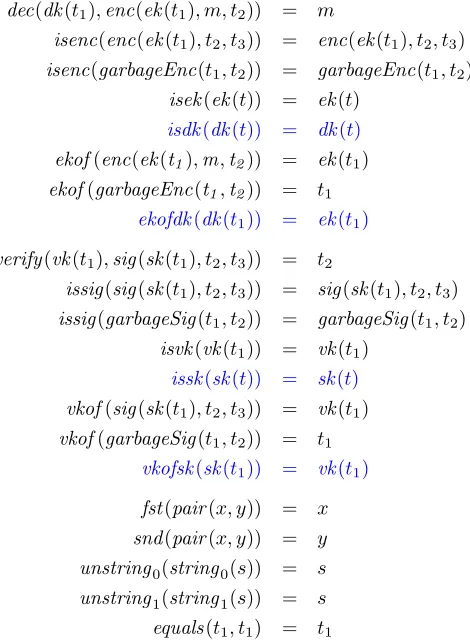
dec(dk(t1),enc(ek(t1), m, t2)) = m
isenc(enc(ek(t1), t2, t3)) = enc(ek(t1), t2, t3)
isenc(garbageEnc(t1, t2)) = garbageEnc(t1, t2)
isek(ek(t)) = ek(t) isdk(dk(t)) = dk(t)
ekof(enc(ek(t1),m,t2)) = ek(t1)
ekof(garbageEnc(t1,t2)) = t1
ekofdk(dk(t1)) = ek(t1)
verify(vk(t1),sig(sk(t1), t2, t3)) = t2
issig(sig(sk(t1), t2, t3)) = sig(sk(t1), t2, t3)
issig(garbageSig(t1, t2)) = garbageSig(t1, t2)
isvk(vk(t1)) = vk(t1)
issk(sk(t)) = sk(t)
vkof(sig(sk(t1), t2, t3)) = vk(t1)
vkof(garbageSig(t1, t2)) = t1
vkofsk(sk(t1)) = vk(t1)
fst(pair(x, y)) = x
snd(pair(x, y)) = y
unstring0(string0(s)) = s
unstring1(string1(s)) = s
equals(t1, t1) = t1
Figure 1: Rules defining the destructors. A destructor application matching none of these rules evaluates to⊥.
isdk,isvk,issk, isenc, andissig realize predicates to test whether a term is an encryption key, decryption key, verification key, signing key, ciphertext, or signature, respectively. ekof ex-tracts the encryption key from a ciphertext,vkof extracts the verification key from a signature.
dec(dk(r), c)decrypts the ciphertextc. verify(vk(r), s)verifies the signatureswith respect to the verification keyvk(r) and returns the signed message if successful. ekofdk andvkofsk compute the encryption/verification key corresponding to a decryption/signing key. The destructorsfst
andsnd are used to destruct pairs, and the destructorsunstring0 andunstring1 allow to parse payload-strings. (Destructorsispair andisstring are not necessary, they can be emulated using
fst,unstringi, andequals(·,empty).)
The destructors are defined by the rules in Figure 1; an application matching none of these rules evaluates to⊥:
Deduction relation. ⊢is the smallest relation satisfying the rules in Figure 2. This deduction relation specifies which terms the adversary can deduce given already known messages S. We use the shorthand evalf for the application of a constructor or destructor. evalf(t1, . . . , tn) =
m∈S S⊢m
N ∈NE S⊢N
S⊢t t∈T F ∈C∪D evalF(t)6=⊥ S⊢evalF(t)
Figure 2: Deduction rules for the symbolic model
Protocols. We use the protocol model from the CoSP framework [4]. There, a protocol is modeled as a (possibly infinite) tree of nodes. Each node corresponds to a particular protocol action such as receiving a term from the adversary, sending a previously computed term to the adversary, applying a constructor or destructor to previously computed terms (and branching depending on whether the application is successful), or picking a nonce. We do not describe the protocol model in detail here, but it suffices to know that a protocol can freely apply constructors and destructors (computation nodes), branch depending on destructor success, and communicate with the adversary. Despite the simplicity of the model, it is expressive enough to embed powerful calculi such as the appliedπ-calculus (shown in [4]) or RCF, a core calculus for F# (shown in [6]).
Protocol execution. Given a particular protocol Π (modeled as a tree), the set of possible protocol traces is defined by traversing the tree: in case of an input node the adversary non-deterministically picks a term t with S ⊢ t where S are the terms sent so far through output nodes; at computation nodes, a new term is computed by applying a constructor or destructor to terms computed/received at earlier nodes; then the left or right successor is taken depending on whether the destructor succeeded. The sequence of nodes we traverse in this fashion is called
a symbolic node trace of the protocol. By specifying sets of node traces, we can specify trace
properties for a given protocol. We refer to [4] for details on the protocol model and its semantics.
3
Definitions of computational soundness
We now sketch how computational soundness is defined. For details, we refer to [4]. In order to say whether we have computational soundness or not, we first need to specify a computational implementation A. Following [4], this is done by specifying a partial deterministic function AF : ({0,1}∗)n → {0,1}∗for each constructor or destructorF/n.3 AlsoAN is an distribution of
bitstrings modeling the distribution of nonces. Given a computational implementation, we can execute a protocol in the computational model. This execution is fully analogous to the symbolic execution, except that in computation nodes, instead of applying constructors/destructorsF to terms, we applyAF to bitstrings, and in input/output nodes, we receive/send bitstring from/to
a polynomial-time adversary.
Definition 1 (Computational soundness – simplified [4]) We say a computational
imple-mentation A is a computationally sound implementation of a symbolic model for a class P of
protocols if the following holds with overwhelming probability for any polynomial-time adversary
A and any protocol Π ∈ P: The node trace in the computational protocol execution is a valid
node trace in the symbolic protocol execution.
3
A Sim Π τ
β
Figure 3: A typical CoSP simulator
4
Computational soundness proofs in CoSP
Before we proceed and present the computational assumptions, we first give an overview on how prior computational soundness proofs were conducted. Since we based our result on the proof in the CoSP framework, we review the proof as it was performed there [4]. The problems we will face are not specific to their proof though.
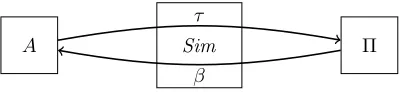
Remember that in the CoSP framework, a protocol is modeled as a tree whose nodes corre-spond to the steps of the protocol execution; security properties are expressed as sets of node traces. Computational soundness means that for any polynomial-time adversaryAthe trace in the computational execution is, except with negligible probability, also a possible node trace in the symbolic execution. The approach for showing this is to construct a so-called simulatorSim. The simulator is a machine that interacts with a symbolic execution of the protocolΠ on the one hand, and with the adversaryA on the other hand; we call this a hybrid execution. (See Figure 3.) The simulator has to satisfy the following two properties:
• Indistinguishability: The node trace in the hybrid execution is computationally indistin-guishable from that in the computational execution with adversaryA.
• Dolev-Yaoness: The simulatorSim never (except for negligible probability) sends terms t to the protocol with S 0twhere S is the list of termsSim received from the protocol so
far.
The existence of such a simulator (for anyA) then guarantees computational soundness: Dolev-Yaoness guarantees that only node traces occur in the hybrid execution that are possible in the symbolic execution, and indistinguishability guarantees that only node traces occur in the computational execution that can occur in the hybrid one.
How to construct a simulator? In [4], the simulatorSimis constructed as follows: Whenever it gets a term from the protocol, it constructs a corresponding bitstring and sends it to the adversary, and when receiving a bitstring from the adversary it parses it and sends the resulting term to the protocol. Constructing bitstrings is done using a function β, parsing bitstrings to terms using a function τ. (See Figure 3.) The simulator picks all random values and keys himself: For each protocol nonce N, he initially picks a bitstring rN. He then translates, e.g.,
β(N) := rN and β(ek(N)) := Aek(rN) and β(enc(ek(N), t, M)) := Aenc(Aek(rN), β(t), rM).
Translating back is also natural: Givenm=rN, we letτ(m) :=N, and ifcis a ciphertext that
can be decrypted asmusingAdk(rN), we setτ(c) :=enc(ek(N), τ(m), M). However, in the last
case, a subtlety occurs: what nonceM should we use as symbolic randomness in τ(c)? Here we distinguish two cases:
Ifcwas earlier produced by the simulator: Thencwas the result of computingβ(t)for some t =enc(ek(N), t′, M)and some nonce M. We then simply setτ(c) :=t and have consistently
mappedcback to the term it came from.
and later β(t) is invoked, we need to make sure that β(t) = c in order for the Sim to work consistently (formally, this is needed in the proof of the indistinguishability of Sim). And we need to make sure that when computingτ(c)again, we use the sameM. This bookkeeping can be avoided using the following trick: We identify the adversary nonces with symbolsNmannotated
with bitstringsm. Thenτ(c) :=enc(ek(N), τ(m), Nc), i.e., we setM :=Nc. This ensures that
differentcget different randomness noncesNc, the samecis always assigned the sameNc, and
β(t)is easy to define: β(enc(ek(N), m, Nc)) :=cbecause we know that enc(ek(N), m, Nc)can
only have been produced byτ(c). To illustrate, here are excerpts of the definitions ofβ and τ (the first matching rule counts):
• τ(c) := enc(ek(M), t, N) if c has earlier been output by β(enc(ek(M), t, N)) for some M ∈N, N ∈NP
• τ(c) :=enc(ek(M), τ(m), Nc)ifc is of type ciphertext andτ(A
ekof(c)) =ek(M)for some
M ∈NP andm:=Adec(Adk(rM), c)6=⊥
• β(enc(ek(N), t, M)) :=Aenc(Aek(rN), β(t), rM)ifM ∈NP • β(enc(ek(M), t, Nm)) :=mifM ∈N
P
Bitstrings m that cannot be suitably parsed are mapped into terms garbage(Nm) and similar
that can then be mapped back byβ using the annotationm.
Showing indistinguishability. Showing indistinguishability essentially boils down to show-ing that the functions β and τ consistently translate terms back and forth. More precisely, we show that β(τ(m)) = m and τ(β(t)) = t. Furthermore, we need to show that in any pro-tocol step where a constructor or destructor F is applied to terms t1, . . . , tn, we have that
β(F(t1, . . . , tn)) = AF(β(t1), . . . , β(tn)). This makes sure that the computational execution
(whereAF is applied) stays in sync with the hybrid execution (whereF is applied and the result
is translated using β). The proofs of these facts are lengthy (involving case distinctions over all constructors and destructors) but do not provide much additional insight; they are very im-portant though because they are responsible for most of the implementation conditions that are needed for the computational soundness result.
Showing Dolev-Yaoness. The proof of Dolev-Yaoness is where most of the actual crypto-graphic assumptions come in. In this sketch, we will slightly deviate from the original proof in [4] for easier comparison with the proof in the present paper. The differences are, however, inessential. Starting from the simulatorSim, we introduce a sequence of simulatorsSim2,Sim4,
Sim7. (We use a numbering with gaps here to be compatible with our full proof in Appendix C.)
In Sim2, we change the function β as follows: When invoked as β(enc(ek(N), t, M)) with
M ∈ NP, instead of computing Aenc(Aek(rN), β(t), rM), β invokes an encryption oracle OencN to produce the ciphertext c. Similarly,β(ek(N))returns the public key provided by the oracle
ON
enc. Also, the function τ is changed to invokeOencN whenever it needs to decrypt a ciphertext
while parsing. Notice that if c was returned by β(t) with t := enc(. . .), then τ(c) just recalls the term t without having to decrypt. Hence ON
enc is never asked to decrypt a ciphertext it
produced. The hybrid executions ofSim andSim2 are then indistinguishable. (Here we use that
the protocol conditions guarantee that no randomness is used in two places.)
InSim4, we replace the encryption oracleONencby a fake encryption oracleONfakethat encrypts
zero-plaintexts instead of the true plaintexts. SinceON
enc is never asked to decrypt a ciphertext
it produced, IND-CCA2 security guarantees that the hybrid executions of Sim2 and Sim4 are
indistinguishable. Since the plaintexts given to ON
fake are never used, we can further change
β(enc(N, t, M))to never even compute the plaintextβ(t).
Finally, in Sim7, we additionally changeβ to use a signing oracle in order to produce
Since the hybrid executions of Sim and Sim7 are indistinguishable, in order to show
Dolev-Yaoness ofSim, it is sufficient to show Dolev-Yaoness ofSim7.
The first step to showing this is to show that wheneverSim7 invokesβ(t), thenS⊢t holds
(whereSare the terms received from the protocol). This follows from the fact thatβ is invoked on terms t0 sent by the protocol (which are then by definition inS), and recursively descends
only into subterms that can be deduced fromt0. In particular, inSim4we made sure that β(t)
is not invoked byβ(enc(ek(N), t, M)); twould not be deducible fromenc(ek(N), t, M).
Next we prove that wheneverS0t, thentcontains a visible subtermtbad withS 0tbad such
that tbad is a protocol nonce, or a ciphertext enc(. . . , N) where N is a protocol nonces, or a
signature, or a few other similar cases. (Visibility is a purely syntactic condition and essentially means thattbad is not protected by an honestly generated encryption.)
Now we can conclude Dolev-Yaoness ofSim7: If it does not hold,Sim7sends a termt=τ(m)
wheremwas sent by the adversaryA. Thenthas a visible subtermtbad. Visibility implies that
the recursive computation ofτ(m)had a subinvocation τ(mbad) = tbad. For each possible case
oftbadwe derive a contradiction. For example, iftbad is a protocol nonce, thenβ(tbad)was never
invoked (sinceS0tbad) and thusmbad =rN was guessed by the simulator without ever accessing
rN which can happen only with negligible probability. Other cases are excluded, e.g., by the
unforgeability of the signature scheme and by the unpredictability of encryptions. Thus, Sim7
is Dolev-Yao, henceSim is indistinguishable and Dolev-Yao. Computational soundness follows.
5
Restrictions in the proof and how to solve them
The proof of computational soundness from [4] only works if protocols obey the following restric-tions:
• The protocol never sends a decryption key (not even within a ciphertext).
• The protocol never decrypts using a decryption key it received from the net.
• The protocol avoids key cycles (i.e., encryptions of decryption keys using their correspond-ing encryptions keys). This latter condition is actually already ensured by never sendcorrespond-ing decryption keys, but we mention it explicitly for completeness.
(Similar restrictions occur for signing keys in [4], however, those restrictions are not due to principal issues, removing them just adds some cases to the proof.)
We will now explain where these restrictions come from and how we avoid them in our proof.
5.1
Sending secret keys
The first restriction that we encounter in the above proof is that we are not allowed to send secret keys. For example, the following simple protocol is not covered by the above proof:
Alice picks a encryption/decryption key pair (ek,dk) and publishes ek. Then Alice sends
enc(ek, N)for some fresh nonceN. And finally Alice sendsdk.
When applying the above proof to this protocol, the faking simulator (more precisely, the function τ in that simulator) will translate enc(ek, N)into an encryption cof 0(as opposed to an encryption of rN). But then, whendk is sent later by the symbolic protocol, the simulator
would have to send the corresponding computational decryption key. But that would allow the adversary to decryptc, and the adversary would notice thatcis a fake ciphertext.
may depend on the messages produced by the simulator). Of course, we might let the simulator guess which keys will be revealed. That, however, will only work when the number of keys is logarithmic in the security parameter. Otherwise the probability of guessing correctly will be negligible.4
(Notice also that the problem is also not solved if the simulator does not produce fake ci-phertexts if in doubt: Then our argument that the bitstringmbad is unguessable would become
invalid.)
To get rid of the restriction, we take a different approach. Instead of forcing the simulator to decide right away whether a given ciphertext should be a fake ciphertext or not, we let him decide this later. More precisely, we make sure that the simulator can produce a ciphertext c without knowing the plaintext, and later may “reprogram” the ciphertextcsuch that it becomes an encryption of a messagemof his choice. (But not after revealing the secret key, of course.)
At the first glance, this seems impossible. Since the ciphertextcmay already have been sent to the adversary,ccannot be changed. It might be possible to have an encryption scheme where for each encryption key, there can be many decryption keys; then the simulator could produce a special decryption key that decryptsc to whatever he wishes. But simple counting arguments show that then the decryption key would need to be as long as the plaintexts of all ciphertexts c produced so far together. This would lead to a highly impractical scheme, and be impossible if we do not impose an a-priori bound on the number of ciphertexts. (See [32].)
However, we can get around this impossibility if we work in the random oracle model. (In the following, we use the word random oracle for any oracle chosen uniformly out of a family of functions; thus also the ideal cipher model or the generic group model fall under this term. The “standard” random oracle [15] which is a uniformly randomly chosen function from the set of all functions we call “random hash oracle” for disambiguation.)
In the random oracle model, we can see the random oracle as a function that is initially undefined, and upon access, the function table is populated as needed (lazy sampling). This enables the following proof technique: When a certain random oracle location has not been queried yet, we may set it to a particular value of our choosing (this is called “programming the random oracle”). In our case this can be used to program a ciphertext c: As long as we make sure that the adversary has not yet queried the random oracle at the locations needed for decryptingc (e.g., because to find these locations he needs to know the secret key), we can still change the value of the oracle at these locations. This in turn may allow us to change the value thatc decrypts to.
Summarizing, we look for an encryption scheme with the following property: There is a strategy for producing (fake) keys and ciphertexts, and for reprogramming the random oracle (we will call this strategy the “ciphertext simulator”), such that the following two things are indistinguishable: (a) (Normally) encrypting a valuem, sending the resulting ciphertextc, and then sending the decryption key. (b) Producing a fake ciphertextc. Choosingm. And sending the decryption key.
Such a scheme could then be used in our computational soundness proof: Sim2would encrypt
messagesm normally. Sim4 would produce fake ciphertexts cinstead, and only when revealing
the decryption key, reprogram the ciphertextscto contain the right messagesm. Then, we would consider an additional simulatorSim5that does not even computemuntil it is needed. This will
then allow us to argue that the bitstringmbad corresponding to a “bad” subtermtbad cannot be
guessed because the information needed for guessing this bitstring was never computed/accessed. A security definition for encryption schemes with the required properties has been presented in [35] (called PROG-KDM), together with a natural construction satisfying the definition. In
4
the following, we present and explain their definition and how it allows us to get computational soundness for protocols sending secret keys.
Formally defining PROG-KDM security turns out to be more complex than one might expect. We cannot just state that the ciphertext simulator is indistinguishable from an honest encryption oracle. The ciphertext simulator has a completely different interface from the honest encryption oracle. In particular, it expects the plaintext when being asked for the secret key, while the encryption oracle would expect these upon encryption. To cope with this problem, we define two “wrappers”, the real and the fake challenger. The real challenger essentially gives us access to the encryption algorithm while the fake challenger, although it expects the plaintexts during encryption (to be indistinguishable from the real challenger), uses the plaintexts only when the decryption key is to be produced. These two challengers should then be indistinguishable. (The challengers additionally make sure that the adversary does not perform any forbidden queries such as submitting a ciphertext for decryption that was produced by the challenger.)
We first define the real challenger. The real challenger needs to allows us to query the en-cryption and deen-cryption keys, to perform enen-cryptions and deen-cryptions, and to give us access to the underlying random oracle. However, if we only have these queries, situations like the following would lead to problems: The adversary wishes to get Enc(ek1,Enc(ek2, m)). We do
not wish the adversary to have to request Enc(ek2, m) first and then resubmit it for the
sec-ond encryption, because this would reveal Enc(ek2, m), and we might later wish to argue that
Enc(ek2, m)stays secret. To be able to model such setting, we need to allow the adversary to
evaluate sequences of queries without revealing their outcome. For this, we introduce queries such as R:= encch(N, R1). This means: Take the value from registerR1, encrypt it with the
key with index N ∈ {0,1}∗, and store the result in register R. Also, we need a query to apply
arbitrary functions to registers: R := evalch(C, R1, . . . , Rn) applies the circuit C to registers
R1, . . . , Rn. (This in particular allows us to load a fixed value into a register by using a circuit
with zero inputs (n= 0). Finally, we have a queryrevealch(R1)that outputs the content of a
register.
Formally, the definition of the real challenger is the following:
Definition 2 (Real challenger) Fix an oracleOand an encryption scheme(K, E, D)relative
to that oracle. The real challenger RC is an interactive machine defined as follows. RC has
access to the oracle O. RC maintains a family (ekN,dkN)N∈{0,1}∗ of key pairs (initialized as (ekN,dkN)←K(1η)upon first use), a family(regN)N∈{0,1}∗ of registers (initially allregN =⊥),
and a family of sets cipherN (initially empty). RC responds to the following queries (when no
answer is specified, the empty word is returned):
• R:=getekch(N): RCsets regR:=ekN. • R:=getdkch(N): RCsets regR:=dkN.
• R :=evalch(C, R1, . . . , Rn) where C is a Boolean circuit:5 Compute m :=C(regR1, . . . ,
regRn)and set regR:=m.
• R:=encch(N, R1): Computec←EO(ekN,regR1), appendctocipherN, and setregR:=c.
• oraclech(x): ReturnO(x).
• decch(N, c): Ifc∈cipherN, returnforbiddenwhereforbiddenis a special symbol (differ-ent from any bitstring and from a failed decryption⊥). Otherwise, invokem←DO(dk
N, c)
and return m.
• revealch(R1): ReturnregR1.
Here N and c range over bitstrings, R ranges over bitstrings with regR =⊥ and the Ri range
over bitstringsR withregRi 6=⊥.
5
Notice that the fact that we can do “hidden evaluations” of complex expressions, also covers KDM security (security under key-dependent messages): We can make a register contain the computation of, e.g.,Enc(ek,dk)wheredk is the decryption key corresponding toek.
We now proceed to define the fake challenger. The fake challenger responds to the same queries, but computes the plaintexts as late as possible. In order to do this, upon a query such as R:=encch(N, R1), the fake challenger just stores the symbolic expression “encch(N, R1)” in
registerR(instead of an actual ciphertext). Only when the content of a register is to be revealed, the bitstrings are recursively computed (using the functionFCRetrievebelow) by querying the ciphertext simulator. Thus, before defining the fake challenger, we first have to define formally what a ciphertext simulator is:
Definition 3 (Ciphertext simulator) A ciphertext simulatorCS for an oracle O is an in-teractive machine that responds to the following queries: fakeenccs(R, l),deccs(c),enccs(R, m), getekcs(), getdkcs(), and programcs(R, m). Any query is answered with a bitstring (except deccs(c)which may also return⊥). A ciphertext simulator runs in polynomial-time in the total
length of the queries. A ciphertext simulator is furthermore given access to an oracle O. The
ciphertext simulator is also allowed to program O (that is, it may perform assignments of the
formO(x) :=y). Furthermore, the ciphertext simulator has access to the list of all queries made toO so far.6
The interesting queries here are fakeenccs(R, l)and programcs(R, m). A fakeenccs(R, l)-query is expected to return a fake ciphertext for an unspecified plaintext of lengthl (associated with a handleR). And a subsequentprogramcs(R, m)-query with|m|=lis supposed to program the random oracle such that decrypting c will return m. The ciphertext simulator expects to get all necessary programcs(R, m)-queries directly after a getdkcs()-query revealing the key. (Formally, we do not impose this rule, but the PROG-KDM does not guarantee anything if the ciphertext simulator is not queried in the same way as does the fake challenger below.) We stress that we allow to first ask for the key and then to program. This is needed to handle key dependencies, e.g., if we wish to program the plaintext to be the decryption key. The definition of the fake challenger will make sure that although we reveal the decryption key before programming, we do not use its value for anything but the programming until the programming is done.
Note that we do not fix any concrete behavior of the ciphertext simulator since our definition will just require the existence of some ciphertext simulator.
We can now define the real challenger together with its recursive retrieval function FCRetrieve:
Definition 4 (Fake challenger) Fix an oracle O, a length-regular encryption scheme (K, E, D) relative to that oracle, and a ciphertext simulator CS for O. The fake challenger
FCfor CS is an interactive machine defined as follows. FC maintains the following state:
• A family of instances (CSN)N∈{0,1}∗ of CS (initialized upon first use). Each ciphertext simulator is given (read-write) oracle access toO.
• A family (regR)R∈{0,1}∗ of registers (initially all regR = ⊥). Registers regN are either undefined(regN =⊥), or bitstrings, or queries (written “getekch(N)” or “getdkch(N)” or “evalch(C, R1, . . . , Rn)” etc.).
• A family (cipherN)N∈{0,1}∗ of sets of bitstrings. (Initially all empty.)
FCanswers to the same queries as the real challenger, but implements them differently:
6
• R := getekch(N) or R := getdkch(N) or R := evalch(C, R1, . . . , Rn) or R :=
encch(N, R1): Set regR := “getekch(N)” or regR := “getdkch(N)” or regR :=
“evalch(C, R1, . . . , Rn)” orregR:=“encch(N, R1)”, respectively.
• decch(N, c): If c∈cipherN, return forbidden. Otherwise, query deccs(c) fromCSN and
return its response.
• oraclech(x): ReturnO(x).
• revealch(R1): Compute m ← FCRetrieve(R1). (FCRetrieve is defined below in
Definition 5.) Returnm.
Definition 5 (Retrieve function ofFC) The retrieve function FCRetrieve has access to
the registers regR and the ciphertext simulators CSN of FC. It additionally stores a family
(plainN)N∈{0,1}∗ of lists between invocations (all plainN are initially empty lists). FCRetrieve takes an argumentR (withregR6=⊥) and is recursively defined as follows:
• If regR is a bitstring, returnregR.
• If regR = “getekch(N)”: Query CSN with getekcs(). Store the answer in regR.
Re-turnregR.
• If regR = “evalch(C, R1, . . . , Rn)”: Compute mi := FCRetrieve(Ri) for i = 1, . . . , n.
Compute m′:=C(m
1, . . . , mn). SetregR:=m′. Returnm′.
• If regR = “encch(N, R1)” and there was no getdkcs()-query to CSN yet: Compute l :=
FCLen(R1). (FCLenis defined in Definition 7 below.) Query CSN with fakeenccs(R, l).
Denote the answer withc. Set regR:=c. Append(R7→R1)to the list plainN. Append c
tocipherN. Return c.
• If regR = “encch(N, R1)” and there was a getdkcs()-query to CSN: Compute m :=
FCRetrieve(R1). Query CSN withenccs(R, m). Denote the answer withc. SetregR:=c.
Append (R7→R1)toplainN. Append c tocipherN. Return c.
• If regR =“getdkch(N)”: Query CSN with getdkcs(). Store the answer in regR. If this
was the first getdkcs(N)-query for that value of N, do the following for each(R′7→R′
1)∈
plainN (in the order they occur in the list):
– Invoke m:=FCRetrieve(R′
1).
– Send the queryprogramcs(R′, m) toCS N.
Finally, return regR.
The retrieve function uses the auxiliary functionFCLenthat computes what length a bitstring associated with a register should have. This function only makes sense if we require the encryption scheme to be length regular, i.e., the length of the output of the encryption scheme depends only on the lengths of its inputs.
Definition 6 (Length regular encryption scheme) An encryption scheme (K, E, D) is length-regular if there are functions ℓek, ℓdk, ℓc such that for all η ∈ N and all m ∈ {0,1}
∗
and for (ek,dk) ← K(1η) and c ← E(ek, m) we have |ek| = ℓ
ek(η) and |dk| = ℓdk(η) and |c|=ℓc(η,|m|)with probability1.
Definition 7 (Length function ofFC) The length functionFCLenhas (read-only) access to the registersregR ofFC. FCLentakes an argumentR(with regR6=⊥) and is recursively defined as follows:
• If regR is a bitstring, return|regR|.
• If regR=“evalch(C, R1, . . . , Rn)”: Return the length of the output of the circuitC. (Note
that the length of the output of a Boolean circuit is independent of its arguments.)
• If regR =“getekch(N)” or regR =“getdkcs(N)”: Let ℓek and ℓdk be as in Definition 6.
• If regR=“encch(N, R1)”: Letℓc be as in Definition 6. Returnℓc(η,FCLen(R1)).
We are now finally ready to define PROG-KDM security:
Definition 8 (PROG-KDM security) A length-regular encryption scheme (K, E, D)
(rela-tive to an oracle O) is PROG-KDM secure iff there exists a ciphertext simulator CS such that
for all polynomial-time oracle machines A,7
Pr[ARC(1η) = 1]−Pr[AFC(1η) = 1] is negligible
inη. Here RC is the real challenger for(K, E, D)and Oand FCis the fake challenger for CS
andO. Notice that Adoes not directly queryO.
If we assume that the computational implementation of ek,dk,enc,dec is a PROG-KDM secure encryption scheme, we can make the proof sketched in Section 4 go through even if the protocol may reveal its decryption keys: The simulatorSim2uses the real challenger to produce
the output ofβ. He does this by computing all ofβ(t) inside the real challenger (using queries such as R := evalch(C, . . .)). Then Sim4 uses the fake challenger instead. By PROG-KDM
security,Sim2 and Sim4 are indistinguishable. ButSim4 still provides all values needed in the
computation early (because the real challenger needs them early). But we can then defineSim5
which does not use the real challenger any more, but directly accesses the ciphertext simulator (in the same way as the fake challenger would). Sim5is then indistinguishable fromSim2, but,
since the fake challenger performed all computations on when needed,Sim2now also performs all
computations only when actually needed. This has the effect that in the end, we can show that the bitstringmbad represents a contradiction because it guesses values that were never accessed.
[35] shows that PROG-KDM security can be achieved using a standard construction, namely hybrid encryption using any CCA2-secure key encapsulation mechanism, a block cipher (modeled as an ideal cipher) in CBC-mode, and encrypt-then-MAC with an arbitrary one-time MAC.
We have now removed the restriction that a protocol may not send its decryption keys. (And in one go, we also enabled key-cycles because PROG-KDM covers that case, too.) It remains to remove the restriction that we cannot use decryption keys received from the adversary,
The need for PROG-KDM security. The question that arises in this context is whether we actually need such a strong notion as PROG-KDM in this context. Obviously, IND-CCA2 security alone is not sufficient, there are schemes that are IND-CCA2 secure and break down in the presence of key-cycles.8
But what about, e.g., KDM-CCA2 [18] that covers key dependent messages and active attacks?
To illustrate the necessity of a notion stronger than KDM-CCA2, consider the following example: Assume a protocol in which we want to share a secretswith nparties in such a way that n/2 parties are needed to recover the secret s. We do this by distributing n decryption keys to thenparties, and by producing a number of nested encryptions such thatn/2−1of the decryption keys are not sufficient to recovers. More precisely, we use the following protocol:9
• The dealerD chooses a noncesandnkey pairs(eki,dki).
• D chooses additional key pairs(eki,j,dki,j)fori= 0, . . . , n/2andj= 0, . . . , n.
7
Here we considerApolynomial-time if it runs a polynomial number of steps inη, and the number of steps performed by RC or FC is also polynomially-bounded. This additional requirement is necessary since for an encryption scheme with multiplicative overhead (say, length-doubling), a sequence of queriesRi:=encch(N, Ri−1)
of polynomial length will lead to the computation of an exponential-length ciphertext. 8
Take, e.g., an IND-CCA2 secure encryption scheme(KeyGen,Enc,Dec)and modify it such thatEnc(ek,dk) := dk ifekanddk are a valid key pair, and letDec(dk,dk) :=dk. It is easy to see that the modified scheme is still
IND-CCA2 secure, but the key cycleEnc(ek,dk)reveals the decryption key.
9
• D computes ei,j ← Enc(ekj,(Enc(eki−1,0,dki,j), . . . ,Enc(eki−1,j−1,dki,j))) for all i =
1, . . . , n/2,j= 1, . . . , n, and publishes allei,j,dk0,j. (dki,j can then be computed ifdkj is
known and at leastikeys fromdk1, . . . ,dkj are known.)
• D computes ej←Enc(ekn/2,j, s)forj= 1, . . . , n, and publishes allej.
(scan then be computed ifdkn/2,j is known for somej. Thus,s can be computed ifn/2
of thedkj are known.)
• The adversary may choosen/2−1indicesj ∈ {1, . . . , n}, andD sendsdkj for each of the
selectedj.
• The adversary wins if he guesses the secret nonce s.
It is easy to see that givenn/2keysdkj, one can recovers. But in a reasonable symbolic model
(e.g., the one from Section 2), the adversary cannot win.10
So a computational soundness result without restrictions on sending and encrypting decryption keys would imply that the protocol is secure in the computational setting. Hence any security notion that allows us to derive the computational soundness result must also be sufficient to show that the protocol is secure in a computational setting. (Notice that situations similar to the one in this protocol could occur, e.g., if we enforce some complex authorization policy by a suitable set of nested encryptions.)
But it seems that IND-CCA2 or KDM-CCA2 security does not allow us to prove the security of this protocol. In a proof using one of these notions, one typically first defines a gameG1which
models an execution of the protocol. Then one defines a modified gameG2in which some of the
ciphertexts are replaced by encryptions of0. Then one uses IND-CCA2 or KDM-CCA2 to show that G1 and G2 are indistinguishable. Finally, one uses that in gameG2, the secret sis never
accessed, because we have replaced all occurrences ofsby0. If we would know in advance which keysdkj the adversary requests, this proof would indeed go through. However, the selection of
thedkj by the adversary can be done adaptively, even depending on the values of theei,j. (E.g.,
the adversary could produce a hash of all protocol messages and use the bits in the hash value to decide which keys to reveal.) Hence, when encrypting, we do not know yet which ciphertexts will be opened. Since there are an exponential number of possibilities, we cannot guess. There seems to be no other way of choosing which ciphertexts should be0-encryptions. Because of this, IND-CCA2 and KDM-CCA2 seem unapplicable for this protocol.11
Also notions such as IND-SO-CPA and SIM-SO-CPA which are designed for situations with selective opening of ciphertexts (cf. [17]) do not seem to match this protocol. Possibly extensions of these notions might cover this case, but it is not clear what these extensions should look like (in particular if we extend the protocol such that some of theei,j may depend on otherei,j, e.g.,
by including the latter in some of the plaintexts of the former).
So, it seems that the only known security notion for encryption schemes that can show the security of the above protocol is PROG-KDM. Thus it is not surprising that we need to use PROG-KDM security in our proof.
5.2
Receiving decryption keys
The second restriction we face in the proof sketched in Section 4 is that a protocol is not allowed to receive decryption keys. This is due to the way the simulator Sim parses a bitstring into a term (using the function τ): When receiving a ciphertext c for which the decryption key d is
10
Proof sketch: Fix a setI ⊆ {dk1, . . . ,dkn}. Let S := {ej, ei,j,dk0,j} ∪I. By induction over i, we have that S ⊢ dki,j implies |I∩ {dk1, . . . ,dkj}| ≥ i. If S ⊢ s there is a j with S ⊢ dkn/2,j, and hence |I| ≥ |I∩ {dk1, . . . ,dkj}| ≥n/2.
SoS⊢sonly if|I| ≥n/2, i.e., the adversary can only recoversby requesting at leastn/2keys. 11
known, Sim computes τ(c) := enc(ek(Ne), τ(m), Nc) where m is the plaintext of c and e the
corresponding encryption key. Ifdis not known (becausecwas produced by the adversary with respect to a key that the protocol did not pick),Sim computesτ(c) :=garbageEnc(ek(Ne), Nc).
Notice that in the latter case we are cheating: even thoughc may be a valid ciphertext (just with respect to an encryption key whose decryption key we do not know), we declare it to be an invalid ciphertext. But the fact that we will never use the decryption key saves us: we will never be caught in a lie. The situation is different if we receive decryption keys from the adversary. Then the adversary might first send c which we parse togarbageEnc(ek(Ne), Nc). Then later
he sends us the corresponding decryption key d which we parse to dk(Ne). But then in the
computational execution, decryptingc usingdworks, while in the hybrid execution, decrypting
garbageEnc(ek(Ne), Nc)necessarily fails.
So if we allow the protocol to receive decryption keys, we need to change the simulator so that it parses τ(c) := enc(ek(Ne), t, Nc) when receiving a valid ciphertext c, even if the he cannot
decryptc. But then, how should the simulator compute the termt? And for that matter, how should the simulator know thatc is valid? (It might be invalid, and then should be parsed as
garbageEnc(ek(Ne), Nc).)
A solution for this problem has been proposed in the first revision of [5] (not contained in later versions!) but has not been applied there. The idea is to allow the simulator to partially parse terms (lazy simulator). That is, we allow the simulator to output terms that contain variables, and to only after the hybrid execution we ask the simulator to decide what terms these variables stand for.
In our case, we change the simulator such that when parsing a ciphertext c (corresponding to a key not picked by the simulator), the simulator just outputsτ(c) :=xc. (Here we assume
an infinite set of variablesxindexed by ciphertexts.) And in the end, when the hybrid execution finished, the simulator outputs a “final substitution” ϕthat mapsxc to eitherenc(Ne, τ(m), Nc)
if by the end of the execution the simulator has learned the corresponding decryption key and can compute the plaintextm, or togarbageEnc(Ne, Nc)if the decryption key was not received
or decryption fails.
Unfortunately, to make this go through, the simulator gets an additional tasks. In the orig-inal hybrid execution, terms sent to the protocol do not contain variables, and whenever we reach a computation node in the protocol, we can apply the constructor or destructor to the arguments of that node and compute the resulting new term. This is not possible any more. For example, what would be the output adec-node with plaintext argument xc? Thus, the hybrid
execution will in this case just maintain a “destructor term”, in which the destructors are not evaluated. (E.g., a node might then store the term dec(dk(Ne), xc).) That leaves the
follow-ing problem: A computation node branches to its yes- or no-successor dependfollow-ing on whether constructor/destructor application succeeds or fails. But in the hybrid execution, the construc-tor/destructor application is not evaluated, we do not know whether it succeeds or fails. This leads to an additional requirement for the simulator: After each computation node in the hybrid execution, the simulator is asked a “question”. This question consists of the destructor term that is computed at the current node, and the simulator has to answer yes or no, indicating whether the application should be considered to have succeeded or failed. (And then the yes- or no-successor of the current node is taken accordingly.)
In our case, to answer these questions, the simulator will just reduce the term as much as possible (by evaluating destructors), replace variablesxc byenc- orgarbageEnc-terms wherever
we already know the necessary keys, and make the “right” choices when destructors are applied to xc. If all destructors succeed, the simulator answers yes. A large part of the full proof is
dedicated to showing that this can be done in a consistent fashion.
exists, then we have computational soundness:
• Indistinguishability: The hybrid and the computational execution are indistinguishable (in terms of the nodes passed through in execution).
• DY-ness: Letϕbe the final substitution (output by the simulator at the end of the execu-tion). Then in any step of the execution it holds thatSϕ⊢tϕwheret is the term sent by the simulator to the protocol, andS is the set of the terms received by the protocol (note that althoughS, tmay be destructor terms,Sϕandtϕdo not contain variables any more and thus reduce to regular terms without destructors).
• Consistency: For any question Q that was asked from the simulator, we have that the simulator answered yes iff evaluating Qϕ (which contains destructors but no variables) does not return⊥.
• Abort-freeness: The simulator does not abort.
In the proof we construct such a simulator and show all the properties above. (Indistin-guishability is relatively similar to the case without lazy parsing, but needs some additional care because the invariants need to be formulated with respect to unevaluated destructor terms. DY-ness follows the same lines but becomes considerably more complicated.)
The need for malicious-key extractability. In the proof of DY-ness, it does, however, turn out that lazy sampling does not fully solve the problem of receiving decryption keys. In fact, PROG-KDM security alone is not sufficient to guarantee computational soundness in this case (and neither is IND-CCA2). We illustrate the problem by an example protocol:
Alice picks a keyek(N), a nonceM and sends a ciphertextc:=enc(ek(N), M, R)over the network (i.e., to the adversary). Then Alice expects a ciphertextc∗. Then Alice sends dk(N).
Then Alice expects a secret keysk∗. Finally, Alice tests whetherdec(sk∗, c∗) = (M, M).
It is easy to see that in the symbolic model, this test will always fail. But in the computa-tional setting, it is possible to construct encryption schemes with respect to which the adver-sary can produce c∗,sk∗ such that this test succeeds: Start with a secure encryption scheme
(KeyGen′,Enc′,Dec′). Then letKeyGen:=KeyGen′, andEnc:=Enc′, but modifyDec′ as follows: Given a secret key of the formsk = (special, m), and a ciphertext c = (special), Dec(sk, c) outputsm. On other inputs,Decbehaves likeDec′. Now the adversary can break the above pro-tocol by sendingsk∗:= (special,(M, M)). Notice that if(KeyGen′,Enc′,Dec′)was PROG-KDM (or IND-CCA2), then(KeyGen,Enc,Dec)is still PROG-KDM (or IND-CCA2): Both definitions say nothing about the behavior of the encryption scheme for dishonestly generated keys.
Of course, the above encryption scheme can easily be excluded by adding simple conditions on encryption schemes: Encryption keys should uniquely determine decryption keys and vice versa, any valid decryption key should successfully decrypt any ciphertext that was honestly generated using the corresponding encryption key, ciphertexts should determine their encryption key.
But even then a more complex construction works: Let Cbe some class of circuits such that for eachC ∈ C, there exists at most one x, y such that C(x, y) = 1. Let KeyGen :=KeyGen′. Modify Enc′ as follows: Upon input ek = (special,ek′, C), Enc(ek, m) runs Enc′(ek′, m). For other inputs, Enc behaves like Enc′. And Dec′ is modified as follows: Upon input
dk = (special,dk′, C, x, y) and c = (special,ek′, C) with C(x, y) = 1, Dec(dk, c) returnsx. Upondk = (special,dk′, C, x, y)withC(x, y) = 1and differentc,Dec(dk, c)returnsDec′(dk′, c). And upon all other inputs,Dec′behaves likeDec. Again, this construction does not loose PROG-KDM or IND-CCA2 security.
The adversary can break our toy protocol by choosing C as the class of circuits Cc defined
by Cc((M, M),sk) = 1 if Dec(sk, c) = M and Cc(x, y) = 0 in all other cases. Then after
gettingc, the adversary chooses(ek′,dk′)←KeyGen′,c∗:= (special,ek′, C
c)and after receiving
Notice that this example can be generalized to many different protocols where some m is uniquely determined by the messages sent by Alice, and the adversary learns m only after producing c but before sending the corresponding decryption key: Simply choose a different classC of circuits such thatC(m, x) = 1is a proof thatmis the message encoded by Alice.
Clearly, the above example shows that PROG-KDM alone does not imply computational soundness. To understand what condition we need, let us first understand where the mismatch between the symbolic and the computational model is. In the symbolic model, the adversary can only produce an encryption of some message if he knows the underlying plaintext. In the computational model, however, even if we require unique decryption keys, it is sufficient that the underlying plaintext is fixed, it is not necessary that the adversary actually knows it.
Thus, to get computational soundness, we need to ensure that the adversary actually knows the plaintext of any message he produces. A common way for modeling knowledge is to require that we can extract the plaintext from the adversary. Since we work in the random oracle model anyway (as PROG-KDM only makes sense there), we use the following random-oracle based definition:12
Definition 9 We call an encryption scheme(KeyGen,Enc,Dec)malicious-key extractableif for
any polynomial-time (A1, A2), there exists a polynomial-time algorithm MKE (the
malicious-key-extractorsuch that the following probability is negligible:
Pr
DecO(d, c)6=⊥ ∧DecO(d, c)∈/M : (z, c)←AO1(1η),
M ←MKEO(1η, c,queries), d←AO2(1η, z)
HereOis a random oracle. Andqueries is the list of all random oracle queries performed byA1.
AndM is a list of messages (of polynomial length).
This definition guarantees that when the adversary produces a decryption keydthat decrypts cto some messagem, then he must already have knownmwhile producing c.
Notice that malicious-key extractability is easy to achieve: Given a PROG-KDM secure encryption scheme, we modify it so that instead of encryptingm, we always encrypt(m, H(m)) where H is a random hash oracle (and decryption checks the correctness of that hash value). The resulting scheme does not loose PROG-KDM security and is malicious-key extractable.
In Definition 9, we only require that the extractor can output a list of plaintexts, one of which should be the correct one. We could strengthen the requirement and require the extractor to output only a single plaintext. This definition would considerably simplify our proof (essentially, we could get rid of lazy sampling since we can decrypt all adversary generated ciphertexts). However, that stronger definition would, for example, not be satisfied by the scheme that simply encrypts (m, H(m)). Since we strive for minimal assumptions, we opt for the weaker definition and the more complex proof instead.
How is malicious-key extractability used in the proof of computational soundness? We extend the simulator to call the extractor on all ciphertexts he sees (Sim3). In the original proof, a
simulator that is not DY implied that a term t withSϕ0 tϕis produced by τ in some stepi.
This means that tϕ has a “bad” subterm tbad. This, however, does not immediately lead to a
contradiction, becausetbad could be a subterm not oft, but ofϕ(xc)for some variable xc int.
Since ϕ(xc) is produced at some later point, we cannot arrive at a contradiction (because the
bitstringmbad which is supposed to be unguessable in stepi, might already have been sent in
stepj). But if the simulator runs the malicious-key extractor in stepi, we can conclude that the
12
bitstringmbad corresponding to the subterm tbad ofϕ(xc)has already been seen during step i.
This then leads to a contradiction as before.
6
The main result
We are now ready to state the main result of this paper. First, we state the conditions a symbolic protocol should satisfy.
Definition 10 A CoSP protocol is randomness-safe if it satisfies the following conditions: 1. The argument of everyek-, dk-, vk-, and sk-computation node and the third argument of
every E- and sig-computation node is an N-computation node with N ∈NP. (Here and
in the following, we call the nodes referenced by a protocol node its arguments.) We call
these N-computation nodes randomness nodes. Any two randomness nodes on the same
path are annotated with different nonces.
2. Every computation node that is the argument of an ek-computation node or of a dk
-computation node on some path p occurs only as argument to ek- and dk-computation
nodes on that path p.
3. Every computation node that is the argument of a vk-computation node or of an sk
-computation node on some path p occurs only as argument to vk- and sk-computation
nodes on that path p.
4. Every computation node that is the third argument of anE-computation node or of a sig
-computation node on some path poccurs exactly once as an argument in that path p.
5. There are no computation nodes with the constructorsgarbage,garbageEnc,garbageSig, or N ∈NE.
In contrast to [4], we do not put any restrictions on the use of keys any more. The requirements above translate to simple syntactic restrictions on the protocols that require us to use each randomness nonce only once. For example, in the applied π-calculus, this would mean that whenever we create a termenc(e, p, r), we require that ris under a restrictionνrand used only here.
In addition to randomness-safe protocols, we put a number of conditions on the computa-tional implementation. The cryptographically relevant conditions are PROG-KDM security and malicious-key extractability of the encryption scheme, and strong existential unforgeability of the signature scheme. In addition, we have a large number of additional conditions of syntactic nature, e.g., that the pair-constructor works as expected, that from a ciphertext one can effi-ciently compute the corresponding encryption key, or that an encryption key uniquely determines its decryption key. These requirements are either natural or can be easily achieved by suitable tagging (e.g., by tagging ciphertexts with their encryption keys). The full list of implementation conditions are given in Appendix B.
Theorem 1 The implementationA(satisfying the implementation conditions from Appendix B) is a computationally sound implementation of the symbolic model from Section 2 for the class of randomness-safe protocols. (Note that our definition of computational soundness covers trace properties, not equivalence properties.)
7
Proof sketch
We now present a proof sketch of Theorem 1. We have highlighted the changes with respect of the proof sketch to the original CoSP result (Section 4) in blue. There is a certain amount of redundancy with Section 4 since we tried to make this section self-contained. The full proof is presented in Appendix C.
Remember that in the CoSP framework, a protocol is modeled as a tree whose nodes corre-spond to the steps of the protocol execution; security properties are expressed as sets of node traces. Computational soundness means that for any polynomial-time adversaryA the trace in the computational execution is, except with negligible probability, also a possible node trace in the symbolic execution. The approach for showing this is to construct a so-called simulator
Sim. The simulator is a machine that interacts with a symbolic execution of the protocol Π on the one hand, and with the adversaryA on the other hand; we call this a hybrid execution. (See Figure 3.) In contrast to the situation described in Section 4, we allow the simulator to produce incomplete terms. These may contain variablesxm, standing for subterms the simulator has not figured out yet. Whenever the protocol makes a decision that depends on the as yet undetermined values of these variables (e.g., when branching depends on the applicability of a destructor which in turn depends on the value to be assigned toxm), the simulator is asked what the correct decision would be (i.e., the simulator is asked whether the destructor application would succeed).
The simulator has to satisfy the following three properties:
• Indistinguishability: The node trace in the hybrid execution is computationally indistin-guishable from that in the computational execution with adversaryA.
• Dolev-Yaoness: The simulatorSim never (except for negligible probability) sends terms t to the protocol with S 0twhere S is the list of termsSim received from the protocol so
far.
• Consistency: The simulator outputs an assignment ϕto all variablesxc in the end of the execution. This assignment must guarantee that any decision the simulator made for the protocol was correct. I.e., when the simulator said a destructor application D(containing variablesxc) succeeds, thenDϕmust actually succeed. And vice versa.
• Abort-freeness: The simulator does not abort. Since our simulator will not have an abort instruction, this property will be automatically fulfilled.
The existence of such a simulator (for anyA) then guarantees computational soundness: Dolev-Yaonesstogether with consistencyguarantees that only node traces occur in the hybrid execution that are possible in the symbolic execution, and indistinguishability guarantees that only node traces occur in the computational execution that can occur in the hybrid one.
How to construct the simulator? In [4], the simulatorSim is constructed as follows: When-ever it gets a term from the protocol, it constructs a corresponding bitstring and sends it to the adversary, and when receiving a bitstring from the adversary it parses it and sends the result-ing term to the protocol. Constructresult-ing bitstrresult-ings is done usresult-ing a function β, parsing bitstrings to terms using a function τ. (See Figure 3.) The simulator picks all random values and keys himself: For each protocol nonce N, he initially picks a bitstring rN. He then translates, e.g.,
β(N) := rN and β(ek(N)) := Aek(rN) and β(enc(ek(N), t, M)) := Aenc(Aek(rN), β(t), rM).
Translating back is also natural: Givenm=rN, we letτ(m) :=N, and ifcis a ciphertext that