Cardiology in the Young
http://journals.cambridge.org/CTY
Additional services for
Cardiology in the Young:
Email alerts: Click here Subscriptions: Click here Commercial reprints: Click here Terms of use : Click here
Francis Fontan
Robert H. Anderson
Cardiology in the Young / Volume 9 / Issue 06 / November 1999, pp 592 600 DOI: 10.1017/S1047951100005631, Published online: 19 August 2008
Link to this article: http://journals.cambridge.org/abstract_S1047951100005631
How to cite this article:
Robert H. Anderson (1999). Francis Fontan. Cardiology in the Young,9, pp 592600 doi:10.1017/S1047951100005631
Request Permissions : Click here
ISSN 1047-9511
The Paediatric Cardiology Hall of Fame
Francis Fontan
Robert H. Anderson
Department of Cardiology, Institute of Child Health, University College, London, UK
T
here are many hallmarks of fame. In the medical literature, perhaps the most obvious, and certainly the most readily manifest, is to become eponymous. Thus, we constantly remember Wilhelm Ebstein, and Arthur Louis Etienne Fallot, when we describe patients with the malformations named in their honour. But these accolades did not accrue until many years until after their deaths. Indeed, in the case of Ebstein, his now-famous description was but a minor case report amongst his overall bibliography of over 200 publications. It took almost a century before his name became widely used in the clinical context. Nowadays, however, one man's name is used even more frequently than those of Ebstein and Fallot. And he is very much alive. He is, of course, Francis Fontan (Fig. 1). Simply for the achievements which attracted the eponymous success, Francis would have deserved his induction into the Paediatric Cardiology Hall of Fame. But his activities in designing and pioneering his operation,1'2 in following its progress,3"5 establishing the criterions for its use,6 and establishing its optimal horizons,7 are just a small tranch of his overall achievements. These all round accomplishments extend far beyond the field of Paediatric Cardiology. Francis was, for 23 years, the Professor of Cardiovascular Surgery at the University of Bordeaux. Over this period, and during the apprenticeship leading to his appointment, his interests spanned all aspects of surgery on the heart and great vessels. His achieve-ments in all these fields are impressive. For himself, however, he rates his greatest achievement as his part in the establishment of the European Association of Cardiothoracic Surgery, an organi-sation which is still growing in importance, and ofCorrespondence to: Professor R H Anderson, Cardiology Unit, Institute of Child Health, 30 Guildford Street, London WC1N 2EH, UK. Tel: (020) 7905 2322; Fax: (020) 7905 2324
Manuscript accepted 16 August 1999
which he was the first President.8 It is for the oper-ation, nonetheless, and for its modifications and ramifications, that he is, and will be, remembered amongst those involved with Cardiology in the Young. It was through our mutual interest in tricuspid atresia that I was fortunate enough, in 1974, to meet Francis. Since then, I have been honoured to count him as one of my mentors, and privileged to become one of his friends. As part of this friendship, I have enjoyed and shared his interests and expertise in wine, not unexpected for one based in Bordeaux, and similarly in golf. In this tribute, I will try and give some insight to all these multiple achievements.
Studentship and Apprenticeship
Francis was born in 1929, in the French burgh of Nay, in the foothills of the Pyrenees mountains. He
Figure 1.
Vol. 9, No. 6 The Paediatrk Cardiology Hall of Fame: Francis Fontan 593
was born into reflected fame, since his father Victor was a noted professional cyclist. Victor Fontan achieved his greatest accolades as "King of the Mountains" in the Tour de France. On one occasion, he was leading the Tour itself by 15 minutes, but then suffered an accident. In those years, when support from the team and its mechanics was not as it is today, he was unable to recover. He was also a builder of bicycles, and a businessman, becoming involved in motor transport, so early childhood for Francis was comfortable. But then, when Francis was 10, France itself was engulfed in the conflict which was to become global. By this time, he had commenced as Boarder at the local Lycee in Nay. Initially, the Southern part of France was unoccupied by the German army. When it became occupied, he was able to continue his schooling, but no longer as a boarder, since his lodgings had been comman-deered by the occupying troops. Despite the tradition of his father, he was not encouraged to cycle for sport, but became proficient at Rugby. His schooling was satisfactory despite the war, since soon after the Annee de la Victoire, he was accepted at the age of 17 to enter the Faculte des Medicins at the University of Bordeaux. He spent six years as a medical student in Bordeaux, before continuing in the service of the University Hospitals as an Interne des Hopitaux. Only 13 of one hundred students were accorded this honour. His internship occupied him for four years. He then entered the compe-tition amongst interns to undertake a fifth year, and was sufficiently successful to be awarded the Gold Medal. Already he had selected his department for further studies and, in his third year of Internship, he entered the newly growing Department of Cardiac Surgery, working under his patron Georges Dubourg. Extracorporeal circu-lation as an adjunct to cardiac surgery was then an innovation. It had been introduced to France in 1955, and to Bordeaux in 1956. Surgery within the heart had been performed in Bordeaux since 1955, but supported by hypothermia rather than extra-corporeal circulation. The use of the extracardiac circuit became the topic for his doctoral thesis. This was accepted, and circulated internationally, in 1959- Thereafter, progress was rapid. Already by 1959, he had become Chef de Clinique in the Medical Department of Cardiology, working under Professor Pierre Broustet. Then, in I960, he became Chef de Clinique of the Surgical Department of Cardiac Diseases, returning to the service of Professor Dubourg. He became Professeur Agrege in 1963 and, on the retirement of Dubourg in 1968, he assumed command of the
Surgical Department of Cardiac Diseases at the University of Bordeaux, based at the Hopital du Tondu. It was here that he devised and performed the operations which have earned him his fame.
The Evolution of the Operation
Francis had become interested in the entity of tricuspid atresia following his experience with a young teenager who died in the Department of Medical Cardiology whilst he was an intern in Cardiac Surgery. Professor Broustet instructed Francis, together with his colleague Modeste Dallochio, to conduct the autopsy and harvest and describe the specimen.9 Georges Dubourg then suggested using this experience as the basis for a discourse on the currently available option for surgical treatment, which at that stage was exclu-sively palliative. T h e paper subsequently appeared.10 Within it, the opinion was expressed that, in the absence of a functioning right ventricle, the only corrective option at some future stage might become cardiac transplantation. The research needed to produce this paper made him aware of the cavopulmonary shunt procedure. He knew this anastomosis as the Bakoulev operation, since the concept of the shunt had been proposed in Moscow by Alexander Bakoulev, proved experi-mentally there by NT. K. Galankin, and then performed clinically by E. Meshalkin. Already, however, Francis had come under the influence of Gerard Brom, Professor of Cardiothoracic Surgery at the University of Leiden in Holland. It was Gerard who drew Francis' attention to the earlier work of Glenn and Patino.11 The concept of the cavopulmonary connection immediately triggered his imagination. He pondered that, if it was possible for the superior caval vein adequately to feed the right pulmonary artery, why should not the inferior caval vein be channelled to the remainder of the pulmonary trunk to supply the left lung? This concept was explored in the experi-mental surgical laboratory, using dogs and extra-corporeal circulation. H e closed the tricuspid valve, and by-passed the right ventricle. Apart from survival in the initial few hours, all operations proved unsuccessful. The results were never published. The work itself was performed between 1964 and 1966. The ideas then remained dormant. Then, by 1968, Francis had become Chief of the Department.
offered were either the Blalock shunt or a Glenn procedure. But Francis then suggested the procedure tried previously, but unsuccessfully, in the dog laboratory. Despite the lack of experi-mental success, he was convinced it would work in the clinical setting. The patient had absence of the right atrioventricular connection, with concordant ventriculo-arterial connections, and naturally occurring pulmonary stenosis. Broustet, to his eternal credit, had sufficient confidence in the skills and judgement of his young surgical colleague to encourage him to proceed.
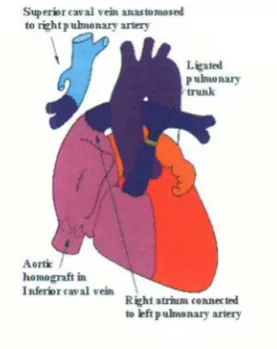
The operation was performed through a median sternotomy. At the same procedure, Francis fash-ioned an end-to-end anastomosis of the superior caval vein to the right pulmonary artery, closing the proximal stump of the caval vein. This, of course, was the Glenn shunt with which Francis was already very comfortable. He then proceeded by connecting the right atrium directly to the remaining part of the bifurcation of the pulmonary trunk (Fig. 2). Because of man's orthograde posture, an aortic homograft valve was inserted into the orifice of the inferior caval vein. Francis was equally familiar with the use of homograft aortic valves since, in 1965, he had established the first homograft bank on the Continent of Europe. The postoperative course was far from smooth, with pleural effusions and ascites as well as oliguria and, subsequently, anuria. Several periods of haemo-dialysis were required before the patient could be discharged, but this proved possible after several weeks of hospitalisation. She continues to do well, although conversion to an extracardiac Fontan procedure will likely be required in the near future. One further operation has been needed in the interim, namely removal of the stenotic and calcified aortic homograft valve.
Despite this success, no report was given of this initial experience. Then, in 1970, Francis was confronted by a second patient. This lady had survived to the age of 30 with no previous palliative procedures. She was very blue. This time the patient had tricuspid atresia with discordant ventriculo-arterial connections. The basic procedure was the same, but on this occasion, an aortic homograft was inserted between the right atrium and the pulmonary trunk (Fig.3). The postoperative course on this occasion was relatively smooth. She did well, became married, and gave birth to a healthy child. Unfortunately, after several years, she developed mitral incompetence. She died after a long and difficult replacement of the mitral valve.
The experience with these two cases was published in a French journal in 1971.1 Between
Sup crier caval vein anastomosed to right p ubnonary arteiy
Aortic / homograft in Inferior caval vein
Right atrium connected to fcftpuhnonary arteiy
Figure 2.
The operative manoeuvers performed in the first Fontan procedure
Superior caval vein to
ri-htpuhnonaiyartay Aortk homognift from ' right atrium to left
/pulmonary artery
Aortk home-graft
Figure 3.
The pathways constructed in the second operation, which included placement of an aortic homograft valve between the right atrium and
the pulmonary arteries.
acceptance and publication, a third patient was seen, who underwent the same procedure but died. The autopsy revealed unsuspected pulmonary hyper-tension. On the basis of this experience, all three cases were published in Thorax, noting and empha-sising the important contraindication to the surgical procedure.2 It was the appearance of the report in the English language which then caught the imagi-nation of the Interimagi-national Surgical Community.
Vol. 9, No. 6 The Paediatrk Cardiology Hall of Fame: Francis Fontan 595
second procedure. Of particular importance in the further development of the procedure in Bordeaux was the cooperation with Brom in Leiden. This had started in 1972 and, by the time of a Symposium held in London in 1977, forty patients had undergone the procedure. At this meeting, in addition to presenting the combined surgical results of Bordeaux and Leiden,14 Francis joined with his colleague Alain Choussat in promulgating the indications for the operation which soon became known as the "Ten Commandments".6 Already in the experience at Leiden, Francis had used the procedure in a patient with previously unsuspected double inlet left ventricle, and this option was popularised by Magdi Yacoub, who also emphasised the use of valves inserted into the orifices of the caval veins.15
Francis has followed further developments in "his" procedure with great personal interest. He is attracted by the concept of the total cavopulmonary connection, provided it is achieved by using the patient's own tissues to construct the venous chan-nels, since he is concerned about inserting prosthetic material within the atriums. He is also concerned, however, with the potential danger of creating long suture lines, recognising the fact that such proce-dures unequivocally set the scene for subsequent arrhythmias. Because of this, he is particularly attracted by the concept of the extracardiac Fontan procedure, introduced initially by Carlo Marcelletti.16 Indeed, he collaborated with Marcelletti, Hanley, Mavroudis and others in preparing a joint presen-tation on this topic delivered at this year's meeting of the American Association of Thoracic Surgeons.17 Equally important in the evolution of his procedure was the analysis undertaken with John Kirklin at the University of Alabama in Birmingham. This culmi-nated in the report of the "perfect" Fontan procedure.18 The activity continues even now. The next step will be an additional review of the next ten years of follow-up in the patients who formed the population for the "perfect" Fontan procedure. At the recent symposium held in London to celebrate the achievements of Christopher Lincoln, Francis reviewed again experience with "his" operation. In the course of his oration, he commented that, had he not thought of the procedure, then someone else certainly would, since the time was ripe. This is undoubtedly true. It is equally true, nonetheless, that he did think of, and successfully perform, the procedure. He comments that none of the patients undergoing his operation have been cured. This also is true. But very many patients throughout the world now owe their survival to his ingenuity and dedication.
Other Surgical Achievements
American Association was "transplantation of knowledge". Francis has achieved great success also in this field. His first pupil was Eugene Baudet, still Professor of Cardiac Surgery at the University of Bordeaux. Eugene also followed in the steps of Francis to become the 12th President of the European Association of Cardiothoracic Surgeons. It is no mean achievement for Bordeaux to have provided two of the Presidents of this young but flourishing Association. During his tenure at Bordeaux, many other young surgeons and physicians flocked to learn from Francis. I was fortunate to visit on several occasions, often with Michael Tynan, and the advice and friendship offered was considerable. One particular aspect sticks in my mind, which I subsequently found was handed down from one of his own mentors. When you think you have finished a manuscript, put it away for four to six weeks, and then re-examine the work. Any deficiencies will then be much easier to appreciate. Jan Quaegebeur also acknowledges his particular debt for experience gained in Bordeaux, and during visits made by Francis to Leiden. Perhaps the biggest accolade was when a group of his young pupils persuaded him to leave the University of Bordeaux in 1991 and join them at the relatively new practice created at Clinique St Augustin. This happy asso-ciation also continues to flourish.
Administrative Achievements
As mentioned already, Francis himself considers his greatest achievement to be the part he played in the establishment of the European Association of Cardiothoracic Surgery. He described some of the steps involved in the address he gave as President at the first Annual Meeting.8 The success of the Association reflects his own involvement, and he is particularly gratified by the establishment in his name of the Francis Fontan prize. Now awarded annually, the successful applicant is permitted to spend one year of training as set out in the application to the Prize Committee. Perhaps equally important for Bordeaux was his part in the establishment of the Hopital Cardiologique at Haut-Leveque. This hospital, newly created in 1978, replaced the old Hopital Tondu. It was built over a period of two years, following long and arduous discussions and deliberations with local, University, and national politicians, all requiring the very best of his considerable diplomatic skills.
T h e Inner Man
Vol. 9, No. 6 The Paediatric Cardiology Hall of Fame: Francis Fontan 597
Figure 4.
Francis photographed with myself during a visit to Brompton Hospital in March, 1988.
Figure 5.
Francis and myself photographed in June, 1999
Figure 6.
Francis and his wife, Maryse, photographed in London in June, 1999
Figure 7.
A bottle of the 1992 vintage of Chateau L'Ermitage. This wine was ranked first of the Sauternes 1992 in the Gault and Millau magazine of September 1994, and obtained the Prize of Excellence at the Vinalies International in March, 1995.
References
1. Fontan F, Mounicot FB, Baudet E, Simonneau J, Gordo J, Gouffrant JM. "Correction" de l'atresie tricuspidienne. Rapport de deux cas "corriges" par ['utilisation d'une technique chirur-gicale nouvelle. Ann Chir Thorac Cardiovasc 1971; 10: 39—47. 2. Fontan F, Baudet E. Surgical repair of tricuspid atresia. Thorax
1971;26: 240-248.
3. Fontan F, Deville C, Quaegebeur J, Ottenkamp J, Sourdille N, Choussat A, Brom GA. Repair of tricuspid atresia in 100 patients. J Thorac Cardiovasc Surg 1983;85: 647-660. 4. Girod DA, Fontan F, Deville C, Ottenkamp J, Choussat A.
Long-term results after the Fontan operation for tricuspid atresia. Circulation 1987;75: 605-610.
5. Fontan F, Fernandez G, Costa F, Naftel DC, Tritto F, Blackstone EH, Kirklin JW The size of the pulmonary arteries and the results of the Fontan operation. J Thorac Cardiovasc Surg 1989;98: 711-724.
6. Choussat A, Fontan F, Besse 1^ Vallot F, Chauve A, Bricaud H. Selection criteria for Fontan's procedure. In: Anderson RH, Shinebourne EA, eds. Paediatric Cardiology 1977. Churchill Livingstone, Edinburgh. 1978: 559—566.
8. Fontan F. The faith in the future. Eur J Cardio-thorac Surg 1988;2: 1-7.
9- Broustet P, Bricaud H, Fontan F, Dallocchio M. Sur un cas d'atresie tricuspidienne. (Presentation de piece). J Med Bordeaux et Sud-Ouest 1959;136:
345-359-10. Dubourg G, Fontan F, Blanchot P, Dallocchio M, Bricaud H, Broustet P L'atresie tricuspidienne et son traitement chirur-gical. J Med Bordeaux et Sud-Ouest 1959;136: 699-712. 11. Glenn WWL, Patino JF. Circulatory bypass of right heart:
preliminary observation on direct delivery of vena caval blood into pulmonary arterial circulation. Azygos vein-pulmonary artery shunt. Yale J Biol Med 1954 ;27: 147-151.
12. Bjork VO, Olin CL, Bjarke BB, Thoren LA. Right atrial-right ventricular anastomosis for correction of tricuspid atresia. J Thorac Cardiovasc Surg 1979;77: 452-458.
13- Kreutzer G, Galindez E, Bono H, De Palma C, Laura JP An operation for the correction of tricuspid atresia. J Thorac Cardiovasc Surg 1973;66: 613—621.
14. Fontan F, Choussat A, Brom AG, Chauve A, Deville C, Castro-Cels A. Repair of tricuspid atresia — surgical considerations and results. In: Anderson RH, Shinebourne EA, eds. Paediatric Cardiology 1977. Churchill Livingstone, Edinburgh. 1978: 567-580.
15. Yacoub M, Radley-Smith R. The use of the Fontan procedure for treatment of single ventricle. In: Anderson RH, Shinebourne EA, eds. Paediatric Cardiology 1977. Churchill Livingstone, Edinburgh. 1978: 3 9 6 ^ 0 1 .
16. Marcelletti C, Corno A, Giannico S, Marino B. Inferior vena cava-pulmonary artery extracardiac conduit. A new form of right heart bypass. J Thorac Cardiovasc Surg 1990;100: 228-232.
17. Marcelletti CF, Hanley FL, McElhinney DB, Mavroudis C, Abella RF, Marianeschi SM, Seddio F, Reddy P, de la Torre T, Casagrande L, Backer CL, Cipriani F, Iorio FS, Fontan F. Revision of previous Fontan connections to total extracardiac cavopulmonary anastomosis: a multicenter experience. J Thorac Cardiovasc Surg 1999 in press
18. Fontan F. Transplantation of knowledge. J Thorac Cardiovasc Surg 1990;99: 387-395.
19- Dulong de Rosnay H, Coustou F, Crockett R, Fontan, Dubourg G. Homogreffes valvulaires aortiques. Organisation d'une banque. Ann Chir Thorac Cardiovasc 1968;7: 539—541. 20. Fontan F, Mounicot F, Ploquin F, Baudet E, Badiola P.
Techiques et premiers resultats des homogreffes valvulaires aortiques. Arch Mai Coeur 1969;62: 527-536.
21. Fontan F, Choussat A, Deville C, Doutremepuich C, Coupillaud J, Vosa C. Aortic valve homografts in the surgical treatment of complex cardiac malformations. J Thorac Cardiovasc Surg 1984;87: 649-657.
22. Fontan F, Chauve A, Deville C, Baudet E. Ruptures trauma-tiques de l'isthme aortique. Reparation chirurgicale. Resultats. Chirugie 1978; 104: 38-43.
23. Fernandez G, Fontan F, Deville C, Maddonna F, Thibaud D. Long-term evaluation of direct repair of traumatic isthmic aortic transection. Eur J Cardio-thorac Surg 1989;3: 333-334. 24. Fontan F, Baudet E, Mounicot FB, Gordo J, Gouffrant JM. Resection-greffe dun aneurysme de la crosse de I'aorte (segment II) a coeur battant et sous shunt pulse partiel. Ann Chir thorac Cardiovasc 1971; 10: 59-63.
25. Fontan F, Madonna F, Naftel DC, Kirklin JW, Blackstone EH, Digerness S. Modifying myocardial management in cardiac surgery: a randomized trial. Eur J Cardio-thorac Surg 1992; 6: 127-137.
26. Fontan F, Madonna DC, Naftel DC, Kirklin JW, Blackstone EH, Digerness S. The effect of reperfusion pressure on early outcomes after coronary artery by-pass grafting. A randomized trial. Thorac Cardiorasc Surg 1994; 107: 265-270.
Published Works
The published works of Francis Fontan currently number 266. The items listed here are the ones selected by Francis as being of particular importance either historically or scientifically.
1. Broustet P, Bricaud H, Fontan F, Dallocchio M. Sur un cas d'atresie tricuspidienne (Presentation de piece). J Med Bordeaux et du Sud-Ouest 1959; 136: 345-359.
2. Dubourg G, Fontan F, Blanchot P, Dallocchio M, Bricaud H, Broustet P. L'atresie tricuspidienne et son traitement chirur-gical. J Med Bordeaux et du Sud-Ouest 1959; 136:699-712. 3. Fontan F. L'arret cardiaque par anoxie en circulation
extra-corporelle. These Bordeaux 1959 (Drouillard, Impr.).
4. Bergouignan M, Fontan F, Trarieux M, Julien J. Syndromes chor-eiformes de l'enfant au decours d'interventions cardio-chirurgi-cales sous hypothermie profonde. Rev Neural 1961; 105: 48—60. 5. Dubourq G, Fontan F, Trarieux M, Gaily JC, Ploquin F. Trente-trois interventions chirurgicales cardiaques sous circulation extra-corporelle en auto-perfusion. Memoires de 1'Academie de Chirurgie 1963; 89: 513-519.
6. Dubourg G, Fontan F, Trarieux M, Bricaud H, Broustet R Insuffisance aortique traumatique. Correction chirurgicale sous hypothermie profonde. Arch Mai Coeur 1963; 56: 782—790. 7. Fontan F, Mounicot F, Raulin Y, Lartigue G. Notre experience
des homogreffes aortiques. La Revue de Medecine 1967; 1535-1539.
8. Dulong de Rosnay H, Coustou F, Crockett R, Fontan F, Dubourg G. Homogreffes valvulaires aortiques. Organisation dune banque. Ann ChirThorac Cardiovasc 1968; 7: 539—541. 9. Fontan F, Mounicot F, Raulin Y, Ploquin F, Dubourg G. Homogreffes valvulaires aortiques. Techniques et resultats clin-iques. Ann Chir Thorac Cardiovasc 1968; 7: 543-547. 10 Dallocchio M, Fontan F, Bezian J, Bricaud H, Broustet R
Anatomical lesions of the transplanted heart. Cardiovasc Res 1970, Vie World Congress of Cardiology-Abstracts: D 115. 11 Dallocchio M, Fontan F, Baudet E, Bezian, Bridaud H,
Pautrizel R, Broustet R Les lesions arterielles dun coeur humain de sujet jeune transplante sur un sujet jeune. Arch Mai Coeur Vaiss 1970; 7: 935-950.
12 Fontan F, Baudet E, Mounicot FB, Gordo J, Gouffrant JM. Resection-greffe d'un aneurysme de la crosse de I'aorte (segment II) A coeur battant et sous shunt pulse partiel. Ann Chir Thorac Cardiovasc 1971; 10: 59-63.
13 Fontan F, Mounicot FB, Baudet E, Simonneau J, Gordo J, Gouffrant JM. "Correction" de l'atresie tricuspidienne. Rapport de deux cas "corriges" par l'utilisation d'une technique chirur-gicale nouvelle. Ann Chir Thorac Cardiovas 1971; 10: 39—47. 14 Fontan F, Baudet E. Surgical repair of tricuspid atresia. Thorax
1971; 26: 3,240-248.
15 Fontan F, Baudet E, Mounicot FB, Badiola P, Ploquin F, Gouffrant JM. Aneurysme par rupture traumatique de l'isthme aortique. Interet de la reparation par suture directe. Ann Chir Thorac Cardiovasc 1972; 11: 29-33.
16 Ruffie P, Berjon JJ, Baudet E, Dulong de Rosnay Ch, Meunier JM, Fontan F. Attenuation des caracteres antigeniques de valves aortiques humaines destinees a la greffe. C.R. Acad Science Paris 1974; 278: 2381-2383.
17 Ruffie P, Fontan F, Dulong de Rosnay Ch, Meunier JM, Laparra J, Berjon JJ. Etude de la survie, apres conservation a basse temperature, de valves aortiques humaines destinees a la greffe. C.R. Acad Science Paris 1974; 278: 2827-2830.
Vol. 9, No. 6 The Paediatric Cardiology Hall of Fame: Francis Fontan 599
19 Ruffle P, Berjon JJ, Larrue J, Baudet E, Meunier JM, Fontan F. Aspects biologiques recents des homogreffes valvulaires aortiques. Coeur 1975; 6: 549-558.
20 Fontan F, Choussat A. Tratamiento quirurgico de la atresia tricuspidea. Hospital General 1975; 15: 4 0 7 ^ 1 6 .
21 Doutremepuich Ch, Baudet E, Chauve A, Coqueran JE, Fontan F. Detection and prevention of a fibrinolysis after an extracorporeal circulation in cardiac surgery. Thromb Haemost
1976; 36: 296.
22 Bricaud H, Clementy J, Baudet E, Dallocchi M, Fontan F. Les reinterventions apres chirurgie de remplacement valvulaire. Etude de 358 observations. Arch Mai Coeur Vaiss 1976; 69: 205-213.
23 Doutremepuich Ch, Oca C, Coqueran JE, Chauve A, Fontan F. Variations de l'hemostase du nourrisson sous hypothermie profonde. Annales d'Anesthesiologie Franchise 1977; 18: 62—65. 24 Choussat A, Fontan F, Besse P, Fel G, Clementy J, Bricaud H. Fallot's tetralogy. Pre and post-operative evaluation. In: Anderson RH, Shinebourne EA (eds). Paediatric Cardiology 1977. Edinburgh: Churchill Livingstone 1978; pp 266-272. 25 Choussat A, Fontan F, Besse P, Vallot F, Chauve A, Bricaud H.
Selection criteria for Fontan's procedure. In: Anderson RH, Shinebourne EA (eds). Paediatric Cardiology 1977. Edinburgh: Churchill Livingstone 1978; pp 559-566.
26 Fontan F, Choussat A, Brom AG, Chauve A, Deville Cl, Castro-Cels A. Repair of triciuspid atresia. Surgical considerations and results. In: Anderson RH, Shinebourne EA (eds). Paediatric Cardiology 1977. Edinburgh: Churchill Livingstone 1978; pp 567-580.
27 Conri C, Sicart M, Page A, Chauve A, Baudet E, Fontan F, Besse P Etude hemodynamique et evaluation fonctionnelle des aneurysmes du ventricule gauche. Arch Mai Coeur Vaiss 1978; 71: 1029-1035.
28 Fontan F, Chauve A, Deville Cl, E Baudet E. Ruptures trauma-tiques de l'isthme aortique. Reparation chirurgicale. Resultats. Memoires de l'academie de Chirurgie 1978; 104: 38-43. 29 Fontan F. Tricuspid atresia. Operative surgery. Fundamental
interventional techniques. In: Jackson J W (ed) Cardiothoracic Surgery. London: Butterworths 1978; 152—157.
30 Doutremepuich Ch, Fontan F. Haemostasis defects following cardio-pulmonary by-pass based on study of 1350 patients. Thromb Haemost 1978; 39: 539-541.
31 Fontan F. The prognostic value of pre-operative left ventricular performance in left ventricular resection. Thorac Cardiovasc Surg 1979; 27: 281 288.
32 Annechino FP, Fontan F, Chauve A, Quaegebeur J. Palliative reconstruction of the right ventricular outflow tract in tricuspid atresia. A report of 5 patients. Ann Thorac Surg 1980; 29: 317-321.
33 Chauve A, Fontan F, Wicker P, Besse R Surgical constriction of the pulmonary artery. A new experimental technique. Thorac Cardiovasc Surg 1981; 29: 77-81.
34 Ledain L, Hadjj J, Colle JP, Ohayon J, Deville Cl, Fontan F, Besse R Les aneurysmes du ventricule gauche: Etude pronos-tique resultats operatoires. Arch Mai Coeur Vaissl982; 75: 1101-1110.
35 Ottemkamp J, Rohmer J, Quaegebeur JM, Brom AG, Fontan F. Nine year's experience of physiological correction of tricuspid atresia: Long-term results and current surgical approach. Thorax 1982; 37: 718-726.
36 Fontan F, Deville Cl, Quaegebeur J, Ottenkamp J, Sourdille N, Choussat A, Brom AG. Repair of tricuspid atresia in 100 patients. J Thorac Cardiovasc Surg 1983; 85: 647-660. 37 Fontan F, Choussat A, Deville Cl, Doutrepuich Ch, Coupillaud
J, Vosa C. Aortic valve homografts in the surgical treatment of complex cardiac malformations. J Thorac Cardiovasc Surg 1984; 87: 649-657.
38 Brendel AJ, Wynchank S, Choussat A, Barat JL, Deville Cl, Ducassou D, Fontan F. Radionuclide studies in postoperative evaluation of the Fontan procedure. Am J Roentgenol 1984; 143:
39 Fontan F, Doutremepuich Ch, Quaegebeur J, Brom AG. Tricuspid atresia: "Evolution of an approach'. In: Moulton AM (ed) Congenital Heart Surgery. Current Techniques and Controversies. Passadena, California; Appleton-Davies Inc. 1984; pp 275-290.
40 Busquet J, Fontan F, Anderson RH, Ho SY The surgical signif-icance of the atrial branches of the coronary arteries. Int J Cardiol 1984; 6: 223-234.
41 Ottenkamp J, Wenink ACG, Quaegebeur J, Rohmer J, Gittenberger-de Groot AC, Brom AG, Fontan F. Tricuspid atresia. Morphology of the outlet chamber with special emphasis on surgical implications. J Thorac Cardiovasc Surg
1985; 89: 597-603.
42 Girod D, Fontan F, Deville C, Ottenkamp J, Choussat A. Long-term results after Fontan operation for tricuspid atresia. Circulation 1987;75: 605-610.
43 Fontan F, Fernandez G. Ventricle to pulmonary artery homo-graft valved conduits. Early and late results. In: D'Alessandro LC (ed). Heart Surgery 1985. Roma: Casa Editrice Scientifica Internazionale. 1985; pp 307-320.
44 Baldwin JC, Fontan F. The Fontan operation. In: Jamieson SW, Shumway NE (eds). Cardiac Surgery Fourth Edition. London: Butterworths. 1986; pp 191-203.
45 Vaislic C, Puel P, Grondin P, Vargas A, Thevenet A, Fontan F. Results after 11 years of treatment of cancers of the kidney invading the vena cava and the heart. J Thorac Cardiovasc Surg
1986; 91: 604-609.
46 Busquet J, Fontan F, Choussat A, Caianiello G, Fernandez G. Exclusive double outlet right ventricle with atrioventricular concordance and pulmonary stenosis. Results of reconstructive surgery. Eur J Cardio-thorac Surg 1988 2: 176-184.
47 Deville Cl, Roques X, Fernandez G, Laborde N, Baudet E, Fontan F. Should circulatory arrest with deep hypothermia be revised in aortic arch surgery? Eur J Cardio-thorac Surg 1988; 2: 185-191.
48 Fernandez G, Deville Cl, Ebner A, Doutremepuich Ch, Fontan F. Allograft conduit for Fontan procedure. In: Yankah AC (ed). Cardiac Valve Allografts 1962-1987. Darmstadt: Steinkopff Verlag. 1988; pp 237-247.
49 Fontan F. The faith in the future. Presidential address, 1st Annual Meeting of The European Association for Cardio-thoracic Surgery. Eur J Cardio-thorac Surg 1988; 2: 1—7. 50 Fernandez G, Fontan F, Deville C, Madonna D, Thibaud D.
Long-term evaluation of direct repair of traumatic isthmic aortic transection. EurJ Cardio-thorac Surg 1989; 3: 312—320. 51 Fontan F, Fernandez G, Ebner A. Risk factors for the Fontan procedure. A new analysis of the Bordeaux experience. In: Crupi G, Parenzan L, Anderson RH (eds). Perspectives in Pediatric Cardiology, Volume 2. Mount Kisco, New York: Futura Publishing Company Inc. 1989; pp 179—183.
5 2 Fontan F, Fernandez G, Stark J. Reoperations after the Fontan procedure. In: Stark J, Pacifico AD (eds). Reoperations in Cardiac Surgery. Berlin: Springer-Verlag. 1989; pp 291—304. 53 Fernandez G, Costa F, Fontan F, Naftel DC, Blackstone EH,
Kirklin JW. Prevalence of reoperation for pathway obstruction after Fontan operation. Ann Thorac Surg 1989; 48: 645-659. 54 Fontan F, Fernandez G, Costa F, Naftel DC, Tritto F,
Blackstone EH, Kirklin JW. The size of the pulmonary arteries and the results of the Fontan operation. J Thorac Cardiovasc Surg 1989; 98: 711-724.
Thoracic and Cardiovascular Surgery. Fifth Edition Volume II. Norwalk, Connecticut: Appleton & Lange. 1991; pp 1061-1068.
56 Fontan F. Transplantation of knowledge. J Thorac Cardiovasc Surg 1990; 99: 387-395.
57 Fontan F, Kirklin JW, Fernandez G, Costa F, Naftel DC, Tritto F, Blackstone EH. Outcome after a perfect Fontan operation. Circulation 1990; 81: 1520-1536.
58 Kirklin JW, Fernandez G, Fontan F, Naftel DC, Ebner A, Baclstone EH. Therapeutic use of right atrial pressures early and after the Fontan operation. Eur J Cardio-thoracic Surg 1990; 4: 2-7.
59 Fontan F, Madonna F, Naftel DC, Kirklin JW, Blackstone EH, Digerness S. Modifying myocardial management in cardiac surgery: a randomized trial. Eur J Cardio-thorac Surg 1992; 6: 127-137.
60 Kirklin JW, Digerness S, Fontan F, Kirklin JK. Controlled aortic root reperfusion in cardiac surgery. Sem Thorac Cardiovasc Surg. 1993; 5: 134-140.
61 Fontan F, Madonna DC, Naftel DC, Kirklin JW, Blackstone EH, Digerness S. The effect of reperfusion pressure on early outcomes after coronary artery by-pass grafting. A randomized trial. Thorac Cardiovasc Surg 1994; 107: 265-270.
62 Fontan F, Dehant P The small aortic root: from surgery to echocardiography and back. In: Piwnica A, Westaby (eds). Surgery for Acquired Aortic Valve Disease. Oxford: Isis Medical Media Ltd. 1997; pp 155-160.