Wibree Is A Wireless Technology
Muddasani Shravani
Assistant professor, MallaReddy institute of technology and science
Abstract:
Wibree is a short-range wireless protocol optimized for low power consumption. Developed by Nokia, the company has submitted Wibree as an open standard to promote adoption and interoperability. Wibree is intended to compliment Bluetooth communications in certain PAN applications where small, lightweight design makes standard Bluetooth communication unsuitable or difficult. Bluetooth-enabled wristwatches require relatively large transmitters and batteries, making the devices heavy and uncomfortable. Wibree-enabled wristwatches can use smaller transmitters and smaller batteries, increasing user comfort and reducing fatigue while extending battery life.
Keywords
Wi-Fi,Wibree, Zigbee,blue tooth
1.Introduction
Wibree is a technology that has been under development by Nokia since 2001.It was originally adapted from the Bluetooth specification, and in 2006, the Bluetooth Special Interest Group (SIG) announced it would be adopting Wibree into the Bluetooth specification. Integrated Bluetooth/Wibree devices are not yet shipping, though Semiconductor has published a preliminary product specification. While the Wibree and Bluetooth specs are being integrated, the new name of the Wibree technology has changed several times. While Wibree has been under development, the competing IEEE 802.15.4 technology of ZigBee has been available to the public for several years. ZigBee was designed as a low- power, low-cost, low-speed solution, and has many benefits over Bluetooth, though fewer benefits over the wibree.
It performs many of the same functions that Bluetooth does while using far less power. Wibree would allow for the use of wireless technology in many devices that require long battery life. Wibree chips are also smaller than
use them in certain applications where space is at a premium. However, Wibree transmits data more slowly. Bluetooth can transfer 3 megabit per second, wibree 1 megabits per second. The battery life time time is day to months in Bluetooth, 1-2 years in wibree.
Naming to wibree:
The name has also raised eyebrows. Like Bluetooth, it is a new word that tells us little of the technology. It derivation shows some of the same interest in northern European history and mythology that generated Bluetooth. The “Wi” is the now obligatory prefix for “wireless”, with Nokia claiming that the “bree” comes from the Old English word for a Crossroad.
We are not totally convinced – we have a suspicion that this definition of bree is a Tolkien invention, as my Old English dictionaries define bree as “agitation”, “to frighten” or “eyebrow. Both of which seem equally appropriate. So we have “Wireless at the Crossroad”, “Wireless to be scared of” or “Wireless eyebrows”. Whichever takes your fancy, one thing is certain - Wibree will certainly herald a new era of personal wireless connectivity.
Logo:
Fig 3.1: Wibree logo
Origin & Development:
• Around 2001, the Nokia Research Center was looking at options for future personal wireless networking. • They thought of low power devices such
as sensors, but realized that there was no suitable technology connecting those to larger devices such as a mobile phone.
• It made them to develop a technology called Wibree to meet the requirements of low power consumption, small size, and low cost with interoperability based on open specification.
• Nokia decided to create a new open wireless protocol along with its partners Broadcom Corporation, CSR, Epson, and Nordic Semiconductor, is working to bring it to market.
History of wibree:
• In 2001:Research Center started the development of a wireless technology which would provide lower power usage and price while still introducing as small changes to Bluetooth as possible
• In 2004:The results were published using the name “Bluetooth Low End Extension”
• In October 2006: Technology was released to public with brand name “Wibree”
• In June 2007: Bluetooth SIG announced that Wibree will be a part of the Bluetooth specification as an ultra-low-power Bluetooth technology.
3.3 Component of Wibree:
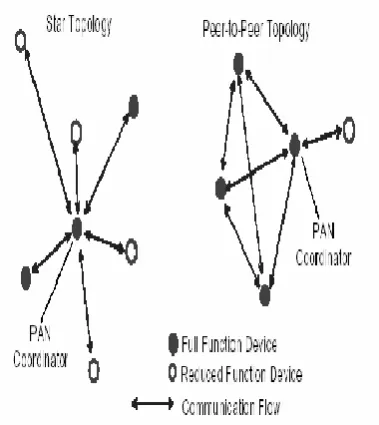
Depending on the application requirements, it may operate in either of two topologies .
They are
• Star topology
• Peer-to-peer topology.
Network topologies:
Fig 3.2: Star topology and peer-to-peer topology
Star topology:
In the star topology the communication is established between devices and a single central controller, called the PAN coordinator. A device typically has some associated application and is either the initiation point or
the termination point for
network communications. A PAN coordinator may also have a specific application, but it can be used to initiate, terminate, or route communication around the network.
peripherals, toys and games, and personal health care.
Peer-to-Peer Topology:
The peer-to-peer topology also has a PAN coordinator; however, it differs from the star topology in that any device can communicate with any other device as long as they are in range of one another. Peer-to-peer topology allows more complex network formations to be implemented, such as mesh networking topology. Applications such as industrial control and monitoring, wireless sensor networks, asset and inventory tracking, intelligent agriculture, and security would benefit from such a network topology. A peer-to-peer network can be ad hoc, self-organizing and self-healing. It may also allow multiple hops to route messages from any device to any other device on the network. Such functions can be added at the network layer, but are not part of this standard.
Implementation of technology:
There will be two types of implementations
1. Stand-alone (wibree)
2. Dual mode (wibree & Bluetooth)
Fig3.4: Examples for implementing technologies
Stand-alone mode:
Stand-alone Wibree chips would be implemented in small, low cost devices such as wireless mouse and keyboards, sensors, and toys.
Dual mode:
The Wibree-Bluetooth dual-mode chips would probably be implemented in future mobile phones, allowing users to benefit from both worlds – Bluetooth high speed and Wibree's low power and extended ability to communicate with a new generation of smaller wireless devices.
Fig3.6: point-to-multipoint communication
Technology mainly used in:
Fig 3.7: wrist watch
Bluetooth-enabled wristwatches require relatively large transmitters and batteries, making, the devices heavy and uncomfortable. Wibree-enabled wristwatches can use smaller transmitters and smaller batteries, increasing user comfort and reducing fatigue while extending battery life. Wibree is having coin size battery it can work for a year without any recharge.
3.6 Comparing the technologies:
Why Wibree a Compliment to Bluetooth?
• It performs many of the same functions as the Bluetooth.
• It is up to 10 times more energy efficient than Bluetooth but can easily be integrated with the existing technology.
• Like Bluetooth used to link cell phones with headsets, computers and printers to transfer calls, calendar items, documents, songs and pictures.
• This system has longer battery life and more compact devices When Wibree has become a standard. The wibree battery life time is 1-2 years and Bluetooth battery days to months.
• Wibree chips are also smaller than Bluetooth chips which would make it easier to use them in certain applications where space is at a premium.
• Bluetooth works for periodic short-range wireless links but not for applications with heavier duty cycles, such as audio transfer to head phones or speakers while wibree can. While Bluetooth is looking for ultra high frequencies above 6 gigahertz for new faster connections, Wibree will operate in the 2.4 gigahertz band.
• Bluetooth uses fixed packet length. This increases power usage as unnecessary transmission occurs. Wibree has a variable packet length and transmits only when necessary.
• While Bluetooth can be used to transmit audio and media files, Wibree is designed to extend this network by serving applications that transmit only small amounts of data and where size and cost are priorities.
Is wibree Bluetooth killer?
• Bluetooth is a standard for a small, cheap radio chip to be plugged into computers, printers, mobile phones etc
A Bluetooth chip is designed to replace cables by taking the information normally carried by the cable, and transmitting it at a special frequency to a receiver. Bluetooth chip, which will then give the information received to the computer, phone. Hence it is a cable-replacement technology.
• Wibree is similar in many respects to the now prevalent Bluetooth standard. It complements close range communication with Bluetooth. • The two complementary technologies differ in size, price, and most of all power consumptions. • Wibree would use only a fraction of the power
consumed by today's Bluetooth chips, resulting in a much longer battery life and more compact devices.
• Bluetooth drains your cell phone battery as it needs quite a lot of power to remain active. Wibree aims to survive for a full year on a button sized battery. In contrast to Bluetooth, wibree goes into sleep mode when not transmitting. In sleep mode the radio will be off and will save a lot of power. Wibree devices wake up only when they want to transmit. Comparison to wibree, zigbee and Bluetooth:
Particulars Bluetoot
h Wibree Zigbee 1st
specification 1994 2008 2004 Power 100mw ~10m
w 30mw
battery life
Day-months 1-2 years 6mont hs-2years Range 10-30m 10m
10-75m Data Rate 1-3Mbps 1mbp
s
25-250kb ps Network
Topology Point-point, star
Point-point, star
Mesh, star
Security 128-bit encryptio n
128-bit encry ption
128-bit encryp tion
Table3.1: Comparisons between wibree, zigbee and Bluetooth
All these are short-range radio technology aimed at applications with low data rates and low power consumption such as industrial controls, home automation and other monitoring and control operations.
Drawback: Wibree transmits data more slowly where Wibree can 1 megabit per second, Bluetooth's 3 megabits per second.
3.7 Future with Wibree:
We can have every device connected to each other and thus have a network all around us with wibree. Anything and everything can be shared and may hope that emotions can be shared in Wireless.
Fig3.8: Sharing the files from one to other
Benefits can Wibree bring to already-crowded wireless PAN markets:
• Wibree is complementary to existing technologies; it does not replace them. • Nokia believes that Bluetooth, as we
• The same will apply to Wibree, meaning that there will be room for both technologies.
• The communication becomes more
data-intensive, the power
consumption benefits of Wibree will diminish compared to Bluetooth.
• It is more power efficient, you'll get longer battery life and it can be put into smaller devices, like a pen or watch. Wibree makes it possible to operate these devices for more than a year without recharging.
3.8 Advantages, disadvantages and applications:
Advantages:
• Wibree is the first wireless technology to solve the following needs in a single solution.
• Ultra low peak and average power consumption in both active and idle modes. • Ultra low cost and small size for accessories and human interface devices (HID).
• Minimal cost and size addition to mobile phones and pcs.
• Global, intuitive and secure multi-vendor interoperability.
Disadvantages:
• Data transmission is very slow, i.e, only 1 megabit per second.
• Cannot be used in high
bandwidth required applications.
Most suitable only for text, graphics & controlling data transfer
Applications:
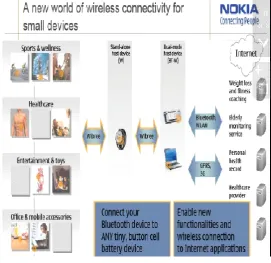
1. Golden gulf club
2. Sports and health center 3. Health care
4. Home appliances 5. Entertainment
6. Office &mobile accessories
Fig 3.9: A new world of wireless connectivity for small devices Conclusion:
Wibree will also extend the battery lifetime and less power consumption of existing wireless device such as keyboards, mice and remote controls. Technology keeps on changing we shift to the technology which is more effective and less expensive.
Nokia said the first commercial version of the standard to be available during the second quarter of 2007. The firm said it expected dual Bluetooth-wibree devices such as mobile phones to hit the market within two years. Acronyms:
• Wibree: Wireless Eyebrow • PAN : Personal Area Network • VOIP: Voice Over Internet Protocol • HID: Human Interface Devices • PC: Personal computer
• PDA: Personal Digital Assistant • Wi-Fi: Wireless Fidelity
• GUIDP: Generic User Interface Device Profile
Bibliography
Books:
• Mobile Web Design by Cameron Moll
Journals:
• [1]Ciardiello, T.”Wireless
communications for industrial control and monitoring “computing control engineering.
• [2]Baker, N,”Zigbee and Bluetooth strength and weakness for industrial applications”, computing controlling engineering.
websites referred:
• http://www.bluetooth.com/Bluetooth/tec hnology
• http://en.wikipedia.org/wiki/wibree • http;//nokia.com/global/about-nokia • http://www.futureofthings.com