Crop Diversification and Changing Cropping Pattern in Leh District: A Block-Wise
Study
Jigmat Norboo
Ph.D. Scholar
Centre for the Study of Regional Development, School of Social Sciences, Jawaharlal Nehru University, New Delhi – 110 067
E-mail: [email protected]
Abstract: In this paper, an attempt has been made to understand the pattern and extent of crop diversification and changing cropping pattern in Leh district based on secondary data collected for the period 1985-86 to 2010-11 from various government sources. To measure the extent of crop diversification, Herfindhal Index has been used. The study has revealed that most of the blocks in Leh districts are experiencing a lateral movement towards crop diversification. An analysis of temporal changes in cropping pattern in Leh district has indicated that the area under fruits and vegetables has witnessed significant increase over the period by varying degree. In the end, it has suggested some developmental strategies for fostering the process of crop diversification.
Keywords – Crop Diversification, Cropping Pattern, Herfindhal Index, Leh District I
Introduction
niche and human adaptation mechanism created by unique vertical dimensions that distinguish them from the plains and other eco-systems”1. Agriculture in such regions is also characterised by low productivity due to dominance of traditional agricultural practices, inadequate capital formation, low investment, poor resources and small sizes of landholdings. Nevertheless, recent development in terms of road infrastructure and better access to markets coupled with government initiatives have led to the diversification of agriculture towards high value cash crops including fruits and off-season vegetables, which holds the key to the overall development of the region by way of creating employment, generating income and ensuring food security.
The potentiality of crop diversification to high value cash crops in raising farm income and increasing employment opportunities has recently been realised by farmers across the Himalayan region. A number of studies have also shown that crop diversification to high value cash crops has made a significant impact on the quality of life of the local people. The micro level experiences further show that diversification through high value crops is not only economically beneficial but ameliorates stress on natural resource base2
(Chand, 1996). According to a study by Sharma (2005), the adoption of high value cash crop also helps mountain farmers in maintaining and improving the ecology and environment by promoting soil conservation and improving soil fertility. It is clear that the adoption of high value crops is not only beneficial in economic terms but also helps in sustainable use of natural environment. However, economic progress attainted by diversification through high value crops is not same everywhere as some pockets have experienced remarkable achievements, while others have lagged behind. This has attracted the attention of agricultural researchers and policy makers, and it is suggested that the experience of areas advanced in crop diversification be replicated and expanded to other areas. Therefore, the present study is an attempt to examine crop diversification and changing cropping pattern in Leh district. More specifically, the study examines the extent of crop diversification in Leh district at block level. It also analyses temporal changes in cropping pattern including area under high value crops in Leh district since 1996-97. Block-wise changes in cropping pattern have also been captured.
1 Agricultural Development and Crop Diversification in Himachal Pradesh: Understanding the Patterns,
The study is organised into six sections. The second section deals with the data and methods used in conducting the study. Third section discusses crop diversification in Leh district. Cropping pattern and changes therein from 1985-86 to 2010-11 have been analysed in section IV. Section V includes conclusions.
II
Data and Methods
The study is based on secondary data. The secondary data have been collected from various publications and records from government departments, namely, Agricultural Department, Horticulture Department, Leh District. Various appropriate statistical tools have been used to analyse the data. The average and percentages have been computed to understand the changes in the cropping pattern. The temporal changes in the extent of crop diversification have been studied block-wise by constructing Hefindhal Index. The index has been computed using the following method.
Herfindhal Index
HI = ∑ pi
𝑛
𝑖=1 2
Where, 𝑝𝑖 is the proportion of area under ithcrop,
𝑝𝑖 = 𝐴1
∑𝑛𝑖=1𝐴1
Here, 𝐴1 is area under ithcrop, ∑𝑛𝑖=1𝐴1 denotes the total cropped area and the value of HI ranges from 0 to 1. While, unity implies complete specialization, zero implies high diversification
III
Crop Diversification
other blocks were relatively diversified blocks with HI-index value lower than the district’s average value. In the second period (2007-08) too, except Nyoma-Durbok, all other blocks have depicted HI-index value lower than 0.43, thereby showing relatively diversified. Similar pattern has been found in the third period (2010-11). A comparison of HI values for the periods 2005-06 and 2007-08 reveal that except Nyoma-Durbok, all other districts have experienced a significant degree of crop diversification.
The block Nyoma-Durbok, located in the high altitude region of Leh district, have depicted higher values of HI, close to 0.5 in the second period. From first to second period, there is a clear trend of decline in HI value for Leh-Karu block, depicting crop diversification in the block. On the contrary, all other blocks have depicted higher values of HI, showing crop specialisation. In the next phase, second to third, the values for Nubra and Leh-Karu block have shown a significant change towards crop diversification. On the other hand, the values for Khaltse and Nyoma-Durbok have depicted crop specialisation.
Hence, we may conclude that crop diversification is taking place in two blocks of Leh-Karu and Nubra, whereas other two blocks have shown a significant change towards crop specialisation. The finding needs to be seen in the context of the fact that Nyoma block, which is located at a high altitude, has depicted a higher level of specialisation. Due to data constraints, changes in the extent of crop diversification have not been able show clearly.
Therefore, further study needs to be done to capture the extent of crop diversification. Table 1
BLOCK-WISE CROP DIVERSIFICATION INDEX IN LEH DISTRICT, 2005-2010
Block HI Index Value
Source: Author’s calculations based on ‘area’ data for crops taken from Statistical
Handbook, Leh District, 2005-06 and 2010-11.
Note: Only combined data was available for Nyoma and Durbok blocks. Same is the case with Leh and Karu blocks.
IV
Cropping Pattern and Changes therein
Cropping pattern in the region is dominated by traditional and low productivity crops which occupy majority of the crop area. Most important among them are barley, wheat, buckwheat,
some other millets and pulses; several different local and adopted varieties of these crops are grown. Only one crop in a year is possible in most parts of the region due to short growing season because of harsh climatic conditions. It is only in a few lower or warmer areas, where cultivation of two crops in an agricultural season is possible. Here barley is sown as the first crop, which is harvested in early July. Usually buckwheat and small millets are sown in autumn as second crop. However, in recent years, fruit crops especially apricot, apple, walnut, almond and peach have become important cash crop, supplementing income to the local farmers. In addition to this is the cultivation of commercial vegetable crops like
potatoes, green peas, turnip, carrot, radish, cauliflower, onion and tomato that has led to change in the cropping pattern of the region.
Cropping pattern in a particular region is determined by physical factors such as fertility of soil, climate as well as socio-economic variables like land-tenancy, size of holdings, irrigation, distance from market, and availability of modern inputs.3 However, in mountainous areas like Leh district, physical environment plays vital role in the decision
3 Majid Husain (1982), “Crop Combinations in India”, Concept Publishing Company, Bali Nagar, New Delhi, p. 34
Leh-Karu 0.36 0.29 0.27
Khaltse 0.32 0.33 0.37
Nubra 0.27 0.29 0.27
making about crops to be sown by the farmers. Therefore, it requires analysis of cropping pattern and variations therein.
Table 2 reveals that total cropped area was 9801 hectares in 1996-97. A large proportion i.e. 37.29 per cent of total cultivated area was under barley crop. It indicates the significance of barley as a staple crop. An area of 32.90 per cent of total cropped area was under wheat. Fodder crop covered 20.17 per cent of land. Fodder crop have to be grown as
no natural pastures are available in winters. Other crops like millets, pulses, vegetables, oil seeds and fruits covered small proportion of total cultivated area in 1996-97.
Significant changes in the area under different crops were seen during 1996-97 to 2010-11. Barley increased to 46.12 per cent of total cropped are. After barley, land under
wheat had largest area accounting for 26.91 per cent. Area under cultivation of wheat
declined by -20.03 per cent and became 26.91 per cent from 32.90 per cent during this period. It can be observed from the table that land under fruits grew by 63.75 per cent from 0.82 per cent to 1.37 per cent during 1996-97 to 2010-11. Area under fodder crop also came down from 1977 hectares in 1996-97 to 1947 hectares in 2010-11. It may be due to the decreasing trend of livestock rearing.
Table 2
Crops Area
(Hectares)
% age of total cropped area
AREA UNDER DIFFERENT CROPS, LEH DISTRICT: 1996-97 to 2010-11 (Hectares)
Source: Computed form Deputy Commissioner Office, Leh
The analysis shows that total area under cultivation has decreased in the past decade. Area under wheat crop seems to have declined in favour of barley. This is mainly to due to easy availability of wheat in the market and introduction of government subsidised food ration distributed through Public Distribution System which ensured availability of fine wheat flour. These ‘external drivers’ are responsible for change in cropping pattern in the region.4 Beside these, “development of science and new agricultural technology brought about changes in age old cropping pattern”.5 Area under fruits and vegetables cultivation has
registered significant increase which shows growing importance of vegetables and horticultural crops in the region. Increased demand for fruits and vegetables are met by Cooperative Marketing Societies which acquire these from farmers resulting in a shift from subsistence farming to raising cash crops. A wide variety of vegetables crops has been introduced in the region to meet the demand of army, tourists and local urban people. Therefore, temporal changes in cropping pattern need to be analysed.
4 Dame and Mankelow (2010), “Stongde Revisited: Land-Use Change in Central Zanskar”, Erdkunde, Vol. 64, No. 4, pp. 355-370
5 Bhat and Shah (2011), “Agricultural Land Use and Cropping Pattern in Jammu and Kashmir”, Research
Journal of Agricultural Sciences, Vol. 2, No. 3, pp. 710-712
Area % Years 1996-97 2010-11 1996-97 2010-11 1996-97 to 2010-11
Wheat 3225 2579 32.90 26.91 -646 -20.03
Barley 3655 4421 37.29 46.12 +766 +20.96
Other Millets 294 - 3.00 - - -
Pulses 274 192 2.80 2.00 -82 -29.93
Fruits 80 131 0.82 1.37 +51 +63.75
Vegetables 212 229 2.16 2.39 +17 +8.02
Oil seeds 84 86 0.86 0.90 -2 -2.38
Fodder 1977 1947 20.17 20.31 -30 -1.52
Table 3
TEMPORAL CHANGES IN CROPPING PATTERN IN LEH DISTRICT, 1985-86 TO 2010-11
(per cent to total cropped area)
Source: Computed from Statistical Handbook, Leh District, 2005-06 and 2010-11.
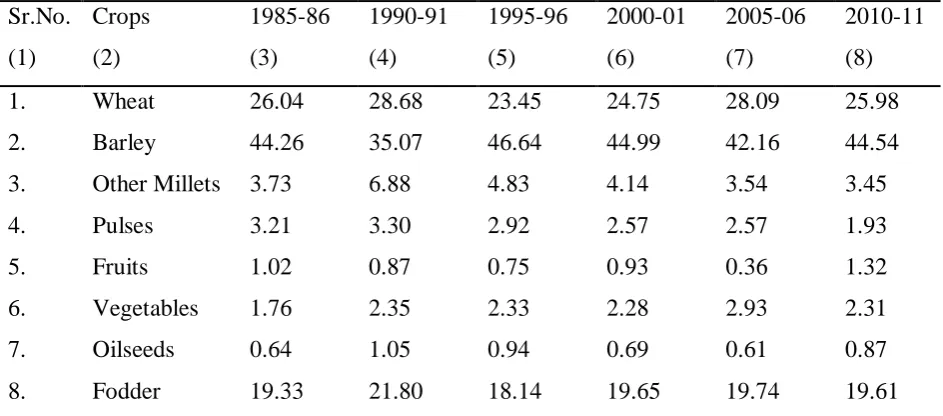
Table 3 shows that among food grain crops the share of area under wheat declined steadily while that area under barley remained more or less same. Among the non-food
grains, the area under fruits and vegetables increased over the period by varying degree. It can be attributed to the fact that the district fall in the temperate region has potential to grow temperate fruits and vegetables. It is, therefore, essential to examine the changes in the area under different crops at a block-level.
Table 4 Sr.No.
(1)
Crops (2)
1985-86 (3)
1990-91 (4)
1995-96 (5)
2000-01 (6)
2005-06 (7)
2010-11 (8)
1. Wheat 26.04 28.68 23.45 24.75 28.09 25.98
2. Barley 44.26 35.07 46.64 44.99 42.16 44.54
3. Other Millets 3.73 6.88 4.83 4.14 3.54 3.45
4. Pulses 3.21 3.30 2.92 2.57 2.57 1.93
5. Fruits 1.02 0.87 0.75 0.93 0.36 1.32
6. Vegetables 1.76 2.35 2.33 2.28 2.93 2.31
7. Oilseeds 0.64 1.05 0.94 0.69 0.61 0.87
AREAUNDER DIFFERENT CROPS, BLOCK –WISE, 2007-08 TO 2011-12 (Hectares)
Source: Computed from Statistical Handbook, Leh District, 2010-11
Note: Only combined data was available for Nyoma and Durbok blocks. Same is the case with Leh and Karu blocks.
Leh-Karu Block
Crops Area
(Hectares)
% age of total cropped area
Change
Area %
Years 2007-08 2011-12 2007-08 2011-12 2007-08 to 2011-12
Barley 1505 1841 28.44 35.61 +336 22.33
Wheat 2001 1670 37.81 32.35 -331 -16.54
Other Millets 191 90 3.61 1.74 -101 -52.88
Pulses 94 78 1.78 1.51 -16 -17.02
Fruits 16 16 0.38 0.31 0 0
Vegetables 140 172 2.65 3.33 +30 22.86
Oil seeds 42 43 0.79 0.83 +1 2.38
Fodder 1303 1252 24.62 24.25 -51 -3.91
Total 5292 5162 100 100
Khaltse Block
Barley 1123 975 55.62 59.41 -148 -13.18
Wheat 222 182 11 11.09 -40 -18.02
Other Millets 91 1 4.51 0.06 -90 -98.9
Pulses 63 64 3.12 3.9 +1 1.59
Fruits 12 12 0.59 0.73 0 0
Vegetables 74 38 3.67 2.32 -36 -48.65
Oil seeds 5 8 0.25 0.49 +3 60
Fodder 429 361 21.25 22 -68 -15.85
Total 2019 1641 100 100
Nubra Block
Barley 883 717 39.94 36.51 -166 -18.8
Wheat 728 731 32.93 37.22 +3 0.41
Other Millets 56 - 2.53 - 0 0
Pulses 87 65 3.93 3.31 -22 -25.29
Fruits 11 12 0.5 0.61 +1 9.09
Vegetables 85 53 3.84 2.7 -32 -37.65
Oil seeds 12 17 0.54 0.87 +5 41.67
Fodder 349 369 15.78 18.79 +20 5.73
Total 2211 1964 100 100
Nyoma-Durbok Block
Barley 941 955 88.94 90.35 +14 1.49
Wheat 17 12 1.61 1.14 -5 -29.41
Other Millets 21 6 1.98 0.57 -15 -71.43
Pulses 42 36 3.97 3.41 -6 -14.29
Fruits - - - -
Vegetables 14 17 1.32 1.61 +3 21.43
Oil seeds 15 22 1.42 2.08 +7 46.67
Fodder 8 9 0.76 0.85 +1 12.5
Table 4 and Map 4 reveal that most cultivated land is occupied by food grain crops which are largely grown for domestic consumption. Almost same pattern is seen in all blocks of the district with a few exceptions. Nearly 70 per cent of cultivated land was under food grain crops. Barley predominates over all other crops and its magnitude has increased. It is grown in all the blocks irrespective of varied physical conditions. It is mainly due to the fact that barley matures in short span of time. It is clear from table that highest proportion i.e. 88.94 per cent of total cropped area was under barley in Nyoma-Durbok block in 2007-08. It has marginally increased by 1.49 per cent in 2011-12. Area under wheat was 1.61 per cent of total cropped area in 2007-08. It declined to 1.14 per cent in 2011-12. Major portion of land is devoted to barley in favour of wheat due to very short agricultural season especially in higher areas. It shows the importance of barley in this block which has the highest altitude. Here, climatic conditions restrict growing other crops. However, crops such as other millets,
pulses, vegetables and oil seeds are also grown in some pockets but their proportion in total cropped area is very less.
An area covered by barley was 39.94 per cent, followed by wheat with 32.93 per cent of total cropped area during 2007-08 in Nubra block. This block is comparatively lower in altitude and has more fertile land compared to Nyoma-Durbok. Area under wheat grew by 0.41 per cent in 2011-12 and barley recorded decline by -18.8 per cent during the same year. Next, fodder crop occupied 5.78 per cent in 2007 which increased to 18.79 per cent in 2011-12. Area under pulses was 3.93 per cent in 2007-08 and it declined by -25.29 per cent in 2011-12. It may be due to increase in area under fruits which increased by 9.09 per cent during 2007-08 to 2011-12.
Largest proportion of 55.62 per cent of total cropped was occupied by barley in 2007-08 in Khaltse block. It is mainly due to importance of barley in Ladakhi society. It is followed by area under wheat which accounted for 11 per cent in 2007-08. Area under other millets was 4.51 per cent which declined to 0.06 per cent during 2007-08 to 2011-12. Fodder
Most important crop after barley is wheat which accounted for 37.81 per cent of total cropped area during 2007-08 in Leh-Karu block. It is significant to note that area under wheat
is constantly decreasing and it registered a decline of -16.54 per cent during 2007-08 to 2011-12. Area under barley covered of 28.44 per cent and it increased to 35.61 per cent from 2007-08 to 2011-12. Fodder crop covered 24.62 per cent of total cropped area. Area under
vegetables was 2.65 per cent in 2007-08 and it registered significant increase by 22.86 per cent in 2011-12. It is mainly due to proximity of this block to Leh town which provide huge market for villages of this block.
It is clear from the above discussion that farmers allocate almost equal proportion of the total area under barley and wheat crops in lower altitude blocks. Wheat does not mature properly due to extreme weather conditions leading to short growing season in the higher altitude blocks. It has been observed that proportion of land under commercial crops is going up. Vegetables are grown in almost all the blocks but there are huge variations in the distribution. It has become an important trend in agricultural development in the region due to modernisation of agriculture. This suggests that cropping pattern is changing in the district, and there is a shift from food crops to cash crops such as vegetables and fruits. Lower altitude blocks have higher proportion of area under vegetables than the higher ones. Fruits
cannot be grown in Nyoma-Durbuk block due to unfavorable climate. Area under other crops such as other millets, pulses and oilseeds are also growing in the region with varied distribution.
IV Conclusions
The analysis of cropping pattern indicated that the last few decades had seen traditional crops being replaced by commercial crops because of growing demand by tourists and deployment of security forces in the region. The area under fruits and vegetables had increased from 1985-86 to 2010-11 by varying degree. Block-wise analysis also revealed that cropping pattern is changing in the district thereby shifting from food crops to cash crops such as vegetables and fruits. Lower altitude blocks have higher proportion of area under
vegetables than the higher ones. Fruits cannot be grown in Nyoma-Durbuk block due to unfavorable climate.
Crop diversification through fruits and vegetables has a huge potential for employment and income generation in Leh district. To harness this potentiality, infrastructural facilities like access to motorable road and market, adoption of modern technology and irrigation facilities need to be strengthened through government intervention. Further, the adoption of developmental strategies incorporating regional specificities is an essential pre-requisite for creating enabling environment for fostering the process of crop diversification.
References
Aima A. (1986), “Farm Economy of Cold Desert Regions: A Case Study of Leh, Ladakh”,
Indian Journal of Economics, Vol. 65, Part – 3, No – 263, pp223-28.
Chand, Ramesh and Sonia Chauhan (2002), “Socio-Economic Factors in Agricultural Diversification in India”, Agricultural Situation in India, Vol. 58, No. 11, pp. 523-529.
Ghosh, B.K. (2011), “Essence of crop diversification: A study of West Bengal agriculture”,
Asian Journal ofAgricultural Research, Vol. 5, No. 1, pp. 28-44.
Nayak, Dinesh K. (2016), “Changing Cropping Pattern, Agricultural Diversification and Productivity in Odisha – A District-wise Study”, Agricultural Economics Research Review, Vol. 29, No. 1, pp. 93-104.
Sati, V.P. (2012), “Agricultural Diversification in the Garhwal Himalaya: A Spatio-Temporal Analysis”, Sustainable Agriculture Research, Vol. 1, No. 1, pp. 77-86