P a g e | 650
Trust Based Cloud Services
#1.THAKUR NIHAL SINGH,B.Tech Student #2.VISHWANATH DEVUNOORI,B.Tech
Student,
#3.T.POORNIMA,B.Tech Student,
#4.D.PRAVALIKA,B.Tech Student,
#5.V.DIVYAMANI,B.Tech Student
Department Of CSE,
MOTHER THERESSA COLLEGE OF ENGINEERING AND TECHNOLOGY, PEDDAPALLI, T.S, INDIA.
ABSTRACT: Trust management is one of the most challenging issues for the adoption and growth of cloud computing. The highly dynamic, distributed, and non-transparent nature of cloud services introduces several challenging issues such as privacy, security, and availability. Preserving consumer’s privacy is not an easy task due to the sensitive information involved in the interactions between consumers and the trust management service. Protecting cloud services against their malicious users (e.g., such users might give misleading feedback to disadvantage a particular cloud service) is a difficult problem. Guaranteeing the availability of the trust management service is another significant challenge because of the dynamic nature of cloud environments. In this article, we describe the design and implementation of CloudArmor, a reputation-based trust management framework that provides a set of functionalities to deliver Trust as a Service (TaaS), which includes i) a novel protocol to prove the credibility of trust feedbacks and preserve users’ privacy, ii) an adaptive and robust credibility model for measuring the credibility of trust feedbacks to protect cloud services from malicious users and to compare the trustworthiness of cloud services, and iii) an availability model to manage the availability of the decentralized implementation of the trust management service. The feasibility and benefits of our approach have been validated by a prototype and experimental studies using a collection of realworld trust feedbacks on cloud services.
Keywords: Cloud Computing, Trust Management, Security, Crypto System, Confidentiality.
I.INTRODUCTION
The highly dynamic, distributed, and nontransparent nature of cloud services make the trust management in cloud environments a significant challenge. According to researchers at Berkeley, trust and security is ranked one of the top 10 obstacles for the adoption of cloud computing. Indeed, Service-Level Agreements (SLAs) alone are inadequate to establish trust between cloud consumers and providers because of its unclear and inconsistent clauses. Consumers’ feedback is a good source to assess the overall trustworthiness of cloud services. Several researchers have recognized the significance of trust management and proposed solutions to assess and manage trust based on feedbacks collected from participants. In reality, it is not unusual that a cloud service experiences malicious behaviors (e.g., collusion or Sybil attacks) from its users. This system focuses on improving trust management in cloud environments by proposing novel ways to ensure the credibility of trust feedbacks. In particular, we distinguish the following key issues of the trust management in cloud environments:
Consumers’ Privacy
The adoption of cloud computing raise privacy concerns. Consumers can have dynamic interactions with cloud providers, which may involve sensitive information. There are several cases of privacy breaches such as leaks of sensitive information (e.g., date of birth and address) or behavioral information (e.g., with whom the consumer interacted, the kind of cloud services the consumer showed interest, etc.). Undoubtedly, services which involve consumers’ data (e.g., interaction histories) should preserve their privacy.
Cloud Services
P a g e | 651
attacks. Finally, it is difficult to predict when malicious behaviors occur (i.e., strategic VS. occasional behaviors).
Trust Management Service’s Availability
A trust management service (TMS) provides an interface be teen users and cloud services for effective trust management. However, guaranteeing the availability of TMS is a difficult problem due to the unpredictable number of users and the highly dynamic nature of the cloud environment. Approaches that require understanding of users’ interests and capabilities through similarity measurements or operational availability measurements (i.e., uptime to the total time) are inappropriate in cloud environments. TMS should be adaptive and highly scalable to be functional in cloud environments.
A. Design Overview
In this system, we overview the design and the implementation of Cloud Armor (Cloud consumers credibility Assessment & trust management of cloud services): a framework for reputation-based trust management in cloud environments. In Cloud Armor, trust is delivered as a service (TaaS) where TMS spans several distributed nodes to manage feedbacks in a decentralized way. Cloud Armor exploits techniques to identify credible feedbacks from malicious ones. In a nutshell, the salient features of Cloud Armor are:
Zero-Knowledge Credibility Proof Protocol (ZKC2P)
We introduce ZKC2P that not only preserves the consumers’ privacy, but also enables the TMS to prove the credibility of a particular consumer’s feedback. We propose that the Identity Management Service (IdM) can help TMS in measuring the credibility of trust feedbacks without breaching consumers’ privacy. Anonymization techniques are exploited to protect users from privacy breaches in users’ identity or interactions. • A Credibility Model. The credibility of feedbacks plays an important role in the trust management service’s performance. Therefore, we propose several metrics for the feedback collusion detection including the Feedback Density and Occasional Feedback Collusion. These metrics distinguish misleading feedbacks from malicious users. It also has the ability to detect strategic and occasional behaviors of collusion attacks (i.e., attackers who intend to manipulate the trust results by giving multiple trust feedbacks to a certain cloud servicein a long or short period of time). In addition, we propose several metrics for the Sybil attacks detection including the Multi-Identity Recognition and Occasional Sybil Attacks. These metrics allow TMS to identify misleading feedbacks from Sybil attacks.
An Availability Model
High availability is an important requirement to the trust management service. Thus, we propose to spread several distributed nodes to manage feedbacks given by users in a decentralized way. Load balancing techniques are exploited to share the workload, thereby always maintaining a desired
availability level. The number of TMS nodes is determined through an operational power metric. Replication techniques are exploited to minimize the impact of crashing TMS instances. The number of replicas for each node is determined through a replication determination metric that we introduce. This metric exploits particle filtering techniques to precisely predict the availability of each node.
B. The Cloud Armor Framework
P a g e | 652
in IdM before using TMS. Our framework also exploits a Web crawling approach for automatic cloud services discovery, where cloud services are automatically discovered on the Internet and stored in a cloud services repository. Moreover, our framework contains an Identity Management Service (see Figure 1) which is responsible for the registration where users register their credentials before using TMS and proving the credibility of a particular consumer’s feedback through ZKC2P.
II. RELATED WORK
According to Hatman: Intra-Cloud Trust Management for Hadoop - S. M. Khan and K. W. Hamlen, the authors quoted on Data and computation integrity and security are major concerns for users of cloud computing facilities. Many production-level clouds optimistically assume that all cloud nodes are equally trustworthy when dispatching jobs; jobs are dispatched based on node load, not reputation. This increases their vulnerability to attack, since compromising even one node suffices to corrupt the integrity of many distributed computations. This paper presents and evaluates Hatman: the first full-scale, data-centric, reputation-based trust management system for Hadoop clouds. Hatman dynamically assesses node integrity by comparing job replica outputs for consistency. This yields agreement feedback for a trust manager based on EigenTrust. Low overhead and high scalability is achieved by formulating both consistencychecking and trust management as secure cloud computations; thus, the cloud's distributed computing power is leveraged to strengthen its security. Experiments demonstrate that with feedback from only 100 jobs, Hatman attains over 90% accuracy when 25% of the Hadoop cloud is malicious. According to Privacy, Security and Trust in Cloud Computing - S. Pearson, the authors quoted on, Cloud computing refers to the underlying infrastructure for an emerging model of service provision that has the advantage of reducing cost by sharing computing and storage resources, combined with an on-demand provisioning mechanism relying on a pay-per-use business model. These new features have a direct impact on information technology (IT) budgeting but also affect traditional security, trust and privacy mechanisms. The advantages of cloud computing— its ability to scale rapidly, store data remotely and share services in a dynamic environment—can become disadvantages in maintaining a level of assurance sufficient to sustain confidence in potential customers. Some core traditional mechanisms for addressing privacy (such as model contracts) are no longer flexible or dynamic enough, so new approaches need to be developed to fit this new paradigm. In this chapter, we assess how security, trust and privacy issues occur in the context of cloud computing and discuss ways in which they may be addressed. According to Trust Mechanisms for Cloud Computing - J. Huang and D.
P a g e | 653
S. Ries, and M. Muhlhauser, the authors quoted on, Cloud computing provides cost-efficient opportunities for enterprises by offering a variety of dynamic, scalable, and shared services. Usually, cloud providers provide assurances by specifying technical and functional descriptions in Service Level Agreements (SLAs) for the services they offer. The descriptions in SLAs are not consistent among the cloud providers even though they offer services with similar functionality. Therefore, customers are not sure whether they can identify a trustworthy cloud provider only based on its SLA. To support the customers in reliably identifying trustworthy cloud providers, we propose a multi-faceted Trust Management (TM) system architecture for a cloud computing marketplace. This system provides means to identify the trustworthy cloud providers in terms of different attributes (e.g., security, performance, compliance) assessed by multiple sources and roots of trust information.
III. PROPOSED APPROACH
The Cloud Armor framework is based on the service oriented architecture (SOA), which delivers trust as a service. SOA and Web services are one of the most important enabling technologies for cloud computing in the sense that resources (e.g., infrastructures, platforms, and software) are exposed in clouds as services. In particular, the trust management service spans several distributed nodes that expose interfaces so that users can give their feedbacks or inquire the trust results. This proposed system depicts the framework, which consists of three different layers, namely the Cloud Service Provider Layer, the Trust Management Service Layer, and the Cloud Service Consumer Layer. The Cloud Service Provider Layer.
This layer consists of different cloud service providers who offer one or several cloud services, i.e., IaaS (Infrastructure as a Service), PaaS (Platform as a Service), and SaaS (Software as a Service), publicly on the Web (more details about cloud services models and designs can be found). These cloud services are accessible through Web portals and indexed on Web search engines such as Google, Yahoo, and Baidu. Interactions for this layer are considered as cloud service interaction with users and TMS, and cloud services advertisements where providers are able to advertise their services on the Web. The Trust Management Service Layer consists of several distributed TMS nodes which are hosted in multiple cloud environments in different geographical areas. These TMS nodes expose interfaces so that users can give their feedback or inquire the trust results in a decentralized way. Interactions for this layer include: i) cloud service interaction with cloud service providers, ii) service advertisement to advertise the trust as a service to users through the Internet, iii) cloud service discovery through the Internet to allow users to assess the trust of new cloud services, and iv) Zero-Knowledge Credibility Proof
Protocol (ZKC2P) interactions enabling TMS to prove the credibility of a particular consumer’s feedback.
Fig.1. System Architecture
The Cloud Service Consumer Layer. Finally, this layer consists of different users who use cloud services. For example, a new startup that has limited funding can consume cloud services (e.g., hosting their services in Amazon S3). Interactions for this layer include: i) service discovery where users are able to discover new cloud services and other services through the Internet, ii) trust and service interactions where users are able to give their feedback or retrieve the trust results of a particular cloud service, and iii) registration where users establish their identity through registering their credentials in IdM before using TMS. Our framework also exploits a Web crawling approach for automatic cloud services discovery, where cloud services are automatically discovered on the Internet and stored in a cloud services repository. Moreover, our framework contains an Identity Management Service which is responsible for the registration where users register their credentials before using TMS and proving the credibility of a particular consumer’s feedback through ZKC2P.
VI. TRUST MANAGEMENT SYSTEM
ARCHITECTURE FOR CLOUD
COMPUTING
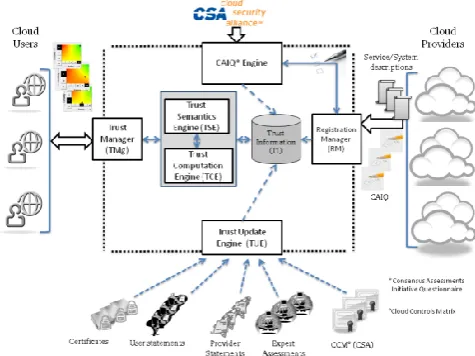
Having introduced the necessary tools for assessing, representing and computing trust, in this section, we propose a novel architecture (cf. Fig. 3) of a TM system for cloud computing marketplaces and a brief description of its internal components.
A. Registration Manager (RM)
P a g e | 654
questionnaire as a part of cloud marketplace policy. The RM forwards the answers of the questionnaire and system/service description to the CAIQ engine and TI (Trust Information) respectively for further processing.
B. Consensus Assessments Initiative Questionnaire (CAIQ) Engine
The CAIQ engine allows cloud providers to fill in the CAI questionnaire by providing an intuitive graphical interface through the RM. The questionnaire helps cloud providers to represent their competencies to the potential users with respect to different attributes. The questions are designed to be answered in ’yes’ or ’no’. All the answers are stored in the TI for further processing.
C. Trust Manager (TMg)
The TMg allows cloud users to specify their requirements and opinions when accessing the trust score of cloud providers. It provides a web-based front end to the users for specifying their requirements. Based on the requirements, the TMg provides the trust score of cloud providers by using the Trust Semantic Engine (TSE) and Trust Computation Engine (TCE). By default, users receive the trust value of a cloud provider based on the selfassessment using the CAIQ and assessment of cloud-based services/systems. Otherwise, users can specify their own preferences (e.g., security and performance are preferred over customer support), according to their business policy and requirements, to get a customized trust value of the cloud providers. Users may also choose the sources and roots of information that need to be taken into account when computing the trust value of cloud providers. The TMg should also be able to provide individual trust values in the form of opinions (o(t, c, f)) and a graphical interface (i.e., HTI) of every single attribute used for calculating the overall trust value. In the TM system architecture (cf. Fig. 3), the TMg is tightly coupled with the TSE and TCE to support the above mentioned features for the cloud users.
D. Trust Semantics Engine (TSE)
The TSE models which configuration of PLTs are considered to be the expected (trustworthy) behaviour of a cloud provider in terms of a specific attribute. A default configuration of PLTs should be based on the CAIQ answers stored in the repository (TI). The TSE should be able to convert every trust relevant information into PLTs. For deriving PLTs from system/service specifications, the TSE integrates the formal framework proposed in [29]. PLTs can also be derived from the CAI questionnaire. Especially, we model the bottom-level questions of the questionnaire, e.g., CO-01 to CO-07, in the category compliance (CO) as propositions, and ask the cloud providers for their opinions. Afterwards, we use the Certain Logic’s AND operator to combine these opinions on the propositions within each category. Finally, we combine the opinions that have been derived per category over all the categories. Moreover, this engine supports users to express
their preferred attributes and also the sources and roots of information which they choose to be taken into account. The TSE should be able to customize the configuration of PLTs in order to reflect the users’ preference. Customized PLTs are sent to the TCE for the final evaluation.
Figure 3. Architecture Overview
E. Trust Computation Engine (TCE)
The TCE consist of operations related to the operators (AND, OR, NOT, F USION, CONSENSUS, DISCOUNT ING), used in PLTs to compute the corresponding trust values. The TCE is tightly coupled with the TSE to evaluate the PLTs and compute corresponding trust values. The trust values are archived in the TI repository after computation.
F. Trust Update Engine (TUE)
The TUE allows to collect opinions from various sources and roots about the trustworthiness of cloud providers. The opinions collected here should be filtered in such a way so that the users may use the valid opinions according to their requirements. For example, spam and information filtering should be used to eliminate junk or useless information to be stored in the TI repository. The filtered opinions are then taken into account when updating the trust value of cloud providers.
VI. CONCLUSION
P a g e | 655
based attacks and allowing users to effectively identify trustworthy cloud services. In particular, we introduce a credibility model that not only identifies misleading trust feedbacks from collusion attacks but also detects Sybil attacks no matter these attacks take place in a long or short period of time (i.e., strategic or occasional attacks respectively). We also develop an availability model that maintains the trust management service at a desired level. We have collected a large number of consumer’s trust feedbacks given on real-world cloud services (i.e., over 10,000 records) to evaluate our proposed techniques. The experimental results demonstrate the applicability of our approach and show the capability of detecting such malicious behaviors. There are a few directions for our future work. We plan to combine different trust management techniques such as reputation and recommendation to increase the trust results accuracy. Performance optimization of the trust management service is another focus of our future research work.
REFERENCES
[1] A. Birolini, Reliability Engineering: Theory and Practice. Springer2010.
[2] C. Dellarocas, ―The Digitization of Word of Mouth: Promise and Challenges of Online Feedback Mechanisms,‖ Management Science, vol. 49, no. 10, pp. 1407–1424, 2003. [3] E. Bertino, F. Paci, R. Ferrini, and N. Shang, ―Privacy-preserving Digital Identity Management for Cloud Computing,‖ IEEE Data Eng. Bull, vol. 32, no. 1, pp. 21–27, 2009.
[4] I. Brandic, S. Dustdar, T. Anstett, D. Schumm, F. Leymann, and R. Konrad, ―Compliant Cloud Computing (C3): Architecture and Language Support for User-Driven Compliance Management in Clouds,‖ in Proc. of CLOUD’10, 2010.
[5] Jingwei Huang and David M Nicol, Trust mechanisms for cloud computing, April 2013
[6] J. Huang and D. M. Nicol, ―Trust Mechanisms for Cloud Computing,‖ Journal of Cloud Computing, vol. 2, no. 1, pp. 1–14, 2013.
[7] Kai Hwang Deyi Li, Trusted Cloud Computing with Secure Resources and Data Coloring, Sept.-Oct. 2010 [8] K. Hoffman, D. Zage, and C. NitaRotaru, ―A Survey of Attack and Defense Techniques for Reputation Systems,‖ ACM Computing Surveys, vol. 42, no. 1, pp. 1– 31, 2009. [9] Lina Yao Quan Z. Sheng Zakaria Maamar, Achieving High Availability of Web Services Based on A Particle Filtering Approach, 2012
[10] R. Ko, P. Jagadpramana, M. Mowbray, S. Pearson, M. Kirchberg, Q. Liang, and B. Lee, ―TrustCloud: A Framework for Accountability and Trust in Cloud Computing,‖ in Proc. SERVICES’11, 2011.
[11] S. Habib, S. Ries, and M. Muhlhauser, ―Towards a Trust Management System for Cloud Computing,‖ in Proc. of TrustCom’11, 2011.
[12] Sheikh Mahbub Habib , Sebastian Ries y, Max M• uhlh• auser, Towards a Trust Management System for Cloud Computing
[13] Siani Pearson and Azzedine Benameur, Privacy, Security and Trust Issues Arising from Cloud Computing , 2010.