EXACT PERFORMANCE MEASURES FOR
DIRECT-SEQUENCE CODE SYNCHRONIZATION IN FADING CHANNELS
Y.-H. You
School of Computer Engineering Sejong University
98 Kunja-Dong, Kwangjin-Ku, Seoul 143-747, Korea
Abstract—This paper presents an exact performance analysis for the evaluating a mean acquisition time in a cellular code division multiple access system. New expressions for the probabilities of detection, miss, and false alarm are derived in a frequency-selective Rician fading channel. From the numerical results, it is shown that our formula gives the accurate results of the mean acquisition time in the performance analysis of the parallel acquisition system with the reference filter.
1. INTRODUCTION
Radio code-division multiple access (CDMA) already plays an important role in the current wireless personal communication system (PCS) such as cellular, microcellular, indoor, and satellite communications [1–6]. Among the cellular systems being considered, IMT-2000 and wideband CDMA (W-CDMA) are both based on direct-sequence CDMA (DS-CDMA) technology [7–10]. Code synchronization is the necessary first step in the receiver of DS-CDMA systems, since data demodulation becomes possible only after code synchronization was established. A wide variety of code acquisition methods have been proposed in various mobile radio channels, analyzed and applied in a wide range of applications, especially for DS-CDMA cellular communications. Some of popular methods are multiple-dwell serial search acquisition, rapid serial search acquisition with matched filters, rapid acquisition with parallel search, and sequential acquisition [11–17].
the mean acquisition time, however, at the expense of hardware com-plexity. An approach using a bank ofN parallel I-Q noncoherent PN matched filters (PNMF) is proposed in [16, 17]. The performance of the acquisition scheme will depend on the setting of the threshold [18, 19]. In practice, a receiver has no prior knowledge about the signal-to-noise ratio (SNR) of any received PN code and it can be estimated after ini-tial synchronization [20], thus the threshold value is often determined numerically to minimize the mean acquisition time in both the search mode and the verification mode [16, 17]. Thus, it is essential to de-sign an acquisition threshold with its value being set according to the SNR of the received PN code. In [11, 12], the running average of the output of a reference filter is estimated and the result multiplied by a weighting factor is used as a decision threshold.
This paper derives and computes new expressions for acquisition probabilities of the DS-CDMA code acquisition system in a frequency-selective Rician fading channel. The acquisition system utilizes a bank of parallel I-Q noncoherent PNMF’s similar to [16, 17]. To detect a desired threshold value, this scheme employs a reference filter [11, 12]. From the numerical analysis, it is shown that the exact evaluation of the decision threshold seems more appropriate in the performance analysis of the acquisition system with the reference filter than the approximation of the decision threshold adopted in other previous works [11, 12].
The considered parallel acquisition scheme is briefly revisited in Section 2. In Section 3, the probabilities of detection, miss, and false alarm are derived for the frequency-selective Rician fading channel. Some examples are discussed in Section 4. Finally, conclusions are presented in Section 5.
2. CODE ACQUISITION SYSTEM
Generally, code acquisition schemes have two modes of operation: search mode and verification mode. In the considered parallel acquisition system, the search mode consists of a bank of N parallel detecting I-Q passive noncoherent PNMF’s and a reference I-Q PNMF. The number of taps on each delay line is M/∆ with ∆Tc delay
between successive taps, whereM is the MF length, ∆ is 2−nfor some n= 0,1,2,· · ·, andTc is the chip duration. For our analysis, a typical
value for ∆ is 1/2. Similar to [16], the full period of the PN code ofL chips is divided intoN subsequences each of lengthM =N/L. Each of theN detecting I-Q PNMFM FD has, as a reference input, one of the
subsequence of lengthM and the reference I-Q PNMFM FR is loaded
After M Tc seconds, M N/∆ samples are collected from the N
parallel detecting MF’s, the largest of the resulting M N/∆ samples is chosen, and the sum of M/∆ samples of the reference filter is divided by weighting factorD, whereDis an integer which constitutes a fundamental design parameter. If the largest of M N/∆ samples exceeds RD which is the sum divided by D, the corresponding phase
is assumed tentatively to be coarsely aligned with the received PN code signal. There is a miss probability that none of the M N/∆ samples exceed RD, in this case new M N/∆ samples are collected,
and so on. Since one of the M N/∆ samples is the correct phase, it is therefore possible to initially acquire in M Tc seconds. Most code
acquisition systems use the verification mode to confirm whether or not the tentative decision is true. However, in the CDMA reverse link, an error handling technique for slotted-mode preamble search, such as a cyclic redundancy check, is used instead of the verification mode. In this paper, we consider a single-dwell system without verification mode.
3. CODE ACQUISITION ANALYSIS IN
FREQUENCY-SELECTIVE RICIAN FADING CHANNEL
The channel to be considered in this section is the frequency-selective Rician fading channel, where the model used for the fading process is the wide-sense-stationary uncorrelated scattering (WSSUS). In deriving the probability expressions, the same assumptions used in [13, 16] are adopted.
3.1. Signal Description
The DS-CDMA transmitted signal with no data modulation can be written as
s(t) =Re
∞
l=−∞
√
2P c(t−lTc)ejw0t
(1)
whereRe(x) denotes the real part ofx,w0 is the carrier frequency, P
is the transmitter signal power, andc(t) is a real function that presents the PN spreading code, assumed a square pulse from 0 to Tc seconds
that takes values of±1. The received signal in a general Rician fading channel is given by
r(t) =Re
α
∞
l=−∞
√
2P c(t−lTc)ej(w0t+φ)
whereα is a real constant, φis a uniformly distributed random phase angle,n(t) represents AWGN with double-sided power spectral density N0/2 and zero mean, and F(t) is the faded component at the output
of the considered channel. For the WSSUS channel,F(t) is given by F(t) =Re
√
2P β
∞
−∞h(τ;t)c(t−τ)dτ e
j(w0t+φ)
(3)
whereβ is a real constant andh(τ;t) is a zero-mean complex Gaussian process. For a WSSUS channel selective only with respect to frequency, the covariance function ofh(τ;t) is written as E{h(τ1;t)h∗(τ2;t)}/2 =
ρ(τ1)δ(τ1−τ2), whereρ(τ) is a real function ofτ andδ(τ) is the Dirac
delta function. To obtain specific results, ρ(τ) used in [21], namely
ρ(τ) =
0, |τ| ≥KTc
1 KTc
1− |τ| KTc
, |τ| ≤KTc
(4)
is arbitrarily chosen. This limits the inter-symbol interference (ISI) to the adjacent KTc chips.
Referring to the parallel acquisition system in [16], the output of the I and Q branches of each I-Q PNMF is given by eI/Q =
SI/Q+FI/Q+NI/Q, where X/Y notation denotes the corresponding
term-wise pair. SI andSQare outputs due to the specular component,
and NI and NQ are independent identically distributed zero-mean
Gaussian random variables with varianceσn2 =N0M Tc/2, respectively.
Then, under hypothesisH0,SI|H0 =SQ|H0 = 0, while underH1, one
gets SI/Q|H1 =α
√
SM Tccosφ/sinφ.
Under hypothesis H1 : Since we assume that the specular component
is exactly matching with one of the I-Q PNMF’s, FI from that I-Q
PNMF is given by
FI|H1=β
√ P
M Tc
t=0
∞
τ=−∞
h(τ;t)c(t−τ)c(t)dτ dt. (5) It can be seen from [16] thatFI follows the Gaussian distribution with
zero mean and varianceσF2 =β2SM2Tc2f0/K2wheref0= (4K−1)/6. Under hypothesis H0 : FI from the I-Q PNMF is given by
FI|H0=β
√ P
(q+M)Tc
t=qTc
∞
τ=−∞
h(τ;t)c(t−τ)c(t−qTc)dτ dt (6)
cells for which|q|> K+ 1/2 (Hnocells) are non-faded samples, which
follow the Gaussian distribution with zero mean and variance σ2n; 2) 2(2K+ 1 )H0 cells for which|q|= 1/2,1,3/2,· · · , K+ 1/2 (H0,q cells)
are samples with a delay ofqchips. These samples follow the zero-mean Gaussian distribution with varianceσF,q2 =β2SM2Tc2fq/K2 [16].
From the above definitions, the probability density function (PDF) of the output Rk = e2I +e2Q of the I-Q MF’s under hypothesis H1 is
the noncentral χ2 distribution, which is given by fR(y|H1) =
1 2(σ2F +σ2
n)
exp
− B2+y 2(σ2F +σ2
n)
I0
B√y σF2 +σ2
n
(7)
while under H0 it follows the χ2 distribution with two degrees of
freedom:
fR(y|H0,q) =
1 2(σF,q2 +σ2
n)
exp
− y
2(σF,q2 +σ2 n)
; 1
2 ≤ |q| ≤K+ 1 2
(8)
fR(y|Hno) =
1 2σ2
n
exp
− y 2σ2
n
; otherwise (9)
where B = SI2 +SQ2 = α2M2Tc2P and I0(·) is the modified Bessel
function of first kind and zero order. On the other hand, a threshold value from the reference filter can be expressed asRD =D−12Mk=1Rk.
For the case of a frequency-selective Rician fading channel, it can be readily shown that under the assumption that the reference code and the transmitted code in M FR are purely orthogonal, the variance of
the output of each of the MF correlators inM FR is given byσ2R=σn2.
From this assumption, the PDF ofRD and follows theχ2 distribution
with 2M degrees of freedom:
fRD(y) =
D2M (2σ2
n)2MΓ(2M)
y2M−1exp
−Dy 2σ2 n
(10)
where Γ(p) = (p−1)! for any integerp >0. 3.2. Probability Expression
and threshold RD, which is given by
PD =
∞ 0 1 F0 exp
− M γc
(1+ Ω)F0 exp − y 2F0 I0
2M γcy
(1+ Ω)F02
·1−exp
−y 2
2L−4K−3 2K+1
m=−(2K+1) m=0
1−exp
− y 2Fm/2 ·
1−exp
−Dy 2
2M−1
k=0 1 k! Dy 2 k dy (11)
where Ω = 2β2/α2 and Fq =γcM fqΩ/K2(1 + Ω) + 1. In Eqn. (11),
γc = α2P Tc(1+ Ω)/N0 is the total received signal-to-noise ratio
(SNR/chip).
To further derive Eqn. (11), the 2(2K + 1) product term of Eqn. (11) may be rewritten in the form of
2K+1
m=−(2K+1) m=0
1−exp
− y 2Fm/2
= 1 +
2(2K+1)
k=1
(−1)k
2K+1
i1=−(2K+1) i1=0
· · ·
2K+1
ik=−(2K+1) ik=0
k j=1 exp − y 2Fij/2
= 1 +
2(2K+1)
k=1
(−1)k
2K+1
i1=−(2K+1) i1=0
· · ·
2K+1
ik=−(2K+1) ik=0
exp − y 2Fk (12)
wherei1< i2 <· · ·< ik and 1/Fk= k
j=11/Fij/2.
Substituting Eqn. (12) into Eqn. (11) and using a binomial theorem gives
PD = L
n=0
(−1)n
L n 1 2F0 exp
− M γc
(1+ Ω)F0
(PD1−PD2+PD3−PD4)
(13)
with
PD1=
2F0
1 +nF0
exp
− M γc
(1+ Ω)(1+nF0)F0
PD2 = exp
−M γc
(1+Ω)(1+nF0+DF0)F0
2M−1
k=0
DF0
1 +nF0+DF0 k+1
·2 DF
−k,1;− M γc
(1+ Ω)(1+nF0+DF0)F0
, (15)
PD3 =
2(2K+1)
k=1
(−1)k
2K+1
i1=−(2K+1) i1=0
· · ·
2K+1
ik=−(2K+1) ik=0
2F0Fk
Fk+nF0Fk+F0
·exp
− FkM γc
(1+ Ω)(Fk+nF0Fk+F0)F0
, (16)
and
PD4 = 2M−1
l=0
2(2K+1)
k=1
(−1)k
2K+1
i1=−(2K+1) i1=0
· · ·
2K+1
ik=−(2K+1) ik=0
2 D
·
DF0Fk
F0+Fk(1+nF0+DF0) l+1
exp
− FkM γc(1+ Ω)−1F0−1
F0+Fk(1+nF0+DF0)
·F
−l,1;− FkM γc(1+ Ω)−
1F−1 0
F0+Fk(1+nF0+DF0)
(17)
whereL= 2L−4K−3.
On the other hand, the miss probability of the search mode is the probability that all samples are less thanRD. This probability can be
written as
PM =
∞
0
D2M 22MΓ(2M)y
2M−1exp
−Dy
2 1−exp
−y 2 L · 2K+1
m=−(2K+1) m=0
1−exp
− y
2Fm/2 1−Q
2M γc
(1+ Ω)F0
, y F0 dy (18) with
Q(a, b) = exp
−a2+b2 2 ∞ k=0 a b k
Ik(ab) (19)
whereIk(·) is the kth-order modified Bessel function of first kind. By
PM can be also divided into four terms as
PM = L
n=0
(−1)n
L n
(PM1−PM2+PM3−PM4) (20)
where
PM1 =
D D+n
2M
, (21)
PM2 =
DF0
1 +nF0+DF0 2M
·exp
− M γc(n+D)
(1+ Ω)(1+nF0+DF0)
∞
l=0
1 l!
M γc
(1+ Ω)F0 l
·F
l−2M + 1, l+ 1 ;− M γc
(1+ Ω)(1+nF0+DF0)F0
, (22)
PM3 =
2(2K+1)
k=1
(−1)k
2K+1
i1=−(2K+1) i1=0
· · ·
2K+1
ik=−(2K+1) ik=0
DFk
1 +nFk+DFk 2M
,
(23)
and
PM4 = exp
−M γcF0−1
1 + Ω
∞
l=0
1 l!
M γc
(1+ Ω)F0
l2(2K+1)
k=1
(−1)k
·
2K+1
i1=−(2K+1) i1=0
· · ·
2K+1
ik=−(2K+1) ik=0
DF0Fk
F0+Fk(1+nF0+DF0) 2M
·exp
− FkM γc(1+ Ω)−1F0−1
F0+Fk(1+nF0+DF0)
·F
l−2M+ 1, l+ 1 ;− FkM γc(1+ Ω)
−1F−1 0
F0+Fk(1+nF0+DF0)
. (24) Finally, the false alarm probability can be obtained from PD and PM
3.3. Mean Acquisition Time
For a single-dwell parallel acquisition scheme, the transfer function is simply obtained by
U(z) = PDz
M Tc
1−
PM ·zM Tc+Tr +PF ·zM Tc+Tp
(25)
where the average penalty time for a returning false alarmTp and the
average reset time for a miss detectionTr are assumed to be same, i.e.
Tp = Tr = J M Tc. Then, the mean acquisition time E [Tacq] can be
calculated as
E [Tacq] =
dU(z) dz
z=1
= {1 +J(1−PD)}M Tc PD
.
(26)
In this paper, we derive some probability expressions for detection, false alarm, and miss for a considered single-dwell system without verification mode. However, the results can be extended to a double-dwell system with verification mode [16][17] in a straightforward manner.
4. EXAMPLES AND DISCUSSIONS
In simply validating the effectiveness of presented analysis for the considered parallel system, we used the following parameters, namely: 1) PN code length of 1023 chips is considered, 2) matched filter lengths (M) of 93 chips are taken, which correspond to the number of parallel I-Q MF N = 11, 3) a penalty factor (J) of 10000 chips is used.
Figure 1shows the mean acquisition time versus the weighting factor D according to various values of SNR/chip when K = 50 and Ω = 1.5 are used. In this figure, the mean acquisition time has been normalized by Tc. An immediate conclusion is that optimal values of
20 25 30 35 40
Weighting Factor
1E+002 1E+003 1E+004 1E+005 1E+006 1E+007 1E+008
E[Tacq]
/Tc
SNR = -20
SNR = -15
SNR = -10
SNR = -5
Figure 1. Mean acquisition time versus D for various values of SNR when K = 50 and Ω = 1.5 are used: (1) Solid lines - exact mean acquisition time (2) Dash lines - approximated mean acquisition time.
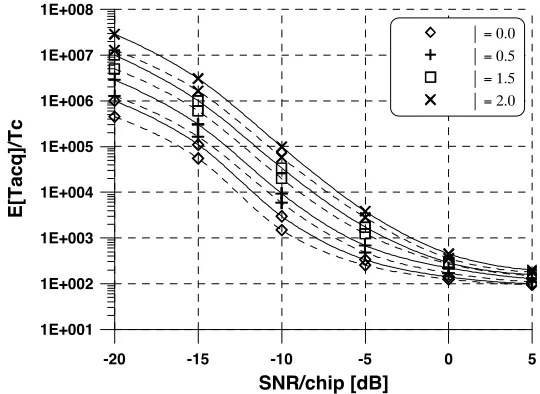
-20 -15 -10 -5 0 5
SNR/chip [dB]
1E+001 1E+002 1E+003 1E+004 1E+005 1E+006 1E+007 1E+008
E[Tacq]
/Tc
= 0.0 = 0.5 = 1.5 = 2.0
The comparison between the approximated and the exact mean acquisition time is given in Fig. 2 for a selected value of D = 30. It can be seen from this figure that the approximation of the threshold value is reasonable especially for a high SNR/chip. However, there are noticeable differences in mean acquisition time performance between the exact expression when SNR/chip is low. In particular, numerical examples show that the approximation gives significantly optimistic mean acquisition time values at low SNR/chip.
5. CONCLUSION
In this paper, an exact formulation for obtaining the acquisition probabilities for the DS-CDMA parallel code acquisition system with the reference filter has been developed in a frequency-selective Rician fading channel. To evaluate the mean acquisition time in a single-dwell acquisition system without verification mode, some expressions of acquisition probabilities for the parallel acquisition system were obtained and is readily evaluated numerically. We find that our formula provides the accurate results of the mean acquisition time in the performance analysis of the parallel acquisition system with the reference filter.
ACKNOWLEDGMENT
This research is supported by the Ubiquitous Computing and Network (UCN) Project, the Ministry of Information and Communication (MIC) 21st Century Frontier R&D Program in Korea, and this research is supported by Seoul R&BD Program.
REFERENCES
1. Dolil, S. A., A. Y. Al-Nahari, M. I. Desouky, and F. E. A El-Samie, “Uplink power based admission control in multi-cell WCDMA networks with heterogeneous traffic,” Progress In Electromagnetics Research B, Vol. 1, 115–134, 2008.
2. Al-Kamali, F. S., M. I. Dessouky, B. M. Sallam, and F. E. A. El-Samie, “Frequency domain interference cancellation for single carrier cyclic prefix CDMA system,”Progress In Electromagnetics Research B, Vol. 3, 255–269, 2008.
4. Tarhuni, N., T. Korhonen, and M. Elmusrati, “State-of-polarization encoding for optical code-division multiple-access networks,” Journal of Electromagnetic Waves and Applications, Vol. 21, No. 10, 1313–1321, 2007.
5. Dessouky, M., H. Sharshar, and Y. Albagory, “Improving the cellular coverage from a high altitude platform by novel tapered beamforming technique,” Journal of Electromagnetic Waves and Applications, Vol. 21, No. 13, 1721–1731, 2007.
6. Mu, M. K., J. T. Huangfu, L. X. Ran, and K. Zang, “Design of lightning protector compatible for both 2G and 3G cellular systems,” Journal of Electromagnetic Waves and Applications, Vol. 20, No. 15, 2167–2175, 2006.
7. Liu, W. C. and C. F. Hsu, “CPW-FED notched monopole antenna for UMTS/IMT-2000/WLAN applications,” Journal of Electromagnetic Waves and Applications, Vol. 21, No. 6, 841–851, 2007.
8. Wang, F. J. and J. S. Zhang, “Wideband printed dipole antenna for multiple wireless services,”Journal of Electromagnetic Waves and Applications, Vol. 21, No. 11, 1469–1477, 2007.
9. Bilotti, F., M. Manzini, A. Alu, and L. Vegni, “Polygonal patch antennas with reactive impedance surfaces,” Journal of Electromagnetic Waves and Applications, Vol. 20, No. 2, 169–182, 2006.
10. Shamsinejad, S., M. Soleimani, and N. Komjani, “Novel miniaturized wilkinson power divider for 3G mobile receivers,” Progress In Electromagnetics Research Letters, Vol. 3, 9–16, 2008. 11. Ibrahim, B. B. and A. H. Aghvami, “Direct sequence spread spec-trum matched filter acquisition in frequency-selective Rayleigh fading channels,” IEEE Journal on Selected Area in Commun., Vol. 12. No. 5, 885–890, June 1994.
12. Krzymien, W., A. Jalali, and P. Mermelstein, “Rapid acquisition algorithms for synchronization of bursty transmissions in CDMA microcellular and personal wireless systems,” IEEE Journal on Selected Area in Commun., Vol. 14. No. 3, 570–579, April 1996. 13. Su, Y. T., “Rapid code acquisition algorithm employing PN
matched filter,” IEEE Trans. Commun., Vol. COM-36, 724–733, June 1988.
15. Lee, S. and J. Kim, “Performance analysis of DS-SS PN code acquisition systems using soft-decision techniques in a Rayleigh-fading channel,” IEEE Trans. Vehicular Technology, Vol. 51, No. 6, 1587–1595, November 2002.
16. Sourour, E. and S. C. Gupta, “Direct-sequence spread spectrum parallel acquisition in nonselective and frequency-selective Rician fading mobile channels,” IEEE Journal on Selected Area in Commun., Vol. 10, No. 3, 535–544, April 1992.
17. Sourour, E. and S. C. Gupta, “Direct-sequence spread spectrum parallel acquisition in a fading mobile channel,” IEEE Trans. Commun., Vol. COM-38, 992–998, July 1990.
18. Iinatti, J., “On the threshold setting principles in code acquisition of DS-SS signals,” IEEE Journal on Selected Area in Commun., Vol. 18, No. 1, 62–72, January 2000.
19. Noneaker, D., A. Raghavan, and C. Baum, “The effect of automatic gain control on serial, matched-filter acquisition in direct-sequence packet radio communications,” IEEE Trans. Vehicular Technology, Vol. 50, No. 4, 1140–1150, July 2001. 20. Hua, J., L. Meng, Z. Xu, and D. Wang, “A new method for SNR
and Doppler shift estimation in wireless propagations,”Journal of Electromagnetic Waves and Applications, Vol. 21, No. 15, 2431– 2441, 2007.