Available online: https://edupediapublications.org/journals/index.php/IJR/ P a g e | 66
Remote Data Checking in Clouds
Ms.Farhat Begum
1, Prof.Dr.G.Manoj Someswar
2Research Scholar, VBS Purvanchal University, Jaunpur, U.P., India
Research Supervisor, VBS Purvanchal University, Jaunpur, U.P., India
ABSTRACT
Late mechanical advances have offered ascend to the notoriety and accomplishment of cloud. This new
worldview is picking up a growing enthusiasm, since it gives cost effective models that help the
transmission, stockpiling, and concentrated processing of information. In any case, these promising
stockpiling administrations bring many testing configuration issues, impressively because of the loss of
information control. These difficulties, to be specific information classification and information
respectability, have noteworthy effect on the security and exhibitions of the cloud framework. Some
danger models accept that the cloud specialist organization can't be trusted, and in this manner security
creators propose an abnormal state security confirmation, for example, putting away scrambled
information in cloud servers. Others assume that cloud suppliers can be trusted, and that potential
dangers come essentially from outside aggressors and different vindictive cloud clients. Furthermore, a
cloud client can never deny a potential server breakdown. Thus, there are a few difficulties that should be
tended to as for security and protection in a cloud setting.
This proposition goes for defeating this
exchange off, while considering two information
security concerns. On one hand, we concentrate
on information secrecy safeguarding which
turns out to be more complex with adaptable
information sharing among a dynamic
gathering of clients. It requires the mystery of
outsourced information and an efficient sharing
of unscrambling keys between different
approved clients.
For this reason, we, in the first place, proposed
another technique depending on the utilization
of ID-Based Cryptography, where every
customer goes about as a Private Key
Generator. That is, he creates his own open
components and infers his comparing private
key utilizing a mystery. Because of IBC
properties, this commitment is appeared to help
information security and confidentiality, and to
be impervious to unapproved access to
information amid the sharing procedure, while
considering two sensible risk models, to be
specific a genuine however inquisitive server
and a malignant client foe.
Second, we characterize CloudaSec, an open key
based arrangement, which proposes the
partition of membership based key
administration and privacy situated deviated
encryption strategies. That is, CloudaSec
empowers adaptable and versatile sending of the
arrangement and also solid security ensures for
outsourced information in cloud servers. Trial
comes about, under Open Stack Swift, have
demonstrated the efficiency of CloudaSec in
versatile information sharing while at the same
time considering the effect of the cryptographic
Available online: https://edupediapublications.org/journals/index.php/IJR/ P a g e | 67 Then again, we address the Proof of Data
Possession (PDP) concern. Actually, the cloud
client ought to have an efficient approach to
perform periodical remote respectability
confirmations, without keeping the information
locally, following three considerable angles:
security level, open certainty, and execution.
This worry is amplified by the customer's
compelled stockpiling and calculation capacities
and the expansive size of outsourced
information.
Keeping in mind the end goal to satisfy this
security prerequisite, we initially characterize
another zero-learning PDP protocol that gives
deterministic honesty check ensures, depending
on the uniqueness of the Euclidean Division.
These assurances are considered as fascinating,
contrasted with a few proposed plans, showing
probabilistic methodologies.
At that point, we propose SHOPS, a
Set-Homomorphism Proof of Data Possession plot,
supporting the 3 levels of information
confirmation. SHOPS empowers the cloud
customer not exclusively to acquire a proof of
ownership from the remote server, yet in
addition to check that a given information
document is dispersed over numerous capacity
gadgets to accomplish a specific wanted level of
blame tolerance. Without a doubt, we display
the set homomorphism property, which
stretches out pliability to set operations
properties, for example, union, convergence and
incorporation. SHOPS display high security
level and low preparing many-sided quality. For
example, SHOPS spares vitality inside the cloud
supplier by appropriating the calculation over
numerous hubs. Every hub gives confirmations
of neighbourhood information square sets. This
is to make appropriate, subsequent evidence
over arrangements of information squares,
fulfilling a few needs, for example, proofs
accumulation.
Keywords:
Set-Homomorphism Proof of DataPossession, PDP protocol, pseudorandom capacities (PRFs), Proof of Data Possession (PDP), Third Party Auditor (TPA)
PDP and PoR Review
In this segment, we initially acquaint the innocent
approach with play out remote information looking
at and we point its fundamental disadvantages. At
that point, we give a diagram of a few developing
PDP and PoR plans.
Naive Approach
The Proof of Data Possession (PDP) is a test
reaction convention empowering a customer to
check whether a document information D put away
on a remote cloud server is accessible in its unique
frame. A PDP plot comprises of four strategies:
pre-process, challenge, confirmation, check (cf. Fig
1). For building meta-information of a document,
the customer runs the pre-preparing method. In a
large portion of the cases, the customer keeps the
meta-information mystery and sends a variant of
the information record to the cloud server (e.g.,
encoded information, mistake coding, inserted
watermark).
To check the ownership of the information record, the customer sends a randomized test to the server for a proof
of predetermined document information. Accordingly, the server creates the confirmation which requires the
ownership of the first information to figure the evidence which relies upon the got test to stay away from the
Available online: https://edupediapublications.org/journals/index.php/IJR/ P a g e | 68
Figure 1 - Generic PDP scheme
The least complex answer for outline a PDP plot
depends on a hash work H(). That is, the customer
pre-ascertains k arbitrary difficulties ci, where I 2
f1; kg and figures the comparing proofs as pi =
H(cijjD). Amid the testing methodology,[1] the
customer sends ci to the server which registers p0i
= H(cijjD). On the off chance that the correlation
holds, the customer assumes that the cloud supplier
protects the right information document. The
greatest impediment of this plan is the settled
number of difficulties that were registered in the
pre-handling methodology. That is, the customer
can ask for the server, for honesty checking, just k
times.
Introduction to Remote Data Checking
Schemes
The thought of PDP has first been presented by
Ateniese et al. in That is, the customer separates the
document information D into pieces and makes a
cryptographic tag for each square bi, as Ti;b =
(H(Wi)gbi)d)modN, where N is a RSA number, g
is an open parameter, d is the mystery key of the
information proprietor and H(Wi) is an irregular
esteem. The evidence age is performed by
conglomerating a few cryptographic labels, in light
of the asked for information piece records.
It is efficient as there is no compelling reason to
recover information obstructs for the confirmation
of information ownership. The primary downsides
are calculation intricacy due huge number of
particular exponentiations in both setup stage and
check stage, and the private verifiability which
requires the mystery key of the information
proprietor. In Ateniese et al. propose an openly
irrefutable rendition, which enables any element to
challenge the cloud server. In any case, is uncertain
against replay assaults in powerful situations in
light of the conditions of list hinders in
confirmation age and the loss of homomorphism
property in the check methodology.[2]
Juels et al. acquaint a strategy with identify
unapproved changes of put away information by
haphazardly including sentinels in the first
information. Their plan, called Proof of Retrieve
capacity (PoR), does not bolster open undeniable
nature. Likewise, just a settled number of
difficulties is permitted.
As of late, Xu et al. propose another idea to
demonstrate the server information ownership.
That is, the customer makes labels as polynomials
Available online: https://edupediapublications.org/journals/index.php/IJR/ P a g e | 69 to polynomials. The confirmation system depends
on polynomial duty and utilizations assessment in
the exponential rather than bilinear maps. This
thought has additionally been received by in light
of Lagrangian insertion.
Security Requirements
The arrangement of a remote data checking plan is
stirred by offering assistance of both generosity and
efficiency,[3] while considering the confined
amassing and taking care of advantages of
customer devices. It needs to fulfill the going with
necessities:
• Public irrefutable nature: individuals all in
all data possession check is a basic require-ment,
enabling any affirmed substance to affirm the
rightness of outsourced data. In this way, the data
proprietor can be calmed from the heaviness of
limit and computation.
• Stateless affirmation: confirmations
should be made by a self-assertively virtuoso
induced challenge. In this way, stateless
affirmation requires the usage of unordinary
regards.[4]
Low computation overhead: on one hand, for
flexibility reasons, the measure of count at the
dispersed stockpiling server should be also
restricted, as the server may be related with
concurrent associations. Of course, the proposed
counts should in like manner have low taking care
of multifaceted nature, at the client side.
Low correspondence overhead: an efficient PDP
ought to limit the utilization of transfer speed,
depending on low correspondence cost.
• Low stockpiling cost: the constrained
stockpiling limits of the client gadgets have a basic
significance in planning our answer. So that, low
stockpiling cost at the customer side is profoundly
prescribed.[5]
• Unlimited challenges: the quantity of
difficulties ought to be boundless. This condition is
considered as imperative to the efficiency of a PDP
plot.
In the accompanying subsections, we introduce the
advancements of PDP and PoR plans, with a
specific end goal to enhance open certainty,
efficiency, and dynamic information bolster,
separately.
Public Verifiability
Enhancing open unquestionable status has turned
into a well known subject for specialists, since the
presentation of the main unique PoR plot, proposed
by Juels et al. Based on Shacham et al. propose
two new PoR plans. The primary instrument is
secretly obvious and it depends on pseudorandom
capacities (PRFs). Be that as it may, the quantity of
verification tokens put away on the server is
relative to the quantity of information squares, and
the proposed method does not keep from
information pieces' spillage.[5] The second plan
depends on bilinear marks, proposed by Boneh et
al. in. This second technique guarantees open
information check and the evidences are decreased
to a solitary validation esteem, along these lines
diminished correspondence unpredictability from
O(n) to O(1), where n is the quantity of information
squares. Sadly, this plan still takes a shot at static
information just, without help of dynamic
Available online: https://edupediapublications.org/journals/index.php/IJR/ P a g e | 70 In 2009, Wang et al. proposed a novel framework
display, which depends on a Third Party Auditor
(TPA) In light of a protection saving outsider
reviewing convention, the TPA is considered as a
put stock in substance, which deals with the put
away information in cloud. That is, the information
proprietor delegates periodical information
uprightness confirmations to the TPA, which
assumes responsibility of observing trades between
the customer and the remote cloud server. In TPA
receives an open key based homomorphic
authenticator to perform open evaluating without
keeping a nearby duplicate of information for
respectability checking. Homomorphic
authenticators are utilized to confirm
meta-information produced from singular meta-information
squares while the accumulated authenticators frame
a direct mix of information pieces.
A while later, Zhu et al. propose a development of
a dynamic review conspire for un trusted remote
stockpiling frameworks. Their plan identifies
anomalous conduct of the prover by utilizing part
structure, irregular testing, and list hash table.
Despite the fact that TPA based plans permit open
information honesty check, they have a significant
downside.[6] That is, they require an extra
segment, which is an outsider examiner, added to
the current distributed storage design. The usage of
such plans may be a weight for specialist co-ops as
a result of extra expenses.
E
ffi
ciency
As examined above, efficiency of remote
information checking plans comprises on the
optimization of calculation multifaceted nature,
correspondence overhead and capacity cost. A few
research works are dedicated to enhance efficiency
of PDP and PoR plans.[7] For example, in 2008,
Curtmola et al. coordinate blunder rectifying codes
to the PDP plot, proposed by Ateniese et el. in],
keeping in mind the end goal to secure different
reproductions over distributed framework without
encoding each different copy. This system
considerably diminishes the calculation
multifaceted nature. Moreover, Dodis et al.
enhance the Shacham PoR plot by decreasing the
test size to be direct concerning the security
parameter, from O (n2) to O(n).
In Ateniese et al. propose an enhanced form of
their unique PDP conspire, alluded to as versatile
PDP plot. receives symmetric key encryption
rather than open key encryption which decreases
the calculation overhead. It likewise underpins
refreshes on outsourced information. In any case,
adaptable PDP does not bolster people in general
undeniable nature necessity, because of the
utilization of the symmetric key cryptography. In
addition, all difficulties and checks must be
pre-processed, and the quantity of updates is
constrained and settled from the earlier.
A while later, Bowers et al. present an appropriated
cryptographic framework, to demonstrate
information irretrievability. Their plan, called
HAIL (High Availability and Integrity Layer),
differs from every single earlier work. Truth be
told, HAIL considers a dispersed setting in which a
customer must spread a document over various
servers with repetition and just stores a little
consistent state locally.
Dynamic Data Support
In this area, we give a review of remote uprightness
check plots that help dynamic information
refreshes. In any case, we need to take note of that
we don't think about this plan necessity, in the
Available online: https://edupediapublications.org/journals/index.php/IJR/ P a g e | 71 Supporting dynamic information refreshes in
remote trustworthiness confirmation plans is a
challenging concern. In 2008, Ateniese et al.
presented the principal mostly unique PDP
conspire, where piece inclusion was not upheld.[9]
In 2009, Erway et al. proposed a Dynamic Provable
Data Possession system (DPDP) . Their plan
bolsters full unique operations (eg., affix, embed,
alter, erase), while depending on rank-based
validated catalogs. All things considered, keeps up
a rundown of labels and stores root metadata, at the
customer side to avoid replay assaults.
Accordingly, the computational com-plexity raises
up to O(logn), which stays alluring, because of the
help of dynamic updates. For example, to create a
proof for 1 GB document, DPDP delivers just 415
KB evidence data, with 30 ms computational
overhead.
Wang et al. propose a dynamic evidence conspire,
which depends on the utilization of homomor-phic
tokens with circulated check of eradication coded
information. It gives piece refresh, erase and annex
operations and does not bolster the embed work. Be
that as it may, includes an outsider evaluator to
guarantee open certainty.
Summary
At long last, we express that PDP and PoR plans
are considered as advancing methodologies which
guarantee remote information uprightness checking
in distributed storage situations. The main PDP and
PoR plan calculations are a bit different, with
respect to a few perspectives. For example, PoR
plans are thought to be more secure contrasted with
PDP calculations. That is, PoR instruments require
the encryption of the first information and mistake
rectifying codes must be connected to recoup
harmed information. Be that as it may, PDP plans
are known for higher efficiency and materialness to
expansive scale open databases, for example,
computerized libraries.
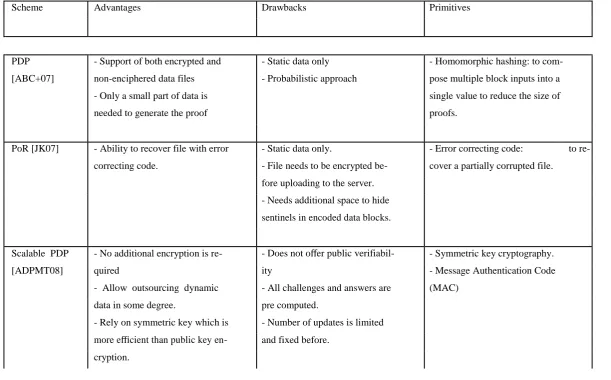
Table 1 compresses a few remote information
checking plans. That is, we lead a comparison
between these rising methodologies, while
counting the preferences and downsides of every
instrument. What's more, we concentrate on the
cryptographic natives associated with the age and
Available online: https://edupediapublications.org/journals/index.php/IJR/ P a g e | 72
Table 1 - Approaches of Data Integrity Checking in the Cloud Storage Environments
Scheme Advantages Drawbacks Primitives
PDP - Support of both encrypted and - Static data only - Homomorphic hashing: to com-
[ABC+07] non-enciphered data files - Probabilistic approach pose multiple block inputs into a
- Only a small part of data is single value to reduce the size of
needed to generate the proof proofs.
PoR [JK07] - Ability to recover file with error - Static data only. - Error correcting code: to re-
correcting code. - File needs to be encrypted be- cover a partially corrupted file.
fore uploading to the server.
- Needs additional space to hide
sentinels in encoded data blocks.
Scalable PDP - No additional encryption is re- - Does not offer public verifiabil- - Symmetric key cryptography.
[ADPMT08] quired ity - Message Authentication Code
- Allow outsourcing dynamic - All challenges and answers are (MAC)
data in some degree. pre computed.
- Rely on symmetric key which is - Number of updates is limited
more efficient than public key en- and fixed before.
cryption.
HAIL [BJO09] - Ability to check integrity in dis- - Static data only - Pseudo-random functions
tributed storage via data redun- - Message Authentication code
dancy. (MAC)
- Proof is compact in size and is - Universal hash functions.
Available online: https://edupediapublications.org/journals/index.php/IJR/ P a g e | 73
CHA
P
T
5.
R
E
MO
T
E
D
A
T
A
CHEC
K
ING
IN
CLO
UD
Available online: https://edupediapublications.org/journals/index.php/IJR/ P a g e | 74 As of late, in Bowers et al. investigate new monetary
security models for cloud administrations. They give
a different plan of the dangers that cloud clients
confront. That is, RAFT proposes an approach
affirming information repetition on capacity
frameworks, in light of a period measure work. The
fundamental disservice of this plan is the
correspondence cost which relies upon the quantity of
squares in the testing demand, and the capacity cost
restrictively vital. Truth be told, the creators
uncovered two confirmation approaches. To begin
with, they propose a private confirmation calculation
to check the exactitude of server's reactions in view
of a nearby duplicate put away by the information
proprietor. While this choice may efficiently work for
a few situations, it is excessively prohibitive in
numerous different cases as it undermines a great part
of the advantages of cloud outsourcing. Second, with
a specific end goal to enhance stockpiling limit
utilization, they allude to the Merkle Tree signature.
Subsequently, this strategy additionally requires the
utilization of a mystery for each outsourced
information document.
Thinking about other testing worries to give remote
evidence confirmations, means to demonstrate
redress information encryption very still by forcing a
period premise convention. An issue emerging in the
plan of this hourglass convention is the way that the
customer needs a credible variant of the outsourced
information document, to check reactions from the
server. Be that as it may, the customer's stockpiling
needs ought to be of consistent size, generally the
advantages of information outsourcing diminish. So
as to improve capacity cost at the customer side,
proposes to utilize extra MACs or Merkle Tree forms
at the customer side. This requires the customer
recovers the trustworthiness checks amid the test
reaction convention which raises the transmission
capacity utilization. Likewise, the verifier must keep
a mystery for each outsourced information (if MACs
are utilized) or the base of the hash tree.
Based on, Williams and Sion propose SR-ORAM
conspire. It permits a customer concealing its
information get to design from an untrusted cloud
server in a solitary round convention. In any case,
this plan requires a poly-logarithmic capacity cost
and does not bolster open sharing check.
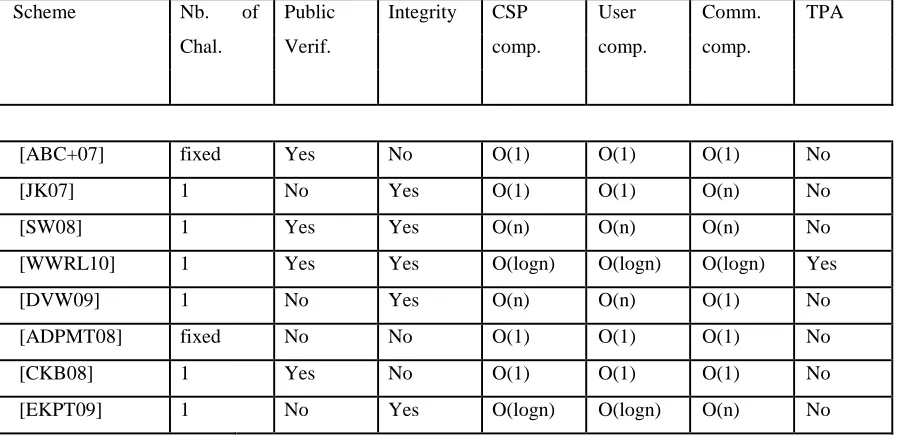
In Table 2, we condense the above inspected PoR and
PDP conspires by an exhaustive correlation of their
exhibitions, in view of security necessities displayed
in this research paper. Actually, we audit the capacity
to help a boundless number of difficulties, meant by
the Nb. of chal metric. What's more, we look at
people in general unquestionable status outline
prerequisite and the retrieve ability highlight, meant
by Public Verif. what's more, Integrity, separately.
We should take note of that, by retrieve ability
include, we mean the help of remote information
trustworthiness checking. In addition, we
contemplate the heartiness and efficiency of surveyed
calculations, while breaking down the calculation and
correspondence many-sided quality at both the
Available online: https://edupediapublications.org/journals/index.php/IJR/ P a g e | 75 the arrangement of a Third Party Auditor, looking for
a completely assignment of respectability checking
operations. At long last, we need to take note of that
plans set apart by a reference mark ( ) bolster either
in part or completely unique information refreshes.
It is imperative that plans guaranteeing dynamic
information bolster suffer from higher complexities
contrasted with their partners. Future research
bearings incorporate changes on efficiency and
completely powerful information bolster. To enhance
efficiency of those plans, lessening correspondence
cost and capacity overhead are legitimate
contemplations. Be that as it may, completely unique
information bolster remains a testing objective, since
it builds many-sided quality while diminishing
refresh data at the cloud server side
Table 2 - Performances Comparison for Remote Data Verification Schemes in Cloud
Data Storage Environments (n is the number of data blocks)
Scheme Nb. of Public Integrity CSP User Comm. TPA
Chal. Verif. comp. comp. comp.
[ABC+07] fixed Yes No O(1) O(1) O(1) No
[JK07] 1 No Yes O(1) O(1) O(n) No
[SW08] 1 Yes Yes O(n) O(n) O(n) No
[WWRL10] 1 Yes Yes O(logn) O(logn) O(logn) Yes
[DVW09] 1 No Yes O(n) O(n) O(1) No
[ADPMT08] fixed No No O(1) O(1) O(1) No
[CKB08] 1 Yes No O(1) O(1) O(1) No
[EKPT09] 1 No Yes O(logn) O(logn) O(n) No
Conclusion
In distributed storage conditions, it is essential to
enable clients to efficiently and safely confirm that
distributed storage servers store their information
accurately. To address this issue, various Proof of
Retrievability (PoR) and Proof of Data Possession
(PDP) plans have been proposed wherein servers
must demonstrate to a verifier that information are
put away effectively. In this part, we give an outline
Available online: https://edupediapublications.org/journals/index.php/IJR/ P a g e | 76 showing security prerequisites for the outline of a
PDP and a PoR calculation.
While existing POR and PDP plans offer fair
arrangements tending to different practical issues,
they either have non-trifling (direct or quadratic)
correspondence and computational multifaceted
nature, or just help private confirmation. Recently
developing remote information confirmation plans
intend to give both pragmatic and genuine honesty
checking for remote calculation. Towards this
objective, Setty et al. propose to profit by early
research results, for example, intuitive verification
framework. These instruments are alluded to as
perfect strategies that empower a cloud customer to
confirm a proof's accuracy in a consistent time, while
depending on a reasonably encoded proof under an
immaterial possibility of false positives.
Following this heading, we display, in next parts, our
commitments for safely checking outsourced
information trustworthiness. Both PDP suggestions
guarantee open irrefutability and stateless
confirmations, and have following identifiable
highlights:
lightweight and exceedingly secure PDP plot with
concentrated calculation done at the CSP: our third
commitment depends on zero information proofs. It
profits by the lightweight calculation cost of the
Euclidean Division (ED) and the high security level
of zero information conventions, keeping in mind the
end goal to give deterministic confirmations, with
consistent correspondence overhead. Be that as it
may, our zero-learning proposition requires the CSP
to bring together the calculation of the confirmation
at the portal focal hub after re-amassing the
information sections from the putting away hubs
circulated confirmation calculation by the CSP: our
fourth commitment, alluded to as SHOPS proposes
an adaptable and particular information uprightness
check conspire. SHOPS is an intriguing way to deal
with spare vitality, since it proposes to appropriate
the prover capacity to many putting away hubs, in
this manner giving low calculation many-sided
quality at the CSP.
References
1. Prasad P, Ojha B. (13 march 2011) '3 Dimensional
security in Cloud Computing', Computer Research
and Development (ICCRD), 3rd International
Conference, 198-201.
2. Qian Wang, Cong Wang. (May 2011) 'Enablic
Public Auditability and Data Dynamics for Storage
Security in Cloud Computing', IEEE Transactions on
Parallel and Distributed Systems, 847-859.
3. Q.L Nguyen. (June 2011) 'Designing SCIT
architecture pattren in a Cloud based environment',
41st International Conference on Dependable
Systems and Networks workshop (DSN-W),
123-128.
4. Ran Liu, Jian-Ping Li. (2010) 'A Predictive
Available online: https://edupediapublications.org/journals/index.php/IJR/ P a g e | 77
Cloud Computing environment', Apperceiving
Computing and Intelligence Analysis (ICACIA),
International Conference 2010, 22-25.
5. Rihoux B, R.C. (2004) 'Qualitative Comparative
analysis (QCA): state of the art and prospects ',
APSA 2004 Annual Meeting Panel 47-9, Chicago.
6. Sanka S, H.C. (Dec.2010) 'Secure data access in
Cloud Computing', IEEE 4th International
Conference on Internet Multimedia Services
Architecture and Application (IMSAA), 1-6.
7. Saripalli P, Walters B. (July 2010) 'A Quantitative
Impact and Risk Assessment Framwork for Cloud
Security ', 3rd International Conference on Cloud
Computing , 280-288.
8. Shucheng Yu, Cong Wang. (March 2010)
'Achieving secure Scalabe and Fine grained data
access control in Cloud Computing ', IEEE
Conference INFOCOM , 1-9.
9. Sirisha A, Kumari G. (Dec 2010) 'API access
control in Cloud using the Role Based Access
Control Model', Trendz in Information sciences &
Computing (TISC), 135-137.
10. Somani U, Lakhani K. (Oct 2010) 'Implementing
Digital signature with RSA Encryption algorithm to
enhance the data security of Cloud in Cloud
Computing', 1st International Conference on Parallel
Distributed and Grid Computing , 211-216.
11. Sravan Kumar R, Saxena A. (jan 2011) 'Data
Integrity proofs in Cloud storage', Communication
Systems and networks (COMSNETS), Third
International Conference 2011, 1-4.
12. Srinivasatava Prashant, Singh Satyam. (June
2011) 'An Architecture based n Proactive model for
Securrity in Cloud Computing', International
conference on recent Trends in Information