Optimisation of Downlink Resource Allocation
Algorithms for UMTS Networks
Michel Terr ´e
Conservatoire National des Arts et M´etiers (CNAM), 292 rue Saint Martin, 75003 Paris, France Email:[email protected]
Emmanuelle Vivier
Institut Sup´erieur d’Electronique de Paris (ISEP), 28 rue Notre Dame des Champs, 75006 Paris, France Email:[email protected]
Bernard Fino
Conservatoire National des Arts et M´etiers (CNAM), 292 rue Saint Martin, 75003 Paris, France Email:[email protected]
Received 22 October 2004; Revised 3 June 2005; Recommended for Publication by Sayandev Mukherjee
Recent interest in resource allocation algorithms for multiservice CDMA networks has focused on algorithms optimising the aggregate uplink or downlink throughput, sum of all individual throughputs. For a given set of real-time (RT) and non-real-time (NRT) communications services, an upper bound of the uplink throughput has recently been obtained. In this paper, we give the upper bound for the downlink throughput and we introduce two downlink algorithms maximising either downlink throughput, or maximising the number of users connected to the system, when orthogonal variable spreading factors (OVSFs) are limited to the wideband code division multiple access (WCDMA) set.
Keywords and phrases:resource management, capacity optimisation, code division multiple access, OVSF, multiservices.
1. INTRODUCTION
Third generation (3G) wireless mobile systems like UMTS provide a wide variety of packet data services and will proba-bly encounter an even greater success than already successful existing 2G systems like GSM [1]. With the growing number of services, the optimisation of resource allocation mecha-nisms involved in the medium access control (MAC) layer is a difficult aspect of new radio mobile communications sys-tems. The resource allocation algorithm allocates the avail-able resources to the active users of the network. These re-sources could be radio rere-sources: they are time-slots in the case of a 2.5G network like (E)GPRS, but in a 3G network like UMTS, using WCDMA technology, they are spreading codes and power. Each user of data services can request, depend-ing on his negotiated transmission rate, a spreaddepend-ing code of variable length with a corresponding transmission power at each moment. In a cell, we have real-time (RT) commu-nications services that are served with the highest priority
This is an open access article distributed under the Creative Commons Attribution License, which permits unrestricted use, distribution, and reproduction in any medium, provided the original work is properly cited.
and non-real-time (NRT) communications services that are served with the lowest priority. Having allocated resources to the RT services, the base station then has to allocate resources to NRT services. In this paper we consider two possible cri-teria: the greatest number of allocated NRT services and the maximisation of the downlink throughput [2].
Most of notations used in this paper are close to those of [3,4,5,6] where the downlink case was analysed, and of [7,8,9,10] concerning the uplink case.
Compared with these previous papers, we take into con-sideration the problem of the orthogonal variable spread-ing factors (OVSF) of UMTS terrestrial radio access network (UTRAN) solution where spreading factors are limited to the wideband code division multiple access (WCDMA) finite set [11,12,13,14]. This constraint was neither introduced in [5,6] where algorithms presented are then perfectly suited for the UTRAN context, nor in [10] where the spreading fac-tor set used is infinite and yields to a complex search table algorithm.
Following approach presented in [9] for the uplink, we first introduce in the paper the optimal downlink upper bound, in order to compare performances of proposed al-gorithm with this upper bound.
The remainder of the paper is organised as follows: main notations are introduced inSection 2. The upper bound for the aggregate downlink throughput is given inSection 3. The solution for the powers to the NRT flows is given inSection 4. Two allocation algorithms are detailed in Section 5. The proof of the optimality of the proposed “downlinkDSF-U al-gorithm” is given inSection 6. Simulations results are finally presented inSection 7.
2. NOTATIONS
We consider a cell withQRT terminals andMNRT termi-nals. Let 0 ≤ pi ≤ Pmax andNi ∈ N+ be the transmis-sion power and spreading factor of the ith flow at slot t.
Pmax is the maximum transmission power of the base sta-tion. N+ is the set of possible spreading factors. Let g
i > 0 be the channel gains between the base station and the
ith user andIi the interference level for the ith user. This interference level includes the background, thermal noise power, and the intercell interference power.Ii does not in-clude the intracell interference power due to other flows (RT and NRT) of the cell.
Indexi=1, 2,. . .,Qis devoted to RT terminals while
in-dexi=Q+ 1,Q+ 2,. . .,Q+Mis devoted to NRT terminals.
For each NRT user, we introduce a new gi variable repre-senting its own “channel quality” defined by the ratio of its channel gain to its interference level:gi=gi/Ii. Without loss of generality, we assumegQ+1≥g
Q+2≥ · · · ≥gQ+M, so lower index values correspond to higher channel quality.
We assume that the coherence time of the most rapidly varying channel is greater than the duration of a time slot, so that the variations of the channel are small enough to con-sider that the gains are constant over a time slot.
We introduceΓirepresenting the target signal-to-noise-plus-interference ratio requested for RT or NRT services.
Finally we introduce the constant 0≤α≤1, representing the loss of orthogonality of downlink spreading codes. We considerα=0 for an additive white Gaussian noise channel, where codes stay orthogonal at the input of the terminal re-ceiver, and typicallyα=1/2 for a multipath channel, where orthogonality is partially lost.
Therefore, for theith terminal we have
Γi= Nipig i
1 +αPT−pigi, (1)
wherePT = Qk=1+Mpkrepresents the sum of allocated pow-ers either to RT terminals (k∈[1,Q]) or to NRT terminals (k∈[Q+ 1,Q+M]).
Constraints are 0 ≤ PT ≤ Pmax andNi ∈ N+. The ag-gregate downlink throughput of NRT terminalsΩ↓NRTis pro-portional to the sum of the inverse of the allocated spread-ing factors:Ω↓NRT ∝Q+M
i=Q+11/Ni. In this paper we consider
that all NRT terminals correspond to the same service cate-gory and request all the same QoS and then the same signal-to-noise-plus-interference ratio. We then haveΓi =Γfor all
i∈[Q,Q+ 1].
3. UPPER BOUND FOR THE DOWNLINK
THROUGHPUT
The upper bound for the downlink throughput is straightfor-ward. We allocate powers to RT flows considering that resid-ual available power is then allocated to the first NRT flow (having the highest channel quality). Actually we can first consider the choice between allocating the maximal power either to the first NRT flow with a spreading factorNQ+1or to the second NRT flow with a spreading factor NQ+2. Due to the constant term equal to one in (1) and the nondecreas-ing function f(x) = ax/(1 +bx),a,b > 0, it appears that
g
Q+1 > gQ+2 leads to 1/NQ+1 > 1/NQ+2, so the first solution
gives a higher throughput. We now consider a solution allo-cating powers to both flowsQ+1 andQ+2. It is then obvious that the power allocated to the second NRT flow generates a higher throughput if it is transferred to the first NRT flow. Generalising this result to more than two flows gives the so-lution for maximising the downlink throughput. The ideal and minimal spreading factorNQ+1 for the fist NRT flow is obtained using (1) by
NQ+1=
Γ1 +αPRTg Q+1
Pmax−PRT
g
Q+1
, (2)
wherePRT =Q
k=1pk represents power allocated to RT ter-minals.
This allocation leads to the following optimal upper bound for the downlink throughputΩ↓∗NRT ∝1/NQ+1. How-ever, NQ+1 has no reason to be in the set of valuesN+ =
{4, 8, 16, 32, 64, 128, 256, 512}that have been normalised for UTRAN downlink [11,12,13,14]. Consequently,Ω↓∗NRT is a theoretical upper bound forΩ↓NRT. In this paper we pro-pose an optimal downlink allocation algorithm where allo-cated spreading factors belong to the finite set of available spreading factors of UTRAN.
4. POWERS ALLOCATED FOR NRT FLOWS
We propose to split the allocation problem in two steps. First we identify a set of spreading factors N =
(N1,N2,. . .,NQ,NQ+1,. . .,NQ+M) suited to the UTRAN
con-straints and, in a second step, the corresponding powers
p = (p1,p2,. . .,pQ,pQ+1,. . .,pQ+M) are computed. For the
spreading factors allocation, RT services define rigorously the
Qfirst spreading factors (N1,N2,. . .,NQ) and the degree of freedom of the allocation algorithm concerns only theMlast spreading factors (NQ+1,. . .,NQ+M).
we then have “feasible” and, once spreading factors are allocated, piis di-rectly obtained by combining (5) and (3). If constraints are not checked, the allocation is not possible and the through-put must be decreased through an increase of the spreading factors.
5. NRT SPREADING FACTORS ALLOCATION ALGORITHMS
In this section we propose two allocation algorithms. In both cases we first allocate RT terminals, then we continue with NRT terminals sorted in ascending order (numbered from
Q+ 1 toQ+M, corresponding to the channel qualitygQ+1 to gQ+M). Both algorithms check that powers obtained by solving (5) lead to 0 ≤ PT ≤ Pmax. If this condition is not checked, the algorithm stops and keeps the last correct allocation. The first algorithm, so-called downlink discrete spreading factor down (downlinkDSF-D), first allocates the highest spreading factor (SF=512) to the greatest number of NRT terminals in order to maximise the number of served terminals. If possible, it then decreases progressively all the spreading factors, starting with the terminal with the high-est channel quality in the cell (NQ+1), then NQ+2, and so forth. If the allocation is not possible, the algorithm ends and the spreading factor of the processed terminal keeps its previous value. In the paper we note Ni = ∞if no spread-ing factor is allocated to the correspondspread-ing terminal. Obvi-ously, this algorithm maximises the number of users simul-taneously served and tries, if possible, in a second time, to increase as much as possible the downlink throughput but without decreasing the number of served terminals. The sec-ond algorithm, so called downlink discrete spreading factor up (downlinkDSF-U) proceeds terminal by terminal and in order to maximise the aggregate downlink throughput, it al-locates the lowest spreading factor (SF=4) to the terminal with the highest channel quality in the cell (NQ+1), then to the second (NQ+2), and so forth. If the allocation is not possible, the spreading factor of the processed terminal is increased until a correct set of{Ni} is found; otherwise,the terminal
is rejected and the algorithm stops. This second algorithm optimises the downlink throughput. The proof is presented in the next section.
6. OPTIMALITY OF THE DOWNLINKDSF-UP ALGORITHM
Definition1 (definition of an arranged solution). Arranging a solutionN=(N1,. . .,NQ,NQ+1,. . .,NQ+M) consists in con-sidering onlyMlast spreading factors corresponding to NRT terminals and for them (1) reordering spreading factors in increasing order, and (2) in the case of two equal factors
Nk = Nk+1(> Nmin) to recombineNk byNk/2 and Nk+1 by
∞. The operation is reiterated as many times as possible. At the end of the process the solution is arranged. Throughputs of the original solution and its arranged version are equals. Except forNi=Nmin =4, any NRT spreading factor cannot appear twice in the last spreading factors set of the arranged solution.
Theorem 2. For any solution N = (N1,. . .,NQ,NQ+1,. . ., NQ+K)the corresponding arranged solution leads to a reduction
of the transmitted powerPT =Qi=1+Kpi.
Proof ofTheorem 2. (A) Permutation: we consider two so-lutions N1 = (N for any NRT terminal). For the numerator we notice that
M+Q−2 terms are similar for these two powers. We then have to analyse 4 terms in order to compare powers corre-sponding to these two different spreading factors allocations:
signPT2−P1 and after some easy derivation,
signPT2−P1
(i) Analysis ofNum1−Num2: After successive reordering and permuting we obtain the ar-ranged version of the original solution. It has same through-put, lowerPT, and anyNi =4 can appear only once.
Remark1. If a solutionN2is possible, it means that 0≤P2 T ≤
Pmax, then we have Den1 >Den2 >0 andP1T < PT2 ≤Pmax. With (5) we conclude that the arranged versionN1 of any possible solutionN2exists always and is possible.
Theorem 3. The downlinkDSF-U algorithm maximises the aggregate downlink throughput.
Proof ofTheorem 3.We consider an exhaustive search among all possible solutions. We identify the solution Nbest giving the highest throughput and minimising, for this throughput, the transmitted power PT. Because PT is minimal, this so-lution is necessarily arranged (cf.Theorem 2). We now com-pare spreading factors used by this optimal solutionNbestand those used by the downlinkDSF-U algorithmNUp. If we can find an NRT index isuch thatNbest
i > NiUp then, since
W-CDMA spreading factors are successive powers of 2, we have
Nbest
i ≥ 2NiUp. The corresponding throughput difference is then greater or equal to (2NiUp)−1. At this point, even if for
all j > i,NUpj = ∞, this throughput loss cannot be
bal-anced by spreading factors corresponding to indices j > i of the “best” solution. To check this, we just have to con-sider that for all j≥i,Nbest ditional throughput is maximal when each spreading factor is replaced by its minimal value. Accordingly,
Ωbest
In order to prove Theorem 3, we just have to compare spreading factorsNbestandNUp.
Fori=Q+ 1, we have three possibilities. (i) Nbest
Q+1 > N
Up
Q+1: as mentioned earlier this case is impos-sible because it leads toΩUp>Ωbest.
(ii) NQbest+1 < N
Up
Q+1: this case is impossible because the downlinkDSF-U algorithms have minimisedNQUp+1. (iii) Nbest
Q+1=N Up
Q+1: so the two solutions are equivalent. Having finallyNQbest+1=N
Up
Q+1, we can now consideri=Q+ 2 and so forth following the same argument. At the end, we obtain Nbest = NUp. The downlinkDSF-U algorithm gives the optimal solution, which maximises then the downlink throughput.
7. SIMULATION RESULTS
RT and NRT terminals are uniformly distributed in the cell at distances from the base station from 325 m–1.2 km. In order to determine the channel gains, we chose Okumura-Hata propagation model in an urban area with f =2 GHz,
hbase station = 40 m, and hterminal = 1.5 m. LetPmax = 10 W andIinter = −63 dBm (equivalent to 6 base stations situated 2.4 km away from the base station and transmitting atPmax).
ΓRT andΓNRT are set to7.4 dB.Qis set to 50 andM varies from 1–500. Finally,NRT=256 andα=0.5.
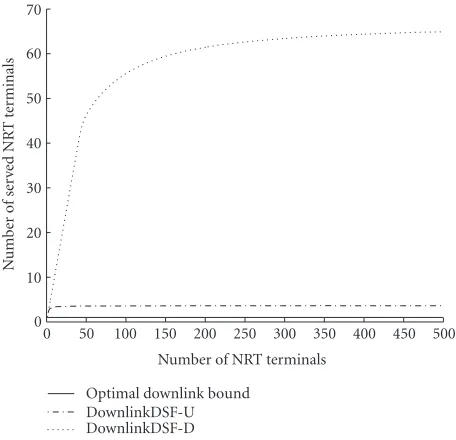
Simulation results represent mean values obtained af-ter more than thousand trials.Figure 1illustrates the varia-tions ofΩ↓∗NRT,Ω↓NRTobtained with downlinkDSF-U and with downlinkDSF-D. Actually, a constant chip rate (including the radio supervision) of 5120 chips per 10/15 milliseconds is performed with UTRAN. The aggregate downlink through-put of NRT terminals is then equal toΩ↓NRT=Mi=17.68/Ni, in Mbps (7.68 is the UTRAN 3.84 chip rate doubled with modulation).
0 50 100 150 200 250 300 350 400 450 500 Number of NRT terminals
600 700 800 900 1000 1100 1200 1300 1400 1500 1600
Thr
o
ug
hpu
t
(kbps)
Optimal downlink bound DownlinkDSF-U DownlinkDSF-D
Figure 1: Ω↓∗NRT and Ω↓NRT obtained with downlinkDSF-U and
downlinkDSF-D.
0 50 100 150 200 250 300 350 400 450 500 Number of NRT terminals
0 10 20 30 40 50 60 70
N
u
mb
er
of
ser
ve
d
NR
T
ter
minals
Optimal downlink bound DownlinkDSF-U DownlinkDSF-D
Figure2: Number of simultaneously transmitted NRT services with
downlinkDSF-U and downlinkDSF-D, as a function of the total number of active NRT services in the cell.
Figure 2gives the number of simultaneously transmit-ted NRT services with downlinkDSF-U and downlinkDSF-D as a function of the total number of active downlink NRT terminals in the cell. Objectives of the two algorithms are different and this figure is just an illustration more than a performance comparison. It is recalled that with the upper bound, only one NRT terminal is served. It appears that when downlinkDSF-D is applied, the number of simultane-ous transmitted NRT services is exactlyM whenM is low
0 50 100 150 200 250 300 350 400 450 500 Number of NRT terminals
7.5 8 8.5 9 9.5 10
M
ean
val
u
e
for
the
total
do
w
n
link
po
w
er
(W
att)
DownlinkDSF-U DownlinkDSF-D
Figure3: Mean value of the downlink power.
(typically lower than 40). Then, as the base station uses all its power to reach more and more terminals benefiting from worse and worse conditions of propagation, it cannot satisfy all NRT services and the individual rates remain minimum. Therefore, the aggregate throughput is nearly proportional to the number of simultaneously served NRT services. On the opposite, the downlinkDSF-U never transmits simulta-neously information to more than 4 NRT terminals. Further more, the probability of having terminals benefiting from better conditions of propagation increases with M increas-ing.
Figure 3gives the total power radiated by the base sta-tion with respect to the number of active NRT services in the cell. It appears that the power is close to the 10 W max-imum value. This maxmax-imum value is quickly obtained with the downlinkDSF-U, while the downlinkDSF-D seems to be unable to serve all terminals and therefore has to choose ter-minals with good channel quality in order to reach this max-imal power value.
8. CONCLUSION
spreading factors and considering the multicodes allocation principle. The two optimal algorithms are legitimate, respec-tively, for the operators (seeking maximum revenue) and users (seeking a fair part of the available resources). We have shown that these allocations are quite opposite so that trade offalgorithms have to be studied. A suggestion for further work is to look for maximising throughput in short term while looking for fair use of the resources among users in the long term.
REFERENCES
[1] P. Stuckmann,The GSM Evolution: Mobile Packet Data Ser-vices, John Wiley & Sons, Chichester, UK, 2003.
[2] S. Ramakrishna and J. M. Holtzman, “A scheme for through-put maximization in a dual-class CDMA system,”IEEE J. Se-lect. Areas Commun., vol. 16, no. 6, pp. 830–844, 1998. [3] J.-H. Wen, J.-S. Sheu, and J.-L. Chen, “An optimum downlink
power control method for CDMA cellular mobile systems,” in
Proc. IEEE International Conference on Communications (ICC ’01), vol. 6, pp. 1738–1742, Helsinki, Finland, June 2001. [4] L. Nuaymi, P. Godlewski, and X. Lagrange, “Power allocation
and control for the downlink in cellular CDMA networks,” in
Proc. 12th IEEE International Symposium on Personal, Indoor and Mobile Radio Communications (PIMRC ’01), vol. 1, pp. C-29–C-33, San Diego, Calif, USA, September–October 2001. [5] D. I. Kim, E. Hossain, and V. K. Bhargava, “Downlink joint rate and power allocation in cellular multirate WCDMA sys-tems,”IEEE Transactions on Wireless Communications, vol. 2, no. 1, pp. 69–80, 2003.
[6] D. I. Kim, E. Hossain, and V. K. Bhargava, “Dynamic rate and power adaptation for provisioning class-based QoS in cellu-lar multirate WCDMA systems,”IEEE Transactions on Wireless Communications, vol. 3, no. 5, pp. 1590–1601, 2004.
[7] R. Jantti and S.-L. Kim, “Transmission rate scheduling for the non-real-time data in a cellular CDMA system,”IEEE Com-mun. Lett., vol. 5, no. 5, pp. 200–202, 2001.
[8] F. Berggren, S.-L. Kim, R. Jantti, and J. Zander, “Joint power control and intracell scheduling of DS-CDMA non real time data,”IEEE J. Select. Areas Commun., vol. 19, no. 10, pp. 1860– 1870, 2001.
[9] S.-J. Oh, D. Zhang, and K. M. Wasserman, “Optimal resource allocation in multiservice CDMA networks,”IEEE Transac-tions on Wireless CommunicaTransac-tions, vol. 2, no. 4, pp. 811–821, 2003.
[10] S. A. Jafar and A. Goldsmith, “Adaptive multirate CDMA for uplink throughput maximisation,”IEEE Transactions on Wire-less Communications, vol. 2, no. 2, pp. 218–228, 2003. [11] 3GPP, “General UMTS architecture,” TS 23.101, v. 4.0.0, April
2001.
[12] 3GPP, “UTRAN overall description,” TS 25.401, v.6.1.0, June 2003.
[13] 3GPP, “Spreading and modulation (FDD),” TS 25.213, v.5.2.0, September 2002.
[14] 3GPP, “Radio resource management strategies,” TS 25.922, v.5.0.0, March 2002.
[15] O. Sallent, J. Perez-Romero, F. J. Casadevall, and R. Agusti, “An emulator framework for a new radio resources management for QoS guaranteed services in W-CDMA systems,”IEEE J. Select. Areas Commun., vol. 19, no. 10, pp. 1893–1904, 2001.
Michel Terr´e was born in 1964. He re-ceived the Engineering degree from the Institut National des T´el´ecommunications, Evry, France, in 1987, the Ph.D. degree in signal processing from the Conservatoire National des Arts et M´etiers, Paris, France, in 1995, and the Habilitation `a Diriger des Recherches (HDR) degree from the Univer-sity Paris XIII, Villetaneuse, France, in 2004. He first had an industrial career in research
and development, mostly in the field of radio communications at TRT-Philips, Paris, Thal`es Communications, Colombes, France, and Alcatel, Nanterre, France. Since 1998, he has been an Assistant Professor at the Conservatoire National des Arts et M´etiers, Paris. Dr. Terr´e is a Senior Member of SEE.
Emmanuelle Vivier was born in 1972. She received the Engineering degree from the Institut Sup´erieur d’Electronique de Paris, France, in 1996, the Mast`ere de-gree from the Ecole Nationale Sup´erieure des T´el´ecommunications, Paris, France, in 1997, and the Ph.D. degree in radio com-munications from the Conservatoire Na-tional des Arts et M´etiers, Paris, in 2004. She first had an industrial career in research and
development at Bouygues Telecom, Paris, France. Since 1999, she has been a Professor at the Institut Sup´erieur d’Electronique de Paris, where she heads the Telecommunication Department.
Bernard Fino was born in 1945. He received the Engineering D.E. degree from the Ecole Nationale Sup´erieure des T´el´ecommunications, Paris, France, in 1968, and the M.S. and Ph.D. degrees in electrical engineering and computer science from the University of California, Berkeley, in 1969 and 1973, respectively. He first had an industrial career in research and development, mostly in the field of radio