R E S E A R C H
Open Access
On signal processing scheme based on
network coding in relay-assisted D2D
systems
Bo Li
1, Qiuming Zhao
1, Ruofei Ma
1*, Hongjuan Yang
1, Gongliang Liu
1and Weidang Lu
2Abstract
Network coding (NC) can greatly improve a system’s performance on throughput and channel utilization via corresponding signal processing on the relay side. Implementation of NC in relay-assisted device-to-device (RA-D2D) communications is a promising way to further explore the advantages of RA-D2D communications in cellular systems. This paper proposes a signal processing scheme for RA-D2D which jointly takes into account NC and optimal relay selection. First, the optimal relay user equipment (UE) is selected by jointly considering the end-to-end data rate, end-to-end transmission delay, and relay survival time. Then, in the procedure of signal processing, the transmitted useful signal is combined with interference signal for NC operation, and finally, the original useful signal is recovered at the destination node. Simulation results show that the proposed scheme is able to not only eliminate the interference effectively but also has a superior performance on end-to-end transmission delay, reachability, and amount of transmitted information than that without NC. In particular, signal processing via NC is equivalent to encrypting the signal, which further enhances the information security in D2D communications.
Keywords: D2D signal processing, Network coding, Relay selection, Interference cancellation
1 Introduction
People constantly send and receive messages in different ways, in which the essence is to solve the problems on sig-nal transmission, processing, and detection [1, 2]. With the continuous improvement of communication and sig-nal processing methods, great progress has been made in both effectiveness and reliability. However, it is envi-sioned that, in future networks, more and more wireless terminals will be included, and communication systems should be able to provide access interfaces for these terminals. Therefore, how to improve system capacity and channel utilization with limited resources is critical [3,4]. The research of [5] introduces the device-to-device (D2D) communication technology under the control of the base station (BS) in the cellular network, and it demonstrates that users can directly perform signal trans-mission to complete the communication, whereas the BS
*Correspondence:[email protected]
1School of Information Science and Engineering, Harbin Institute of Technology (Weihai), Weihai, China
Full list of author information is available at the end of the article
is only responsible for allocating resources and controlling the whole communication process, which improves the resources’ usage efficiency and reduces the burden of BS [6, 7]. When the distance between the D2D users is too far to establish a direct link, an idle user can be selected as a relay node to form a relay-assisted D2D (RA-D2D) link to complete the end-to-end signal trans-mission in two time slots. However, the end-to-end rate and reliability of the signal will be affected due to the user mutual interference which will inevitably occur. In previ-ous researches, the interference was mainly controlled via performing joint scheduling on resource allocation, power control, and communication mode selection at the BS [8–12]. In the traditional relay-assisted communication system, the relay node is responsible for store-and-forward without performing any signal processing [13]. In [14], it is proved that network coding (NC) can improve system throughput and transmission rate through arith-metic processing in relay. The early study in [15–17] identified that NC can be implemented into RA-D2D sig-nal processing to effectively eliminate interference and improve transmission rate and reliability of the system.
However, the issue of relay selection and resource allo-cation are not considered. In [18], the RA-D2D signal processing based on NC was further improved, in which the coding and modulation were adaptively performed according to link quality. Although a scheduling scheme jointly considering resource allocation, power control, and relay selection was proposed in [19], the factors taken into account were not comprehensive. The researches men-tioned above are all based on the situation of a single antenna. In [20], NC was implemented into multi-hop and multi-antenna RA-D2D signal processing, and it was proved that bringing NC into RA-D2D signal processing could achieve further improvement on the system perfor-mance and enhance security in the data transmission.
In view of the deficiencies in the existing researches, this paper will implement NC into the relay selection of RA-D2D to achieve more efficient cross-layer relay selection and resource allocation. End-to-end data rate, end-to-end transmission delay, and relay survival time will be jointly considered when NC signal processing is per-formed to select the optimal relay node. Hence, the overall communication process will be optimized.
The main contributions of this paper are summarized as follows:
First, we propose a session mechanism for network coding involved D2D communications, which is mainly implemented in the relay-assisted D2D communication mode. With this mechanism, the interference signal gen-erated by the cellular users is used to perform network coding process at the relay node, thereby improving trans-mission efficiency and saving resources while eliminating interference.
Second, we incorporate the proposed networking cod-ing mechanism into the relay selection process in the relay-assisted D2D communications. By jointly consider-ing the network codconsider-ing processconsider-ing at the candidate relay nodes, the to-end data rate of the relay path, end-to-end delay of the relay path, and the remaining battery capacity of the candidate relay nodes, the new relay selec-tion scheme is expected to provide an even better overall transmission performances. Simulation results demon-strate the better performance of our proposed scheme and reveal the impact of network coding on D2D communica-tion systems based on optimal relay seleccommunica-tion.
The remainder of this paper is organized as follows. In Section2, we introduce the system model. The proposed joint scheme is presented in Section3. Simulation results are provided in Section 4 to illustrate the performance of the proposed algorithms. We conclude this paper in Section5.
2 System model
The system model in this paper is a single-cell scenario in modern cellular systems (e.g., LTE-A). Assume that there
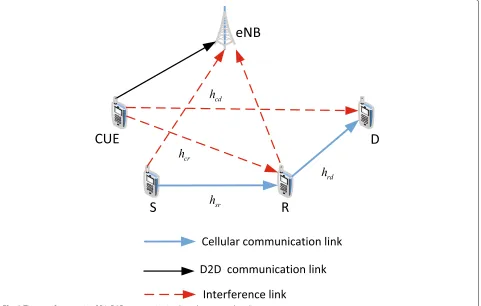
is efficient interference coordination between adjacent cells, with which, the base stations in different cells can perform power coordination and semi-persistent resource scheduling between cells via exchanging the user equip-ment (UE) information and resource usage information [21, 22]. In such a way, the inter-cell interference can be minimized. Hence, the inter-cell interference is omit-ted in this paper to emphasize the research focus. The researched single-cell scenario only includes a base sta-tion, cellular user equipments (CUEs), relay-capable UEs (RUEs), and D2D-capable UEs (DUEs), as shown in Fig.1. In order to emphasize the research focus on the influence of network coding processing on relay selection in D2D communications, it is just assumed that there are only one pair of D2D communications users. Meanwhile, there areNCUEs andMRUEs, denoted as [C1,C2, ...Cj, ...CN] and [R1,R2, ...Ri, ...RM], respectively. The transmitter and receiver of the DUEs are denoted by S and D respec-tively. It is assumed that the cell is overloaded; that means resources are not idle and cannot be separately allocated to DUEs, and only CUEs’ uplink resources can be reused [23]. DUEs can communicate directly or with RA-D2D mode according to channel quality and communication requirements. For each of the two communication modes, at most, one CUE’s uplink resource can be reused. In RA-D2D communication mode, transmitter-to-relay and relay-to-receiver transmissions are finished in two time slots, and transmitter-to-relay and relay-to-receiver links reuse the same uplink resource. As a result, the CUE whose uplink channel is reused will generate interference to the relay UE and the receive DUEs. In addition, assume that all UEs in the cell are under the control of the BS, which can acquire all channel state information, control DUEs’ communication mode, select the reused resource, and optimize the relay selection.
Based on a comprehensive survey on the path loss sce-narios mentioned in 3GPP releases (e.g., Release 9 [24]), a channel gain model given in [25] is adopted in analysis of the communication process, which jointly considered the path loss, slow fading, and fast fading. Such a channel gain model can ensure the universality of the proposed strat-egy. One can easily modify such a channel gain model to make the proposed relay selection strategy applicable in a specific propagation scenario suggested in [24]. The chan-nel gain between transmitteraand receiverbis defined as
|ha,b|2=K0βa,bs β f
a,bd−a,bα (1)
whereK0da,b−α is the path loss given in 3GPP Release 9,K0 is a constant whose value corresponds to the implemented path loss model, da,b is the distance from the transmit-ter to the receiver,α is is the path loss exponent,βa,bs is
Fig. 1System model for a single-cell scenario in modern cellular systems
3 The proposed joint scheme
3.1 RA-D2D signal processing scheme based on network coding
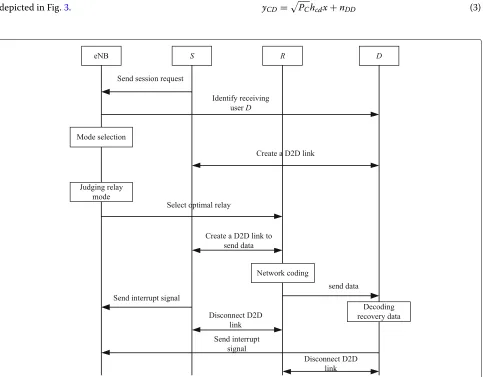
In this paper, the specific scenario of RA-D2D signal pro-cessing based on NC is shown in Fig.2.SandDare the two DUEs, R is a RUE, and the CUE is a cellular user whose uplink resources are reused. Note that the same CUE’s uplink channel is reused by the RA-D2D commu-nications in the two time slots, and the CUE’s interference to RUERand the receive DUEDduring the signal trans-mission are taken into account. In the scheduling, when selecting the cellular uplink channel that can be used by the researched D2D link, the required signal to noise and interference ratio (SINR) of the reused uplink channel is assured. Power control strategy at the source UEs is not considered in this paper and the interference suppression is just guaranteed by selecting the optimal cellular uplink channels that can be reused.
In addition, all UEs are assumed to be with single antenna and work on half-duplex mode. The specific pro-cedure for session establishment and communication is depicted in Fig.3.
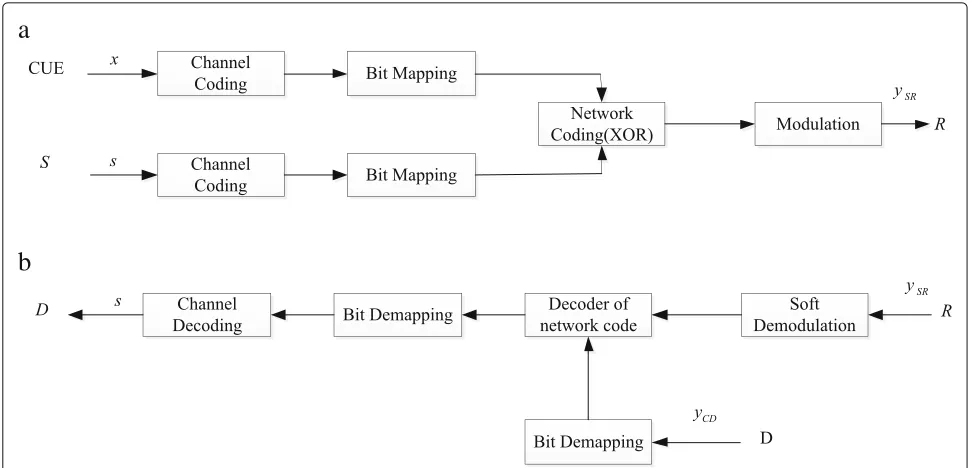
Let x and s denote the signal sent by the CUE to the BS and the signal from S to D respectively. We divide the NC-based RA-D2D signal processing into two phases: transmitting phase and receiving phase. In this work, linear channel coding and BPSK modulation are assumed to be used in the network coding assisted D2D communications. The block diagram for the signal pro-cessing procedure is shown in Fig.4. As a result, the CUE whose uplink channel is reused will generate interference to the relay UE and the receive DUEs. In addition, we assume that the distance from the CUE to the DUE and the link quality meet the restriction requirements, so the signals transmitted by the CUE can be correctly detected at both the relay and the DUED.
In the first phase, the relayRreceives the signal trans-mitted by the CUE andS, andDreceives the interference signals transmitted by the CUE. The received signals atR
andDcan be expressed as
ySR=
PShsrs+
PChcrx+nSR (2)
yCD=
PChcdx+nDD (3)
a
b
Fig. 4The two phases of the signal processing based on network coding in RA-D2D communication:aTransmitting phase.bReceiving phase
wherePCandPCare the transmit power of the DUEs and the CUE respectively. hsr , hcr, and hcd are the channel gains between the users;nSR andnDD are additive white Gaussian noises.
In the second phase, the relay nodeRrecoverssˆandxˆ
by maximum likelihood detection and then performs net-work coding operation (XOR) and transmits the encoded signalxˆ⊕ ˆsto the receiverD. The received signal atDis receiverDwith maximum likelihood detection
Finally, the original transmission signal is recovered via NC decoding, i.e.,xˆ⊕ ˆs⊕ ˆx.
The interference signal generated by the CUE is effec-tively eliminated through the network coding operation, so that the influence of the interference is effectively eliminated and the signal-to-noise ratio is improved. The instantaneous signal to interference and noise ratio (SINR) from the transmitter to the relay in the first phase is
γSR= PS|hsr|2+PC|hcr|2
N0
(6)
In the second phase, the instantaneous signal to inter-ference and noise ratio (SINR) from the relay to the receiver is
γRD= PR|hrd|2
N0
(7)
Therefore, the end-to-end reachability rate is
RNC=min
3.2 Optimal relay selection strategy
This subsection describes the cross-layer design for the optimal relay selection, which jointly takes into account the end-to-end transmission rate, end-to-end transmis-sion delay, and relay survival time. The end-to-end rate
RNC of the system is calculated in Section 3.1. Subse-quently, we will introduce how to calculate the relay survival time and end-to-end delay and discuss the opti-mization problem of relay selection scheme with different criteria considered [27].
a.Relay survival time
Depending on the relay user’s remaining power, obvi-ously the longer survival time, the more informa-tion can be delivered. Therefore, the user with more remaining power is selected as the candidate relay. Let
E1,E2, ...Ei, ...,EM denote the remaining battery capaci-ties of theMRUEs. The survival time of RUERi can be obtained according to
Ti=Ei/Iiα (9)
Fig. 5The distribution of the users in the cell
paper, the discharge voltage is a predefined parameter and the total power used for data transmission at each transmit UE can be calculated according to the remaining battery capacity.α is constant to indicate the non-linear effect, and its value is around 1.3.
b.End-to-end delay
In the communication, the end-to-end delay mainly contains the queue buffer delay on the device and the retransmission delay caused by packet loss. Packet loss includes packet dropping due to limited buffer length and transmission errors due to poor communication link quality.
The average queue length of the device is assumed to be
Q(si,j)in theS-Rlink, and the average throughput in a time slot isTs(i,j). Using the algorithm in [27], the delay caused by data queuing can be calculated as
ν(s,1i,j)= Q( i,j) s
Ts(i,j)
= Q(
i,j) s
λsT1−psd(i,j) 1−p(sei,j)
(10)
where λsT is the number of packets arriving at the device in one time slot,λsis the arrival rate, andp(sdi,j)and
p(sei,j) are the packet dropping rate and packet error rate, respectively.
If the successful transmission time of the data packet is
ts(i,j), and the retransmission time required for the failure transmission is ts,er(i,j), the retransmission delay caused by packet errors can be expressed as
ν(s,2i,j)=t( i,j)
s,er −t(si,j) (11)
The sum of (10) and (11) is the delay generated by the
S-Rlink
ν(si,j)=ν(s,1i,j)+ν( i,j)
s,2 (12)
Similarly, the transmission delay for the R-D link can be acquired as νr(i,j). Therefore, the end-to-end trans-mission delay during the communication process is ν(i,j) =ν(i,j)
s +ν(ri,j).
c.Relay selection optimization
The relay selection optimization problem is discussed as follows. The end-to-end date rate-based relay selection model is
Table 1Simulation parameters
Parameters Value
Cell radius (R) 500 m
Path loss exponent (α) 4
Path loss constant (K0) 0.01
Noise powerσ2
N
−174 dBm/Hz
Transmit power of UEs 24 dBm
Distance between source and destination DUEs
[0,200](m)
Slow fading coefficientβs
a,b Log-normal distribution
with standard deviation of 8 dB
Fast fading coefficientβf
a,b Exponential distribution
max
i,j {RNC} s.t. ⎧ ⎨ ⎩
i∈[1, 2,· · ·,M]
j∈[1, 2,· · ·,N]
RNC≥B0log2(1+γd)
(13)
whereγd is the SINR at the receiverD. The end-to-end rate- and RUE survival time-based relay selection models are
max
i,j {Ti×RNC} s.t. ⎧ ⎨ ⎩
i∈[1, 2,· · ·,M]
j∈[1, 2,· · ·,N]
RNC≥B0log2(1+γd) (14)
The relay selection model that jointly considered the end transmission rate, RUE survival time, and end-to-end transmission delay is given as
max i,j
Ti×RNC ν(i,j)
s.t. ⎧ ⎨ ⎩
i∈[1, 2,· · ·,M]
j∈[1, 2,· · ·,N]
RNC≥B0log2(1+γd) (15)
It is possible to transmit data at the maximum end-to-end rate over a long relay survival time while producing a short end-to-end delay with (15).
4 Simulation results and discussions
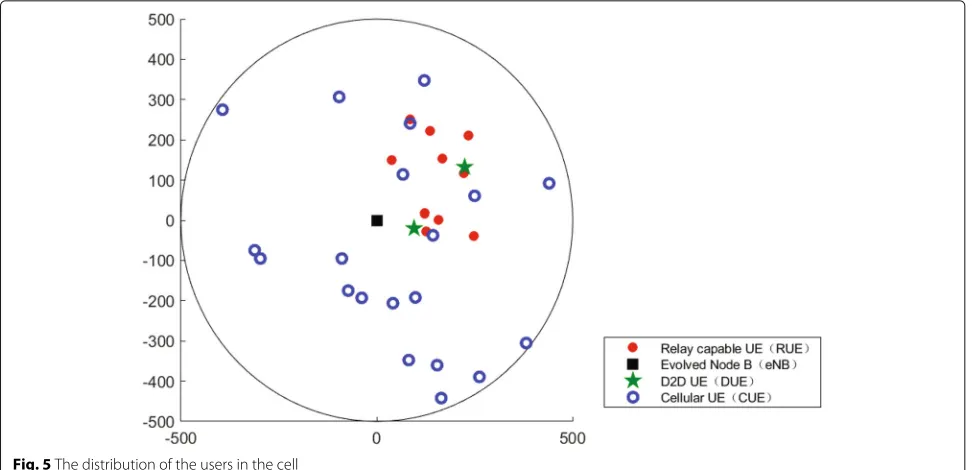
In this section, the performance of the joint network cod-ing and optimal RA-D2D signal processcod-ing scheme is simulated and analyzed. The scenario is a single cell with a radius of 500 m, and the communication nodes in the cell include a BS and a pair of DUEs; the number of RUEs and CUEs is 10 and 20 respectively. The distribution of different types of UEs is shown in Fig.5; the source DUE is assumed to be located at a distance no less than half of the cell radius from the base station which is located at the center of the cell. The destination DUE is randomly distributed on a circumference with the source DUE as its center node. All the candidate relay-capable UEs are randomly distributed within the circle area defined by the locations of source and destination DUEs. The other simulation parameters are given in Table1.
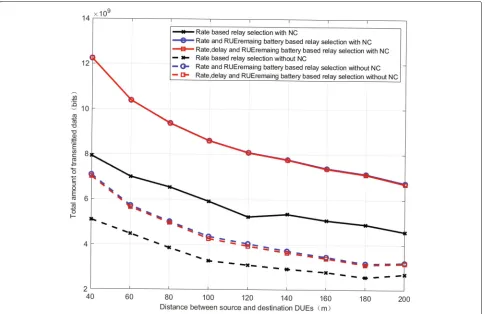
In Fig.6, the performance on the total amount of data that can be transmitted with the three relay selection schemes, i.e., relay selection based on rate, relay selection based on rate and RUE survival time, and relay selection based on rate, RUE survival time, and delay, are simu-lated and compared. The simulation results show that, when the distance between the source and the destina-tion DUEs increases, the total data that can be transmitted
decreases, due to the fact that the energy consumption increases along with the separation distance increasing and the increasing of path loss leads to the decreasing of the data transmission rate. The vertical comparison shows that the relay selection scheme only based on data rate corresponds to the worst performance on total amount of data that can be transmitted. The reason is that, much more energy is consumed to achieve the maximum trans-mission rate, which leads to a great decrease of the relay UE’s survival time. The scheme that jointly considers end-to-end rate and relay survival time enables transmission at the fastest rate with the most remaining power, so it cor-responds to the best performance on the total amount of data that can be transmitted. For the scheme that jointly considers end-to-end transmission rate, RUE’s survival time, and end-to-end transmission delay, its performance on total data amount is slightly worse than the scheme that jointly considers only the end-to-end data rate and the RUEs’ survival time. The reason is that although the delay caused by the transmission loss is taken into account, the impact can be found to be small. When comparing the results with and without NC for the same relay selec-tion scheme, it shows that no matter which relay selecselec-tion method is adopted, the total amount of data that can be transmitted under the situation with NC is significantly
higher than that under the situation without NC. As NC is performed, the curves for the relay selection schemes based on rate, delay, and RUE survival time and the relay selection scheme based on rate and RUE survival time are almost coincident. Because the possible interference has been effectively eliminated via NC processing, and the reachable data rate is improved while the transmission delay is reduced.
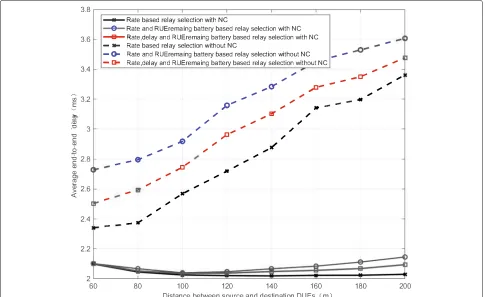
The performance on average end-to-end transmission delay under the three relay selection schemes are further simulated and compared, as shown in Fig.7. With the dis-tance between the source and destination DUEs is increas-ing, the delays corresponding to the three relay selection schemes are all increasing. This is reasonable, because increasing of the separation distance leads to the increas-ing of path loss, which would make the packet loss and retransmission even worse. In addition, the low transmis-sion rate makes the queuing time increasing. The vertical comparison for the three relay selection schemes shows us that the rate-based scheme corresponds to a minimum end-to-end transmission delay under the same simulation settings, because the maximum transmission rate natu-rally takes the least transmission time. The scheme based on rate and RUE survival time has the maximum end-to-end transmission delay, while the scheme based on
rate, delay, and RUE survival time corresponds to a delay performance between the former two schemes.
Jointly reviewing Figs. 6 and 7, it is seen that the scheme based on rate and RUE survival time is similar to the scheme based on rate, delay, and RUE survival time in terms of the performance on total amount of data that can be transmitted, whereas the latter is sig-nificantly better than the former in terms of the delay performance. Therefore, the relay selection scheme jointly considering rate, delay, and RUE survival time corre-sponds to the best overall transmission performance. Fur-thermore, it can be found that, for each of the three relay selection schemes, implementing NC processing can greatly reduce the end-to-end transmission delay, because the interference is effectively eliminated via the network coding operation. Since NC utilize the inter-ference generated by the CUEs whose uplink channels are reused, it can reduce the retransmission time caused by packet errors and end-to-end time delay. In addition, it will not have a big impact on the time delay caused by increasing of the distance between the source and destination DUEs.
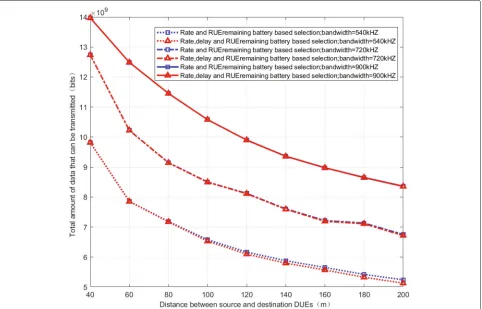
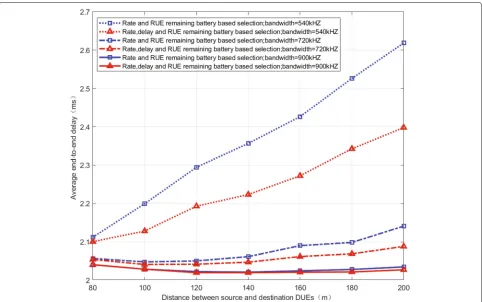
Figures 8 and 9 show the performance on total data amount and average end-to-end transmission delay under the aforementioned two relay selection schemes, i.e., the
scheme based on rate and RUE survival time and the scheme based on rate, delay, and RUE survival time, with different channel bandwidths. The influence of the band-width on the transmission performance is obvious in Figs.8and9. No matter which relay selection scheme is implemented, with the broadening of the channel band-width, the performance on the total amount of data that can be transmitted and the end-to-end transmission delay becomes better. The wider the channel bandwidth, the higher the end-to-end data transmission rate. It further reduces the times consumed on data queuing, and thus decreases the transmission delay and more transmission can be finished within the relay UE’s survival time. In such situations, the influence of taking transmission delay into account on the relay selection is reduces. Accordingly, the performance difference generated by the two different relay selection strategies becomes smaller.
5 Conclusions
In this paper, we designed a relay-assisted D2D signal processing scheme based on network coding. Different from the traditional store-and-forward processing, the network coding operation for the desired and interference signal at the selected relay node effectively eliminates the interference caused by resource reusing and expands
Fig. 9The average end-to-end delay in different bandwidths for joint network coding and relay selection schemes
the communication range of the D2D communications. Bringing network coding into relay assisted D2D signal processing further explores the benefits of D2D commu-nications underlaying cellular systems. The security for the transmitted information in the relay assisted D2D link can also be improved with the help of network coding. In the proposed scheme, the candidate relay-capable UE that can achieve the optimal overall performance on end-to-end data rate, end-end-to-end transmission delay, and link survival time is selected as the final relay node. Simulation results indicated that the relay selection scheme jointly considering end-to-end data rate, transmission delay, and link survival time corresponds to the best overall perfor-mance on total amount of data that can be transmitted and end-to-end transmission delay. Moreover, for a specific relay selection scheme, the overall transmission perfor-mance with network coding is significantly better than that without network coding when the optimal relay UE is selected. Hence, the effectiveness of including network coding into the relay selection process in the relay assisted D2D communications is validated.
Acknowledgements
This work is supported in part by National Natural Science Foundation of China (No. 61801144, No. 61671184, and No. 61871348), Natural Science Foundation of Shandong Province (No. ZR2018PF001 and No. ZR2014FP016), the Fundamental Research Funds for the Central Universities (No. HIT. NSRIF.
201720 and 2016100) and the Scientific Research Foundation of Harbin Institute of Technology at Weihai (No. HIT(WH)201409 and 201410).
Funding
National Natural Science Foundation of China (Grant No. 61801144, No. 61671184, and No. 61871348) are supporting the data acquisition devices and materials; Natural Science Foundation of Shandong Province (Grant No. ZR2018PF001 and No. ZR2014FP016) are supporting the simulations; and the Fundamental Research Funds for the Central Universities (Grant No. HIT.NSRIF.2016100 and 201720) and the Scientific Research Foundation of Harbin Institute of Technology at Weihai (No. HIT(WH)201409 and 201410) are supporting the data analyses.
Availability of data and materials
Data sharing not applicable to this article as no datasets were generated or analysed during the current study.
Authors’ contributions
BL and RM conceived and designed the experiments. QZ and WL performed the experiments. HY and GL contributed simulation tools. BL and QZ wrote the paper. RM undertook revision works of the paper. All authors have read and approved the final manuscript.
Competing interests
The authors declare that they have no competing interests.
Publisher’s Note
Springer Nature remains neutral with regard to jurisdictional claims in published maps and institutional affiliations.
Author details
1School of Information Science and Engineering, Harbin Institute of
Technology (Weihai), Weihai, China.2College of Information Engineering,
Received: 30 August 2018 Accepted: 21 February 2019
References
1. Y. Cao, N. Zhao, F. Yu, et al., Optimization or alignment: secure primary transmission assisted by secondary networks. IEEE Sel. J. Areas Comm.
36(4), 905–917 (2018)
2. X. Liu, Y. Wang, et al., A multichannel cognitive radio system design and its performance optimization. IEEE Access.6, 7–12335 (2018)
3. W. Lu, Y. Gong, X. Liu, et al., Collaborative energy and information transfer in green wireless sensor networks for smart cities. IEEE Trans. Ind. Info.
14(4), 1585–1593 (2018)
4. S. Hu, Z. Liu, et al., Sequence design for cognitive CDMA communications under arbitrary spectrum hole constraint. IEEE Sel. J. Areas Comm.32(11), 1974–1986 (2014)
5. L. Lei, Z. Zhong, C. Lin, Operator controlled device-to-device
communications in LTE-advanced networks. IEEE Wirel. Commun.19(3), 96–104 (2012)
6. A. Asadi, Q. Wang, V. Mancuso, A survey on device-to-device communication in cellular networks. Guilin. J. Univ. Ele. Tech.16(4), 1801–1819 (2014)
7. X. Liu, M. Jia, et al., A novel multi-channel Internet of Things based on dynamic spectrum sharing in 5G communication. IEEE Int. Things J. (2018). Published onlinehttps://doi.org/10.1109/JIOT.2018.2847731 8. H. Elsawy, E. Hossain, M. S. Alouini, Analytical modeling of mode selection
and power control for underlay D2D communication in cellular networks. IEEE Trans. Comm.62(11), 4147–4161 (2014)
9. P. Phunchongharn, E. Hossain, I. K. Dong, Resource allocation for device-to-device communications underlying LTE-Advanced network. IEEE Wirel. Comm.20(4), 91–100 (2013)
10. X. Liu, F. Li, Z. Na, Optimal resource allocation simultaneous cooperative spectrum sensing and energy harvesting for multichannel cognitive radio. IEEE Access.5, 3801–3812 (2017)
11. X. Liu, M. Jia, Z. Na, W. Lu, F. Li, Multi-modal cooperative spectrum sensing based on dempster-shafer fusion in 5G-based cognitive radio. IEEE Access.6, 199–208 (2018)
12. R. Ma, N. Xia, H. Chen, Mode selection, radio resource allocation, and power coordination in D2D communications. IEEE Wirel. Comm.22(3), 112–121 (2017)
13. L. Lu, M. Xiao, L. Rasmussen, Design and analysis of relay-aided broadcast using binary network codes. Comm. J.6(8), 610–617 (2011)
14. R. Ahlswede, N. Cai, S. Li, R. Yeung, Network information flow. IEEE Trans. Inf. Theory.46(4), 1204–1216 (2000)
15. Z. Zhao, S. Shao, J. Sun, in2013 International Conference On Computer Networks and Communication Engineering. The research of network coding in D2D communication system, (2013), pp. 396–400 16. R. Louie, Y. Li, B. Vucetic, Practical physical layer network coding for
two-way relay channels: performance analysis and comparison. IEEE Trans. Wirel. Comm.9(2), 764–777 (2010)
17. T. Zhao, B. Xu, T. Xu, H. Hu, User-specific link adaptation scheme for device-to-device network coding multicast. IEEE Comm. letters.9(3), 367–374 (2015)
18. F. Wang, S. Wang, Q. Song, L. Guo, Adaptive relaying method selection for multi-rate wireless networks with network coding. IEEE Comm. Letters.
16(12), 2004–2007 (2012)
19. Y. Zhao, Y. Li, X. Chen, N. Ge, Joint optimization of resource allocation and relay selection for network coding aided device-to-device
communications. IEEE Comm. Letters.19(5), 807–810 (2015)
20. L. Jayasinghe, P. Jayasinghe, N. Rajatheva, M. Latva-Aho, in2013 IEEE 24th Annual International Symposium on Personal, Indoor, and Mobile Radio Communications (PIMRC). MIMO physical layer network coding based underlay device-to-device communication, (2013), pp. 89–94 21. Y. Huang, A. A. Nasir, S. Durrani, et al., Mode Selection, Resource
Allocation, and Power Control for D2D-Enabled Two-Tier Cellular Network. IEEE Trans. Comm.64(8), 3534–3547 (2016)
22. T. D. Novlan, J. G. Andrews, Analytical evaluation of uplink fractional frequency reuse. IEEE Trans. Comm.61(5), 2098–2108 (2013)
23. C. Yu, K. Doppler, C. Ribeiro, O. Tirkkonen, Resource sharing optimization for device-to-device communication underlay cellular networks. IEEE Trans. Wirel. Comm.10(8), 2752–2763 (2011)
24. 3GPP, 3rd generation partnership project; technical specification group radio access network; evolved universal terrestrial radio access (E-UTRA); further advancements for E-UTRA physical layer aspects (release 9), 3GPP TR 36.814 V9.0.0 (2010)
25. D. Feng, L. Lu, Y.Y.-Wu, G. Y. Li, G. Feng, S. Li, Device-to-device
communications underlaying cellular networks. IEEE Trans. Comm.16(8), 3541–3551 (2013)
26. L. Lei, Y. Kuang, X. Shen, C. Lin, Resource control in network assisted device-to-device communications: solutions and challenges. IEEE Comm. Mag.52(6), 108–117 (2014)