• No results found

Feasibility, acceptability and efficacy of a web based computer tailored physical activity intervention for pregnant women the Fit4Two randomised controlled trial

N/A
N/A
Protected

Academic year: 2020

Share "Feasibility, acceptability and efficacy of a web based computer tailored physical activity intervention for pregnant women the Fit4Two randomised controlled trial"

Copied!
10
0
0

Loading.... (view fulltext now)

Full text

(1)

R E S E A R C H A R T I C L E

Open Access

Feasibility, acceptability and efficacy of a

web-based computer-tailored physical

activity intervention for pregnant women

-the

Fit4Two randomised controlled trial

Melanie Hayman

1

, Peter Reaburn

1

, Matthew Browne

2

, Corneel Vandelanotte

3*

, Stephanie Alley

3

and Camille E. Short

4

Abstract

Background:Physical activity (PA) during pregnancy is associated with a variety of health benefits including a reduced risk of pregnancy related conditions such as pre-eclampsia and pregnancy-induced hypertension and leads to greater control over gestational weight gain. Despite these associated health benefits, very few pregnant women are

sufficiently active. In an attempt to increase health outcomes, it is important to explore innovative ways to increase PA among pregnant women. Therefore, the aim of this study was to assess the feasibility, acceptability and efficacy of a four week web-based computer-tailored PA intervention among pregnant women.

Methods:Seventy-seven participants were randomised into either: (1) an intervention group that received tailored PA advice and access to a resource library of articles relating to PA during pregnancy; or (2) a standard information group that only received access to the resources library. Objective moderate-to-vigorous physical activity (MVPA) was assessed at baseline and immediately post-intervention. Recruitment, attrition, intervention adherence, and website engagement were assessed. Questions on usability and satisfaction were administered post-intervention.

Results:Feasibility was demonstrated through acceptable recruitment (8.5 participants recruited and randomised/ month), and attrition (25%). Acceptability among intervention group participants was positive with high intervention adherence (96% of 4 modules completed). High website engagement (participants logged in 1.6 times/week although only required to log in once per week), usability (75/100), and satisfaction outcomes were reported in both groups. However, participants in the intervention group viewed significantly more pages on the website (p< 0.05), reported that the website felt more personally relevant(p< 0.05), and significantly increased their MVPA from baseline to post-intervention (mean difference = 35.87 min), compared to the control group (mean difference = 9.83 min) (p < 0.05), suggesting efficacy.

Conclusions:The delivery of a computer-tailored web-based intervention designed to increase PA in pregnant women is feasible, well accepted and associated with increases in short-term MVPA. Findings suggest the use of computer-tailored information leads to greater website engagement, satisfaction and greater PA levels among pregnant women compared to a generic information only website.

Trial registration:The trial was‘retrospectively registered’with the Australian New Zealand Clinical Trials Registry (ACTRN12614001105639) on 17thOctober, 2014.

Keywords:Physical activity, Pregnancy, Intervention, Behaviour change, Web-based, Internet, Online

* Correspondence:[email protected]

3School of Human, Health and Social Sciences, Central Queensland

University, Rockhampton, QLD 4702, Australia

Full list of author information is available at the end of the article

(2)

Background

Participation in physical activity (PA) during pregnancy is associated with a variety of well-documented physical and physiological health benefits for both the mother and child [1]. These include greater control of gesta-tional weight gain, decreased risk of pregnancy-related complications, such as preeclampsia and hypertension [1]. Despite these benefits, less than 35% of Australian pregnant women appear sufficiently active [2, 3] in ac-cordance with exercise during pregnancy guidelines [4].

PA during pregnancy is linked to a variety of unique barriers experienced during pregnancy [5]. These include barriers such as increased fatigue and tiredness and physical discomfort, lack of time, motivation and/or social support, and neighbourhood or environmental barriers such as bad weather or poorly maintained walk-ing paths [5]. To assist pregnant women overcome these barriers, PA interventions using a variety of strategies have been implemented, including counselling, exercise and educational interventions [6, 7]. Most of these PA interventions have traditionally included face-to-face behaviour change programs conducted in a primary care environment by exercise specialists and/or health profes-sionals such as medical practitioners [6, 7]. However, such face-to-face behaviour change programs can be time consuming, expensive and limited in reach [8, 9].

Online interventions, especially those that employ

computer-tailoring, present as an alternative intervention delivery mode to traditional face-to-face interventions; es-pecially given that online interventions have been found to be cost effective, sustainable and wide reaching [10, 11]. Computer-tailoring automatically generates personalised feedback and advice based on participants’responses to a series of online questions. While web-based, computer-tailored interventions have been shown to be effective at increasing PA among other populations, [11] their feasibil-ity, acceptability and efficacy have not been examined among pregnant women. Thus, the purpose of this study was to test the feasibility, acceptability and efficacy of a computer-tailored web-based intervention (Fit4Two) de-signed to promote PA among pregnant women.

Methods

This study was a randomised controlled, two-arm, four-week behaviour change trial with an immediate follow-up, conducted in Rockhampton, Queensland from October 2014 to June 2015. Ethics approval was obtained from Central Queensland University Human Research Ethics Committee (H14/02-031). The protocol was registered with the Australian New Zealand Clinical Trials Registry (ACTRN12614001105639). The reporting and conduct adheres to the Consolidating Standards of Reporting Clinical Trials (CONSORT) guidelines [12].

To be eligible, participants were required to be proficient in English, 18+ years, have a gestational age of

10–20 weeks (ensuring all participants completed the

intervention in their second trimester for consistency), and considered healthy and free of any medical and/or obstetric contraindications to participate in PA. To ascertain contraindications, potential participants were required to complete a modified online version of both the Physical Activity Readiness Medical Examination for Pregnancy (PARmed-X for pregnancy) [13] and the Physical Activity Readiness Questionnaire [14]. If partici-pants answered ‘yes’ to any of the screening questions, they were asked to seek medical approval to participate in the study.

Recruitment involved the dissemination of study infor-mation by medical practitioners, such as general practi-tioners and obstetricians, private and public hospital staff, and free and paid promotion of the study via social media. For all methods, a brief study overview was provided including information on the randomisation process. Following baseline assessment, participants were required to collect aGeneActivoriginal accelerom-eter (ActiveInsights, United Kingdom) for which content validity and test-retest reliability has previously been established in pregnant women, [15] from the study site. Participants were instructed to wear the accelerometer on their non-dominate wrist for seven days. Participants were also provided with an A4 instruction sheet includ-ing what should happen if the device stopped workinclud-ing, and general care instructions. Data was collected at 100Hz, with minimum wear time criteria consisting of >4 days, >10 waking hours/day and including two week-end days. Once objective baseline accelerometer data

was successfully collected, participants were then

automatically randomised to either the intervention or control group via the study website using a computer-generated block randomisations sequence (with block sizes of four) on a 1:1 ratio. All project team members were blinded to this process.

Participants assigned to the intervention group were

given full access to the Fit4Two website. The

(3)

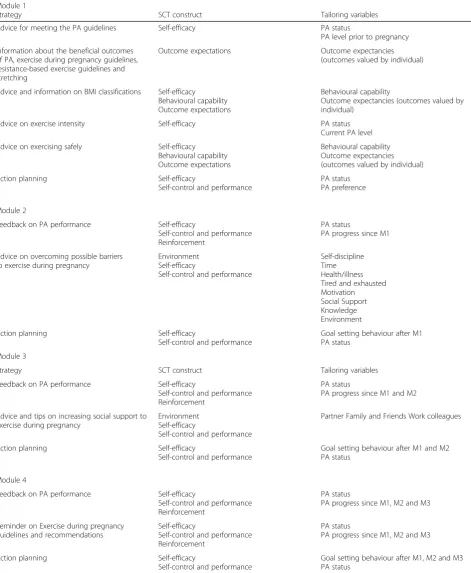
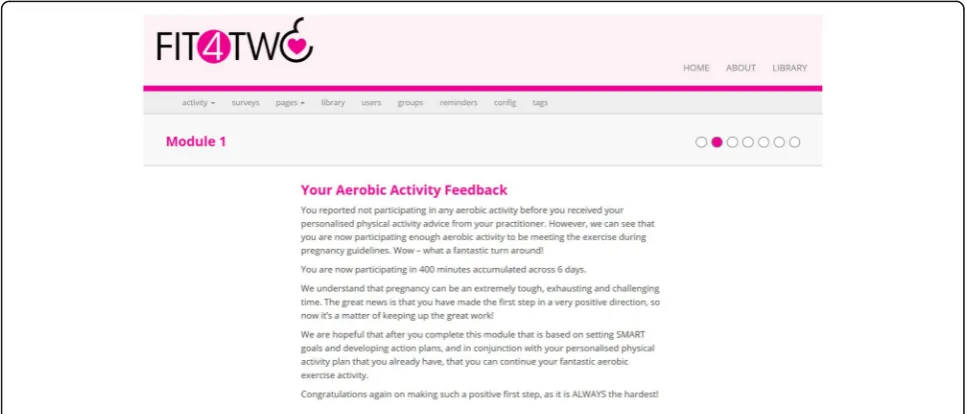
such as identifying the benefits associated with meeting the guidelines, all of which have been previously identi-fied as significant constructs to increasing PA among pregnant women [6, 16]. In addition to the weekly SCT module, participants were also provided with access to a weekly action planning tool, which guided participants in setting a detailed plan for their PA including when they would exercise, who they might exercise with, where the exercise would take place, and what barrier/s might come up, and how they would overcome them over the coming week. Please refer to Table 1 for the operationalisation of the SCT constructs relevant to the Fit4Two study. Figures 1 and 2 show the look and feel of the intervention website.

Upon commencing the intervention, participants were asked a series of questions based on their PA behaviours [18] over the previous seven days, and the weekly SCT constructs (goal setting and action planning, social support, perceived barriers and PA reinforcement).

Participants were then provided with immediate

computer-tailored feedback messages based on their responses to the PA behaviour and SCT construct ques-tions. For example, if a participant answered that her friends and work colleagues were the ones that provided her with social support to be physically active during her pregnancy, the tailored feedback addressed this. The website also included a resources library providing up-to-date, evidence-based advice on current exercise during pregnancy guidelines, aerobic and resistance-based exercise recommendations, safety considerations to exercise during pregnancy, and general advice for ac-tive living during pregnancy. Participants assigned to the minimum intervention control group only had access to the resources library for the four-week intervention phase. Upon completion of the intervention phase, par-ticipants in the control group were then given unlimited access to the website.

Feasibility was assessed using recruitment, and attrition data. Acceptability was measured through intervention adherence, website engagement, website usability and satisfaction items relating to website quality, relevance and usefulness. Specifically, intervention adherence was measured by number of modules and goal setting/action planning tools that were completed. Website engagement totalled the number of site sessions (log-ins), page views and time spent (minutes) on the website from baseline to four week follow-up using Google Analytics [19]. Website usability was measured using the widely accepted and reli-able 10-item System Usability Scale (SUS) [20]. All items were assessed on a five-point Likert scale with response items ranging from ‘strongly agree’ to ‘strongly disagree’. Reverse coding was used to adjust scores for

negatively-framed items before participants’ response scores were

added together for all 10 items and then multiplied by 2.5.

This allowed for the original scores ranging from 0 to 40 to be converted to a score of 1–100. Based on previous research, a score above 68 on the SUS scale indicates

‘above average usability’[20]. Finally, participant’s percep-tions of the website in terms of how much they would like to continue to use it, and how credible, interesting, easy to understand, and personally relevant they found the website were assessed using five items from previous tailoring studies on a five-point Likert scale (1–strongly disagree–5 strongly agree) [21, 22]. For example, partici-pants were asked to rate their level of agreement that‘the content was personally relevant to me’and‘I would like to continue using the Fit4Two website throughout the remain-der of my pregnancy’. Two open-ended questions were also used to ask participants; (1) what they liked and/or disliked about the website and; (2) how they believe the website could be improved.

Efficacy was determined based on a 2×2 group X time interaction model describing differences in moderate-vigorous physical activity (MVPA), controlling for

base-line differences. The GeneActiv accelerometer data was

used to assess MVPA objectively at baseline (seven days prior to randomisation) and follow-up (seven days after

completing the Fit4Two study). At the end of each

collection period, the raw accelerometer output data was

uploaded into the GeneActiv post-processing software

(GeneActiv, version 2.2, Activinsights Ltd) and converted into 60 s epoch files. The epoch files were then proc-essed using the GGIR script in the R environment (http://cran.r-project.org) [23] to produce a series of standardised accelerometery outcome variables. Finally, validated acceleration magnitude cut points were used to classify activity into light, moderate and vigorous intensities [24].

Chi-square and analyses of variance were performed

usingSPSS Version 20(IBM Corp, NY) to determine

(4)

Results

A total of 425‘guests’visited theFit4Twowebsite over the nine-month recruitment period, with 149 women express-ing interest in the study and screened for eligibility.

Seventy-seven eligible participants provided informed con-sent by agreeing to the study terms and conditions listed on the Fit4Two website, and by choosing to continue in the study to complete the baseline survey, and wear an

Table 1Operationalisation of the SCT Constructs relevant to this study

Module 1

Strategy SCT construct Tailoring variables

Advice for meeting the PA guidelines Self-efficacy PA status

PA level prior to pregnancy

Information about the beneficial outcomes of PA, exercise during pregnancy guidelines, resistance-based exercise guidelines and stretching

Outcome expectations Outcome expectancies

(outcomes valued by individual)

Advice and information on BMI classifications Self-efficacy Behavioural capability Outcome expectations

Behavioural capability

Outcome expectancies (outcomes valued by individual)

Advice on exercise intensity Self-efficacy PA status

Current PA level

Advice on exercising safely Self-efficacy Behavioural capability

Feedback on PA performance Self-efficacy

Self-control and performance Reinforcement

PA status

PA progress since M1

Advice on overcoming possible barriers to exercise during pregnancy

Goal setting behaviour after M1 PA status

Module 3

Strategy SCT construct Tailoring variables

Feedback on PA performance Self-efficacy

Self-control and performance Reinforcement

PA status

PA progress since M1 and M2

Advice and tips on increasing social support to exercise during pregnancy

Environment Self-efficacy

Self-control and performance

Partner Family and Friends Work colleagues

Action planning Self-efficacy

Self-control and performance

Goal setting behaviour after M1 and M2 PA status

Module 4

Feedback on PA performance Self-efficacy

Self-control and performance Reinforcement

PA status

PA progress since M1, M2 and M3

Reminder on Exercise during pregnancy guidelines and recommendations

Self-efficacy

Self-control and performance Reinforcement

PA status

PA progress since M1, M2 and M3

Action planning Self-efficacy

Self-control and performance

(5)

accelerometer in accordance with the study’s adherence guidelines. These participants were then randomised to ei-ther the control group (n= 38) or intervention group (n= 39). The main reasons for ineligibility were geographical lo-cation or gestational age being greater than 20 weeks. Of these 77 randomised participants, 18% were recruited from marketing materials displayed in doctor/hospital/obstetri-cian clinics, 9% were recruited via family and/or friends, and 59% via media outlets (Facebook47%, community news 3%, other 9%). There was no significant difference in attri-tion rates between groups. Twenty participants dropped out of the study including 8 from the control group (80% re-tention) and 12 from the intervention group (70% reten-tion). The flow of participants through the study is displayed in Fig. 3.

Baseline characteristics for all participants are shown in Table 2. There were no significant demographic dif-ferences between groups. Compared to available national data, participants were found to be representative of the target population [26] for age (mean 29 years), BMI

(mean 26 kg/m2), combined household income (62%

earned less than $100,000 per year), and highest level of education (51% completed a university degree).

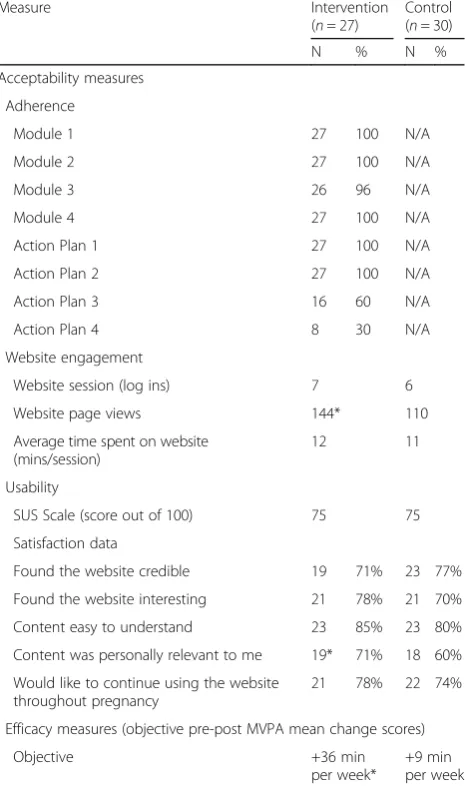
Feasibility, acceptability and efficacy outcomes are shown in Table 3. Of the participants who completed the study and were allocated to the intervention group

(n= 27), 96% completed all four of the weekly

SCT-based modules. Adherence to the Goal Setting/Action Planning tool was also positive (72%), with all

partici-pants completing Action Plans 1 and 2, 59% (n= 16)

Fig. 1Fit4Two Website Homepage

(6)

completing Action Plan 3 and 30% (n= 8) completing Action Plan 4.

Website engagement was highest in the intervention group, with participants in this group recording more sessions (log-ins), spending longer on the website and view-ing significantly more pages (p< 0.05), than those in the control group. All participants scored the usability of the website ‘above average’ with a mean score of 75/100 [20]. Participant satisfaction was positive with the majority of participants either‘strongly agreeing’or‘agreeing’that web-site as credible, the content was easy to understand, and that they would like to have continued to use the website throughout the remainder of their pregnancy. No significant between-group differences were observed for any measure

Fig. 3CONSORT Flow Chart of Participants through the Fit4Two Study

Table 2Demographic characteristics of Fit4Two participants

Variable Intervention Control Total

(n= 39) (n= 38) (n= 77)

n % n % n %

Married, de facto 34 87 34 89 68 88

Completed university 19 49 20 53 39 51

Combined Household Income ($100,000-$150,000 per year)

12 31 17 45 29 38

Full-time employed 17 44 21 55 38 49

Born in Australia 31 79 37 97 68 88

One other child at home 21 54 15 39 37 48

Have been pregnant before 27 69 23 60 50 65

(7)

of acceptability with the exception of perceived content rele-vance, where participants in the intervention group felt the website content was significantly more relevant to them personally than those in the control group (p= 0.024).

Whilst many participants said ‘they would not change a

thing’, some participants suggested that the inclusion of ac-tual exercise programs would have benefited the program.

Table 3 shows that at follow-up, participants in the intervention group were found to have increased their MVPA (mean increase 36 min/week) more than those in the control group (mean increase 9 min/week). This group x time interaction was significant when MVPA was modelled on the log scale using bootstrapped confidence intervals, βgroup X time= 1.31, 95% CI [0.175,

2.484],p= 0.0126. There were no adverse events, or un-intended harm reported from participants in this study.

Discussion

The present study is the first study to explore the feasibility, acceptability and efficacy of a web-based computer-tailored intervention aimed at increasing PA among pregnant

women. The feasibility of theFit4Two program was

dem-onstrated in terms of successful recruitment and attrition throughout the screening process with no participants dropping out between eligibility and randomisation. Acceptability was also established, with the majority of par-ticipants rating the website positively and reporting above average usability scores. Almost all participants allocated to the intervention group engaged with the tailored modules and action plans as intended. Finally, there was evidence in favour of the Fit4Two program in terms of efficacy, with those allocated to the intervention group showing a signifi-cant increase in MVPA compared to the control group.

The feasibility outcomes in this study are favourable com-pared to other studies [27–29]. For example, the present study recruited and randomised an average of 9 participants per month from targeted marketing in a regional Australian town with a population of approximately 65,000 people [30]. In comparison, a recent study examining the feasibility and efficacy of a PA mobile health intervention among Australian pregnant women from a metropolitan area of nearly 600,000 people, [27] recruited and randomised 5.6 participants per month [27]. Almost half (47%) of the par-ticipants within this study were recruited via the social media platform,Facebook. In this study, paid advertisements that included the Fit4Two study logo, and targeted central Queensland pregnant women wanting to know more about physical activity during pregnancy were used, and found to be a very effective recruitment tool. This is not surprising however given the fact that pregnant women are already reported to be utilising the web to source, and seek out, pregnancy related information. Specifically, the emergence of information technology sees over 93% of pregnant women using the internet to source additional information about their pregnancy with 83% using eHealth information to assist in decision-making during their pregnancy [31, 32]. The attrition rate in the present study (26%) is considered acceptable for PA web-based interventions undertaken in non-pregnant populations, [33] and also fell well within the lower range of attrition rates reported for PA interventions

among pregnant women (0–43%) [6]. Web-based

interven-tions are commonly associated with larger attrition among participants (up to 80%), more so among participants allocated to intervention/treatment groups compared to those of a control group [30]. In the present study, more participant drop-outs were observed in the intervention group (30%) compared to the control group (21%). This finding is not uncommon in interventions, [34] given the greater burden placed on intervention participants [34].

Participant acceptability in terms of adherence, website engagement, usability and process evaluation data in our

Table 3Feasibility, acceptability and efficacy of Fit4Two participants

Measure Intervention

Action Plan 1 27 100 N/A

Action Plan 2 27 100 N/A

Action Plan 3 16 60 N/A

Action Plan 4 8 30 N/A

Website engagement

Website session (log ins) 7 6

Website page views 144* 110

Average time spent on website (mins/session)

12 11

Usability

SUS Scale (score out of 100) 75 75

Satisfaction data

Found the website credible 19 71% 23 77%

Found the website interesting 21 78% 21 70%

Content easy to understand 23 85% 23 80%

Content was personally relevant to me 19* 71% 18 60%

Would like to continue using the website throughout pregnancy

21 78% 22 74%

Efficacy measures (objective pre-post MVPA mean change scores)

Objective +36 min

per week*

+9 min per week

(8)

study was very high compared to other web-based stud-ies among pregnant women [27–29]. All but one partici-pant completed all four of the weekly SCT modules. A total of 78/108 (72%) goal setting/action planning tasks were also completed. This finding is positive when com-pared to previous studies that have used goal setting and action planning tools in both pregnant women [27] and other populations [34]. However, in line with other stud-ies, the use of the action plan tool did decline overtime. There may be a number of explanations for this observa-tion. For example, some participants may not have felt that they needed to continue to set goals or develop ac-tion plans after the first two weeks of the intervenac-tion because they were successfully increasing their PA. Al-ternatively, participants may have felt that setting goals and developing action plans on a weekly basis was too demanding. Irrespective of the reasoning behind this de-cline, it is important that participants are aware of the positive relationship between setting goals, developing action plans, and overcoming barriers to PA [6, 35].

Participants in this study logged in an average of 1.63 times per week. This is a positive finding given that participants in the intervention group were only required to log-in once a week, and participants in the control were only required to log in once throughout the entire inter-vention period. This figure is higher than studies previ-ously undertaken in pregnant women [27]. For example, in a recent web-based intervention aimed at increasing PA among pregnant women, 64% (29/45) of participants were reported as having ‘no engagement’or ‘low engagement’ with the website tools, characterised by number of log-ins and interaction with the website content [27]. Possible ex-planations for the differing findings may be that the

Fit4Twowebsite included activities designed to help bring about positive behavioural changes, or that participants received computer-tailored feedback that was immediate, personalised, and based on their reported PA behaviours and perceived barriers to PA [27]. Alternatively, partici-pants found the resources library section of the website useful and visited it frequently.

Participant satisfaction data was positive. However, participants in the intervention group reported that the content of the website was significantly more relevant to them than the participants in the control group. Inter-ventions utilising computer-tailored messaging have previously been shown to be more effective at increasing PA (in other populations) than generic, non-tailored messaging, and this is believed to be owing to increased personal relevance [10, 11, 33]. Thus, the use of computer-tailoring in PA interventions among pregnant women is recommended to increase participant accept-ability and efficacy. However, participants reported that the provision of specific exercise programs would have further enhanced the Fit4Two website. This request is

supported by the literature in that some women still perceive exercise during pregnancy as somewhat‘unsafe’ and are‘unsure’as to what exercise they can and cannot do [35, 36]. The reason for not providing exercise

programs as a part of theFit4Twoprogram was because

the research team did not believe the provision of generic programs would be safe for all participants, thus not taking into consideration their health status, physio-logical differences and possible contraindications to physical activity. However, future interventions might look to involve an accredited exercise physiologist (AEP) or other appropriately skilled professional to provide this service. Alternatively, the intervention could incorporate a referral tool that helps to link pregnant women with local AEPs within their area.

Finally, the efficacy of the Fit4Two project was con-firmed with the intervention group significantly increas-ing their MVPA in comparison to the control group. This increase in MVPA is most likely a result of the personalised and relevant computer-tailored feedback that included appropriate behaviour change techniques (BCTs), identified by the use of the SCT theoretical framework [12, 29]. The benefit of using theories such as the SCT is that they help identify key determinants that assist in the selection of appropriate behaviour change techniques to overcoming the determinants of PA in specific cohorts, thus increasing the personal relevance of the intervention [16]. In the present study, participants in the intervention group were taught how to set goals and develop action plans, overcome perceived barriers to PA, and how to develop social support networks. Each of these BCTs has previously been identified as major facilitators to increasing PA among pregnant women [6, 7, 16].

Taken together, the findings in this study suggest that the Fit4Two program is feasible, acceptable and effica-cious. The use of the SCT theoretical framework used to guide the development and design of the program, and the incorporation of computer-tailored messaging are two recognisable strengths of this study. Additional strengths of this study include the use of objectively measured MVPA and website engagement. A limitation to this study was that the only follow-up occurred immediately after the completion of the intervention. It is recommended that future studies also consider an additional follow-up time point to access the long-term efficacy of the intervention. Based on the positive findings of the present study, a larger trial ofFit4Two undertaken across a nationally representable sample is warranted.

Conclusions

(9)

for pregnant women presents as a promising approach to increasing PA among pregnant women. A larger study undertaken across a nationally representable sample is now recommended.

Abbreviations

AEP:Accredited exercise physiologist; BCT: Behaviour change theory; MVPA: Moderate-to-vigorous physical activity; PA: Physical activity; SCT: Social cognitive theory

Acknowledgements

We thank the study participants for their time and willingness to participate in this study. We also thank the participating practices and their staff who also supported this study.

Funding

This study was supported by funding from the Central Queensland‘Healthy CQ’ Grants Scheme. The authors also acknowledge the time and effort contributed by the participants. CS is supported by a National Health and Medical Research Council ECR Fellowship (ID 1090517). CV (ID 100427) is supported by a Future Leader Fellowship from the National Heart Foundation of Australia.

Availability of data and materials

The dataset used and/or analysed during this current study is available from the corresponding author on reasonable request.

Authors’contributions

MH, CS, PR and CV conceived the study, participated in its design and coordination. MC, CS, SA and MB performed the analysis. All authors helped to draft the manuscript, read and approved the final manuscript.

Competing interests

The authors declare that they have no competing interests.

Consent for publication

Not applicable.

Ethics approval and consent to participate

Ethics approval was obtained from CQUniversity Human Research Ethics Committee (H14/02-031). Informed consent to participate in the study was obtained from all participants.

Publisher’s Note

Springer Nature remains neutral with regard to jurisdictional claims in published maps and institutional affiliations.

Author details

1School of Medical and Applied Sciences, Central Queensland University,

Rockhampton, QLD 4702, Australia.2School of Human, Health and Social Sciences, Central Queensland University, Bundaberg, QLD 4670, Australia.

3School of Human, Health and Social Sciences, Central Queensland

University, Rockhampton, QLD 4702, Australia.4NHMRC ECR Fellow.

Freemasons Foundation Centre for Men’s Health. Faculty of Health Sciences, The University of Adelaide, Adelaide, SA 5000, Australia.

Received: 5 December 2016 Accepted: 14 March 2017

References

1. Harrison CL, Brown WJ, Hayman MJ, Moran LJ, Redman LM. The Role of Physical Activity in Preconception, Pregnancy and Postpartum Health. Semin Reprod Med. 2016; 34(2):e28–37.

2. Hayman M, Short C, Reaburn P. An investigation into the exercise behaviours of regionally-based Australian pregnant women. J Sci Med Sport. 2016;19(8):664–8.

3. Wilkinson S, Miller Y, Watson B. Prevalence of health behaviours in pregnancy at service entry in a Queensland health service district. Aust N Z J Public Health. 2009;33(3):228–33.

4. Hayman M, Ferrar K, Marchese R, Tan J, Brown W: Exercise in pregnancy and the postpartum period. Sports Medicine Australia (SMA) Position Statement (2016). Available online at: www.sma.org. Accessed Sept 2016.

5. Evenson K, Moos M, Carrier K, Siega-Riiz A. Perceived barriers to physical activity among pregnant women. Matern Child Health J. 2009;13:36475. 6. Currie S, Sinclair M, Murphy M, Madden E, Dunwoody L, Liddle D. Reducing

the decline in physical activity during pregnancy: a systematic review of behaviour change interventions. PLoS One. 2013;8(6):e66385.

7. Pearce E, Evenson K, Downs D, Steckler A. Strategies to promote physical activity during pregnancy: a systematic review of intervention evidence. Am J Lifestyle Med. 2013;7(1). doi:10.1177/1559827612446416..

8. Foster C, Hillsdon M, Thorogood M, Kuar A, Wedatilake T. Interventions for promoting physical activity. Cochrane Database Syst Rev. 2005;(Issue 1): CD003180. doi:10.1002/14651858.CD003180.pub2.

9. Noar S, Benac C, Harris M. Does tailoring matter? Meta-analytic review of tailored print health behaviour change interventions. Psychol Bull. 2007; 133(4):673–93.

10. Lustria M, Noar S, Cortese J, Van Stee S, Glueckauf R, Lee J. A meta-analysis of web-delivered tailored health behavior change interventions. J Health Commun. 2013;18(9):1039–69.

11. Wolfenden L, Nathan N, Williams CM. Computer-tailored interventions to facilitate health behavioural change. Br J Sports Med. 2014;49(22):1478–9. 12. Moher D, Hopewell S, Schulz K: CONSORT 2010 explanation and

elaboration: updated guidelines for reporting parallel group randomised trials. BMJ. 2010;340(c869). doi:10.1136/bmj.c869.

13. Canadian Society for Exercise Physiology (CSEP). Physical Activity Readiness Medical Examination for Pregnancy [PARmed-X for pregnancy]. 2015. Available online at: http://www.csep.ca. Accessed June 2016. 14. Godin G, Shepard R. Godin leisure-time exercise questionnaire. Med Sci

Sports Exerc. 1997;29:368.

15. van Hees VT, Renstorm F, Wright A, Gradmark A, Catt M, Chen K, Lof M, Bluck L, Pomeroy J, Wareham N, et al. Estimation of daily energy expenditure in pregnant and non-pregnant owmen using a wrist-worn tri-axial accelerometer. PLoS One. 2011;6(7):e22922.

16. Gaston A, Cramp A. Exercise during pregnancy: a review of patterns and determinants. J Sci Med Sports Med Aust. 2011;14(4):299–305. 17. Bandura A. Health promotions by social cognitive means. Health Edud

Behav. 2004;31(2):14364.

18. Australian Institute of Health and Welfare (AIHW). The Active Australia Survey: A guide and manual for implementation, analysis and reporting. Cat. No. CVD 22. Canberra: AIWH. Available online at: www.aihw.gov.au. Accessed Nov 2015. 19. Esolang A. Google analytics computer software. Available online at: https://

developers.google.com/analytics. Accessed June 2015.

20. Bangor A, Kortum P, Miller J. An emperical evaluation of the system usability scale. Int J Human-Computer Interact. 2008;24(6):574–94. 21. Short C, James E, Girgis A, Souza M, Plotnikoff R. Main outcomes of the move

more for life trial: a raondomised controlled trial examining the effects of tailored-print and targeted-tailored-print materials for promoting physical activity among post-treatment breast cancner survivors. Psycho-Oncology. 2015;24(7):7718. 22. Compernolle S, Vandelanotte C, Cardon G, De Bourdeaudhuij I, De Cocker K.

Effectiveness of a web-based, computer-tailored, pedometer-based physical activity intervention for adults: a cluster randomized controlled trial. JMIR. 2015;17(2):e38. 23. Van Hees V, Fang Z, Zheo J, Sabia S. GGIR: Raw accelerometer data analysis.

2017. Available online at: https://cran.r-project.org. Accessed Mar 2017. 24. Esliger D, Rowlands AV, Hurst T, Catt M, Murray P, Eston R. Validation of the

GENEA accelerometer. Med Sci Sports Exerc. 2011;43(6):1085–93. 25. R Core Team. R: A Language and Environment for Statistical Computing.

Vienna: R Foundation for Statistical Computing; 2014. Available online at: http://www.R-project.org/. Accessed July 2015.

26. Mishra G, Loxton D, Anderson A, Hockey R, Powers J, Brown W, Dobson A, Duffy L, Graves A, Harris M, et al. Health and wellbeing of women aged 18 to 23 in 2013 and 1996: Findings from the Australian Longitudinal Study on Women’s Health. Australian Report prepared for the Australian Government Department of Health; 2014. Available online at: http://www.alswh.org.au. Accessed Jan 2016. 27. Smith K. The blossom project online: use of a behaviourally-based website to promote physical activity and prevent excessive gestational wieght gain in previoulsy sedentary pregnant women. Graduate Theses and Dissertations. Paper 14051. 2014. Available online at: http://lib.dr.iastate.edu/cgi/. Accessed June 2016. 28. Choi J, Lee J, Vittinghoff E, Fukuoka Y. mHealth physical activity intervention:

(10)

29. Hayes L, Mcparlin C, Kinnunen T, Poston L, Robson S, Bell R. Change in level of physical activity during pregnancy in obese women: findings from the UPBEAT pilot trial. BMC Pregnancy Childbirth. 2015;15(52):1–8.

30. Australian Bureau of Statistics (ABS). Regional Data Summary: Rockhampton (SA3). Available online at: www.stat.abs.gov.au/. Accessed Sept 2015. 31. Lagan B, Sinclair M, Kernohan W. Internet use in pregnancy informs

women’s decidion making: a web-based survey. Birth. 2010;37(2):106–15. 32. McMullan M. Patients using the internet to obtain health information: how

this affects the patient-health professional relationship. Patient Educ Couns. 2006;63(1-2):248.

33. Davies C, Spence J, Vandelanotte C, Caperchione C, Mummery K. Meta-analysis of internet-delivered interventions to increase physical activity levels. Int J Behav Nutr Phys Act. 2012;9(52). doi:10.1186/1479-5868-9-52. 34. Evenson K, Bradley C. Beliefs about exercise and physical activity among

pregnant women. Patient Educ Couns. 2010;79:124–9.

35. Symons Downs D, Chasan-Taber L, Evenson K, Leiferman J, Yeo S. Physical activity and pregnancy. Res Q Exerc Sport. 2012;83(4):485–502.

36. Prestwich A, Sniehotta F, Whittington C, Dombroski S, Rogers L, Michie S. Does theory influce the effectiveness of health behavior interventions? Meta-analysis. Health Psychol Rev. 2013;33(5):465–74.

We accept pre-submission inquiries

Our selector tool helps you to find the most relevant journal

We provide round the clock customer support

Convenient online submission

Thorough peer review

Inclusion in PubMed and all major indexing services

Maximum visibility for your research

Submit your manuscript at www.biomedcentral.com/submit

Figure

Table 1 Operationalisation of the SCT Constructs relevant to this study
Fig. 1 Fit4Two Website Homepage
Table 2 Demographic characteristics of Fit4Two participants
Table 3 Feasibility, acceptability and efficacy of Fit4Two participants

References

Related documents

effective shamanachikitsa which can give better cure this study on Svayambhuvagugguluvati is selected Source of data: A minimum of 20 patients suffering from JanuSandhigatavata

It can be missed the opportunity to state that ozone therapy is an integrative approach to be used either for improving the therapeutic response or when

This paper takes the minimum flexibility of the structure as the objective function and the volume ratio of the solid material as the constraint condition to realize the

Teachers should gradually guide students to master the construction process of simple mathematical models in teaching to make students learn how to build mathematical models

Because environmental costs involve product development, production, usage, sales, and scrap, they requires enterprises to rise from the internal manufacturing link to the

[r]

The Role of Legal Department in the Process of Property Tax Revenue Generation at PGMC The Role of Finance Department the Process of Property Tax Revenue Generation at PGMC

Defenders of the good faith test suggest that the deterrent objectives of the exclusionary rule cannot be served by its application in cases in which a law enforcement