Leveraging Native Data to Correct Preposition Errors in Learners’ Dutch
Lennart Kloppenburg and Malvina Nissim
Center for Language and Cognition Groningen – Language Technology Rijksuniversiteit Groningen, The Netherlands
[email protected], [email protected]
Abstract
We address the task of automatically correcting preposition errors in learners’ Dutch by modelling preposition usage in native language. Specifically, we build two models exploiting a large corpus of Dutch. The first is a binary model for detecting whether a preposition should be used at all in a given position or not. The second is a multiclass model for selecting the appropriate preposition in case one should be used. The models are tested on native as well as learners data. For the latter we exploit a crowdsourcing strategy to elicit native judgements. On native test data the models perform very well, showing that we can model preposition usage appropriately. However, the evaluation on learners’ data shows that while detecting that a given preposition is wrong is doable reasonably well, detecting the absence of a preposition is a lot more difficult. Observing such results and the data we deal with, we envisage various ways of improving performance, and report them in the final section of this article.
Keywords:Preposition correction, language modelling, learners’ data, Dutch
1.
Introduction
Computer-assisted language learning is a field where lan-guage technology is combined with human lanlan-guage ac-quisition. To make it possible, we need systems that are able to recognise errors and suggest corrections. However, in spite of recent campaigns on automatic error correction (Ng et al., 2013; Ng et al., 2014), and in spite of some no-table exceptions (Nicholls, 2003) the lack of large amounts of error-annotated data remains a bottleneck in the develop-ment and evaluation of systems that support language learn-ing, especially for L2s other than English.
One obvious solution is creating error-aware resources to build and test robust models of learners’ language use (Han et al., 2010), which has however substantial costs, especially in terms of human effort. Another way of by-passing this shortage of data is to exploitnativedata, which can be considered as having gold labels of correct usage of language (Han et al., 2006; Tetreault and Chodorow, 2008; Gamon et al., 2008; De Felice and Pulman, 2009). This latter strategy is what we adopt in this work, focusing on preposition errors in learners of Dutch. As far as we are aware, this is the first such work for this language.
It has been noted that in many languages prepositional constructions are the most difficult for foreign language learners, because of their versatile and often ambiguous character (Dale et al., 2012). Although we have no spe-cific figures on this kind of error in learners of Dutch, we know that prepositions are used extremely frequently and that large corpora of native Dutch are available, which can be exploited to build models of correct preposition usage.
In this paper we describe a two-stage approach to the detection and correction of preposition errors in essays written by learners of Dutch. We train two models on na-tive data that are to be deployed in a pipeline. The models are tested both on withheld native data as well as learners’ data. For the latter, we crowdsourced correctedness judg-ments from native speakers, as the corpus we drew test data from is not specifically error-annotated.
2.
Phenomenon and Task
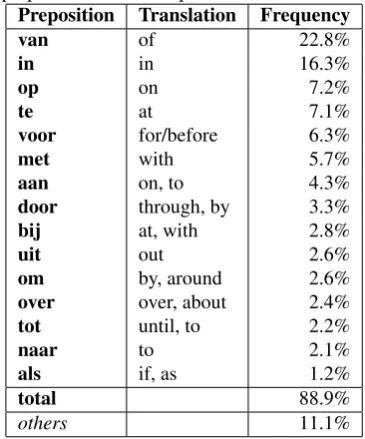
In Dutch, there are just over a hundred prepositions, and only some of them are used commonly. In thecdb(Alpino Treebank, (van Noord, 2006)), a corpus of ca. 140,000 words from the Eindhoven corpus (newspaper text), about 15% of all tokens are prepositions, despite only represent-ing 0.66% of all types (n=15,863), with the top 15 preposi-tions comprising almost 90% of all preposition use (see Ta-ble 1 for details). In other words, prepositions are used very frequently despite being a relatively small lexical class.
Table 1: Frequency distribution of the 15 most Dutch prepositions in thecdb(van Noord, 2006). The total num-ber of prepositions in the corpus is 18,790.
Preposition Translation Frequency
van of 22.8%
in in 16.3%
op on 7.2%
te at 7.1%
voor for/before 6.3%
met with 5.7%
aan on, to 4.3%
door through, by 3.3%
bij at, with 2.8%
uit out 2.6%
om by, around 2.6%
over over, about 2.4%
tot until, to 2.2%
naar to 2.1%
als if, as 1.2%
total 88.9%
others 11.1%
or correction. Three basic situations of preposition mis-use can be identified (Eeg-Olofsson and Knutsson, 2003; Chodorow et al., 2007; Liu, 2008):
1. insertion (a preposition is invoked erroneously)
2. deletion (a preposition is omitted erroneously)
3. substitution (a preposition is picked erroneously)
Deletion and insertion errors are shown in Examples (1) and (2), respectively. In (a) we report the learner’s sentence with the error, and in (b) the correct version.
(1) a. *Hij zet tot 8 soorten van dranken, maar geen chocolade melk. (It can make up to eight types ofdrinks, but no hot chocolate.)
b. Hij zet tot 8 soorten drank, maar geen choco-lademelk.
(2) a. *Roger Federer werdø 1981 geboren. (*Roger Federer was bornø1981.)
b. Roger Federer werdin1981 geboren.
In a substitution error, as in Example (3), the learner under-stands that a preposition must be used, but picks the wrong one (a). The task is to find out this out, and replace the preposition with the correct one (b).
(3) a. *Vanaf nu gaat alle communicatiedooremail, en niet de telefoon. (From now on, all communica-tion will be donethroughemail, rather than the telephone.)
b. Vanaf nu gaat alle communicatieviaemail, en niet de telefoon.
This classification effectively separates distinct types of er-rors which might require different strategies to solve. Note that thedeletionandinsertionerrors are mirrored, as shown in Table 2, hinting at a possibly joint treatment.
Table 2: Mirroring ofdeletionandinsertionerror types. Correct use Learner sample
Deletion prepP ø
Insertion ø prepP
Indeed, forinsertionanddeletion, the task is to model pres-ence or abspres-ence of a preposition in any given context, and could be thus conceived as a binary classification task.
3.
Data
To build and test our models we used two datasets. The first is LASSY Large (LArge Scale SYntactic Annotation of Written Dutch (van Noord et al., 2011; Van Noord et al., 2013)), a syntactically annotated corpus of native Dutch which includes newswire and Wikipedia articles, for a total of 700M words and over 64M sentences.
The second is Leerdercorpus Nederlands (Perrez and Degand, 2009), an as of yet relatively unused corpus which contains 3,468 essays and argumentative texts written by
students who study Dutch as a second language, with a va-riety of mother tongues. The total amount of tokens is re-ported at 774,658. The distribution of mother languages expresses quite a bit of variation, including French (1247), German (877), Polish (599), Hungarian (413), Indonesian (197), English (9) and others which are not defined further (125), making it not quite possible to rely on the regularities of source-language-specific error types.
To the best of our knowledge, this is the only learner corpus for Dutch, but it is not error-annotated, meaning that the density of preposition errors is unknown and that evalu-ation cannot be done automatically against a gold standard (see Section 5.2. for further details).
4.
Method
In order to detect potential preposition errors, one needs to be able to discriminate between good language use and bad language use. In absence of error-annotated data, we trained models of correct preposition usage on LASSY Large, with the assumption that native data pro-vides gold labels on grammatical choices. Building on the observations on error types in Section 2., we trained two different models. The first is a binary detection model trained on positive and negative preposition events, and used to predict whether a given context contains a prepo-sition or not. The second is a multiclassselection model: a classifier with fifteen prepositions as class values, used to select a preposition if none was present (as indicated by the detection model), or if the present preposition was wrong. They are deployed in a pipeline.
4.1.
Detection model
Using SVM, we trained a model to detect insertion and deletion errors: given a feature-vector, the model predicts whether this vector is built around a white-space (absence) or a preposition (presence). We define a white-space vec-tor as a vecvec-tor which is extracted around a case which had no preposition, but could potentially harbour a prepo-sition given its surrounding linguistic properties. We de-termined this by comparing POS n-gram chunks without prepositions with POS bigram windows on either side of a preposition. To give an example, let us consider a case where we have a POS pattern that includes a preposition: VERB ADV PREP NOUN $ (where $ is end of sentence). Any case with the same POS contextbut without a preposi-tion, such asVERB ADV NOUN$, can be considered as a non-trivial case of preposition absence. A pairwise exam-ple to illustrate the concept of thisnon-trivialpreposition absence is given in (4) and (5).
(4) De man gaat vaaknaarconcerten. (The man goesto concerts often.)
(5) De man bezoek vaak ø concerten. (The man visitsø concerts often.)
preposition as it is a transitive verb and takes a direct object. As explained above, since the surrounding POS pattern could hypothetically hold a preposition (as in Example (4)), we call this a case of non-trivial preposition absence. Be-cause we are in fact talking about theabsenceof a preposi-tion, these have to be considered asnegativeinstances and their (preposition) class value is set to “false”. A preposi-tion case, i.e. apositiveinstance with class value “true”, is a vector whose linguistic properties were extracted around a preposition. The actual task is to then train the model to find distinctions between these two types of vectors.
The model is informed by n-gram-based features (see Table 3), both at the word- and at the POS-level, which define the linguistic context in which the preposition or the whitespace occurs.
Table 3: Features for the detection model.
Feature Description
bigram left Token bigram left of preposition
bigram right Token bigram right of preposition
trigram left Token trigram left of preposition
trigram right Token trigram left of preposition
bigram postags left POS bigram left of preposition
bigram postags right POS bigram right of preposition
trigram postags left POS trigram left of preposition
trigram postags right POS trigram right of preposition
A feature selection experiment based on information gain run on a small dataset of 150K examples, showed that surrounding POS N-grams are highly indicative in discern-ing between preposition absence or presence. We include an overview of the most informative features in Table 4.
The possible outcomes of the model are shown in Table 5.
4.2.
Selection model
The selection model is used for selecting suitable preposi-tions. As outlined in Table 5, this can occur in two situa-tions: because of asubstitutionerror or because of a dele-tionerror. Note that before feeding the vector with a prepo-sition to this selection model, it is still unknown whether this preposition is correct or incorrect. Attesting this is done by analysing the output from the model. Table 6 illustrates the different outcomes of the selection model.
For this task, we selected the 15 most frequent prepo-sitions in Dutch (see Table 1), and trained an SVM model on vectors of native data, using the features in Table 7, in-spired by (Chodorow et al., 2007). The selected preposition is predicted as a single-label classification task.
5.
Results
The detection and selection models were trained on 2M and 20M feature vectors, respectively. The models were subse-quently tested on 268,895 feature vectors of unseen native data and on 1,499 items of the L2 data.
5.1.
Baselines
In order to have a lower bound to compare our system to, we devised a few baselines for each model, with increasing predictive power.
Table 4: Feature-selection results for the detection model based on Information Gain.
InfoGain Feature Value
0.242 bigram postags right verb det 0.211 trigram postags right verb det noun 0.177 bigram postags right det noun 0.054 bigram postags right det name 0.052 bigram postags right det adj 0.048 trigram postags right det noun punct 0.048 trigram postags right det adj noun 0.048 trigram postags right adv det noun 0.048 bigram postags right adv det 0.046 trigram postags right name name punct 0.046 bigram postags left det noun 0.046 bigram postags right name name 0.044 bigram postags right noun det
Table 5: Outcomes and procedure for the detection model.
Observed Predicted Message Action
Presence Presence No error (yet) Feed toselection model Presence Absence Insertion error Delete preposition Absence Presence Deletion error Feed toselection model Absence Absence No error Stop.
Table 6: Outcomes and procedure for the selection model. *Assigned by the detection model.
Observed Predicted Message Action
None Pj Deletion error* Correction: usePj
Pj Pj No error None
Pj P¬j Substitution error Correction: useP¬j
Table 7: Feature set for the substitution model.
Feature Description
bigram left Token bigram left of preposition
bigram right Token bigram right of preposition
trigram left Token trigram left of preposition
trigram right Token trigram left of preposition
PRE verb Verb preceding the preposition
FOLL verb Verb following the preposition
PRE noun Noun preceding the preposition
FOLL noun Noun following the preposition
bigram postags left POS bigram left of preposition
bigram postags right POS bigram right of preposition
trigram postags left POS trigram left of preposition
trigram postags right POS trigram right of preposition
FOLL phr head Headword of following phrase
PRE phr Preceding phrase-type
FOLL phr Following phrase-type
Preposition The preposition
POS patterns are based on trigrams.
Selection model Baseline 1 is always predicting the prepositionvan(most frequent). Baseline 2 is a basic clas-sifier trained on the surrounding POS bigrams only.
5.2.
Evaluation on native data
Table 8 outlines the results (including results for the base-lines) on native test data for the detection model, which only determines either the absence or the presence of a preposition. The results for the detection model are sur-prisingly high (but so are those for Baseline 3). This might be due to the fact that negative preposition vectors are all extracted in the same way (as explained in Section 4.1.). In other words, it could depend also on the way the data is represented. Future work will investigate this further, espe-cially in terms of what exactly makes a non-trivial whites-pace case.
Table 8: Detection model’s and baselines’ performance on native test data.
Precision Recall F-score
Detection Model 1.00 1.00 1.00
Baseline 1 0.25 0.50 0.33
Baseline 2 0.75 0.51 0.36
Baseline 3 0.97 0.97 0.97
Table 9 shows the results on native test data for the selection model. A comparison with the baselines is in Table 10.
Table 9: Selection model’s performance on native test data with breakdown per preposition.
Preposition Prec Rec F # cases
aan 0.72 0.69 0.71 11,690
als 0.81 0.51 0.63 5,157
bij 0.57 0.43 0.49 8,369
door 0.66 0.55 0.60 9,154
in 0.72 0.81 0.76 47,649
met 0.67 0.67 0.67 17,167
naar 0.69 0.62 0.65 6,232
om 0.77 0.69 0.73 10,881
op 0.78 0.78 0.78 23,111
over 0.65 0.59 0.62 6,036
te 0.97 0.97 0.97 19,746
tot 0.75 0.68 0.71 6,703
uit 0.69 0.56 0.62 6,514
van 0.80 0.87 0.83 71,102
voor 0.64 0.58 0.61 19,380
Average 0.75 0.75 0.75 Total: 268,895
As we can see from the tables, results show that the sys-tem is very accurate for some prepositions (van,in,te,op), while not so much for others (als,bij,door). Most preposi-tions with low scores seem to occur less than the more eas-ily predicted prepositions (als andbij), though this is not always the case (voor,met). Conversely, the system per-forms quite well for the prepositiontot, which is also quite infrequent.
We assume that learner data will contain more erroneous spelling but less variety in structure because of the fact that
Table 10: Comparison of the performance of the selection model and the baselines on native test data.
Precision Recall F-score
Selection Model 0.75 0.75 0.75
Baseline 1 0.07 0.26 0.11
Baseline 2 0.38 0.42 0.35
most data from the Dutch Learning Corpus consists of stu-dent essays. Erroneous spelling, poor lexical choice and grammatical errors will likely contribute to the results on learner test data.
5.3.
Evaluation on learners’ data
Because the learners’ corpus is not error-annotated we col-lect human judgements via crowdsourcing. Annotators were asked to assess whether any given spot would con-tain a preposition, and in case which one. More than one choice was allowed, so that a system’s decision in the selec-tion model is deemed as correct if the predicted preposiselec-tion is included in the set of those chosen by the annotators.
In order to gather annotations through crowdsourcing, we developed a web application that allowed users to create an account and annotate sentences written by L2 students, directly extracted by the Leerdercorpus Nederlands. Sen-tences of any length or structure were matched for extrac-tion. An important reason to refrain from performing any preselection was to exploit the data in its actual form and distribution. For every sentence, a preposition (or white-space) was replaced by a question mark and participants were asked to select prepositions (from the fifteen prepo-sitions that were included in the model) that would fit the context or indicate that the context should not have a prepo-sition at all. Figure 1 shows a screenshot of the annotation interface.
The resulting annotated subset of the learners’ data con-sists of 1,499 cases. Of these, 971 were based on actual prepositions and were picked randomly from the system’s decisions, while ensuring that every preposition would be represented. The rest were attempts of the system to de-tect deletion errors, so that the presence of a preposition is the system’s guess. In the test set, the annotators identified 105 errors (7%). Of these: 72 were substitution errors, 29 insertion errors and 4 deletion errors, as shown in Table 11. We also show the confusion matrix for the selection model in Table 12. Apart from the encouraging diagonal line showing the correct decisions, we cannot observe any specific confusion patterns. We hypothesise that this can be due to the varied nature of the mother tongues represented in the Leerdercorpus Nederlands, making it unlikely for any regular error trend to arise. A more focused analysis on a single mother tongue might show a different picture in this sense, but is left to future work.
6.
Discussion and Outlook
substan-Figure 1: Screenshot of the web-based annotation interface used for crowdsourcing native judgements on sentences ex-tracted from the Leerdercorpus Nederlands.
Table 11: Results on learners’ data. We do not report per-formance on correction for the baselines, as they have not been deployed in a pipeline but only applied separately.
Detection Correction
Prec Rec Accuracy N (gold)
Substitution 0.14 0.90 0.60 72
Insertion 0.22 0.21 – 29
Deletion 0.01 0.75 1.00 4
Correct 0.99 0.36 – 1,394
Average/Total 0.91 0.38 0.62 1,499
Baseline 1 0.14 0.37 – –
Baseline 2 0.39 0.37 – –
Baseline 3 0.43 0.55 – –
Table 12: Confusion matrix for model selection (columns) and gold standard annotation (rows) in learners’ test data.
aan als bij door in met naar om op over te tot uit van
v
oor
aan 24 0 2 2 4 7 0 1 0 0 0 1 0 4
als 1 1 2 1 3 0 0 1 1 2 0 1 0 0 2
bij 2 0 14 2 9 3 0 1 4 0 0 0 0 5 2
door 1 0 3 2 3 2 0 3 1 1 0 0 2 0 1
in 2 0 5 0 117 4 0 1 5 0 0 0 2 5 3
met 0 0 5 1 15 41 1 7 2 3 0 0 0 6 1
naar 1 0 1 0 2 1 12 0 2 0 0 0 0 2 0
om 0 0 1 0 8 3 1 35 0 2 0 1 0 2 1
op 1 1 1 0 12 0 3 1 48 1 0 0 1 2 2
over 1 0 2 1 6 3 0 3 1 20 0 0 0 0 1
te 1 0 0 0 2 0 0 0 1 4 87 0 0 2 2
tot 0 0 0 1 0 1 0 3 3 0 0 5 0 0 0
uit 0 0 2 0 1 0 0 0 0 0 0 1 7 0 1
van 2 0 2 2 15 6 1 2 3 3 0 0 0 93 8
voor 5 0 8 3 8 12 0 8 3 0 2 0 1 4 70
tial, especially because native data does not provide any in-formation on the types of errors and confusions that learn-ers make (Han et al., 2010). The detection model sufflearn-ers mostly from the transition from L1 to L2 test data. The model is clearly too biased towards preposition presence,
which makes little sense, as the chances that any given whitespace contains a preposition are intuitively very low. Insertion error detection and correction are both rather low, yet promising. Most insertion errors were confused as sub-stitution errors, another consequence of the detection model because it would rather see a preposition than none. The high recall for substitution is encouraging, and the low pre-cision is worrying; they are both due to the fact that the selection model picks one preposition only, even if other candidates might be similarly acceptable.
In this sense, one logical next step is rebuilding the se-lection procedure into amultilabelmodel, which would re-duce the number of false positives, and also improve the learner’s experience by suggesting more than one option to a (likely) wrongly used preposition. Multiple suggestions would reduce the number of false positives when detecting substitution errors (De Felice and Pulman, 2009). Adding more information to the model, such as semantic features relative to word classes, for example, could also yield better results. For example, features could be inherited by similar words, so as to cope with unseen nouns or verbs. To this end, similarity information could be exploited either in the form of simple synonym lookup via lexical resources such as WordNet (Fellbaum, 1998), or via corpus-derived dis-tributional information in the form, for example, of word embeddings (Mikolov et al., 2013).
learner test data. They make sure that the distribution of these errors is similar to the distribution of errors in ESL (English as a Second Language) data. This could prove very useful as it teaches the system what kind of errors can be expected and which errors are rare, and might be espe-cially interesting for the case of prepositions as they are a closed class but with many possible different confusions.
As far as the corpus itself is concerned, the LCN corpus proved to be useful and promising for this task because it features typical learner errors. There is much more data in the corpus which we did not annotate in the short amount of time we had. A next step for the LCN would be to make it error-annotated so tasks on automatic error correction or language acquisition can be tackled more conveniently.
Acknowledgements
We would like to sincerely thank Liesbeth Degand for pro-viding us with the Leerdercorpus Nederlands, and those who partook in annotating the L2 data. We are also grate-ful to the reviewers for their helpgrate-ful comments, which have undoubtably improved the quality of this paper.
References
Chodorow, M., Tetreault, J. R., and Han, N.-R. (2007). Detection of grammatical errors involving prepositions. Proceedings of the 4th ACL-SIGSEM Workshop on Prepositions, pages 25–30, June.
Dale, R., Anisimoff, I., and Narroway, G. (2012). Hoo 2012: A report on the preposition and determiner error correction shared task. The 7th Workshop on the Innova-tive Use of NLP for Building Educational Applications, pages 54–62, June.
De Felice, R. and Pulman, S. (2009). Automatic detection of preposition errors in learner writing. CALICO Jour-nal, pages 512–528.
Eeg-Olofsson, J. and Knutsson, O. (2003). Automatic grammar checking for second language learners the use of prepositions. InProceedings of Nodalida 2003. Fellbaum, C. (1998). WordNet: An Electronic Lexical
Database. Bradford Books.
Gamon, M., Gao, J., Brockett, C., Klementiev, A., Dolan, W. B., Belenko, D., and Vanderwende, L. (2008). Us-ing contextual speller techniques and language modelUs-ing for ESL error correction. InProceedings of the Third In-ternational Joint Conference on Natural Language Pro-cessing: Volume-I, pages 449–456.
Han, N., Chodorow, M., and Leacock, C. (2006). Detect-ing errors in English article usage by non-native speak-ers. Natural Language Engineering, 12(2):115–129. Han, N., Tetreault, J., hwa Lee, S., and young Ha, J. (2010).
Using an error-annotated learner corpus to develop and esl/efl error correction system. InPrcoeedings of LREC 2010.
Liu, Y. (2008). The effects of error feedback in second lan-guage writing.Arizona Working Papers in SLA & Teach-ing, 15:65–79.
Mikolov, T., Chen, K., Corrado, G., and Dean, J. (2013). Efficient estimation of word representations in vector space. InProceedings of the ICLR Workshop, pages 1– 12.
Ng, H. T., Wu, S. M., Wu, Y., Hadiwinoto, C., and Tetreault, J. (2013). The conll-2013 shared task on grammatical error correction. InProceedings of the Sev-enteenth Conference on Computational Natural Lan-guage Learning: Shared Task, pages 1–12, Sofia, Bul-garia, August. Association for Computational Linguis-tics.
Ng, H. T., Wu, S. M., Briscoe, T., Hadiwinoto, C., Susanto, R. H., and Bryant, C. (2014). The conll-2014 shared task on grammatical error correction. In Proceedings of the Eighteenth Conference on Computational Natu-ral Language Learning: Shared Task, pages 1–14, Bal-timore, Maryland, June. Association for Computational Linguistics.
Nicholls, D. (2003). The Cambridge learner corpus— Error coding and analysis for lexicography. In D. Archer, et al., editors, Proceedings of the Corpus Linguis-tics 2003 Conference, pages 572–581, Lancaster, UK. UCREL, Lancaster University.
Perrez, J. and Degand, L. (2009). Het Leerdercorpus Ned-erlands in theorie en in de praktijk. IVN - 17e Collo-quium Neerlandicum.
Rozovskaya, A. and Roth, D. (2010). Training paradigms for correcting errors in grammar and usage. In Human Language Technologies: The 2010 Annual Conference of the North American Chapter of the Association for Computational Linguistics, pages 154–162, Los Ange-les, California, June. Association for Computational Lin-guistics.
Tetreault, J. R. and Chodorow, M. (2008). The ups and downs of preposition error detection in ESL writing. In Proceedings of the 22Nd International Conference on Computational Linguistics - Volume 1, COLING ’08, pages 865–872, Stroudsburg, PA, USA. Association for Computational Linguistics.
van Noord, G., Schuurman, I., and Bouma, G. (2011). Handleiding lassy syntactische annotatie. Technical re-port, University of Groningen, September.
Van Noord, G., Bouma, G., Van Eynde, F., De Kok, D., Van der Linde, J., Schuurman, I., Sang, E. T. K., and Van-deghinste, V. (2013). Large scale syntactic annotation of written Dutch: Lassy. InEssential Speech and Language Technology for Dutch, pages 147–164. Springer. van Noord, G. (2006). At Last Parsing Is Now Operational.