Cross-Layer Resource Allocation for Variable
Bit Rate Multiclass Services in a Multirate
Multicarrier DS-CDMA Network
Tung Chong Wong
Institute for Infocomm Research, Agency for Science, Technology and Research, 21 Heng Mui Keng Terrace, Singapore 119613 Email:[email protected]
Jon W. Mark
Centre for Wireless Communications, Department of Electrical and Computer Engineering, University of Waterloo, Waterloo, Ontario, Canada N2L 3G1
Email:[email protected]
Kee-Chaing Chua
Department of Electrical and Computer Engineering, National University of Singapore, 10 Kent Ridge Crescent, Singapore 119260 Email:[email protected]
Received 28 July 2003; Revised 27 April 2004
An approximate analytical formulation of the resource allocation problem for handlingvariable bit rate multiclassservices in a cellular round-robin carrier-hopping multirate multicarrier direct-sequence code-division multiple-access (MC-DS-CDMA) system is presented. In this paper, all grade-of-service (GoS) or quality-of-service (QoS) requirements at the connection level, packet level, and link layer are satisfiedsimultaneouslyin the system, instead of being satisfied at the connection level or at the link layer only. The analytical formulation shows how the GoS/QoS in the different layers are intertwined across the layers. A novelty of this paper is that the outages in the subcarriers are minimized by spreading the subcarriers’ signal-to-interference ratio evenly among all the subcarriers by using a dynamic round-robin carrier-hopping allocation scheme. A complete sharing (CS) scheme with guard capacity is used for the resource sharing policy at the connection level based on the mean rates of the connections. Numerical results illustrate that significant gain in the system utilization is achieved through the joint coupling of connection/packet levels and link layer.
Keywords and phrases:bit error rate, outage probability, variable bit rate multiclass services, round-robin carrier hopping, mul-tirate multicarrier DS-CDMA, cross-layer coupling.
1. INTRODUCTION
Connection-level resource allocation typically has new con-nection and handoffconnection blocking probabilities, and forced termination probability of handoff connections as grade-of-service (GoS) measures. These system connections’ GoS metrics are collectively defined at theconnection level. When traffic flows are admitted into the system, quality of service (QoS) is measured in terms of packet loss rate and/or packet delay. These packets’ QoS metrics are collectively de-fined at thepacket level. Scheduling andstatistical multiplex-ing gainsplay an important role in determining the amount of traffic that can be admitted into the system while still sat-isfying the packet-level QoS. Satsat-isfying the connection-level GoS constraints alone may limit the packet-level traffic load
that can potentially be admitted into the system. Higher sys-tem utilization can be achieved by making use of both the connection-level and packet-level characteristics [1]. To our knowledge, Cheung and Mark [1] were the first to propose a resource allocation strategy in a cellular network subject to joint packet/connection-level GoS/QoS constraints to im-prove system performance for a single-class traffic. In [2], Wong et al. considered a complete sharing scheme withK
classes in their numerical results. Improvements in system utilization with joint coupling of connection/packet-levels are found in these papers.
include the link layer in order to maximize system utilization for a multirate direct-sequence code-division multiple-access (DS-CDMA) system usingcross-layerdesigns in [3,4]. The analytical formulations in [3,4] are based on a single-carrier multirate DS-CDMA system with on/offand Maglaris’ vari-able bit rate (VBR) sources [5], respectively. Maglaris’ model is suitable for video or other multirate traffic.
Recently, multicarrier (MC-) CDMA systems have been receiving a lot of attention as they can promise high data rate required by 4G mobile cellular systems, and they are effective in mitigating multipath fading and rejecting narrowband in-terference [6,7,8,9,10]. From a physical point of view, MC systems can also offer frequency diversity. Thus, MC-CDMA is one of the candidates for 4G cellular multimedia networks. In this paper, the performance of the cross-layer coupling in the uplink of a novel round-robin carrier-hopping mul-tirate MC-DS-CDMA system with Maglaris’ VBR traffic is derived. A novelty of this paper is that the outages in the sub-carriers are minimized by spreading the subsub-carriers’ signal-to-interference ratio (SIR) evenly among all the subcarriers by using a dynamic round-robin carrier-hopping allocation scheme. This will also help to increase the number of users that can be supported in the system. To the best of our knowl-edge, this way of evenly distributing the SIR among all the subcarriers is new. The current work utilizes and adapts the analytical model in [3] to analyze cross-layer resource allo-cation for a round-robin carrier-hopping multirate MC-DS-CDMA.
The rest of the paper is organized as follows. InSection 2, we describe the system model and system parameters in an MC-DS-CDMA system. InSection 3, we describe the prob-lem that this paper will address. Section 4presents a novel round-robin carrier-hopping multirate MC-DS-CDMA sys-tem. In Section 5, we present an analytical model for VBR multiclass services at the connection level, packet-level and link layer in the round-robin carrier-hopping multirate MC-DS-CDMA system.Section 6presents numerical results for three classes from the analysis presented inSection 4. Finally, concluding remarks are made inSection 7.
2. SYSTEM MODEL
We consider a typical generic radio cell with physical capac-ityCin a cellular arrangement. For easy reference, we define the basic unit of capacity as achannel. A user of some traffic class may transmit at a rate equal to one channel, while other transmission rates may require multiple channels. The cell-site (base station) supportsKclasses of services that can orig-inate from mobile users in the cell. The generic cell is charac-terized by the following system parameters used throughout the paper.
System-level parameters
(i) C: total physical capacity in a cell. (ii) K: total number of traffic classes. (iii) Nc: number of subcarriers.
(iv) rk: number of equivalent basic channels (units)
re-quired by each classkconnection’s spreading code in a subcarrier.
(v) Mk: maximum number of active spreading codes used
by each classkconnection in the active subcarriers. (vi) N > C: total nominal capacity in a cell (capitalizing
on statistical multiplexing gain).
The dynamics of a radio cell are driven by new connec-tion requests, connecconnec-tion terminaconnec-tions, and handoffs in-duced by user mobility. Since maintaining an ongoing con-nection is more important than admitting a new concon-nection, handoffconnections are given a higher access priority. One way to facilitate this is to reserve capacity for admitting hand-offconnections, which is not accessible by new requests. The reserved capacity is sometimes referred to asguard capacity.
LetCGandCidenote, respectively, the guard capacity and
the instantaneous capacity occupancy plus the new or hand-offconnection capacity. We have the following.
Admission rule
(1) Admit both new and handoffconnections ifN −Ci≥
CG, where (N−Ci) is the free capacity left after
admit-ting a new or handoffconnection.
(2) Admit only handoffconnections if 0≤N −Ci< CG,
where (N−Ci) is the free capacity left after admitting
a handoffconnection.
Deployment of the guard capacity policy has the following ramifications.
(i) A handoffconnection is accepted as long as there is enoughcapacityavailable.
(ii) A new connection is accepted as long as the available capacity (if it is admitted) is greater thanCG.
In a CDMA-based system, system capacity is a soft quan-tity which is determined by the SIR specification, corre-sponding to the target bit error rate (BER) at the link layer. This is the reason that we refer toN as the nominal capac-ity. The connection level, packet-level, and link layer have different but related performance measures. Specifically, the connection-level performance is measured in terms of block-ing probabilities (GoS); the packet-level performance is mea-sured in terms of packet loss rate (QoS); and the link layer performance is measured in terms of SIR or outage probabil-ity.
3. PROBLEM STATEMENT
Consider a classk connection. Its GoS/QoS is specified by the new connection blocking probabilityBnk, handoff
con-nection blocking probabilityBhk, and system utilizationNuk
at the connection level; the packet loss probabilityLkat the
packet-level; and the outage probability Poutage,k at the link
t10 t9 t8 t7 t6 t5 t4 t3 t2 t1
Time 1
2 Mi
Bi
t-ra
te
le
ve
l
Figure1: A VBR source.
4. ROUND-ROBIN CARRIER-HOPPING
MULTIRATE MC-DS-CDMA
A single-carrier DS-CDMA system has a spread-spectrum bandwidth ofW at a center frequency of f, while a multi-carrier DS-CDMA system has a spread-spectrum bandwidth ofW/Ncat frequency fcin each of its subcarriers, whereNc
is the number of subcarriers andc=1, 2,. . .,Nc. The same
spreading code can be used in each of the subcarriers for a user.
Figure 1shows a VBR source with discrete bit rate levels.
Each level has a bit-rate ofRi, wherei=1, 2,. . .,KandKis
the number of traffic classes. The highest level isMiand it has
a bit rate ofMiRi. Each level of bit rate is transmitted through
one subcarrier. Thus, a VBR source is transmitted through a number of subcarriers, each using the same spreading code. In each subcarrier, there can be different classes of users, each transmitting at different bit ratesRi. Every user in the same
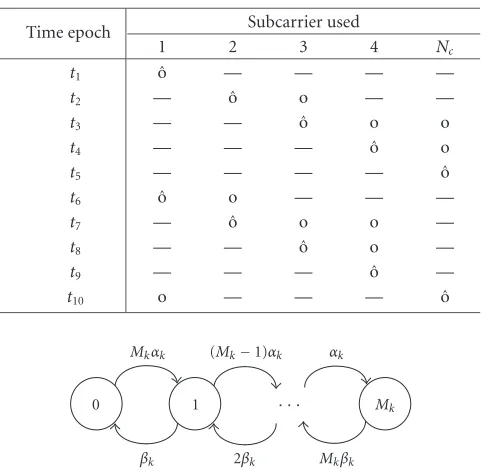
class transmits at the same bit rate in each of the subcarri-ers that they are transmitting in. For ease of illustration, the time durations for a source at each level are shown equal. To evenly spread the usage of the subcarriers and outage proba-bilities in the subcarriers and to increase the number of users in the system, we propose to use a novel round-robin carrier-hopping multirate MC-DS-CDMA scheme. The usage of the subcarriers is shown inTable 1. The symbol ˆo represents that a reference subcarrier is used, while the symbol o represents that the subsequent subcarrier is used. This round-robin carrier-hopping carrier allocation scheme works as follows. The reference subcarrier is moved in a round-robin manner over all the subcarriers.Table 1shows that the goal of evenly spreading the usage of the subcarriers is achieved. Thus, the outage probabilities in the subcarriers are lowered and the number of users that can be supported is increased.
Note that a round-robin carrier-hopping scheme is easier to implement than a random carrier-hopping scheme.
5. ANALYTICAL MODEL
5.1. Connection level
Consider aK-class complete sharing (CS) model. The guard capacityCGis reserved for handoffconnections only. To
fa-cilitate analytical modeling, it is necessary to make certain assumptions about the traffic parameters. It is not unreason-able to assume that the holding time has a negative
exponen-Table 1: Subcarriers used for a VBR source in a round-robin carrier-hopping MC-DS-CDMA system.
Time epoch Subcarrier used
1 2 3 4 Nc
t1 ˆo — — — —
t2 — ˆo o — —
t3 — — ˆo o o
t4 — — — ˆo o
t5 — — — — ˆo
t6 ˆo o — — —
t7 — ˆo o o —
t8 — — ˆo o —
t9 — — — ˆo —
t10 o — — — ˆo
0 Mkαk
βk
1
(Mk−1)αk
2βk
· · · αk
Mkβk
Mk
Figure2: Continuous-time Markov chain for a single VBR source.
tial distribution [11]. Although a negative exponential dis-tribution assumption may not be as reasonable for the cell-dwell time, for analytical tractability, we will make the same assumption for cell-dwell time (interhandofftime) [11] and model the channel occupancy as a K-dimensional Markov chain with the connection-level parameters inSection 3. This Markov chain can be modeled and solved using the tech-niques in [12].
The connection-level GoS is dependent on the packet-level QoS. Thus we need to understand the packet-packet-level char-acteristics before solving for the connection-level GoS. We assume that a classk connection, after being admitted into the system, behaves according to Maglaris’ model [5]. From Maglaris’ model [5], a VBR source can be modeled by a continuous-time Markov chain with finite states as shown in
Figure 2.
Each statemkrepresents the discrete level of bit rates
gen-erated by a single source. The combined data rate of each source ismkRk, whereRkis the bit rate for userkusing one
spreading code in the subcarrier. That is, we assume that each level of bit rate uses one spreading code in one subcarrier for a classkuser. This means that each level has a data rate ofRk
corresponding to one classkspreading code. Users use the same spreading code in their subcarriers. Each low-bit-rate level is modeled by a two-state mini-source with an increase rate of αk and a decrease rate ofβk. Thus the
continuous-time MC for a single VBR source at statemkhas an increase
rate of (Mk−mk)αkand a decrease rate ofmkβk, whereMk
is the highest-level bit rate, and this is also the maximum number of active spreading codes used inMksubcarrier by
The steady-state probability of being in statemk, denoted by
Analytical techniques such as those in [12] can be used to solve for the connection-level GoS like blocking probabilities and system utilization. To this end, letn = (n1,n2,. . .,nK)
denote the state of the system with the number of users (nk) in each of the K classes, let r = (rl,rl,. . .,rl)
de-note the number of basic subcarrier channels (rk) required
for each class k connection’s spreading code in the sub-carriers, and let m = {m1,m2,. . .,mK} denote the mean
number of active subcarrier spreading codes used by each class k connection in the active subcarriers, wheremk =
Mkαk/(αk+βk). Letλk(n) denote the arrival rate andµk(n)
the departure rate in the system. The state space of the sys-tem, denoted by S, is given by S := {n : (m·r)·n ≤
N}.
When the system is in statenand a classkconnection (new or handoff) arrives, an admission policy determines whether or not the connection is admitted into the system. Here, the admission policy is a complete sharing scheme with guard capacity. We can specify the admission policy by mappingf:=(f1,. . .,fK) for new and handoffconnections, fG :=(fG1,. . .,fGK) for handoffconnections, where fk and
fGk : S → {0, 1}, and fk(n) and fGk(n) each takes on the
value 0 or 1 if a classkconnection is rejected or admitted, respectively, when the system state isn. These mappings are defined by the following equations:
fk(n)=
LetP(n) denote the equilibrium probability that the sys-tem is in staten. The global balance equations for the Markov process under the policiesfandfGare
K
whereek is aK-dimensional vector of all zeros except for a
one in thekth place,
λnk is the arrival rate of classknew connections,λhk is the
arrival rate of classkhandoffconnections, 1/µckis the mean
connection holding time or lifetime of a classkconnection, and 1/µhkis the mean dwell time of a classkconnection. The
first condition in (4) allows both new and handoff connec-tions to be admitted to (N −CG) channels, while the second
condition allows only handoffconnections to be admitted to
CGchannels. Equation (5) allows both new and handoff
con-nections to be serviced when the total channel occupancy is less than or equal toNbasic channels. Due to the memoryless property of the exponential distribution, the distribution of the remaining connection holding time is the same as the dis-tribution of the original connection holding time. The depar-ture of a connection from the cell depends on the minimum of its cell-dwell time and its remaining connection holding time. Equation (3) can be solved using LU decomposition [13] together with the condition for the total probability of all states to obtainP(n). LU decomposition is a common nu-merical technique for solving linear algebraic equations. This gives exact solution. However, an efficient approximate com-putational algorithm [11] can be used for a large system state space. Results can be precomputed and stored in a lookup table for real-time applications in this situation.
Letθnk denote the probability that the next arrival is a
new classkconnection. Thenθnk = λnk/
K
k=1λk. Similarly,
if θhk denotes the probability that the next arrival is a class
k handoffconnection, we have θhk = λhk/
K
k=1λk, and if
θk denotes the probability that the next arrival is a classk
connection, we have θk = λk/
K
k=1λk. A new class k
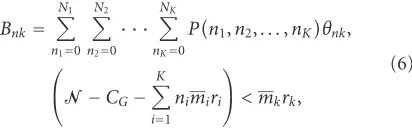
con-nection is blocked from entering the system (and is assumed lost) if upon arrival, it finds that it cannot be accommo-dated because the availablebasic channel capacity(excluding the guard capacity) is less than mkrk. Therefore the
block-ing probability for a new classkconnection considering all classes is given by
Bnk =
tions with maximum limits of Nk’s define the system state
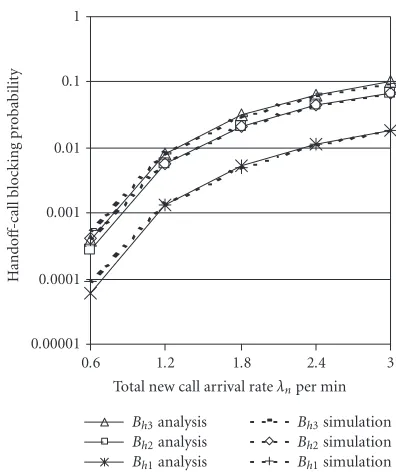
space S := {n : m·r·n ≤ N}. A classk handoff con-nection is blocked from entering the system (and is assumed lost) if upon arrival, it finds that it cannot be accommo-dated because the available basic channel capacity is less than
probability for a classk handoffconnection considering all classes is given by
Bhk=
The blocking probabilities of new and handoffconnections, denoted by Bn and Bh, respectively, are given by Bn =
K
k=1Bnk andBh=
K
k=1Bhk. SummingBnandBhyields the
total blocking probability,B=Bn+Bh. The system
utiliza-tion, defined as the number of basic rate users that can be supported, for classkconnections is given by
Nuk=
The total system utilization isNu=
K
k=1Nuk. From [2],
in-voking Little’s law for a generic cell, the classkhandoff con-nection arrival rate can be approximated under low blocking probabilities as follows:
λhk=µhkλnk
µck
, (9)
where 1/µhk is the mean dwell time of a classkconnection,
λnkis the arrival rate of classknew connections, and 1/µckis
the mean connection holding time of a classkconnection. Letnk be the number of active classkconnections.
Us-ing the definition of marginal distribution, the pmf of nk,
denoted byP(nk), is given by
Thus the mean, second moment and variance of nk,
de-noted bynk,n2kand Var[nk], are, respectively, given bynk =
The connection admission used here at the connection level is based onmwhich is based on the mean rate of a con-nection. Nevertheless, the joint QoS coupling for the connec-tion level, packet level, and link layer using CDMA inherently achieves statistical multiplexing and assures that all GoS/QoS requirements at the connection level, packet level, and link layer are satisfied simultaneously.
5.2. Packet level
We consider a subcarrier, assuming that all subcarriers are statistically identical. This assumption is valid as a round-robin carrier-hopping carrier allocation scheme is used.
The probability that subcarrier c is used for transmission, given that the source is in statemk, denoted byPc|mk, is given
Unconditioning the dependence on statemk, using (1) and
(11), and simplifying, the probability that subcarriercis used for transmission, denoted byPc, is given by
Pc=
the probability that subcarrier c is used for transmission is simply equal to the source activity factor pi divided by
the number of subcarriers Nc. This is due to the
round-robin carrier-hopping allocation scheme used. This alloca-tion scheme evenly spreads the subcarriers’ usage by a source. Treating each subcarrier as orthogonal from other sub-carriers, we can model each subcarrier as though it has on/offmulticlass traffic with the multirate MC-DS-CDMA sources’ subcarrier activity factors being treated like the on/offsources’ activity factors. Thus we can make use of the results in [3].
The probability that an active spreading code in a subcar-rier is used by sourcek, denoted by Pr[ψk=1]=qk, is given
by
Prψk=1
=qk=Pc, k=1, 2,. . .,K. (13)
The first and second moments, and the variances of the active classkspreading code used,xk, in a subcarrier are,
re-spectively, given byxk=qk,x2k=qkand Var[xk]=qk(1−qk).
For a stationary admission control policy, the underlying process is Markovian. Let
(i) rk =Rk/R, whereRis the basic data rate, be the
num-ber of basic channels a class k connection needs to transmit its packets for each of its spreading codes in a subcarrier;
(ii) nkbe the number of classkconnections in progress;
(iii) lkbe the number of active spreading codes used bynk
classkconnections in a subcarrier;
nkandlktogether characterize the state space, with the state
descriptor given by
(n,l)=n1,. . .,nK;l1,. . .,lK
. (14)
The probability that lk active spreading codes are used in a
subcarrier, given that there arenkconnections in progress, is
Assuming one packet is transmitted in a basic channel and no packet buffer, the equivalent classkpacket loss probability normalized over all classes for the CS scheme is given by
Lk=
andPoutage,kis the outage probability for classkconnections
which is defined in (18). The total packet loss probability is given byL=K
k=1Lk.
5.3. Link layer
To solve for the link layer QoS of outage probability in a sub-carrier, the first and second moments, and the variance of the required energy-to-interference density ratio (Eb/I0)kfor
each class k connection in the subcarrier are required. Let
εk denote the required energy-to-interference density ratio
(Eb/I0)kfor each classkconnection in the subcarrier under
some propagation conditions. Assuming that the classk sig-nal emerging from the propagation channel in the subcar-rier is lognormal distributed with a normal mean oftkand
a normal variance ofσ2
k. The mean and second moment of
εk are, respectively, given byεk = exp((βσk)2/2 +βtk), and
ε2
k =exp(2(βσk)2+ 2βtk), whereβ=(ln 10)/10. Its variance
is thus Var[εk]=exp(2(βσk)2+ 2βtk)−exp((βσk)2+ 2βtk).
We consider the uplink capacity focusing on a subcar-rier assuming statistically identical subcarsubcar-riers and define the outage to occur when the total influence of the users, both intracell and intercell, introduces an amount of interference densityI0so great that it exceeds the background noise level N0by an amountI0/N0 =1/ηin a subcarrier. Applying the approach in [3] to a subcarrier, the classioutage probability in a subcarrierPoutage,ifor MC-DS-CDMA can be written as
Poutage,i≈Q W/Nc
ing code in the subcarrier, W/Nc is the spread-spectrum
bandwidth in the subcarrier, and f is the other cell to own the cell relative interference factor in a subcarrier. Clearly, from (18) and (19), the link layer classioutage probability in a subcarrier is a function of not just the link layer character-istics (σk,tk) of the required energy-to-interference density
ratios, but also a function of the connection-level character-istics (nk) of the number of users of different classes as well as
a function of the packet-level characteristics (Mk,pk) of the
VBR sources and the number of subcarriers (Nc). Note that
qk=Mkpk/Nc.
For the purpose of assessing the performance of the un-coupled connection-level, packet-level, and link-layer ap-proach, we will assume that the nominal capacityN without coupling is given by
N =maxn1,maxi
5.4. Joint connection-level, packet-level, and link-layer QoS coupling
We can maximize the system utilization through coupling of the connection-level, packet-level, and link-layer parameters. This is also equivalent to maximizing the nominal capacity N. The maximization can be achieved by solving the cou-pling problem
maxNu
or max{N} (21)
subject to the constraints
Table2: Parameter values used.
Symbol Value Symbol Value
Nc 20, 40, or 60 1/µh2 18/60 min
CG 3 1/µh3 18/60 min
r1 1 t1=t2=t3 7 dB
r2 2 1/µc1 1 min
r3 2 1/µc2 2 min
M1 6 1/µc3 3 min
M2 3 σ1=σ2=σ3 2.5 dB
M3 2 (W/Nc)/R1 48, 24, or 16
α1 1/0.650 R=R1 96 kbps
α2 0.2 R2 192 kbps
α3 0.9 R3 192 kbps
β1 1/0.352 f 0.576
β2 0.1 η=N0/I0∗ 0.1
β3 0.1 B∗n1=B∗n2=B∗n3 0.1
θn1 θn2=θn3 Bh∗1=B∗h2=B∗h3 0.1 1/µh1 18/60 min L∗1 =L∗2 =L∗3 5×10⁻⁵
where the superscript ∗denotes the threshold of the cor-responding parameter. Numerical results for the maximum system utilization are obtained in Section 6.3by iteratively increasing the load until the target constraints are met.
6. NUMERICAL RESULTS
In this section we present results to examine the connection-and packet-level performance for the CS scheme with guard capacity, as well as the performance gain in system utiliza-tion through joint-layers GoS/QoS coupling. The analytical results have been obtained by means of the foregoing anal-ysis from Section 5, while the simulation results have been obtained from a simulation program coded in C for the con-nection level and ran with a simulation kernel. We consider three traffic classes (K=3).
The parameter values used in the numerical example pre-sented in this section are tabulated inTable 2.
6.1. Connection-level blocking probabilities and system utilization
The connection-level analytical and simulation results of new and handoffconnection blocking probabilities as a func-tion of the new connecfunc-tion arrival rate are shown in Figures
3and4, respectively.
For illustration purpose, a nominal capacity ofN =24 andNc=20 are chosen. Clearly, the larger the load, the larger
the blocking probabilities. Figure 5shows the connection-level analytical and simulation results of system utilization. The larger the load, the higher the system utilization.
6.2. Packet-level packet loss probabilities
Packet loss rates are presented in Figure 6. Intuitively, the larger the load, the larger the packet loss probabilities.
3 2.4
1.8 1.2
0.6
Total new call arrival rateλnper min
0.0001 0.001 0.01 0.1 1
N
ew-call
bloc
king
pr
obabilit
y
Bn3analysis Bn2analysis Bn1analysis
Bn3simulation Bn2simulation Bn1simulation Figure3: New connection blocking probabilities, whereCG =3, N =24, andNc=20.
3 2.4
1.8 1.2
0.6
Total new call arrival rateλnper min
0.00001 0.0001 0.001 0.01 0.1 1
Ha
n
d
o
ff
-call
bloc
king
pr
obabilit
y
Bh3analysis Bh2analysis Bh1analysis
Bh3simulation Bh2simulation Bh1simulation Figure4: Handoffconnection blocking probabilities, whereCG=
3,N =24, andNc=20.
6.3. Coupling of the connection-level, packet-level, and link-layer GoS/QoS
Figure 7 shows the effect of the gain in system utilization
through joint connection-level, packet-level, and link-layer GoS/QoS coupling for Nc = 20. The gain in system
3 2.4
1.8 1.2
0.6
Total new call arrival rateλnper min
0 5 10 15 20
U
tilization
Nuanalysis
Nu3analysis Nu2analysis Nu1analysis
Nusimulation
Nu3simulation Nu2simulation Nu1simulation Figure5: System utilization, whereCG=3,N =24, andNc=20.
3 2.4 1.8
1.2 0.6
Total new call arrival rateλnper min
1E-12 1E-11 1E-10 1E-09 1E-08 1E-07 1E-06 0.00001
P
ac
ket
loss
pr
obabilit
y
L3analysis L2analysis L1analysis
Figure6: Packet loss probabilities, whereCG = 3,N = 24, and Nc=20.
coupling. Without coupling, the nominal capacity isN =17, from (20). The total nominal capacityN is increased until the new or handoffconnections’ blocking probabilities,Bnk
orBhk, or the packet loss probabilities,Lk, violate any of their
respective thresholds.
The point, just before this violation occurs, corresponds to the maximum system utilizationNuand nominal
capac-ity N. With coupling, the nominal capacityN = {> 38,>
38,>38,>38, 29}forλn= {0.6, 1.2, 1.8, 2.4, 3.0}per minute.
3 2.4
1.8 1.2
0.6
Total new call arrival rateλnper min
0 5 10 15 20
U
tilization
Nuwith coupling
Nu3with coupling Nu2with coupling Nu1with coupling
Nuwithout coupling
Nu3without coupling Nu2without coupling Nu1without coupling Figure 7: System utilization with and without joint connec-tion/packet-level and link-layer GoS/QoS coupling forNc=20 and CG=3.
2.25 1.8
1.35 0.9
0.45
Total new call arrival rateλnper min
0 2 4 6 8 10 12
U
tilization
Nuwith coupling
Nu3with coupling Nu2with coupling Nu1with coupling
Nuwithout coupling
Nu3without coupling Nu2without coupling Nu1without coupling Figure 8: System utilization with and without joint connec-tion/packet-level and link-layer GoS/QoS coupling forNc=40 and CG=3.
We note that at N = 38, the packet loss probabilities at
λn= {0.6, 1.2, 1.8, 2.4}are still very low (in the order of 10−11
to 10−5) compared to the constraints of 5×10⁻⁵. However, their corresponding system utilization values are already at their maximum values. Thus we can assume these values forλn = {0.6, 1.2, 1.8, 2.4}per minute. At low load, where
λn=0.6 per minute, there is a very small gain in system
1.5 1.2
0.9 0.6
0.3
Total new call arrival rateλnper min
0 2 4 6 8 10
U
tilization
Nuwith coupling
Nu3with coupling Nu2with coupling Nu1with coupling
Nuwithout coupling
Nu3without coupling Nu2without coupling Nu1without coupling Figure 9: System utilization with and without joint connec-tion/packet-level and link-layer GoS/QoS coupling forNc=60 and CG=3.
GoS/QoS constraints in (21). At slightly above mid load, whereλn=2.4 per minute, the gain in system utilization is
the largest. At high load, whereλn=3.0 per minute, there is
still some gain in system utilization. Beyond that, the system utilization is being curbed by the packet loss probabilities in this numerical example. This means that the system is ap-proaching congestion. Overall, there is a significant gain in system utilization.
Figures 8 and9 show the effect of the gain in system utilization through joint connection-level, packet-level, and link-layer GoS/QoS coupling forNc =40 andNc =60,
re-spectively. Without coupling, the nominal capacity is N =
9 and N = 17, respectively, from (20). With coupling, the nominal capacity N = {> 38,> 38,> 38, 26, 20} for
λn = {0.45, 0.9, 1.35, 1.8, 2.25} per minute and N = {>
38,>38,>38,>38, 20}forλn = {0.3, 0.6, 0.9, 1.2, 1.5}per
minute, respectively. Although the absolute system utiliza-tion is larger for a smaller number of subcarriers Nc than
those for larger numbers of subcarriers, the gain in system utilization is larger for a larger number of subcarriers than those for small numbers of subcarriers as seen from Figures
7,8, and9. The reason for this is that the nominal capacity N =6 forNc =60,N =9 forNc =40, andN =17 for
Nc=20, respectively. Thus the system utilization forN =17
is higher than that forN =9, and that forN =9 is higher than that forN =6 due to the increase loading effect ofN as it increases.
7. CONCLUDING REMARKS
An approximate analytical formulation of the resource al-location problem for handling VBR multiclass services in a novel round-robin carrier-hopping multirate
MC-DS-CDMA cellular system has been presented in this paper. A complete sharing scheme is used for the resource sharing pol-icy. The analytical model is solved using a K-dimensional Markov chain for the CS scheme. In the formulation, all GoS/QoS requirements are satisfied across the layers simul-taneously. Numerical results illustrate that significant gain in system utilization can be achieved through the coupling of the connection/packet-levels and the link-layer parameters. This gain in utilization can translate to possibly more rev-enue for network providers and/or lower charges for mobile users.
REFERENCES
[1] M. Cheung and J. W. Mark, “Resource allocation in wireless networks based on joint packet/call levels QoS constraints,” inProc. IEEE Global Telecommunications Conference (GLOBE-COM ’00), vol. 1, pp. 271–275, San Francisco, Calif, USA, November–December 2000.
[2] T. C. Wong, J. W. Mark, and K. C. Chua, “Resource alloca-tion in mobile cellular networks with QoS constraints,” in Proc. IEEE Wireless Communications and Networking Confer-ence (WCNC ’02), vol. 2, pp. 717–722, Orlando, Fla, USA, March 2002.
[3] T. C. Wong, J. W. Mark, K. C. Chua, and Y. H. Chew, “Joint connection level, packet level and link layer resource alloca-tion in mobile cellular networks with QoS constraints,” in IEEE 57th Vehicular Technology Conference (VTC ’03), vol. 2, pp. 950–954, Jeju, South Korea, April 2003.
[4] T. C. Wong, J. W. Mark, and K.-C. Chua, “Joint connec-tion level, packet level, and link layer resource allocaconnec-tion for variable bit rate multiclass services in cellular DS-CDMA net-works with QoS constraints,” IEEE Journal on Selected Areas in Communications, vol. 21, no. 10, pp. 1536–1545, 2003. [5] B. Maglaris, D. Anastassiou, P. Sen, G. Karlsson, and J. D.
Robbins, “Performance models of statistical multiplexing in packet video communications,”IEEE Trans. Communications, vol. 36, no. 7, pp. 834–844, 1988.
[6] K. Fazel and G. P. Fettweis, Multi-Carrier Spread Spectrum, Kluwer Academic Publishers, Dordrecht, The Netherlands, 1997.
[7] M. K. Simon and M.-S. Alouini,Digital Communication over Fading Channels: A Unified Approach to Performance Analysis, John Wiley & Sons, New York, NY, USA, 2000.
[8] L. Hanzo, W. Webb, and T. Keller, Single- and Multi-Carrier Quadrature Amplitude Modulation: Principles and Applica-tions for Personal CommunicaApplica-tions, WLANs and Broadcasting, John Wiley & Sons, New York, NY, USA, 2000.
[9] K. Fazel and S. Kaiser, Eds., Multi-Carrier Spread-Spectrum and Related Topics, Kluwer Academic Publishers, Boston, Mass, USA, 2000.
[10] S. Hara and R. Prasad, Multicarrier Techniques for 4G Mobile Communications, Artech House, Boston, Mass, USA, 2003. [11] S. C. Borst and D. Mitra, “Virtual partitioning for robust
re-source sharing: computational techniques for heterogeneous traffic,” IEEE Journal on Selected Areas in Communications, vol. 16, no. 5, pp. 668–678, 1998.
[12] K. W. Ross, Multiservice Loss Models for Broadband Telecom-munication Networks, Springer-Verlag, London, UK, 1995. [13] W. H. Press, S. A. Teukolsky, W. T. Vetterling, and B. P.
Tung Chong Wongreceived the B.Eng. and M.Eng. degrees from the National Univer-sity of Singapore (NUS) in 1992 and 1994, respectively, and the Ph.D. degree from the University of Waterloo, Canada, in 1999, all in electrical engineering. He has been with the Institute for Infocomm Research, Singa-pore, (formerly known as Centre for Wire-less Communications, NUS, and Institute for Communications Research) first, as a
Research Engineer and currently as a Scientist, since 1994. His re-search interests are in communications networks and 3G/4G wire-less mobile multimedia networks. His areas of research are in the medium access control, resource allocation with quality-of-service constraints, and traffic policing with heterogeneous traffic. Dr. Wong is a Senior Member of IEEE. He was on the Technical Pro-gram Committee of the IEEE WCNC 2003 and will be serving on the Technical Program Committee of the IEEE WCNC 2005.
Jon W. Markreceived the Ph.D. degree in electrical engineering from McMaster Uni-versity, Canada, in 1970. He joined the De-partment of Electrical Engineering (now Electrical and Computer Engineering), the University of Waterloo, became a Full Pro-fessor in 1978, and served as a Depart-ment Chairman from July 1984 to June 1990. He established the Centre for Wire-less Communications (CWC), the
Univer-sity of Waterloo, in 1996. He coauthored the recent book Wire-less Communications and Networking, Prentice-Hall, 2003. He is the recipient of the 2000 Canadian Award in Telecommunica-tions Research and the 2000 Award of Merit by the Educa-tional Foundation of the Association of Chinese Canadian Pro-fessionals. He is currently a Distinguished Professor Emeritus and founding Director of CWC, the University of Waterloo. His cur-rent research interests are in wireless communications and wire-less/wireline interworking, particularly in the areas of resource management, mobility management, and end-to-end information delivery with QoS provisioning. Dr. Mark is a Life Fellow of the IEEE and has served as a Member of Editorial Boards, includ-ing IEEE Transactions on Communications, ACM/Baltzer Wire-less Networks, and so forth. He was a Member of the Inter-Society Steering Committee of the IEEE/ACM Transactions on Network-ing from 1992 to 2003, and served as the SC Chair durNetwork-ing 2002-2003.