R E S E A R C H A R T I C L E
Open Access
Could a remarkable decrease in leptin and
insulin levels from colostrum to mature
milk contribute to early growth catch-up of
SGA infants?
Marina Nunes
1,2, Clécio Homrich da Silva
1,2,3, Vera Lucia Bosa
1,3, Juliana Rombaldi Bernardi
1,2,
Isabel Cristina Ribas Werlang
1,2, Marcelo Zubaran Goldani
1,2,3*and NESCA Group
1Abstract
Background:
Breast milk is known to contain many bioactive hormones and peptides, which can influence infant
growth and development. In this context, the purpose of this study was to evaluate the influence of different
clinical pregnancy conditions on hormone concentrations in colostrum and mature breast milk.
Methods:
An observational study was performed with mother-newborn pairs divided into five groups according to
maternal clinical background: diabetes (12), hypertension (5), smoking (19), intrauterine growth restriction of unknown
causes with small-for-gestational-age newborns at delivery (12), and controls (21). Socioeconomic data, anthropometric
measurements and breast milk samples were collected between the first 24 and 48 h and 30 days postpartum. Leptin,
adiponectin, and insulin levels in breast milk were measured by immunoassays.
Results:
A significant decrease in leptin (
p
= 0.050) and insulin (
p
= 0.012) levels from colostrum to mature breast milk
in mothers of small-for-gestational-age infants was observed. Maternal body mass index was correlated with both
leptin and insulin, but not with adiponectin. Insulin levels were negatively correlated to infant weight gain from birth
to one month (
p
= 0.050). In addition, catch-up growth was verified for small-for-gestational-age infants throughout the
first month of life.
Conclusions:
This study suggests that a remarkable decrease in leptin and insulin levels in mature milk of mothers of
small-for-gestational-age newborns may be involved in the rapid weight gain of these newborns. The physiological
and external mechanisms by which these significant decreases and rapid weight gains occur in this group remain to
be elucidated.
Keywords:
Breast milk, Leptin, Insulin, Adiponectin, Maternal body mass index, Small-for-gestational-age
Background
Breast milk contains bioactive components, which play
an important biological role for the newborn. Leptin,
insulin and adiponectin are some of the hormones that
possess important functions in energy balance
regula-tion, food intake, and child body composition [1
–
3].
Leptin is an anorexigenic hormone that acts on neuronal
cells of the hypothalamus [4]. It is produced by
adipo-cytes, the human placenta and mammary glands [5
–
7].
Insulin displays anorexigenic effects similar to leptin [8].
It captures glucose for several tissues after food intake
[9], and seems to interfere on enteral hormones slowing
gastric emptying and promoting a sensation of satiety
[10]. Adiponectin is secreted by adipose tissue and
stimulates food intake and decreases energy expenditure,
the inverse action of leptin and insulin [11, 12]. This
hormone acts on glucose and lipid metabolisms,
* Correspondence:[email protected]1Laboratório de Pediatria Translacional / Núcleo de Estudos em Saúde da
Criança e do Adolescente (NESCA)–Hospital de Clínicas de Porto Alegre, Porto Alegre/RS, Brazil
2Programa de Pós-Graduação em Saúde da Criança e do Adolescente–
Faculdade de Medicina, Universidade Federal do Rio Grande do Sul, Porto Alegre/RS, Brazil
Full list of author information is available at the end of the article
improving insulin sensitization and fatty acid oxidation,
while also inhibiting hepatic glucose production [13, 14].
It is known that breast milk composition can be
influ-enced by the maternal clinical background [11, 12], in
which the body fat deposits are proportionally associated
to leptin, adiponectin and insulin levels. Positive
correla-tions have been demonstrated between maternal body
mass index (BMI) and hormone concentrations in breast
milk [12, 15–20], and between maternal BMI and serum
leptin concentrations in breastfed infants [21].
Insulin quantification in the breast milk of diabetic
mothers has been described by Whitmore et al. [22],
who observed no differences in insulin levels over 24 h
or in relation to diabetes type. Breast milk components
can be modified by smoking, which induces variations in
the concentration of certain cytokines [23–25]. However,
no such changes have been observed for leptin or other
hormones [24, 26]. Liu et al., assessed adiponectin
con-centrations in the breast milk of mothers presenting
pre-eclampsia and observed increases when compared to
controls [27].
In this context, the aim of the present study was to
evaluate the influence of different clinical conditions
during pregnancy (diabetes, hypertension, smoking and
idiopathic intrauterine growth restriction) on hormone
concentrations in colostrum and mature breast milk and
their associations with the early development of the
newborns.
Methods
The present prospective and observational study was
part of a larger project, named
Impact of Perinatal
Different Intrauterine Environments on Child Growth
and Development in the First Six Months of Life
(IVAPSA Birth Cohort Study)
. The research protocol has
been previously published [28]. The recruitment for the
IVAPSA study was carried out in public hospitals - the
Hospital de Clínicas de Porto Alegre and the Grupo
Hospitalar Conceição (Hospital Fêmina and Hospital
Conceição). Both are similar in maternal and child care
and are located in Porto Alegre, Rio Grande do Sul,
Brazil. Mothers were recruited at 24 to 48 h postpartum
and were divided into five groups according to maternal
clinical
background
and
pregnancy
outcome:
(I)
gestational diabetes treated only by diet (GDM) (II)
gestational hypertension without intrauterine growth
re-striction (HTN). These maternal clinical backgrounds
(diabetes and hypertension) were previously diagnosed
by prenatal physicians; (III) smoking (SMS)
–
mothers
who smoked at any time during the pregnancy. Smoking
mothers were selected by asking whether they had
smoked during their pregnancy (1 cigarette or more);
(IV) idiopathic intrauterine growth restriction with
small-for-gestational-age (SGA) newborn at delivery
–
birth weight below 5th percentile [29]; and (V) control
(CTL)
–
healthy mothers without diabetes or
hyperten-sion, who did not smoke during their pregnancy and
who did not deliver an SGA baby for unknown causes.
Exclusion criteria for all groups were HIV-positive
mother status, preterm delivery (< 37 gestational
weeks), newborn twin, newborn presenting malformations
at birth or newborn requiring any hospitalization after
delivery.
Two observations were performed, the first one
be-tween 24 to 48 h after delivery (PP) at the hospital, and
the second at one month postpartum (1 M).
Two-hun-dred and fourteen mother-newborn pairs were recruited
(GDM
–
25; HTN
–
23; SMS
–
58; SGA
–
25; CTL
–
83). The samples comprised mothers whose colostrum
and mature breast milk were available. Many of the
elected mothers did not provide breast milk, either
dur-ing the postpartum period, at 1-month postpartum, or at
any timeframe at all. In some cases, the sample amount
was insufficient for all the conducted analyses.
Informa-tion on birth, prenatal, social, economic, family, and
health data were obtained during interviews, using a
structured questionnaire developed by the investigators.
Anthropometric measurements were also obtained:
height and weight were measured using a portable
stadiometer
(AlturaExata®)
and
balance
(Marte®),
respectively. Infant weight gain was expressed from
Z-scores
for
age
according
to
the
World
Health
Organization growth curves [30].
Breast milk (1
–
5 mL) was collected according to the
availability of each mother in the first 24 and 48 h after
delivery and 30 days postpartum. No control if mothers
had breastfed their infants recently was performed,
precluding the determination of whether the collected
sample was hindmilk or foremilk. Previously
pub-lished results have shown no significant difference in
leptin [1, 22, 31
–
33] and insulin [22] levels between
breast milk samples obtained from the initial and
ter-minal phases of suckling. Maternal fasting status was
also not controlled. After milk expression into sterile
flasks by manual milking, the samples were
immedi-ately fractionated into labeled 1.5-mL tubes and
stored at
−
80 °C until analysis. Prior to the assays,
the milk samples (colostrum and mature milk) were
thawed and centrifuged at 15,000 rpm at 4 °C for
30 min to isolate fat in order to avoid its interference
on the performed measurements. The isolated fat was
discarded. No protease inhibitor was added.
Leptin, adiponectin and insulin were quantified in
du-plicate using commercially available Enzyme Linked
Immuno Sorbent Assay (ELISA) kits (Millipore®)
accord-ing to the manufacturer
’
s instructions.
(SPSS Inc.). The descriptive analyses were performed
ac-cording to the parametric or nonparametric distribution
of data, as identified by the Kolmogorov–Smirnov test.
The chi-square test was used to verify sample
homogen-eity between groups, as was the Kruskal–Wallis test for
continuous data. The Wilcoxon test was used for paired
nonparametric data (to evaluate differences in breast milk
hormone concentrations from colostrum to mature
milk), and the differences between groups were
assessed by the medians of the Kruskal-Wallis test
ap-plying the Games–Howell post-hoc test. An analysis
of variance (ANOVA) test applying Tukey’s post-hoc
test was used to compare the parametric variables of
maternal BMI between groups. Spearman coefficients
were used to assess potential nonparametric
correla-tions between breast milk hormone levels and
mater-nal BMI. A significance level of 5% (
p
≤
0.05) and
95% confidence intervals were considered.
Results
Sixty-nine mother–child pairs were distributed across the
five groups (12 GDM, 5 HTN, 19 SMS, 12 SGA, and 21
CTL). Of the mothers who provided breast milk in the
first moment (colostrum), 9 (3 DM, 2 HTN, 1 SGA and 3
CTL) did not provide the second sample (mature milk).
There were no significant differences in socioeconomic
variables, as displayed in Table 1. Mothers of SGA
new-borns presented lower BMI values in all measurements.
All infants were still being breastfed during the second
milk sampling of which forty-one were exclusively
breastfeeding. Nineteen mothers offered other foods
(solid, semi-solid or liquids) beyond breast milk and no
differences in concurrent neonatal feeds and hormone
concentration were observed (data not shown).
A significant difference between adiponectin
concen-trations of the HTN and CTL groups for colostrum (
p
=
0.015) was observed. Leptin and insulin concentrations
decreased in all groups over time. These decreases were
significant in mothers with SGA infants (
p
= 0.050),
lead-ing to the lowest leptin values of all groups at one
month (
p
= 0.031) (Table 2).
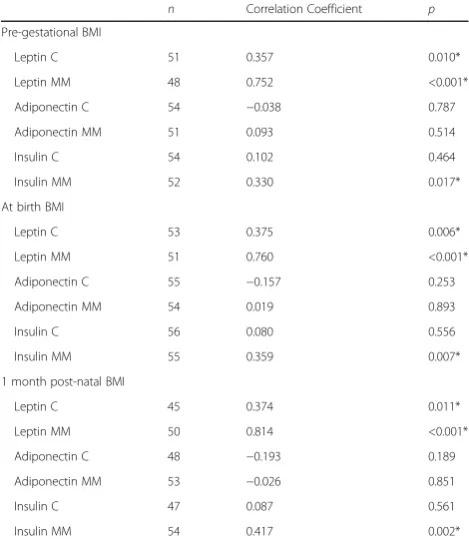
Leptin concentrations in colostrum and mature breast
milk were correlated with pre-gestational maternal BMI,
as well as at delivery and at one month post-natal,
whereas insulin presented a similar correlation for
ma-ture milk samples. Adiponectin showed no correlation
with maternal BMI during any of the evaluated
time-frames (Table 3).
Insulin in mature milk was negatively correlated to
in-fant weight gain at one month (
p
= 0.050) (Table 4). A
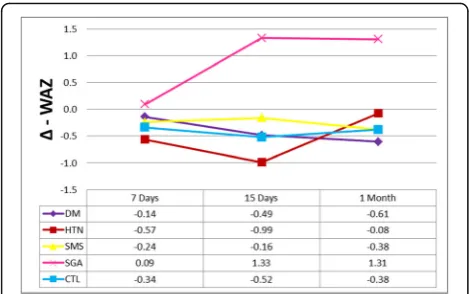
catch-up growth was observed in the SGA group at one
month, as displayed in Fig. 1.
Table 1
Socioeconomic and maternal characteristics in each group
GDM (12)
HTN (5)
SMS (19)
SGA (12)
CTL (21)
p
Race, n (%)
White 6 (50.0) 5 (100) 11 (57.9) 3 (25.0) 12 (57.1) 0.720
Marital situation, n (%)
With a partner 11 (91.7) 4 (80.0) 16 (84.2) 10 (83.3) 16 (76.2) 0.853
Education Level, n (%)
≤8 years 2 (16.7) 2 (40.0) 8 (44.4) 4 (33.3) 10 (52.6)
9–11 years 10 (83.3) 3 (60.0) 10 (65.6) 8 (66.7) 9 (47.4) 0.358
Social Classa
, n (%)
B 2 (18.2) 3 (60.0) 4 (21.1) 3 (25.0) 7 (33.3)
C 9 (81.8) 1 (20.0) 14 (73.7) 7 (58.3) 10 (47.6) 0.296
D 0 (0) 1 (20.0) 1 (5.3) 2 (16.7) 4 (19.0)
Age (years), x (SD) 26.64 (5.75) 27.81 (11.22) 26.28 (5.96) 22.35 (5.64) 27.54 (7.49) 0.303
Mode of delivery, n (%)
Cesarean 5 (41.7) 3 (60.0) 5 (26.3) 2 (16.7) 5 (23.8) 0.343
Maternal BMI (Kg/m2), x (SD)
Pre-gestational 27.38 (5.72)** 26.82 (2.86) 23.90 (4.83) 21.09 (3.46)** 25.07 (5.73) 0.037*
At birth 31.86 (6.14)** 32.31 (4.06)** 30.24 (5,30)** 24.66 (2.77)** 30.95 (5.05)** 0.004*
At 1 month post-natal 28.26 (6.42) 29.57 (2.69) 26.62 (4.61) 22.32 (2.30)** 29.70 (5.57)** 0.020*
There were no statistically significant differences across groups in socioeconomic characteristics (p > 0.05 for chi-square test [categorical data] and Kruskal–Wallis test [continuous data]). Maternal BMI data: *p≤0.05, ANOVA test between groups; **p≤0.05, Tukey post-hoc test.a
Discussion
The evaluation of socioeconomic and maternal factors
such as race, marital status, age, education level and
so-cial class showed a homogeneous sample, with similar
characteristics despite the influence of different maternal
gestational clinical conditions. Mothers of SGA infants
presumably contributed through their lower BMI to
restriction mechanisms of their offspring, although other
factors may be involved, such as caloric restrictions or
no apparent pathological conditions [34–36].
Results indicate no differences in insulin and leptin
concentrations in colostrum regardless of the influence
of the maternal gestational clinical condition, as
previ-ously demonstrated for diabetic [22] and smoking
mothers [23, 26]. On the other hand, increased
adipo-nectin levels have been observed for hypertensive
mothers in comparison to controls, as described by Liu
et al. [27]. Higher adiponectin serum and leptin levels in
preeclampsia mothers have also been described by other
authors [37, 38].
Decreases in hormone levels were observed during the
first month of breastfeeding, in accordance to other
studies [12, 17, 39–41]. Interestingly, breast milk from
mothers of SGA infants exhibited a remarkable decrease
in leptin and insulin levels at one month compared to
other groups. Leptin and insulin breast milk levels
correlate with their serum counterparts, which are
Table 2
Breast Milk leptin, adiponectin and insulin concentrations at colostrum and mature milk according to groups
GDM
p 1.000 0.655 0.753 0.050* 0.234
Adiponectin, C (ng/mL) 10.230
p 0.109 0.180 0.112 0.123 0.959
Insulin, C (μU/mL) 49.370
p 0.273 0.180 0.084 0.012* 0.041*
*p≤0.05, Wilcoxon test for paired data; **p≤0.05, Kruskal–Wallis test between groups; ***p≤0.05, Games–Howell post-hoc test. (C): colostrum; (MM): mature milk; GDM: Gestational Diabetes Mellitus; HTN: Gestational Hypertension; SMS: Smoking; SGA: Small-for-gestational-age; CTL: Control
Table 3
Correlation of breast milk hormones with maternal BMI
n Correlation Coefficient p
Pre-gestational BMI
Leptin C 51 0.357 0.010*
Leptin MM 48 0.752 <0.001*
Adiponectin C 54 −0.038 0.787
Adiponectin MM 51 0.093 0.514
Insulin C 54 0.102 0.464
Insulin MM 52 0.330 0.017*
At birth BMI
Leptin C 53 0.375 0.006*
Leptin MM 51 0.760 <0.001*
Adiponectin C 55 −0.157 0.253
Adiponectin MM 54 0.019 0.893
Insulin C 56 0.080 0.556
Insulin MM 55 0.359 0.007*
1 month post-natal BMI
Leptin C 45 0.374 0.011*
Leptin MM 50 0.814 <0.001*
Adiponectin C 48 −0.193 0.189
Adiponectin MM 53 −0.026 0.851
Insulin C 47 0.087 0.561
Insulin MM 54 0.417 0.002*
*p≤0.05, Spearman’s test. C: colostrum; MM: mature milk. BMI:body mass index
Table 4
Correlation of breast milk hormone concentrations
with infant weight gain
n Correlation coefficient p Weight gain at 1 month
Leptin, C 45 0.039 0.800
Leptin, MM 50 −0.264 0.064
Adiponectin, C 48 −0.112 0.450
Adiponectin, MM 53 −0.211 0.129
Insulin, C 47 −0.055 0.715
Insulin, MM 54 −0.268 0.050*
proportional to maternal fat tissue [16, 19, 42]. Thus,
these significant decreases can be related, at least in part,
to the lower BMI of SGA mothers. A recent study
demonstrated that the frequency and duration of
breast-feeding presented a positive correlation with protein
concentrations in breastmilk [43]. However, some
authors have demonstrated that leptin levels are not
modi-fied comparing before and after suckling [1, 22, 31–33].
Maternal leptin and insulin serum concentrations
dur-ing pregnancy increase concomitantly with maternal
BMI [16, 44, 45], whereas adiponectin levels decrease
[46]. Several studies have demonstrated a correlation
be-tween maternal BMI and satiety hormones in breast
milk and serum of both mothers and neonates at
delivery, as well as a broad variation in hormone levels
[16–21, 42]. Herein, leptin concentrations in colostrum
and mature milk positively correlated to maternal BMI
before pregnancy, at delivery and at one month
postpar-tum. Studies have demonstrated the same correlation for
both colostrum [14, 17] and mature milk [6, 15, 17, 19, 47]
with pre-gestational BMI, as well as maternal BMI at
delivery [14] and at one month postpartum [1].
Maternal obesity has been associated with several
ad-verse effects in children, such as metabolic, neurological
and cardiovascular disorders later in life [48
–
51].
Increased leptin levels delivered to the fetus during
preg-nancy and breastfeeding may lead to predisposition for
leptin resistance, impairing the ability of leptin to
regu-late appetite [52
–
55]. On the other hand, intrauterine
growth restriction (IUGR) may also lead to leptin
resist-ance [55
–
58]. Wattez et al. [59] have demonstrated
lep-tin/insulin
resistance
in
offspring
from
both
undernourished dams and dams fed an obesogenic diet.
The timing of neonatal leptin increases influenced by
fetal nutrition contributes to the development of obesity
in later life [58]. This reinforces the importance of
ma-ternal weight control before and during pregnancy in
order to avoid adverse outcomes to the newborn.
Insulin levels in mature milk were also positively
correlated to maternal BMI at each measurement period.
However, no correlation was verified for colostrum
sam-ples. Few studies linking insulin concentrations in breast
milk with maternal BMI are available. Ley and
collabora-tors reported similar findings regarding pre-gestational
BMI [12], while other researchers found no correlation
between insulin levels and maternal BMI [15, 60]. In the
present study, no correlation was observed between
adiponectin concentrations and maternal BMI in any
of the evaluated timeframes, in accordance to the
literature [6, 7, 12, 41, 47, 61].
Insulin levels were negatively correlated with infant
weight gain at one month of age, in accordance to its
role as an energy balance, food intake and body
compos-ition regulator. In addcompos-ition, high exposure to insulin
during the lactation period has been associated with
lower infant weight and lower lean mass at one month
[15]. Insulin signaling pathways are involved in the
development of the infant gastrointestinal system [10]
and could act in the arcuate nucleus of the
hypothal-amus, affecting satiety and appetite control [8, 9]. Thus,
it may influence postnatal growth.
The present study also demonstrates a catch-up
growth of SGA infants through one month, which
was not been observed for any other group. Rapid
weight gain in both infancy and early childhood is a
risk factor for adult adiposity and obesity [62]. In
addition, rapid infant weight gain has also been
associated with increased risk of being overweight at
4
years
of
age,
independently
of
the
potential
confounders [62] and other unfavorable outcomes
[56, 63
–
66]. Although early catch-up growth appears
to be beneficial for the child, the Latin American SGA
Consensus Guidelines recommend that children born
SGA should not be allowed to gain weight too rapidly or
excessively, probably in an effort to circumvent the
devel-opment of metabolic disturbances [67].
The strengths of this study are the completeness of
the collected maternal and neonatal data and the
com-parison of the impact of different maternal gestational
clinical conditions on hormone concentrations in breast
milk in a homogeneous sample. Some limitations are
noteworthy, such as the lack of time control for the
breast milk sampling or maternal fasting status, despite
the fact that some studies have found no influence of
these factors on hormone measurements [1, 22, 31
–
33].
Furthermore, the rigorous methodology for inclusion in
the sample groups restricted the sample size.
Conclusions
The results obtained herein demonstrate different
patterns of hormone concentrations in breast milk from
mothers of SGA newborns. The significant decreases in
Fig. 1Differences in Weight-for-Age Z-scores (Δ–WAZ) in relationleptin and insulin concentrations after birth may be
in-volved in weight regain as usual in SGA newborns.
Interestingly, these changes occurred after birth,
suggest-ing that post-natal and even external mediatsuggest-ing factors
could contribute to this outcome. Further investigations
are required to clarify these findings.
Abbreviations
1 M:1 month postpartum; ANOVA: Analysis of variance; BMI: Body mass index; CTL: Control; ELISA: Enzyme Linked Immuno Sorbent Assay; GDM: Gestational Diabetes Mellitus; HTN: Gestational Hypertension; PP: Postpartum; SGA: Small-for-gestational-age; SMS: Smoking
Acknowledgements
We thank all the other researchers from NESCA group (Amanda Ferreira, Fabiana Copes, Mariana Lopes de Brito, Monique Cabral Hahn, Salete de Matos, Sara Brunetto, Tanara Vogel Pinheiro, Thamíris Medeiros). We also thank the participant families for their time and patience.
Funding
The research was supported by National Support Program for Centers of Excellence PRONEX/ FAPERGS 2009; PRONEM/FAPERGS 2011; CNPq; CAPES and FIPE/HCPA.
Availability of data and materials
The datasets used and/or analysed during the current study available from the corresponding author on reasonable request.
Authors’contributions
MN was responsible for designed and conducted research, analyzed data or performed statistical analysis, wrote paper, and had primary responsibility for final content and sample analysis. CHS was responsible for designed and conducted research and final review of paper. VLB was responsible for designed research. JRB was responsible for designed and conducted research. ICRW was responsible for designed and conducted research, wrote paper, and had primary responsibility for final content and sample analysis. MZG was responsible for designed and conducted research, analyzed data or performed statistical analysis, wrote paper and had primary responsibility for final content. All the authors read and approved the final version of the manuscript.
Ethics approval and consent to participate
The procedures performed here are in accordance with the ethical standards of Hospital de Clínicas de Porto Alegre Research Ethics Committee with judgment number 11–0097 and by the Grupo Hospitalar Conceição Ethics Committee with judgment number 11–027. All participants gave their written informed consent prior to their inclusion in the study. Details that might disclose the identity of the subjects under study had been omitted.
Consent for publication
Not applicable.
Competing interests
The authors declare that they have no competing interest.
Publisher
’
s Note
Springer Nature remains neutral with regard to jurisdictional claims in published maps and institutional affiliations.
Author details
1Laboratório de Pediatria Translacional / Núcleo de Estudos em Saúde da
Criança e do Adolescente (NESCA)–Hospital de Clínicas de Porto Alegre, Porto Alegre/RS, Brazil.2Programa de Pós-Graduação em Saúde da Criança e
do Adolescente–Faculdade de Medicina, Universidade Federal do Rio Grande do Sul, Porto Alegre/RS, Brazil.3Departamento de Pediatria
-Faculdade de Medicina, Universidade Federal do Rio Grande do Sul, Porto Alegre/RS, Brazil.
Received: 16 March 2016 Accepted: 23 November 2017
References
1. Schueler J, Alexander B, Hart AM, Austin K, Larson-Meyer DE. Presence and dynamics of leptin, GLP-1, and PYY in human breast milk at early postpartum. Obesity (Silver Spring). 2013;21:1451–8.
2. Gupta M, Zaheer, Jora R, Kaul V, Gupta R. Breast feeding and insulin levels in low birth weight neonates: a randomized study. Indian J Pediatr. 2010;77:509–13.
3. Schuster S, Hechler C, Gebauer C, Kiess W, Kratzsch J. Leptin in maternal serum and breast milk: association with infants’body weight gain in a longitudinal study over 6 months of lactation. Pediatr Res. 2011;70:633–7. 4. Savino F, Benetti S, Liguori SA, Sorrenti M, Cordero Di Montezemolo L.
Advances on human milk hormones and protection against obesity. Cell Mol Biol. 2013;59:89–98.
5. Jaquet D, Leger J, Levy-Marchal C, Oury JF, Czernichow P. Ontogeny of leptin in human fetuses and newborns: effect of intrauterine growth retardation on serum leptin concentrations. J Clin Endocrinol Metab. 1998;83:1243–6. 6. Weyermann M, Beermann C, Brenner H, Rothenbacher D. Adiponectin and leptin
in maternal serum, cord blood, and breast milk. Clin Chem. 2006;52:2095–102. 7. Dundar NO, Dundar B, Cesur G, Yilmaz N, Sutcu R, Ozguner F. Ghrelin and
adiponectin levels in colostrum, cord blood and maternal serum. Pediatr Int. 2010;52:622–5.
8. Pliquett RU, Führer D, Falk S, et al. The effects of insulin on the central nervous system-focus on appetite regulation. Horm Metab Res. 2006;38:442–6. 9. de Graaf C, Blom WA, Smeets PA, Stafleu A, Hendriks HF. Biomarkers of
satiation and satiety. Am J Clin Nutr. 2004;79:946–61.
10. Shehadeh N, Sukhotnik I, Shamir R. Gastrointestinal tract as a target organ for orally administered insulin. J Pediatr Gastroenterol Nutr. 2006;43:276–81. 11. Ley SH, O'Connor DL, Retnakaran R, Hamilton JK, Sermer M, Zinman B,
Hanley AJ. Impact of maternal metabolic abnormalities in pregnancy on human milk and subsequent infant metabolic development: methodology and design. BMC Public Health. 2010;10:590.
12. Ley SH, Hanley AJ, Sermer M, Zinman B, O'Connor DL. Associations of prenatal metabolic abnormalities with insulin and adiponectin concentrations in human milk. Am J Clin Nutr. 2012;95:867–74.
13. Newburg DS, Woo JG, Morrow AL. Characteristics and potential functions of human milk adiponectin. J Pediatr. 2010;156:S41–6.
14. Bronsky J, Karpisek M, Bronska E, Pechova M, Jancikova B, Kotolova H, Stejskal D, Prusa R, Nevoral J. Adiponectin, adipocyte fatty acid binding protein, and epidermal fatty acid binding protein: proteins newly identified in human breast milk. Clin Chem. 2006;52:1763–70.
15. Fields DA, Demerath EW. Relationship of insulin, glucose, leptin, IL-6 and TNF-alpha in human breast milk with infant growth and body composition. Pediatr Obes. 2012;7:304–12.
16. Butte NF, Hopkinson JM, Nicolson MA. Leptin in human reproduction: serum leptin levels in pregnant and lactating women. J Clin Endocrinol Metab. 1997;82:585–9.
17. Eilers E, Ziska T, Harder T, Plagemann A, Obladen M, Loui A. Leptin determination in colostrum and early human milk from mothers of preterm and term infants. Early Hum Dev. 2011;87:415–9.
18. Maple-Brown L, Ye C, Hanley AJ, Connelly PW, Sermer M, Zinman B, Retnakaran R. Maternal pregravid weight is the primary determinant of serum leptin and its metabolic associations in pregnancy, irrespective of gestational glucose tolerance status. J Clin Endocrinol Metab. 2012;97:4148–55. 19. Miralles O, Sanchez J, Palou A, Pico C. A physiological role of breast milk
leptin in body weight control in developing infants. Obesity (Silver Spring). 2006;14:1371–7.
20. Andreas NJ, Hyde MJ, Gale C, Parkinson JR, Jeffries S, Holmes E, Modi N. Effect of maternal body mass index on hormones in breast milk: a systematic review. PLoS One. 2014;9:e115043.
21. Savino F, Liguori SA, Oggero R, Silvestro L, Miniero R. Maternal BMI and serum leptin concentration of infants in the first year of life. Acta Paediatr. 2006;95:414–8.
22. Whitmore TJ, Trengove NJ, Graham DF, Hartmann PE. Analysis of insulin in human breast milk in mothers with type 1 and type 2 diabetes mellitus. Int J Endocrinol. 2012;2012:296368.
interleukin-1alpha, beta-endorphin, and leptin concentrations and leptin concentrations. Environ Health Perspect. 2005;113:1410–3.
24. Etem Piskin I, Nur Karavar H, Arasli M, Ermis B. Effect of maternal smoking on colostrum and breast milk cytokines. Eur Cytokine Netw. 2012;23:187–90. 25. Szlagatys-Sidorkiewicz A, Wos E, Aleksandrowicz E, Luczak G, Zagierski M,
Martysiak-Zurowska D, Marek K, Kaminska B. Cytokine profile of mature milk from smoking and nonsmoking mothers. J Pediatr Gastroenterol Nutr. 2013;56:382–4. 26. Ozkan B, Ermis B, Tastekin A, Doneray H, Yildirim A, Ors R. Effect of smoking
on neonatal and maternal serum and breast milk leptin levels. Endocr Res. 2005;31:177–83.
27. Liu Y, Zhu L, Pan Y, Sun L, Chen D, Li X. Adiponectin levels in circulation and breast milk and mRNA expression in adipose tissue of preeclampsia women. Hypertens Pregnancy. 2012;31:40–9.
28. Bernardi JR, Ferreira CF, Nunes M, da Silva CH, Bosa VL, Silveira PP, Goldani MZ. Impact of Perinatal different intrauterine environments on child growth and development in the first six months of life-IVAPSA birth cohort: rationale, design, and methods. BMC Pregnancy Childbirth. 2012;12:25. 29. Alexander GR, Himes JH, Kaufman RB, Mor J, Kogan MA. United States National Reference for fetal growth. Obstet Gynecol. 1996;87(2):163–8. 30. World Health Organization. WHO child growth standards: methods and
development: length/height-for-age, weight-for-age, weight-for-length, weight-for-height and body mass index-for-age. Geneva: World Health Organization; 2006.
31. Cannon AM, Kakulas F, Hepworth AR, Lai CT, Hartmann PE, Geddes DT. The effects of Leptin on breastfeeding behaviour. Int J Environ Res Public Health. 2015;12:12340–55.
32. Karatas Z, Durmus Aydogdu S, Dinleyici EC, Colak O, Dogruel N. Breastmilk ghrelin, leptin, and fat levels changing foremilk to hindmilk: is that important for self-control of feeding? Eur J Pediatr. 2011;170:1273–80. 33. Uçar B, Kirel B, Bor O, Kilic FS, Dogruel N, Aydogdu SD, Tekin N. Breast milk
leptin concentrations in initial and terminal milk samples: relationships to maternal and infant plasma leptin concentrations, adiposity, serum glucose, insulin, lipid and lipoprotein levels. J Pediatr Endocrinol Metab. 2000;13:149–56. 34. Vahdaninia M, Tavafian SS, Montazeri A. Correlates of low birth weight in
term pregnancies: a retrospective study from Iran. BMC Pregnancy Childbirth. 2008;8:12.
35. Heaman M, Kingston D, Chalmers B, Sauve R, Lee L, Young D. Risk factors for preterm birth and small-for-gestational-age births among Canadian women. Paediatr Perinat Epidemiol. 2013;27:54–61.
36. Xaverius PK, Salas J, Woolfolk CL, Leung F, Yuan J, Chang JJ. Predictors of size for gestational age in St. Louis City and county. Biomed Res Int. 2014; 2014:515827.
37. Salimi S, Farajian-Mashhadi F, Naghavi A, Mokhtari M, Shahrakipour M, Saravani M, Yaghmaei M. Different profile of serum leptin between early onset and late onset preeclampsia. Dis Markers. 2014;2014:628476. 38. Haugen F, Ranheim T, Harsem NK, Lips E, Staff AC, Drevon CA. Increased
plasma levels of adipokines in preeclampsia: relationship to placenta and adipose tissue gene expression. Am J Physiol Endocrinol Metab. 2006;290: E326–33.
39. Ilcol YO, Hizli ZB, Ozkan T. Leptin concentration in breast milk and its relationship to duration of lactation and hormonal status. Int Breastfeed J. 2006;1:21. 40. Martin LJ, Woo JG, Geraghty SR, Altaye M, Davidson BS, Banach W, Dolan
LM, Ruiz-Palacios GM, Morrow AL. Adiponectin is present in human milk and is associated with maternal factors. Am J Clin Nutr. 2006;83:1106–11. 41. Bronsky J, Mitrova K, Karpisek M, Mazoch J, Durilova M, Fisarkova B, Stechova K,
Prusa R, Nevoral J, Adiponectin AFABP. Leptin in human breast milk during 12 months of lactation. J Pediatr Gastroenterol Nutr. 2011;52:474–7.
42. Casabiell X, Piñeiro V, Tomé MA, Peinó R, Diéguez C, Casanueva FF. Presence of leptin in colostrum and/or breast milk from lactating mothers: a potential role in the regulation of neonatal food intake. J Clin Endocrinol Metab. 1997;82:4270–3.
43. Khan S, Hepworth AR, Prime DK, Lai CT, Trengove NJ, Hartmann PE. Variation in fat, lactose, and protein composition in breast milk over 24 hours: associations with infant feeding patterns. J Hum Lact. 2013;29:81–9. 44. Schubring C, Englaro P, Siebler T, Blum WF, Demirakca T, Kratzsch J, Kiess W.
Longitudinal analysis of maternal serum Leptin levels during pregnancy, at birth and up to six weeks after birth: relation to body mass index, Skinfolds, sex steroids and umbilical cord blood Leptin levels. Horm Res. 1998;50:276–83. 45. Pérez-Pérez A, Jiménez F, Maymó J, Dueñas JL, Varone C,
Sánchez-Margalet V. Role of leptin in female reproduction. Clin Chem Lab Med. 2015;53:15–28.
46. Catalano PM, Hoegh M, Minium J, Huston-Presley L, Bernard S, Kalhan S, Hauguel-De Mouzon S. Adiponectin in human pregnancy: implications for regulation of glucose and lipid metabolism. Diabetologia. 2006;49:1677–85. 47. Brunner S, Schmid D, Zang K, Much D, Knoeferl B, Kratzsch J, Amann-Gassner
U, Bader BL, Hauner H. Breast milk leptin and adiponectin in relation to infant body composition up to 2 years. Pediatr Obes. 2015;10:67–73.
48. Edlow AG. Maternal obesity and neurodevelopmental and psychiatric disorders in offspring. Prenat Diagn. 2017;37(1):95–110.
49. Rivera HM, Christiansen KJ, Sullivan EL. The role of maternal obesity in the risk of neuropsychiatric disorders. Front Neurosci. 2015;9:194.
50. Roberts VH, Frias AE, Grove KL. Impact of maternal obesity on fetal programming of cardiovascular disease. Physiology (Bethesda). 2015;30(3):224–31.
51. Santangeli L, Sattar N, Huda SS. Impact of maternal obesity on perinatal and childhood outcomes. Best Pract Res Clin Obstet Gynaecol. 2015;29(3):438–48. 52. Glavas MM, Kirigiti MA, Xiao XQ, Enriori PJ, Fisher SK, Evans AE, et al. Early
overnutrition results in early-onset arcuate leptin resistance and increased sensitivity to high-fat diet. Endocrinology. 2010;151:1598–610.
53. Kirk SL, Samuelsson AM, Argenton M, Dhonye H, Kalamatianos T, Poston L, et al. Maternal obesity induced by diet in rats permanently influences central processes regulating food intake in offspring. PLoS One. 2009;4(6):e5870. 54. Morris MJ, Chen H. Established maternal obesity in the rat reprograms
hypothalamic appetite regulators and leptin signaling at birth. Int J Obes. 2009;33(1):115–22.
55. Vickers MH, Sloboda DM. Leptin as mediator of the effects of
developmental programming. Best Pract Res Clin Endocrinol Metab. 2012; 26(5):677–87.
56. Coupe B, Grit I, Hulin P, Randuineau G, Parnet P. Postnatal growth after intrauterine growth restriction alters central leptin signal and energy homeostasis. PLoS One. 2012;7:30616.
57. Jaquet D, Leger J, Tabone MD, Czernichow P, Levy-Marchal C. High serum leptin concentrations during catch-up growth of children born with intrauterine growth retardation. J Clin Endocrinol Metab. 1999;84(6):1949–53. 58. Yura S, Itoh H, Sagawa N, Yamamoto H, Masuzaki H, Nakao K, et al. Role of premature leptin surge in obesity resulting from intrauterine undernutrition. Cell Metab. 2005;1(6):371–8.
59. Wattez JS, Delahaye F, Lukaszewski MA, Risold PY, Eberlé D, Vieau D, et al. Perinatal nutrition programs the hypothalamic melanocortin system in offspring. Horm Metab Res. 2013;45(13):980–90.
60. Shehadeh N, Khaesh-Goldberg E, Shamir R, Perlman R, Sujov P, Tamir A, Makhoul IR. Insulin in human milk, postpartum changes and effect of gestational age. Arch Dis Child Fetal Neonatal Ed. 2003;88:F214–6. 61. Luoto R, Laitinen K, Nermes M, Isolauri E. Impact of maternal
probiotic-supplemented dietary counseling during pregnancy on colostrum adiponectin concentration: a prospective, randomized, placebo-controlled study. Early Hum Dev. 2012;88:339–44.
62. Ekelund U, Ong K, Linné Y, Neovius M, Brage S, Dunger DB, Wareham NJ, Rössner S. Upward weight percentile crossing in infancy and early childhood independently predicts fat mass in young adults: the Stockholm weight development study (SWEDES). Am J Clin Nutr. 2006;83:324–30. 63. Dennison BA, Edmunds LS, Stratton HH, Pruzek RM. Rapid infant weight
gain predicts childhood overweight. Obesity (Silver Spring). 2006;14:491–9. 64. Barker DJ, Eriksson JG, Forsen T, Osmond C. Fetal origins of adult disease:
strength of effects and biological basis. I. Int J Epidemiol. 2002;31:1235–9. 65. Ong KK, Preece MA, Emmett PM, Ahmed ML, Dunger DB, Team AS. Size at
birth and early childhood growth in relation to maternal smoking, parity and infant breast-feeding: longitudinal birth cohort study and analysis. Pediatr Res. 2002;52:863–7.
66. Putzker S, Bechtold-Dalla Pozza S, Kugler K, Schwarz HP, Bonfig W. Insulin resistance in young adults born small-for-gestational-age (SGA). J Pediatr Endocrinol Metab. 2014;27:253–9.