R E S E A R C H
Open Access
Resource allocation for secure Gaussian
parallel relay channels with finite-length
coding and discrete constellations
Linda Senigagliesi
1*†, Marco Baldi
1†and Stefano Tomasin
2†Abstract
We investigate the transmission of a secret message from Alice to Bob in the presence of an eavesdropper (Eve) and many of decode-and-forward relay nodes. Each link comprises a set of parallel channels, modeling for example an orthogonal frequency division multiplexing transmission. We consider the impact of efficient implementations, including discrete constellations and finite-length coding, defining an achievable secrecy rate under a constraint on the equivocation rate at Eve. Then, we propose a power and channel allocation algorithm that maximizes the achievable secrecy rate by resorting to two coupled Gale-Shapley algorithms for stable matching problem. We consider the scenarios of both full and partial channel state information at Alice. In the latter case, we only guarantee anoutagesecrecy rate, i.e., the rate of a message that remains secret with a given probability. Numerical results are provided for Rayleigh fading channels in terms of average outage secrecy rate, showing that practical schemes achieve a performance quite close to that of ideal ones.
Keywords: Channel state information, Decode-and-forward, Physical layer security, Relay channel, Resource allocation
1 Introduction
Adding secrecy features to the physical layer is an active and promising research area [1] that complements tra-ditional computational security approaches. Indeed, a proper coding scheme can prevent an eavesdropper Eve from getting information on a message exchanged between the two legitimate users Alice and Bob [2].
In this paper we expand the results of [3] on resource allocation for confidential communications over the Gaussian parallel relay channels, as that work was lim-ited to an ideal scenario, while we address a more realistic model by including the practical constraints of finite-length coding and discrete constellations. We first derive the achievable secrecy rate of this scheme under the assumption of full channel state information (CSI) by Alice and the relay nodes. Then, in order to consider the impact of discrete constellations and finite-length coding,
*Correspondence:[email protected]
†Linda Senigagliesi, Marco Baldi, and Stefano Tomasin contributed equally to this work.
1Dipartimento di Ingegneria dell’Informazione, Università Politecnica delle
Marche, Via Brecce Bianche 12, 60131 Ancona, Italy
Full list of author information is available at the end of the article
we define an achievable secrecy rate under a constraint on the equivocation rate at Eve. Using an approximated formula of the achievable secrecy rate, we derive the optimal power allocation for point-to-point confidential transmission. By exploiting the power and rate adaptation algorithm for the parallel relay channels of [3], we obtain a resource allocation algorithm coupling two Gale and Shapley algorithms to allocate resources over the parallel relay channels. We also consider the partial CSI scenario, wherein Alice does not know the gains of her channels to Eve, while knowing their statistics. In this case, we only guarantee anoutagesecrecy rate, i.e., the rate of a message that remains secret with a given probability. We show that the algorithm derived for full CSI can be easily adapted to a partial CSI. Numerical results are provided, showing the merit of the proposed solution.
1.1 Related works
The physical layer security of messages transmitted over parallel channels with the assistance of trusted relays has already been addressed in the literature. Most works consider that relays can either forward the message or generate a noise signal to jam Eve. For links comprising a single channel, early works have addressed the relay
selection problem [4–6], while various combinations of message forwarding and jamming are considered in [7– 10] with multiple antenna nodes. In [11], multiple relays either jam or forward noise, i.e., they transmit random codewords from a globally known codebook, that hurts more Eve than Bob.
We focus on links comprising parallel channels. For this scenario, in [12], rate-equivocation regions are derived by considering one relay only and assuming full CSI. In [13], orthogonal frequency division multiplexing (OFDM) is considered with a single relay, and Eve is equipped with multiple antennas under partial CSI: subcarriers, powers, and rates are optimized to maximize the average secrecy outage capacity. In [14], the downlink of a cellular sys-tem is considered, where the multi-antenna base station performs both beamforming and jamming against a sin-gle multi-antenna eavesdropper, and an outage problem is formulated under partial CSI. The scenario is extended in [15], where multiple relays operate in decode and forward (DF) mode and still an outage approach is considered. In [16], a single relay with parallel channels is considered, which performs cooperative jamming against Eve, under full CSI. When the single relay performs DF, resource optimization has been considered in [17]. More compre-hensive results, considering also the direct transmission from Alice to Bob, are obtained in [18]. Resource allo-cation for transmission over parallel channels assisted by DF relays without secrecy features has also been widely studied. Bit loading [19] and power and rate allocation [20] have been investigated, while the availability of mul-tiple relays transmitting on a single sub-carrier is studied in [21], with efficient greedy algorithms provided in [22]. The resource allocation for parallel channels with secrecy outage constraint has been considered in [23] and [24], without taking into account the conditions imposed by the presence of relay nodes in the system.
Recently, optimal resource allocation for security pur-poses under different conditions has gained the attention of several authors. In [25], an optimization framework for two-hop communications is proposed, jointly opti-mizing source and relay powers together, with the goal of maximizing the secrecy outage capacity in a mas-sive multiple input multiple output (MIMO) scenario. In [26], optimal power allocation and pricing strategies are determined using a Stackelberg game model in order to maximize the players’ utilities, under both perfect and imperfect CSI assumptions in the presence of multiple eavesdroppers. An optimal power strategy to maximize the achievable secrecy rate in wireless multi-hop DF relay networks with a power constraint is studied in [27], under the assumption of global CSI, and an iterative cooper-ative beamformer design is also proposed. The work is extended in [28] to the case of full-duplex relays, with cooperative beamforming to null out the signal at multiple
eavesdroppers. In [29], a heuristic resource allocation iterative algorithm is presented, based on the proximal theory that maximizes the secure capacity of device-to-device communications in heterogeneous networks. Joint source-relay power optimization in a dual-hop communi-cation using duality theory is performed in [30], with the aim of maximizing the overall secrecy rate, under indi-vidual power constraints and using a high signal to noise ratio (SNR) approximation. In [31], a robust resource allo-cation framework is proposed in the presence of an active eavesdropper, assuming that both the legitimate receiver and the eavesdropper are full-duplex: the receiver sends jamming signals against the eavesdropper, without the need for external helpers and having a partial CSI on the links between the eavesdropper and the legitimate receivers. Other works consider optimal power allocation for security purposes with the help of imperfect hardware analysis [32] and an external jammer [33]. Optimization algorithms for null-space beamforming with full CSI have been proposed in [34], while in [35], the authors pro-pose a joint relay selection and optimal power allocation algorithm to maximize security in a cooperative network, considering the presence of untrusted relays and passive eavesdroppers, possibly colluding. These works do not take into consideration the impact of practical limitations in the system.
The impact of finite-constellation inputs on the achiev-able secrecy rate is analyzed in [36, 37]. However, the role of finite-length coding is not investigated, and neither parallel relay channels nor optimal power allocation are considered. The effect of finite-alphabet signaling on the secrecy performance achievable over the multiple-input single-output wiretap channel is instead studied in [38], where artificial noise is used to degrade the eavesdrop-per’s performance. Still in [38], a power allocation scheme based on gradient search optimizes the ratio between the power of the information-bearing signal and the power of the artificial noise. In our setting, instead, we do not use artificial noise, i.e., we fixφ = 1, and therefore, the optimization approach of [38] can not be applied to our case.
The rest of the paper is organized as follows. Section2 outlines the system model for secret message transmis-sion over parallel Gaussian relay channels. The achievable secrecy rates under full CSI are computed in Section3, where we also compute the outage secrecy rate. In Section 4, an algorithm for resource allocation of a secure point-to-point transmission over parallel chan-nels is obtained, which is used then in Section5for the resource allocation in a relay network. Numerical results of the proposed solution are presented in Section6, before some conclusions are drawn in Section7.
by log and ln, respectively. We indicate the positive part of a real quantity x as [x]+=max{x; 0}. E[X] denotes the expectation of the random variable X, P[·] is the probability operator, andT denotes the matrix transpose operator. The entropy is denoted asH(·), while the mutual information is denoted asI(·;·).
2 Methods and contribution
Next, we describe the setting we consider and the main contributions we provide.
2.1 System model
We consider a communication system to transmit a confi-dential messageMfrom Alice to Bob throughNtrusted cooperating relays. Any link between a pair of devices is constituted by a set of K parallel additive white Gaus-sian noise (AWGN) channels. Eve is an eavesdropping device that overhears communications originated from both Alice and the relays. We assume that relay nodes decode and forward (DF) the messages they receive. This implies that each transmitting node in the system uses the same code and the same constellation to send a mes-sage. No direct link between Alice and Bob is available, and all devices operate in half-duplex mode. Therefore, the message transmission comprises two phases:
1) Alice transmits to the relays, and 2) The relays transmit to Bob.
We also assume that in phase 2 at most one relay trans-mits on channelkand that the two phases have the same duration.
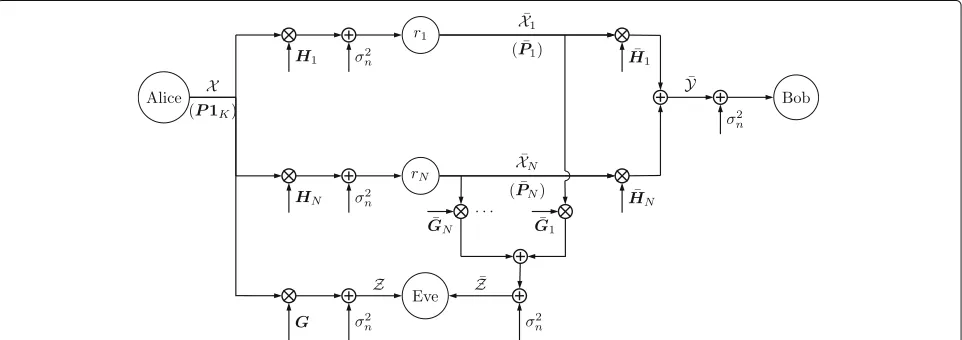
The setting we consider is depicted in Fig.1, where the link from Alice to relaynis represented by theK-size col-umn vectorcHn =[Hn,1,. . .,Hn,K]T containing the gains for each channel. The power of the signal received by relay
non channelkis thereforeHn,kPn,k. Similarly, the vector ¯
Hn denotes the power gains of the link between relay n and Bob, andH¯n,kP¯n,k is the power of the signal received by Bob from relaynon channelk. Concerning Eve’s chan-nel,Gis the vector of power gains of the signal coming from Alice, whileG¯nis the power gain vector of the signal coming from relayn.
Let us denote withXn,k andX¯n,k the signals transmit-ted by Alice and by relaynon channelkin the first and second phase, respectively. Similarly,Yn,kandY¯n,kdenote the signals received by relaynand Bob on channelk in the first and second phase, respectively. Finally,Zn,k and
¯
Zn,k denote the signals received by Eve from Alice and from relaynon channelkin the first and second phase, respectively.
We can therefore write the signal received by the n-th relay on channel k and the signal received by Bob respectively as
Yn,k=HnXn,k+wn, (1a)
¯
Yn,k= ¯HnX¯n,k+ ¯wn. (1b) On Eve’s side, we can write
Zn,k=GnXn,k+wn, (2a)
¯
Zn,k= ¯GnX¯n,k+ ¯wn, (2b) wherewn andw¯n represent the noise vectors in phase 1 and phase 2, which are assumed to be independent identi-cally distributed (iid), with zero mean and unitary variance
σ2
n =1
for all channels.
Figure1also shows in brackets the power flow of the considered scenario. We indicate withPn,k the transmit power of Alice on channelk to relaynin phase 1, while
¯
Pn,kis the transmit power of relaynon channelkin phase
2. The N × K matrix P (P¯) collects all transmit pow-ers, havingPn,k (P¯n,k) at entryn,k. In Fig.1,P1K denotes the N-size column vector of transmit powers for each relay, with1K being theK-size column vector of all ones. We consider power constraints for both Alice and the relays, i.e.,
The power constraint per relay in phase (1) simplifies the power allocation in this phase and still provides an upper bound on the total transmit power from the source that cannot exceedNPtot, 1.
Being the noise iid, the SNR at relaynfor a transmis-sion from Alice on channelkisHn,kPn,k, and similarly for a transmission from relaynon channelk, the SNR at Bob in phase 2 isH¯n,kP¯n,k.
2.2 Contribution
With respect to the previously described state of the art, the main contributions of this paper can be summarized as follows:
• To the best of our knowledge, there are no existing works on power allocation with a secrecy rate target under practical conditions, such as the use of finite-length codes and discrete constellations. Motivated by this, we provide a formulation of the secrecy rate under practical constraints and compare it with the achievable rate in ideal conditions. We consider both perfect and partial CSI under outage constraints.
• By proposing an approximated expression for the secrecy rate under practical conditions, we optimize the link-level parallel channel power allocation, generalizing the solution obtained for the ideal transmission scenario.
• Extending [3], we maximize the secrecy rate by resorting to an iterative algorithm based on the Gale and Shapley theory for the stable matching problem.
• Extending [24], we derive the optimal power allocation for the case of relayed transmission.
• Through numerical examples, we show that it is possible to achieve an acceptable secrecy rate, even using short codes and constellations with a small alphabet.
3 Achievable secrecy rate
We consider a per-channel encoding, i.e., Alice splitsM intoKmessagesMk,k = 1,. . .,K, each of which is sep-arately encoded and transmitted on a channel. In [24], an
in-depth analysis of this coding strategy is provided, show-ing that it performs similarly to the scheme with joint coding across channels, while being simpler to design. Therefore, each relay in general receives only a subset of bits of the entire message. In the second phase, again, each relay splits the received secret bits into groups, which are separately encoded and transmitted on a different channel, among those assigned to the relay.
In both phases, secrecy is achieved through classical wiretap coding [1], based on adding random bits to the secret message and encoding the resulting block with capacity-achieving codes. The weak secrecy rate of a point-to-point transmission is the rate of a message M that [1]: (i) is correctly decoded by Bob and (ii) has a rate of mutual information with the signal received by EveZ that is vanishing for infinite codewords, i.e.,
lim l→∞
1
lI(Z;M)=0 , (4)
where l is the message length in bits. Due to the per-channel encoding, the achievable weak secrecy rate is the sum of the achievable secrecy rates on each used chan-nel. Let Rn,k be the secrecy rate on channelk, intended for relaynin phase 1, andR¯n,kthe secrecy rate on chan-nel k transmitted by relayn in phase 2. Assuming that the added random bits at each transmission are indepen-dent, we immediately conclude that the achievable secrecy rate between Alice and Bob is the minimum between the secrecy rates in both phases, i.e.,
Rtot duration, and we have highlighted the dependence of the achievable rates on the transmit powers. The minimum reflects the fact that either of the two phases can be a bot-tleneck for transmission, and the sum over the subcarriers ktakes into account the fact that we decode and re-encode the data signal at the relays; thus, each relay demodulates all received signals and splits power and data among the subcarriers in its own way upon transmission in phase 2.
Since we assume that Alice is transmitting to a single relay per channel, we also have
Rn∗,k(Pn∗,k) >0→Rn,k(Pn,k)=0 , n=n∗, (6) and since we assume that at most one relay is transmitting in any channel in phase 2, we also have
discrete modulation formats. Then with discuss the -outage achievable secrecy rate when Alice has only a par-tial CSI, i.e., she knows only the statistics of her channels to Eve.
3.1 Infinite-length coding with Gaussian signaling When infinite-length coding and Gaussian signaling are used, perfect secrecy, i.e., no information leakage to Eve, can be achieved [1]. In this case, the achievable secrecy rate can be written as
Rn,k(Pn,k)=C(Pn,kHn,k)−C(Pn,kGn,k), (8)
whereC(x)=log(1+x). Similar expressions are obtained forR¯n,k(P¯n,k)where Pn,k, Hn,k, and Gn,k are replaced by
¯
Pn,k,H¯n,k, andG¯n,k, respectively.
3.2 Finite-length coding with Gaussian signaling
A first limitation to the achievable secrecy rates intro-duced by practical systems is related to the use of codes working on finite-length blocks of symbols. In such a set-ting, weak secrecy can not be guaranteed and Eve can get some information on the secret message1. Moreover, the decodability condition at Bob can not be guaranteed, and we must consider a non-zero codeword error rate (CER)κ. LetRn,kandR¯n,kbe the message rates, for which we have a level of secrecyθ. In particular, in order to measure the information leakage to Eve, we resort to the equivocation rate, i.e., Eve’s uncertainty about the message after observ-ing the transmitted codeword (through her channel). For relayntransmitting on channelkand using codewords of msymbols, the equivocation rate per symbol is
ρn,k(Pn,k)=
where the factor 2 comes from the fact that we have two phases of the same duration. We have that
0≤ρn,k(Pn,k)≤Rn,k(Pn,k), (11)
where the upper bound is achieved with infinitely long codewords (m → ∞). We consider that transmission is secure if
where θ ∈ (0, 1] is a suitably defined parameter that limits the gap with respect to weak secrecy conditions with infinite-length coding. Let us indicate withMˆnthe decoded version of messageMn. Theachievable secrecy
1Indeed, the definition of weak secrecy (4) entails a limit to infinity of the
message length that can not be used in finite-codewords schemes.
ratesfor finite-length coding are therefore the maximum rates satisfying condition (13), i.e.,
Rn,k(Pn,k)=max a constraint on the decoding failure rate. A similar prob-lem can be written for phase 2, for a given allocated power
¯
For the computation of the equivocation rate, we can resort to a lower bound. By the definition of entropy and mutual information, we have that Eve’s equivocation rate can be rewritten as Eve in phase 1, respectively.
By the definition of spectral efficiency as upper bound to the mutual information, we have that
I(Xn,k;Zn,k) <mC(Pn,kGn,k), (17) and
H(Mn|Zn,k,Xn,k)≤H(Mn|Xn,k)=0. (18) On the other hand, the entropy ofXn,kis the code rate, which in turn determines the (non-null) CER at relayn, due to the use of finite-length coding. A bound on the code rate as a function of the CER for finite-length coding is provided by [39], that in this scenario can be written as
Letη(Rn,k,Pn,kGn,k)be the CER experienced by a ficti-tious receiver at the wiretapper position trying to decode forXn,kfrom observingZn,kandM. By the Fano
inequal-We pessimistically assume that Eve can exploit the chan-nel to the maximum of its capacity, i.e., she can decode the received message without errors.
The above analysis can be simplified by considering that, for adherence to practical systems, deterministic coding instead of random coding can be used. In such a case, each l-bit block of data is univocally mapped into a codeword
Cn,k. This is opposed to either random or coset coding, which are often invoked in the literature for this kind of systems, but yield further issues (e.g., concerning the generation of randomness). In the case of deterministic coding, we no longer need to estimate the CER for the fic-titious receiver, and we can write a simpler lower bound on the equivocation rate, that is
ρn,k(Pn,k)= 1
m H(Cn,k)−I(Cn,k;Zn,k)
. (22)
Resorting again to (17) and (19), we obtain the following approximation on Eve’s equivocation rate
ρn,k(Pn,k)ξn,k(Pn,k) rates) in problems (14) and (15) and removing the (already used) constraint on the error probabilityP[Mn = ˆMn], we obtain the approximated achievable rates in the two phases; the solution can be easily obtained in a closed form as
Note that the obtained secrecy rate with finite-length coding is smaller than that obtained with infinite-length coding. In particular, √loge
2mQ
−1(κ)represents the secrecy
rate loss due to finite-length coding, which decreases as either the code lengthmor the CERκincrease. Note that
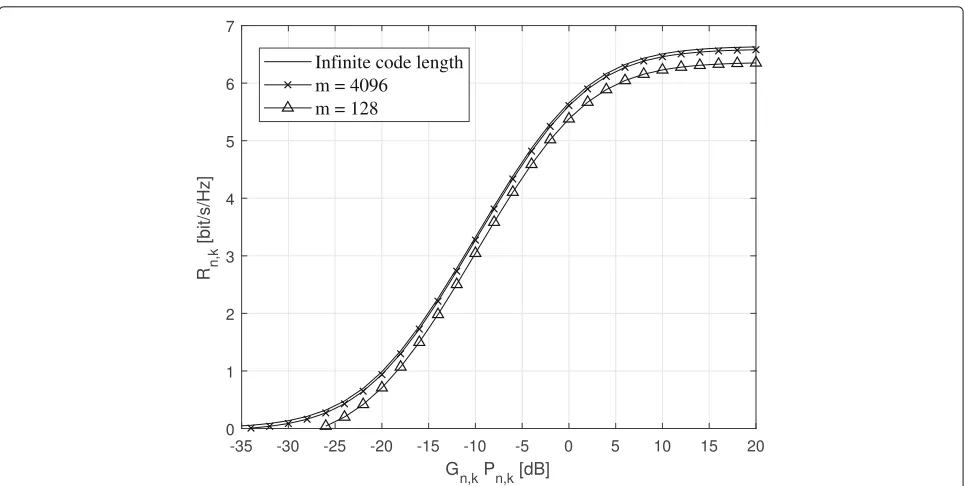
the choice ofmis mostly dictated by implementation con-straints as well as desired latency limitations, while κ is associated to the reliability of the transmission. In Fig.2, we compare the results obtained forRn,k(Pn,k)as a func-tion of Gn,kPn,k for codes of different length, choosing Hn,k/Gn,kof 20 dB andθ =1.
We consider a fitting ofRn,k(Pn,k)solution of (14) by the linear combination of logarithms of the powers, in order to ease resource allocation, i.e.,
Rn,k(Pn,k)α1+α2log(1+α3Hn,kPn,k)−
Note that (25) directly models the achievable secrecy rate rather than the equivocation rate, and the parametersαi are chosen at solution of problem (14). By this formula-tion, the secrecy rates with ideal conditions can be seen as a sub-case of (25) withαi=1 fori=2, 3, 6, 7, andαi =0 otherwise. The motivation behind the choice of this fitting will be better understood when using it in the resource optimization problem focus of this paper: indeed, it will turn out (see Section4) that with this choice the optimiza-tion problem boils down to finding the roots of suitable polynomials.
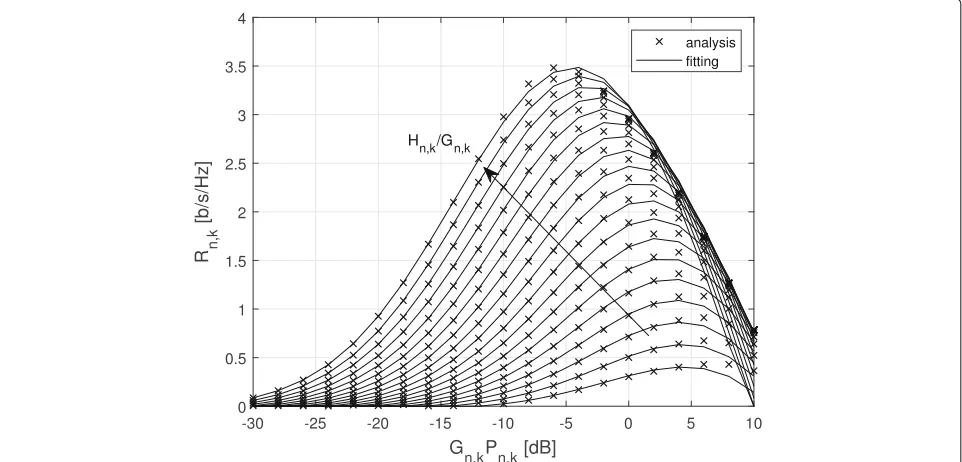
Figure3 showsRn,k(Pn,k) as a function ofGn,kPn,k for values of Hn,k/Gn,k between 2 and 20 dB with a step of 1 dB, and results obtained by the fitting function (25) with κ = 10−3, m = 4096, and θ = 0.9. We observe a good agreement of the fitting function with Rn,k(Pn,k), especially at low rates, and high values ofGn,kPn,k, with a slight overestimation of the rate for intermediate values of Gn,kPn,kfor highHn,k/Gn,kratios.
3.3 Infinite-length coding with discrete constellations A second limitation of practical systems is the use of suboptimal constellations with discrete points taken from a finite alphabet. In this case, perfect secrecy can still be achieved, but we must consider the constellation-constrained spectral efficiency [40]Cˆ(·) instead ofC(·), i.e., (8) becomes
Rn,k(Pn,k)= ˆC(Pn,kHn,k)− ˆC(Pn,kGn,k). (26)
Fig. 2Rn,k(Pn,k)as a function ofGn,kPn,kforHn,k/Gn,kequals to 20 dB, for infinite-length codes and codes of length 4096 and 128, andθ=1
between the fitting and the analysis in correspondence of the maximum rate, which is however not so relevant (especially for increasing values ofHn,k/Gn,k).
3.4 Finite-length coding with discrete constellations Let us consider the limitations introduced in Sections3.2 and3.3jointly, i.e., both finite-length coding and discrete constellations, which describe a practical scenario. Also in this case, we resort to the equivocation rate for the defini-tion of the achievable secrecy rate (see problems (14) and (15)), by replacing the spectral efficiency C(P) with the
Fig. 3Rn,k(Pn,k)as a function ofGn,kPn,kfor values ofHn,k/Gn,k between 2 and 20 dB with a step of 1 dB, and results obtained with the fitting function (25), for codes of length 4096 andθ=0.9
constellation-constrained spectral efficiencyCˆ(P)in (23). On the other hand, since the approximation provided by [39] is valid for any input distribution, (19) still holds true. As already done in the previous section, we propose to fitRn,k(Pn,k)by the function (25). Figure5showsRn,k(Pn,k) for values ofHn,k/Gn,kbetween 2 and 20 dB with a step of 1 dB, and results obtained by the fitting function (25) with
κ =10−3, 16-QAM constellation, andm= 4096. In this case, we observe a good agreement between the approx-imated and the exact curves for low values ofGn,kPn,k, while the curves show a small difference at high values. As observed for the case of infinite-length coding, also in this case, the high power values will not be used in the optimization.
3.5 -Outage achievable secrecy rate
In many practical scenarios, Alice and the relays have only a partial CSI of their channels to Eve. This is mainly due to the fact that Eve may not have an advantage in revealing its channels, e.g., by transmitting, unless this could be useful to increase the rate of other messages exchanged between her and the legitimate nodes. Indeed, in the absence of full CSI, there is a non-zero probability (outage probability) that for any power allocation and choice of the secret message rate, Eve may get some information onM.
In particular, we focus on the secrecy outage probability in each transmission phase and for each channel. Letπn,k andπ¯n,k be the secrecy outage probabilities on channelk with respect to relaynin the first and the second phase, when messages are transmitted at rates Rn,k(Pn,k) and
¯
Fig. 4Rn,k(Pn,k)as a function ofGn,kPn,kfor values ofHn,k/Gn,kbetween 2 and 20 dB with a step of 1 dB, and results obtained with the fitting function (25), considering a 16-QAM constellation
the limitation of the secrecy outage probability on each channel, i.e.,
πn,k ≤, π¯n,k ≤, (27)
whereis the target secrecy outage probability.
In the following, we assume that the legitimate nodes know the statistics of both Gn,k and G¯n,k, thus having a partial CSI. If Rn,k(Pn,k) is the achievable secrecy rate
for Alice-Eve channel realization G∗n,k, then the secrecy outage probability can be written as
πn,k =P Gn,k>G∗n,k
. (28)
Similar expressions are obtained for the second phase. From (27), we defineFas theoutage gain, i.e., the channel gain for which
πn,k=P Gn,k >F=. (29) Then, the -outage achievable secrecy rate can be obtained from the previous sections by considering Gn,k = ¯Gn,k =F.
Note that this approach works with any kind of fading (e.g., Rayleigh Rician, Nakagami fading). For example, for Rayleigh fading whereζis the path-loss exponent, therefore
F= −dE−ζln. (31) For Nakagami fading, Gn,k is gamma distributed, i.e., P Gn,k ≤F = (σ)1 γ (σ,κF), where σ is the shape parameter, κ is the rate parameter, and (·) and γ (·) are the Gamma and lower-incomplete Gamma functions, respectively. Therefore, we have
F= 1κγ−1(σ,(σ)), (32) whereγ−1(σ,x)represents the inverse lower-incomplete Gamma function.
4 Single link power optimization
We first consider the single-link power optimization, where we allocate powers that maximize the secrecy sum rate between two nodes, using parallel channels. This problem must be solved in both transmission phases, and here, we focus on the first phase, i.e., the optimization of the communication from Alice to a specific relay n, assuming that all powerPtot,1can be used on that link. In
this situation, we havePn,k =0 forn=n,n=1,. . .,N,
The four cases of previous section are considered, i.e., (a) infinite-length coding with Gaussian constellation, (b) finite-length coding with Gaussian constellation, (c) infinite-length coding with discrete constellations, and (d) finite-length coding with discrete constellations. More-over, we consider here the case of-outage rates discussed in Section 3.5, thus considering gainF for all channels to Eve.
4.1 Infinite-length coding with Gaussian signaling For infinite-length coding with Gaussian signaling, the optimization problem (33) has been proven to be convex and solved in [41, Th. 1]. In particular, we immediately see that all channels for whichHn,k<Fmust be switched off (Pn,k =0), since they do not provide any secrecy rate. Let the set of used channels be
F = {k:Hn,k >F}. (34)
whereλ≥0 is the Lagrange multiplier to be optimized in order to satisfy the power constraint, which can be com-puted by a dichotomic search to find the unique optimal solution.
4.2 Finite-length coding with Gaussian signaling
For finite-length coding with Gaussian signaling, we exploit the fitting (25) and the optimization problem (33) becomes
We observe that (36) is a maximization problem of con-tinuously differentiable objective functions with inequal-ity constraints of continuously differentiable functions, thus satisfying the necessary conditions for the applica-tion of the Lagrange multipliers method, which provides the constrained maxima as one or more solutions of
α2α3Hn,k
whereλ ≥ 0 is the Lagrange multiplier to be chosen in order to satisfy the power constraint.
An,k=λln(2)α3α5α7α9Hn2,kF2, (38a)
Then, the Lagrangian (37) becomes
An,kPn4,k+Bn,kP3n,k+Cn,kP2n,k
+Dn,kPn,k+En,k=0 . (39)
For a given λ ≥ 0, for all real positive roots of the polynomial, we compute (26) and select the root yielding the highest secrecy rate. When no real roots are found, it means that the secrecy rate is strictly decreasing for Pn,k >0; thus,Pn,k =0 and a null secrecy rate is achieved. We can now appreciate the value of the fitting (25), which provides the simple polynomial (39), whose roots can be obtained using well-established algorithms. Note that the algorithm must include a dichotomic search over
λ ≥ 0 in order to satisfy the power constraints. Again, note that the solution to problem (36) is a generalization of the solution (35) for ideal transmission conditions.
4.3 Discrete constellations
For infinite-length coding with discrete constellations, the optimization problem (33) using the fitting (25) becomes (36); hence, by applying also in this case the Lagrange multiplier method, we obtain again (39).
For finite-length coding with discrete constellations, the optimization problem (33) using the fitting (25) becomes (36) and the Lagrange multiplier methods lead to (39).
5 Maximum rate power allocation
We now consider the power allocation problem at Alice and Bob with the aim of maximizing the secrecy rate, i.e.,
Rmax=max P,P¯
Rtot(P,P¯), (40a)
subject to power constraints (3), (40b)
and rate constraints (6) and (7). (40c)
As observed in [3], this is a mixed-integer programming problem, and for its solution, we resort to the iterative approach of [3], based on the game-theoretic Gale and Shapley algorithm for the stable matching problem [42]. In the following, we report the algorithm developed in [3] with its detailed description.
The stable matching problem aims at matching dames to cavaliers, preventing any dame and any cavalier belonging to two different couples both preferring to be matched. In our scenario, dames and cavaliers are channels and relay, respectively, and the preference of matching is the achiev-able secrecy rate when using the channel for that relay. We have actually two coupled stable matching problems for the two phases. We use an iterative algorithm, where at each iteration, one step of the Gale and Shapley algorithm is performed for both problems.
We start computing the overall rates obtained by assign-ing all channels to each relay in phase 2 (findassign-ing the best power allocation for both phases and the best chan-nel assignment in phase 1), and then, we exclude the relay-channel couple in phase 2 that provides the low-est rate. At the second iteration, we compute the overall rates obtained by assigning all channels (except the cou-ple excluded in the first iteration) to each relay in phase 2 (again optimizing powers and phase-1 channel alloca-tion), before excluding another relay-channel couple in phase 2 that provides the lowest rate. The process is iter-ated excluding a couple at each iteration until for each channel we have at most one associated relay in phase 2. Within each iteration, the channel allocation for phase 1 is obtained by applying the Gale and Shapley algorithm to the matching of channels and relays in phase 1 (for a given allocation in phase 2).
for each channel, and Bob discards the proposal providing the lowest rate for all channels where at least two propos-als have been received. The process is iterated until Bob receives at most one proposal of non-zero rate for each channel. The outputs of the algorithm are the allocated power matricesPandP¯, having as(n,k) entryPn,k and
¯
Pn,k, respectively. Matrices R and R¯ collect the rates in the two phases and are defined analogously. The setQ¯k, k=1,. . ., is iteratively updated and at each iteration col-lects the indices of relays that are not allowed to transmit on channelkin phase 2. SetS¯n = {k : n ∈ ¯/ Qk}instead collects all channels available for transmission to relaynin phase 2.
Algorithm 1: General Resource Allocation Algorithm
Initially, all these sets are empty as all relays are poten-tially free to transmit on any channel in phase 2. Note that the constraint of having at most one relay transmit-ting in each channel is not taken into account initially. However, at each iteration, a competing relay for one channel is prevented from transmitting and the process stops exactly when there is at most one relay trans-mitting on each channel. At each iteration, the rou-tineRate_Offer_Phase_2is run, which provides the power allocation that maximizes the total rate under the power constraints and the channel availability in phase 2 (i.e., sets Q¯k). Then, we remove the relay that pro-vides the minimum rate on one channel, i.e., we select the relay/channel index
(n,k)=argmin(n,k):| ¯Qk|<(N−1)andn∈ ¯/QkR¯n,k (41) and insert its index inQ¯k.
The Rate_Offer_Phase_2 algorithm (shown in Algorithm 2) computes the rate offers for phase 2, given channel availabilityS¯nfor each relayn=1,. . .,N. In for-mulas, this is problem (40a)-(40b) subject to the additional constraint
The solution is achieved by computing the rates achieved in phase 2 through functionMACalPowRate, which takes into account channel availability. LetR¯(P¯n,k) be obtained solution. Then, we compute the max-imum rates achievable in phase 1 under the rate matching constraint (40c), by invoking the function
Rate_Offer_Phase_1. Lastly, we consider the rates obtained in phase 1 as a constraint to re-compute the optimal power allocation in phase 2, under the chan-nel availability constraint. This is achieved by calling
MACalPowRatefor each relay, with the additional con-straint that the rate in phase 2 can not exceed that in phase 1, i.e.,Kk=1Rn,k.
The MACalPowRate algorithm is reported in Algorithm 3, wherehdenotes the channel matrix (possi-bly being a sub-matrix ofH orH¯). TheMACalPowRate
algorithm aims at maximizing the total secret rate over channel setSn, in point to point transmission, under (a) a power constraint and (b) a total rate constraint. Note that the point to point solution of Section4 is indicated by function MACAllocation and that the algorithm performs a dichotomic search between zero allocated power andPtot in order to find the intermediate power
constraint that yields a rate satisfying the rate constraint. Further details on the algorithm can be found in [23].
Algorithm 3:MACalPowRate
secrecy rate to relayn, assuming that all power is avail-able to transmit to relay n. This is achieved by calling NtimesMACAllocation, one time for each Alice-relay link, obtaining power allocationsP∗n,k. Among all propos-als to all relay, we select the worst one, corresponding to the channel-relay couple(n,k) =argmin(n,k)Rn,k
P∗n,k, and we discard it, by preventing relayn from allocating power on channel k. The process is iterated by updat-ing the power allocation for usern. In order to take into account the power constraint of phase 1 that operates across the relays, the maximum power available to relayn is reduced, since channelkis used by another relay. As we
Algorithm 4:Rate_Offer_Phase_1
do not know which relay at the end will use the channel, the total power available for usernis reduced by the mini-mum among all power allocations, i.e.,Ptot−minn=nPn,k∗. The process is iterated until for each channel Alice trans-mits at most one relay. At a generic iteration, letQkbe the set of relays to which Alice transmits on channelk, andSn the set of channels that can be used for relayn. Then, the discarded proposal is that of relay/channel couple
(n,k)= min k,n∈Qk
Rn,k(Pn∗,k), (43) and the maximum power to be used for transmission to relaynis
The complexityC of Algorithm 1 can be measured as a function of the number of relaysNas follows
C=O2N2I5(1+I3)+N3[C5(1+I3)+1]
, (45)
where I3 and I5 represent the number of iterations
performed within the while cycle of the Algorithms
MACalPowRate and MACAllocation, respectively. Therefore, we can say that the proposed resource allo-cation algorithm asymptotic complexity corresponds to
O(N3). In order to evaluate the impact ofI3 andI5 in
terms of average and maximum value, in Fig.6, we report their cumulative density function (c.d.f.) for different val-ues of N. Note that both I3 and I5 do not depend on
N, and they do not depend either on the configuration setting, i.e., on choice of code and modulation. I3 and I5 show an average value of about 4 and 13.5 iterations,
respectively, independently ofN.
6 Results and discussion
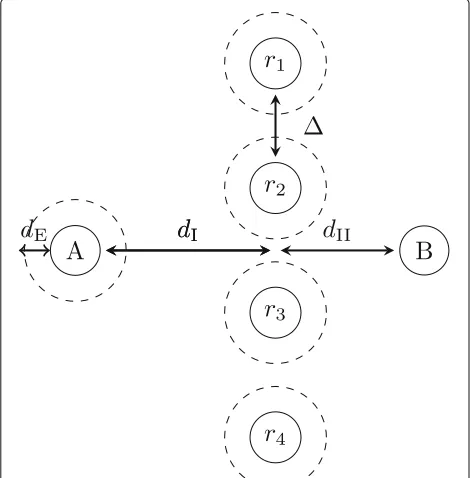
Let us consider the scenario reported in Fig.7, where the relay nodes are positioned along a line that is orthog-onal to the segment between Alice to Bob, intersecting it at a distance dI anddII from Alice and Bob,
respec-tively. Moreover, relays are equispaced with a distance between any two adjacent relays. We further assume that the eavesdropper is at least at a distance dE from any
transmitting node, i.e., it is outside of the dashed circles surrounding Alice and the relays.
TheK = 16 channels between any couple of nodes are assumed independent Rayleigh fading. We also consider Ptot,1=Ptot,2=1. The average SNR at unitary distance is
of 0 dB, and the path loss coefficient is 3.5; thus, the aver-age SNR at distance disd−3.5. About the eavesdropper,
since it is assumed to be at a minimum distancedEfrom
any transmitting node, the outage gain is obtained from (29). For finite-length coding, we assume a CER at Bob
Fig. 6Cumulative density function (c.d.f.) ofI3andI5
6.1 Impact of eve’s distance
We first consider a scenario wherein each relay has the same distance from Alice and Bob, i.e.,dI=dII=0.8, the
separation between relays is=0.05, and the number of relays isN=2, 4, or 8.
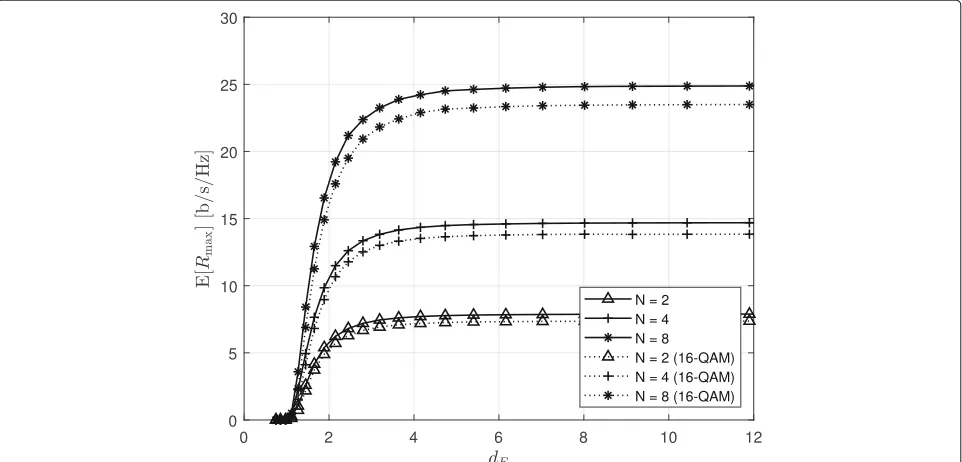
Figures 8 and 9 show the average maximum outage secrecy rateE[Rmax], averaged over channel realizations,
as a function of dE, for a target secrecy outage
prob-ability = 10−4, and comparing different coding and
Fig. 7Node position diagram. (A) Alice, (B) Bob,rn: relayn
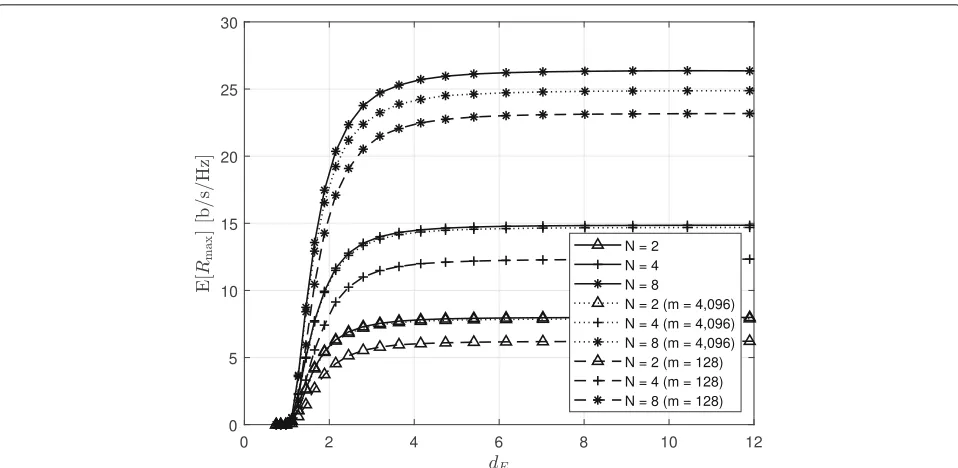
constellations settings. We first investigate the impact of discrete constellations with respect to Gaussian sig-naling, and Fig. 8 shows the average maximum outage secrecy rate obtained when using infinite-length coding with both the aforementioned signalling schemes. We observe that the use of 16-QAM does not yield any signif-icant performance loss with respect to Gaussian signaling, since the maximum rate of 16 channels with 16-QAM is 256 b/s/Hz, which is well above the average secrecy rate of 25 b/s/Hz achievable in the considered setting with ideal Gaussian signaling. Therefore, constellations with small alphabet already provide close-to-optimal per-formance. Moreover, by increasing the number of relays, the average maximum outage secrecy rate increases, as a diversity gain is available on the links among legitimate nodes. Figure9shows results for finite-length coding and both Gaussian signaling and discrete constellations. As regards the Gaussian signaling, comparing Figs.8and9, we note a negligible performance degradation for a code-word length m = 4096 with respect to infinite-length coding, sinceQ−1(κ) = 3.1, and from (23), the loss is of
the order ofK·10−3≈10−2. About Fig.9, we observe that
finite-length coding further increases the gap with respect to Gaussian signaling: this is due to the fact that proper matching in the two phases of relaying must be found to achieve an end-to-end secrecy rate and adding constraints further limits this performance, in a non-linear fashion. Lastly, asdE → ∞, we note that the rate curves flatten
Fig. 8Average maximum secrecy rate as a function ofdEwith infinite-length coding, both Gaussian signaling and discrete (16-QAM) constellations
and various values ofN
6.2 Impact of codeword length
In Fig.10, the impact of the codeword length for finite-length coding with Gaussian signaling is investigated. Note that the performance of codes with long codewords (m = 4096) is comparable to that of infinite-length coding. Considering a 16-QAM, differences between infinite-length coding and 4096-length coding are negligi-ble as the average maximum outage secrecy rates coincide for all numbers of relay nodes. Similar results are obtained
with discrete constellations, not reported here for the sake of conciseness, where, as seen before, the impact of finite-length coding is stronger than for the Gaussian signaling.
6.3 Impact of relative node distances
We now study the impact of the relative distances among legitimate nodes. In particular, we fix the Alice-Bob distance todI+dII=2, and we let both the ratio between
Fig. 9Average maximum outage secrecy rate as a function ofdEwith finite-length coding (m=4096), both Gaussian and discrete (16-QAM)
Fig. 10Average maximum outage secrecy rate as a function ofdEwith Gaussian constellation, both infinite- and finite-length (m=128 and m=4096) coding, and various values ofN
the two distances (dI/dII) and the distance among the
relays vary, i.e.,= {0.05, 0.1, 0.5}, fordE=10,=10−4,
andN=4 relays.
Figure11shows the average maximum outage secrecy rate as a function of dI/dII, and finite-length coding
(m=4096) with Gaussian signaling. We observe that for decreasing values of, the curves tend asymptotically to a maximum average secrecy rate of 2 b/s/Hz. On the other hand, as dI/dII tends to infinity, the average maximum
outage secrecy rate tends to zero, as the Alice-relay links will provide vanishing data rates. When the distance tends to zero, all the relay nodes are squeezed in the same point between Alice and Bob, which represents the optimal relaying configuration.
6.4 Comparison with other solutions
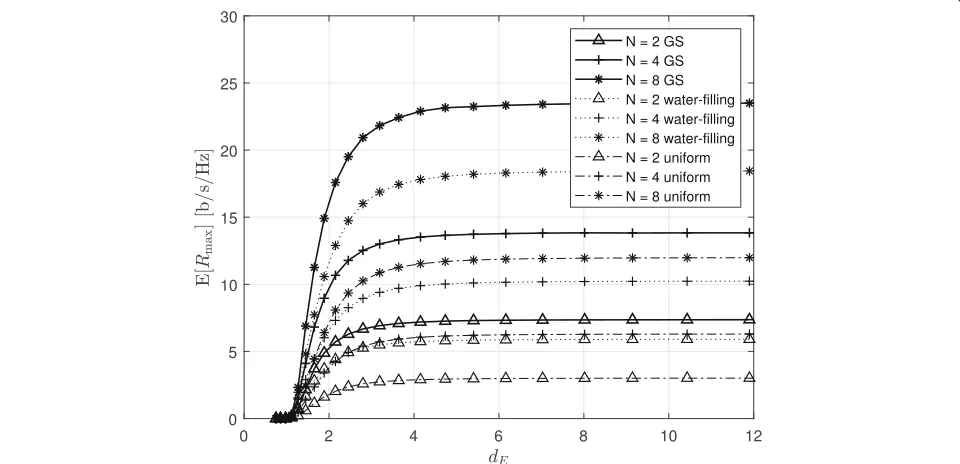
Figures 12 and 13 provide a comparison between our resource allocation (denoted as Gale-Shapley, or GS)
Fig. 11Average maximum outage secrecy rate as a function ofdI/dII, various values of, and finite-length coding (m=4096) with discrete
Fig. 12Average maximum outage secrecy rate as a function ofdE, with infinite-length coding (m=4096) and Gaussian constellation, obtained using GS power allocation, water-filling, and uniform power allocation
strategy and two suboptimal solutions, respectively uni-form power allocation over the K channels and water-filling allocation. Various scenarios are considered, i.e., inlength codes with Gaussian signaling and finite-length coding with discrete constellations. We also con-sider that each relay has the same distance from Alice and Bob, i.e.,dI = dII = 0.8, the separation between relays
is = 0.05, and the number of relays isN = 2, 4, or 8.
Water-filling provides the best possible power allocation in Eve’s absence, since it assigns more power to the chan-nels presenting better gains. However, this solution is not convenient from a security standpoint, since channels that are good for the legitimate receiver could also be good for the attacker, thus degrading the secrecy performance. As predicted, uniform allocation leads to the worst average secrecy rate for all the considered cases.
7 Conclusions
In this paper, we have derived the secrecy rate of the Gaussian relay parallel channel under finite-length cod-ing and discrete constellation constraints, defined as the maximum rate for which a minimum equivocation rate is achieved at Eve. Moreover, we have applied a coupled ver-sion of the Gale and Shapley algorithm to allocate power within each channel in order to maximize the secrecy rate. Numerical results show the effectiveness of our resource allocation approach and show that moderate sizes of both the constellation alphabet and the codeword length are sufficient to achieve close-to-optimal secrecy rates for typical wireless transmission scenarios.
Abbreviations
AWGN: Additive white Gaussian noise; CER: Codeword error rate; CSI: Channel state information; DF: Decode and forward; iid: Independent identically distributed; MIMO: Multiple input multiple output; OFDM: Orthogonal frequency division multiplexing; SNR: Signal to noise ratio
Acknowledgements
The material in this paper was presented in part at the IEEE Conference on Communications and Network Security (CNS 2015) – Workshop on Physical-layer Methods for Wireless Security, Florence, Italy, Sep. 2015. Authors’ contributions
All the authors participated in writing the article and revising the manuscript. All authors read and approved the final manuscript.
Availability of data and materials Not applicable.
Competing interests
The authors declare that they have no competing interests. Author details
1Dipartimento di Ingegneria dell’Informazione, Università Politecnica delle Marche, Via Brecce Bianche 12, 60131 Ancona, Italy.2Department of Information Engineering, University of Padova, Via Gradenigo 6, 35131 Padova, Italy.
Received: 22 May 2019 Accepted: 15 November 2019
References
1. M. Bloch, J. Barros,Physical-Layer Security. From Information Theory to Security Engineering. (Cambridge University Press, Cambridge, 2011), p. 357 2. W. K. Harrison, J. Almeida, M. R. Bloch, S. W. McLaughlin, J. Barros, Coding
for secrecy: an overview of error-control coding techniques for physical-layer security. IEEE Signal Process. Mag.30(5), 41–50 (2013) 3. S. Tomasin, inProc. IEEE Conference on Communications and Network
Security (CNS). A Gale-Shapley algorithm for allocation of relayed parallel wiretap coding channels, (2015), pp. 119–124.https://doi.org/10.1109/ CNS.2015.7346819
4. C.-L. Wang, T.-N. Cho, K.-J. Yang, inProc. 75th IEEE Vehicular Technology Conference (VTC Spring). A new cooperative transmission strategy for physical-layer security with multiple eavesdroppers, (2012), pp. 1–5. https://doi.org/10.1109/VETECS.2012.6240269
5. Y. Shen, X. Jiang, J. Ma, W. Shi, inInformation Technology Convergence, ed. by J. J. J. H. Park, L. Barolli, F. Xhafa, and H.-Y. Jeong. Secure and reliable transmission with cooperative relays in two-hop wireless networks (Springer, Dordrecht, 2013), pp. 397–406
6. S. Luo, H. Godrich, A. Petropulu, H. V. Poor, inProc. IEEE Int. Conf. on Acoustics, Speech and Signal Processing (ICASSP). A knapsack problem formulation for relay selection in secure cooperative wireless communication, (2011), pp. 2512–2515.https://doi.org/10.1109/ICASSP. 2011.5946995
7. Z. Ding, M. Xu, J. Lu, F. Liu, Improving wireless security for bidirectional communication scenarios. IEEE Trans. Veh. Technol.61(6), 2842–2848 (2012).https://doi.org/10.1109/TVT.2012.2197032
8. L. Dong, Z. Han, A. P. Petropulu, H. V. Poor, Improving wireless physical layer security via cooperating relays. IEEE Trans. Signal Process.58(3), 1875–1888 (2010).https://doi.org/10.1109/TSP.2009.2038412 9. J. Li, A. P. Petropulu, S. Weber, On cooperative relaying schemes for
wireless physical layer security. IEEE Trans. Signal Process.59(10), 4985–4997 (2011).https://doi.org/10.1109/TSP.2011.2159598 10. X. Chen, D. W. K. Ng, W. H. Gerstacker, H. Chen, A survey on
multiple-antenna techniques for physical layer security. IEEE Commun. Surv. Tutor. 19(2), 1027–1053 (2017).https://doi.org/10.1109/COMST.2016.2633387 11. R. Bassily, S. Ulukus, Deaf cooperation and relay selection strategies for
secure communication in multiple relay networks. IEEE Trans. Signal Process.61(6), 1544–1554 (2013).https://doi.org/10.1109/TSP.2012. 2235433
12. Z. H. Awan, A. Zaidi, L. Vandendorpe, Secure communication over parallel relay channel. IEEE Trans. Inf. Forensic. Secur.7(2), 359–371 (2012).https:// doi.org/10.1109/TIFS.2012.2185493
13. D. W. K. Ng, E. S. Lo, R. Schober, Secure resource allocation and scheduling for OFDMA decode-and-forward relay networks. IEEE Trans. Wirel. Commun.10(10), 3528–3540 (2011).https://doi.org/10.1109/TWC.2011. 082011.110538
14. D. W. K. Ng, E. S. Lo, R. Schober, inProc. IEEE Global Telecommunications Conference (GLOBECOM). Resource allocation for secure OFDMA networks with imperfect csit, (2011), pp. 1–6.https://doi.org/10.1109/GLOCOM. 2011.6133580
15. D. W. K. Ng, R. Schober, inProc. 12th Canadian Workshop on Information Theory (CWIT). Resource allocation for secure OFDMA
decode-and-forward relay networks, (2011), pp. 202–205.https://doi.org/ 10.1109/CWIT.2011.5872157
16. Z. Yu, Y. Ma, B. Wang, J. Zhao, inProc. Int. Conf. on Wireless Communications Signal Processing (WCSP). Optimal resource allocation for OFDM wiretap channel with cooperative jammer, (2012), pp. 1–4.https://doi.org/10. 1109/WCSP.2012.6542965
17. C. Jeong, I.-M. Kim, inProc. 8th Int. Workshop on Multi-Carrier Systems Solutions (MC-SS). Optimal power allocation for secure multi-carrier relay systems, (2011), pp. 1–4.https://doi.org/10.1109/MC-SS.2011.5910728 18. C. Jeong, I.-M. Kim, Optimal power allocation for secure multicarrier relay
systems. IEEE Trans. Signal Process.59(11), 5428–5442 (2011).https://doi. org/10.1109/TSP.2011.2162956
19. B. Gui, L. J. Cimini, Bit loading algorithms for cooperative OFDM systems. EURASIP J. Wirel. Commun. Netw.2008(1), 476797 (2008)
20. L. Vandendorpe, J. Louveaux, O. Oguz, A. Zaidi, Rate-optimized power allocation for DF-relayed OFDM transmission under sum and individual power constraints. EURASIP J. Wirel. Commun. Netw.2009(1), 814278 (2009).https://doi.org/10.1155/2009/814278
21. T. Wang, L. Vandendorpe, Sum rate maximized resource allocation in multiple DF relays aided OFDM transmission. IEEE J. Sel. Areas Commun. 29(8), 1559–1571 (2011)
22. K. Bakanoglu, S. Tomasin, E. Erkip, Resource allocation for the parallel relay channel with multiple relays. IEEE Trans. Wirel. Commun.10(3), 792–802 (2011)
23. N. Laurenti, S. Tomasin, F. Renna, inProc. IEEE Int. Conf. Commun. (ICC). Resource allocation for secret transmissions on parallel Rayleigh channels, (2014).https://doi.org/10.1109/icc.2014.6883651
24. M. Baldi, F. Chiaraluce, N. Laurenti, S. Tomasin, F. Renna, Secrecy transmission on parallel channels: theoretical limits and performance of practical codes. IEEE Trans. Inf. Forensic. Secur.9(11), 1765–1779 (2014). https://doi.org/10.1109/TIFS.2014.2348915
25. J. Chen, X. Chen, W. H. Gerstacker, D. W. K. Ng, Resource allocation for a massive MIMO relay aided secure communication. IEEE Trans. Inf. Forensic. Secur.11(8), 1700–1711 (2016)
26. H. Fang, L. Xu, K.-K. R. Choo, Stackelberg game based relay selection for physical layer security and energy efficiency enhancement in cognitive radio networks. Appl. Math. Comput.296, 153–167 (2017)
27. J. H. Lee, Optimal power allocation for physical layer security in multi-hop DF relay networks. IEEE Trans. Wirel. Commun.15(1), 28–38 (2016). https://doi.org/10.1109/TWC.2015.2466091
29. K. Zhang, M. Peng, P. Zhang, X. Li, Secrecy-optimized resource allocation for device-to-device communication underlaying heterogeneous networks. IEEE Trans. Veh. Technol.66(2), 1822–1834 (2017).https://doi. org/10.1109/TVT.2016.2566298
30. W. Aman, G. A. S. Sidhu, H. M. Furqan, Z. Ali, Enhancing physical layer security in AF relay-assisted multicarrier wireless transmission. Trans. Emerg. Telecommun. Technol.29(6), 1–14 (2018).https://doi.org/10. 1002/ett.3289
31. M. R. Abedi, N. Mokari, H. Saeedi, H. Yanikomeroglu, Robust resource allocation to enhance physical layer security in systems with full-duplex receivers: active adversary. IEEE Trans. Wirel. Commun.16(2), 885–899 (2017).https://doi.org/10.1109/TWC.2016.2633336
32. A. Kuhestani, A. Mohammadi, K. Wong, P. L. Yeoh, M. Moradikia, M. R. A. Khandaker, Optimal power allocation by imperfect hardware analysis in untrusted relaying networks. IEEE Trans. Wirel. Commun.17(7), 4302–4314 (2018)
33. A. Kuhestani, A. Mohammadi, P. L. Yeoh, Optimal power allocation and secrecy sum rate in two-way untrusted relaying networks with an external jammer. IEEE Trans. Commun.66(6), 2671–2684 (2018) 34. M. Obeed, W. Mesbah, Efficient algorithms for physical layer security in
two-way relay systems. Phys. Commun.28, 78–88 (2018).https://doi.org/ 10.1016/j.phycom.2018.03.007
35. A. Kuhestani, A. Mohammadi, M. Mohammadi, Joint relay selection and power allocation in large-scale MIMO systems with untrusted relays and passive eavesdroppers. IEEE Trans. Inf. Forensic. Secur.13(2), 341–355 (2018)
36. S. Bashar, Z. Ding, C. Xiao, On secrecy rate analysis of MIMO wiretap channels driven by finite-alphabet input. IEEE Trans. Commun.60(12), 3816–3825 (2012).https://doi.org/10.1109/TCOMM.2012.091212.110199 37. Z. Mheich, F. Alberge, P. Duhamel, Achievable secrecy rates for the
broadcast channel with confidential message and finite constellation inputs. IEEE Trans. Commun.63(1), 195–205 (2015)
38. X. Liu, D. Ma, J. Xiong, W. Li, L. Cheng, in2016 IEEE 84th Vehicular Technology Conference (VTC-Fall). Power allocation for an-aided beamforming design in MISO wiretap channels with finite-alphabet signaling, (2016), pp. 1–6.https://doi.org/10.1109/vtcfall.2016.7881170 39. Y. Polyanskiy, Saddle point in the minimax converse for channel coding.
IEEE Trans. Inf. Theory.59(5), 2576–2595 (2013)
40. N. Varnica, X. Ma, A. Kavcic, inGlobal Telecommunications Conference, 2002. GLOBECOM ’02. IEEE. Capacity of power constrained memoryless AWGN channels with fixed input constellations, vol. 2, (2002), pp. 1339–13432. https://doi.org/10.1109/GLOCOM.2002.1188416
41. E. A. Jorswieck, A. Wolf, inProc. of Int. Workshop on Multiple Access Communications (MACOM). Resource allocation for the wire-tap multi-carrier broadcast channel, (Saint Petersburg, 2008).https://doi.org/ 10.1109/ictel.2008.4652697
42. D. Gale, L. S. Shapley, College admissions and the stability of marriage. Am. Math. Mon.69, 9–15 (1962)
Publisher’s Note