Volume 2008, Article ID 476797,9pages doi:10.1155/2008/476797
Research Article
Bit Loading Algorithms for Cooperative OFDM Systems
Bo Gui and Leonard J. Cimini Jr.
Department of Electrical and Computer Engineering, University of Delaware, Newark, DE 19716, USA
Correspondence should be addressed to Bo Gui,[email protected]
Received 18 May 2007; Revised 9 August 2007; Accepted 25 September 2007
Recommended by Hikmet Sari
We investigate the resource allocation problem for an OFDM cooperative network with a single source-destination pair and mul-tiple relays. Assuming knowledge of the instantaneous channel gains for all links in the entire network, we propose several bit and power allocation schemes aiming at minimizing the total transmission power under a target rate constraint. First, an optimal and efficient bit loading algorithm is proposed when the relay node uses the same subchannel to relay the information transmitted by the source node. To further improve the performance gain, subchannel permutation, in which the subchannels are reallocated at relay nodes, is considered. An optimal subchannel permutation algorithm is first proposed and then an efficient suboptimal algorithm is considered to achieve a better complexity-performance tradeoff. A distributed bit loading algorithm is also proposed for ad hoc networks. Simulation results show that significant performance gains can be achieved by the proposed bit loading algo-rithms, especially when subchannel permutation is employed.
Copyright © 2008 B. Gui and L. J. Cimini Jr.. This is an open access article distributed under the Creative Commons Attribution License, which permits unrestricted use, distribution, and reproduction in any medium, provided the original work is properly cited.
1. INTRODUCTION
In cooperative systems, a group of single-antenna nodes transmits as a “virtual antenna array,” obtaining diver-sity gain without requiring multiple antennas at individual nodes. Much recent work has addressed aspects of coopera-tive diversity, and significant benefits can be achieved (e.g., see [1,2]).
Orthogonal frequency-division multiplexing (OFDM) is the underlying physical-layer technology for IEEE802.11 (WiFi) [3], as well as for IEEE802.16 (WiMAX) [4]. The modularity of OFDM and the fact that it will be used in many current and future systems make it very appealing for consid-eration in cooperative wireless networks. More importantly, the use of orthogonal signaling and the inherent frequency diversity in a well-designed OFDM system are especially use-ful in obtaining the maximum benefits from cooperation. Currently, relay and cooperative networks with OFDM(A) transceivers have been proposed for applications in several emerging systems. IEEE 802.16’s Relay Task Group [5] is a developing standard for 802.16-based multihop networks. Also, relaying is considered in IEEE 802.11s [6], a develop-ing mesh networkdevelop-ing standard.
In an OFDM system, additional significant gains can be achieved by adaptive loading. In particular, more bits are
placed in subchannels with larger channel gains, while sub-channels which are faded carry less or even no bits. Over the past decade, this problem has been extensively investigated (e.g., see [7]). In particular, different power and bit alloca-tion schemes with diverse optimizaalloca-tion objectives in single-user and multisingle-user environments have been studied.
The resource allocation problem in cooperative net-works, however, has received much less attention. In [8], adaptive loading is employed in relay-to-destination links in an OFDM cooperative network to improve the end-to-end performance. In [9,10], the power allocation problem for nonregenerative OFDM relay links is investigated; in this work, the instantaneous rate is maximized for a given source and relay power constraint. In [11], aiming at maximizing the achievable sum rate from all the sources to the destina-tion, a source, relay, and subchannel allocation problem for an OFDMA relay network are studied; in this work, the relay node retransmits the information in the same subchannel as the source node. This assumption, however, limits the per-formance gain.
S D Stage 1
Stage 2
S D
Figure1: Two-stage transmission protocol. In the first stage, the source transmits; in the second stage, those nodes which can decode the message from the source retransmit it to the destination.
nodes. Our objective is to minimize the total transmission power by allocating bits and power to each subchannel based on the instantaneous channel gains. We first devise optimal bit loading algorithms under the assumption that the relay nodes retransmit the information in the same subchannel as the source node. Then, we consider reallocating the source subchannels to possibly different relay subchannels to further improve performance. In this regard, the optimal subchannel permutation algorithm is described. To achieve the optimum performance, however, a large number of computations and comparisons is needed. We then propose a simple and effi -cient subchannel permutation algorithm. Simulation results indicate that significant performance gains can be achieved by the proposed bit loading algorithms, especially with sub-channel permutation at the relay nodes.
The paper is organized as follows. The system model is described inSection 2. InSection 3, we propose optimal and efficient bit loading algorithms without subchannel permu-tation. The combination of these algorithms with subchannel permutation is considered in Section 4. Simulation results are given in Section 5. A distributed bit loading algorithm is proposed inSection 6. Finally,Section 7summarizes and concludes the paper.
2. SYSTEM MODEL
We consider a single source-destination cooperative system withK relay nodes, as shown inFigure 1. The relay nodes are randomly located between the source node and the des-tination node. An OFDM transceiver withNsubchannels is available at each node. We assume perfect time and frequency synchronization among nodes and the inclusion of a cyclic prefix that is long enough to accommodate the delay spread of the channel.
A two-stage transmission protocol, as shown inFigure 1, is adopted. In the first stage, the source transmits and the other nodes listen—the links in this stage are called the source-relay (SR) links and the source-destination (SD) link. In the second stage, the relays retransmit the message to the destination—the links in this stage are called the relay-destination (RD) links. The source node does not transmit in
the second stage. Hence, the source node and the relay nodes cannot transmit at the same time. Here, we adopt a selec-tivedecode-and-forward relaying strategy. In particular, each source subchannel can only be relayed by one relay node. The selected relay node will fully decode the received informa-tion, reencode it, and then forward it to the destination in one RD subchannel. In the RD links, a specific subchannel can only be used by one relay node. Different source sub-channels may select different relay nodes, similar to the se-lective OFDMA relaying in [12]. The destination node em-ploys maximal ratio combining (MRC) to combine the re-ceived signals from the first and second stages. With these assumptions, interference is avoided.
Centralized resource allocation algorithms are consid-ered in this paper. In particular, a central controller first collects the instantaneous channel gains of all links in the system. Then, it performs the assignment of resources and broadcasts the decisions to each node. We also assume all the channels experience slow fading. The possible applica-tion scenarios include WiFi and fixed WiMax systems, where the access point (AP) or base station can serve as the central controller.
We assume that the total required data rate isRbits per OFDM symbol (block). Letbndenote the number of bits
as-signed to source subchanneln;bncan take values in the set
B= {0, 1,. . .,Bmax}. Further, denote the channel response of subchannelnfrom the source node to relay nodek, from the source node to the destination node, and from relay node
k to the destination node as Hsrk(n), Hsd(n), and Hrkd(n),
respectively. In general, these include path loss, shadowing, and Rayleigh fading. For convenience, let Gsrk(n), Gsd(n),
and Grkd(n) denote the channel power gains, Hsrk(n)
2,
Hsd(n)2, andHrkd(n)
2
, respectively.
Letγ(bn) be the required received SNR per symbol in
subchannelnfor reliable reception ofbnbits/symbol. As in
[13], SNR per symbol for subchannelnis
γbn
=ρ∗22bn−1. (1)
The parameterρranges from 1 to about 6.4, depending on the degree of coding used [13]. The required received power
Preq(bn) can be written as
Preq
bn
=γbn
N0, (2)
where N0 is the double-sided noise power spectral density level.
Each subchannel can operate in two different modes: direct or cooperative transmissions. Each subchannel com-pares the required power of these two modes and selects the one which has the minimum required power to achieve reli-able reception at the destination node. The minimum power required for the direct transmission mode is
PDsd(n)=
Preq
bn
Gsd(n) . (3)
source node to the relay nodek. The second part is the trans-mission power of relay nodek, which is determined by the fact that the sum of the two received powers at the desti-nation node should be greater than the required minimum received powerPreq(bn). We assume that relay nodekuses
subchannel jto retransmit the information from the source node in subchanneln. The relay node can use either the same subchannel to retransmit the information or another sub-channel. LetPC
srk(n) andP
C
rkd(n,j) denote the source power
and the relaykpower, respectively. The two powers should satisfy
The total power for cooperative transmission is
PsrCkd(n,j)=P
C srk(n) +P
C
rkd(n,j). (6)
When the channel gains of the SR and the RD links are both greater than the channel gains of the SD links, that is,
Gsd(n)<min{Gsrk(n),Grkd(j)}for anyk, cooperative
trans-mission requires less power than direct transtrans-mission. In this case, the minimum power required for cooperative transmis-sion through subchannel j at relay node kcan then be ex-pressed as
Here, for cooperative transmission, we define an equiva-lent channel power gainGCsrkd(n,j), given by
GC
srkd(n,j)=
Gsrk(n)Grkd(j)
Δk(n,j) . (8)
Thus, the minimum total power required for cooperative transmission for subchannelnthrough subchannel jat re-lay nodekis subchannelnoperates. Letβ(n) = 1 indicate direct trans-mission. Also, we useαk(n,j) ∈ {0, 1}to indicate whether
or not subchannel nis used in cooperation with subchan-nel j at relay node k. Our objective is to allocate bits and power to each subchannel to minimize the total transmitting powerPT∗. Mathematically, we can formulate the
optimiza-tion problem as
subject to the following three constraints:
C1 :R=
Note thatC1 is the rate constraint,C2 indicates that each SR subchannel can only be relayed by at most one relay at a given time, andC3 means that each RD subchanneljcan be used by at most one relay.
3. BIT LOADING
In this section, we devise bit loading algorithms without subchannel permutation. In this case, for subchannel nin the SR links, the selected relay node also uses subchanneln
in the RD links to retransmit the information. The equiva-lent channel power gain through relay nodekis determined by the mode in which the subchannel is used. IfGsd(n) <
min{Gsrk(n),Grkd(n)}, cooperative transmission is preferred
and the equivalent channel power gain is the cooperative transmission gain,GCsrkd(n,n); otherwise, direct transmission
costs less power and the equivalent channel power gain is the gain of SD links,Gsd(n). Hence, the equivalent channel
power gain through relay nodekis
Gsrkd(n)=
Each subchannel should be used by the relay node, among theK nodes, which has the largest equivalent chan-nel power gain to relay the information. LetGeq(n) denote this maximum equivalent channel power gain, then it can be written as
Geq(n)=arg max
k=1,...,KGsrkd(n). (16)
The optimization problem in (10) can be rewritten as
PT∗=min
In this case,C2 andC3 are automatically satisfied, and we only need to consider the rate constraint,C1.
3.1. Greedy algorithm
greedy algorithm, first introduced in [14–16], is believed to yield the optimal solution. This algorithm allocates bits one by one until the target rateRis achieved. In each step, the ad-ditional power increase of each subchannel in order to trans-mit the additional bit in that subchannel is calculated, and the one with the minimum power increase is selected. The idea is quite simple and several efficient greedy algorithms [17] have been proposed. However, sorting and comparisons in each step make the algorithm complex, especially when the available subchannels and the target number of bits are very large, as in IEEE 802.16 systems.
3.2. Lagrange optimization
As discussed in the previous subsection, the greedy algorithm has the optimal performance, but it is too complex for high data-rate systems. In this subsection, we propose an efficient bit loading algorithm. To solve the optimization problem (17), we first release the constraint thatbnmust be an integer.
Substituting (1) and (2) into (17), we obtain
So the optimization problem reduces to
PT∗=min
Including the constraint, the objective function is
L(λ)=
whereλ is a Lagrange multiplier. After differentiatingL(λ) with respect tobn, and setting to 0, we obtain
22bn
Geq(n)= λ
2ρN0∗ln 2 =ϕ
, ∀n, (21)
whereϕis a constant independent ofn. Then we get
The first part in (23) is the average number of bits per sub-channel. The second part is a margin determined by the ratio of then-th subchannel’s power gain over the geometric mean of theNsubchannels’ power gains [7]. It is interesting to no-tice that (23) is similar to (11) in [18]; although the objective functions and constraints are different.
In the previous derivations, we removed the constraint onbnto be an integer. Moreover, the result in (23) may be
less than zero. This means that the channel gain of subchan-nelnis so small that we should not transmit any information. We exclude these subchannels and then repeatedly apply (23) until all thebnare greater than zero. Next, we can adopt the
algorithm in [18] to roundbn to an integer value. The
re-quired transmission power can be calculated using (17) af-ter all the bits are allocated. Note that, in this algorithm, the number of iterations is determined by the number of sub-channels with zero bits, which is much smaller than the num-ber of iterations in the greedy algorithm.
4. SUBCHANNEL PERMUTATION
In this section, we consider subchannel permutation to fur-ther save transmission power. We not only allocate bits and power to subchannels, but also reallocate the subchannels used for transmission in the RD links. The optimization problem (10) becomes a combinational problem and is dif-ficult to solve. Exhaustive search can obtain the optimal so-lution; however, the computational complexity is too high. Here, we first propose a simplified greedy algorithm, which is still complex, especially when the number of target bits is high. Next, we propose a suboptimal algorithm, which is more efficient but which is close to optimum performance.
4.1. Greedy algorithm
As discussed inSection 3.1, greedy algorithms allocate bits on a bit-by-bit basis to the subchannel which has the mini-mum increase in power required to transmit the additional bit. In each step, the increase in power for all possible allo-cation schemes is calculated. When we allocate the first bit, there areN2K possible allocation schemes, whereK is the number of relay nodes andNis the number of subchannels. First, consider the inverse of the channel power gain in (8), that is,
Step 1. Initializebn=0 for alln=1,. . .,N.
Step 2. Compute the additional transmit power for subchan-neln,n=1,. . .,N. If SR subchannelnhas been paired, then compute the additional transmit power as
ΔP(n)=Preq subchannel nwith the unpaired RD subchannel in relayk
which has maximum channel power gain, and we denote that subchannel as jk. Calculate the equivalent channel power
gainGsrkd
so the equivalent channel power gain is
G(n)=Gsrk∗d jk∗
. (28)
Then the additional transmit power can be calculated as in (25).
Step 3. Find the minimum power increase amongN sub-channels
n∗=arg min
n=1,...,NΔp(n), (29)
and updateb(n∗) as
bn∗=bn∗+ 1. (30)
Also, if SR subchanneln∗is newly paired with RD subchan-nel jin Step2, then RD subchannels jof allK relay nodes are marked unavailable.
Step 4. If rate constraint (12) is satisfied, then bit loading op-eration is complete; otherwise, go to Step2.
The performance of the greedy algorithm, of course, will serve as a bound for the performance of the suboptimal al-gorithms.
4.2. Suboptimal algorithm
Although the simplified greedy algorithm is much simpler than exhaustive search, it is still quite complex when the number of target bits is large. Here, we propose an alter-native algorithm which has suboptimal performance but is much more efficient. In this algorithm, we first reallocate
subchannels in the SR links to subchannels in the RD links, and then we perform the bit loading algorithm proposed in
Section 3.2.
We know that cooperative transmission is preferred when
Gsd(n) is smaller thanGsrk(n) andGrkd(j). Soδ(n) of (23) is
a value between zero and one when cooperative transmission is preferred. Then, 1/GCsrkd(n,j) can be roughly approximated
by the sum of 1/Grkd(j) and 1/Gsrk(n). It is easy to see that
we should pair good subchannels in the SR links with good subchannels in the RD links. Also, bad SR subchannls should be paired with bad RD subchannels. After permutation, the equivalent channel power gains of cooperative transmission vary greatly from subchannel to subchannel. In this case, the frequency diversity can be easily exploited by bit loading. Based on this idea, we propose the following greedy subchan-nel permutation algorithm. In our algorithm, the subchansubchan-nel is paired in a one-by-one basis. In each step, we pair the best unpaired SR subchannel with the best unpaired RD subchan-nel. The details of the algorithm are summarized below.
Step 1. For each relay k, find the maximum subchannel power gains of the SR and RD links, respectively; denote them byGsrk(n) andGrkd(j). Calculate the equivalent
chan-nel power gainGsrkd(n,j), as in (26).
Step 2. Compare the equivalent channel power gain
Gsrkd(n,j) of theK relay nodes. Determine the values ofn
andjwhich maximizeGsrkd(n,j). Pair those subchannels and
denote them asnandj.
Step 3. Set the gains of the SR subchannelnand the RD sub-channeljof all relay nodes to zero.
Step 4. If all the subchannels are paired, the subchannel per-mutation operation is complete. Otherwise, go to Step1.
In the subchannel permutation approach, the computa-tional complexity mainly comes from finding the maximum channel gains of the SR links and the SD links. The number of iterations is equal to the number of subchannels,N, which is much smaller than the number of iterations for the greedy al-gorithms. After reallocating subchannels, the bit-loading La-grange algorithm inSection 3.2is performed to allocate the power and bits. As discussed there, the Lagrange algorithm has low-computational complexity. Thus, the computational complexity can be greatly reduced by performing subchannel permutation and bit loading separately.
5. SIMULATION RESULTS
15 15.5 16 16.5 17 17.5 18 18.5 19 19.5 20
T
o
ta
l
tra
ns
mi
tti
ng
p
o
w
er
(d
B
)
0 0.02 0.04 0.06 0.08 0.1 RMS delay spread (T)
GBL LBL EBA
Figure 2: Average transmission power required for different bit loading algorithms withK=1.
and to the destination to one; the path loss exponent is 4. Shadowing is not considered. We assume that the channels between the source and each relay and the channels between each relay and the destination are independent. The power delay profile is assumed to be exponential with a root-mean-square delay spreadτrms = ηT, whereTis the time duration of one OFDM symbol (block),T=NTs, and 0< η≤0.1. In
the simulation, we use a discrete-time model with an impulse response limited to 16 samples spaced byTs. This is sufficient
to encompass all of the paths with significant energy. We assume that the target bit rate of the system is such that there are 128 bits per OFDM symbol. Andbncan take
values in the setB = {0, 1,. . ., 4}. So, without bit loading, each subchannel will transmit 2 bits per OFDM symbol; we call this equal bit allocation (EBA).1When there are multi-ple relay nodes, for each subchanneln, the best subchannel amongKrelays is selected.
InFigure 2, we compare the average required
transmis-sion power for greedy bit loading (GBL), Lagrange bit load-ing (LBL), and EBA. We do not consider subchannel permu-tation (SP) in this case, and we assume there is only one relay node, that is,K =1. It can be seen that the required trans-mission power for GBL and LBL are almost the same, but LBL is much less complex. We also notice that the required transmission power for GBL and LBL decreases with an in-crease in the delay spread,τrms. This is because an increase in delay spread corresponds to more available frequency diver-sity, and hence more gains can be achieved. The performance
1Coding is not considered in this paper. It has been shown that coded bit
loading OFDM systems also greatly outperform coded OFDM systems in point-to-point networks [17]. Here, for cooperative networks, distributed coding is an interesting problem to be explored in future work.
10−4
10−3
10−2
10−1
100
B
loc
k
error
ra
te
0 5 10 15 20 25
SNR (dB)
BL with 1 relay EBA with 1 relay BL with 2 relays
EBA with 2 relays BL with 4 relays EBA with 4 relays
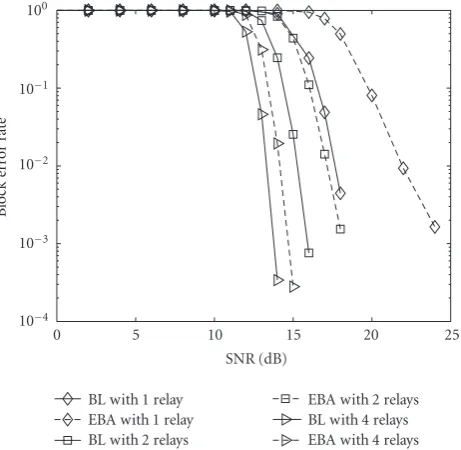
Figure3: Block error rate for different bit loading algorithms with K=1, 2, 4.
of EBA is not good because coding is not employed; thus the frequency diversity is not exploited for EBA as implemented here. Compared to EBA, a 3-dB power saving can be achieved by LBL.
In the following simulation, we assumeτrms = 0.1T, which is a reasonable delay spread for practical systems.
Figure 3 presents the block error rate (BLER) versus SNR
with different numbers of relay nodes. We adopt the effi -cient LBL in the simulation. From the results, we can see that the performance gains of LBL over EBA decrease with an in-crease inK, the number of relay nodes. Forτrms = 0.1T, the power saving of LBL decreases from 3-dB with one relay node to 1-dB with four relay nodes. The main reason is that, for each subchannel, we compare the subchannel gains ofK
relay nodes and select the best one. The more relay nodes, the less subchannel gain variation after selection, and the less frequency diversity to be exploited by bit loading.
Figure 4shows the BLER comparison of the bit loading
algorithms with and without subchannel permutation (SP). The number of relay nodesKis one in this simulation. From the results, we can see that the optimal BL with SP further improves the performance by 2-dB. Compared with EBA, a 5-dB gain can be achieved by bit loading algorithm at the expenses of extra internode communications and computa-tions.
InFigure 5, we present the performance of the bit
load-ing algorithms usload-ing subchannel permutation (SP) withK=
10−4
10−3
10−2
10−1
100
B
loc
k
error
ra
te
0 5 10 15 20 25
SNR (dB)
BL with SP optimal BL without SP EBA
Figure4: Block error rate for different bit loading algorithms with subchannel permutation,K=1.
10−4
10−3
10−2
10−1
100
B
loc
k
error
ra
te
0 5 10 15 20 25
SNR (dB)
BL with SP optimal, 1 relay BL with SP optimal, 2 relays BL with SP optimal, 4 relays
EBA, 1 relay EBA, 2 relays EBA, 4 relays
Figure5: Block error rate for different bit loading algorithms with subchannel permutation,K=1, 2, 4.
compare the performance degradation using the suboptimal, but less complex, BL with SP. We can see that the perfor-mance gap increases with an increase in the number of re-lay nodes, K. At an outage of 10−2, a 0.5-dB performance degradation can be observed by suboptimal algorithm when
K = 4; although, it is still 2.5-dB better than EBA. A good complexity and performance tradeoffcan be achieved by us-ing the suboptimal algorithm.
From these results, we can see that the proposed BL al-gorithm can significantly save transmission power, especially
10−4
10−3
10−2
10−1
100
B
loc
k
error
ra
te
0 5 10 15 20
SNR (dB)
BL with SP suboptimal,1 relay BL with SP optimal, 1 relay BL with SP suboptimal, 2 relays BL with SP optimal, 2 relays BL with SP suboptimal, 4 relays BL with SP optimal, 4 relays
Figure6: Block error rate for optimal and suboptimal bit loading algorithms with subchannel permutation,K=1, 2, 4.
when the number of relays is small. A small number of re-lays on their own does not provide enough space diversity. So that even simple BL without SP can provide significant gains, compared to EBA. With an increase in the number of relays, however, space diversity can provide good performance im-provement; thus, only the BL with SP can provide significant performance gain, at the expense of complex computations.
The communications overhead of BL and EBA are sim-ilar. The instantaneous channel gains are required by both to make decisions, and these must be broadcast to nodes in the network. EBA only needs to select the good subchannels among relays. BL, however, also allocates bits to subchannels, which entails more complexity.
6. DISTRIBUTED ALGORITHM
In the previous part, we mainly concentrated on bit loading algorithms with a central controller. Distributed algorithms are more attractive in ad hoc networks, in which central con-trollers are not affordable. Here, we propose a distributed bit loading algorithm for ad hoc networks.
10−4
10−3
10−2
10−1
100
B
loc
k
error
ra
te
0 5 10 15 20 25
SNR (dB)
BL 4 relays BL 2 relays BL 1 relay
EBA 4 relays EBA 2 relays EBA 1 relay
Figure7: Block error rate for distributed BL and EBA algorithms, K=1, 2, 4.
channel gains of the SD links. Hence, each relay node can per-form bit loading algorithms and calculate the total minimum transmission power. A similar distributed relay selection al-gorithm as in [19] can be adopted here. In this algorithm, each relay sets a timer based on its calculated total transmis-sion power. The smaller the total transmistransmis-sion power is, the shorter the timer should be. In this way, the timer of the relay with the smallest total transmission power will expire first. That relay then sends a flag signal with the resource allo-cation information. All other relays, while waiting for their timer to be reduced to zero, are in listening mode. As soon as they hear the flag signal, they back off. So the relay node which has minimum total transmission power will partici-pate the cooperative transmission between the source node and the destination node.
In this distributed algorithm, only one relay node is se-lected to participate the cooperative transmission, that is, all the subchannels are relayed by the same relay node. In the centralized algorithm, however, each subchannel may be re-layed by different relay nodes, and all the relay nodes may participate the cooperative transmission. Obviously, the cen-tralized algorithm performs better than the distributed algo-rithm at the expense of more communications overhead.
In the following, we compare the performance of the dis-tributed BL algorithm and the disdis-tributed EBA algorithm. For the distributed EBA algorithm, the same process as the the distributed BL algorithm is performed. Only one relay node is selected to relay the information and all the sub-channels have the same number of bits. The same simu-lation environment as inSection 5 is adopted. The subop-timal BL with SP is employed in the distributed BL algo-rithm. As shown in Figure 7, the distributed BL algorithm significantly outperforms the distributed EBA algorithm. Al-though the performance gain decreases with an increase in
the number of relay nodes, K, a 4 db performance gain is still achieved by BL at an outage of 10−2. Compared with the centralized BL algorithm with SP, 2.5 dB performance degra-dation can be observed with 4 relay nodes. The main reason is that only one relay node is selected in the distributed algo-rithm.
7. CONCLUSIONS
In this paper, we investigated resource allocation for coop-erative OFDM systems. Aiming at minimizing the total two-stage transmission power for a given transmission rate, we formulated the optimization problem and proposed several bit loading algorithms. First, without considering subchan-nel permutation, we showed that the optimization prob-lem is similar to that for point-to-point OFDM systems. We proposed an efficient bit loading algorithm and simula-tion results demonstrated that the proposed algorithm has similar performance to the optimal one. Using these algo-rithms, the total transmitting power can be reduced by 3 dB, compared to the EBA algorithm. The performance gain, however, decreases with an increase in the number of relay nodes.
To further improve the bit-loading performance gain, we considered reallocating subchannels in the RD links, called subchannel permutation. An optimal algorithm and an effi -cient suboptimal algorithm were proposed for this case. Sim-ulation results show that the optimal algorithm with sub-channel permutation can further improve the performance by at least 2 dB. Even with four relay nodes, the optimal al-gorithm with subchannel permutation still outperforms EBA by about 3 dB. An efficient suboptimal subchannel permuta-tion algorithm was also proposed which can achieve a good performance-complexity tradeoff.
We also propose a distributed bit-loading algorithm for ad hoc networks. A significant performance gain can be achieved by this algorithm, compared with the distributed EBA algorithm. Compared with the centralized algorithms, only a small performance degradation is observed. Devising distributed algorithms with performance as good as central-ized algorithms is an interesting and challenging problem. In particular, a distributed coding approach might be a fruitful direction for future study.
ACKNOWLEDGMENTS
REFERENCES
[1] J. N. Laneman, D. N. C. Tse, and G. W. Wornell, “Cooperative diversity in wireless networks: efficient protocols and outage behavior,”IEEE Transactions on Information Theory, vol. 50, no. 12, pp. 3062–3080, 2004.
[2] J. N. Laneman and G. W. Wornell, “Distributed space-time-coded protocols for exploiting cooperative diversity in wireless networks,”IEEE Transactions on Information Theory, vol. 49, no. 10, pp. 2415–2425, 2003.
[3] IEEE 802.11-1999, “Wireless LAN Medium Access Control (MAC) and Physical Layer (PHY) Specifications,” August 1999.
[4] IEEE 802.16-2004, “IEEE Standard for Local and Metropolitan Area Networks—Part 16: Air Interface for Broadband Wireless Access Systems,” May 2004.
[5] http://www.ieee802.org/16/relay/. [6] http://grouper.ieee.org/groups/802/11/.
[7] J. M. Cioffiand L. M. C. Hoo, “Performance optimization,” in Orthogonal Frequency Division Multiplexing for Wireless Com-munications, Y. J. Li and G. L. Stuber, Eds., Springer, New York, NY, USA, 2006.
[8] B. Gui, L. J. Cimini Jr., and L. Dai, “OFDM for cooperative net-working with limited channel state information,” in Proceed-ings of Military Communications Conference (MILCOM ’06), pp. 1–6, Washington, DC, USA, October 2006.
[9] I. Hammerstr¨om and A. Wittneben, “On the optimal power allocation for nonregenerative OFDM relay links,” in Pro-ceedings of IEEE International Conference on Communications (ICC ’06), vol. 10, pp. 4463–4468, Istanbul, Turkey, June 2006. [10] I. Hammerstr¨om and A. Wittneben, “Joint power allocation for nonregenerative MIMO-OFDM relay links,” in Proceed-ings of IEEE International Conference on Acoustics, Speech and Signal Processing (ICASSP ’06), vol. 4, pp. 49–52, Toulouse, France, 2006.
[11] G. Li and H. Liu, “Resource allocation for OFDMA relay net-works with fairness constraints,”IEEE Journal on Selected Areas in Communications, vol. 24, no. 11, pp. 2061–2069, 2006. [12] L. Dai, B. Gui, and L. J. Cimini Jr., “Selective relaying in OFDM
multihop cooperative networks,” inProceedings of IEEE Wire-less Communications and Networking Conference (WCNC ’07), pp. 963–968, Hong Kong, March 2007.
[13] S. Catreux, P. F. Driessen, and L. J. Greenstein, “Data through-puts using multiple-input multiple-output (MIMO) tech-niques in a noise-limited cellular environment,”IEEE Trans-actions on Wireless Communications, vol. 1, no. 2, pp. 226–235, 2002.
[14] D. Hughes-Hartogs, “Ensemble modem structure for imper-fect transmission media,” U.S.Patent no. 4,679,227, July 1987. [15] D. Hughes-Hartogs, “Ensemble modem structure for imper-fect transmission media,” U.S.Patent no. 4,731816, March 1988.
[16] D. Hughes-Hartogs, “Ensemble modem structure for imper-fect transmission media,” U.S.Patent no. 4,833,796, May 1989. [17] S. K. Lai, R. S. Cheng, K. B. Letaief, and R. D. Murch, “Adap-tive Trellis Coded MQAM and power optimization for OFDM transmission,” inProceedings of the 49th IEEE Vehicular Tech-nology Conference (VTC ’99), vol. 1, pp. 290–294, Houston, Tex, USA, May 1999.
[18] R. F. H. Fischer and J. B. Huber, “A new loading algorithm for discrete multitone transmission,” inProceedings of IEEE Global Telecommunications Conference Communications: The Key to Global Prosperity (GLOBECOM ’96), vol. 1, pp. 724–728, Lon-don, UK, November 1996.