N
-gram Counts and Language Models from the Common Crawl
Christian Buck
†, Kenneth Heafield
‡, Bas van Ooyen
∗ †University of Edinburgh, Edinburgh, Scotland‡Stanford University, Stanford, CA, USA ∗Owlin BV, Utrecht, Netherlands
[email protected], [email protected], [email protected]
Abstract
We contribute 5-gram counts and language models trained on the Common Crawl corpus, a collection over 9 billion web pages. This release improves upon the Google n-gram counts in two key ways: the inclusion of low-count entries and deduplication to reduce boilerplate. By preserving singletons, we were able to use Kneser-Ney smoothing to build large language models. This paper describes how the corpus was processed with emphasis on the problems that arise in working with data at this scale. Our unpruned Kneser-Ney English5-gram language model, built on 975 billion deduplicated tokens, contains over 500 billion uniquen-grams. We show gains of 0.5–1.4 BLEU by using large language models to translate into various languages.
Keywords:web corpora, language models, multilingual
1.
Introduction
The sheer amount of data in multiple languages makes web-scale corpora attractive for many natural language process-ing tasks. Of particular importance is language modelprocess-ing, where web-scale language models have been shown to im-prove machine translation and automatic speech recogni-tion performance (Brants et al., 2007; Chelba and Schalk-wyk, 2013; Guthrie and Hepple, 2010). In this work, we contributen-gram counts and language models trained on the Common Crawl corpus.1
Google has released n-gram counts (Brants and Franz, 2006) trained on one trillion tokens of text. However, they pruned anyn-grams that appeard less than 40 times. Moover, all words that appeared less than 200 times were re-placed with the unknown word. Both forms of pruning make the counts unsuitable for estimating a language model with the popular and successful Kneser-Ney smoothing al-gorithm, which requires unpruned counts even if the final model is to be pruned.
The second issue with the publicly available Google n -gram counts (Brants and Franz, 2006) is that the training data was not deduplicated, so boilerplate such as copyright notices has unreasonably high counts (Lin et al., 2010). Google has shared a deduplicated version (Bergsma et al., 2010) in limited contexts (Lin et al., 2010), but it was never publicly released (Lin, 2013). Our training data was dedu-plicated before countingn-grams.
Microsoft provides a web service (Wang et al., 2010) that can be queried for language model probabilities. The ser-vice is currently limited to the English language whereas we provide models for many languages. Moreover, an ini-tial experiment on reranking English machine translation output led to so many queries that the service went down several times, despite client-side caching. Using the Mi-crosoft service during machine translation decoding would entail far more queries and require lower latency.
1http://statmt.org/ngrams
2.
Data Preparation
The Common Crawl2 is a publicly available crawl of the
web. We use the 2012, early 2013, and “winter” 2013 crawls, consisting of3.8 billion,2billion, and2.3 billion pages, respectively. Because both 2013 crawls are simi-lar in terms of seed addresses and distribution of top-level domains in this work we only distinguish 2012 and 2013 crawls.
The data is made available both as raw HTML and as text only files. The latter collection consists of all HTML and RSS files from which all tags were stripped. The HTML comes in the original encoding, while the text has been con-verted to UTF-8, albeit with the occasional invalid charac-ter.
Using the HTML files has the advantage of being able to exploit the document structure to select paragraphs and to tell boilerplate from actual content. However, parsing such large amounts of HTML is non-trivial and requires many normalization steps.
In this work we focus on processing the text only files which we downloaded and processed locally on a small cluster. The advantages of structured text do not outweigh the extra computing power needed to process them.
2.1.
Language Detection
The first step in our pipeline is splitting the data by lan-guage. We explored the option of automatically detecting the main language for every page but found that mixed-language content is quite common. By using the Compact Language Detector 2 (CLD2)3we are able to partition every
document into monolingual spans. CLD2 is able to detect 175 languages and fast enough to process the entire corpus within a week.
Table 1 shows the relative contribution of the most common languages in the separated data. At this stage of process-ing we have no meanprocess-ingful notion of token or line counts and therefore report the size of the extracted files. As
2
http://commoncrawl.org/
Relative occurrence % Size Language 2012 2013 both both
English 54.79 79.53 67.05 23.62TiB German 4.53 1.23 2.89 1.02TiB Spanish 3.91 1.68 2.80 986.86GiB French 4.01 1.14 2.59 912.16GiB Japanese 3.11 0.14 1.64 577.14GiB Russian 2.93 0.09 1.53 537.36GiB Polish 1.81 0.08 0.95 334.31GiB Italian 1.40 0.44 0.92 325.58GiB Portuguese 1.32 0.48 0.90 316.87GiB Chinese 1.45 0.04 0.75 264.91GiB Dutch 0.95 0.22 0.59 207.90GiB
other 12.23 12.57 12.40 4.37TiB
Table 1: Results of language detection on raw text, showing the 11 most common languages.
expected English is by far the predominant language fol-lowed by European languages. Due to the large size of the overall corpus (35.23TiB), even a small percentage con-stitutes a corpus of useful size. For example, only0.14% of the data were classified as Finnish, yet yielding a cor-pus of47.73GiB. In total we found73languages with at least1GiB of uncompressed text each and42with at least
10GiB.
2.2.
Deduplication
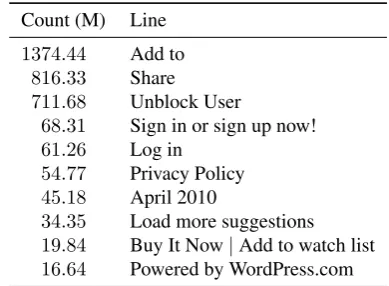
Since the Common Crawl contains web pages, many frag-ments are not content but artifacts of automatic page gen-eration, such as copyright notices. In order to reduce the amount of boilerplate, we remove duplicate lines prior to sentence splitting. While a selection of very common lines in Table 2 suggests that mostly irrelevant data is removed, we do risk deduplicating content thatshouldappear repeat-edly.
Storing all of the lines in memory would take too much RAM. Instead, we take a 64-bit hash of each line using MurmurHash4. If the hash was not seen before we keep
the line and add it to an in-memory hash-table. However, for common languages, such as English, it is not feasible to keep all hashes in memory. We therefore shard the data us-ing a different hash, so that all identical lines end up in the same shard. We then deduplicate each shard individiually. While hash collisions can lead to lines being incorrectly identified as duplicates we found that on a10GiB sample of the corpus no such errors were made.
The deduplication step removes about 80% of the En-glish data which is in line with the reductions reported by Bergsma et al. (2010). Comparing Table 1 and Table 3 we find that this rate is lower for other languages, e.g. about
2/3for Spanish and German. We speculate that this is due to mixed language content on websites, where boilerplate text may be English despite the main content appearing in another language.
4
https://sites.google.com/site/murmurhash/
Count (M) Line
1374.44 Add to
816.33 Share
711.68 Unblock User
68.31 Sign in or sign up now!
61.26 Log in
54.77 Privacy Policy
45.18 April 2010
34.35 Load more suggestions
19.84 Buy It Now|Add to watch list
16.64 Powered by WordPress.com
Table 2: Selection of very common lines in the English por-tion of the data. We only keep one instance. The counts are given as million lines.
Language Lines (B) Tokens (B) Bytes
English 59.13 975.63 5.14TiB German 3.87 51.93 317.46GiB Spanish 3.50 62.21 337.16GiB French 3.04 49.31 273.96GiB Russian 1.79 21.41 220.62GiB Czech 0.47 5.79 34.67GiB
Table 3: Data statistics after preprocessing
2.3.
Normalization
In addition to deduplicating, we restricted the data to print-able Unicode characters, replaced all e-mail addresses with the same address, stripped out remaining HTML, and split sentences using the Europarl splitter (Koehn, 2005). We distribute the text after this stage for those who wish to use their own tokenizer.
Before building language models, we normalized punctu-ation using the script provided by the Workshop on Sta-tistical Machine Translation (Bojar et al., 2013), tokenized using the Moses tokenizer (Koehn et al., 2007), and applied the Moses truecaser. The truecaser was trained on data from the 2014 Workshop on Statistical Machine Translation for each language, including Europarl (Koehn, 2005), United Nations parallel data, the Giga Fr-En corpus, parallel data mined from CommonCrawl (Smith et al., 2013), the news commentary corpus, LDC Gigaword corpora (Parker et al., 2011), and the news crawls provided by the evaluation. Our release includes a frozen version of the scripts and truecas-ing model used to preprocess the data.
Table 3 gives some statistics of the data after all preprocess-ing steps have been performed.
3.
Language Model Estimation
After preprocessing, we are left with several large mono-lingual corpora. By using disk-based streaming (Heafield et al., 2013) we are able to efficiently estimate language models much larger than the physical memory on our ma-chines. For example, estimating a language model on535
n-gram length count
Table 4:N-gram counts for the English language model.
RAM. For all languages for which we have sufficient data and a preprocessing pipeline, we produce unpruned5-gram models using interpolated modified Kneser-Ney smoothing (Kneser and Ney, 1995; Chen and Goodman, 1998). We don’t give details for all models but the largest one. Ta-ble 4 showsn-gram counts for the English language model that was estimated on almost a trillion tokens. The resulting model has a size of5.6TB.
4.
Experiments
To evaluate the language models, we compute perplexity and run machine translation experiments. Measurements are based on the 3003-sentence test set from the 2014 Workshop on Statistical Machine Translation shared task, with encoding issues fixed by the organizers. Since Span-ish was not part of the 2014 evaluation, we use the 2013 test set. These test sets, hereafter referred to asnewstest, were drawn from news articles in various languages and were professionally translated to the other languages. One issue that arises when using data collected online is the pos-sibility that sentences from the test set might occur in the training data. We use the most recent test data to minimize the possible overlap.
4.1.
Perplexity
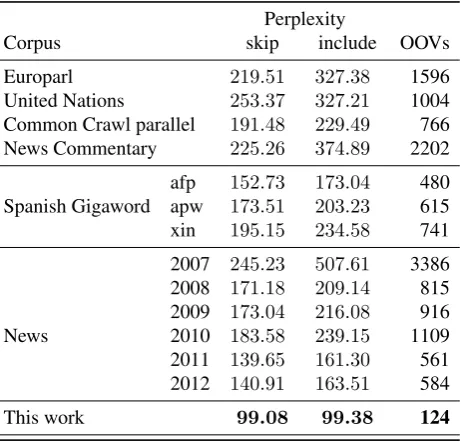
Tables 5, 6, and 7 show perplexity results on the newstest corpus. We report perplexity both by skipping unknown words and by including unknown words withp(<unk>). For comparison, we also computed perplexity using lan-guage models trained on various corpora allowed by the constrained condition of the 2014 Workshop on Statistical Machine Translation. We preprocessed the training data and newstest data using the same normalization, tokeniza-tion, and truecasing steps described in Section 2.3. The monolingual corpora from which these models were esti-mated are much smaller but are generally cleaner. Because the duplication rate was low, we did not deduplicate train-ing data for constrastive models, though some corpora were already deduplicated beforehand.
A common problem with perplexity comparisons is that models have different vocabularies. For example, a lan-guage model could achieve low perplexity with a small vo-cabulary and a high probability for the unknown word. To work around this problem, we took the maximum vocabu-lary size and applied it to all models. Essentially, we en-sure that all words appear in all models, even if they have count zero in a given model’s training data. In Kneser-Ney smoothing, these count-zero words act just like copies of the unknown word. Their probability mass arises when
Perplexity
Corpus skip include OOVs
Europarl 357.99 620.58 1902 United Nations 378.83 484.47 863 Giga Fr-En (English) 273.57 303.08 355 Common Crawl parallel 266.86 299.43 418 News Commentary 349.39 696.20 2568
English Gigaword
This work 58.44 58.55 5
Table 5: Perplexities on English newstest 2014. The “skip” column ignores unknown words for purposes of perplexity computation while the “include” column usesp(<unk>). Since all models were trained with the same vocabulary size, the “include” column is more directly comparable across corpora.
the unigrams are interpolated with the uniform distribution, adding
1 |vocabulary|
times the interpolation weight to each unigram probability. We simply use the same vocabulary size in the denominator of this equation for all models being compared. As a result, all models sum to1over the entire vocabulary. We empha-size that this approach is not new, but rather standard prac-tice recommended by IRSTLM (Federico et al., 2008). The tables show perplexity results with models trained with a consistent vocabulary size. However, we also trained mod-els in the normal way and found that the large language model still had smaller perplexity, despite having the small-est unknown word probability.
4.2.
Machine Translation
For a practical application of the models presented in this work we add them to a Machine Translation system. For this we did not build new models ourselves but used those that were produced for the WMT 2014 Machine Translation shared task.
Perplexity
Corpus skip include OOVs
Europarl 180.73 269.28 1747 United Nations 189.90 230.88 861 Giga Fr-En (French) 143.77 156.56 372 Common Crawl parallel 143.36 157.84 446 News Commentary 186.08 318.83 2558
French Gigaword afp 91.62 99.06 320 apw 105.98 120.21 539
News
2007 173.44 268.26 2183 2008 99.55 111.04 474 2009 100.14 111.47 468 2010 110.17 125.87 596 2011 89.02 96.84 361 2012 89.74 97.67 365 2013 74.37 78.62 235
All interpolated 60.78 62.02 88
This work 65.50 65.76 16
Table 6: Perplexities on French newstest 2014. Interpo-lating the cleaner data led to lower perplexity than using CommonCrawl alone.
Perplexity
Corpus skip include OOVs
Europarl 219.51 327.38 1596 United Nations 253.37 327.21 1004 Common Crawl parallel 191.48 229.49 766 News Commentary 225.26 374.89 2202
Spanish Gigaword
afp 152.73 173.04 480 apw 173.51 203.23 615 xin 195.15 234.58 741
News
2007 245.23 507.61 3386 2008 171.18 209.14 815 2009 173.04 216.08 916 2010 183.58 239.15 1109 2011 139.65 161.30 561 2012 140.91 163.51 584
This work 99.08 99.38 124
Table 7: Perplexities on Spanish newstest 2013
GIZA++ alignments, an interpolated Kneser-Ney smoothed 5-gram language model with KenLM (Heafield et al., 2013) used at runtime, a lexically-driven 5-gram operation se-quence model (Durrani et al., 2013), msd-bidirectional-fe lexicalized reordering, sparse lexical and domain features (Hasler et al., 2012), a distortion limit of 6, 100-best trans-lation options, Minimum Bayes Risk decoding (Kumar and Byrne, 2004), Cube Pruning (Huang and Chiang, 2007), with a stack-size of 1000 during tuning and 5000 during test and the no-reordering-over-punctuation heuristic. The English-to-German systems also use POS and
morpholog-BLEU
Language Pair Baseline + this work ∆
English-Czech 21.5 22.1 0.6
English-Hindi 11.1 12.5 1.4
English-Russian 28.7 29.9 1.2
English-German 20.5 21.0 0.5
Hindi-English 15.3 16.2 0.9
Table 8: Results of adding the language models presented in this work to an MT system. The given results refer to uncased BLEU scores.
BLEU
2012 ∆ 2013 ∆
Baseline 35.8 30.9
+50M lines 36.3 0.5 31.5 0.6
+100M lines 36.5 0.7 31.5 0.6
+200M lines 36.6 0.8 31.8 0.9
+400M lines 37.0 1.2 31.8 0.9
+800M lines 37.3 1.6 31.8 0.9
+1.3B lines 37.7 1.9 32.0 1.1
Table 9: Machine Translation performance for English-Spanish on newstest 2012/2013 using increasing amounts of data for the additional language model.
ical target sequence models built on the in-domain subset of the parallel corpus using Kneser-Ney smoothed 7-gram models and as additional factors in phrase translation mod-els (Koehn and Hoang, 2007). Additionally target-side lan-guage models over automatically built word-classes (Birch et al., 2013) were built. The Hindi-English system uses transliteration for unknown words (Durrani et al., 2014).
These results5 are based on automatic BLEU (Papineni et al., 2002) scores as human evaluations were not available at time of writing. The baseline systems performed well in the shared task as measured by BLEU yielding an improvement between0.5%and1.4%over the baseline as shown in Table 8.
Finally, we investigate the relation between the amount of Common Crawl data used and improvements in MT qual-ity. To this end we train a system using Moses and standard settings but all available parallel data as detailed in Section 2.3. with the exception of 2013 news data. Next, we add a language model trained on a sample of the available data and retune the system. The samples are selected such that each larger sample is a superset of any smaller one. Results in Table 9 show that even though the web data is quite noisy even limited amounts give improvements. We should how-ever keep in mind that these numbers may be optimistic as we cannot rule out the possibility that some of the segments appear in the Common Crawl data.
5.
Conclusion
We release n-gram counts and language models built on very large corpora which overcome limitations of similar publicly available resources. We show that even without sophisticated cleaning of the data we obtain results that out-perform state-of-the-art language models used in Statistical Machine Translation. We show that improvements in per-plexity also lead to better translations when used during de-coding.
Acknowledgements
The authors would like to thank Nadir Durrani for the base-line models used in Section 4.2.
This work was supported by the MateCat project, which is funded by the EC under the7thFramework Programme.
This work used the Extreme Science and Engineering Dis-covery Environment (XSEDE), which is supported by Na-tional Science Foundation grant number OCI-1053575. Specifically, we used Stampede provided by the Texas Advanced Computing Center (TACC) at The University of Texas at Austin under NSF XSEDE allocation TG-CCR140009. We also acknowledge the support of the Defense Advanced Research Projects Agency (DARPA) Broad Operational Language Translation (BOLT) program through IBM. Any opinions, findings, and conclusions or recommendations expressed in this material are those of the author(s) and do not necessarily reflect the view of the DARPA or the US government.
6.
References
Shane Bergsma, Emily Pitler, and Dekang Lin. 2010. Cre-ating robust supervised classifiers via web-scale n-gram data. InProceedings of the 48th Annual Meeting of the
Association for Computational Linguistics, pages 865–
874. Association for Computational Linguistics, July. Alexandra Birch, Nadir Durrani, and Philipp Koehn. 2013.
Edinburgh SLT and MT System Description for the IWSLT 2013 Evaluation. InProceedings of the 10th
In-ternational Workshop on Spoken Language Translation,
pages 40–48, Heidelberg, Germany, December.
Ondˇrej Bojar, Christian Buck, Chris Callison-Burch, Chris-tian Federmann, Barry Haddow, Philipp Koehn, Christof Monz, Matt Post, Radu Soricut, and Lucia Specia. 2013. Findings of the 2013 Workshop on Statistical Machine Translation. InProceedings of the Eighth Workshop on Statistical Machine Translation, pages 1–44, Sofia, Bul-garia, August. Association for Computational Linguis-tics.
Thorsten Brants and Alex Franz. 2006. The Google web 1T 5-gram corpus version 1.1. LDC2006T13.
Thorsten Brants, Ashok C. Popat, Peng Xu, Franz J. Och, and Jeffrey Dean. 2007. Large language models in ma-chine translation. InProceedings of the 2007 Joint Con-ference on Empirical Methods in Natural Language
Pro-cessing and Computational Language Learning, pages
858–867, June.
Ciprian Chelba and Johan Schalkwyk, 2013. Empirical Exploration of Language Modeling for the google.com
Query Stream as Applied to Mobile Voice Search, pages
197–229. Springer, New York.
Stanley Chen and Joshua Goodman. 1998. An empirical study of smoothing techniques for language modeling. Technical Report TR-10-98, Harvard University, August. Nadir Durrani, Alexander Fraser, Helmut Schmid, Hieu Hoang, and Philipp Koehn. 2013. Can Markov Mod-els Over Minimal Translation Units Help Phrase-Based SMT? InProceedings of the 51st Annual Meeting of the Association for Computational Linguistics, Sofia, Bul-garia, August. Association for Computational Linguis-tics.
Nadir Durrani, Hassan Sajjad, Hieu Hoang, and Philipp Koehn. 2014. Integrating an Unsupervised Translitera-tion Model into Statistical Machine TranslaTranslitera-tion. In Pro-ceedings of the 15th Conference of the European Chapter
of the ACL (EACL 2014), Gothenburg, Sweden, April.
Association for Computational Linguistics. To appear. Marcello Federico, Nicola Bertoldi, and Mauro Cettolo.
2008. IRSTLM: an open source toolkit for handling large scale language models. In Proceedings of Inter-speech, Brisbane, Australia.
David Guthrie and Mark Hepple. 2010. Storing the web in memory: Space efficient language models with constant time retrieval. InProceedings of EMNLP 2010, Los An-geles, CA.
Eva Hasler, Barry Haddow, and Philipp Koehn. 2012. Sparse Lexicalised features and Topic Adaptation for SMT. InProceedings of the seventh International
Work-shop on Spoken Language Translation (IWSLT), pages
268–275.
Kenneth Heafield, Ivan Pouzyrevsky, Jonathan H. Clark, and Philipp Koehn. 2013. Scalable modified Kneser-Ney language model estimation. InProceedings of the 51st Annual Meeting of the Association for Computa-tional Linguistics, Sofia, Bulgaria, August.
Liang Huang and David Chiang. 2007. Forest Rescor-ing: Faster Decoding with Integrated Language Models.
In Proceedings of the 45th Annual Meeting of the
As-sociation of Computational Linguistics, pages 144–151, Prague, Czech Republic, June. Association for Compu-tational Linguistics.
Reinhard Kneser and Hermann Ney. 1995. Improved backing-off for m-gram language modeling. In Proceed-ings of the IEEE International Conference on Acoustics,
Speech and Signal Processing, pages 181–184.
Philipp Koehn and Hieu Hoang. 2007. Factored Transla-tion Models. InProceedings of the 2007 Joint Confer-ence on Empirical Methods in Natural Language Pro-cessing and Computational Natural Language Learning
(EMNLP-CoNLL), pages 868–876, Prague, Czech
Re-public, June. Association for Computational Linguistics. Philipp Koehn, Hieu Hoang, Alexandra Birch, Chris Callison-Burch, Marcello Federico, Nicola Bertoldi, Brooke Cowan, Wade Shen, Christine Moran, Richard Zens, Chris Dyer, Ondˇrej Bojar, Alexandra Constantin, and Evan Herbst. 2007. Moses: Open source toolkit for statistical machine translation. In Annual Meeting of the Association for Computational Linguistics (ACL), Prague, Czech Republic, June.
sta-tistical machine translation. InProceedings of MT Sum-mit.
Shankar Kumar and William J. Byrne. 2004. Minimum Bayes-Risk Decoding for Statistical Machine Transla-tion. InHLT-NAACL, pages 169–176.
Dekang Lin, Kenneth Church, Heng Ji, Satoshi Sekine, David Yarowsky, Shane Bergsma andKailash Patil, Emily Pitler, Rachel Lathbury, Vikram Rao, Kapil Dal-wani, and Sushant Narsale. 2010. Final report of the 2009 JHU CLSP workshop, June.
Dekang Lin. 2013. Personal communication, October. Kishore Papineni, Salim Roukos, Todd Ward, and
Wei-Jing Zhu. 2002. BLEU: A method for automatic evalu-tion of machine translaevalu-tion. InProceedings 40th Annual Meeting of the Association for Computational Linguis-tics, pages 311–318, Philadelphia, PA, July.
Robert Parker, David Graff, Junbo Kong, Ke Chen, and Kazuaki Maeda. 2011. English gigaword fifth edition, June. LDC2011T07.
Jason Smith, Herv´e Saint-Amand, Magdalena Plamada, Philipp Koehn, Chris Callison-Burch, and Adam Lopez. 2013. Dirt cheap web-scale parallel text from the com-mon crawl. In Proceedings of ACL. Association for Computational Linguistics, August.