Construction of Rate-Compatible LDPC Codes Utilizing
Information Shortening and Parity Puncturing
Tao Tian
QUALCOMM Incorporated, San Diego, CA 92121, USA Email:[email protected]
Christopher R. Jones
Jet Propulsion Laboratory, California Institute of Technology, NASA, CA 91109, USA Email:[email protected]
Received 27 January 2005; Revised 25 July 2005; Recommended for Publication by Tongtong Li
This paper proposes a method for constructing rate-compatible low-density parity-check (LDPC) codes. The construction consid-ers the problem of optimizing a family of rate-compatible degree distributions as well as the placement of bipartite graph edges. A hybrid approach that combines information shortening and parity puncturing is proposed. Local graph conditioning techniques for the suppression of error floors are also included in the construction methodology.
Keywords and phrases:rate compatibility, shortened codes, punctured codes, irregular low-density parity-check codes, density evolution, extrinsic message degree.
1. INTRODUCTION
Complexity-constrained systems that undergo variations in link budget may benefit from the adoption of a rate-compatible family of codes. Code symbol puncturing has been widely used to construct rate-compatible convolutional codes [1], parallel concatenated codes [2,3], and serially con-catenated codes [4]. Techniques for implementing rate com-patibility in the context of LDPC coding have primarily pur-sued parity puncturing [5,6]. In particular, a density evo-lution model for an additive white Gaussian noise (AWGN) channel with puncturing was developed by Ha et al. [5]. The model was used to find asymptotically optimal punctur-ing fractions (in a density evolution sense) for each variable node degree of a mother code distribution to achieve given (higher) code rates. Li and Narayanan [7] show that punc-turing alone is insufficient for the formation of a sequence of capacity-approaching LDPC codes across a wide range of rates. In addition to puncturing, the authors in [7,8] used extending (adding columns and rows to the code’s parity ma-trix) to achieve rate compatibility.
In contrast to prior work that has focused primar-ily on puncturing and extending, this paper proposes a
This is an open access article distributed under the Creative Commons Attribution License, which permits unrestricted use, distribution, and reproduction in any medium, provided the original work is properly cited.
rate-compatible scheme that carefully combines parity punc-turing and information shortening. In addition to provid-ing good asymptotic distributions with which to achieve rate compatibility, we also present a column weight assignment strategy that seeks to adhere to the weight distribution goal provided by each rate. The parity puncturing portion of our method leverages the work of Ha et al. [5] while the informa-tion shortening part of the approach introduces a novel tech-nique for “fitting” an optimal degree distribution for each component rate to the portion of the graph that effectively implements this rate. Simulation results show that a hybrid scheme achieves close-to-capacity performance with low er-ror floors across a wide range (0.1 to 0.9) of code rates.
Shortening and puncturing techniques can affect the rate that a given graph implements by forcing what would oth-erwise be channel reliability values on variable node inputs to distinct extreme values. Shortening (rate reduction) is achieved by placing infinite reliability on the corresponding graph variable node. Puncturing (rate expansion) is achieved by placing 50% reliability on variable nodes in the decoding graph that correspond to punctured code symbols. At the transmitter, both techniques are implemented through the omission of the shortened or punctured code symbols dur-ing the transmission of the codeword.
3750 bits Info shortened
Info sent
Parity sent
1250 5000 bits
0 1
1 1
1 1
1 1
1
(a)
3750 bits Parity punctured Info sent
Parity sent
1250 5000 bits
0 1
1 1
1 1
1 1
1
(b)
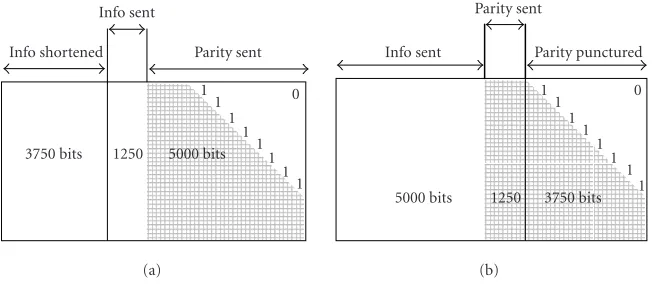
Figure1: Parity matrix of the proposed rate-compatible scheme for center rateR0=0.5. The lower triangular structure speeds up encoding
and suppresses error floor, as explained below; (a) information shortening to achieveR=0.2 and (b) parity puncturing to achieveR=0.8.
information shortening to reduce rate, then the mother code that is used should have a relatively high rate and will contain a relatively large number of columns compared to its number of rows. The girth of the high-rate mother code is likely im-paired and structures that have low extrinsic message degree [9] may dominate code performance.
The puncturing technique from [5] achieves good results for 0.5≤R≤0.9. However, high-performance rate compat-ibility across 0.1≤R≤0.9 is difficult to achieve with punc-turing alone since 88.9% of the columns of a rate 0.1 mother code matrix would need to be punctured to achieve rate 0.9. In such an approach, avoidance of stopping set puncturing at the highest rate would dictate a parity matrix structure that would yield relatively poor low rate performance. Our hy-brid rate-compatible scheme achieves results similar to those of [5] in rates ranging from 0.5≤R≤0.9. This is to be ex-pected since the puncturing profile for this range of rates has been borrowed from [5]. However, the proposed technique also gracefully extends the useful rate range down toR=0.1. In general, the hybrid scheme can achieve rate compatibility across a rate rangeRL≤R≤RHby setting the mother code
rate toR0=(RL+RH)/2.
Figure 1shows an example of how the proposed method achieves low rate 0.2 and high rate 0.8 from a length-104 mother code that has rate R0 = 0.5. Information bits are on the left side (white area) and parity bits on the right side (shaded area).
The above rate-compatible LDPC code can be used within the framework of a single iterative encoder/decoder pair. To achieveR=0.2 from the rate 0.5 mother code, ze-ros are used instead of payload data for the leftmost 3750 in-formation bits in the encoding/decoding process. To achieve R = 0.8 from the rate 0.5 mother code, the rightmost 3750 parity bits are punctured and the decoder initializes the punctured variables with 50% reliability. The number of information bits shortened and the number of parity bits punctured can be varied to achieve a wide range of code rates. Rates aboveR0are achieved exclusively through parity puncturing and rates belowR0exclusively through informa-tion shortening. InSection 2, we propose a column degree
assigning algorithm that has been designed to fit the degree distribution associated with a given code rate to the desired degree distribution for that rate. InSection 3, we discuss how to generate the desired degree distributions that achieve good shortening performance across [RL,R0].
2. DEGREE DISTRIBUTION SELECTION AND COLUMN ASSIGNMENT STRATEGY
Our construction methodology first obtains a degree distri-bution for each of the target rates and then constructs the parity matrix using a greedy approach that tries to best match each subportion of the matrix with the degree distribution that is associated with the corresponding rate.
We denote thenode-wisevariable degree distribution by ˜
λ, whose relationship with the edge-wise variable degree dis-tributionλis
˜
λi=dλvi/i
j=2λj/ j
, i=2, 3,. . .,dv, (1)
wheredvis the highest variable degree.
Similarly, thenode-wiseconstraint degree distribution ˜ρ is related to the edge-wise constraint degree distributionρby
˜
ρi=dcρi/i
j=2ρj/ j
, i=2, 3,. . .,dc, (2)
wheredcis the highest constraint degree.
A sequence of node-wise variable degree distributions such as the following will be used:
˜
λ(RL),. . ., ˜λ(Rα),. . ., ˜λ(R0),. . ., ˜λ(Rβ),. . ., ˜λ(RH), RL<· · ·< Rα<· · ·< R0<· · ·< Rβ<· · ·< RH,
(3)
where R0 denotes the code rate of the mother code, and [RL,RH] denotes the code rate range of the rate-compatible
At code rates Rα < R0, degree distributions are found
using a linear program whose constraints and objective are determined by Chung’s Gaussian approximation [10]. Both Urbanke and Chung [10,11] have indicated that the selec-tion of a uniform or nearly uniform constraint node degree yields good threshold performance. Throughout the rest of the paper, the constraint degree distribution will be concen-trated at a level that is optimal for the mother code at rate R0.
Shortened LDPC codes have the property of generic LDPC codes, therefore, thenode-wiseaverage constraint de-gree of a shortened code can be calculated from the variable degree distribution of the corresponding code rate
¯
when we generate the mother code parity matrix, we con-trol the row budget in a way such that the constraint degree distributions of shortened codes are as concentrated as pos-sible.
The simplicity in the design of concentrated constraint degree distributions is not shared by that of variable degree distributions, which vary with rate. First, we normalize these distributions with respect to the dimensions of the mother code matrix (as the component distributions must “fit” the mother code matrix),
define the puncturing fraction on degree-ivariable nodes at rateRβ > R0. In summary, we use the following definition
for the normalized node-wise degree distribution of the rate-compatible code family:
Note that an essentially continuously parameterized (in rate) ˜
Λ(R)
i can be achieved by interpolation.
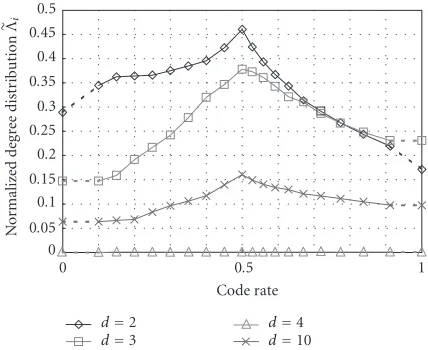
The mother code degree distribution we use is a rate 0.5 code from [5]:λ(x) =0.25105x+ 0.30938x2+ 0.00104x3+ 0.43853x9 andρ(x) = 0.63676x6+ 0.36324x7. We plot ˜Λ
i
of a rate-compatible scheme based on this mother code in
0 0.5 1
Figure2: Normalized node-wise variable degree distribution ˜Λi.
Figure 2. Distributions for the shortened portion (R < R0) of the scheme are generated with a constrained density evolu-tion algorithm to be discussed in the next secevolu-tion.
The curves inFigure 2must be extrapolated to code rates 0 and 1 for the allocation of columns in the middle of the mother code matrix (where either shortening or puncturing reach their respective maximum levels). Because an applica-tion is only interested in a certain code rate range [RL,RH],
the allocation of columns out of the interesting rate range is arbitrary to some extent. However, the extrapolation must satisfy
(i) monotonicity, ˜Λi is nondecreasing for R < 0.5 and
nonincreasing forR >0.5, (ii) continuity,
Equation (7) can be understood in the following way: ˜
Λ(0)
i describes the normalized distribution of the parity
por-tion ofH; ˜Λ(1)i describes the normalized distribution of the information portion ofH; the sum of ˜Λ(0)i and ˜Λ(1)i is equal to the overall distribution of the mother code (at rateR0=0.5). We use an extrapolation strategy that optimizes the thresh-old signal-to-noise ratio (SNR) at the lowest shortened code rateRLwhile simultaneously satisfying the above two
crite-ria. These ideas will be discussed in more detail in the next section.
Next we present a greedy algorithm (seeAlgorithm 1) to assign column degrees in a way that is meant to minimize the discrepancy between the distribution realized in the final ma-trix and the distribution goal shown inFigure 2. The number of columns that have been assigned to degree-iis denoted by niand code block length byn.
Column degree allocation
Algorithm1: The greedy algorithm.
index j=nR0, is assigned degreesWjaccording to
Wj=arg max
To understand the above objective, note that the first columns assigned correspond to columns in the shortening portion of the matrix with rates close toR0. As the column index approachesnR0, the portion of the matrix to the right must implement a code with rate close to zero (which occurs when nR0 columns have been nulled (shortened)). When column assignment begins, the target rate isR0. As the as-signment index increases, the distribution target inFigure 2 moves left toward rate 0. Per the objective in (8), node-wise distributions for variable degrees that fall offmore rapidly as code rate decreases fromR0to 0 are assigned with higher priority.
After the first nR0 column indices have been assigned variable degrees, the target rate of the graph switches from zero to one with a single index step. As previously mentioned, a discontinuity in the target degree distribution that might otherwise occur is avoided by enforcing the continuity condi-tion of (7). The second part of the column assignment strat-egy, columns in the index range j∈ {nR0+ 1,n}, is assigned degreesWjaccording to
Wj=arg max
The first columns assigned under this objective (columns with j indices slightly larger thannR0) correspond to codes with rate close to 1 (which occurs whennR0columns have been punctured). As the column index approachesn, the en-tire matrix implements a code with rate close toR0(exactly when no columns are punctured). As the assignment index increases, the distribution target inFigure 2moves left from rate 1 toward rateR0. Per the objective in (9), node-wise dis-tributions for variable degrees that rise more rapidly as code rate decreases from 1 toR0are assigned with higher priority. In addition to the column degree assignment strategy, we also use the lower triangular structure inFigure 1b. Reasons
for this are twofold. First, the parity matrix satisfies the struc-ture proposed by [12] and hence has an almost linear time encoder. Second, the proposed structure can suppress error floors. We know from [13] that to form a stopping set, each constraint neighbor of a variable set must connect to this variable set at least twice. Any column subset of the right-most portion of the matrix inFigure 1bis not a stopping set, because the leftmost column of this subset is by construction only singly connected to this set.
3. CONSTRAINED DENSITY EVOLUTION
We need to design the edge-wise degree distributionsλ(x)=
dv
i=2λixi−1(for variables) andρ(x)=
dc
i=2ρixi−1 (for
con-straints), wheredvanddcare the highest variable degree and
the highest constraint degree, respectively. Our construction shall employ node-wise degree distributions:
˜
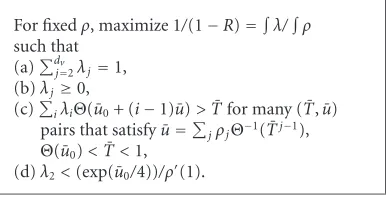
The well-known work of Chung et al. [10] presented a technique that approximates the true evolution of densities in an iterative decoding procedure with a mixture of Gaus-sian densities. The following equations describe the recur-sions provided by Chung:
¯
u1=0 (initial condition),
(11)
where ¯ulis the mean of the log-likelihood ratio (LLR)
gen-erated by constraint nodes after the lth iteration, ¯Tl = E(tanh(vl/2)),vlis the LLR generated by variable nodes
af-ter thelth iteration, and ¯u0=2/σ2is the mean of thea priori LLRs.
For fixedρ, maximize 1/(1−R)=λ/ρ
such that (a)dv
j=2λj=1,
(b)λj≥0,
(c)iλiΘ( ¯u0+ (i−1) ¯u)>T¯for many ( ¯T, ¯u)
pairs that satisfy ¯u=jρjΘ−1( ¯Tj−1), Θ( ¯u0)<T <¯ 1,
(d)λ2<(exp( ¯u0/4))/ρ(1).
Algorithm2: Traditional optimization algorithm.
The monotonicity constraint can be expressed as
˜
Λ(R1)
i ≤
1−R0 iρ(R)λ
(R)
i ≤Λ˜(iR2), ∀R∈
R1,R2, (13)
whereR1≥RLandR2≤R0.
The continuity constraint can be expressed as
1−R0 iρ(RL)λ
(RL)
i ≤Λ˜(iR0)−Λ˜(iRH). (14)
We assume that the mother code distribution is given, and the distribution at the highest rateRH is fixed (the
op-timization on puncturing component rates is conducted be-fore the optimization on shortening component rates). Then (13) and (14) can be applied to density evolution of any shortening component code rate within [RL,R0). It should be
noted that the code rate range is closed on the left and open on the right, because RL is a rate subject to optimization,
while the distribution atR0is prescribed. The concentrated row distributionρ(R)is chosen so it maximizes the code rate in density evolution.
No known research focuses on the problem of simulta-neously optimizing all code rates in the shortening code rate range. To define the optimality of a rate-compatible short-ened LDPC code, we first discuss the existence of “dominant solutions.”
Definition 1. A series of normalized variable degree distri-bution ˜Λ(RL)
D ,. . ., ˜Λ (Rα) D ,. . ., ˜Λ
(R0)
D is called dominant if it
sat-isfies monotonicity and continuity, and for allR∈[RL,R0),
the corresponding iterative decoder converges at the high-est Gaussian noise power, that is,σ( ˜Λ(DR))≥σ( ˜Λ(R)), where
˜
Λ(RL),. . ., ˜Λ(Rα),. . ., ˜Λ(R0) is any other series of normalized
variable degree distribution that satisfies monotonicity and continuity.
If a dominant solution exists,Theorem 1explains how to find it.
Therom 1. If density evolution with the constraint
˜
Λ(RL)
i ≤Λ˜
(R)
Di ≤Λ˜
(R0)
i −Λ˜
(RH)
i (15)
yields a series of Λ˜(DR) within [RL,R0)that satisfy the
mono-tonicity constraint, then this series ofΛ˜(DR)is a dominant solu-tion as defined inDefinition 1.
Proof. Distribution ˜Λ(DR)is obtained with the loosest mono-tonicity constraint that only considers boundary code rates. Therefore, its corresponding iterative decoder converges at equal or higher Gaussian noise power than any other feasible solution at rateR.
Theorem 1 indicates that if a dominant solution exists, the above optimization process should yield at least one series of distributions that satisfies the monotonicity con-straint. For the test mother code distribution, we try to in-dividually optimize code rates of interest. However, the re-sulting series of distributions do not satisfy the monotonicity constraint, which suggests that at least for some cases, there is no dominant solution.
Without a dominant solution, we resort to a strategy that optimizes code rates close to RL and those close toR0
be-fore it optimizes code rates close to (RL+R0)/2.Figure 2was
generated this way and our experiment shows that although suboptimal, this method nevertheless gives a good solution to the shortening component rates.
4. SIMULATION RESULTS
Bit error rate (BER) and frame error rate (FER) results for additive white Gaussian noise (AWGN) channels are shown in Figures3and4, respectively. The degree distribution pro-file of the mother code is described byFigure 2. The mother code is generated by the ACE algorithm proposed in [9] with the further constraint that columns be allocated per the de-gree assignment of the previous section. The parity matrix is also constructed to have a semilower triangular form as this prevents stopping set activation due to parity puncturing.
The ACE algorithm [9] targets cycles in the bipartite graph corresponding to an LDPC code. The algorithm has two parameters,dACEandηACE. The design criterion is such that for all cycles of length 2dACEor less, the number of ex-trinsic edge connections (edges that do not participate in the cycle) is at leastηACE. This approach increases the connectiv-ity between any portion of the bipartite graph with the rest of the graph, and therefore prevents the occurrence of isolated cycles (cycles with poor variable node connectivity in the graph form stopping sets [9]). The ACE parameters achieved by the designed rate-compatible scheme aredACE =10 and ηACE=4.
−9 −7 −5 −3 −1 1 3 5 7 9 11 1.E−07
1.E−06 1.E−05 1.E−04 1.E−03 1.E−02 1.E−01
Es/N0(dB)
BER
556/5556=0.1 1250/6250=0.2 2143/7143=0.3 3333/8333=0.4 5000/10000=0.5
5000/8333=0.6 5000/7143=0.7 5000/6250=0.8 5000/5556=0.9
Figure3: BER simulation results and AWGN channel.
−9 −7 −5 −3 −1 1 3 5 7 9 11 1.E−05
1.E−04 1.E−03 1.E−02 1.E−01 1.E + 00
Es/N0(dB)
FER
556/5556=0.1 1250/6250=0.2 2143/7143=0.3 3333/8333=0.4 5000/10000=0.5
5000/8333=0.6 5000/7143=0.7 5000/6250=0.8 5000/5556=0.9
Figure4: FER simulation results and AWGN channel.
at infinity block length, while the sphere-packing threshold is achieved with finite (n,k) pairs for generic BIAWGNC. Shannon sphere-packing bound is included here to account for the information-bits reduction for shortened codes, and the block-size reduction for punctured codes. We evaluate code performance at BER =10−5instead of at FER=10−4 because some low rate (shortened) codes have error floors higher than FER=10−4.
The figure shows that the threshold degrades gracefully aroundR0=0.5. For example, the simulation threshold SNR is 0.66 dB worse than the density evolution threshold for the mother code (R0=0.5). This difference is 2.58 dB atR=0.1 and 3.19 dB atR = 0.9, respectively. Therefore, the excess
−2 −1 0 1 2 3 4 5 6 7 8
0 0.1 0.2 0.3 0.4 0.5 0.6 0.7 0.8 0.9 1
Eb/N0(dB)
Co
de
ra
te
DE threshold
Simu BER−1.E−5Eb/N0
BIAWGNC capacity threshold BIAWGNC sphere-packing
threshold FER−1.E−4
Figure5: Code performance compared to theoretical bounds.
SNR to capacity at either rate extreme is approximately 3 dB at the designed block size.
5. CONCLUSION
A hybrid rate-compatible scheme for irregular LDPC codes that achieve good performance across a wide range of rates has been presented. The hybrid approach complements Ha and McLaughlin’s puncturing technique by extending rate compatibility to the lower rate regime.
ACKNOWLEDGMENTS
The authors would like to acknowledge Sam Dolinar for pro-viding them with the Shannon sphere-packing bound data and Michael Smith for reviewing this work. The research de-scribed in this paper was carried out at the Jet Propulsion Laboratory, California Institute of Technology, under a con-tract with the National Aeronautics and Space Administra-tion.
REFERENCES
[1] J. Hagenauer, “Rate-compatible punctured convolutional codes (RCPC codes) and their applications,” IEEE Trans. Commun., vol. 36, no. 4, pp. 389–400, 1988.
[2] A. S. Barbulescu and S. S. Pietrobon, “Rate compatible turbo codes,” IEE Electronics Letters, vol. 31, no. 7, pp. 535–536, 1995.
[3] D. N. Rowitch and L. B. Milstein, “On the performance of hybrid FEC/ARQ systems using rate compatible punctured turbo (RCPT) codes,”IEEE Trans. Commun., vol. 48, no. 6, pp. 948–959, 2000.
[5] J. Ha, J. Kim, and S. W. McLaughlin, “Rate-compatible punc-turing of low-density parity-check codes,”IEEE Trans. Inform. Theory, vol. 50, no. 11, pp. 2824–2836, 2004.
[6] H. Pishro-Nik and F. Fekri, “Results on punctured LDPC codes,” inProc. IEEE Information Theory Workshop, pp. 215– 219, San Antonio, Tex, USA, October 2004.
[7] J. Li and K. R. Narayanan, “Rate-compatible low density par-ity check codes for capacpar-ity-approaching ARQ schemes in packet data communications,” inProc. IASTED International Conference. Communications, Internet, and Information Tech-nology (CIIT ’02), pp. 201–206, St.Thomas, Virgin Islands, USA, November 2002.
[8] M. R. Yazdani and A. H. Banihashemi, “On construction of rate-compatible low-density parity-check codes,”IEEE Com-mun. Lett., vol. 8, no. 3, pp. 159–161, 2004.
[9] T. Tian, C. R. Jones, J. D. Villasenor, and R. D. Wesel, “Selec-tive avoidance of cycles in irregular LDPC code construction,” IEEE Trans. Commun., vol. 52, no. 8, pp. 1242–1247, 2004. [10] S.-Y. Chung, T. J. Richardson, and R. L. Urbanke, “Analysis
of sum-product decoding of low-density parity-check codes using a Gaussian approximation,”IEEE Trans. Inform. Theory, vol. 47, no. 2, pp. 657–670, 2001.
[11] T. J. Richardson, M. A. Shokrollahi, and R. L. Urbanke, “De-sign of capacity-approaching irregular low-density parity-check codes,”IEEE Trans. Inform. Theory, vol. 47, no. 2, pp. 619–637, 2001.
[12] T. J. Richardson and R. L. Urbanke, “Efficient encoding of low-density parity-check codes,”IEEE Trans. Inform. Theory, vol. 47, no. 2, pp. 638–656, 2001.
[13] C. Di, D. Proietti, I. E. Telatar, T. J. Richardson, and R. L. Urbanke, “Finite-length analysis of low-density parity-check codes on the binary erasure channel,” IEEE Trans. Inform. Theory, vol. 48, no. 6, pp. 1570–1579, 2002.
Tao Tian received B.S. degree from Ts-inghua University, Beijing, China, in 1999, and M.S. and Ph.D. degrees from Univer-sity of California, Los Angeles (UCLA) in 2000 and 2003, all in electrical engineering. From 2003 to 2004, he worked with Medi-aWorks Integrated Systems Inc. in Irvine, Calif. Since April 2004, he has been with QUALCOMM Incorporated in San Diego, Calif, where he works on problems related
to multimedia signal processing and communications.