Volume 2007, Article ID 54968,10pages doi:10.1155/2007/54968
Research Article
Communication Timing Control with Interference
Detection for Wireless Sensor Networks
Yuki Kubo1, 2and Kokuke Sekiyama3
1Ubiquitous System Laboratory, Corporate Research and Development Center, OKI Electric Industry Co., Ltd.,
2-5-7 Honmachi, Chuo-Ku, Osaka-Shi, Osaka 541-0053, Japan
2Department of System Design Engineering, University of Fukui, 3-9-1 Bunkyo, Fukui-Shi, Fukui 910-8507, Japan 3Department of Micro-Nano Systems Engineering, Nagoya University, Furo-Cho, Chikusa-Ku, Nagoya 464-8603, Japan
Received 31 May 2006; Revised 16 October 2006; Accepted 18 October 2006
Recommended by Xiuzhen Cheng
This paper deals with a novel communication timing control for wireless networks and radio interference problem. Communica-tion timing control is based on the mutual synchronizaCommunica-tion of coupled phase oscillatory dynamics with a stochastic adaptaCommunica-tion, according to the history of collision frequency in communication nodes. Through local and fully distributed interactions in the communication network, the coupled phase dynamics self-organizes collision-free communication. In wireless communication, the influence of the interference wave causes unexpected collisions. Therefore, we propose a more effective timing control by se-lecting the interaction nodes according to the received signal strength.
Copyright © 2007 Y. Kubo and K. Sekiyama. This is an open access article distributed under the Creative Commons Attribution License, which permits unrestricted use, distribution, and reproduction in any medium, provided the original work is properly cited.
1. INTRODUCTION
In recent years, research on wireless sensor networks has been
promoted rapidly [1]. The sensor networks are composed of
distributed sensor devices connected with wireless commu-nication and sensing functions. Potential application fields of the sensor networks include stock-management systems,
road traffic surveillance systems, and air-conditioning
con-trol systems of a large-scale institution and so on. There are many technical issues in the sensor networks. In this paper, we deal with two problems. One of them is a communica-tion timing control for collision avoidance. Another is the influence of interference wave on the communication timing control. In order to cope with malfunctions and changes of the number of active sensor nodes, a distributed autonomous communication timing control is preferable to centralized approaches which must rely on a fixed base station in general.
In order to avoid the collision issue, TDMA [2] system
has been presented, which is a multiplexing technology in the time domain that makes it possible to avoid collisions by assigning a communication slot to one frame. Hence, no col-lision occurs, and any node can obtain impartial communi-cation right in TDMA. TDMA is widely used in cellular tele-phone systems. However, TDMA is fundamentally a
central-ized management technique depending on a base station and is applicable to a star link network. Meanwhile, distributed slot assignment TDMA approach for ad hoc networks has
been proposed. In Ephremides and Truong algorithm [3],
allocation of one transmission slot is assured for each node
by preparingN slots forN nodes. In addition, it is possible
to add more slot allocations by referring to information of the slot allocation within the two hop nodes for the collision avoidance based on the distributed algorithm. However, this algorithm requires total number of the node. Hence, this al-gorithm has a limitation in changing the number of nodes
flexibly. USAP-MA [4] deals with a distributed slot
assign-ment in TDMA for changes of the number of nodes. This method provides a dynamic change of frame length corre-sponding to the number of nodes and network topology, and
improves bandwidth efficiency. Also, the other methods of
slot reservation have been proposed for TDMA [4–6].
How-ever, these TDMA-based approaches require a global time synchronization.
As another collision avoidance technique, CSMA [7,8]
has been widely used. CSMA is a simple and scalable
pro-tocol. In the case of low-traffic situation, CSMA works effi
9
Initial state Convergence state 12
Figure1: (a) Node arrangement and communication range; (b) phase pattern formation for collision avoidance.
frequent packet collisions. Such collisions should be avoided
for not only improvement of the throughput efficiency, but
also saving the electric energy consumption required in the retransmissions. Furthermore, several problems are pointed
out with regard to the cost of carrier sense [9] and hidden
ter-minals [7,8]. Also, with the CSMA-based approach, it is diffi
-cult to ensure impartial communication right because of the high contention of nodes that share communication channel. Other research in the wireless sensor networks includes
SMAC [10], SMACS [11]. SMAC is based on CSMA, where
each node broadcasts a sleep timing schedule to the neigh-bor nodes. The nodes receiving this message are to adjust the schedule of sleep, by which a node can save energy con-sumption. Although the problem of collision is inevitable, the aim of this research is focused on a timing control for en-ergy saving. Hence, fundamental problems in CSMA remain
unsolved. SMACS realizes an efficient communication based
on synchronization between two nodes. These nodes attempt to schedule a communication timing with each other.
Ad-ditionally, each node utilizes a different frequency band for
a different link for collision avoidance. In this method, the
risk of collisions can be reduced by random sharing of the
frequency band. SMACS is different from the basic TDMA
in that synchronization is required between two correspond-ing nodes while TDMA requires global synchronization. In general, global synchronization without a base station is hard to achieve. We have proposed a distributed communication
timing control for collision avoidance named phase diff
u-sion time-diviu-sion method (PDTD) [12]. This method is a distributed communication timing control based on the dy-namics of coupled phase oscillator among the peripheral nodes. Through local and fully distributed interactions, the
coupled phase dynamics self-organizes the effective phase
synchronous state that allows collision-free communication. On the other hand, radio interference is an important problem in the wireless communication. Interference prob-lems include two kinds of probprob-lems. One of them is to re-duce influence of interference. Another problem concerns the communication timing under the influence of interfer-ence. Radio interference greatly influences the
communica-tion protocol [13]. Decentralized scheduling TDMA is based
on the graph structure of the node connection within com-munication range. The issue of radio interference is not con-sidered in decentralized scheduling TDMA. Therefore, in the presence of interference wave, it may not be an appropri-ate schedule method when considering the issue of inter-ference. Also, in the case of CSMA-based protocol, hidden terminal collision avoidance mechanism based on RTS and
CTS messages will not work appropriately [14]. In the
previ-ous timing control based on PDTD, we did not deal with ra-dio interference problems. Therefore, unexpected collisions may occur in the real environment. In this paper, we pro-pose the extended version of PDTD with interference de-tection (PDTD/ID). Each node exchanges the received sig-nal strength and specifies the interference source node. This has to be incorporated for interaction nodes for collision
avoidance in PDTD. We verify the efficiency of the proposed
method by simulation experiments.
2. COMMUNICATION TIMING CONTROL
2.1. Outline of PDTD
In this section, we will review a basic concept of PDTD. We assume a situation in which a node periodically transmits data. The node is modeled as an oscillator that periodically repeats the states of the communication and noncommu-nication. Hence, mutual adjustment of the communication timing is formulated based on the coupled oscillator dynam-ics. The communication timing state of the node is expressed
as a phase. The phase of the oscillator for nodeiis denoted
asθi, and angular velocity isωi. We suppose that each node
can transmit data only within the phase interval 0< θi < φc
as depicted inFigure 1. If other nodes do not transmit in the
interval 0< θi < φc, no collision occurs.Figure 1shows the
phase relation from the viewpoint of node 0.Figure 1(left)
depicts initial state. In this case, the phase difference is not
large enough, hence a collision occurs. If each node forms
ap-propriate communication timing likeFigure 1(right),
4
(a) Node arrangement and communica-tion range
(b) Sending phase value by control message
Figure2: Node interaction based on control message.
atθi=0 for communication timing control. Each node is
as-sumed to know the phase value of the neighbor nodes by re-ceiving the control message, and to calculate phase dynamics.
2.2. Node interaction
We explain the method of exchanging phase value with each other by the control message. The control message from node
iincludes the following information:
(1) one-hop neighbor node IDj=(0, 1, 2,. . .);
(2) phase value of one-hop neighbor (θi0,θi1,θi2,. . .,θi j);
(3) received signal strength value from one-hop neighbor (Pi 0,Pi 1,Pi 2,. . .,Pi j).
The phase value of one-hop neighbor is used for calcula-tion of communicacalcula-tion timing control. The received signal strength value is used for selection of interference nodes.
These are detailed in Sections 2.3and3. Since the control
messages are transmitted by the same channel with the data messages, there is possibility that the control messages might be occasionally lost by collisions. However, the transmission of the control messages is executed periodically, it is unlikely that the control message is lost every time.
The process to convey node information to the neigh-boring nodes is explained as follows. The node is assumed to be able to know only its self phase value when calculat-ing phase dynamics. However, the node estimates the phase value of the neighboring nodes from their control mes-sages. In this paper, the neighbor node of which informa-tion is temporarily generated based on this estimainforma-tion is called a virtual node. The node controls communication
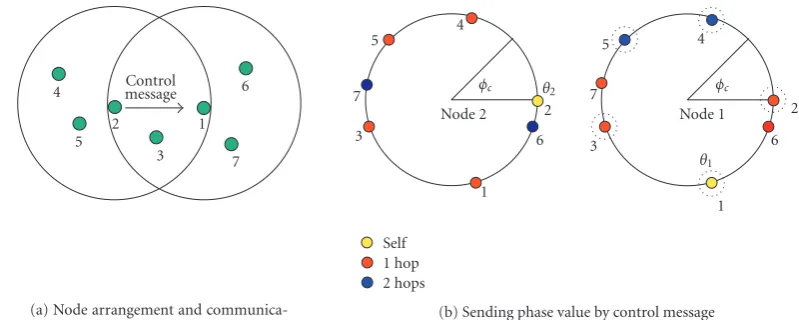
tim-ing by the interaction with a virtual node. Figures2(a)and
2(b)show the case that node 2 transmits the control
mes-sage.Figure 2(a)shows node allocation and communication
range.Figure 2(b)shows the state of virtual nodes of nodes 1
and 2 corresponding toFigure 2(a). The interaction process
of nodes 1 and 2 is as follows. Node 2 transmits the control
message at phaseθ2 =0, then the control message includes
information of nodes 1, 3, 4, and 5 that exist in one-hop
neighbor. Node 1 that received this massage generates virtual nodes corresponding to nodes 1, 2, 3, 4, and 5 listed in con-trol message from node 2. The phase with dashed circle in Figure 2(b)denotes the corresponding node. A virtual node corresponding to node 2 (sender of the control message) is registered as one-hop neighbor node. Nodes 3, 4, and 5 (the other nodes contained in the control message) are registered as two-hop neighbor nodes. In this regard, node 3 is classi-fied as the two-hop neighbor node from node 1. However, if node 1 is able to communication directly with node 3, node 3 is registered as the one-hop neighbor node. Through send-ing and receivsend-ing of a periodic control message, each node has node information within two-hop neighbor nodes as a virtual node.
2.3. Communication timing control based on PDTD
Coupled phase dynamics
PDTD provides communication timing control based on
phase dynamics for collision avoidance. Nodeiinteracts with
a virtual node and forms appropriate phase-difference
pat-tern. Letθi jdenote phase value of virtual node jfor nodei.
Then the governing equation is given by the following equa-tions:
virtual node j, respectively, and kj is the coupled strength
value.Kiis a virtual node set of nodei. Every node is allowed
to transmit data forφc/ωi(s) every cycle.ξ(Si) is a stochastic
term, details of which are explained inSection 2.3.
functionR(Δθi j) which is a repulsive function as follows:
When relying only on the repulsive interaction, the
phase-difference pattern often fails to converge to the desired
sta-tionary state. Therefore, a stochastic adaptation termξ(Si) is
introduced, which is determined by the estimated risk of the collision. As an evaluation index, phase overlap rate is
de-fined. Node communication state is defined such thatOi=1
denotes that nodeiis allowed to communicate, andOi =0
denotes that nodeiis prohibited to communicate, which is
given by
Flag function to indicate phase overlap of communication
timing between nodeiand virtual nodes is given by
xi(t)=
xi=1 indicates that there is a phase overlap that would cause
a collision. Iftt+Txi(t)=0, then one collision is counted for
one cycle. Letγindicate the occurrence time of phase overlap
for pastncycles. overlap rateciis given by
ci(t)= γ
n. (7)
The stress of being exposed to the risk of collision is accumu-lated by the following mechanism:
Si(t)=2Si(t τ) +s
whereτ =nTiis a stress accumulating time scale. Random
phase jump is implemented everynTi[s] cycles with
prob-abilitySi, where ifSi >1, thenSi 1. After random phase
jump, thenSi0. The destination of phase jump is decided
as follows. Assume that nodeihasNivirtual nodes, the phase
of which is denoted asθi j. Sorting the phase valueθi j in
as-corresponding node tokth phase value isvk. The destination
of stochastic jump is depicted as shown inFigure 3. The list
of destinationukis given by
uk=vk
Figure3: Destination list of random phase jump.
The preferential selection probability uk is decided by the
equation
whereβis a sensitivity parameter of the selection.
3. COMMUNICATION TIMING CONTROL WITH INTERFERENCE NODE DETECTION
3.1. Radio interference problem
In a wireless communication, even in the presence of weak interference wave, a node may fail to communicate if the desired wave strength from the node is weak. On the other
hand, if the desired wave strength is sufficiently strong, the
node may be able to receive data from the other node suc-cessfully despite presence of a strong interference wave. The reception error caused by an interference wave is estimated by signal-to-interference ratio (SIR). The threshold of SIR to correctly receive a signal is determined by modulation meth-ods and spec of the receiver. In the communication timing
control described inSection 2.3, however, the influence of
in-terference wave was not taken into account in our model. In spite of the assumption that the interaction range is within the two-hop neighbors, interference waves can be reached beyond the interaction range, and hence this could cause un-expected collisions. Therefore, each node has to select the in-teraction nodes based on the relation between received signal wave strength and interference wave strength.
3.2. Radio interference model
In this section, we discuss how the interference source is specified based on the received electric power. As shown in Figure 4, nodesi, j, andkare placed, where the internode
distance between nodesiandjand the one between nodesj
andkare denoted byds,di, respectively. The interference
oc-curs in nodejwhen nodeitransmits to node j. Also assume
that all nodes transmit in the same electric powertp(mW).
The received electric power p(d)(mW) is assumed available
by the following equation [14]:
p(d)=ctp
dα , (11)
wheredis the distance between the sender node and the
re-ceiver node. αis the signal attenuation coefficient.cis the
combined parameter that is related to the reception strength.
k
Figure4: The existence range of interference source (ERIS).
an interference source. With (11), SIR is defined as the ratio
of the electric power between the desired signal from nodei
and the interference wave from nodek;
SIR= p
SIR has to be bigger than the thresholdesir in order for the
transmission from nodeito be successfully received in node
j. Otherwise, in the case of SIResir, the interference would
occur in node j, and nodekis referred to as the interference
source node for nodej. In general, the existence range of
in-terference source node is given by the following equation:
di
α
esirds. (13)
We call the existence range of interference source node as ERIS in the following section. It can be said that ERIS is
pro-portional to the distancedsby (13). In order for nodeito be
able to communicate with node jsuccessfully, nodeihas to
specify which node can be the interference node for node j.
Such nodes are referred to as the interference source nodes.
Nodeiis not allowed to transmit at the same time as the
in-terference source node.
3.3. Interference node detection
Existence range of interference source
As mentioned in the previous section,
SIR= p
is required for successful communication in the presence of
interference waves. Taking logarithm in (14), we obtain
Ps Pi> Esir, (15)
where Ps = 10 log10p(ds), Pi = 10 log10p(di), and Esir =
10 log10esir.Figure 5 shows the existence range of
interfer-ence source (ERIS). LetPmin(dBm) be the minimum received
signal strength for a successful communication. In the case
Pi=Pmin Esir
Pi=Pmin
3 1 2
Pc
Pmin
Figure5: Limitation of destination node and ERIS.
that node 1 transmits to node 2 that is located on the bound-ary of communication range from node 1, the received signal
strength on the boundary positions will becomePmin(dBm).
Hence, it is supposed thatPs=Pminin (15), thenPmin Esir>
Piis derived, which indicates that node 2 will fail to receive
the transmission from node 1, if the strength of interference
wave is larger thanPi = Pmin Esir(dBm). The ERIS, the
corresponding range forPi, will become larger than the
com-munication range of node 2. Therefore, some extension is re-quired for the timing control with two-hop neighbor nodes based on the PDTD because the interference wave may cause another collision. On the other hand, when node 1 transmits to node 3, which is closer than node 2, assume that node 3
re-ceives the signal of strengthPc=Pmin+Esir(dBm). This is the
case ofPs=Pcin (15), where sincePc Esir> Pi,Pmin > Pi
is obtained. This implies that the ERIS (Pi) is the same or
inside of the communication range of node 3. Therefore, if
the communication range is redefined asPcinstead ofPmin,
it is possible to avoid the problem caused by the interference wave in PDTD.
Detection process of interference node
In this section, the process of interference node detection is addressed. This method is based on the evaluation of the
re-ceived signal strength, where two different scenarios can be
considered. The first case is that when node atransmits to
nodeb, the interference occurs in the destination nodeb
be-cause of transmissions from some other nodes. In this case,
nodeaneeds to specify which nodes are causing the
inter-ference to nodeb (detection of the interference nodes), in
an attempt to execute the timing control with such interfer-ence nodes. On the other hand, the second case is that the
transmission from nodeato a destination nodecis causing
an interference to nodeb, where nodeais becoming an
in-terference node for nodebunintentionally, and such a node
could exist many around nodea. Hence, nodeais asked to
specify the node set that can be interfered by the transmission
of nodea, and conduct a timing control with those nodes to
avoid a potential collision.
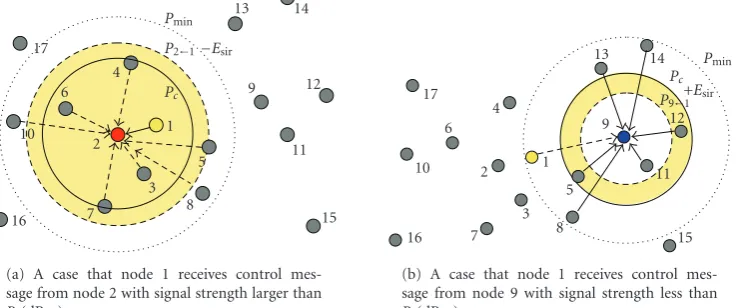
The first case is exemplified in more detail inFigure 6(a),
where node 1 receives a control message from node 2 with
17
(a) A case that node 1 receives control mes-sage from node 2 with signal strength larger than Pc(dBm)
(b) A case that node 1 receives control mes-sage from node 9 with signal strength less than Pc(dBm)
Figure6: Interference node selection based on received signal strength.
specify the interference nodes for node 2. As described in Section 2.2, the control message from node 2 includes the signal strength data which had been received by node 2 from
the other nodes. InFigure 6(a), this control message includes
data from nodes 1, 3, 4, 5, 6, 7, 8, and 10.
LetPb a denote the received signal strength of node b
from nodea, then node 1 comparesP2 1 (the desired
sig-nal) withP2 x, (x = 3, 4, 5, 6, 8, 10) in order to judge as to
whether each nodexwould become the interference source.
From (15), ifP2 1 P2 xEsir, nodexmay cause the
inter-ference to node 2. Such a node set is defined as
LI(b a)=
xPb xPb a Esir,x=a
. (16)
Equation (16) represents the node set that could cause the
interference to nodebwhen nodeatransmits to nodeb. It
should be noted that the node setLI(b a) is determined
by nodeabased on the control message from nodeb, hence
nodeais excluded from the setLI(b a). As depicted in
Figure 6(a),LI(21)= 3, 4, 5, 6, 7that are the nodes
in-side the range of dashed circle,P2 1 Esir. While, the
sec-ond scenario is exemplified inFigure 6(b)where there is no
direct communication between nodes 1 and 9 but node 1 can receive the control message from node 9 with the signal
strength of less thanPc(dBm) for the sake of the interaction
in PDTD. In other words, node 1 is outside the
communica-tion rangePcthough it is within the interaction rangePmin.
Node 9 will have a direct communication with nodex, the
signal strength of which isP9 x> Pc. When node 1 transmits
to a peripheral node, such as node 2, the transmission from node 1 may interfere with the desired signal for node 9 from
nodex, for instance,x=12. Also, ifP9 x P9 1Esirholds,
node 1 becomes an interference node to the desired signal for node 9. Therefore, the node set comprising the nodes that
are interfered with the transmission of nodeAand prevented
from receiving a desired signal from nodeBis defined as
fol-lows:
abased on the received control message from nodeb, node
ais excluded from the node setCI(b a). As an example,
CI(91)= 5, 12is depicted in the confined colored area
ofFigure 6(b).
In this method, the parameters associated with necessary
SIR thresholdEsirand the minimum reception electric power
Pminhave to be preassigned in order to abstract the
interfer-ence nodes. After every node specifies the interferinterfer-ence nodes, it conducts a communication timing control with those
in-cluded inLIandCI. That is, the interaction nodes (the
vir-tual node set for nodei)Kiin (1) are adaptively specified as
LI(ji)CI(ji).
4. SIMULATION
4.1. Simulation setting
Simulations are conducted to illustrate performance of
PDTD/ ID. As a simulation setting, 1010 nodes are assigned
as follows.
Case 1(regular grid model (Figure 7(a))). 1010 nodes are assigned on the regular grid, where the internode distance is
assumed asd=25 (m).
Case 2 (perturbed grid model (Figure 7(b))). Node
alloca-tion is perturbed by the uniform random value in [ d/2,
d/2) from the regular grid allocation.
The radio parameters and the node parameters are listed
in Tables1and2, respectively. Also, the node arrangement
and communication range are depicted inFigure 7. The
ini-tial value of the phaseθiis randomly assigned in [0, 2π) for
both Cases1and2. Since the purpose of this simulation is to
verify the proposed timing control and interference node se-lection, we focus our argument on the timing control, hence
the traffic model is simplified. Each node transmits packets in
the phase interval 0< θi< φcevery cycle. It is preferable that
90 91 92 93 94 95 96 97 98 99
(a) Regular grid
9091 92 93 94 (b) Perturbed grid
Figure7: Node arrangement and interference node.
Table1: Radio parameters.
cp
t Radio parameter 0.01135
α Signal attenuation coefficient 4
Esir Necessary SIR 10 (dB)
Pmin Lowest reception electric power 90 (dBm)
Table2: Node parameters.
φc n Calculation cycle of collision rate 5 cycles
ω Eigenfrequency of node 2π/5 (rad/s)
β Sensitivity of stochastic jump 10
as a fixed value in this simulation. We evaluate the successful transmission rate that is defined as available communication time(s) per cycle normalized by the maximum
communica-tion time(s) per cycle (φc/ωi). Collision rate is the collision
state time(s) per cycle normalized by the maximum commu-nication time(s) per cycle.
4.2. Simulation results
The results of node selection for interaction are shown in
Figures 7(a) and7(b), where the large circle indicates the
communication range of node 34, and the small circle
in-dicates the equivalent curve of the signal strengthPc from
node 34. The encircled nodes inFigure 7 imply the
inter-ference nodes in the case that node 34 transmits to a node
within the small circlePccurve (or communication range);
hence node 34 has to interact with encircled nodes for
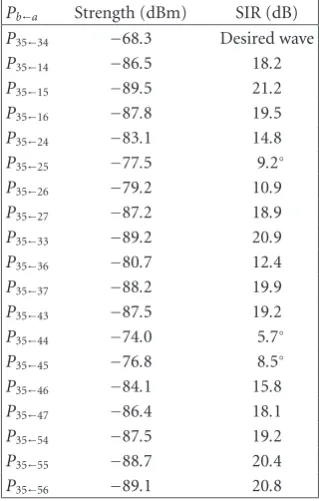
col-lision avoidance.Table 3shows a specific example for signal
strength values in the case ofFigure 7(b).Table 3(a) shows
the list of signal strength in the case that node 34 receives the control message from node 35, the information gathered by node 35. Node 34 specifies the interaction nodes based on
(16). Because the value of SIR is less than the desired
thresh-oldEsir=10 (dB) as listed inTable 1for successful reception,
node 34 has to avoid the overlap of communication timing
with nodes 25, 44, and 45.Table 3(b) shows the table of signal
strength, when node 34 receives a control message from node
33, and node 34 selects interaction node based on (17).
Be-cause node 34 interferes with reception of node 33, node 34 has to avoid overlap of communication timing with 24 and
43. Thus, interaction nodes (encircled nodes inFigure 7) are
selected autonomously.
As mentioned in Section 2.3, each node evaluates the
overlap rate of communication phase by (7). It can be said
that the phase-difference pattern for the communication
timing control is completed when the overlap rate of all nodes converged to 0. The time series of average overlap rate
is shown in Figures8(a)and9(a), and it can be seen that it
took around 60–100 cycles to complete the timing control. Also, average successful transmission rate increased accord-ing to decline of the average overlap rate as shown in Figures
8(b)and9(b). Because of the overhead of the control
mes-sage for interactions, the average success transmission rate is inevitably below 1. After having converged to the stationary state, the successful transmission rate remained steady in the high value, and any collision did not occur as shown in
Fig-ures8(c) and9(c). Hence, it is confirmed that every node
correctly specified the interference source nodes and eff
Table3: Signal strength and interaction node selection.
(a) Control message from 35, receiver node 34, corresponding toFigure 7(b)
Pba Strength (dBm) SIR (dB)
(b) Control message from 33, receiver node 34, corresponding toFigure 7(b)
to keep the collision rate at low level by collision avoidance based on the exchange of the communication timing infor-mation. Average collision rate declined sharply as shown in
Figures8(c)and9(c).
Figure 9shows performance difference with/without in-terference node detection. In the case without inin-terference node detection, in spite of phase overlap rate becomes 0,
0
(a) Average overlap rate
0.7
(b) Average successful transmission rate
0
(c) Average collision rate
Figure8: Simulation result inCase 1.
average collision rate indicates 0.1. That collision is caused
by influence of nodes outside two hops. Additionally,
avail-able phase intervalφcbecomes small (with ID 2π/27,
with-out ID 2π/34) so that a lot of interaction nodes exist.
How-ever, interference node detection has the limitation of range
of destination node (Figure 5).
Figures10(a)and10(b)show the spatial distribution of
the successful transmission rate and the collision rate. After having completed the timing control, the inequality of trans-mission right was prevented. In the conventional
contention-based access control, the equal transmission right is difficult
to achieve. Thus, the communication timing control which can also cope with the interference wave is realized in a static radio condition. However, the reception signal strength may
change dynamically due to the influence of fading effect, a
0 Without interference detection
(a) Average overlap rate
0.65 Without interference detection (b) Average successful transmission rate
0 Without interference detection
(c) Average collision rate
Figure9: Simulation result inCase 2(performance difference with/ without interference detection).
5. CONCLUSION
In this paper, we proposed a novel communication
tim-ing control method for the wireless networks, namedphase
diffusion time-division method with interference detection, PDTD/ID. Without interference detection, PDTD may be
5
(a) Average time of successful transmission rate
5
(b) Average time of collision rate
Figure10: Spatial distribution of successful transmission rate and collision rate.
faced with difficulty to operate in real environment. Through
the local exchanging of received signal strength value, every node selects the interaction nodes for collision avoidance in the presence of interference wave. PDTD/ID realizes a fully distributed timing control with the interference node detec-tion. A model of the interference wave was examined for the simulation, and the simulation experiments illustrated sat-isfactory results in the large-scale network. Interaction node selecting method based on the reception signal strength is
ex-pected to be effective in the real environment.
REFERENCES
[1] I. F. Akyildiz, W. Su, Y. Sankarasubramaniam, and E. Cayirci, “Wireless sensor networks: a survey,” Computer Networks, vol. 38, no. 4, pp. 393–422, 2002.
[2] D. D. Falconer, F. Adachi, and B. Gudmundson, “Time divi-sion multiple access methods for wireless personal communi-cations,”IEEE Communications Magazine, vol. 33, no. 1, pp. 50–57, 1995.
[4] C. D. Young, “USAP multiple access: dynamic resource alloca-tion for mobile multihop multichannel wireless networking,” inProceedings of IEEE Military Communications Conference (MILCOM ’99), vol. 1, pp. 271–275, Atlantic City, NJ, USA, October-November 1999.
[5] M. K. Marina, G. D. Kondylis, and U. C. Kozat, “RBRP: a ro-bust broadcast reservation protocol for mobile ad hoc net-works,” in Proceedings of IEEE International Conference on Communications (ICC ’01), vol. 3, pp. 878–885, Helsinki, Fin-land, June 2001.
[6] Z. Tang and J. J. Garcia-Luna-Aceves, “A protocol for topology-dependent transmission scheduling in wireless net-works,” inProceedings of IEEE Wireless Communications and Networking Conference (WCNC ’99), vol. 3, pp. 1333–1337, New Orleans, La, USA, September 1999.
[7] L. Kleinrock and F. Tobagi, “Packet switching in radio chan-nels: part I—carrier sense multiple-access modes and their throughput-delay characteristics,”IEEE Transactions on Com-munications, vol. 23, no. 12, pp. 1400–1416, 1975.
[8] F. Tobagi and L. Kleinrock, “Packet switching in radio chan-nels: part II—the hidden terminal problem in carrier sense multiple-access and the busy-tone solution,” IEEE Transac-tions on CommunicaTransac-tions, vol. 23, no. 12, pp. 1417–1433, 1975. [9] S. G. Glisic, “1-persistent carrier sense multiple access in radio channels with imperfect carrier sensing,”IEEE Transactions on Communications, vol. 39, no. 3, pp. 458–464, 1991.
[10] W. Ye, J. S. Heidemann, and D. Estrin, “An energy-efficient MAC protocol for wireless sensor networks,” inProceedings of 21st Annual Joint Conference of the IEEE Computer and Com-munications Societies (INFOCOM ’02), pp. 1567–1576, New York, NY, USA, June 2002.
[11] K. Sohrabi, J. Gao, V. Ailawadhi, and G. J. Pottie, “Protocols for self-organization of a wireless sensor network,”IEEE Personal Communications, vol. 7, no. 5, pp. 16–27, 2000.
[12] K. Sekiyama, Y. Kubo, S. Fukunaga, and M. Date, “Distributed time division pattern formation for wireless communication networks,” International Journal of Distributed Sensor Net-works, vol. 1, no. 3-4, pp. 283–304, 2005.
[13] J. Li, C. Blake, D. S. J. De Couto, H. I. Lee, and R. Morris, “Capacity of ad hoc wireless networks,” inProceedings of the 7th ACM International Conference on Mobile Computing and Networking, pp. 61–69, Rome, Italy, July 2001.