Orbital evolution around irregular bodies
A. Rossi1,2, F. Marzari3, and P. Farinella4
1CNUCE-CNR, Via S. Maria 36, 56126, Pisa, Italy
2Universit´e de Paris VII - Obs. de Paris, DESPA, 92195 Meudon Principal cedex, France 3Dipartimento di Fisica, Universit`a di Padova, Via Marzolo 8, 35131 Padova, Italy 4Dipartimento di Matematica, Universit`a di Pisa, Via Buonarroti 2, 56127 Pisa, Italy
(Received October 12, 1998; Revised April 20, 1999; Accepted May 10, 1999)
The new profiles of the space missions aimed at asteroids and comets, moving from fly-bys to rendezvous and orbiting, call for new spaceflight dynamics tools capable of propagating orbits in an accurate way around these small irregular objects. Moreover, interesting celestial mechanics and planetary science problems, requiring the same sophisticated tools, have been raised by the first images of asteroids (Ida/Dactyl, Gaspra and Mathilde) taken by the Galileo and NEAR probes, and by the discovery that several near-Earth asteroids are probably binary. We have now developed two independent codes which can integrate numerically the orbits of test particles around irregularly shaped primary bodies. One is based on a representation of the central body in terms of “mascons” (discrete spherical masses), while the other one models the central body as a polyhedron with a variable number of triangular faces. To check the reliability and performances of these two codes we have performed a series of tests and compared their results. First we have used the two algorithms to calculate the gravitational potential around non-spherical bodies, and have checked that the results are similar to each other and to those of other, more common, approaches; the polyhedron model appears to be somewhat more accurate in representing the potential very close to the body’s surface. Then we have run a series of orbit propagation tests, integrating several different trajectories of a test particle around a sample ellipsoid. Again the two codes give results in fair agreement with each other. By comparing these numerical results to those predicted by classical perturbation formulae, we have noted that when the orbit of the test particle gets close to the surface of the primary, the analytical approximations break down and the corresponding predictions do not match the results of the numerical integrations. This is confirmed by the fact that the agreement gets better and better for orbits farther away from the primary. Finally, we have found that in terms of CPU time requirements, the performances of the two codes are quite similar, and that the optimal choice probably depends on the specific problem under study.
1.
Introduction
The first images of asteroidal bodies (Ida, Gaspra and Mathilde) taken by the Galileo and NEAR probes have shown very irregularly shaped objects. A small satellite, Dactyl, was also discovered around Ida (Chapmanet al., 1995). These findings, along with ground-based observations indicating the existence of other asteroidal binaries (Pravec and Hahn, 1997; Pravecet al., 1998), have stimulated the study of or-bital dynamics around such irregular bodies; in particular the existence of stable orbits allowing for the long-term survival of satellites has been investigated in some detail (Scheereset al., 1996; Geissleret al., 1997; Petitet al., 1997; Scheeres et al., 1998a).
The first close images of asteroids were taken during fast fly-bys, but the new space missions profiles include now ren-dezvous with and orbiting around asteroids and comets. The NEAR probe is going to orbit the relatively large near-Earth asteroid Eros for an extended period of time, the Japanese MUSES-C spacecraft is due to rendezvous with the asteroid 4660 Nereus; even more challenging is the concept of the
Copy right cThe Society of Geomagnetism and Earth, Planetary and Space Sciences (SGEPSS); The Seismological Society of Japan; The Volcanological Society of Japan; The Geodetic Society of Japan; The Japanese Society for Planetary Sciences.
Rosetta mission, where the spacecraft is due to orbit the small nucleus of active comet Wirtanen for more than 8 months. Both these missions require new models and tools to predict and control the navigation and dynamical evolution of an or-biter around a very irregular body in its complex gravity field. Non-gravitational perturbations must also be taken into ac-count, since in particular comets can perturb the spacecraft’s orbit with their intense outgassing.
We have now developed two separate software tools to propagate numerically orbits around irregular bodies. One is based on a representation of the central body in terms of “mascons” (discrete spherical masses), while the other models the central body as a homogeneous polyhedron with a variable number of triangular faces. Different gravitational (third-body) and non-gravitational perturbations can also be included. Our final goal is to have a set of dynamical models implemented in a software suite allowing for the thorough study of the dynamics of orbits around asteroids and comets, both from both a theoretical and a more operative (space missions design and navigation) point of view.
In the most recent phase of this project, we have been val-idating and comparing the two models with relatively easy, yet significant, test cases. In this paper we provide a progress
report on this work, describing the models and the compari-son tests that we have performed so far. In the near future we are going to complete the testing phase and also to include in our software packages new, more refined, models for the non-gravitational perturbations acting around active comet nuclei.
2.
Gravitational Potential Calculations
Thefirst step of our test campaign has been to assess the accuracy of the gravitational potential representation outside a body of given shape. We have compared the results ob-tained by calculating the potential outside an homogeneous ellipsoid by using four different approaches:
• Ivory’s approach;
• a spherical harmonics approach;
• a“mascons”approach;
• a polyhedral approach.
In the following subsections we will briefly recall the theory underlying each of these methods and then we will describe the results of the comparison tests.
2.1 Ivory’s approach
It is possible to compute analytically the gravitational at-traction of a homogeneous triaxial ellipsoid. The theory dates back to Newton’sPrincipia, but it received a substantial im-provement thanks to the work of Laplace and Ivory (Laplace, 1782; Kellog, 1954). The theory allows one to calculate the potential outside a generic ellipsoid; however, the formulae greatly simplify in the case of an axisymmetric ellipsoid, since in this case the elliptic integrals all reduce to elemen-tary functions (arc tangents) (Broucke and Scheeres, 1994). Therefore, for our purposes we have taken an ellipsoid whose semiaxesa,bandcare such thata =b>cand derived the potential at a point with cartesian coordinatesx,yandz.
Let us introduce the two quantities:
R=c2+h and λ= √
a2−c2
R ,
wherehis the positive root of Ivory’s equation:
ψ= x2+y2
the potential is given by:
V = 3μ
whereμis the mass of the ellipsoidMtimes the gravitational constantG.
2.2 Spherical harmonics approach
Since outside of the attracting mass the gravitational po-tential is a harmonic function, it can be expanded into a series of spherical harmonics (e.g., Heiskanen and Moritz, 1967; German and Friedlander, 1991), that is
V(r, θ, λ)= G M
wherer,θandλare the radius, latitude and longitude, respec-tively, in a coordinate system whose origin is at the center of mass of the body, Re =a is the largest equatorial radius of the central body,Pnmare the associated Legendre polyno-mials, andCnm andSnmare the coefficients of the potential determined by the mass distribution within the body.
Given a homogeneous triaxial ellipsoid with axesa,band c, we can calculate the coefficients taking into account that, for such a symmetric body:
Cnm =0 fornormodd
and
Snm =0 for allnandm.
For our purposes we have stopped the expansion of Eq. (1) to the fourth order, and we get the following coefficients:
C20 =
Finally, by expanding to fourth order Eq. (1), we obtain the following expression for the potential:
V = G M
2.3 The mascons approach
This approach, very simple from a conceptual point of view, has been devised in order to calculate the gravitational attraction of bodies with a very irregular shape. Here a body of given shape is approximated by a set of point masses (mascons) placed in a suitable way in order to reproduce the body’s mass distribution (Geissleret al., 1997; Scheereset al., 1998b). In general, the volume circumscribed by the body isfilled with a grid of point masses (adding up to the given total mass) and the force exerted on an orbiting particle is computed as the vector sum of the forces due to each point mass.
2.4 Polyhedral approach
Another way to deal with very irregularly shaped objects is described in Werner (1994) and Werner and Scheeres (1997). Any body of arbitrary shape can be approximated with a poly-hedron having a variable number of faces. Werner developed a theory which allows the calculation, in an analytic form, of the gravitational potential due to a homogeneous polyhedron having triangular faces.
Without going into details (which can be found in Werner and Scheeres (1997)), we give a short description of the method. Given a point at a distance r from the center of a massM, by using Gauss’s divergence theorem the poten-tial can be written as:
U =G
whereρ is the density (assumed to be constant), S is the surface of the body and nˆ is a unit vector normal to the surface elementd S. If we consider the specific case of a polyhedron, Eq. (2) can be written as a sum over all the faces of the polyhedron: vector from thefield point to a given point in the face plane. After some algebra, we obtain thefinal expression for the potential of the polyhedron:
where thefirst sum extends over all the edges and the second one over all the faces of the polyhedron. reis a vector from thefield point to each edge,Eeis a dyad defined in terms of the face and edge normal vectors associated with each edge, Le is a logarithmic term expressing the potential of a 1-D straight wire,Ff is a dyad defined for each face as the outer product of the face unit normal vector with itself and,finally,
ωfis the signed solid angle subtended by a face when viewed from thefield point.
We have implemented this algorithm in a code whichfirst allows for the construction of sample polyhedra by succes-sive deformations of a sphere, approximated as a polyhedron, with the number of triangular faces variable according to the
desired accuracy of the body’s representation. Then it is pos-sible to integrate orbits around this body by taking into ac-count, besides its gravitational attraction, third-body pertur-bations and non-gravitational forces (so far, we have included the solar radiation pressure and the Poynting-Robertson ef-fect) (Rossi and Fulchignoni, 1998).
3.
Results of the Comparison Tests
In order to assess the accuracy of the gravitational potential representations obtained with the methods described above, we have calculated the potential outside two homogeneous ellipsoids: the first is an axisymmetric ellipsoid witha = b =10 km andc =5 km and the second one is a triaxial ellipsoid witha =30 km,b = 10 km andc =6.666 km. We assumed a comet-like densityρ =1 g/cm3, so that the
mass of the two bodies areM1=2.0943951×10¹⁵kg and
M2=8.3775803×10¹⁵kg.
Then we have generated the same ellipsoids with the mas-cons and the polyhedral approaches; due to the approxima-tions involved in the generating procedure the actual masses of the bodies used in the comparison have been: M1 =
2.083095×10¹⁵ kg andM2 =8.29181×10¹⁵kg. In line
of principle, of course, it is possible to match the masses resulting from the numerical approaches to the“theoretical” values reported above—this was not done in this preliminary phase of our work, but we thought that, for the time being, comparisons at the 1% level are enough for our purposes. In the polyhedron approach both the objects had 1521 faces while in the mascons one we used about 6000 point masses.
3.1 Axisymmetric ellipsoid
The axisymmetric ellipsoid allows us to apply the Ivory approach of Subsection 2.1, which we use as thereference valuefor the comparison. The potential is calculated along thexandzaxes at 40 m steps, from the surface (10 km) up to a distance of 30 km.
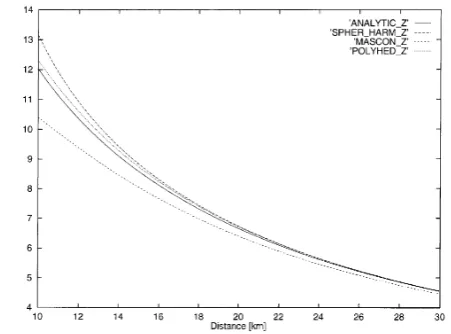
Figure 1 shows the behavior of the potential along thez axis as a function of the distance. In Fig. 2 we plot directly the difference of the potential values obtained from the
Fig. 2. Difference, with respect to Ivory’s approach, of the values of the potential calculated along thezaxis from the polyhedral approach (solid line), the mascons approach (dashed line) and the spherical harmonics approach (small-dashed line).
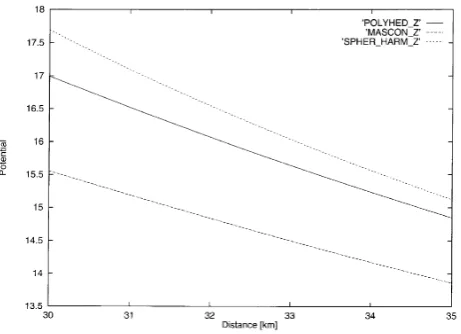
Fig. 3. Potential along thexaxis for the triaxial ellipsoid calculated with the polyhedral approach (solid line), the mascons approach (dashed line) and the spherical harmonics approach (small-dashed line).
ferent approaches along thezaxis, with respect to the value calculated with the Ivory’s approach. All units are taken in the MKS system.
As afirst general remark we can say that the four meth-ods give results fairly close to each other. Of course, going far enough from the central body, the effects due to its non-spherical shape decrease and all the results converge to a common line. On the other hand, when we are very close to the surface the polyhedral approach appears to give more accurate results. For the spherical harmonics approach it has to be noted that the series expansion had been truncated quite soon (stopping to the fourth order), while in the mascons case the roughness of the body surface, due to the regular distribu-tion of the discrete point masses, leads to some discrepancy.
3.2 Triaxial ellipsoid
A more general test can be performed in the case of a triaxial ellipsoid. However, since in this case we cannot apply the analytical Ivory approach described in Subsection 2.1, our comparison is limited to the other three approaches, without
Fig. 4. Potential along theyaxis for the triaxial ellipsoid calculated with the polyhedral approach (solid line), the mascons approach (dashed line) and the spherical harmonics approach (small-dashed line).
Fig. 5. Potential along thezaxis for the triaxial ellipsoid calculated with the polyhedral approach (solid line), the mascons approach (dashed line) and the spherical harmonics approach (small-dashed line).
adopting areferenceone. The potential is calculated along the x, yandzaxes at 100 m steps, starting on or near the surface (atr =30 km) up to a distance of 80 km.
Figures 3–5 show the value of the potential in the re-gion close to the surface calculated with the three different approaches, along the three cartesian axes centered on the body’s center of mass. At large distances, again, the three values quickly converge toward a common line. We can note that the different methods give very similar results; those of the polyhedral and spherical harmonics approaches are generally fairly close to each other, while on most cases the mascons approach shows a more marked (but still small) discrepancy in the region close to the surface.
4.
Orbit Propagations
approx-Table 1. Semimajor axis (a, in km)), eccentricity (e), inclination (i), argument of the ascending node (), argument of pericenter (ω) and mean anomaly (M) for the test propagations.
Initial orbital elements for the test propagations
Test a e i ω M
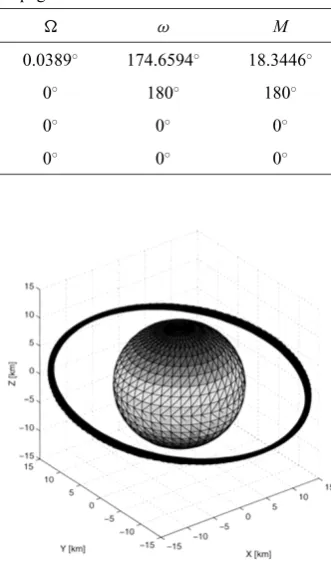
Sphere 19.989 km 0.000356 10◦ 0.0389◦ 174.6594◦ 18.3446◦
Ellipsoid (inclined) 19.987 0.000645 10◦ 0◦ 180◦ 180◦
Ellipsoid (incl./ell.) 19.981 0.199226 10◦ 0◦ 0◦ 0◦
Ellipsoid (distant) 39.961 0.199226 10◦ 0◦ 0◦ 0◦
imated as a polyhedron, with a number of triangular faces variable according to the desired accuracy of the body’s rep-resentation. Then, the orbits of test particles are propagated using, in both the codes, the RA15 version of the numerical integrator RADAU (Everhart, 1985) to integrate numerically the equations of motion. Besides the gravitational attraction of the irregular body (calculated with either the mascons or the polyhedral approach), third-body perturbations and some non-gravitational forces (currently, solar radiation pressure and the Poynting-Robertson effect) can be computed (Rossi and Fulchignoni, 1998). The rotation of the primary around a principal axis of inertia can also be accounted for.
After having verified the reliability of the potential cal-culations with the two different approaches, as described in Section 3, we have performed a systematic comparison of the results of several orbit propagation test cases. Since in this phase of our work we were mainly interested in a validation of the two codes, we have selected a few simple test cases, considering only the gravitational attraction of the central body and no additional perturbation. We also compared the results of the two codes with those obtained by means of a “standard”orbital propagator using the spherical harmonics approach. We have always adopted a propagation time span of 60 days. In Table 1 we have listed the initial orbital ele-ments of the four test propagations described in the remainder of this section.
4.1 Sphere with inclined, circular orbit
Thefirst test case was the propagation of a circular inclined orbit (a =19.989 km,e=0.000356,i=10◦,=0.0389◦,
ω=174.6594◦,M =18.3446◦) around a spherical primary. We have considered a sphere with a radiusR=10 km and a densityρ =1 g/cm3. This sphere was approximated using either 11753 mascons or a polyhedron with 1521 faces. The mass of this“quasi-sphere”was 4.196×10¹⁵kg.
Figure 6 shows a 3-D plot of the initially circular and inclined orbit around the sample polyhedron, and Fig. 7 shows the corresponding semimajor axis evolution. Both in this case and for the same orbit integrated with the mas-cons model, the semimajor axis and eccentricity show short-periodic variations of the order of a few tens of cm inaand a few parts in 10−4ine. Filtering out these short-term
pertur-bations, the two codes perform properly in this case, yielding the samefive constant orbital elements as output as they had been given in input, at least down to a relative error less than 10−6(see Fig. 7).
Fig. 6. Circular inclined orbit around the spherical primary, modelled with the polyhedral approach.
Fig. 7. Semimajor axis vs. time for the test case with a circular orbit around a sphere.
4.2 Ellipsoid with inclined, circular orbit
In this test the central body was an axisymmetric ellipsoid with semiaxes: a = b = 10 km and c = 5 km. It has been approximated either by 5835 mascons or by a polyhe-dron with 1521 faces. The total mass is 2.083×10¹⁵ kg,
corresponding again to a densityρ=1 g/cm3.
0.000645,i=10◦,=0◦,ω=180◦,M =180◦), obtained from both the codes, with the theoretical one derived from perturbation theory. For a satellite in a circular orbit about an oblate planet one can write a modified version of Kepler’s third law (Roy, 1982), as follows:
T =2π
whereRis the body’s equatorial radius and
=3(C−A) 2M R2 ,
withC and Athe moments of inertia of the body with re-spect to thez andx axes. In our test case Eq. (4) yields T = 46305 s. On the other hand, the periods of the inte-grated orbits areTp45256 s andTm45220 (hereinafter the subscriptspandmwill denote results from the polyhedral and the mascons approach, respectively). Thus the periods of the integrated orbits are very close to each other (the dis-crepancy is smaller than 0.1%), whereas the difference from the theoretical value is about 2%. This is already a clear indication that for orbits so close to a strongly non-spherical primary the assumptions implicit in the perturbation equa-tions are not fulfilled to a very high accuracy.
For the nodal rate the classical result fromfirst-order sec-ular perturbation theory is:
is the perturbed mean motion of a particle moving around an oblate body and n0 is the unperturbed value. The J2
coefficient is given by:
J2=
C− A+2B
M R2 =
(a2−c2)
5R2 =0.15
whereBis the moment of inertia with respect to theyaxis. We have used the fact that for an axisymmetric ellipsoid A=B=M(a2+c2)/5. This value ofJ
2can be compared
to the value easily computed numerically for the mascons model, for which we have obtained: A=B=5.206×10²²
kg m2 andC = 8.348×10²² kg m2 and J
2 = 0.15084.
Thus the error implicit in the mascons representation is of the order of 0.6%. The analytical value ofJ4is 0.0964.
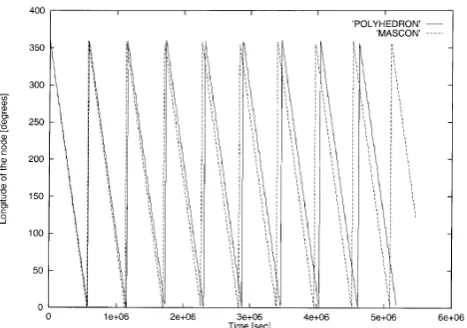
From Eq. (5) the theoretical nodal rate isd/dt= −7.7× 10⁻⁶ rad s−1. On the other hand for the integrated orbits we have obtained: dp/dt −1.09×10⁻⁵ rad s−1 and dm/dt −1.11×10⁻⁵rad s−1, again close to each other (within 2%) but with a much greater difference (about 30%) with respect to the theoretical value given above.
We calculated˙ from the orbits integrated with the spher-ical harmonic approach;first using only J2and then J2 and
J4. The values obtained aredJ2/dt −7.3×10⁻⁶ rad
s−1 andd
J4/dt −1.01×10⁻⁵ rad s−1, respectively.
The valuedJ2/dtis obviously very close to the theoretical
one since the latter is calculated taking into account precisely only this term. On the other hand,dJ4/dtapproaches the
values obtained from the polyhedral and the mascons mod-els,dp/dtanddm/dt. The difference between the values obtained using only theJ2term and that withJ2andJ4shows
that the spherical harmonics expansion is slowly converging for such highly elongated bodies; therefore it is necessary to calculate a large number of coefficients to have a realistic picture of the gravitationalfield. This is of course going to be very difficult if one is dealing with a real highly irregular asteroid or comet nucleus.
Figure 8 shows a comparison between the nodal rates de-rived from the mascons and polyhedral codes.
4.3 Ellipsoid with inclined, elliptical orbit
In the previous case the drift rate of the pericenter could not be determined since the orbit was nearly circular. There-fore in the next test we have propagated, around the same ellipsoid, an inclined elliptical orbit (a = 19.981 km,e = 0.199226,i =10◦,=0◦,ω=0◦,M=0◦).
From Eq. (5) the theoretical nodal drift rate in this case is d/dt= −8.37×10⁻⁶rad s−1, whereas for the numerically
As for the pericenter drift rate, the classical formula from perturbation theory is: rad s−1. On the other hand, the pericenter rates of the integrated orbits are dωp/dt 2.90×10⁻⁵ rad s−1 and dωm/dt 2.72×10⁻⁵ rad s−1 (dωJ4/dt 2.21×10⁻⁵
rad s−1).
Again, the discrepancy between the numerical values (about 6%) is much smaller than with respect to the value from the analytical formula (≈40%).
Figure 9 shows a comparison between the pericenter drift
Fig. 9. Pericenter drift of the numerically integrated elliptic orbit around the ellipsoid from the polyhedral (solid line) and the mascons model (dashed line).
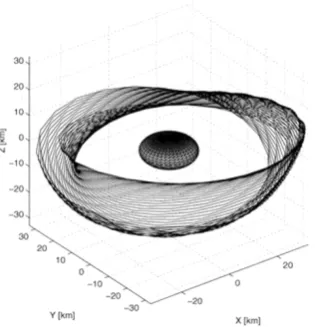
Fig. 10. A 3-D view of the elliptical, inclined, distant orbit around the ellipsoid, approximated with the polyhedral approach.
rates from the polyhedral and mascons codes; short-period effects (whose periodicity coincides with the orbital period) are superimposed to the secular drift.
4.4 Ellipsoid with inclined, elliptical, distant orbit
In general the tests described so far show a relatively good agreement between the results from the two numerical mod-els, but large discrepancies with respect to the theoretical values. As we have mentioned previously, we have found hints that these discrepancies are due to the fact that the orbits integrated in the previous cases stay very close to the surface of the ellipsoid; in this case the effects due to the strongly non-spherical shape of the primary cannot be treated as a small perturbation of the two-body problem. In order to test this tentative conclusion, we have considered a test particle moving farther away from the central body, on an inclined elliptical orbit. The orbital elements are: a =39.961 km, e=0.199226,i=10◦,=0◦,ω=0◦,M =0◦. Figure 10 shows a 3-D plot of this orbit around the sample polyhedron. In this case the theoretical nodal rate isd/dt= −7.10× 10⁻⁷ rad s−1, while those of the integrated orbits are:
dp/dt −7.76×10⁻⁷rad s−1anddm/dt −7.92×
Fig. 11. Pericenter rate of the distant orbit around the ellipsoid from the polyhedral (solid line) and the mascons model (dashed line).
10−7rad s−1, with discrepancies of 8% and 10% respectively
(dJ4/dt −7.79×10⁻⁷rad s−1). The theoretical
pericen-ter drift rate isdω/dt =1.42×10⁻⁶rad s−1, to be compared
todωp/dt 1.53×10⁻⁶rad s−1anddωm/dt1.55×10−6 rad s−1, that is discrepancies of 8% and 10% respectively
(dωJ4/dt1.51×10−6rad s−1). The pericenter drifts
de-rived from the polyhedral and mascons approaches are shown in Fig. 11.
The improved agreement between the theoretical values and the results of the numerical integration confirms that our starting hypothesis is probably correct: orbiting farther away from the central body the perturbations due to the body’s shape are reduced and the analytical formulae provide better approximations.
5.
Conclusions and Future Work
We have described thefirst phase of our work, which was mainly devoted to the validation of the two software pack-ages. The tests and comparison discussed above in our opin-ion show their reliability. They can accurately represent the gravitational potential around non-spherical bodies, and this allows one to integrate numerically the orbits of test particles around these objects. The discrepancies between the results of the two codes, as far as the most important secular per-turbations are concerned, are typically of the order of a few percent. The situation is most critical for orbits staying close to the surface of the primary, which probably require a higher resolution of the models (in terms of the adopted number of mascons or faces) to achieve an acceptable accuracy.
Another interesting result from our work has been that the classical formulae from the perturbation theory have a very poor accuracy whenever the shape of the primary is strongly non-spherical and the orbital distance is as small as several radii of the primary. In these cases numerical integrations appear really needed for a quantitative study of the secular effects.
can be drawn from the tests described in this paper. With the number of faces/mascons adopted here to describe the ellip-soid in the orbit propagation tests (i.e., 1521 faces and 5835 mascons), the CPU time needed for a 60 days integration of the elliptic orbit on a Pentium II 400 MHz computer was about 1280 s with the polyhedral model and 1065 s with the mascons approach. Therefore, with the values adopted for these tests, the mascons code was somewhat faster. On the other hand, we have found hints of a better accuracy of the polyhedral code, especially for orbits getting close to the pri-mary’s surface. Of course, in every specific case an optimal trade-off must be found between accuracy and computing speed. It is likely that the trade-off will be different for the two numerical approaches, and that this can lead to select one of the codes for any specific study to be carried out.
As pointed out by Werner and Scheeres (1997), the poly-hedral algorithm is suitable for parallelization in an almost natural way; in the future we plan to code it also in Pro-fessional Fortran, which allows an easy parallelization of Fortran programs, and this should greatly improve the per-formances of the code. The same could be done with the mascons code too.
In this phase of our work, we have devoted a particular effort to testing the sections of our software packages related to the calculation of the gravitational potential, since these are the most delicate and the less standard models. However, as we noted before, the codes also include different models for gravitational and non-gravitational perturbations, which have been tested separately and will be used again in the near future.
We already used the codes for a few theoretical studies (Rossi and Fulchignoni, 1998; Scheereset al., 1998b). Our final aim is to assemble a software suite capable of dealing both with theoretical and with operational issues (such as mission design and navigation), related to the propagation of orbits around small irregular bodies such as asteroids and comets. For the latter class of bodies, we will need to develop suitable models for the outgassing of the comet nucleus and the related drag forces, perturbing the orbital motion of an orbiting probe. Overall, this is an exciting new area of celes-tial mechanics and astrodynamics, for which times have just become ripe.
Acknowledgments. The authors wish to thank Dr. M. Yoshikawa and Dr. D. Durda for their useful reviews and comments.
References
Broucke, R. A. and D. J. Scheeres, Computing orbits around an ellipsoid of revolution, paper AAS 94–161, inAdvances in the Astronautical Sciences, Spaceflight Mechanics 1994, Vol. 87, Part I, pp. 423–440, 1994. Chapman, C. R., J. Veverka, P. C. Thomas, K. Klaasen, M. J. S. Belton,
A. Harch, A. McEwen, T. V. Johnson, P. Helfenstein, M. E. Davies, W. J. Merline, and T. Denk, Discovery and physical properties of Dactyl, a satellite of the asteroid 243 Ida,Nature,374, 783–785, 1995.
Everhart, E., An efficient integrator that uses Gauss-Radau spacings, in Dynamics of Comets: Their Origin and Evolution, edited by A. Carusi and G. B. Valsecchi, pp. 185–202, Reidel, 1985.
Kellog, O. D.,Foundations of Potential Theory, Dover, 1954.
Geissler, P., J.-M. Petit, D. Durda, R. Greenberg, W. Bottke, M. Nolan, and J. Moore, Erosion and ejecta reaccretion on 243 Ida and its moon,Icarus, 120, 140, 1997.
German, D. and A. L. Friedlander, A simulation of orbits around asteroids using potentialfield modelling, paper AAS 91–182, inAdvances in the Astronautical Sciences, Spaceflight Mechanics 1991, Vol. 75, Part II, pp. 1183–1201, 1991.
Heiskanen, W. A. and H. Moritz,Physical Geodesy, Freeman and Co., 1967. Laplace, P. S.,Oeuvres de Laplace†,Vol. 2, Chapter 1, 1782.
Petit, J.-M., D. D. Durda, R. Greenberg, T. A. Hurford, and P. E. Geissler, The long-term dynamics of Dactyl’s orbit,Icarus,130, 177–197, 1997. Pravec, P. and G. Hahn, Two-period lightcurve of 1994 AW1: Indication of
a binary asteroid?,Icarus,127, 431–440, 1997.
Pravec, P., M. Wolf, and L.Sarounov`a, Occultation/eclipse events in binaryˇ
asteroid 1991 VH,Icarus,133, 79–88, 1998.
Rossi, A. and M. Fulchignoni, Study of the environment around the Rosetta candidate target asteroids,Planet. Space Sci.,47(6–7), 873–881, 1999. Roy, A. E.,Orbital Motion, Hilger, Bristol, 1982.
Scheeres, D. J., S. J. Ostro, R. S. Hudson, and R. A. Werner, Orbits close to asteroid 4769 Castalia,Icarus,121, 67–87, 1996.
Scheeres, D. J., S. J. Ostro, R. S. Hudson, E. M. DeJong, and S. Suzuki, Dynamics of orbits close to asteroid 4179 Toutatis,Icarus,132, 53–79, 1998a.
Scheeres, D. J., F. Marzari, L. Tomasella, and V. Vanzani, ROSETTA mis-sion: Satellite orbits around a cometary nucleus,Planet. Space Sci.,46, 649–671, 1998b.
Werner, R. A., The gravitational potential of a homogeneous polyhedron, Celest. Mech. Dyn. Astr.,59, 253–278, 1994.
Werner, R. A. and D. J. Scheeres, Exterior gravitation of a polyhedron derived and compared with harmonic and mascon gravitation represen-tations of asteroid 4769 Castalia,Celest. Mech. Dyn. Astr.,65, 313–344, 1997.
†English translation by Bowditch